






Table of Content
In the world of software development, Rapid Application Development (RAD) is a methodology that emphasises speed and flexibility in building applications.
As we move towards 2026, RAD is constantly evolving, providing more efficient ways to create software solutions that meet the changing needs of businesses and users.
This guide offers a comprehensive understanding of RAD, including its principles, best practices, and the latest tools and technologies available.
What is Rapid Application Development (RAD)?
Rapid Application Development (RAD) is a software development method that focuses on building applications quickly through short, iterative cycles.
Instead of detailed upfront planning, RAD encourages early prototyping and continuous user feedback to shape the final product.
It supports close collaboration between developers and users, allowing for flexible changes during development.
RAD is especially useful when time is limited and requirements may evolve, making it a more adaptable alternative to the traditional Waterfall approach.
RAD Key Characteristics
- Iterative and Incremental: RAD divides the project into smaller iterations, each delivering a functional component of the final system for quick feedback and adjustments.
- Prototyping: RAD commonly uses prototypes, simplified functional versions of the final product, to clarify requirements and provide a tangible vision for stakeholders.
- User Involvement: RAD involves end-users and stakeholders throughout development, ensuring their feedback is incorporated into each iteration for a final product that meets their needs.
- Rapid Development Tools: RAD utilises tools and frameworks to expedite app development, including visual environments, code generators, and pre-built components.
- Flexible and Adaptive: RAD is ideal for projects with evolving or uncertain requirements, as it enables seamless adjustments and enhancements during development.
Phases of Rapid Application Development
The Rapid Application Development lifecycle is a structured process your product will undergo. This application development method involves several steps, which can be broadly categorised into five major phases of rapid application development.
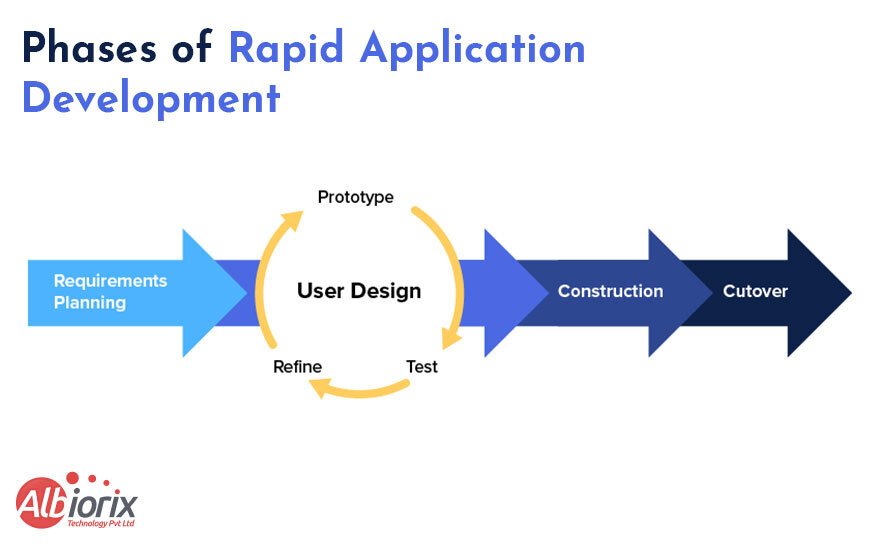
The five main stages of rapid application development:
- Defining Project Requirements: The initial step in the rapid application development methodology involves establishing and solidifying the project’s objectives, timelines, and budget in collaboration with all stakeholders. Once you have meticulously identified and outlined each project requirement, you can seek approval from management.
- Creating Prototypes: Once the project has been accurately scoped, you can kickstart the rapid web app development or mobile app development. Designers and developers will work closely with clients to create and enhance software prototypes until the final product is ready.
- Gathering User Feedback: During the third phase of rapid application development, developers transform prototypes and beta systems into functional models. After collecting user feedback, making any required adjustments to the prototypes becomes essential to crafting the ultimate, optimal product.
- Testing, Testing, Testing: During this stage, it is crucial for your software testers to thoroughly assess your product, ensuring that all its components function correctly and align with the client’s expectations. You must consistently incorporate customer feedback as you test and refine the code to achieve a seamless, fully functional end product.
- Finalising and Cutover: During this stage, developers bring the final product to life and initiate its launch. This phase encompasses all last-minute adjustments, system switchover, data conversion, and comprehensive testing. Furthermore, user training is also conducted during this period.
Advantages:
- Speed: RAD allows for faster delivery of working software, making it ideal for industries that require rapid deployment.
- Customer Satisfaction: Continuous user involvement and feedback ensure that the final product meets user expectations, leading to higher customer satisfaction.
- Cost-Efficiency: RAD can lower development costs and allocate resources more effectively by reducing time spent on planning and documentation.
- Flexibility: RAD is suitable for dynamic or uncertain environments due to its adaptability to changing project requirements.
- Risk Mitigation: Prototyping and getting early feedback can identify issues and prevent late-stage project failures.
Disadvantages:
- Scope Creep: The flexibility of Rapid Application Development (RAD) can sometimes cause scope creep, which is when the project’s scope expands beyond the initial plan, potentially leading to delays and increased costs.
- Not Suitable for All Projects: RAD is best for smaller, well-defined projects but not significant, complex systems.
- Dependency on Skilled Teams: RAD necessitates agile development teams that adeptly respond to evolving requirements and efficaciously produce prototypes.
- Documentation Challenges: Due to RAD’s focus on speed and prototyping, there may be insufficient documentation, leading to maintenance and development issues in the future.
- Limited Reusability: RAD may create project-specific components that could be more easily reusable.
Principles of RAD in 2026
Rapid Application Development (RAD) principles have remained unchanged over the years, focusing on quick prototyping and development. However, it is essential to recognise that software development methodologies and practices can evolve.
In 2026, RAD principles will continue emphasising rapid prototyping and development.
- User-Centered Design: Understanding the end-users needs, preferences, and pain points is crucial in RAD. User feedback should inform the development process to deliver a product that meets their expectations.
- Iterative Development: RAD involves rapid iterations. Shorter cycles in 2025 allow quicker adaptations to changing requirements and technologies.
- Collaboration and Communication: Effective communication and collaboration among cross-functional teams, including developers, designers, business analysts, and end-users, will continue to be essential. Clear communication in a rapidly changing technological landscape can help ensure everyone is aligned with project goals and changes.
- Prototyping: Prototyping continues to be crucial in the Rapid Application Development (RAD) process. In 2025, low-code or no-code platforms and advanced prototyping tools and techniques have become more widespread, facilitating the quick production of functional prototypes for user testing and validation.
- Reusable Components: In RAD, time and effort can be saved by developing and maintaining reusable components, leveraging open-source libraries, and utilising microservices. In 2025, more focus will be on these practices to accelerate development.
It’s worth noting that RAD practices are now being combined with other agile methodologies, such as Scrum or Kanban, to achieve both rapid development and structured project management.
It’s essential to remember that implementing RAD principles may differ from one organisation to another and could evolve to accommodate new technologies and industry trends.
So, staying current with the latest software development methodologies is crucial to effectively applying the most relevant principles.
Need a custom web application to achieve your business goals? Our experienced web developers can help.
The RAD Process in 2026
In 2026, the Rapid Application Development process is still a flexible and efficient way to develop software.
It prioritises collaboration, prototyping, and iterative development to deliver a functional product quickly. Let’s take a quick look at the different phases of the RAD process in 2026.
- Requirements Gathering: To start the project, we first gather and comprehend the requirements of stakeholders, which include end-users, clients, and other relevant parties. In 2025, this phase may involve advanced techniques such as user interviews, surveys, and data analysis to understand the project’s goals and needs comprehensively.
- Rapid Prototyping: At RAD, creating prototypes or mockups of the software in the early stages of development is crucial. This usually involves utilising cutting-edge prototyping tools and technologies to visualise and swiftly demonstrate the software’s core functionalities. These prototypes are vital for obtaining stakeholder feedback and fine-tuning the project’s course.
- Iterative Development: At RAD, development is done through an iterative approach. Teams work in brief cycles called sprints, usually lasting a few weeks. They continuously improve their work by building on previous iterations and incorporating feedback. In 2026, the process is often automated and streamlined through continuous integration and delivery (CI/CD) pipelines.
- Testing and Quality Assurance: As a crucial aspect of the RAD process, testing and quality assurance play a vital role. By 2025, automated testing tools, artificial intelligence, and machine learning could improve testing procedures. To ensure superior software quality, testing is conducted consistently throughout the development cycle to detect and resolve problems as early as possible.
- Deployment and Maintenance: The software deployment to production once sufficient functionality and quality are achieved. With the prevalence of cloud-based infrastructure and containerisation technologies in 2026, deployment and scaling have become more efficient. It is crucial to provide ongoing maintenance and support after deployment to address issues, implement updates, and ensure the long-term reliability and performance of the software.
In 2026, RAD continues to be a viable approach for projects that require rapid development and frequent adaptations to changing requirements due to advancements in technology and development methodologies.
Tools and Technologies for RAD in 2026
Here are some of the most popular tools and technologies for RAD in 2026:
1. Low-code and No-code Platforms:
You can develop applications without coding using low-code and no-code platforms, making them more accessible to non-technical users and speeding up the development process. Popular tools include:
- AppSheet
- Bubble
- OutSystems
- Mendix
- Zoho Creator
2. Modern IDEs and Frameworks:
Modern IDEs and frameworks offer a comprehensive coding environment to enhance productivity and code quality. Popular tools include:
- Visual Studio Code
- IntelliJ IDEA
- Eclipse
- NetBeans
- Sublime Text
3. Cloud Services and PaaS:
Host your applications reliably and at scale. Popular cloud services and PaaS providers can also reduce infrastructure costs. Popular tools include:
- AWS
- Azure
- Google Cloud Platform
- IBM Cloud
- Alibaba Cloud
4. DevOps and CI/CD Integration:
It can automate the development and deployment process, improving release speed and quality. Popular tools include:
- Jenkins
- CircleCI
- Travis CI
- GitLab CI/CD
- Azure Pipelines
5. Data analytics and AI/ML Integration:
This helps you to make better decisions by providing insights into your data. They can also be used to automate tasks and improve the performance of your applications. Popular tools include:
- Jenkins
- CircleCI
- Travis CI
- GitLab CI/CD
- Azure Pipelines
It is important to remember that the tools and technologies utilised in your project may differ based on your project’s needs, your team’s skills, and budget limitations. Be informed about technological advancements to make informed decisions when undertaking your RAD projects.
We create engaging custom mobile apps for all platforms and devices with the help of our experienced team of developers.
Best Practices for Successful RAD Projects
RAD projects are a great starting point as they emphasise speed and flexibility, which align well with the approach. Here’s a detailed breakdown of each best practice:
1. Clear Project Scope and Objectives
To start a RAD project, the initial step is establishing its scope and objectives. This involves clearly defining the software’s purpose and the reason for its development. The project scope should be precise and agreed upon by all stakeholders involved.
2. Cross-Functional Teams
To ensure the success of RAD projects, it is essential to have cross-functional teams with members who possess various skills such as business analysis, development, testing, and design.
This approach guarantees efficient project completion and satisfies the requirements of all parties involved.
3. Agile Project Management
Agile project management methodologies are commonly utilised in the management of RAD projects. These methods involve breaking down the project into more minor, more manageable phases, which are iterative and incremental.
This approach enables quick and easy adaptation to changes, a critical aspect in RAD projects where requirements frequently evolve.
4. Continuous Testing and Feedback
Continuous testing and feedback are crucial to ensure the success of Rapid Application Development (RAD) projects. The software must undergo testing at every stage of development, and stakeholders should provide feedback regularly.
This approach helps identify and resolve issues at an early stage and guarantees that the end product satisfies the requirements of all parties involved.
5. Version Control and Collaboration
Having version control and collaboration tools is crucial when managing projects that use RAD (Rapid Application Development). By using version control tools, you can easily keep track of any changes made to the software throughout the project.
Collaboration tools also play a vital role in helping you work effectively with your team members. These tools are essential in RAD projects, where the software constantly evolves.
To improve the success of your next RAD project, it’s crucial to comprehend the RAD methodology and select appropriate tools and technologies. Along with these practices, you can boost your chances of success.
Here are some additional tips for successful RAD projects:
- Begin by creating a prototype. These working models can gather feedback from stakeholders, clarify requirements, and identify potential problems early on.
- Visual modelling tools can effectively communicate requirements and designs to stakeholders, improving collaboration and reducing misunderstandings.
- Automated testing can speed up software testing, freeing time for other tasks like development and design.
- Consider utilising a project management tool to track progress, manage tasks, and communicate with your team, keeping the project on schedule and avoiding delays.
These tips can help you increase your chances of success on your next RAD project.
RAD in Various Industries
Rapid Application Development is commonly utilised in industries that require fast development and deployment of new applications, including healthcare, finance, e-commerce, education, and government.
Here are some specific examples of how RAD is being used in these industries:
- Healthcare: RAD is used for healthcare software solutions to develop new medical devices, such as robotic surgery systems and wearable health monitors. It is also being used to create electronic health records (EHRs) and other software applications that can help improve patient care.
- Finance: RAD is used for finance software solutions to develop new trading platforms, risk management tools, and customer relationship management (CRM) systems. It also automates back-office processes, such as compliance and reporting.
- Retail & E-commerce: RAD is used for retail software solutions to develop new online shopping platforms, marketing campaigns, and customer support systems. It is also being used to personalise the shopping experience for each customer.
- Education: RAD is used for education software solutions to develop new online courses, learning management systems, and assessment tools. It also creates virtual learning environments that can help students learn independently.
- Government: RAD is used to develop new e-government applications, such as online tax filing systems and social services portals. It is also being used to improve efficiency and transparency in government operations.
We offer custom software solutions for all Industries and needs.
RAD can offer several benefits to organisations, including:
- Faster time to market: RAD can help organisations develop and deploy new applications faster than traditional development methods.
- Increased flexibility: RAD allows organisations to make changes to applications more efficiently, which can help them adapt to changing business needs.
- Reduced costs: RAD can help organisations reduce the cost of software development by eliminating the need for extensive planning and documentation.
However, RAD also has some drawbacks, such as:
- Increased risk: RAD can be more risky than traditional development methods, as there is less time for testing and debugging.
- Lack of documentation: RAD can lead to a lack of documentation, making it easier to maintain and update applications.
- Only suitable for some projects: RAD is only suitable for some projects, such as those requiring a lot of custom coding or strict security requirements.
Rapid Application Development can be helpful for organisations seeking to create and launch new applications promptly. However, it is crucial to thoroughly assess RAD’s pros and cons before determining if it is the appropriate method for a specific project.
Future Trends and Challenges in RAD
As we witness the rapid evolution of technology, we must prepare ourselves for the upcoming trends and challenges in RAD.
1. Automation and AI in RAD
Automation and artificial intelligence (AI) are transforming Rapid Application Development (RAD) by speeding up repetitive tasks and improving accuracy.
Automation tools handle activities like code generation, testing, and deployment, allowing developers to focus on design and user feedback.
AI enhances RAD by analyzing data patterns, predicting project risks, and suggesting improvements during development cycles. This integration helps teams quickly adapt to changes and deliver better software faster.
Using automation and AI in RAD not only boosts efficiency but also reduces errors, making the development process smoother and more reliable.
This combination supports continuous collaboration and quick iterations, ensuring the final product meets user needs effectively.
2. Security in Rapid Development
Rapid development can also lead to security vulnerabilities because RAD often involves cutting corners and skipping traditional security practices.
In the future, it will be essential to find ways to address these security challenges without sacrificing the speed and flexibility of RAD.One way to do this is to adopt a DevSecOps approach to security.
DevSecOps is a methodology that integrates security into the development process. It helps ensure that security is not an afterthought and that vulnerabilities are caught early on.
3. Scaling RAD for Enterprise-Level Applications
RAD is typically used to develop small-scale applications. However, there is a growing demand for RAD to develop enterprise-level applications. This is because enterprise-level applications are often complex and require a lot of flexibility
In the future, finding ways to scale RAD for enterprise-level applications will be necessary. It will require finding ways to automate tasks, improve communication, and manage complexity.
4. Integration with IoT and Edge Computing
The Internet of Things (IoT) and edge computing are changing how software is developed and used. Rapid Application Development (RAD) fits well with these technologies because it supports fast adjustments to changing needs.
By integrating RAD with IoT and edge computing, developers can create applications that use real-time data and local processing power effectively. This means faster responses and better performance, especially for devices connected to the internet.
Incorporating these technologies in the RAD process helps build smarter, more efficient applications that meet the demands of modern users and devices. This integration is becoming essential for future software projects.
These are just some of the future trends and challenges in RAD. As the software development landscape evolves, RAD must adapt to remain relevant.
RAD vs. Other Development Methodologies
Let’s compare RAD with other popular development methodologies: Waterfall, Agile, and DevOps.
1. RAD vs. Waterfall
There are two main approaches regarding software development: the waterfall methodology and RAD. The waterfall method is a linear approach where each action stage must be completed before moving on to the next.
However, this can make changes to the requirements easier once the project has started.
On the other hand, RAD is an iterative approach where the project is broken down into more miniature, more manageable stages, allowing for greater flexibility and faster changes.
Overall, RAD is typically quicker than the waterfall methodology.
2. RAD vs. Agile
The Agile methodology is a modern approach that emphasises continuous development and improvement. Agile projects are divided into short sprints, each dedicated to delivering a functional product.
This enables greater flexibility and collaboration between the development team and the client. RAD (Rapid Application Development) methodology shares similarities with Agile in that it is iterative.
However, RAD is generally more structured and less adaptable than Agile. RAD is also typically used for smaller projects, while Agile is more commonly used for larger projects.
3. RAD vs. DevOps
Rapid Application Development (RAD) and DevOps are both aimed at speeding up software delivery, but they work differently. RAD focuses on quick prototyping and iterative feedback to build applications rapidly. It is more of a traditional development approach.
DevOps, on the other hand, combines development, operations, and security teams to automate and streamline the entire software delivery process. This helps reduce the time to market by improving collaboration and using automation tools.
While RAD and DevOps are distinct, some RAD teams adopt DevOps tools to enhance their workflow and increase efficiency. Both approaches can complement each other depending on project needs.
Conclusion
In conclusion, if you want to stay ahead of the game, consider the potential benefits of RAD for your business. RAD is still a young technology, and many challenges must be addressed before it can be widely adopted.
However, the potential applications of RAD in various industries are vast and promising. As the technology continues to develop, we can expect to see even more innovative and groundbreaking applications for RAD in the years to come.
Here are some final thoughts and recommendations:
- RAD is still a young technology, and many challenges must be addressed before it can be widely adopted. However, the potential benefits of RAD are vast, and it is worth investing in research and development to overcome these challenges.
- Governments and funding agencies should support research into RAD. This will help accelerate the technology’s development and ensure it is available to everyone who needs it.
- Companies should start exploring the potential applications of RAD in their industries. This could lead to new products and services that improve our lives.
- Individuals should stay informed about the latest developments in RAD. This will help them understand the technology’s potential benefits and make informed decisions about its use.
I hope this helps! And you can Contact us for Rapid Application Development.
Albiorix’s focus on quality and innovation and its commitment to delivering exceptional results set them apart as the premier choice for businesses seeking rapid and effective application development solutions.
Get in touch with us for Rapid Application Development Services and empower your business in a competitive business landscape, or send us your details using the contact us form.
Connect with Our Experts!
FAQ
Frequently Asked Questions
RAD is a software development methodology prioritising delivering high-quality software quickly and iteratively. It takes a non-linear approach to development, enabling teams to switch between different stages of the development cycle as needed.
By utilising Rapid Application Development (RAD), teams can bring software to the market faster than traditional development methods. RAD allows for the early and frequent delivery of working prototypes, enabling users to provide feedback and make changes quickly. This iterative approach improves the software’s quality by identifying and fixing defects early. Moreover, early user feedback garnered through RAD ensures that the software meets the needs of its users, ultimately leading to greater user satisfaction.
The RAD methodology is typically divided into four phases:
- The requirements gathering and analysis phase involves collaborating with users to comprehend their needs and requirements.
- The prototyping phase entails developing a functional prototype for the software, allowing for user feedback and necessary changes.
- The final version of the software is developed in the construction phase, taking feedback from the prototyping phase into account.
- The testing and deployment phase involves ensuring that the software meets all requirements and deploying it to production.
When using RAD, teams may face challenges such as needing a skilled team that can work quickly and iteratively. The success of RAD depends on the clarity and specificity of software requirements. However, feature creep is possible, where additional features are added to the project without proper planning because RAD prioritises early user feedback.
RAD offers a range of tools and technologies, including low-code/no-code development platforms, agile development methodologies, and cloud computing. These platforms enable teams to create software without writing code, emphasise iterative development, obtain early user feedback, and assist couples in developing and launching software more efficiently and effectively.
RAD is a good fit for projects where The requirements have been clearly defined, indicating a precise understanding of what is expected. There is a high demand for quick delivery and efficiency. The feedback users provide is crucial for ensuring satisfaction and improving overall performance. RAD is not a good fit for projects where The requirements are intricate and subject to change. Prioritising quality over speed is crucial, and user feedback is essential.
Published Blogs
Latest Blogs : Insights and Innovations from Our Blog
Stay Ahead in Tech: Dive into our Blogs for the Latest in Software, Web, and Mobile App Development. Explore cutting-edge technologies, industry trends, and insightful updates that keep you at the forefront of the digital landscape



Our Clients

Client Showcase: Trusted by Industry Leaders
Explore the illustrious collaborations that define us. Our client showcase highlights the trusted partnerships we've forged with leading brands. Through innovation and dedication, we've empowered our clients to reach new heights. Discover the success stories that shape our journey and envision how we can elevate your business too.










We’re here to help you


