





Table of Content
- What Is the Website Development Process?
- Website Development Life Cycle Explained
- Discovery and Requirement Analysis (Foundation Stage)
- Information Architecture and Planning (Structural Stage)
- UI/UX Design (Experience Stage)
- Website Development and Engineering (Build Stage)
- Testing and Quality Assurance (Validation Stage)
- Deployment and Launch (Go-Live Stage)
- Maintenance, Optimization, and Growth (Evolution Stage)
- Types of Websites Built in 2026
- Key Website Elements That Define Success
- Why Custom Websites Outperform Templates
- Website Development Trends Shaping the Future
- Best Website Development Services for Future-Ready Businesses
- Conclusion
Summary: The website development process is a structured seven-stage framework that transforms an initial concept into a high-performance live site. It encompasses everything from strategic planning and UI/UX design to front-end coding, rigorous testing, and final deployment. Following this systematic approach ensures your site is mobile-responsive, user-friendly, and perfectly aligned with your business goals.
We live in a digital-driven world, and in this world, you will need a solid digital presence for your business to ensure success, especially when aligned with modern web practices.
Along with the social media presence, you will also need a solid online presence where you can showcase all your services, products, and engage with your customers.
This is where a powerful, engaging, and intuitive website comes into play by following web development best practice.
A website is no longer just an online presence. In 2026, a business website will be your growth engine, a brand storyteller, and a conversion platform.
You will need a custom-made business website that meets your goals, exemplifies your business ethics, and reflects your company’s culture.
And, to develop a business website that meets all your requirements, you must understand how an engaging, intuitive, and SEO-friendly website is developed in 2026 using frontend frameworks.
The process of website development in 2026 is a bit different from the traditional one. Understanding the website development process is critical for businesses that want scalable, secure, and future-ready digital products.
Every step in the website development life cycle plays a strategic role in determining success – from ideation to optimization.
This in-depth website development guide breaks down the stages of website development, explains the types of websites, highlights essential website elements, and shows how custom websites deliver long-term value.
The goal is simple: help you make smarter, ROI-driven decisions while aligning with modern search behavior and Google’s EEAT (Experience, Expertise, Authoritativeness, Trustworthiness) standards.
What Is the Website Development Process?
Just as there is a standard development process for building anything, there’s also a detailed and defined website development process. This process is a structured framework that transforms business ideas into a fully functional digital platform.
A website development life cycle blends strategy, design, engineering, and optimization into a repeatable and measurable workflow, often supported by AI web development.
Unlike ad-hoc development, a mature process focuses on:
- Business objectives and user intent alignment
- Scalable architecture and performance optimization
- Security, compliance, and accessibility
- Search visibility and content discoverability
- Continuous improvement through data and feedback
- Long-term maintainability and flexibility
When the process is followed exactly and executed correctly, it reduces the risk of failure, reduces overall development costs, and reduces the time to market.
Website Development Life Cycle Explained
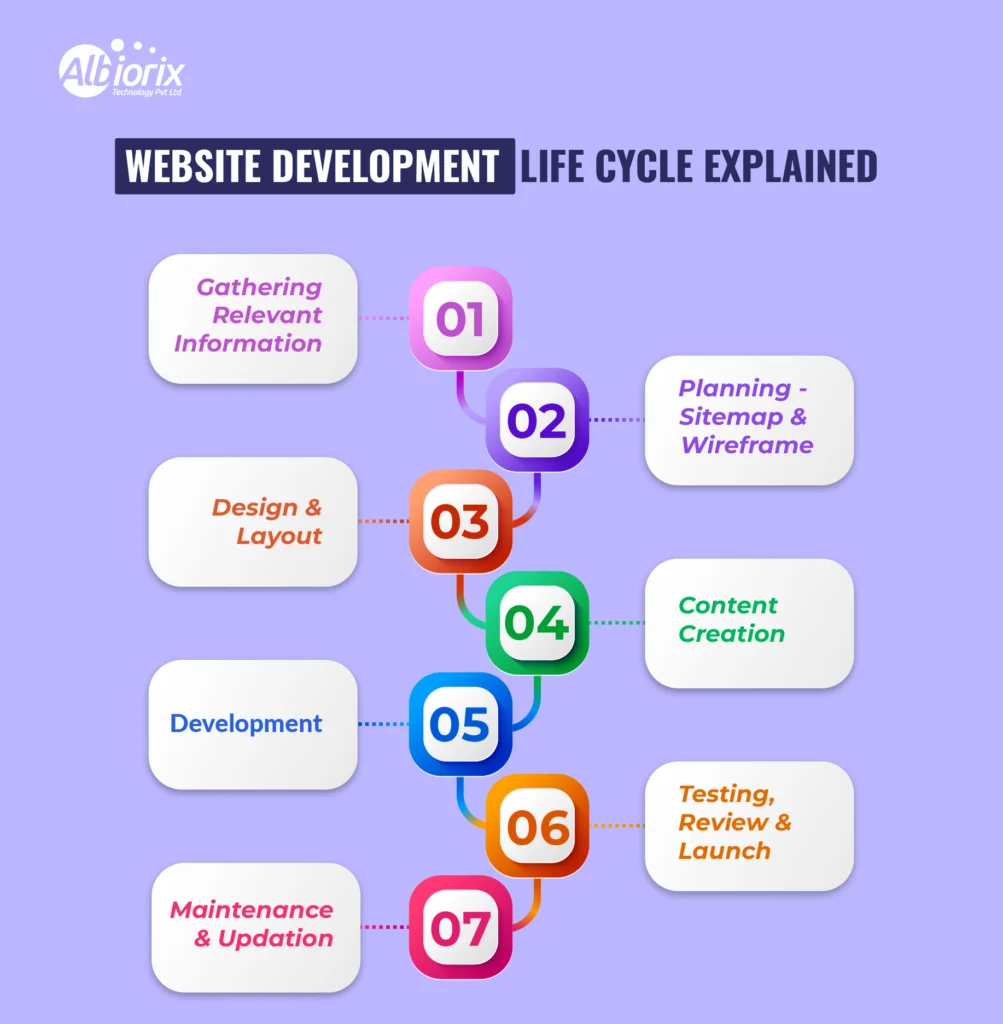
The website development lifecycle outlines the process by which an idea is transformed into a fully functional digital business presence. This process from concept to execution is known as the website development life cycle.
Each phase in website development is built on the previous one to ensure clarity, accountability, and quality at scale.
Discovery and Requirement Analysis (Foundation Stage)
This is the most critical stage of the website development life cycle. In this initial step, critical decisions are made that directly impact performance, scalability, and cost of the website.
Key activities include:
- Business goal identification and KPI mapping
- Target audience and user persona research
- Competitor and market analysis
- Functional and non-functional requirement gathering
- Technology stack evaluation using Angular frameworks
- SEO and content architecture planning
A strong discovery phase ensures your custom website is built for real users—not assumptions.
Information Architecture and Planning (Structural Stage)
Once all the details are gathered and your business objectives are clear, it’s time to move to the next step of website development. This step is called structuring the experience.
This phase focuses on:
- Sitemap creation and page hierarchy definition
- User journey mapping and conversion paths
- Navigation logic and internal linking strategy
- Content placement aligned with search intent
- Scalability planning for future features
- Performance and load optimization planning
When a website’s architecture is developed on well-planned information, a website has great scalability, crawlability, usability, and ranking potential.
UI/UX Design (Experience Stage)
Back in 2010, website design was all about selecting fancy color combinations. Now, in 2026, the definition of website design has changed completely. It’s more than aesthetics. It is about behavior, trust, and usability.
In this step of the website development lifecycle, you need to concentrate on creating intuitive, engaging, and accessible experiences. You need to design an experience that sets up your website apart from competitors.
Key deliverables include:
- Wireframes and interactive prototypes
- Mobile-first and responsive layouts
- Brand-consistent visual systems
- Accessibility and usability standards compliance
- Conversion-focused design patterns
- Micro-interactions and engagement elements
The ultimate goal of modern custom websites in 2026 and beyond is to prioritize clarity, speed, and emotional connection.
Website Development and Engineering (Build Stage)
In this phase of the website development process, the strategy and design are moulded into a working digital product.
In this step, a team of website developers and software developers work together on the front-end and back-end of the website using Angular web development.
Core development activities include:
- Front-end development using modern frameworks
- Back-end logic and database architecture
- CMS or headless CMS integration
- API and third-party service integration
- Security best practices implementation
- Performance and code optimization
A robust development approach and agile development method ensure your website is fast, secure, and future-proof.
Testing and Quality Assurance (Validation Stage)
Once the backend and frontend of the website is engineered, it’s time to test the functions of the website with the real users.
The team of QC experts tests all the features, performance, user experiences, and functionalities of the website to ensure optimum functioning.
Testing typically covers:
- Functional and regression testing
- Cross-browser and cross-device compatibility
- Page speed and performance audits
- Security and vulnerability testing
- Accessibility and compliance checks
- SEO readiness and indexing validation
This stage protects brand credibility and reduces post-launch risks.
Deployment and Launch (Go-Live Stage)
After thorough testing of the website, it’s time to make it live and monitor the performance.
Launch activities include:
- Production server configuration
- Domain and hosting setup
- SSL and security hardening
- Analytics and tracking integration
- Search engine submission and indexing
- Final performance validation
A well-managed launch ensures a smooth transition with minimal downtime.
Maintenance, Optimization, and Growth (Evolution Stage)
Once the website is launched, it’s time to monitor it in terms of different parameters. You must monitor, maintain, and optimize your website continuously to ensure 100% uptime. Continuous improvement is essential for sustained performance.
Ongoing activities involve:
- Content updates and SEO optimization
- Performance monitoring and tuning
- Feature enhancements and scalability upgrades
- Security patches and compliance updates
- UX improvements based on analytics
- Conversion rate optimization (CRO)
This final stage turns your website into a long-term digital asset.
Types of Websites Built in 2026
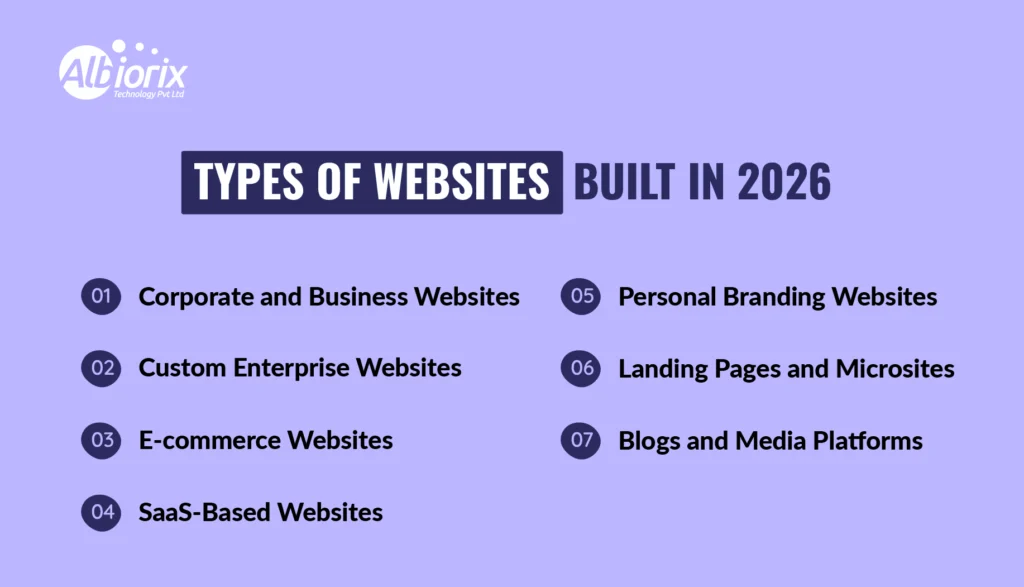
There are types of businesses that require different types of websites as per their end goals and objectives.
The layout, design, and functionalities of an ecommerce website cannot be similar to a healthcare website, especially when building eCommerce web solutions.
They are totally different and demand different types of functionalities to meet their industrial requirements.
Thus, it is important that you choose the right structure and functionalities of the website as per your industry and business requirements.
Each type serves a distinct purpose—from brand building to revenue generation—and plays a specific role within the broader website development process.
Common types of websites in 2026 include:
- Corporate and Business Websites: These websites are designed and developed to establish the credibility of a business. Its purpose is to communicate the brand values to the audiences, partners, and stakeholders.
- Custom Enterprise Websites: These types of websites are built for complex workflows, integrations, and scalability. They are designed and developed to support large organisations with advanced operational needs.
- E-commerce Websites: These are shopping platforms focused on online transactions, product management, payment gateways, and seamless customer purchase journeys.
- SaaS-Based Websites: These types of websites are developed to explain software value propositions, onboard users, and drive subscriptions or demos efficiently.
- Personal Branding Websites: These types of websites are built by professionals and creators to showcase expertise, projects, and achievements compellingly.
- Landing Pages and Microsites: These types of websites are built for conversions, promotions, and short-term marketing campaigns. They are also called Purpose-driven web pages.
- Blogs and Media Platforms: These types of websites are developed to educate, inform, and attract audiences through consistent, SEO-optimised content. They are simple, user-friendly, and intuitive.
As there are many different types of websites as per the industry’s needs and business objectives, it is important that you choose your type carefully.
By choosing the right website type, you can align everything in the right direction for long-term growth.
Key Website Elements That Define Success
When it comes to custom website development in 2026, there are some sets of elements that are mandatory. These key website elements lay the strong foundation of a successful website for your business.
These website elements work together to influence user experience, search visibility, trust, and conversion performance across the entire website development life cycle.
Core website elements include:
- Clear Value Proposition and Messaging: This element communicates with your audiences, tells them what you offer, and why your products/services matter. It helps them easily understand your relevance.
- Intuitive Navigation and Structure: This element allows users to find the products, services, or information they are looking for on your website. It also helps in improving crawlability and internal linking for search engines.
- Responsive and Mobile-Friendly Design: This website element ensures consistent performance and usability across all devices and operating systems. It is critical for engagement and SEO.
- High-Quality, SEO-Optimized Content: This element of a website delivers value-driven information that aligns with search intent and builds authority in your domain.
- Fast Loading Speed and Performance: The role of this website’s elements is to improve user retention, reduce bounce rates, and support higher rankings in competitive search results.
- Security, Privacy, and Compliance: The purpose of this website element is to protect user data, build trust, and ensure compliance with modern regulations and standards.
When these website elements are strategically optimized, they create a seamless experience that benefits both users and search engines alike.
Build a Website That Grows With Your Business
Partner with our website development experts to design and build a future-ready, high-performance digital platform aligned with your goals.
Contact Us
Why Custom Websites Outperform Templates
While templates may offer speed and lower upfront costs, custom websites are designed for long-term performance, scalability, and differentiation.
Many businesses prefer outsourcing web development to achieve faster execution and expert-driven results.
Benefits of custom website development include:
- Tailored User Experiences Aligned with Business Goals – Custom websites are built around specific user journeys, ensuring higher engagement and conversion rates.
- Scalable Architecture for Future Growth – The underlying structure supports new features, integrations, and traffic growth without rework.
- Better SEO and Performance Control – Custom code and architecture allow precise optimization for speed, indexing, and search visibility.
- Enhanced Security and Compliance – Security measures are implemented based on business risk, industry standards, and regulatory needs.
- Seamless Third-Party Integrations – Custom development enables smooth integration with CRMs, ERPs, analytics tools, and other systems.
- Unique Branding and Differentiation – A custom website reflects your brand identity without limitations imposed by pre-built themes.
In essence, custom websites are strategic digital assets that deliver measurable business value. They are not just built to launch—but built to scale, adapt, and compete.
Website Development Trends Shaping the Future
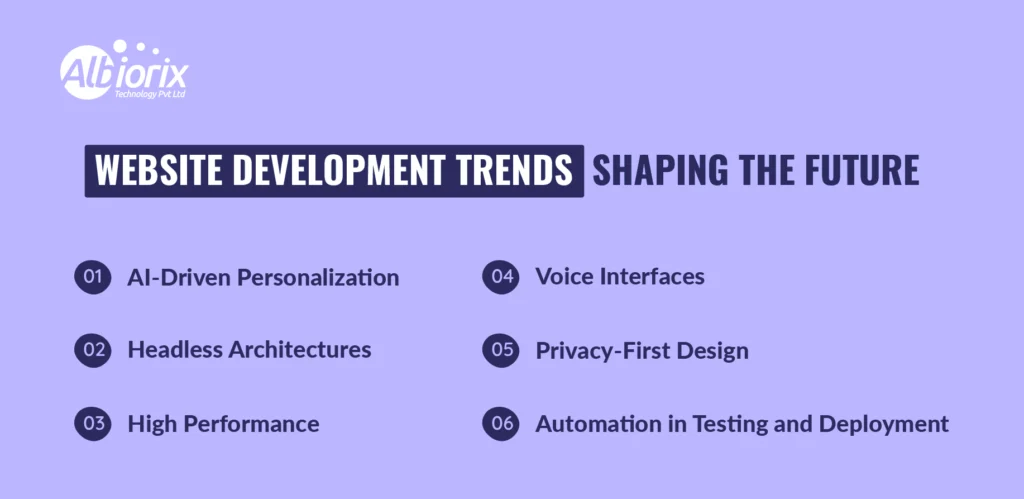
The website development life cycle continues to evolve. It changes with emerging technologies, changing user behavior, and search engine intelligence. Based on these trends, it is decided how digital experiences are built.
In 2026 and beyond, businesses that are aligned with these website development trends are expected to perform better and deliver relevant, fast, and scalable business websites.
Key website development trends shaping the future include:
- AI-Driven Personalization: With the arrival of Artificial Intelligence, most of the websites are now integrating AI to offer enhanced user experience. AI helps them offer personalized experiences.
- Headless Architectures: By decoupling the front end from the back end, businesses gain flexibility to deliver consistent experiences across web, mobile, and emerging digital channels.
- High Performance: In 2026, speed, stability, and responsiveness are the core ranking and user experience factors. Your website must offer a great experience.
- Voice Interfaces: With the rise of voice search and AI assistants, websites are being optimized for natural language queries and conversational user interactions.
- Privacy-First Design: As data regulations grow stricter, websites must be built with transparent data practices, consent management, and secure data handling.
- Automation in Testing and Deployment: Automated testing, CI/CD pipelines, and monitoring tools enable faster releases without sacrificing quality or security.
Together, these trends signal a shift toward intelligent, adaptable, and user-centric websites. Businesses that future-proof their website development process today gain a long-term competitive advantage.
Best Website Development Services for Future-Ready Businesses
Selecting the right development partner is critical for long-term success. Businesses often decide to outsource web development to gain access to skilled teams, modern tools, and scalable delivery models.
A future-ready website must balance performance, scalability, security, and user experience while remaining adaptable to evolving digital trends.
Our approach to the website development process is rooted in deep discovery, thoughtful design, and robust engineering.
We build custom websites that align with your business objectives, reflect your brand identity, and deliver measurable outcomes. From startups to enterprises, our solutions are designed to scale as your business grows.
By combining modern frameworks, SEO-first architecture, and conversion-focused UX, we help businesses create websites that do more than look good—they perform, engage, and convert.
Whether you’re launching a new digital platform or modernizing an existing one, the right website development partner can turn your vision into a competitive digital asset.
Conclusion
The website development process is a strategic journey, not a one-time task.
By understanding the stages of website development, choosing the right types of websites, and optimizing essential website elements, businesses can create digital platforms that support long-term growth.
If you need help planning or executing your website strategy, Contact Us to get expert assistance.
In an era driven by AI, performance metrics, and user trust, investing in a structured website development life cycle and professional website development services is essential.
A well-built custom website is not just an online presence—it’s a foundation for innovation, credibility, and sustained success.
Connect with Our Experts!
FAQ
Frequently Asked Questions (FAQs) About the Website Development Process
The website development process is a structured approach to planning, designing, building, testing, launching, and maintaining a website. It ensures that business goals, user experience, performance, and SEO are aligned throughout every stage of development.
The key stages of website development include discovery and requirement analysis, planning and information architecture, UI/UX design, development, testing and quality assurance, deployment, and ongoing maintenance and optimization.
The website development process focuses on execution steps, while the website development life cycle represents the continuous evolution of a website—from initial idea to long-term growth, optimization, and scalability.
The best types of websites depend on business objectives. Corporate websites are ideal for branding, e-commerce websites drive online sales, SaaS websites support product adoption, and custom enterprise websites handle complex workflows and integrations.
Custom websites are built around specific business needs, offering better scalability, performance, SEO control, security, and unique branding. Unlike templates, they can evolve as business requirements grow.
Key website elements include clear messaging, intuitive navigation, mobile responsiveness, fast loading speed, high-quality content, strong CTAs, and robust security features. Together, these elements improve rankings, trust, and conversions.
The timeline depends on complexity, features, and customization. A basic website may take a few weeks, while complex custom websites can take several months, especially when scalability and integrations are involved.
Modern trends like AI-driven personalization, headless architecture, performance-first development, and privacy-focused design help businesses stay competitive, adaptable, and aligned with evolving user expectations.
Published Blogs
Latest Blogs : Insights and Innovations from Our Blog
Stay Ahead in Tech: Dive into our Blogs for the Latest in Software, Web, and Mobile App Development. Explore cutting-edge technologies, industry trends, and insightful updates that keep you at the forefront of the digital landscape

Our Clients

Client Showcase: Trusted by Industry Leaders
Explore the illustrious collaborations that define us. Our client showcase highlights the trusted partnerships we've forged with leading brands. Through innovation and dedication, we've empowered our clients to reach new heights. Discover the success stories that shape our journey and envision how we can elevate your business too.










We’re here to help you


