






Table of Content
- What Is AI-Powered Software Development?
- 7 Ways AI-Powered Software Development Reduces Business Expenses
- How AI Creates Future-Proof Digital Solutions
- AI-Powered Software Development vs. Traditional Software Development
- What AI Software Development Tools Are Businesses Using?
- Key Considerations Before Adopting AI in Software Development
- How Albiorix Technology Helps Businesses Build AI-Powered Software Solutions
- Conclusion
Key Takeaways
- AI-powered software development reduces repetitive manual work and development overhead.
- AI-assisted coding and testing can accelerate software delivery.
- Intelligent automation helps reduce maintenance and operational expenses.
- AI-powered applications improve scalability, personalization, and business efficiency.
- AI agents enable businesses to automate complex, multi-step workflows.
- Secure architecture and human oversight are essential for long-term success.
- The right AI development strategy helps businesses maximize ROI and remain competitive.
Businesses are under constant pressure to innovate, reduce operational expenses, and deliver better digital experiences. However, traditional software development often involves lengthy development cycles, increasing engineering costs, repetitive manual tasks, and ongoing maintenance challenges.
This is where AI-powered software development is changing the way businesses build and manage digital products.
By integrating artificial intelligence into the software development lifecycle, organizations can automate repetitive activities, accelerate coding and testing, improve decision-making, and create more adaptable applications. From startups developing their first MVP to enterprises modernizing complex systems, AI-driven development offers opportunities to achieve more with existing resources.
But the real value of AI goes beyond writing code faster. It helps businesses rethink how software is planned, developed, deployed, and maintained.
Let’s explore how AI in software development can lower expenses, improve efficiency, and help organizations build future-ready digital solutions.
What Is AI-Powered Software Development?
AI-powered software development is the process of using artificial intelligence technologies, including machine learning, generative AI, large language models (LLMs), and intelligent automation, to improve different stages of software creation.
Instead of depending entirely on manual development processes, engineering teams use AI-powered software development tools to assist with:
- Understanding business requirements and planning projects.
- Generating and optimizing code.
- Identifying bugs and potential security vulnerabilities.
- Automating software testing.
- Improving application performance.
- Analyzing user behavior and application data.
- Supporting software maintenance and modernization.
For example, an AI-assisted development environment can help developers generate repetitive code, suggest improvements, and identify errors before they become larger problems.
However, AI does not replace the need for experienced software engineers. Human expertise remains essential for architecture, business logic, security, quality assurance, and strategic decision-making.
The combination of AI capabilities and skilled developers creates a more efficient and scalable software development approach.
Ready to Reduce Software Development Costs With AI?
Build smarter applications, automate development workflows, and accelerate your digital transformation with AI-powered software solutions.
Discuss Your AI Project
7 Ways AI-Powered Software Development Reduces Business Expenses
Software development expenses are not limited to coding. They also include planning, testing, infrastructure, maintenance, and long-term operational support.
AI-driven software development can optimize these activities and help businesses manage technology budgets more effectively.
1. Automates Repetitive Development Tasks
Developers spend considerable time on repetitive activities such as writing boilerplate code, generating documentation, creating test cases, and fixing common programming errors.
AI-powered coding assistants can automate or accelerate many of these tasks.
For example, developers can use AI tools to generate reusable code structures, explain existing code, suggest corrections, and create initial test cases.
This allows engineering teams to spend more time on complex functionality, application architecture, and business-critical features.
Business impact: Reduced manual effort, improved developer productivity, and better utilization of engineering resources.
2. Reduces Software Testing and Quality Assurance Costs
Manual testing can become expensive and time-consuming, particularly when applications contain multiple features, integrations, and user workflows.
AI-powered application development introduces intelligent testing capabilities that help automate repetitive quality assurance activities.
AI can assist with:
- Automated test case generation.
- Regression testing.
- Bug identification and classification.
- Test coverage analysis.
- Performance monitoring.
- Identifying unusual application behavior.
For example, an AI-powered testing solution can analyze application changes and help identify which areas require additional testing.
This makes it easier to detect issues earlier and reduce expensive corrections after deployment.
Business impact: Faster testing cycles, fewer avoidable defects, and improved software reliability.
3. Optimizes Development Time and Project Delivery
Traditional development projects often experience delays because of manual processes, communication gaps, repetitive coding, and testing bottlenecks.
AI-assisted coding and intelligent development workflows can help teams complete certain activities faster.
AI can support requirement analysis, generate initial code structures, suggest technical solutions, and assist with documentation.
Business impact: Faster development cycles, improved resource allocation, and earlier product launches.
4. Improves Resource Allocation
Hiring and maintaining a large engineering team can increase software development expenses, particularly for startups and growing businesses.
AI-powered development tools help existing teams handle repetitive tasks more efficiently.
For example, a development team can use AI to accelerate code generation, documentation, debugging, and testing while experienced engineers focus on complex technical decisions.
Businesses can also work with AI software development services providers to access specialized expertise without building every capability internally.
Business impact: Better utilization of development resources and more predictable project execution.
5. Minimizes Maintenance and Operational Expenses
Software maintenance is an ongoing expense. Applications require regular updates, performance improvements, security monitoring, and bug fixes.
AI can support software maintenance by analyzing application logs, identifying unusual patterns, detecting potential issues, and helping developers investigate errors.
AI-powered monitoring can also support predictive maintenance by identifying warning signs before they develop into major operational problems.
For example, an intelligent monitoring system can detect unusual database response times and alert engineering teams to investigate performance issues.
Business impact: Reduced troubleshooting effort, improved application availability, and more proactive maintenance.
6. Reduces Infrastructure and Resource Waste
Cloud infrastructure expenses can increase when applications are not optimized properly.
AI-driven software development solutions can incorporate intelligent resource monitoring and optimization to help businesses understand application workloads.
AI can assist with:
- Identifying underutilized cloud resources.
- Analyzing application performance.
- Optimizing resource allocation.
- Detecting unusual infrastructure usage.
- Supporting capacity planning.
For cloud-based applications, these insights can help engineering teams make informed infrastructure decisions.
Business impact: Better resource utilization, controlled cloud spending, and improved operational efficiency.
7. Improves Decision-Making Through Data Insights
Software development decisions directly influence project costs, product performance, and customer satisfaction.
AI-powered analytics can process large amounts of application and business data to identify trends, user behavior, and performance issues.
For example, businesses can analyze customer interactions to understand which features are frequently used and which create friction.
Product teams can use these insights to prioritize development activities instead of investing resources in features that deliver limited business value.
Business impact: Smarter product investments, reduced development waste, and improved customer experiences.
Want to Make Your Software Development More Cost-Efficient?
From AI-assisted coding to intelligent automation, the right development strategy can help your business reduce repetitive work and maximize engineering resources.
Explore AI Development Services
How AI Creates Future-Proof Digital Solutions
Reducing development expenses is important, but businesses also need software that can adapt to changing technologies, customer expectations, and market conditions.
Future-proof software is not simply software built with the latest technology. It is software designed to evolve without requiring expensive redevelopment every time business requirements change.
Here is how AI-powered software development supports that objective.
1. Scalable and Adaptable Architecture
AI-powered applications can be designed using modular architectures, cloud-native technologies, and flexible APIs.
These approaches make it easier to introduce new features, integrate external platforms, and support increasing user demand.
For example, an eCommerce business can begin with an AI-powered recommendation engine and later expand into personalized search, intelligent customer support, and predictive inventory management.
2. Intelligent Automation and AI Agents
AI agents are creating new opportunities for businesses to automate multi-step workflows.
Unlike traditional automation, which generally follows predefined rules, AI agents can interpret information, determine appropriate actions, and interact with connected tools within defined permissions.
Businesses can use AI agents for customer support, internal knowledge management, workflow coordination, and operational assistance.
When designed with proper human oversight and security controls, these solutions can reduce repetitive work and improve business efficiency.
3. Personalized Customer Experiences
Modern customers expect digital products to understand their preferences and deliver relevant experiences.
AI-powered applications can analyze user behavior, interaction patterns, and historical data to support personalized recommendations, intelligent search, and customized experiences.
For example, a retail application can recommend relevant products based on customer preferences, while a financial platform can provide personalized financial insights.
This helps businesses improve customer engagement and create more valuable digital experiences.
4. Seamless Integration With Emerging Technologies
Future-ready applications should be capable of integrating with evolving technologies.
AI-driven software development can support integration with:
- Large language models (LLMs).
- Generative AI platforms.
- Machine learning models.
- Cloud computing platforms.
- Internet of Things (IoT) ecosystems.
- Intelligent automation systems.
- Enterprise APIs and third-party applications.
A flexible integration strategy helps businesses introduce new capabilities without rebuilding their entire technology infrastructure.
5. Continuous Improvement and Predictive Capabilities
AI-powered systems can continuously analyze operational data and identify opportunities for improvement.
For example, predictive analytics can help businesses forecast demand, identify customer behavior patterns, and anticipate operational challenges.
These capabilities make applications more responsive to changing business conditions.
AI-Powered Software Development vs. Traditional Software Development
Both approaches have an important role in modern software engineering. However, AI-powered development introduces additional opportunities for automation, productivity, and intelligent decision-making.
| Comparison | Traditional Development | AI-Powered Development |
|---|---|---|
| Coding | Primarily manual | AI-assisted coding |
| Testing | Often heavily manual | AI-assisted automated testing |
| Bug detection | Manual investigation and tools | AI-supported detection and analysis |
| Documentation | Manually prepared | AI-assisted generation |
| Decision-making | Primarily human-led analysis | Human expertise supported by AI insights |
| Maintenance | Reactive and scheduled processes | Predictive and AI-assisted monitoring |
| Scalability | Depends on architecture and resources | Can combine flexible architecture with AI capabilities |
The key takeaway: AI-powered software development does not eliminate traditional engineering practices. It enhances them by combining automation, intelligent tools, and human expertise.
What AI Software Development Tools Are Businesses Using?
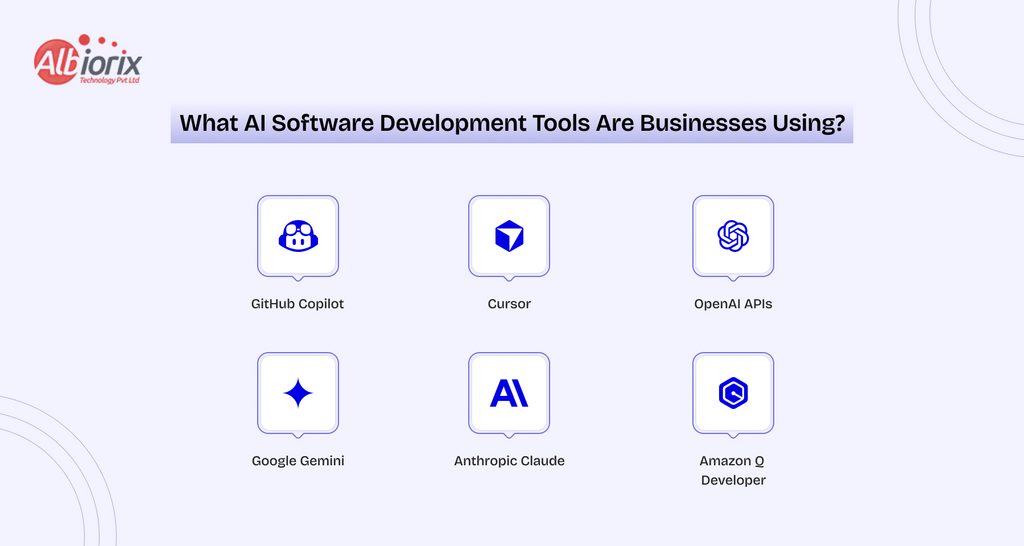
The AI development ecosystem includes tools that support different stages of the software development lifecycle.
Some widely used examples include:
- GitHub Copilot: Supports AI-assisted coding, code suggestions, and developer productivity.
- Cursor: An AI-powered code editor that helps developers understand, generate, and modify code.
- OpenAI APIs: Enable businesses to integrate language models and generative AI capabilities into custom applications.
- Google Gemini: Supports AI-assisted development and the integration of generative AI capabilities.
- Anthropic Claude: Can assist with code generation, analysis, documentation, and complex development tasks.
- Amazon Q Developer: Provides AI assistance for software development and AWS-related workflows.
The right technology depends on the project’s requirements, existing infrastructure, security needs, development environment, and budget.
Businesses should evaluate tools based on measurable outcomes rather than choosing technologies simply because they are popular.
Key Considerations Before Adopting AI in Software Development
Although AI offers significant advantages, successful implementation requires proper planning.
Businesses should consider the following factors before investing in AI software development solutions.
1. Define clear business objectives: Identify whether the priority is reducing development costs, improving productivity, automating workflows, or enhancing customer experiences.
2. Choose the right AI technologies: Select AI models, frameworks, APIs, and development tools based on actual business requirements.
3. Prioritize data security: Establish access controls, data protection policies, and secure development practices when using AI tools.
4. Maintain human oversight: Review AI-generated code, validate outputs, and ensure that important technical decisions remain accountable.
5. Build for scalability: Use modular architecture, flexible integrations, and maintainable development practices.
6. Measure ROI: Track development time, cost per feature, defect rates, maintenance expenses, and operational improvements.
According to Gartner’s November 2026 software engineering outlook, AI-native development platforms, agent sandboxing, and evaluation-driven development are among the important trends shaping enterprise software engineering.
This reinforces the importance of combining AI adoption with security, governance, and quality controls.
How Albiorix Technology Helps Businesses Build AI-Powered Software Solutions
Adopting AI is not just about introducing new tools into an existing development process. Businesses need the right technology strategy, engineering expertise, and implementation roadmap to turn AI opportunities into measurable outcomes.
Albiorix Technology helps businesses transform complex requirements into intelligent digital solutions through custom software development and AI-powered engineering.
Our approach focuses on building solutions that align with business objectives, improve operational efficiency, and support long-term growth.
Our AI and software development capabilities include:
- Custom AI Software Development: Building intelligent applications tailored to specific business requirements.
- AI Integration Services: Integrating AI models, APIs, and automation capabilities into existing business systems.
- AI Agent Development: Developing intelligent agents to automate workflows and support business operations.
- Generative AI Development: Creating AI-powered applications using LLMs and generative AI technologies.
- AI-Powered Application Development: Developing scalable web and mobile applications with intelligent features.
- Software Modernization: Improving existing applications through modern architecture, integrations, and AI capabilities.
Whether you are a startup planning an AI-powered MVP or an enterprise looking to modernize existing software, the focus should remain on business value, scalability, security, and long-term ROI.
Ready to reduce development overhead and build smarter digital solutions?
Let’s discuss how AI-powered software development can help your business accelerate innovation and achieve measurable results.
Talk to Our Experts
Conclusion
AI-powered software development is transforming how businesses approach technology investments. By automating repetitive tasks, improving testing, optimizing resources, and supporting intelligent decision-making, AI helps organizations develop software more efficiently.
However, reducing expenses should not come at the cost of software quality, security, or long-term maintainability.
The most successful approach combines AI-powered tools with experienced developers, strong engineering practices, and a clear business strategy.
For businesses looking to remain competitive, investing in AI-driven software development solutions is an opportunity to reduce unnecessary development overhead while creating scalable, adaptable, and future-ready digital products.
The goal is not simply to build software faster. It is to build software that delivers more business value over time.
Connect with Our Experts!
FAQ
Frequently Asked Questions
AI reduces development expenses by automating repetitive coding tasks, accelerating testing, identifying bugs, optimizing resources, and reducing manual effort throughout the software development lifecycle.
Yes. AI-assisted coding, automated testing, code analysis, and documentation can accelerate development activities and help teams deliver software faster without compromising essential quality controls.
Key benefits include improved developer productivity, reduced development costs, faster time-to-market, automated testing, better application performance, and more efficient software maintenance.
Popular tools include GitHub Copilot, Cursor, OpenAI APIs, Google Gemini, Anthropic Claude, and Amazon Q Developer. The best choice depends on project requirements and technology infrastructure.
Yes. Startups can use AI-assisted development to accelerate MVP development, automate repetitive tasks, optimize engineering resources, and validate product ideas with more efficient development workflows.
AI supports future-ready applications through intelligent automation, predictive analytics, flexible integrations, personalized experiences, and scalable architectures that can adapt to changing business requirements.
No. AI supports developers by automating repetitive activities and assisting with coding and testing. Experienced engineers remain essential for architecture, security, business logic, quality assurance, and complex decisions.
Look for a company with experience in custom software development, AI integration, machine learning, generative AI, application security, and scalable architecture. Evaluate its technical expertise, development process, and ability to align solutions with business goals.
Published Blogs
Latest Blogs : Insights and Innovations from Our Blog
Stay Ahead in Tech: Dive into our Blogs for the Latest in Software, Web, and Mobile App Development. Explore cutting-edge technologies, industry trends, and insightful updates that keep you at the forefront of the digital landscape
Our Clients

Client Showcase: Trusted by Industry Leaders
Explore the illustrious collaborations that define us. Our client showcase highlights the trusted partnerships we've forged with leading brands. Through innovation and dedication, we've empowered our clients to reach new heights. Discover the success stories that shape our journey and envision how we can elevate your business too.










Build Together With
Albiorix Technologies
Partner with us to transform your ideas into powerful, scalable digital products. From design deployment, we deliver with precision and care.
0+
Digital Projects Completed
0+
AI Solutions Delivered
0+
Seasoned Developers
0+
Years of Experience


