






Table of Content
- What is Custom Software Development?
- What is Off-the-Shelf Software?
- Custom Software vs Off-the-Shelf Software: Side-by-Side Comparison
- What is the Real Cost Difference Between Off-the-Shelf vs Custom Software
- What is Better: Custom Software vs SaaS Comparision
- Should My Company Build Custom Software? 5 Questions to Ask
- Enterprise Software Buying Guide: A Decision Framework
- The Role of Software Consulting Services
- Enterprise Software Solutions: What to Expect from a Custom Build
- What are the Common Myths About Custom Software Development
- Hybrid Approaches: The Intelligent Middle Ground
- How to Choose the Right Software Development Partner
- Conclusion
Summary: Choosing between custom software and off-the-shelf (SaaS) comes down to budget, timeline, and competitive advantage. Off-the-shelf is faster and cheaper upfront, ideal for standard tasks. Custom software requires a higher initial investment and time, but is tailored exactly to your workflows, yielding a better long-term ROI.
At some point in time, every growing business faces this question: Do they need a custom software solution or should they invest in an Off-the-shelf software solution available in the market? This question is very important for the growth of your business, and the answer to this question is equally important.
In comparison between a custom software solution vs an off-the-shelf solution, the right answer depends on factors such as scale, business type, operations, and future goals.
This is one of the most common questions among businesses in the USA, UK, Australia, and Germany, and we are writing this guide to help them decide the right one.
In this guide, we will talk about custom software development, its pros, whether it’s useful for your business, and in which cases you must consider building a personalized software solution for your business.
So, let’s find out what’s right for your business: Off-the-Shelf vs Custom Software Development.
What is Custom Software Development?
When you develop a software system to fit your company’s unique operational requirements, it is called custom software development.
The latter is designed, developed, and deployed to increase the operational efficiency of a business. Understanding the specific advantages of custom software development can help you evaluate how personalization impacts your long-term bottom line.
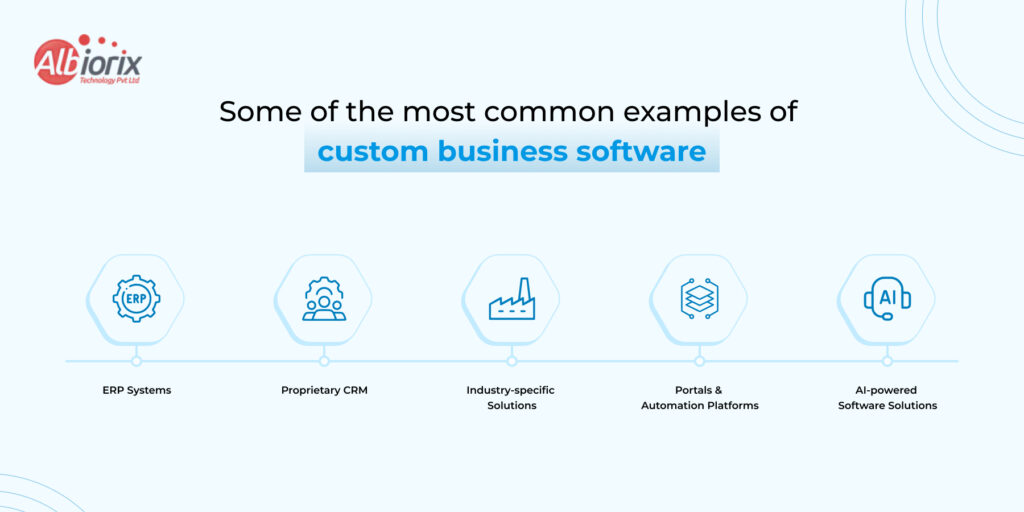
Some of the most common examples of custom business software include:
- ERP Systems: This type of software is developed for manufacturing and logistics operations.
- Proprietary CRM: This type of software platform is built to fit any company’s unique sales cycle.
- Industry-specific Solutions: This type of software platform is built to meet industry compliance and standards.
- Portals & Automation Platforms: This type of software solution is built for unique internal workflows and automations.
- AI-powered Software Solutions: This type of software platform is powered by Artificial Intelligence and developed to automate business operations. You can look at real-world deployments in our overview of AI-powered software solutions & apps by Albiorix.
What is Off-the-Shelf Software?
Off-the-shelf software are readymade software solutions that are built around general purposes for a wide range of businesses and audiences. They have the most common features/functions required by most businesses across the globe.
You can subscribe to or buy a liscensed version of software and configure (up to a certain extent) them as per your business requirements.
Off-the-Shelf software has been around for decades, and some of the most common examples are Salesforce, SAP, HubSpot, Microsoft Dynamics, and QuickBooks, to name a few.
Many also fall under the SaaS (Software as a Service) model, meaning the vendor hosts and maintains the product.
Custom Software vs Off-the-Shelf Software: Side-by-Side Comparison
In the discussion between custom software development vs off-the-shelf software, there are many things to consider. In some cases, when you are running short of budget, traditional software solutions can be truly useful.
But as your business grows, you can invest in custom business software that can accommodate your business needs and help you grow exponentially.
However, before we deduce what’s good for your business and what’s not, let’s have a look at this detailed comparison table between Custom Software vs Off-the-shelf:
| Factors | Custom Software | Off-the-Shelf Software |
|---|---|---|
| Upfront Cost | Higher initial investment | Lower initial cost |
| Long-term ROI | Higher – Built around your workflows | Lower – Licensing fees accumulate |
| Time to Deploy | Weeks to Months (Depens on Scope) | Days to weeks |
| Scalability | Unlimited – Scales with your business | Vendor-dependent, often rigid |
| Integrations | Seamless with existing systems | Vendor-supported APIs |
| Owership | You own the code and IP | Vendor owns the product |
| Customization | 100% tailored to your processes | Minimal – often cosmetic only |
| Security Control | Full – Built to your compliance needs | Vendor-managed, limited control |
| Support | Dedicated dev team/agency | Vendor help desk, community forums |
| Best for | Enterprises, Complex Workflows, Competitive differentiation | SMBs, Standard Use Cases, Fast Deployment |
It’s not always the case that readymade/off-the-shelf are bad for your business. You can start with them, and gradually upgrade to custom software development when your business grows.
However, if you still want to know the cost of an enterprise software solution, we offer a free quote. Talk to our software experts for free.
What is the Real Cost Difference Between Off-the-Shelf vs Custom Software
With the real cost difference between custom software development and off-the-shelf software, we want to discuss licensing rates, development costs, operational expenses, and long-term maintenance costs
How much will you pay in the long run, and which option will be cost-effective and business-centric?
What is the cost of Off-the-Shelf Software?
The cost of off-the-shelf software solutions ranges from $100 to $1000 per user per month. Along with the per-user fees, you also have to pay a license fee, which may start from $5000 to $10,000 (standard purchase).
Now, as your team scales and your business grows, the cost of Off-the-shelf software also increases.
- Have a look at the cost of ownership of an off-the-shelf software:
- Per user licensing fees that compound as your business grows
- Annual price increases at vendor discretion.
- Add-on modules and premium tiers that unlock essential features.
- Professional services fee for customization and implementation
- Expensive migrations when you eventually outgrow the platform.
Investing in off-the-shelf software is not a bad idea initially. But, if you are thinking about the long run, then it is advisable to use custom business software. At least, at the end, you will be owning a business software, it’s equity, and proprietary.
What is the Cost of Custom Software Development?
The development cost of a custom software solution falls somewhere between $50,000 to $500,000. Further, this cost can increase depending on features, complexity, time-to-market, and many other factors.
Custom software development also requires a larger upfront investment. Thus, you have to be prepared for the heavy initial investment.
However, once you have built custom business software, this amount will be recovered in 3-5 years. You eliminate the cost of liscencing, save on paying per-user, and other unexpected costs.
Enterprise software solutions are beneficial as you build a proprietary system that becomes a competitive moat and not a shared commodity. For instance, evaluating how ai agents vs traditional automation perform can help you determine the right intelligence layer for your system.
When working with reputable software development consulting USA firms, the investment typically includes architecture design, development, testing, deployment, and ongoing support, all structured around your business model.
What is Better: Custom Software vs SaaS Comparision
The custom software vs SaaS comparison is increasingly relevant as more businesses default to cloud subscriptions. Here’s where the differences become material:
Data Ownership and Privacy Comparision:
With SaaS, your data lives on a third-party server. For businesses in regulated industries such as healthcare, finance, legal, government, this introduces compliance risk. HIPAA, GDPR, SOC 2, and ISO 27001 requirements can be extremely difficult to meet under a shared SaaS environment.
Custom software gives you full control over where data is stored, how it’s encrypted, and who can access it. This is non-negotiable for enterprises handling sensitive information.
Workflow Fit Comparision:
SaaS platforms are built for the 80% use case — the workflows most businesses share. If your operations are standard, that works fine. But if your business has specific, differentiated processes (and most scaling enterprises do), you end up bending your operations to fit the software rather than the other way around.
Custom business software is designed the other way around: your workflow drives the product logic. Knowing the architectural difference between website and web application platforms ensures you fund the correct framework for those workflows.
Vendor Lock-In Comparision:
Every year you invest in a SaaS tool, migration costs grow. Data portability is rarely clean. Features you depend on can be deprecated or moved behind higher-tier plans. You are, structurally, at the vendor’s mercy.
With custom software, you control the roadmap. Features are added when your business needs them and not when the vendor decides.
Should My Company Build Custom Software? 5 Questions to Ask
If you’re genuinely asking ‘should my company build custom software,’ run through these five diagnostic questions:
Does any existing software actually fit your workflows?
If you’ve tried two or three platforms and spent months in configuration, that’s a signal. Custom might be cheaper in the long run.
Is software a core part of your competitive differentiation?
For tech-enabled service businesses, fintech, healthtech, or logistics companies, the software IS the product. Off-the-shelf gives every competitor the same toolset.
What are your 3-year scaling projections?
SaaS pricing scales linearly with users. Custom software scales on your infrastructure terms.
Do you have strict compliance or security requirements?
If the answer is yes, custom is almost always the correct answer.
Are you wasting significant staff time working around software limitations?
If your team is maintaining spreadsheets alongside your CRM, or manually exporting data between systems, you’re already paying the cost of the wrong software.
Enterprise Software Buying Guide: A Decision Framework
When it comes to investing in enterprise software development, you must understand what your business needs to operate efficiently. Consider this framework before committing either way:
| Choose Off-the-Shelf If… | Choose Custom Software If… |
|---|---|
| Yuo need a solution up and running quickly | Your workflows are complex or highly specific |
| Your use case is standard | You need deep integration with existing systems |
| Budget for the short term is tight | You are planning to scale significantly |
| You are a startup validating a product idea | Data security and compliance are non-negotiable |
| A vendor’s roadmap meets your needs | You want full IP ownership and competitive moat |
Consider this framework before committing either way. If your team leans toward building a proprietary ecosystem, aligning your goals with a structured digital product development lifecycle keeps the project on track.
Get a free quote and consultation from software developers at Albiorix Technology.
Let’s get started!
The Role of Software Consulting Services
One of the most consistent mistakes businesses make is treating this as a binary, all-or-nothing decision. Experienced software consulting services help you avoid that trap.
A qualified software consultant will:
- Audit your current tech stack and identify gaps and redundancies
- Map your business processes and identify which require custom logic
- Evaluate off-the-shelf options honestly and recommending them where they genuinely fit
- Define a build-vs-buy recommendation grounded in TCO (total cost of ownership)
- Architect a solution that allows phased development — starting lean and scaling up
The right software consulting firm doesn’t push custom development because it’s more billable — it recommends what’s right for your specific business model and growth stage. This is why choosing a partner with transparent methodology matters as much as their technical capability.
Enterprise Software Solutions: What to Expect from a Custom Build
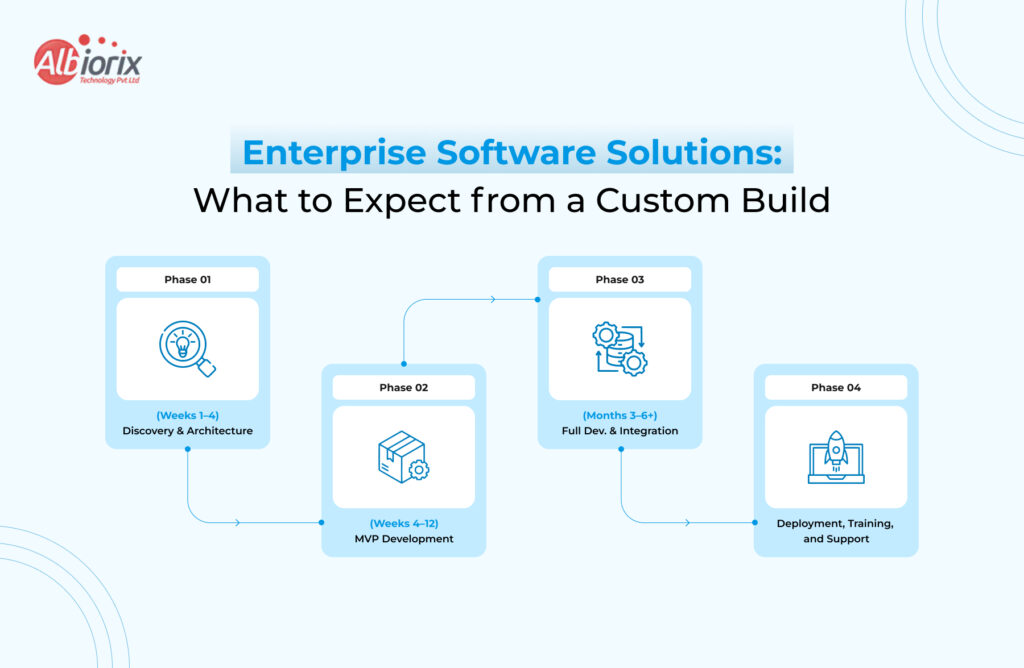
If the analysis points toward custom, here’s what a structured engagement with an enterprise software development partner typically involves:
Phase 1: Discovery and Architecture (Weeks 1–4)
Business analysis, stakeholder interviews, user journey mapping, system architecture design, and technical specification. This phase is what separates experienced software firms from code shops — the upfront thinking determines the quality of the output.
Phase 2: MVP Development (Weeks 4–12)
A minimum viable product is built around your highest-priority workflows. You get early visibility into the product, can test with real users, and provide feedback before the full scope is built. This iterative approach reduces risk significantly.
Phase 3: Full Development and Integration (Months 3–6+)
Complete feature development, third-party integrations, performance optimisation, and security hardening. For complex enterprise software solutions, this phase includes load testing, penetration testing, and compliance audits where required.
Phase 4: Deployment, Training, and Support
Cloud or on-premise deployment, staff onboarding, documentation, and an ongoing support and maintenance arrangement. The best software development consulting USA firms offer a structured hypercare period post-launch.
What are the Common Myths About Custom Software Development
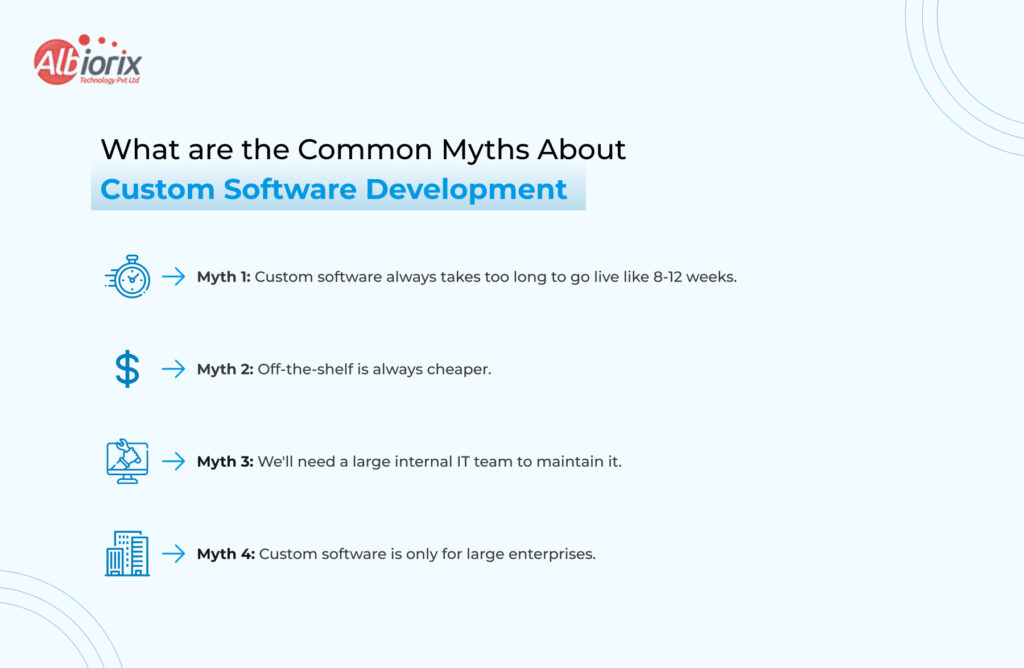
- Myth 1: Custom software always takes too long. With modern frameworks and agile software development methodologies, a focused MVP can go live in 8–12 weeks. It’s not always a multi-year project.
- Myth 2: Off-the-shelf is always cheaper. Short-term, yes. Over 3–5 years, licensing costs, customisation fees, and inefficiencies regularly exceed the cost of a custom build.
- Myth 3: We’ll need a large internal IT team to maintain it. Not true when you work with a software partner on a managed services or retainer model. Many organisations run sophisticated custom platforms with zero in-house developers.
- Myth 4: Custom software is only for large enterprises. Growth-stage companies with $5M–$50M revenue often see the biggest ROI from custom business software, because their processes are complex enough that off-the-shelf fails them but they’re nimble enough to deploy quickly.
Hybrid Approaches: The Intelligent Middle Ground
The custom vs off-the-shelf decision isn’t always binary. Many enterprises run a hybrid model — strategic custom software for differentiating functions, with off-the-shelf tools for commodity needs.
For example:
- A logistics company might use a standard accounting platform (Xero, QuickBooks) but build a custom route optimisation and fleet management system.
- A healthcare provider might deploy a standard EMR but build custom patient-facing portals and analytics dashboards.
- An e-commerce business might use Shopify for the storefront but build custom inventory management and supplier integration software.
Software consulting services can help you identify exactly which parts of your stack warrant custom investment and which don’t.
How to Choose the Right Software Development Partner
If you decide to pursue custom business software, partner selection is critical. Evaluate firms on:
- A company must have relevant domain experience. They must have built software in your industry.
- Discovery process rigour. Do they invest in understanding your business before writing code?
- Do they ensure communication transparency? Will you have visibility into progress, blockers, and timelines?
- Do they offer a post-launch support model? What happens after go-live?
- Explore real client references. Can they provide verifiable case studies?
For businesses in North America, working with software development consulting USA firms gives you the advantage of timezone overlap, legal protectability of IP, and shared regulatory context — particularly important in healthcare, finance, and legal tech.
Conclusion
There is no universal answer. But there is a right answer for your business and it comes from honest analysis, not default assumptions.
Off-the-shelf software is the right call when you need speed, have a standard use case, or are early-stage and validating a model. It gets you moving fast with predictable costs.
Custom software is the right call when your workflows are complex, compliance is non-negotiable, you’re scaling rapidly, or software is central to your competitive advantage. The upfront investment pays back in ownership, efficiency, and strategic control.
The businesses that make this decision well — guided by rigorous software consulting services and a clear understanding of long-term costs — are the ones that build software as an asset, not a liability.
Connect with Our Experts!
Published Blogs
Latest Blogs : Insights and Innovations from Our Blog
Stay Ahead in Tech: Dive into our Blogs for the Latest in Software, Web, and Mobile App Development. Explore cutting-edge technologies, industry trends, and insightful updates that keep you at the forefront of the digital landscape


Our Clients

Client Showcase: Trusted by Industry Leaders
Explore the illustrious collaborations that define us. Our client showcase highlights the trusted partnerships we've forged with leading brands. Through innovation and dedication, we've empowered our clients to reach new heights. Discover the success stories that shape our journey and envision how we can elevate your business too.










We’re here to help you


