






Table of Content
- What Does Healthcare AI Software Development Cost?
- What are the Factors That Affect the Cost of Healthcare AI Software Development?
- Cost Breakdown by Healthcare AI Solution Type
- What HIPAA-Compliant AI Development Actually Costs
- Market Context: Healthcare AI Investment in the US, Germany & Australia
- How to Budget for Healthcare AI: A Practical Framework
- What AI Healthcare Platform Development Looks Like at Albiorix
- What Are The Cons When Evaluating Healthcare AI Development Partners
- Conclusion
Summary: Healthcare AI software development cost runs $25,000 to $2,000,000+, depending on solution type, compliance needs, and integration complexity. This guide breaks down real pricing for hospitals, clinics, and health-tech startups across Australia, Germany, and USA, plus a practical budgeting framework. What should yours cost?
In 2026, the penetration and integration of Artificial Intelligence in Healthcare is beyond one’s imagination. From big hospitals to small clinics, it is everywhere and helps doctors, hospitals, and other medical professionals to offer better treatment and care to their patients.
For example, hospitals in Houston are using AI triage tools that flag deteriorating patients 36 hours before a clinical event. In Melbourne, aged-care networks are deploying predictive models that can reduce hospital readmissions by up to 22%.
Radiology centers in Munich are reading chest CTs with AI assistance in less than 90 seconds. There are plenty of similar examples where AI in Healthcare is doing magic for both doctors and patients.
With so many benefits of using AI in Healthcare, CFOs, CTOs, and operations leads across the world are now asking is not whether to build healthcare AI — it is how much it will cost, what they get for that budget, and which development partner can be trusted with PHI-grade data.
In this detailed guide on “Healthcare AI Software Development Cost”, we will answer all three questions. We will break down AI software development costs across all major solution types, explain what drives prices up or down, and provide a realistic planning framework.
Whether you are a 50-bed community hospital in Adelaide (Australia), a digital health startup in Berlin (Germany), or a large health system in Chicago (United States of America), this detailed guide on Healthcare AI Software Development Cost will answer all your questions.
Who Are We? We, Albiorix Technology, an AI Development Company, have been building HIPAA-compliant and GDPR-aligned AI systems and custom healthcare software development solutions since 2020. Take a look at our portfolio to learn more about our potential as an AI development company.
Let’s Talk About Development Cost Before You Commit!
Every healthcare AI project is different. Our consulting team offers a free 45-minute scoping call to give you a project-specific estimate.
Book your free estimate call
What Does Healthcare AI Software Development Cost?
The development cost of Healthcare AI software typically ranges between $25,000 to $2,000,000+ with a timeline ranging from 6 weeks to 24 months. There are many factors that directly or indirectly affect the development cost of AI software, because healthcare AI is not a single thing.
Cost Breakdown by Use Case (2026)
- Proof of Concept/MVP: It usually costs around $25, 000 to $80,000.
- Clinical Decision Support tool: It usually costs around $80,000 to $200,000.
- AI-Powered EHR Module/Add-on: It usually costs around $120,000 to $350,000.
- Medical Imaging AI Platform: It usually costs around $250,000 to $700,000.
- Remote Patient Monitoring System: It usually costs around $150,000 to $400,000.
- Full AI Healthcare Platform: It usually costs around $500,000 to $2,000,000+.
Look at the detailed breakdown of Cost Along with the Timeline:
| Solution Type | Typical Cost Range (USD) | Timeline |
|---|---|---|
| Proof of Concept/MVP | $25,000 – $80,000 | 6 – 12 weeks |
| Clinical Decision Support Tool | $80,000 – $200,000 | 3 – 6 months |
| AI-Powered EHR Module / Add-on | $120,000 – $350,000 | 4 – 8 months |
| Medical Imaging AI Platform | $250,000 – $700,000+ | 6 – 14 months |
| Remote Patient Monitoring System | $150,000 – $400,000 | 4 – 9 months |
| Full AI Healthcare Platform | $500,000 – $2,000,000+ | 12 – 24 months |
The cost of developing the AI healthcare software discussed above in the table reflects the all-in development cost. It includes everything from discovery, architecture, model training, UI/UX, compliance engineering, QA, and deployment.
However, with these costs, you must be prepared for additional costs after deployment, such as regular maintenance, model retraining, and regulatory submissions.
If an AI healthcare software development company in India offers you a development quote without asking about your EHR stack, data availability, user volumes, or compliance jurisdiction, then you’d better be cautious. Context determines cost in healthcare AI more than in almost any other software category.
What are the Factors That Affect the Cost of Healthcare AI Software Development?
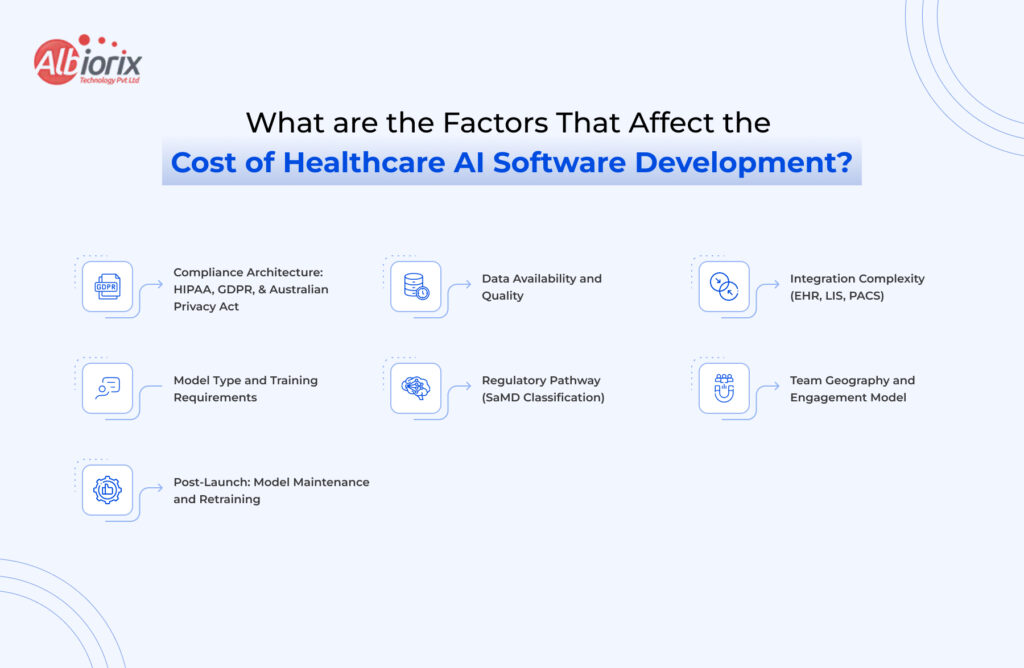
There are seven main factors that directly affect the AI healthcare software development costs, including Compliance Architecture, Data Availability and Quality, Integration Complexity, Model Type and Training Requirements, Regulatory Pathway, Team Geography and Engagement Model, and Model Maintenance and Retraining.
It is very important to understand what moves the needle on price, as it gives you real leverage in scoping conversations. Now, let’s discuss these 7 factors affecting the cost of development in detail.
Compliance Architecture: HIPAA, GDPR, and Australian Privacy Act
One of the major factors that affects the cost of development is Compliance Architecture. A system that needs to be HIPAA-compliant requires encrypted data pipelines, audit logging, role-based access controls, Business Associate Agreements (BAAs) with every sub-processor, and penetration testing before go-live. You cannot ignore compliance engineering, as they are mandatory.
For instance, if you are developing an AI healthcare software for Germany or the European Union (EU), then GDPR adds a second compliance layer; similarly, for Australia, there is the Privacy Act 1988 and the My Health Records Act that governs clinical data.
So, if you are building a HIPAA-compliant AI software, then always add 25-35% to the base development cost. Treating it as an afterthought may cause financial disruption in the end.
Data Availability and Quality
AI models are only as good as the data they learn from. If the data in your organization is well structured, precisely labelled, and in usable format, then the development moves faster and costs less. If data is siloed across systems, inconsistently coded, or needs de-identification and annotation before training can begin, you can expect significant added scope.
Clinical annotation is expensive. Having clinicians label X-ray findings, validate diagnosis codes, or review NLP output for accuracy is a real cost, and skipping it produces unreliable models. Budget $15,000–$60,000 for data preparation on a mid-size project, depending on volume and complexity.
Integration Complexity (EHR, LIS, PACS)
Healthcare AI Software system does not work alone or in isolation. It communicates with your Electronic Health Records (EHR), Laboratory Information System (LIS), PACS (for imaging), billing platform, and other existing systems to deliver correct outputs. Integration with systems like Epic, Cerner, Meditech, or SAP Health using HL7 FHIR, SMART on FHIR, or legacy HL7 v2 adds meaningful development time and costs.
A clean FHIR R4 integration with a modern EHR might add $15,000–$40,000 to a project. A bespoke connector to a legacy system with no standard API can easily add $60,000–$120,000 and several months of timeline.
Model Type and Training Requirements
Different hospitals and doctors require different types of AI Healthcare software; thus, the cost of development varies with requirements and complexity. For instance, the development cost of rules-based risk scoring tools is less compared to that of a deep learning model trained to detect pulmonary nodules in CT scans. Natural language processing for clinical notes, computer vision for pathology slides, and predictive models for sepsis onset all carry different compute, data, and validation requirements.
Pre-trained foundation models (like fine-tuned versions of Med-PaLM or BioGPT) can reduce training time and cost significantly — but they still require domain adaptation, safety evaluation, and clinician validation before clinical deployment.
Regulatory Pathway (SaMD Classification)
If your AI system qualifies as a Software as a Medical Device (SaMD), you face a regulatory pathway — FDA 510(k) or De Novo in the US, CE marking under MDR in the EU, or TGA registration in Australia. This is not a development cost per se, but it affects scope: you will need clinical evidence generation, predicate identification, quality management system documentation (ISO 13485), and regulatory submission support.
FDA submission alone can add $100,000–$500,000 to a project when you factor in clinical study design, regulatory consulting, and submission preparation. Plan for this early.
Team Geography and Engagement Model
Healthcare AI consulting services are priced very differently depending on where your development team is based. A US-based AI development company may charge you approximately $150-$250 per hour, whereas a team of AI healthcare software developers in Germany or Europe may range from $80-$180 per hour. An AI development company in India working for US, EU, and Australian clients charges $35-$75 per hour with no compromise on quality and performance.
At Albiorix Technology, we have a team of AI professionals who understand US and EU healthcare standards better and deliver solutions optimized for efficiency and accuracy. This is how we deliver HIPAA-compliant AI systems at a price point that makes sense for mid-market health systems and digital health startups.
Post-Launch: Model Maintenance and Retraining
Healthcare AI is not deploy-and-forget. Patient populations shift. Clinical protocols change. Model performance drifts over time — a phenomenon called model degradation. Plan for quarterly performance reviews and at minimum annual retraining for production clinical AI systems.
Ongoing maintenance costs typically run 15–25% of initial development cost per year. If you built a $200,000 system, budget $30,000–$50,000 annually for maintenance, monitoring, and model updates.
Cost Breakdown by Healthcare AI Solution Type
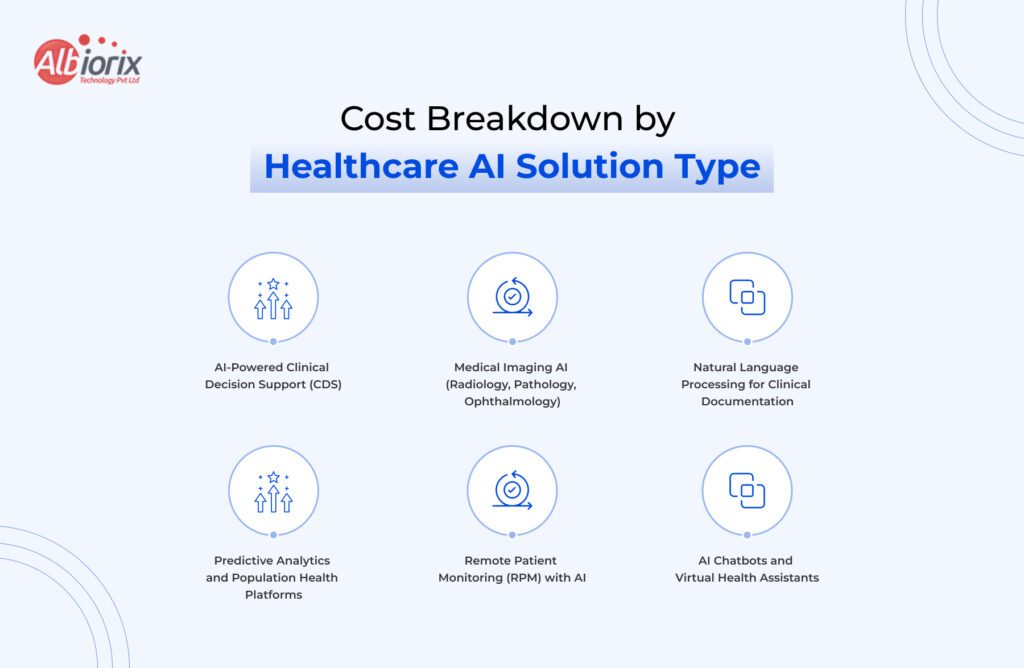
A healthcare AI application cost depends on the type of solution required for your clinic or hospital. We will talk about different types of healthcare AI solutions and break down their overall development cost.
AI-Powered Clinical Decision Support (CDS)
Clinical decision support tools surface relevant information at the point of care — flagging drug interactions, prompting sepsis alerts, or recommending appropriate diagnostic pathways based on presenting symptoms and patient history. These are often the best entry points for organizations new to healthcare AI.
Typical build: $80,000–$200,000. The range is wide because some CDS tools are essentially sophisticated rules engines, while others incorporate machine learning models trained on millions of patient encounters.
For hospital systems in the US, CDS tools integrated with Epic or Cerner via SMART on FHIR apps have become a well-trodden path — and there is meaningful reusability across clients. If your clinical focus overlaps with work we have done before, that benefits your budget.
Medical Imaging AI (Radiology, Pathology, Ophthalmology)
AI-assisted imaging interpretation is one of the most technically mature and commercially validated areas of healthcare AI. FDA-cleared algorithms now exist for detecting diabetic retinopathy, triaging chest X-rays for urgent findings, and screening mammograms. Building one from scratch, however, is a significant undertaking.
A radiology AI platform — covering algorithm development, PACS integration, a radiologist review workflow, and performance reporting — typically costs $350,000–$700,000 for a production-ready system. If you are building on top of a validated foundation model and focusing on a narrow anatomical region, costs can be brought down to $150,000–$300,000 for an MVP.
Annotation is the hidden cost here. Labelling CT scans with confirmed pathology findings, reviewed and approved by board-certified radiologists, can run $0.50–$5.00 per image depending on complexity — and you need tens of thousands of labelled images for a reliable model.
Natural Language Processing for Clinical Documentation
Clinical NLP is the process of extracting structured data from unstructured physician notes, automating coding, and generating draft discharge summaries. All this is done to reduce the documentation burden on clinical staff.
A dedicated NLP tool for a documentation task might cost $60,000–$150,000. A powerful and comprehensive clinical documentation system that can record and structure the entire patient encounter can cost $300,000–$800,000.
Predictive Analytics and Population Health Platforms
Predicting readmission risk, identifying patients likely to develop chronic conditions, or stratifying a patient population for proactive outreach — these are population health AI applications that typically operate on large, longitudinal datasets.
Healthcare AI platform development in this category generally runs $150,000–$500,000, depending on data availability, the number of predictive models required, and whether you need patient-facing features (like a mobile app for care plan adherence). For regional health networks in Australia managing chronic disease across large geographies, these platforms have shown particularly strong ROI in reducing avoidable ED presentations.
Remote Patient Monitoring (RPM) with AI
RPM platforms collect continuous data from wearables, home devices, or patient-reported outcomes — and apply AI to detect deterioration, adjust care plans, or trigger clinical escalations. Post-pandemic, demand for these systems has accelerated significantly across all three of our target markets.
A full RPM platform — device SDK integration, data pipeline, AI alerting engine, clinician dashboard, patient mobile app, and EHR integration — typically runs $200,000–$450,000. Simpler versions focused on a single condition or device category can be built for $80,000–$180,000.
AI Chatbots and Virtual Health Assistants
AI-powered patient engagement tools — symptom checkers, appointment scheduling bots, medication reminder assistants — sit at the lower end of the cost spectrum and often make excellent starting points for organizations exploring healthcare AI.
A well-built, HIPAA-compliant healthcare chatbot integrated with your patient portal or EHR runs $40,000–$120,000 depending on conversation complexity. If you’re building this for a smartphone ecosystem, refer to our healthcare mobile app development guide for compliance specifics.”
For German clients, multilingual capability (German, Turkish, and English at minimum) is often a requirement.
Not Sure Which Solution Type Fits Your Needs?
Our healthcare AI consulting services team can help you evaluate options. We work with health systems, clinics, payers, and digital health startups across the US, Germany, and Australia.
Start a free Consultation!
What HIPAA-Compliant AI Development Actually Costs
We hear from clients who have received proposals from vendors who treat compliance as a checkbox — a brief reference to encryption and access controls. That is not HIPAA compliance. Here is what genuine HIPAA-compliant AI software cost actually includes:
- Encrypted data storage and transmission (AES-256 at rest, TLS 1.3 in transit)
- PHI de-identification pipeline (Safe Harbor or Expert Determination method per HIPAA §164.514)
- Role-based access control with minimum necessary access enforcement
- Comprehensive audit logging with tamper-evident records
- Business Associate Agreement (BAA) with all sub-processors and cloud providers
- Workforce training documentation for your organization’s HIPAA obligations
- Breach notification protocols and incident response procedures
- Annual risk assessment and remediation documentation
- Penetration testing and vulnerability assessment pre-launch
A properly scoped HIPAA compliance architecture adds $25,000–$80,000 to a typical project and saves you from the $100–$50,000 per violation penalties that OCR has issued for preventable breaches. The cost of getting it wrong always exceeds the cost of getting it right.
For clients in Germany, GDPR compliance engineering carries similar investment with additional requirements around data processing records, privacy-by-design documentation, and the DPIA process for high-risk processing activities. Our team has handled combined HIPAA-GDPR architectures for clients who process data across US and EU jurisdictions.
Market Context: Healthcare AI Investment in the US, Germany & Australia
The three markets we serve most actively have distinct dynamics that affect both the opportunity and the regulatory environment.
Healthcare AI Investment in the United States:
The US healthcare AI market is the largest and most mature globally. The FDA has cleared over 950 AI/ML-enabled medical devices as of mid-2025, and CMS reimbursement pathways for AI-assisted procedures are gradually expanding.
The dominant themes in enterprise health system investment are ambient clinical documentation, sepsis prediction, and prior authorization automation. HIPAA compliance is non-negotiable, and the enforcement environment has become significantly more active with OCR settlements averaging $500,000 in 2024.
Healthcare AI Investment in the Germany:
Germany’s Digital Care Modernization Act (DiGAV/DiGA pathway) creates a structured reimbursement route for digital health applications, including AI-powered tools that meet defined quality and data protection standards.
This is one of the most progressive regulatory frameworks for digital health globally. GDPR compliance is rigorously enforced by the BSI and state-level data protection authorities. For AI systems processing patient data, combining GDPR compliance with DiGA quality criteria is increasingly the baseline expectation.
Healthcare AI Investment in the Australia:
The Australian government’s investment in AI in healthcare has accelerated through the Australian Digital Health Agency’s National Digital Health Strategy. The TGA’s therapeutic goods framework for SaMD is aligned with IMDRF guidance and is increasingly active in regulating AI-powered clinical tools.
The My Health Records system creates both an opportunity — rich longitudinal data — and a compliance obligation for systems that access or interact with MHR data.
How to Budget for Healthcare AI: A Practical Framework
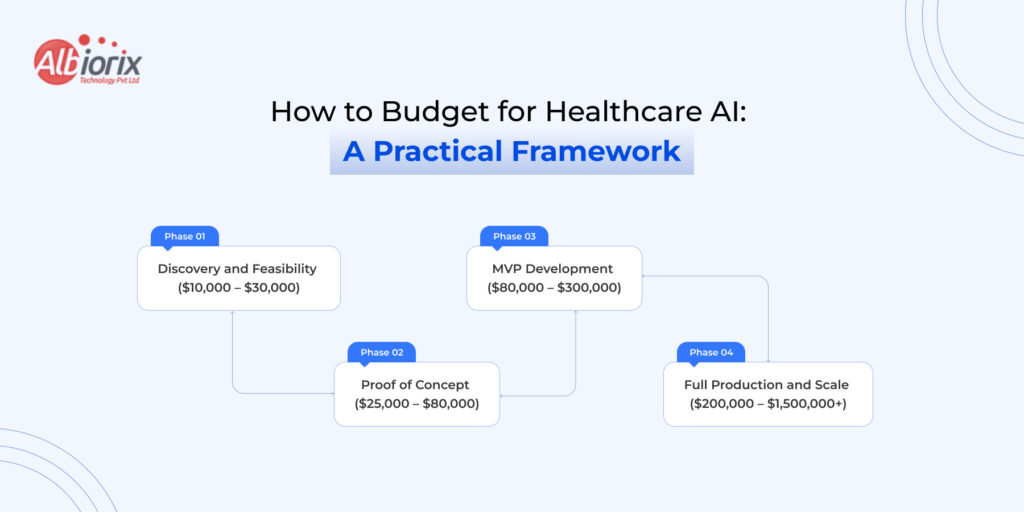
For organizations planning their first healthcare AI initiative, here is a phased budgeting framework that reduces risk and delivers value incrementally.
Phase 1 – Discovery and Feasibility ($10,000 – $30,000)
Before writing code, invest in understanding your data, your clinical use case, and your technical environment. A structured discovery engagement produces a scope document, data readiness assessment, compliance requirements mapping, and a realistic build estimate. This phase routinely saves clients $50,000–$200,000 by surfacing problems before they become expensive surprises.
Phase 2 – Proof of Concept ($25,000 – $80,000)
A focused POC validates the core AI capability — does the model perform at clinically acceptable accuracy on your data? This is not a production system. It is evidence that the investment is justified before the full build.
Phase 3 – MVP Development ($80,000 – $300,000)
A minimum viable product that can be used by clinical staff in a controlled environment. Full compliance architecture, core EHR integration, and the primary AI functionality. Enough to demonstrate value and gather real-world performance data.
Phase 4 – Full Production and Scale ($200,000 – $1,500,000+)
Additional features, multi-site deployment, regulatory submission support, advanced analytics, and the operational infrastructure to run a clinical AI system at scale.
What AI Healthcare Platform Development Looks Like at Albiorix
We are an AI Healthcare software development company, not a strategy consultancy, so when we talk about AI healthcare platform development, we are talking about engineering teams who have actually built these systems.
Our healthcare AI software development practice covers:
- Full-stack development of AI-powered clinical applications (web, mobile, API-first)
- Machine learning model development, training, and validation for clinical datasets
- HIPAA and GDPR compliance architecture and security engineering
- HL7 FHIR integration with Epic, Cerner, Meditech, and other major EHRs
- DICOM and PACS integration for medical imaging AI
- Cloud infrastructure design on AWS, Azure, and GCP with healthcare-grade security
- Post-deployment model monitoring, drift detection, and retraining pipelines
- Regulatory documentation support for FDA SaMD submissions and CE marking
We have delivered projects for clients ranging from 12-person digital health startups to regional hospital networks with 3,000+ beds. Our pricing reflects the efficiency of a well-run, experienced team, not the overhead of a large consulting firm.
What Are The Cons When Evaluating Healthcare AI Development Partners
Not all healthcare AI vendors are equal, and the stakes of choosing wrong are higher in healthcare than almost any other sector. Here are the warning signs we see most often:
- No mention of HIPAA, GDPR, or relevant data protection frameworks in their proposal
- No clinical validation methodology — how will they demonstrate the model actually works?
- Fixed-price proposals for complex AI projects with poorly understood data (a recipe for scope creep)
- No healthcare domain references or case studies in their portfolio
- Inability to explain their approach to model bias and fairness evaluation
- No discussion of model maintenance, drift, and ongoing performance monitoring
- Offshore teams with no compliance expertise for your jurisdiction
Ask any prospective vendor: who on your team has built a HIPAA-compliant AI system before? What was the clinical validation process? Can I speak to a reference client in a similar healthcare setting? Their answers will tell you a great deal.
Conclusion
Albiorix Technology has been building production healthcare AI systems since 2017 — for hospitals, clinics, payers, and digital health companies across the US, Germany, and Australia. Our team combines clinical domain knowledge, compliance expertise, and engineering depth that is rare in a single partner.
If you are planning a healthcare AI initiative — whether you are at the “what’s possible?” stage or ready to scope a full build — we would like to hear about it. Our engagement starts with a free, no-obligation 45-minute discovery session where we focus on your specific clinical goal, your technical environment, and what a realistic budget looks like for your project.
Connect with Our Experts!
FAQ
Frequently Asked Questions
The cost to build healthcare AI software ranges from $25,000 for a focused proof of concept to over $2,000,000 for a full enterprise AI healthcare platform. The most common range for a production-ready, HIPAA-compliant clinical AI application is $80,000–$400,000. This covers discovery and scoping, AI model development and training, compliance architecture (HIPAA, GDPR, or Australian Privacy Act depending on your market), EHR integration, clinical validation, and deployment.
HIPAA-compliant AI development typically costs 20–35% more than equivalent non-healthcare software, due to mandatory compliance architecture. For a mid-scale clinical AI project ($150,000–$300,000 total), HIPAA compliance engineering accounts for roughly $30,000–$80,000 of that budget. This includes encrypted PHI data pipelines (AES-256 at rest, TLS 1.3 in transit), de-identification workflows, role-based access controls with audit logging, Business Associate Agreements with sub-processors, penetration testing, and breach notification protocols.
AI implementation cost for hospitals varies by project scope, system complexity, and integration requirements. A targeted clinical decision support tool integrated with a major EHR like Epic or Cerner might cost $120,000–$250,000 all-in. A comprehensive AI platform deployed across a multi-site health system — including predictive analytics, imaging AI, and NLP for documentation — can run $800,000–$2,000,000.
Development timelines for healthcare AI software range from 6–12 weeks for a proof of concept to 12–24 months for a full production platform. A common clinical AI application typically takes 4–8 months from discovery to deployment. Medical imaging AI platforms take longer, typically between 8–14 months due to the annotation, training, and clinical validation requirements. Regulatory pathways add 6–18 months on top of development time and run in parallel where possible.
Yes — and for organisations that operate in both the US and EU (or that handle data from patients in both jurisdictions), it is often necessary. HIPAA and GDPR share common ground: both require strong data security, access controls, breach notification procedures, and data processing agreements with vendors and sub-processors. The added cost of dual-compliance engineering is typically $15,000–$40,000 on top of single-jurisdiction compliance, significant, but far less than the cost of a cross-border data breach or regulatory action.
An AI healthcare platform is a comprehensive software system that integrates multiple AI-powered clinical capabilities, such as predictive analytics, clinical decision support, NLP for documentation, and remote patient monitoring — within a unified, interoperable architecture. AI healthcare platform development typically costs $500,000–$2,000,000 for a production-ready enterprise system, depending on the number of clinical modules, integration complexity, and regulatory pathway.
Published Blogs
Latest Blogs : Insights and Innovations from Our Blog
Stay Ahead in Tech: Dive into our Blogs for the Latest in Software, Web, and Mobile App Development. Explore cutting-edge technologies, industry trends, and insightful updates that keep you at the forefront of the digital landscape

Our Clients

Client Showcase: Trusted by Industry Leaders
Explore the illustrious collaborations that define us. Our client showcase highlights the trusted partnerships we've forged with leading brands. Through innovation and dedication, we've empowered our clients to reach new heights. Discover the success stories that shape our journey and envision how we can elevate your business too.










We’re here to help you


