






Table of Content
- Introduction
- What is Generative AI for Business?
- How It Differs from Traditional AI
- Core Technologies Behind Generative AI
- Why Businesses Are Investing in Generative AI
- Top Real-World Generative AI Use Cases
- Enterprise Applications of Generative AI
- Industry-Wise Applications of Generative AI
- Benefits of Generative AI for Business
- Best AI Tools for Businesses
- How to Choose the Right AI Tool
- Future of Generative AI in Business
- Conclusion
Key Takeaways Summary
- Generative AI is becoming a strategic technology for organizations across industries.
- Businesses use AI to automate workflows, improve customer experiences, and increase productivity.
- Successful AI adoption requires clear goals, quality data, security controls, and employee training.
- Enterprise AI solutions deliver the most value when integrated with existing business processes.
- Organizations should begin with focused pilot projects and scale based on measurable ROI.
Introduction
Artificial intelligence is transforming the way organizations operate, and Generative AI for Business has emerged as one of the most impactful technologies driving this change. Unlike traditional AI systems that primarily analyze data or automate predefined tasks, generative AI can create content, generate insights, assist with decision-making, and streamline complex business processes. From marketing and customer support to software development, finance, and HR, businesses across industries are leveraging AI to improve productivity, reduce operational costs, enhance customer experiences, and accelerate innovation. However, realizing the full value of generative AI requires more than adopting new tools—it demands a clear strategy, the right technology, and responsible implementation.
In this guide, we’ll explore what Generative AI for Business is, its real-world use cases, enterprise applications, key benefits, implementation best practices, and the future trends shaping AI-powered organizations.
What is Generative AI for Business
Generative AI for Business refers to the use of artificial intelligence systems capable of creating original content, generating insights, automating workflows, and assisting employees in performing business tasks more efficiently. Organizations often partner with experienced providers of Generative AI Development Services to design solutions that align with their business objectives, data requirements, and operational needs.
Unlike conventional AI systems that primarily classify, predict, or analyze data, generative AI creates new outputs based on learned patterns. These outputs can include:
- Documents
- Reports
- Emails
- Marketing copy
- Software code
- Product descriptions
- Images
- Audio
- Business presentations
- Data summaries
This ability makes generative AI one of the most versatile Enterprise AI Solutions available today.
How It Differs from Traditional AI
| Traditional AI | Generative AI |
|---|---|
| Predicts outcomes | Creates new content |
| Uses predefined rules | Learns patterns from massive datasets |
| Focuses on classification | Produces text, images, code, and more |
| Supports decision-making | Assists with creation and problem-solving |
| Limited creativity | Highly adaptable and context-aware |
For example, a traditional AI system may identify fraudulent transactions, while a generative AI system can explain why a transaction appears suspicious, generate an investigation report, and recommend the next steps.
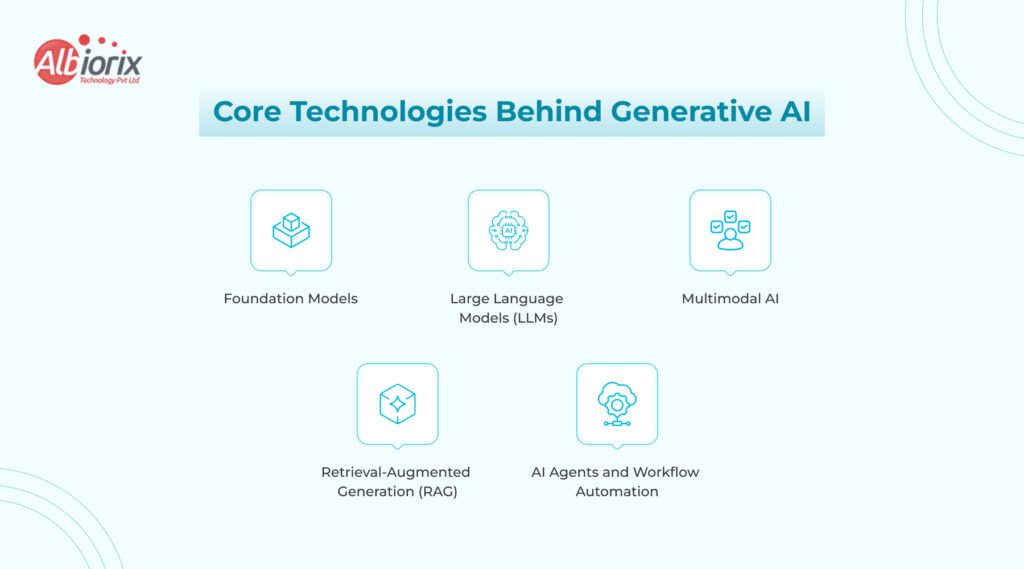
Core Technologies Behind Generative AI
1. Foundation Models
Foundation models are large-scale AI models trained on extensive datasets. They serve as the backbone for multiple AI applications and can be fine-tuned for industry-specific or business-specific tasks.
Examples include language, vision, and multimodal models that support diverse enterprise use cases.
2. Large Language Models (LLMs)
Large Language Models are designed to understand and generate human language. They enable businesses to:
- Draft reports
- Answer employee questions
- Summarize lengthy documents
- Generate software code
- Translate content
- Create marketing materials
- Power intelligent AI chatbots
LLMs reduce the time employees spend on repetitive knowledge-based tasks while improving consistency and productivity.
3. Multimodal AI
Multimodal AI processes multiple types of information simultaneously, such as:
- Text
- Images
- Audio
- Video
- Documents
For example, an insurance company can upload accident photos, customer claims, and written reports into one AI system that analyzes all inputs together to generate claim summaries and recommendations.
4. Retrieval-Augmented Generation (RAG)
Many enterprises enhance generative AI with Retrieval-Augmented Generation (RAG), which allows AI to retrieve relevant information from trusted internal knowledge bases before generating responses. This improves accuracy, reduces hallucinations, and ensures responses reflect company-specific policies and documentation.
5. AI Agents and Workflow Automation
Beyond content generation, businesses are increasingly deploying AI agents that can perform multi-step tasks autonomously. These agents can retrieve data, trigger workflows, coordinate with enterprise systems, and execute actions with minimal human intervention. As part of broader AI workflow automation, they help organizations streamline operations while keeping employees focused on higher-value work.
Common Business AI Applications
Organizations are implementing generative AI across nearly every business function, including:
- Customer service automation
- Sales enablement
- Marketing content creation
- HR recruitment support
- Financial reporting
- Enterprise search
- Knowledge management
- Software development
- Compliance documentation
- Business intelligence
These Business AI Applications demonstrate that generative AI is not a single tool but a flexible capability that can support a wide range of enterprise needs.
Transform Your Business with Generative AI
Unlock the power of AI-driven automation, intelligent workflows, and smarter decision-making. Partner with experts to build scalable Generative AI solutions that improve productivity, enhance customer experiences, and accelerate business growth:
Explore AI Services
Why Businesses Are Investing in Generative AI
Generative AI has shifted from experimental technology to a strategic business capability. Organizations are investing in Enterprise AI because it delivers measurable improvements in efficiency, decision-making, and customer engagement.
While adoption varies by industry and use case, research consistently shows that businesses implementing AI thoughtfully can improve operational performance, accelerate innovation, and empower employees to focus on higher-value work.
More info: https://www.ibm.com/think/insights/ai-economics-compute-cost
Below are the primary drivers behind enterprise investme
1. Increased Productivity
One of the biggest advantages of enterprise generative AI for Business is its ability to automate repetitive knowledge work.
Employees spend significant time writing emails, creating reports, summarizing meetings, searching for information, and preparing presentations. AI can complete many of these tasks in minutes.
Examples include:
- Drafting proposals
- Summarizing documents
- Generating meeting notes
- Writing code
- Creating product descriptions
- Preparing executive reports
Business impact:
- Faster task completion
- Reduced administrative workload
- More time for strategic initiatives
Statistic Placeholder: Industry studies indicate that AI-assisted knowledge workers can save several hours per week on routine administrative tasks.
2. Lower Operational Costs
Automation reduces the need for manual effort across departments.
Organizations use AI Automation to:
- Process documents
- Route customer inquiries
- Generate invoices
- Assist employees
- Produce marketing assets
- Automate internal workflows
Cost Savings Statistics
Businesses implementing AI automation commonly report:
- 20–35% reduction in operational costs for repetitive processes.
- 30–60% faster document processing.
- Up to 70% reduction in customer support response times using AI assistants.
Instead of replacing employees, AI typically augments their capabilities, allowing teams to accomplish more with existing resources.
3. Better Customer Experience
Customers increasingly expect personalized, always-available support.
Generative AI enables organizations to:
- Provide 24/7 assistance
- Deliver personalized recommendations
- Respond faster to inquiries
- Generate multilingual support
- Resolve routine questions automatically
Customer Experience Statistics
- Around 70% of consumers expect companies to provide personalized experiences.
- AI chatbots can resolve 60–80% of routine customer inquiries without human intervention.
- Organizations implementing AI customer support often report 20–30% improvements in customer satisfaction scores.
AI-powered customer interactions improve response times while enabling human agents to focus on complex issues that require empathy and judgment.
4. Faster Innovation
Traditional product development often involves lengthy research, documentation, and collaboration cycles.
Generative AI accelerates innovation by helping teams:
- Brainstorm ideas
- Analyze customer feedback
- Generate prototypes
- Draft technical documentation
- Create design concepts
- Explore alternative solutions
Innovation Statistics
Companies integrating generative AI into product development have reported:
- 30–50% faster content creation.
- 25–40% shorter product design cycles.
- Up to 35% faster documentation generation.
This shortens time-to-market and encourages experimentation without significantly increasing costs.
5. Smarter Decision-Making
Business leaders are inundated with data, making it difficult to extract actionable insights quickly.
Generative AI supports better decisions by:
- Summarizing large datasets
- Identifying trends
- Explaining complex analytics
- Producing executive summaries
- Generating scenario analyses
Rather than replacing analytics platforms, AI enhances them by making insights more accessible and easier to interpret.
6. Competitive Advantage
Organizations that adopt AI strategically can differentiate themselves through:
- Faster customer response times
- More personalized services
- Improved employee productivity
- Accelerated product development
- Enhanced operational efficiency
As AI becomes more widely adopted, businesses that delay implementation may find it harder to keep pace with competitors leveraging intelligent automation and data-driven decision-making.
Top Real-World Generative AI Use Cases
1. Marketing
Business Challenge
Marketing teams are under constant pressure to produce high-quality content across multiple channels while maintaining brand consistency and meeting tight deadlines.
AI Solution
Generative AI helps marketers:
- Create blog articles
- Draft social media posts
- Generate email campaigns
- Write product descriptions
- Produce advertising copy
- Personalize customer messaging
- Repurpose content for different platforms
AI can also analyze campaign performance and suggest improvements based on audience behavior.
Business Benefits
- Faster content production
- Improved campaign scalability
- Lower content creation costs
- Increased personalization
- Higher marketing productivity
2. Sales
Business Challenge
Sales representatives often spend valuable time preparing proposals, researching prospects, updating CRM records, and responding to repetitive customer questions instead of building relationships.
AI Solution
Generative AI supports sales teams by:
- Creating personalized outreach emails
- Summarizing customer meetings
- Drafting proposals
- Generating follow-up messages
- Analyzing CRM data
- Recommending next-best actions
Business Benefits
- Higher sales productivity
- Faster proposal creation
- Improved customer engagement
- Better lead qualification
- Increased conversion rates
3. Human Resources (HR)
Business Challenge
HR teams manage recruitment, onboarding, employee communications, performance reviews, and policy documentation—all of which can be time-intensive.
AI Solution
Generative AI can:
- Draft job descriptions
- Screen resumes
- Generate interview questions
- Create onboarding materials
- Summarize employee feedback
- Answer HR policy questions through internal AI assistants
Business Benefits
- Faster hiring processes
- Improved candidate experience
- Reduced administrative workload
- Better internal communication
- Enhanced employee productivity
4. Finance
Business Challenge
Finance teams spend considerable time preparing reports, reviewing transactions, generating forecasts, and ensuring regulatory compliance.
AI Solution
Generative AI assists by:
- Drafting financial reports
- Summarizing financial statements
- Explaining budget variances
- Detecting unusual transaction patterns
- Supporting forecasting and planning
- Automating documentation for audits
Business Benefits
- Faster reporting cycles
- Better financial visibility
- Improved decision-making
- Reduced manual effort
- Enhanced compliance support
5. Healthcare
Business Challenge
Healthcare providers manage extensive clinical documentation, administrative tasks, patient communication, and knowledge-intensive workflows, which can contribute to staff burnout and operational inefficiencies.
AI Solution
Generative AI helps healthcare organizations:
- Summarize clinical notes
- Draft patient education materials
- Assist with medical documentation
- Support appointment communications
- Organize research findings
- Improve knowledge retrieval for clinicians
These solutions are designed to assist healthcare professionals—not replace clinical judgment—and should operate within applicable privacy, security, and regulatory requirements.
Business Benefits
- Reduced administrative burden
- Faster documentation
- Improved clinician productivity
- Better patient communication
- More efficient knowledge management
6. Manufacturing
Business Challenge
Manufacturers manage complex production processes, equipment maintenance, quality control, and supply chain operations. Manual reporting and fragmented data often slow decision-making and increase operational costs.
AI Solution
Generative AI helps manufacturers by:
- Creating maintenance reports
- Generating standard operating procedures (SOPs)
- Summarizing production data
- Assisting predictive maintenance teams
- Automating quality inspection documentation
- Supporting factory knowledge management
Business Benefits
- Reduced production downtime
- Improved operational efficiency
- Faster documentation
- Better quality control
- Lower maintenance costs
7. Retail
Business Challenge
Retail businesses must continuously manage inventory, customer engagement, promotions, pricing strategies, and personalized shopping experiences.
AI Solution
Generative AI enables retailers to:
- Generate personalized product recommendations
- Create marketing campaigns
- Produce product descriptions
- Assist customer service
- Forecast demand using historical insights
- Optimize promotional content
Business Benefits
- Improved customer engagement
- Faster merchandising
- Higher conversion rates
- Better inventory planning
- Increased sales efficiency
8. Education
Business Challenge
Educational institutions and corporate learning teams spend considerable time creating learning materials, assessments, and personalized learning experiences.
AI Solution
Generative AI Solutions supports education by:
- Creating lesson plans
- Developing quizzes
- Summarizing learning materials
- Translating educational content
- Building personalized learning paths
- Providing AI tutoring assistance
Business Benefits
- Faster course development
- Personalized learning
- Increased learner engagement
- Lower training costs
- Improved knowledge retention
9. Software Development
Business Challenge
Software teams often face tight deadlines while managing coding, testing, debugging, documentation, and technical support.
AI Solution
Generative AI assists developers by:
- Writing code snippets
- Generating documentation
- Reviewing code
- Explaining legacy systems
- Creating unit tests
- Detecting coding issues
Business Benefits
- Faster software delivery
- Improved developer productivity
- Reduced coding errors
- Better documentation
- Shorter release cycles
Enterprise Applications of Generative AI
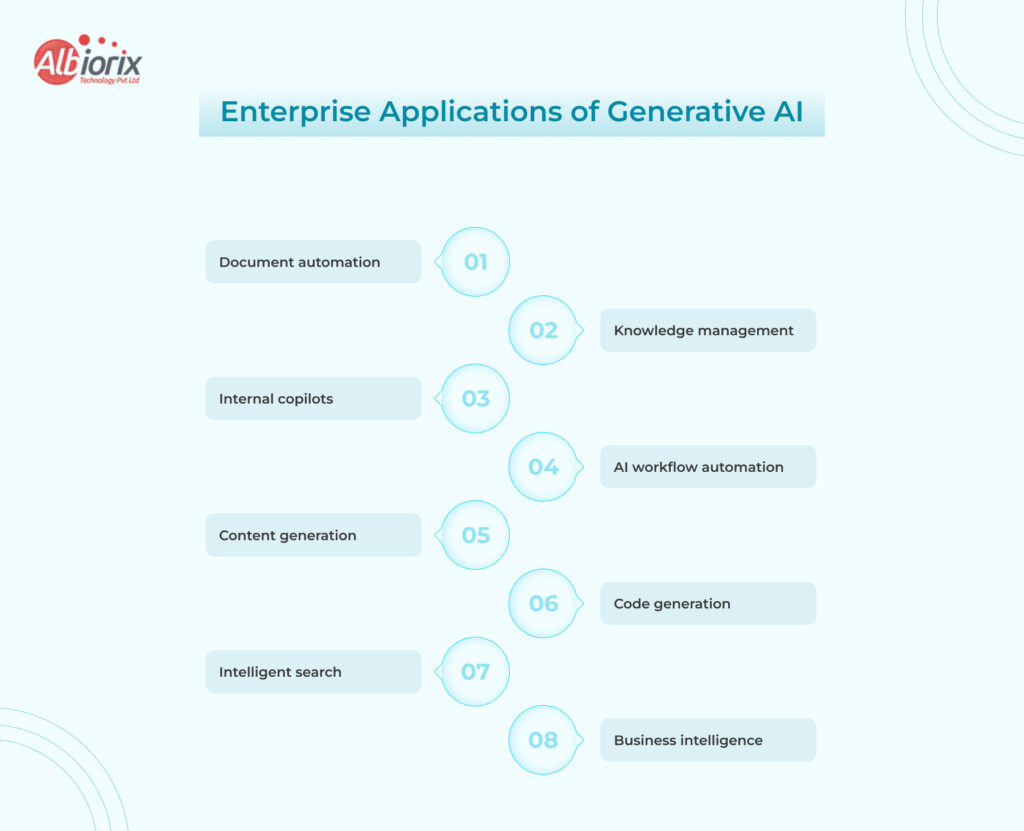
Enterprise Generative AI applications are expanding across business functions.
Common applications include:
- Document automation: Extracting and summarizing information from contracts, reports, and forms.
- Knowledge management: Creating intelligent company search systems.
- Internal copilots: Helping employees access information quickly.
- AI workflow automation: Automating repetitive processes.
- Content generation: Producing marketing, technical, and business documents.
- Code generation: Supporting software development teams.
- Intelligent search: Improving access to organizational knowledge.
- Business intelligence: Turning complex data into actionable insights.
Enterprise Generative AI solutions are most valuable when connected with company data, systems, and workflows.
Industry-Wise Applications of Generative AI
| Industry | AI Application | Business Benefit |
|---|---|---|
| Banking | Fraud analysis, customer support, loan documentation | Faster approvals, improved risk management |
| Insurance | Claims processing, policy generation | Reduced processing time, better customer experience |
| Healthcare | Clinical documentation, patient communication | Higher clinician productivity, improved documentation |
| Retail | Personalized recommendations, inventory insights | Increased sales, stronger customer loyalty |
| Manufacturing | Predictive maintenance, quality reporting | Reduced downtime, operational efficiency |
| Logistics | Route optimization, shipment documentation | Faster deliveries, lower operational costs |
| Education | AI tutoring, content creation | Personalized learning, reduced administrative effort |
| SaaS | Code generation, customer onboarding | Faster development, improved customer success |
| Real Estate | Property descriptions, document automation | Accelerated sales processes, enhanced marketing |
| E-commerce | Product content, AI chatbots, customer support | Better conversions, scalable operations |
Benefits of Generative AI for Business
Organizations investing in a Generative AI Development Company for Business are seeing measurable improvements across productivity, customer experience, and innovation. While outcomes depend on implementation quality and business maturity, the benefits extend far beyond simple task automation.
1. Higher Productivity
AI reduces time spent on repetitive knowledge work such as drafting documents, summarizing meetings, responding to emails, and creating reports.
Benefits include:
- Faster task completion
- Reduced manual effort
- More time for strategic work
- Improved employee satisfaction
2. Reduced Operational Costs
Automation lowers the cost of repetitive business processes by minimizing manual intervention.
Examples include:
- Customer service automation
- Document processing
- Internal knowledge retrieval
- Content creation
- Workflow approvals
This enables organizations to scale operations without proportional increases in staffing.
3. Faster Decision-Making
Generative AI transforms large datasets into concise, actionable insights.
Business leaders can:
- Generate executive summaries
- Analyze trends
- Compare business scenarios
- Identify operational risk
- Support strategic planning
Faster access to insights leads to more informed decisions.
4. Better Customer Engagement
AI enables organizations to deliver personalized experiences at scale.
Examples include:
- Tailored product recommendations
- Personalized marketing campaigns
- Intelligent customer support
- AI-powered virtual assistants
- Multilingual communication
Customers receive faster, more relevant interactions across digital channels.
5. Improved Employee Efficiency
Employees no longer spend excessive time searching for information or creating routine documentation.
Instead, AI assists with:
- Meeting summaries
- Knowledge retrieval
- Draft creation
- Research
- Task prioritization
This allows teams to focus on creative problem-solving and high-value initiatives.
6. Greater Personalization
Generative AI analyzes customer preferences, purchase history, and behavioral patterns to create personalized experiences.
Organizations can tailor:
- Marketing messages
- Product recommendations
- Learning content
- Customer communications
- Sales outreach
Personalization strengthens customer relationships and improves engagement.
7. Accelerated Innovation
AI reduces the time required to move from idea to execution.
Businesses can rapidly:
- Prototype products
- Brainstorm solutions
- Generate design concepts
- Analyze customer feedback
- Explore new business opportunities
This encourages experimentation while reducing development cycles.
8. Enterprise Scalability
As organizations grow, AI helps maintain consistent service quality without significantly increasing operational complexity.
Scalable AI capabilities include:
- Enterprise knowledge assistants
- Automated customer support
- AI-powered reporting
- Intelligent workflow automation
- Organization-wide copilots
These solutions enable sustainable growth while supporting long-term digital transformation.
Best AI Tools for Businesses
Selecting the right AI platform depends on your business goals, existing technology stack, security requirements, and budget. While no single tool fits every organization, the following solutions are widely adopted for enterprise productivity, content creation, software development, and workflow automation.
| Tool | Best For | Key Features | Ideal Business Size |
|---|---|---|---|
| ChatGPT | Content creation, research, business assistance | Writing, coding, data analysis, document summarization, custom GPTs | SMBs to Enterprises |
| Microsoft Copilot | Microsoft 365 productivity | Word, Excel, Outlook, Teams integration | Mid-size to Enterprises |
| Google Gemini | Google Workspace collaboration | AI search, document generation, Workspace integration | SMBs to Enterprises |
| Claude | Long-form writing and document analysis | Large context window, document summarization, reasoning | Mid-size to Enterprises |
| GitHub Copilot | Software development | Code generation, debugging, code completion | Development Teams |
| Perplexity | Research and market intelligence | AI-powered search with source citations | All Business Sizes |
| Zapier AI | Workflow automation | AI-powered automation across business apps | SMBs to Enterprises |
How to Choose the Right AI Tool
Before investing in an AI platform, evaluate your business objectives, technology requirements, security needs, and implementation goals. Working with an experienced AI Development Company can help organizations build customized AI solutions, integrate enterprise systems, and ensure scalable adoption across departments.
- Business objectives: Are you solving productivity, customer service, marketing, or software development challenges?
- Data security: Does the platform support enterprise-grade security and compliance?
- Integration capabilities: Can it connect with your CRM, ERP, HRMS, or existing applications?
- Customization: Can the AI be tailored to your business processes and knowledge base?
- Scalability: Will it continue to support your organization as AI adoption grows?
- Total cost of ownership: Consider licensing, implementation, training, governance, and ongoing maintenance.
Future of Generative AI in Business
Generative AI is evolving from a productivity tool into a core business capability. Over the next several years, enterprises will move beyond simple content generation toward intelligent systems that collaborate with employees, automate end-to-end processes, and support strategic decision-making. As organizations expand their AI capabilities, the demand for skilled professionals continues to grow. Businesses looking to accelerate AI adoption can Hire AI Developers to create intelligent applications, develop AI-powered workflows, and support long-term digital transformation initiatives.
Key trends include:
- AI Agents completing complex workflows
- Enterprise copilots supporting every department
- Hyperautomation combining AI with business process automation
- Multimodal AI handling multiple data types
- Vertical AI solutions designed for specific industries
- Stronger AI governance frameworks
- AI-first organizations redesigning operations around intelligence
Companies that build effective AI strategies today will be better positioned for future competition.
Start Your AI Transformation Journey Today
Identify high-impact AI opportunities and implement solutions designed around your business goals. Take the next step toward building an AI-powered organization with the right strategy, technology, and expertise.
Contact Us
Conclusion
Generative AI is changing how organizations operate, compete, and innovate. From AI automation and intelligent assistants to industry-specific enterprise applications, businesses are discovering practical ways to create value with artificial intelligence.
A successful AI journey does not begin with technology alone. It starts with clear business goals, responsible AI adoption, strong data foundations, and a structured implementation roadmap. Companies exploring Generative AI for Business should begin with focused pilot projects, measure results, and scale solutions that deliver measurable impact.
The organizations that combine human expertise with AI capabilities will be best prepared for the next era of digital transformation.
Ready to transform your organization? Start with one high-impact use case, build a strong implementation roadmap, and scale your AI initiatives with confidence.
Connect with Our Experts!
FAQ
FAQ- Generative AI for Businesses
Generative AI for Business refers to the use of AI systems that create content, automate workflows, generate insights, and assist employees with knowledge-intensive tasks such as writing, coding, reporting, and customer support.
Businesses use Generative AI for marketing, sales, customer support, HR, finance, software development, knowledge management, document automation, and enterprise workflow optimization.
Yes. Small businesses can start with affordable cloud-based AI tools for content creation, customer service, marketing, and productivity before expanding to more advanced enterprise applications.
Implementation costs vary depending on business size, complexity, customization, integrations, and governance requirements. Many organizations begin with a low-cost pilot project before scaling enterprise-wide.
It can be secure when organizations implement appropriate safeguards, including encryption, access controls, data governance, compliance policies, human review, and secure deployment environments.
Popular enterprise AI tools include ChatGPT, Microsoft Copilot, Google Gemini, Claude, GitHub Copilot, and enterprise workflow automation platforms. The right choice depends on your business goals, technology ecosystem, and compliance requirements.
Return on investment is typically measured through improvements in productivity, operational efficiency, cost savings, customer satisfaction, employee engagement, and revenue growth. Organizations should define clear KPIs before implementation to evaluate success.
Common challenges include data quality, integration complexity, employee adoption, governance, privacy, security, model accuracy, and regulatory compliance. A phased implementation with strong oversight can help mitigate these risks.
Start by identifying a high-value business problem, launching a pilot project, measuring outcomes, training employees, and establishing governance before scaling AI across the organization.
Published Blogs
Latest Blogs : Insights and Innovations from Our Blog
Stay Ahead in Tech: Dive into our Blogs for the Latest in Software, Web, and Mobile App Development. Explore cutting-edge technologies, industry trends, and insightful updates that keep you at the forefront of the digital landscape



Our Clients

Client Showcase: Trusted by Industry Leaders
Explore the illustrious collaborations that define us. Our client showcase highlights the trusted partnerships we've forged with leading brands. Through innovation and dedication, we've empowered our clients to reach new heights. Discover the success stories that shape our journey and envision how we can elevate your business too.










We’re here to help you


