






Table of Content
Most businesses evaluating AI in 2026 run into the same confusion early: “AI chatbot” and “AI agent” get used interchangeably in vendor marketing, but they aren’t the same technology, and choosing the wrong one leads to either an underpowered tool or an over-engineered, expensive one.
Here’s the direct answer. A chatbot is primarily built to communicate, it answers questions, holds a conversation, and retrieves information. An AI agent is built to pursue a goal it reasons about a task, decides what needs to happen, uses tools or APIs to take action inside your business systems, and carries out multi-step work with limited human involvement. The rest of this guide breaks down what that means in practice, where each one fits, and how to decide which your business actually needs.
AI Agent vs Chatbot: What’s the Difference?
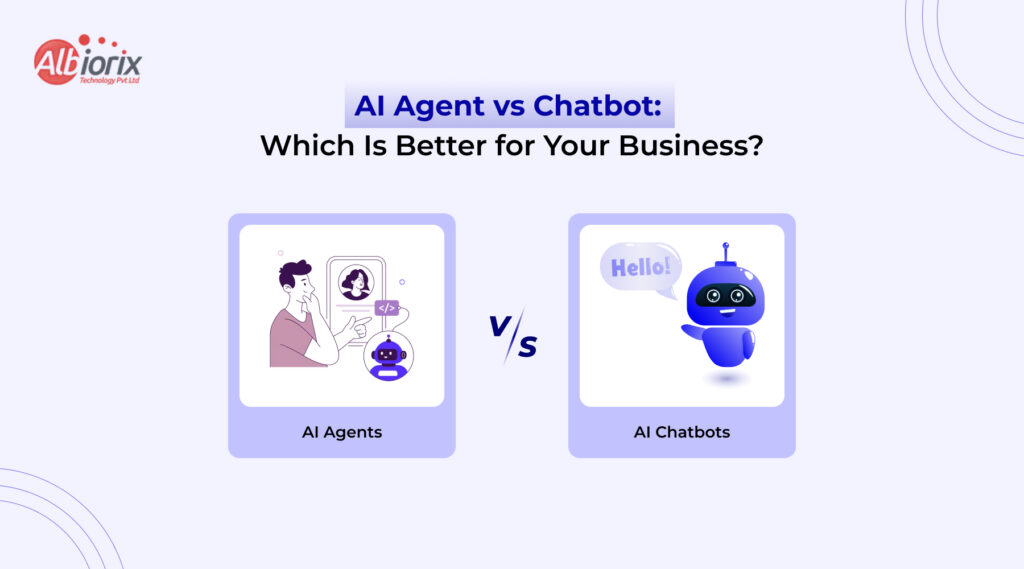
The simplest way to frame it: a chatbot deflects and informs; an AI agent resolves and executes.
| Dimension | AI Chatbot | AI Agent |
|---|---|---|
| Primary purpose | Answer questions, hold conversation | Complete a goal or task |
| Reasoning | Pattern-matches intent to a response | Plans multi-step paths to an outcome |
| Memory/context | Often session-based or limited | Can persist context across steps and sessions |
| Tool/API use | Rare, usually none | Core capability — connects to CRM, ERP, help desk, databases |
| Multi-step workflows | Not supported natively | Native capability |
| Typical business use | FAQs, lead capture, basic support | Order resolution, CRM updates, workflow automation |
| Build complexity | Low to moderate | Moderate to high |
| Relative cost | Lower | Higher, scales with integrations |
| Relative risk | Lower — limited blast radius | Higher — requires access controls and monitoring |
What Is an AI Chatbot?
An AI chatbot is a program designed to simulate conversation. Early chatbots were rule-based: they matched keywords to scripted responses and broke down outside their scripted paths. Modern AI chatbots Development Company typically combine a large language model (LLM) with a knowledge base, often through retrieval-augmented generation (RAG), which lets the bot ground its answers in your documentation rather than guessing.
Strengths: fast to deploy, lower cost, predictable behavior, well-suited to high-volume repetitive questions, low operational risk since the bot generally doesn’t take actions outside the conversation
Limitations: struggles with multi-step or ambiguous requests, typically can’t reach into backend systems to make changes, and context often resets between sessions unless specifically engineered otherwise.
Practical example: A visitor asks a retail site’s chatbot, “What’s your return policy?” The bot retrieves the policy from the knowledge base and answers directly. No system changes, no lookups beyond the answer itself — a good chatbot use case.
What Is an AI Agent?
An AI agent is a goal-oriented system. Instead of only responding to a prompt, it evaluates context, decides on a plan, and executes steps — calling APIs, querying databases, updating records — usually within permissions a business defines in advance (a human-in-the-loop control for anything higher-risk).
The core relationship looks like this: goal → reasoning → tool use → system integration → action → outcome. That chain is what separates an agent from a chatbot that merely answers a question well.
Strengths: can complete real work, not just describe it; connects across CRM, ERP, help desk, and internal tools; handles workflows that span multiple steps and multiple systems; reduces manual handoffs for repetitive operational tasks.
Limitations: higher build and integration cost, longer implementation timeline, and a larger “blast radius” if something goes wrong — which is why permissioning and oversight matter more here than with a chatbot.
AI Agent vs Chatbot for Customer Service
The clearest way to see the difference is a side-by-side support scenario.
Chatbot scenario: Customer: “What are your return policies?” The bot retrieves and states the policy. Done.
Agent scenario: Customer: “My order arrived damaged. Check my order, verify eligibility, create a replacement request, and tell me when it will arrive.“ This requires the system to look up the order in a fulfillment platform, check the customer’s account against return-eligibility rules, generate a replacement order in the OMS, and estimate a delivery date from shipping data — four separate systems, one continuous task. A chatbot can’t do this on its own because it isn’t built to write data back into your systems; it can only read from a knowledge base and talk. An agent, with the right integrations and permissions, can.
That’s the practical test worth applying to any use case you’re evaluating: does resolving this request require only information, or does it require an action inside a business system? Information-only requests are chatbot territory. Anything requiring a write action, a decision against business rules, or coordination across tools points toward an AI Agent.
Not Sure Whether You Need a Chatbot or AI Agent?
Tell us what you want to automate, and we’ll help you identify the right AI solution for your business:
[Book a Free AI Consultation →]
AI Agent vs Chatbot: Which Is Better for Your Business?
Choose a chatbot if
- Most user needs are informational and predictable
- You operate in a narrow knowledge domain
- You need to deploy in weeks, not months
- You want lower complexity and lower operational risk
- No system-level actions are required
Consider an AI agent if
- The workflow spans multiple steps and multiple systems
- The process needs tool/API access to CRM, ERP, or help-desk platforms
- Outcomes justify the added build and maintenance investment
- You can build human approval into higher-risk actions
Consider a hybrid approach if
- You want a chatbot to handle the conversation while an agent (or an automated workflow layer) executes approved actions behind the scenes. This is increasingly the default architecture in mature deployments — a conversational front end paired with an agentic execution layer, rather than choosing one technology exclusively.
AI Agent vs Chatbot: Cost, Complexity, and ROI
Costs vary widely based on model usage, number and complexity of integrations, data sources, security requirements, and ongoing monitoring — so treat any specific dollar figure you see in a vendor blog as illustrative, not a quote for your business. Verify current pricing directly with vendors or in a tool like G2/Gartner Peer Insights before budgeting.
That said, a consistent pattern shows up across implementation guides: chatbots are generally faster and cheaper to stand up, with measurable results (support deflection, resolution time) visible within weeks. AI Agents Development Company typically involve a longer build — largely driven by integration work, permissioning, and testing — and a longer runway before ROI is fully measurable, because the value depends on the agent handling increasing volume reliably over time. Ongoing maintenance is also a real, recurring cost for agents: monitoring, prompt and workflow tuning, and API cost management don’t stop after launch.
The underlying principle: the right technology is the one that produces the required business outcome at an acceptable total cost and risk — not the one with the more impressive label.
Risks and Limitations
Both technologies carry limitations, but the risk profile shifts significantly with autonomy.
Chatbot risks: hallucinated answers if the knowledge base is thin or outdated, frustrating dead ends on requests outside its scope, and over-reliance on it for tasks it was never designed to handle.
AI agent risks: everything a chatbot risks, plus the consequences of taking wrong actions, not just giving wrong answers. Security researchers and standards bodies have been explicit about this in 2026: prompt injection — where an agent is manipulated by adversarial content into ignoring its instructions — is now widely tracked as one of the top vulnerability categories for LLM-based systems, and frameworks like NIST’s Agentic AI Profile (NIST IR 8596) were published specifically because traditional risk-management tools weren’t built for systems that can call tools and take actions autonomously. Over-permissioned agents, weak logging, and insecure tool integrations compound the risk.
Practical mitigation: scope permissions tightly, log every action an agent takes, require human approval for high-impact or irreversible actions (payments, account changes, external communications), and treat every tool or data source the agent touches as untrusted input until validated. Higher autonomy always needs stronger controls — that trade-off doesn’t go away with a better model.
One more evaluation point worth applying directly: before adopting any product marketed as an “AI agent,” confirm it can actually take actions in your systems, not just generate more fluent answers than a chatbot. A number of tools sold as agents in 2026 are still primarily retrieval systems with an LLM layer added — capable of better conversation, not necessarily capable of independent action. Ask a vendor to show, not describe, a multi-step task the product completes end-to-end.
AI Agent vs Chatbot: Final Verdict
So, AI Agent vs AI Chatbot Services—which should your business choose?
If you primarily need conversational engagement, information delivery, FAQs, and basic support, an AI chatbot is often the practical starting point.
If you need autonomous task execution, complex decision-making, multi-step processes, and AI workflow automation, AI agents are the stronger option.
The most effective strategy may be to combine both. Use conversational interfaces to communicate naturally with customers and employees, while AI agents handle the complex workflows behind the scenes.
As businesses move from simply using AI to answer questions toward using AI to accomplish goals, the distinction between chatbots and agents becomes increasingly important. The organizations that identify the right use cases, establish strong AI governance, and implement reliable automation will be better positioned to turn AI investments into measurable business value.
Connect with Our Experts!
FAQ
Frequently Asked Questions
A chatbot is designed primarily to communicate — answering questions and holding a conversation. An AI agent is designed to accomplish a goal: it reasons about a task, uses tools or APIs, and takes action across business systems, often completing multi-step work with limited human involvement.
Depending on its configuration and connected tools, it can function as either. Used purely for conversation, it behaves like a chatbot; when connected to tools, browsing, or code execution to complete multi-step tasks, it functions more like an AI agent.
Neither is universally “better” — they solve different problems. A chatbot is often the better choice for straightforward, high-volume, informational needs. An AI agent is the better choice when a process requires reasoning, tool use, and action across systems.
Not entirely, and usually not the goal. Many businesses run both: a chatbot for conversational front-line interaction and an agent layer for the actions behind it.
It depends on the request. Simple, informational questions are well-suited to a chatbot. Requests requiring account lookups, system updates, or multi-step resolution are better handled by an agent, often with a chatbot as the conversational interface.
It varies significantly by integration complexity, number of connected systems, and ongoing monitoring needs, and is generally higher than chatbot costs due to integration and governance requirements. Get current, business-specific quotes from vendors rather than relying on published averages.
Yes — CRM, ERP, and help-desk integration via APIs is a core capability of AI agents, and is what allows them to take real actions rather than just retrieve information.
Only if the use case genuinely requires multi-step actions across systems. If the need is answering common questions, a well-built chatbot is usually faster to deploy, cheaper, and sufficient.
Published Blogs
Latest Blogs : Insights and Innovations from Our Blog
Stay Ahead in Tech: Dive into our Blogs for the Latest in Software, Web, and Mobile App Development. Explore cutting-edge technologies, industry trends, and insightful updates that keep you at the forefront of the digital landscape
Our Clients

Client Showcase: Trusted by Industry Leaders
Explore the illustrious collaborations that define us. Our client showcase highlights the trusted partnerships we've forged with leading brands. Through innovation and dedication, we've empowered our clients to reach new heights. Discover the success stories that shape our journey and envision how we can elevate your business too.










We’re here to help you


