






Table of Content
- Why Preconstruction Is Ready for AI?
- Where AI Changes the Workflow
- How AI Is Changing Construction Takeoffs?
- How AI Is Improving Construction Cost Estimates?
- What Happens After the Estimate? AI Is Moving Into Bid Review
- Where Generative AI Fits Into Preconstruction?
- Why AI Accuracy Starts With Better Construction Data?
- Build, Buy or Integrate: Choosing the Right AI Approach
- Will AI Replace Construction Estimators?
- Building Smarter Preconstruction Workflows With Albiorix
Key takeaways:
- AI is helping preconstruction teams turn large volumes of drawings, specifications, cost data, and bid documents into actionable insights.
- AI-powered takeoffs can automate repetitive quantity extraction while keeping estimators involved in validation and exception handling.
- Construction estimating becomes more informed when AI connects quantities with historical costs, labor rates, material data, and project context.
- AI can support bid leveling, scope comparison, proposal analysis, and the early identification of potential gaps or exclusions.
- Generative AI extends beyond numerical analysis by helping teams interpret specifications, summarize documents, and retrieve relevant project information.
- Reliable AI outcomes depend on well-structured construction data, consistent cost information, appropriate validation, and human oversight.
- Construction businesses can choose between ready-made AI tools, custom solutions, or integrated approaches based on their workflows and technology environment.
- The role of estimators is evolving toward higher-value analysis, commercial judgment, risk evaluation, and decision-making as routine tasks become increasingly automated.
The most expensive line on a construction site may be the one that was missed on a drawing months earlier.
A missed opportunity. A misunderstood specification. An updated plan contrasted with an obsolete plan. Cost estimates are accepted without verification due in part to pressing time constraints. Several seemingly insignificant decisions made during preconstruction may lead to enormous costs when all is said and done.
Indeed, such early attention makes all the difference. Research done by FMI indicates that 19% of costs of any given project can be attributed to rework made by owners, while companies that utilize innovation in preconstruction processes did not encounter reworks in 65% of cases, they ultimately fared better than those using traditional approaches to preconstruction.
AI solutions in preconstruction can radically change the course of events.
Rather than requesting estimators to go through thousands of documents including plans, quantities, specifications, historical estimates, and bids, AI solutions will be capable of making use of the wealth of information available to create a seamless decision-making process, speeding up takeoffs, identifying discrepancies, associating quantities with cost data and revealing risks when there is still a chance to do something about it.
The opportunity is not to remove expertise from preconstruction. It is to give that expertise better information, earlier.
Why Preconstruction Is Ready for AI?
Preconstruction sits at an unusual intersection: more project information is arriving, while the window to turn it into a confident bid is getting tighter. That makes it a natural environment for AI.
Where the Pressure Builds
Hundreds of project documents
Drawings, specifications, addenda and revisions must be reviewed without losing critical details.
Repeated measurement and verification
Design changes can send teams back through quantities, assumptions and cost calculations.
Fragmented cost intelligence
Historical estimates, supplier inputs, labor rates and project data often live across different systems.
Complex bid comparisons
Subcontractor proposals rarely arrive in identical formats, making scope and exclusion reviews highly manual.
Where AI Changes the Workflow
AI construction software enables construction teams to harness their existing data to read, classify, compare and connect information more effectively than simply adding a new software tool. Businesses have pointed out that AI technology is being used in preconstruction workflows including, but not limited to, takeoffs, estimating, scope review, and risk analysis.
In summary, the continuous process changes from:
- Searching → Surfacing
- Measuring → Automating
- Comparing → Flagging
- Estimating → Validating
Practical implications of AI technology in preconstruction consist of taking the estimator’s workload away from manually searching and processing repetitive information to conducting commercial judgment and risk analysis.
How AI Is Changing Construction Takeoffs?
The first step of every estimation process involves defining what exactly is to be constructed. Traditionally, this means that estimators analyze the drawings, measuring dimensions and counting the parts to convert design data into quantities. Although the job requires certain qualifications and skills, the majority of the work is repetitive.
AI construction takeoff enables changing the initial stage of the process. The advantages of the AI systems appear especially helpful when the designs are updated. The software may compare the versions of the drawings and reveal the changes immediately without waiting for the completion of each revision phase.
However, automation does not mean that the drawings are always correct. The incompleteness of the plans and complicated installations, as well as project requirements, call for human interpretation.
To summarize the above-mentioned, AI systems provide estimators more time for such aspects as studying exceptions and evaluating project circumstances that require specialized knowledge.
Ready to Reduce Manual Takeoff Work?
See how AI-powered takeoff workflows can help your team extract quantities faster while keeping estimators in control of validation.
Explore AI-Powered Takeoffs
How AI Is Improving Construction Cost Estimates?
A takeoff answers “How much do we need?” An estimate has to answer the harder question: “What is it likely to cost?”
This is where AI construction estimating can add another layer of intelligence. Instead of relying only on quantities and manually selected rates, AI models can analyze multiple sources of cost information together:
- Quantities → What materials and components are required
- Historical projects → What comparable work actually cost
- Labor data → Expected workforce costs and productivity
- Material pricing → Current and historical cost inputs
- Project context → Location, scale, complexity and project type
Businesses note that AI-supported estimating can draw on historical project data, material-price databases, supplier price lists and local labor rates to support the estimating process.
The value of construction cost estimating with AI is not that an algorithm produces a number that should be accepted without question. It is that estimators can compare more relevant information, identify unusual cost patterns and test assumptions before an estimate reaches the bid stage.
Used this way, AI-powered construction estimating strengthens professional judgment rather than trying to substitute for it.
What Happens After the Estimate? AI Is Moving Into Bid Review
Creating an estimate is just a part of the preconstruction process. Teams also have to figure out if subcontractor bids are equivalent in the scope of work; they have to identify the exclusions in the bids and decide which of the differences are important.
Standardizing the process is fundamental because bids are seldom received in the same format. For instance, one subcontractor may have an item included, while another has excluded it. Furthermore, qualifications may appear in several pages of a sub’s proposal.
AI can help make that review more manageable
| Structure | Review | Compare |
|---|---|---|
| Structuring proposals into comparable categories | Highlighting exclusions and unusual qualifications | Identifying potential scope gaps between bids |
| Summarizing key differences for estimator review | Supporting bid leveling without replacing commercial judgment | Comparing pricing across equivalent scopes |
This is where AI-enhanced construction bid management software can extend automation beyond calculations into document-heavy decision workflows.
The goal is not to automatically select the lowest bidder. It is to help preconstruction teams understand what is actually included in each number before cost, scope, risk and subcontractor experience are considered together.
Where Generative AI Fits Into Preconstruction?
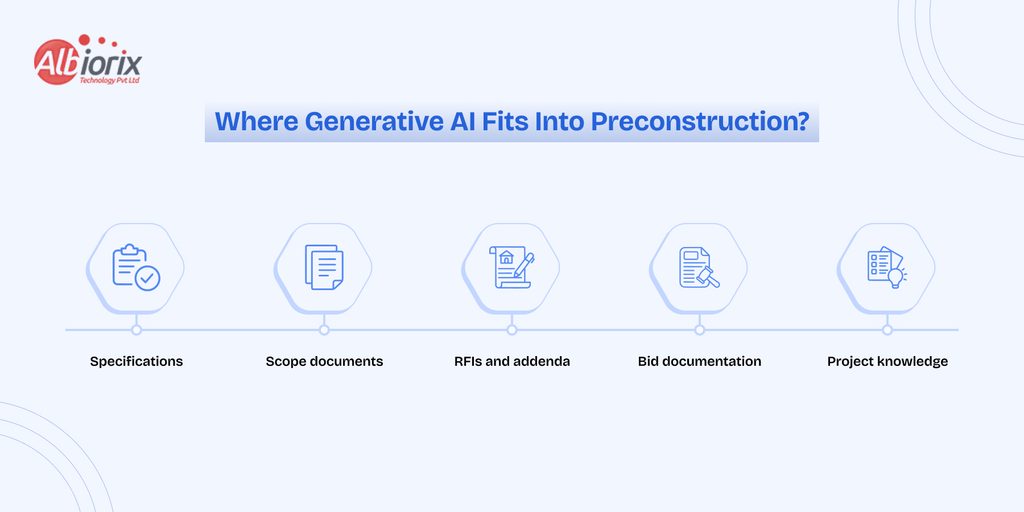
Not every AI application in preconstruction does the same job. While computer vision is particularly useful for interpreting drawings and identifying measurable elements, generative AI is better suited to working with the language and context buried across project documentation.
That distinction creates several practical applications for Generative AI Solutions:
Specifications
Summarize lengthy requirements and surface relevant clauses for review.
Scope documents
Compare descriptions and highlight differences that may require attention.
RFIs and addenda
Retrieve relevant information without manually searching across multiple files.
Bid documentation
Extract qualifications, exclusions and other important commercial details.
Project knowledge
Allow teams to ask natural-language questions across approved project information.
For enterprise use, however, a general-purpose chatbot is rarely enough. Generative AI needs access to the right project information, permissions, context and validation controls.
The value comes from grounding AI in trusted construction data so its responses can support the preconstruction team’s work rather than introducing another source of information that must be independently untangled.
Why AI Accuracy Starts With Better Construction Data?
AI is only as dependable as the project context and data supporting it.
An estimating model may be complex, but inconsistent input data can spoil its output easily. Historical estimates need to be sufficiently detailed for effective comparisons. Cost codes should have consistent formats, drawings should be up-to-date and clear, and supplier information must account for current layers of supply.
Classification of documentation matters as well. When specifications, addenda, drawings and pricing documents are poorly categorized, AI might be unable to set the right context. Thus, unification of those methods of documentation handling is crucial for AI readiness.
As for the construction estimating automation software – reliable inputs are just part of the whole picture. Validation norms should also point out weird batch sizes, missing data or discrepancies.
The entire process is completed by human monitoring. Seasoned estimators need to still question the premises, investigate the discrepancies, and determine whether the output of AI is consistent with the current projects’ needs.
Build, Buy or Integrate: Choosing the Right AI Approach
There isn’t one way to introduce AI into preconstruction. The best methods depend on how standardized one’s workflow is and where the project data is stored, as well as on the company’s need for control over estimation logic.
Buy
Pre-built AI construction cost estimating software is suitable for teams that have processes in place or similar requirements for takeoffs or estimating; using this approach might allow for faster implementation without the need for internal technology development.
Build
Custom AI preconstruction solutions, however, actually come into play when the estimation techniques and approval processes as well as cost models or data requirements are unique to the company.
Integrate
Often, the real challenge is connecting AI with the systems teams already use. AI Integration Services can link AI capabilities with BIM, ERP, document management, project management and historical cost environments so information can move between workflows rather than creating another isolated system.
An experienced AI Development Company can support this decision by assessing data readiness, integration requirements and where custom development can deliver practical value.
The right question is therefore not simply “Should we use AI?” but “Where should AI fit into the way we already work?”
Not Sure Where AI Fits Into Your Preconstruction Workflow?
Albiorix can help assess your existing systems, data, and workflows to identify practical opportunities for AI-powered automation and integration.
Talk to Our AI Experts
Will AI Replace Construction Estimators?
Not in the way the headlines might suggest. The more immediate change is not the disappearance of the estimator, but a shift in where their time and expertise are applied.
AI is increasingly capable of handling work that is repetitive, document-heavy or dependent on finding patterns across large datasets. Estimators bring something different: the ability to understand what the numbers mean in the context of an actual project.
A changing division of work
AI is well suited to:
Quantity extraction · Document search · Cost comparisons · Pattern detection · Anomaly flagging · Bid analysis
Estimators remain essential for:
Constructability · Commercial judgment · Project-specific conditions · Risk interpretation · Supplier knowledge · Final validation
This distinction matters because an estimate is more than a calculation. Two projects with similar quantities can carry very different commercial and execution risks.
As routine analysis becomes increasingly automated, estimator expertise can move toward higher-value work: questioning assumptions, evaluating alternatives and making informed decisions before those decisions become commitments on site.
Building Smarter Preconstruction Workflows With Albiorix
The next phase of AI in preconstruction is likely to be less about isolated automation and more about connecting the decisions that happen before a project reaches the site.
Multimodal AI can increasingly work across drawings, specifications, cost records and other project information. AI agents can support defined workflows such as document review, estimate validation and bid comparison. As these capabilities mature, estimates may also become more dynamic, responding to design revisions, updated pricing and new project information instead of remaining static snapshots.
The bigger opportunity is a connected preconstruction environment where teams can move from project data to commercial insight with fewer information gaps between them.
For construction businesses exploring this shift, Albiorix can help design and integrate AI capabilities around existing preconstruction workflows, data environments and business systems.
The objective should not be AI for its own sake. It should be better-informed estimates, earlier visibility into risk and stronger decisions before those decisions become expensive to change.
Connect with Our Experts!
FAQ
Frequently Asked Questions
AI can support drawing analysis, quantity takeoffs, cost estimation, document review, bid comparison, scope analysis and risk identification. Its role is primarily to process large volumes of project information and help preconstruction professionals find relevant insights faster.
AI can analyze quantities alongside historical project costs, labor rates, material pricing, supplier information and project characteristics. This helps estimators compare relevant information, identify anomalies and validate assumptions rather than relying entirely on manual analysis.
AI can identify, measure and classify many elements within digital construction drawings, reducing repetitive manual takeoff work. However, estimator review remains important for incomplete drawings, unusual assemblies, design changes and project-specific conditions.
Accuracy depends on several factors, including drawing quality, historical data, current pricing, cost-code consistency, project context and the AI model itself. AI-generated outputs should therefore be validated through appropriate rules and experienced human review.
AI takeoff focuses primarily on extracting measurements and quantities from construction documents. AI estimating goes further by connecting quantities with cost information such as materials, labor, historical project data and other relevant project variables.
Yes. Generative AI can help summarize specifications, retrieve information, compare scope language, review addenda and surface relevant details across approved project documents. Enterprise implementations should ground responses in trusted project information and apply appropriate access and validation controls.
It depends on the workflow. Ready-made platforms can suit standardized requirements, while custom development may be appropriate for proprietary estimating logic, unique approval processes or specialized datasets. Integration may be preferable when AI needs to work across existing BIM, ERP and project-management environments.
AI can automate or accelerate repetitive tasks, but estimating also requires constructability knowledge, commercial judgment, contextual understanding, risk assessment and final validation. In practice, AI is better suited to supporting estimator expertise than replacing the professional decision-making behind an estimate.
Published Blogs
Latest Blogs : Insights and Innovations from Our Blog
Stay Ahead in Tech: Dive into our Blogs for the Latest in Software, Web, and Mobile App Development. Explore cutting-edge technologies, industry trends, and insightful updates that keep you at the forefront of the digital landscape


Our Clients

Client Showcase: Trusted by Industry Leaders
Explore the illustrious collaborations that define us. Our client showcase highlights the trusted partnerships we've forged with leading brands. Through innovation and dedication, we've empowered our clients to reach new heights. Discover the success stories that shape our journey and envision how we can elevate your business too.










We’re here to help you


