






Table of Content
- Introduction
- The Market Opportunity Stats
- What Is an AI Agent for Sports Betting Apps?
- 7 Ways AI Agents Are Transforming Sports Betting App Development
- AI Agent Sports Betting Development: A Regional Breakdown
- Core Technology Stack for AI Sports Betting Agent Development
- Challenges in AI Sports Betting Agent Development
- How to Build an AI Agent for Sports Betting Apps: A Development Roadmap
- The Future of AI Agents in Sports Betting in 2026
- Conclusion
Summary: The AI revolution has taken the sports betting industry by storm. The use of popular AI models and generative AI solutions has increased in sports betting apps and software. Following a structured sports betting apps development guide can help businesses effectively integrate these technologies. The big sports betting brands in the USA and Australia have already integrated AI to offer an enhanced experience and make informed business decisions.
Introduction
The global sports betting market is no longer driven by instinct or luck — it’s being reshaped by intelligent, autonomous systems.
AI agents are now at the center of sports betting app development, powering everything from real-time odds computation to hyper-personalised user experiences.
Whether you’re a developer in the USA, an operator expanding into Australia, or a startup navigating Germany’s newly regulated market, understanding the role of AI agent development in sports betting apps is no longer optional — it’s a competitive necessity.
In this blog, we break down exactly how AI agents work inside sports betting platforms, what capabilities they unlock, and what it takes to build these systems for the world’s three fastest-growing betting markets.
The Market Opportunity Stats
| Market Value in 2024 | Market Projections | US Sports Betting Market | Engagement Via Mobile Apps |
| $100.9B Global sports betting market value in 2024 | $187.4B Projected market size by 2030 (11% CAGR) | $149.6B US sports betting handle in 2025 | 90% Bets placed via mobile devices |
These numbers tell a clear story: sports betting is a high-growth, mobile-first, and data-intensive industry. AI agents are the infrastructure that makes it all work at scale.
Want to increase the market share of your sports betting app?
Contact our team of AI developers to discuss how integrating AI can help boost growth in a competitive landscape.
Talk to AI experts
What Is an AI Agent for Sports Betting Apps?
An AI agent is not just a chatbot or a recommendation engine.
In the context of sports betting app development, an AI agent is an autonomous system that can perceive real-time data, reason about that data, make decisions, and take action — all without ongoing human input.
Unlike traditional algorithms that follow fixed rules, AI agents in sports betting apps:
- Continuously learn from live data streams (player stats, weather, injuries, market movements)
- Adapt their betting predictions and recommendations dynamically
- Automate actions such as bet placement, odds adjustment, and fraud flagging
- Operate across multiple tasks simultaneously — customer support, risk management, personalization
Key Insight:
AI agents in sports betting are the difference between a static platform and a living, adaptive system — one that gets smarter with every game played and every bet placed.
7 Ways AI Agents Are Transforming Sports Betting App Development
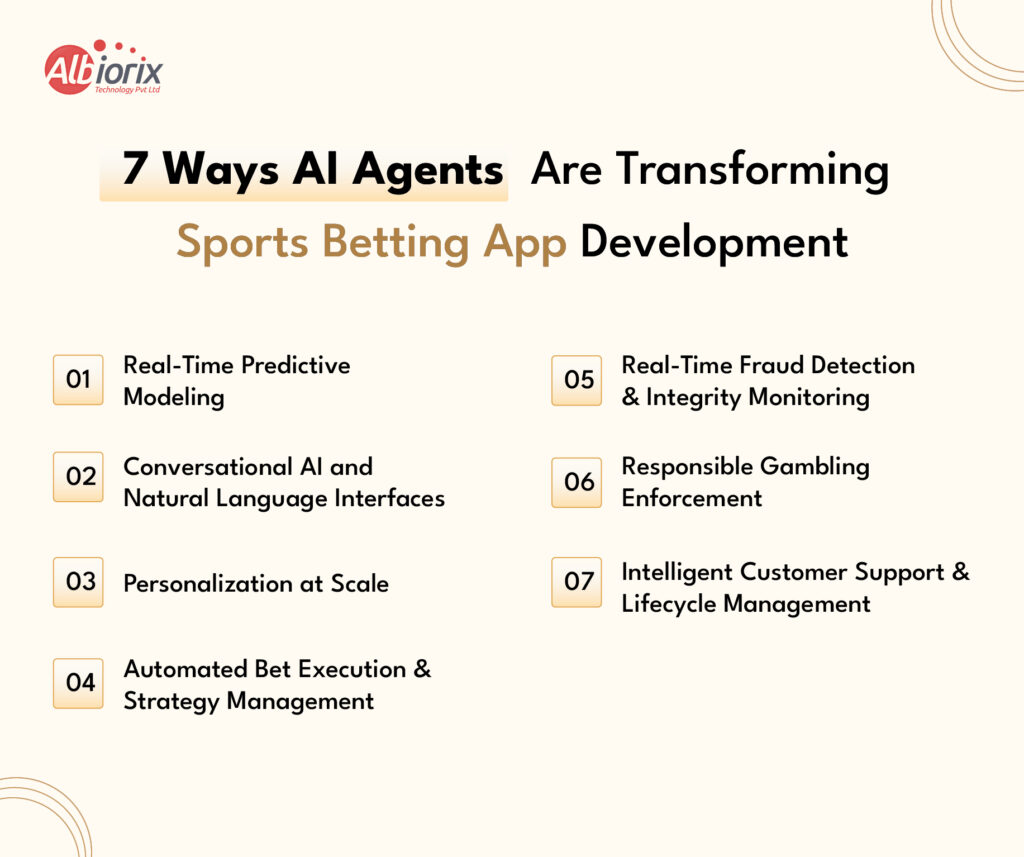
Real-Time Predictive Modeling
The most powerful application of an AI agent for sports betting apps is predictive accuracy.
Modern AI agents process historical performance data, player statistics, team dynamics, referee trends, and even environmental conditions like weather — and update predictions continuously during live events.
In 2025, AI-driven platforms are achieving up to 35% improvement in prediction accuracy compared to traditional statistical models.
Systems like those used by DraftKings can recalculate odds within milliseconds of an in-game event — a quarterback injury, a red card, or a missed penalty — giving both operators and bettors a decisive edge.
Market Data:
The sports analytics market was valued at $854.5 million in 2023 and is forecast to reach $4.74 billion by 2030 (27.7% CAGR), making AI-powered prediction one of the most investable features in sports betting app development.
Conversational AI and Natural Language Interfaces
Gone are the days of navigating complex menus to place a bet. AI agents now power conversational interfaces that let users interact in plain language — by text or voice.
Imagine a bettor typing: “What are the best prop bets for the NBA game tonight?” and receiving an instant, personalized, data-backed response — with the option to execute the bet directly from the conversation.
Platforms like BetHarmony are already deploying AI agents that understand betting slang, support multiple languages, and execute complex parlay combinations through natural dialogue.
This is especially critical for operators targeting Germany and Australia, where localized language support dramatically improves user retention.
- Supports multilingual communication for international markets (critical for Germany and Australia)
- Voice-to-voice betting enables hands-free, in-game wagering
- Reduces onboarding friction for new bettors in newly legalized markets
Personalization at Scale
AI agents analyze individual betting histories, preferences, and behavioral patterns to deliver hyper-personalized experiences. Rather than showing the same promotions and markets to every user, the platform adapts in real time.
Research shows that 60% of users prefer AI-personalized apps, leading to improved retention and increased bet volumes.
Platforms implementing personalized AI agent development have reported up to 30% improvement in user retention metrics.
- Personalization features powered by AI agents include
- Custom odds recommendations based on past behavior
- Automated notifications for relevant sports events
- Tailored promotional offers tied to individual betting patterns
- Dynamic odds presentation based on a user’s preferred sports and markets
Automated Bet Execution and Strategy Management
AI sports betting agents can execute predefined betting strategies autonomously, removing emotional bias and enabling complex multi-leg strategies that would be impractical for manual execution.
This is the backbone of professional sports betting agent development: building systems that can identify value bets, monitor arbitrage opportunities across platforms, manage bankroll limits, and execute wagers at optimal timing — all within the rules of each jurisdiction.
Key Developer Note:
When building an AI agent for sports betting apps in the USA, ensure your automated execution features are compliant with state-level requirements.
In Australia, refer to the Interactive Gambling Act; in Germany, adhere to the Glücksspielstaatsvertrag (GlüStV) framework.
Real-Time Fraud Detection and Integrity Monitoring
AI agents are the first line of defense against match-fixing, fraudulent accounts, and suspicious betting patterns.
Systems like Sportradar’s Fraud Detection System (FDS) use machine learning to monitor thousands of betting markets simultaneously, flagging irregularities before they escalate.
For operators building sports betting apps in highly regulated markets like Germany or US states such as New Jersey and Pennsylvania, robust fraud detection is not just a feature — it’s a licensing requirement.
AI-powered integrity tools can:
- Detect sudden unexplained shifts in betting volumes
- Cross-reference patterns against historical match-fixing data
- Trigger automatic review workflows or account flags in real time
- Integrate with KYC/AML systems for holistic compliance
Responsible Gambling Enforcement
One of the most socially significant applications of AI agent development in sports betting apps is responsible gambling.
AI agents can monitor individual user behavior in real time, identify early signs of problem gambling, and trigger interventions automatically.
This is increasingly a regulatory expectation.
The EU AI Act (effective February 2025) and Australia’s National Consumer Protection Framework both require platforms to implement safeguards that prevent exploitative personalization targeting vulnerable users.
AI-powered responsible gambling tools include:
- Behavioral tracking that flags loss-chasing patterns
- Automated deposit limit enforcement and self-exclusion prompts
- PlayScan-style risk scoring across user sessions
- Regulatory-compliant affordability checks (especially relevant in Germany)
Intelligent Customer Support and Lifecycle Management
AI agents dramatically reduce the cost and latency of customer support in sports betting platforms. Operating 24/7, these systems handle everything from account inquiries and withdrawal processing to live bet assistance and dispute resolution.
For operators targeting multiple time zones — critical for USA (multiple time zones), Australia (AEST/AWST), and Germany (CET) — AI-powered support agents ensure consistent service quality without scaling human teams proportionally.
Beyond support, AI agents drive the entire user lifecycle: onboarding new users, re-engaging dormant bettors, and proactively surfacing upsell opportunities at the right moment in a session.
AI Agent Sports Betting Development: A Regional Breakdown

AI Agent Sports Betting Development: United States
The USA is the world’s most dynamic emerging market for sports betting.
Following the 2018 Supreme Court ruling that overturned the federal ban, 39 states and the District of Columbia have legalized sports betting, with more than 70% of the US population now having legal access.
US sports betting generated $149.6 billion in handle and $13.71 billion in revenue in 2025 alone. AI agent development in this market must account for:
- State-by-state licensing (New Jersey, Pennsylvania, Illinois each have unique requirements)
- SAFE Bet Act proposals that may restrict manipulative AI targeting
- Integration with major platforms like DraftKings and FanDuel APIs
- NFL, BA, MLB, and college sports as primary markets driving live betting volume
The US market rewards AI agents that can operate with high-frequency real-time data given that 95% of bets are placed online and the majority during live game windows.
AI Agent Sports Betting Development: Australia
Australia has one of the world’s most mature and regulated online betting markets.
Sports betting is legal nationally and governed by the Interactive Gambling Act 2001, with state-level licensing handled by bodies including the Northern Territory Racing Commission.
AI sports betting agents targeting Australia must support:
- AFL, NRL, Rugby League, Cricket (Big Bash, Tests), and A-League as primary sports
- Integration with dominant platforms including Sportsbet, TAB, Ladbrokes, and Bet365 Australia
- National Consumer Protection Framework compliance (deposit limits, activity statements, bet confirmation tools)
- Strong personalization for local sports culture and seasonal betting patterns
Australia’s mobile-first bettors and high sports engagement make it an ideal market for AI agents that specialize in live in-play betting and push notification management.
AI Agent Sports Betting Development: Germany
Germany’s sports betting market underwent significant regulatory transformation with the Glücksspielstaatsvertrag 2021 (Interstate Treaty on Gambling), which created a federally unified licensing framework. The market is strict but lucrative.
Key requirements for AI agent development for sports betting apps targeting Germany:
- GlüStV-compliant licensing from the Gemeinsame Glücksspielbehörde der Länder (GGL)
- GDPR and EU AI Act compliance for all data processing and user-targeting features
- Mandatory responsible gambling tools including monthly deposit limits (€1,000 cap)
- Support for German-language interfaces with localized Bundesliga, Champions League, and DFB-Pokal markets
- Prohibition on live in-play betting on certain markets — AI agents must enforce geo-restricted bet types
Germany rewards platforms that combine rigorous compliance with premium user experience. AI agents that can enforce regulations programmatically — without degrading the UX — are a significant competitive advantage here.
Core Technology Stack for AI Sports Betting Agent Development
Building a robust AI agent for sports betting apps requires more than off-the-shelf machine learning. Here is the foundational technology architecture used by leading platforms in 2025:
| Sr. No | Layer | Technology/Tools |
| 1 | Data Ingestion | Real-time sports APIs (Sportradar, Stats Perform, Opta), web scraping, social media NLP feeds |
| 2 | Machine Learning | TensorFlow / PyTorch for predictive models; scikit-learn for statistical baselines; XGBoost for rapid odds recalculation |
| 3 | AI Agent Framework | LangChain / AutoGen for multi-step reasoning; OpenAI GPT-4 / Claude API for NLP interfaces |
| 4 | Real-Time Processing | Apache Kafka for event streaming; Redis for low-latency caching; Apache Flink for stream analytics |
| 5 | Backend Infrastructure | Node.js / Python FastAPI; microservices on AWS / Azure / GCP; PostgreSQL + TimescaleDB for time-series data |
| 6 | Compliance Layer | KYC/AML integrations (Onfido, Jumio); GDPR-compliant data pipelines; geo-restriction enforcement APIs |
| 7 | Mobile/Frontend | React Native for cross-platform iOS/Android; WebSocket connections for live odds delivery |
Challenges in AI Sports Betting Agent Development
Building AI agents for sports betting apps is complex. Development teams must navigate:
Data Quality and Latency
AI agents are only as good as their data. Partnering with certified sports data providers and building low-latency ingestion pipelines is non-negotiable, especially for live in-play betting features where odds can shift within seconds.
Regulatory Complexity Across Jurisdictions
A single platform targeting USA, Australia, and Germany must simultaneously comply with three distinct legal frameworks — each with its own licensing, advertising, responsible gambling, and data protection requirements.
AI agent development must embed compliance logic at the architecture level, not as an afterthought.
Model Bias and Transparency
If training datasets are unbalanced, AI agents can systematically favor certain teams or market outcomes.
Diverse training data, ongoing monitoring, and explainable AI features — which show users how recommendations are generated — are essential for both fairness and regulatory acceptance, particularly under Germany’s EU AI Act obligations.
Responsible Deployment
AI agents that learn individual behavioral vulnerabilities carry ethical obligations.
Platforms must implement the same intelligence that drives personalization to also enforce user protection — a dual mandate that requires thoughtful architecture and ongoing human oversight.
How to Build an AI Agent for Sports Betting Apps: A Development Roadmap
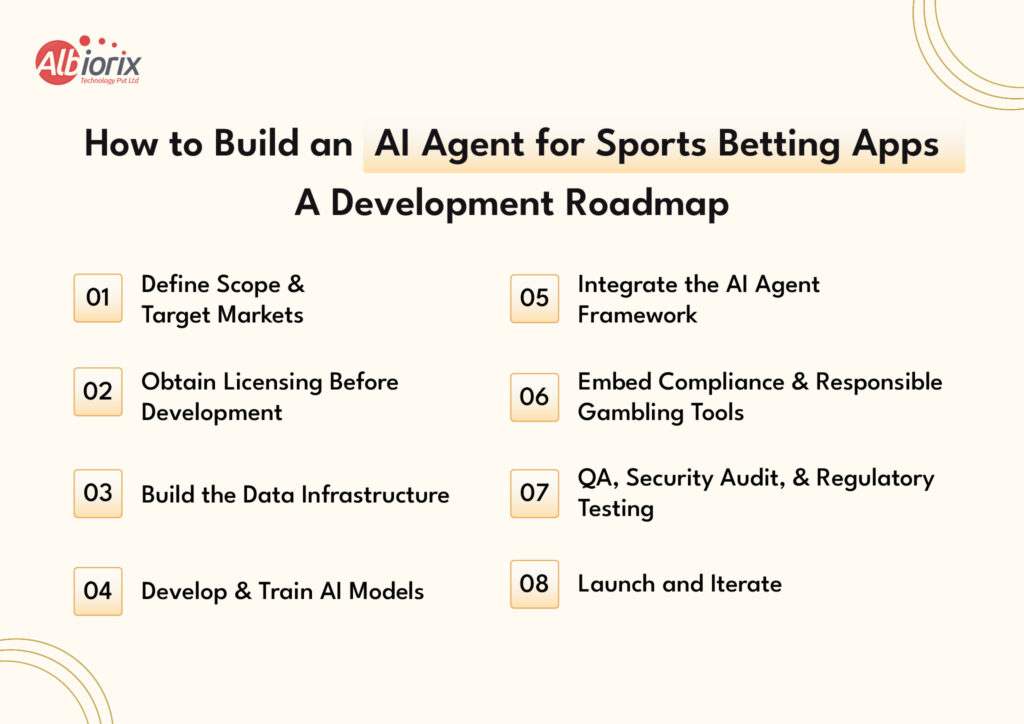
- Define Scope and Target Markets — Identify which sports, bet types, and jurisdictions the platform will support. This determines licensing requirements, data sources, and compliance architecture.
- Obtain Licensing Before Development — In the USA, this means state-by-state applications. In Australia, engage the Northern Territory Racing Commission or relevant state body. In Germany, apply to the GGL. Timeline: 3–12 months depending on jurisdiction.
- Build the Data Infrastructure — Integrate certified real-time sports data APIs. Establish event streaming pipelines capable of processing millions of data points per second during major sporting events.
- Develop and Train AI Models — Begin with foundational predictive models (match outcomes, player props). Layer in personalization engines and NLP interfaces. Use A/B testing frameworks to iterate model performance against live user data.
- Integrate the AI Agent Framework — Connect ML models to an agent orchestration layer that can reason, plan, and execute across multiple tasks: odds adjustment, user recommendation, fraud alert, and customer support simultaneously.
- Embed Compliance and Responsible Gambling Tools — Build KYC/AML flows, GDPR-compliant consent management, deposit limit enforcement, and behavioral monitoring into the core platform — not bolted on post-launch.
- QA, Security Audit, and Regulatory Testing — Run compliance checks specific to each target region. Conduct penetration testing and verify that geo-blocking, age verification, and jurisdictional bet-type restrictions function correctly.
- Launch and Iterate — Start with a soft launch in one market. Use real user data to refine AI models continuously. Scale to additional markets once core performance and compliance are validated.
Development Cost Range:
Custom AI-powered sports betting app development typically ranges from $65,000 to $300,000 USD depending on feature depth, AI integration complexity, and compliance requirements across markets.
The Future of AI Agents in Sports Betting
The trajectory for AI agents in sports betting is clear. Several emerging developments will define the next phase of sports betting app development:
- Agentic Multi-Modal Systems: AI agents will process video feeds, audio commentary, and social media in real time — not just statistical data — to generate betting signals during live events.
- Autonomous Bankroll Management Agents: Fully autonomous agents that manage a user’s entire betting portfolio, adjusting stakes and strategy based on live market conditions and personal risk tolerance.
- Decentralized AI Oracles: Integration with blockchain-based smart contracts to enable transparent, trustless AI-driven betting settlements — highly relevant for crypto-friendly markets.
- Regulatory AI: AI agents that monitor their own outputs for compliance violations in real time, automatically adjusting behavior based on jurisdictional rule sets — a critical advantage for multi-market operators.
- Conversational Betting on Messaging Platforms: AI sports betting agents embedded directly into WhatsApp, Telegram, and social platforms, enabling bet placement through group chats — targeting Gen Z users in all three key markets.
The global AI agent market itself is projected to grow from $5.1 billion in 2024 to $47.1 billion by 2030.
Sports betting is one of the most data-rich and decision-intensive industries in the world — making it one of the highest-value deployment environments for next-generation AI agent development.
Conclusion
AI agents are no longer a future-looking feature for sports betting apps — they are the present competitive standard.
Platforms that build intelligent, adaptive, real-time AI systems today will dominate the betting markets of tomorrow in the USA, Australia, Germany, and beyond.
Whether you’re looking to build a sports betting app from the ground up, integrate AI agent capabilities into an existing platform, or navigate the regulatory complexities of multi-market launches, leveraging Sports Betting Software Development Services can streamline the process and ensure scalability.
The investment in AI agent development delivers measurable returns: higher prediction accuracy, stronger user retention, lower fraud rates, and scalable compliance.
The sports betting industry is estimated to generate more than $221 billion between 2025 and 2029, powered in large part by the AI revolution.
The question is not whether AI agents will transform sports betting apps — they already are. The question is whether your platform will lead that transformation or follow it.
Connect with Our Experts!
FAQ
Frequently Asked Questions
An AI agent for sports betting apps is an autonomous software system that analyzes real-time sports data, makes predictions, personalizes user experiences, detects fraud, and automates betting strategies — continuously learning and improving over time.
Custom AI sports betting app development typically costs between $65,000 and $300,000 USD, depending on feature complexity, AI integration depth, and multi-jurisdiction compliance requirements.
Yes, with the appropriate licensing. In the USA, licensing is state-by-state (39 states have legalized sports betting). In Australia, federal and state licenses are required under the Interactive Gambling Act. In Germany, operators must obtain a license from the GGL under the GlüStV 2021 framework.
AI agents process historical data, real-time statistics, player conditions, and market movements using machine learning models to generate predictions with significantly higher accuracy than traditional methods — with leading platforms reporting up to 35% improvement in prediction accuracy.
For Germany, AI agents in sports betting apps must comply with the GlüStV 2021, enforce the €1,000 monthly deposit cap, implement GDPR-compliant data handling, respect restrictions on certain live in-play bet types, and adhere to EU AI Act requirements on automated decision-making.
Published Blogs
Latest Blogs : Insights and Innovations from Our Blog
Stay Ahead in Tech: Dive into our Blogs for the Latest in Software, Web, and Mobile App Development. Explore cutting-edge technologies, industry trends, and insightful updates that keep you at the forefront of the digital landscape



Our Clients

Client Showcase: Trusted by Industry Leaders
Explore the illustrious collaborations that define us. Our client showcase highlights the trusted partnerships we've forged with leading brands. Through innovation and dedication, we've empowered our clients to reach new heights. Discover the success stories that shape our journey and envision how we can elevate your business too.










We’re here to help you


