






Table of Content
- What is an Agentic AI?
- How Do AI Agents Work?
- Difference between Agentic AI vs Generative AI
- Key Components of Agentic Architecture
- Advantages of Agentic AI for Businesses
- Top Industries Using Agentic AI in 2026
- How to Build Agentic AI Systems
- How to Integrate Agentic AI into Your Business
- Why Choose Albiorix Technology as Your Agentic AI Development Partner
Summary: Agentic AI refers to autonomous systems that can reason, plan, and take actions to achieve complex, multi-step goals with minimal human supervision. Unlike generative AI, which creates content upon request, agentic AI actively uses tools and adapts to environments. Key features include high autonomy, adaptability, and goal-oriented, proactive workflows.
If you’ve been following the AI space lately, you’ve probably noticed that the conversation has shifted. It’s no longer just about chatbots or content generators.
Businesses are now asking a bigger question: What if AI could actually get things done on its own? That’s exactly what Agentic AI is about.
Whether you are a startup founder, a business owner, or an entrepreneur, you should understand Agentic AI in 2026.
As we provide Agentic AI development services, we’ve helped businesses in Australia, the USA, and the UK. We help them move from curiosity to real AI-powered operations.
This guide covers what you need to know. It explains what Agentic AI is. It shows how it differs from generative AI.
What is an Agentic AI?
Agentic AI refers to AI systems that can plan, decide, and act on their own.
They can complete complex, multi-step tasks without constant human guidance.
Think about how you’d assign a task to a capable employee. You give them the goal, maybe some guidelines, and they figure out the rest. They research, make decisions, use tools, handle obstacles, and come back with results.
Agentic AI works the same way. You give it an objective, and it takes independent actions to achieve it.
This is very different from the AI most people are familiar with. People ask questions to most AI models, and the models give you answers. Agentic AI completes the assigned tasks. It doesn’t just respond; it operates.
At its core, an Agentic AI system combines:
- A large language model (LLM) or a set of AI models. It works as a brain
- Tools and APIs used to interact with the world (search engines, databases, code executors, email clients, etc.)
- A memory layer to retain context across steps
- A planning and reasoning engine that breaks goals into actionable steps
- A feedback loop that lets it evaluate its own outputs and correct course
The result? AI that doesn’t just answer questions, it executes workflows, manages processes, and drives outcomes.
How Do AI Agents Work?
To understand the power of AI agents and why they are in huge demand, you have to understand their way of working. An AI agent follows a continuous loop that normally looks like this:
- Perceive: The agent takes in information. This could be a user instruction, data from a database, output from another tool, or even real-time web data.
- Think: The agent uses an AI model, often a large language model. It reasons about the current state. It considers what it knows and what it must do next.
- Plan: It breaks the task into smaller, executable steps and decides which tools or sub-agents to use.
- Act: It takes action calling an API, writing code, sending an email, querying a database, or triggering another agent.
- Reflect: It evaluates whether the action moved it closer to the goal. If not, it adjusts its plan and tries again.
This loop continues until the task is complete. What makes this remarkable is that the agent isn’t following a rigid script.
Understanding this cycle is key to seeing the AI agents vs traditional automation difference, where agents handle the ‘Reflect’ step that rules-based systems cannot.
It adapts in real time. It handles unexpected inputs. It makes judgment calls along the way.
Multi-agent systems take this further. Instead of one agent doing everything, you have a network of specialized agents.
One that researches, one that analyzes, one that writes, one that executes, all coordinated by an orchestrator agent. This reflects how high-performing teams structure themselves in the real world.
Difference between Agentic AI vs Generative AI
There are many businesss that still get confused between the Agentic AI and Generatve AI. Both are very different. Let’s clear it up so you can choose what’s right for your business.
What is Generative AI?
A generative AI is an AI that generates content such as text, images, code, audio, etc. You enter a detailed prompt and it responds with the output.
The best and the most popular example of Generative AI is ChatGPT. It’s reactive and operates in a single turn. Give it an input, get an output.
What is Agentic AI?
An Agentic AI is an AI that operates over multiple steps, across time, using tools, and can initiate actions without being prompted at every step.
Comparision Between Generative AI and Agentic AI
| Feature | Generative AI | Agentic AI |
|---|---|---|
| Primary Function | Generates Content | Executes Tasks & Workflows |
| Interaction Model | Single-turn or Conversational | Multi-step, Goal-driven |
| Tool Use | Limited or None | Extensive (APIs, Databases, Code, etc.) |
| Autonomy | Low – Needs human input per step | High – Operates independently |
| Memory | Limited to Context Window | Long-term Memory Across Sessions |
| Best for | Content Creation, Q&A, Summarization | Process Automation, Complex Workflows |
To explain this simply, Generative AI answers your questions, while Agentic AI completes tasks for you.
For businesses, they must not only use AI models that answer questions. They also need AI agents that help them run their business efficiently.
Key Components of Agentic Architecture
If Agentic AI impresses you and you want to develop it, you should understand its core architecture.
Here’s what makes up a well-designed agentic system:
- LLM/AI Models as the Core Reasoning Engine: The foundation of any AI agent is a strong language model. It can also be a mix of AI models. These models handle natural language understanding, reasoning, and planning.
- The choice of model matters enormously depending on your use case. Some tasks benefit from large frontier models; others can run efficiently on smaller, fine-tuned machine learning models.
- Tool Layer: Agents are only as useful as the tools they can access. A tool can be anything the agent can call. They call it a web search API, a code execution tool, a CRM system, a database, a calendar, or a custom app. The richer the tool layer, the more capable your agent becomes.
- Memory System: Human professionals remember past interactions and learn from them. Good agentic systems do too. Memory in agentic architecture typically comes in three forms:
- In-context memory: What the agent can see in its current session
- External memory: A vector database or knowledge store the agent can query
- Episodic memory: A record of past interactions and outcomes
- Orchestration Layer: In multi-agent systems, an orchestrator decides which agents handle tasks. It manages communication between them. It also tracks progress toward the overall goal. Think of it as the project manager of your AI team.
- Feedback & Reflection Mechanism: Strong agent systems include ways to review their own outputs. They check for errors, mismatches, or weak results. They can self-correct without human help.
- Safety and Guardrails: Autonomous systems need boundaries. A robust agentic architecture uses role-based access controls, action approval thresholds, audit logs, and fail-safes. It ensures agents do only what they are authorized to do.
Advantages of Agentic AI for Businesses
There are many options in the market, but why are businesses investing heavily in agentic systems in 2026? Using agentic AI has many benefits.
These benefits go far beyond what traditional automation can deliver. They also go far beyond what generative AI can deliver.
Top Advantages of Agentic AI for Businesses are:
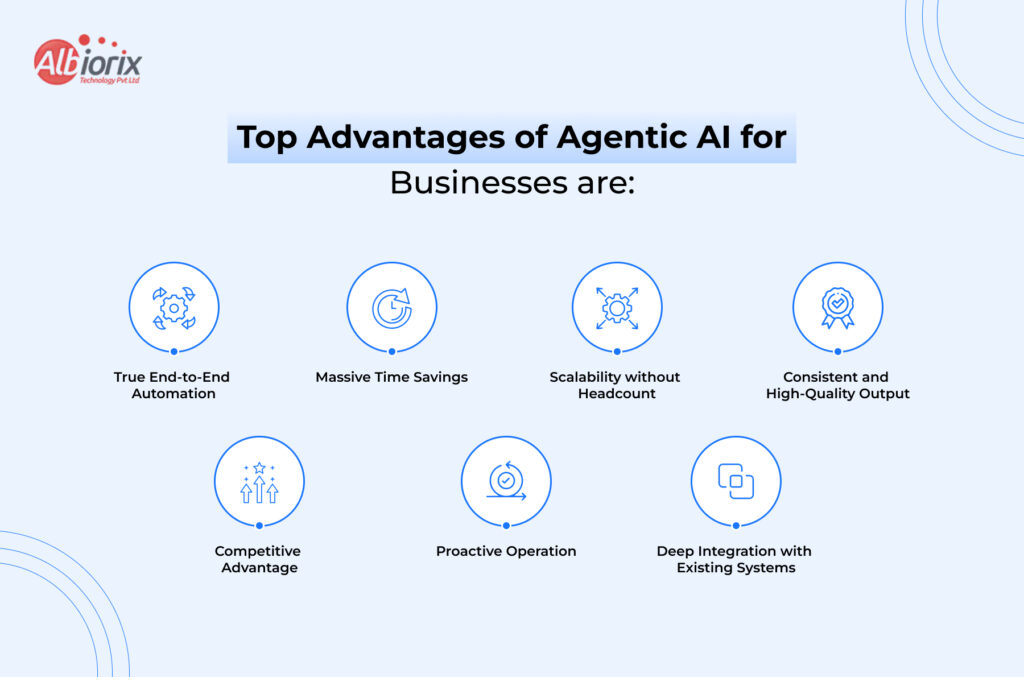
- True End-to-End Automation: Rule-based automation breaks when something unexpected happens. Agentic AI can manage exceptions, adapt to new information, and complete complex workflows without human help.
- Massive Time Savings: A whole team of experts can complete a task that takes several days in just a few hours. Well-trained and developed AI agents are so excellent that they can complete tasks in minutes.
Beyond just saving time, these systems significantly reduce development costs using AI by automating the most labor-intensive parts of the software lifecycle. - Scalability without Headcount: In an organisation, you will need different resources to complete tasks. Whereas in the case of Agentic AI, a single AI agent can handle 10 tasks efficiently. Thus, there is no need to scale up your team. This specifically helps startups and small businesses with limited budgets.
- Consistent and High-Quality Output: Human teams have good days and bad days. AI agents execute with the same precision and consistency every time. It can deliver the same quality output with reduced errors, improved reliability, and high quality at scale.
- Proactive Operation: Generative AI or automated software solutions wait for instructions to perform tasks. Whereas, designers and trainers can build agentic AI to monitor conditions and take proactive action. It can flag anomalies, initiate outreach, or escalate issues.
- Deep Integration with Existing Systems: Modern and advanced agentic systems can easily connect with your existing systems. It can connect to your CRM, ERP, data warehouses, and communication platforms. It adds a layer of smart automation across your whole operation.
- Competitive Advantage: Businesses that deploy agentic AI now are building capabilities their competitors don’t have. The compounding advantage of AI-powered operations is hard to overstate.
Want to see what Agentic AI could do for your business specifically?
Book a free strategy call with our team. We have helped companies in Australia, the USA, and the UK build AI solutions that actually deliver ROI.
Contact Us
Top Industries Using Agentic AI in 2026
Well, the AI revolution has taken every industry by storm. As a result, agentic AI is no longer a niche technology. Organizations are deploying it across virtually every major sector.
Here are the top 12 industries leading the charge:
- Financial Services: In the FinTech industry, AI agents autonomously handle fraud detection, credit risk assessment, regulatory compliance monitoring, and personalised financial advisory at scale.
- Healthcare: In the Healthcare industry, agentic AI systems are managing patient intake, automating clinical documentation, coordinating care pathways, and supporting diagnostic workflows. It helps reduce workloads on hospitals and doctors.
- eCommerce & Retail: AI agents handle end-to-end customer journeys from personalised product recommendations to order management, returns processing, and dynamic pricing adjustments.
- Customer Support/Retail: Retailers are also moving beyond text to autonomous AI voice agents to provide hands-free customer assistance.
- Legal: Law firms and legal tech platforms use AI agents for contract review and due diligence.
- They also use them for case law analysis and document drafting.
- This cuts the time spent on routine tasks.
- They also use them for case law analysis and document drafting.
- Real Estate: Agents autonomously qualify leads, schedule property viewings, generate market analysis reports, and manage post-sale documentation workflows.
- Manufacturing & Supply Chain: Agentic systems monitor supply chain disruptions, optimise procurement, predict equipment failures, and coordinate logistics across global networks.
- Marketing & Advertising: AI agents run multi-channel campaigns on their own. They write copy, A/B test creatives, adjust bids, analyse performance, and improve results.
- Media & Entertainment: In data-heavy sectors, we are seeing specialized use cases like AI agents in sports betting apps that manage real-time odds and user engagement.
- Human Resources: AI agents are changing how HR teams work. They help with sourcing and screening candidates. They also support onboarding, policy compliance, and performance tracking.
- Education & EdTech: Agentic AI powers adaptive learning platforms that personalise curriculum, monitor student progress, provide tutoring, and generate learning content dynamically.
- Software Development: AI agents can write, test, debug, and document code. Some systems can ship full features on their own. They need a clear specification.
How to Build Agentic AI Systems
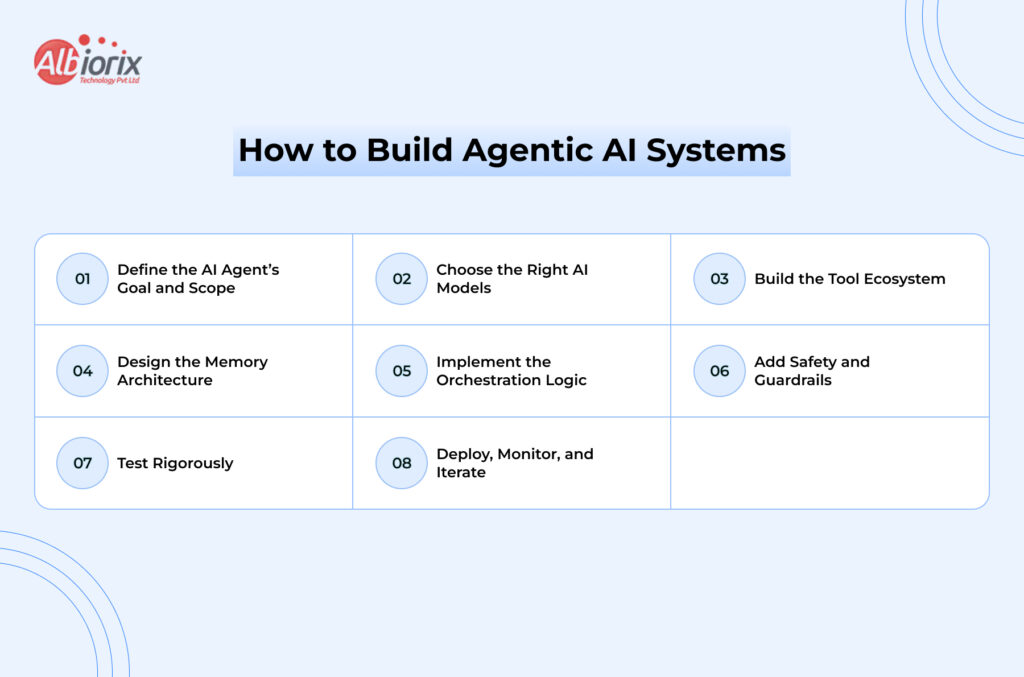
Building a functional agentic AI system requires careful planning and the right technical foundation. Here’s how the process typically unfolds:
Step 1: Define the AI agent’s goal and scope. Before you write any code, be clear on what you want it to do.
What is its primary objective? What decisions is it allowed to make? What actions should always require human approval? The clearer your scope, the better your agent will perform.
Step 2: Choose the Right AI Models: Select the underlying language models and machine learning models based on your use case.
For reasoning-heavy tasks, you’ll want frontier models. For high-volume, lower-complexity tasks, fine-tuned smaller models may be more cost-effective. Often, a combination of models works best a powerful model for planning, a faster one for execution.
Step 3: Build the Tool Ecosystem: Define every external system and API your agent will need to interact with. Map out permissions, authentication, and rate limits. Build or configure tool wrappers that the agent can call cleanly.
Step 4: Design the Memory Architecture: Decide how your agent will store and retrieve information. Short-term context, long-term vector memory, and episodic records each serve different purposes.
The right memory architecture is often what separates a useful agent from a frustrating one.
Step 5: Implement the Orchestration Logic: If you’re building a multi-agent system, design the coordination layer. Define how agents communicate, assign tasks, and handle conflicts or failures.
Step 6: Add Safety and Guardrails: Define what your agent is not allowed to do. Implement hard stops, escalation paths, and audit logging. This is non-negotiable in enterprise deployments.
Step 7: Test Rigorously: Agentic systems behave differently than traditional software. Test for edge cases, adversarial inputs, tool failures, and unexpected sequences of events. Red-team your own system.
Step 8: Deploy, Monitor, and Iterate: Launch in a controlled environment first. Monitor behavior closely, collect feedback, and refine the agent’s instructions, tools, and logic iteratively.
Building these systems is complex; if you prefer to work with experts, explore our Agentic AI development services to accelerate your deployment.
How to Integrate Agentic AI into Your Business
You don’t have to overhaul your entire operation to start benefiting from agentic AI. Here’s a practical approach to integration:
- Start with a high-impact, focused use case.
- Find a process that is repetitive and time-consuming.
- It should be data-heavy and handled by people today.
- They should follow a fairly predictable set of steps. Common starting points include lead qualification, customer support triage, invoice processing, or competitive research.
- Audit your existing data and systems: AI agents are only as good as the data they can access.Before you deploy, ensure your key systems have accessible APIs. Make sure your data is reasonably clean. Confirm your team knows what data the agent will use.
- Before deployment, check for API availability; our agentic AI integration services can help map these connections to ensure your data flows securely.
- Define human-in-the-loop touchpoints: Even highly autonomous agents need clear escalation points.
- These are cases where they pause and ask a human for input. Designing these thoughtfully is what makes agentic AI safe and trustworthy in real operations.
- Integrate gradually: Connect the agent to one system at a time. Validate behavior at each step before expanding its access and responsibilities. This staged rollout approach reduces risk and builds internal confidence.
- Train your team: Agentic AI changes how people work, not just what AI does. Invest in helping your team learn to work with agents, interpret their outputs, and know when to override them.
- Measure and optimize: Define clear success metrics before you launch task completion rate, time saved, error rate, cost per workflow. Review them regularly and use them to guide improvements.
Why Choose Albiorix Technology as Your Agentic AI Development Partner
There are many agentic AI development companies in the USA, Australia, and the UK. Albiorix Technology is an end-to-end agentic AI development company.
We have a team of AI engineers who know the industry well. They also have a deep understanding of agentic systems.
Whether you need Custom AI agent development or Agentic AI integration, our AI developers can help.
Our team has the experience and expertise to deliver smoothly.
These solutions help businesses streamline operations and boost productivity. In our portfolio, you will find AI-powered mobile apps and websolutions like DUCO, Daisy, Deal Signal, and more.
Our Agentic AI Development services are available to businesses in Australia, the USA, and the UK. We have worked across time zones.
Connect with Our Experts!
FAQ
FAQs - Agentic AI Development Company
Agentic AI is artificial intelligence that can take autonomous action to complete multi-step tasks. Unlike a standard chatbot that responds to questions, an AI agent plans, uses tools, makes decisions, and executes processes on its own, the way a capable employee would if you gave them a goal and the resources to achieve it.
Regular AI (including most generative AI tools) reacts to prompts and produces outputs. Agentic AI acts proactively and persistently toward goals. It can use external tools, remember context across sessions, plan sequences of actions, and correct its own mistakes capabilities that most standard AI models don’t have.
AI agents are being used across a wide range of business functions: customer support, sales automation, research, document processing, HR workflows, financial analysis, software development, and more. Any process that involves multiple steps, decision points, and interaction with data systems is a candidate for agent automation.
At a technical level, you need one or more large language models or machine learning models, a set of tools and APIs the agent can interact with, a memory system, an orchestration layer, and guardrails. In practice, most businesses find it far faster and more reliable to partner with an experienced AI agent development company than to build these systems from scratch.
The core advantages of Agentic AI include true end-to-end automation, significant time and cost savings, the ability to scale operations without growing headcount, consistent output quality, and the ability to operate proactively rather than reactively. For businesses, it’s one of the highest-leverage investments available right now.
Yes — when built correctly. Well-designed agentic systems include role-based access controls, action limits, escalation paths, and audit logging. The key is working with experienced developers who build safety and governance into the architecture from the start, not as an afterthought.
It depends on complexity. A focused, well-scoped agent for a single workflow can be built and deployed in a matter of weeks. More complex multi-agent systems with deep enterprise integrations typically take two to four months. The biggest time variables are usually data readiness and integration complexity, not the AI development itself.
Costs vary based on the scope of the system, the number of integrations, and the level of customization required. We offer transparent, milestone-based pricing for all our projects. The better question is ROI: most of our clients see returns that significantly outpace their investment within the first six months.
Yes. Modern agentic systems are designed to integrate with the tools and platforms your business already uses — CRMs, ERPs, communication platforms, databases, and custom applications. Integration is a core part of what our AI solutions team handles.
Practically every industry can benefit, but businesses in financial services, healthcare, legal, e-commerce, real estate, marketing, HR, manufacturing, and software development are seeing some of the most significant early returns. If your business runs repetitive, data-driven workflows — you’re a strong candidate.
The best starting point is a conversation with a team that’s actually built these systems. We offer initial consultations to help businesses identify the highest-impact use cases and understand what a realistic implementation would look like. Reach out to our team at Albiorix Technology — we work with businesses in Australia, the USA, and the UK.
Published Blogs
Latest Blogs : Insights and Innovations from Our Blog
Stay Ahead in Tech: Dive into our Blogs for the Latest in Software, Web, and Mobile App Development. Explore cutting-edge technologies, industry trends, and insightful updates that keep you at the forefront of the digital landscape
Our Clients

Client Showcase: Trusted by Industry Leaders
Explore the illustrious collaborations that define us. Our client showcase highlights the trusted partnerships we've forged with leading brands. Through innovation and dedication, we've empowered our clients to reach new heights. Discover the success stories that shape our journey and envision how we can elevate your business too.










We’re here to help you


