




Table of Content
- What Is Vibe Coding and How Does It Work?
- How Are Vibe Coding Platforms Changing Software Development?
- Vibe Coding vs Traditional Coding: What's the Difference?
- Best Vibe Coding Tools Businesses Should Know in 2027
- Will Vibe Coding Replace Software Developers by 2027?
- AI Software Development Trends 2027: What Businesses Should Expect
- Why Businesses Need Professional Software Developers in the Age of Vibe Coding
- How Albiorix Helps Businesses Embrace AI-Powered Software Development
- Final Thoughts: The Future of Software Development Is Human + AI
Key Takeaways
- Vibe coding is changing software development: AI tools allow users to build applications through natural-language prompts, reducing manual coding efforts.
- AI doesn’t replace developers: Professional developers remain essential for architecture, security, scalability, integrations, and maintenance.
- Vibe coding accelerates MVP development: Startups and businesses can validate ideas, build prototypes, and test features faster.
- AI and traditional coding work better together: Combining AI-powered coding with human engineering expertise helps create reliable software.
- The future of programming is AI-assisted: By 2027, developers will increasingly focus on managing AI-generated code, solving complex problems, and improving software quality.
- Businesses still need the right development partner: Professional software development teams help transform AI-generated prototypes into scalable, production-ready applications.
Artificial Intelligence is transforming the future of software development. Now, instead of coding applications line by line, we use plain natural-language prompts to design apps. This new and innovative technique, called vibe coding, is used by startups, organizations, and developers to build applications faster, innovate on new ideas, and create MVPs.
But what about becoming an AI-replacing software developer by 2027?
Not so much. AI-based code automation and machine learning in software development can reduce your repetitive workload but can’t replace the human element of software programming. Coding experts are still needed for the application architecture, security, security standards, integrations, scalability, and all the other things that go into maintaining software in the long term.
Turn Your Software Idea into Reality with AI
Vibe coding speeds up development, but building secure, scalable software takes expert engineering. Albiorix combines AI innovation with development expertise to turn your ideas into business-ready solutions.
Explore AI Development Services
What Is Vibe Coding and How Does It Work?
Vibe coding is an AI-assisted software development process where users express what they want to construct via prompts written in natural language rather than having to code it themselves.
Generative AI models and LLMs understand these instructions, generate code, propose enhancements, and support users in building apps via conversation.
For instance, a startup founder might ask an AI app builder:
“Build a user login, dashboard, customer records, and appointment scheduling to customer management app.”
This aspect of the system will be responsible for designing a preliminary app structure, user interface, and code. It can then be programmed by the user, according to their specs, with modifications and tests to features.
A common vibe coding workflow consists of:
Describe the concept, including what the app is about and what features are needed.
Create code: first, AI summarizes the preliminary application frames and parts.
The user evaluates the code and the way it works.
Refine features: Additional prompts enhance the interface and application behavior.
Test and deploy: The application is tested and deployed.
A vibe coding app is great for prototyping, especially for non-technical founders and developers looking for speed in the beginning.
Please note, though, that the ability to produce code does not necessarily mean that it will be safe, productive, and ready for production.
How Are Vibe Coding Platforms Changing Software Development?
Vibe coding software is changing how applications are created, enabling developers to go from concept to prototype faster.
Developers do not have to create each of the components by hand. With artificial intelligence, developers are able to write boilerplate code, create UI components, detect errors, and automate other tedious tasks.
Some practical applications include:
Quick prototyping: Make business ideas into working prototypes.
MVP development: Build and validate minimum viable products more quickly.
Code generation: Automate repetitive coding activities.
Debugging help: Find out what is wrong with your code and how to fix it.
UI development: Generate interfaces and application components.
Developer effectiveness: More coding, less thinking.
Various AI-assisted development workflows are supported by a few popular platforms and tools like Cursor, Replit, Lovable, Bolt.new, and GitHub Copilot.
These social platforms can offload some of the hard work for businesses, but sophisticated apps still require technical design, code review, testing, and engineering management.
Vibe Coding vs Traditional Coding: What’s the Difference?
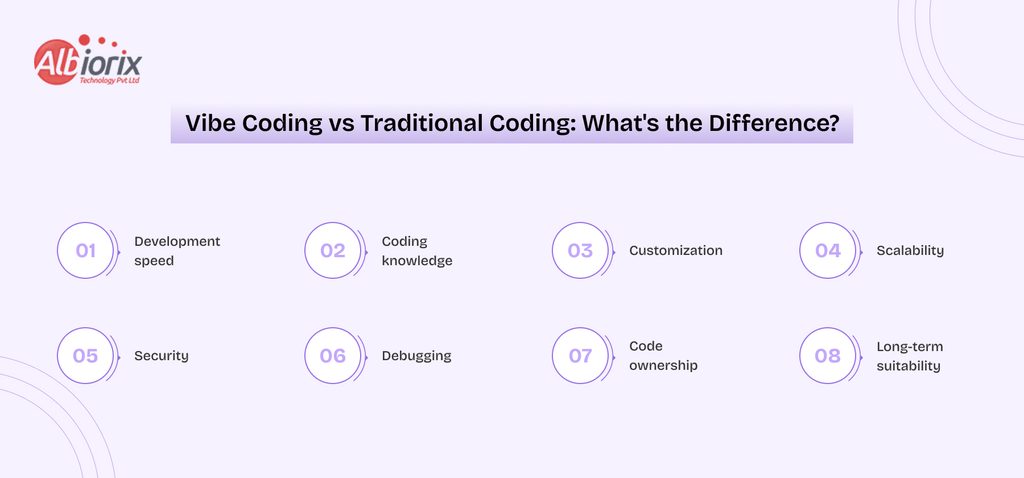
Vibe coding relies on AI that creates and edits code in response to prompts, whereas traditional coding involves writing, reviewing, and maintaining lines of code by programmers.
| Comparison | Vibe Coding | Traditional Coding |
|---|---|---|
| Development speed | Fast for prototypes and simple applications | Depends on project complexity and team experience |
| Coding knowledge | Basic knowledge may be sufficient for simple projects | Requires programming expertise |
| Customization | Depends on tool capabilities and developer control | Greater control over implementation |
| Scalability | Requires architectural review | Designed around planned architecture |
| Security | AI output needs security validation | Developers can apply established security practices |
| Debugging | AI can suggest and implement fixes | Developers investigate and resolve issues |
| Code ownership | Generated code must be understood and maintained | Developers generally have direct implementation knowledge |
| Long-term suitability | Useful for prototypes and selected applications | Essential for complex, business-critical systems |
When Should Businesses Choose Vibe Coding?
Vibe coding is great when:
- Validate an application idea quickly.
- Create an MVP for early user feedback.
- Build internal tools and simple dashboards.
- Experiment with new product features.
- Reduce repetitive development work.
When Is Traditional Software Engineering Better?
Long-term maintenance is an important consideration for engineering systems, users, and mobile content.
The practical solution is not to choose between the two. Companies can take advantage of the rapid delivery AI coding can offer, with quality and architecture in the hands of seasoned and skilled developers.
Best Vibe Coding Tools Businesses Should Know in 2027
The best vibe coding tools for your project will depend on your technical expertise and general requirements for customization, as well as the custom development workflow. Here are five proven options to try.
Tool features are based on the features offered on each tool’s product page at the time of writing. Products and features are subject to change.
1. Cursor
Designed to give developers an understanding of codebases, create features, refactor files, and fix bugs, Cursor is an AI code editor. It uses an Agent mode to allow exploration of projects, editing of several files at the same time, and execution of terminal commands.
Best for: Professional developers, engineering teams, and existing software development.
Pro: Enables integration of AI coding assistance into your current development process.
Note: Developers will still be required to review generated changes and be familiar with the underlying code.
2. Replit
Replit is an online development environment where you can develop your applications with the help of AI.
Best for: Beginners, founders, students, and developers looking to try out ideas for applications.
PRO: Integrates the user-friendly creation environment with AI building.
Note: Development applications are still in need of testing, choices of architecture, and arrangements for applications’ deployment.
3. Lovable
Encourages: Keeps users developing Applications with prompts in natural language. Its platform is used to generate the interface, logic, data, and publish.
Ideal for: User onboarding, product demos, and more.
Benefit: Facilitates quick transition from an idea to a working app, rather than hand-rolling all the bits yourself.
All output from the generated applications needs to be technically evaluated before they can execute major business functions.
4. Bolt.new
Bolt.new allows users to build and change web apps by chatting.
Ideal for: Web developers and entrepreneurs testing their new web app prototypes.
Advantage: Enables pressure-driven application development and quick iteration.
Consideration: May involve manual coding, debugging, and architecture decisions due to complex application requirements.
5. GitHub Copilot
GitHub Copilot can be used in different ways during the software development process through code suggestions, explanations, refactoring, and agentic development workflows.
Best for: Individual developers or teams of engineers who are developing using GitHub.
Pros: Can help with coding, repo context, planning, code review.
Disclaimer: Its capabilities are subject to the edition, environment, and policies.
GitHub Docs
What tool should you use? Companies can take a look at Cursor or GitHub Copilot if they have a developer-first workflow, or the likes of Lovable, Replit, and Bolt. New if they want to develop an application via prompts. The technical needs of their product will help them find the right fit, not how fast a tool types.
Will Vibe Coding Replace Software Developers by 2027?
No, vibe coding will not replace software developers by 2027. It will offer automation of certain programming tasks and alter how developers architect, develop, test, and maintain applications.
AI can write code, construct interfaces, help decode errors, write test cases, and perform the tedious work involved in development. But software development is more than just writing code.
Consider the responsibilities that still require engineering judgment:
- Software architecture: Designing systems to meet business needs as well as growth.
- Security: Detecting weaknesses and safeguarding confidential business information.
- Complex business logic: Implementing real-world business processes as robust app flows.
- System integration: Integrating applications, API, databases, payment gateways, and enterprise platforms.
- Quality assurance: Validating functionality, performance, and reliability.
- Long-term operation: Addressing changes and enhancements in requirements, as well as technical processes and versions.
Research also shows why the impact of AI should be evaluated carefully rather than assumed.
A 2026 Management Science study covering randomized experiments involving 4,867 developers at Microsoft, Accenture, and a Fortune 100 company reported an average 26.08% increase in completed tasks with AI coding assistance, although results varied across experiments.
By 2027, developers will increasingly move from writing every line of code toward directing AI agents, reviewing generated implementations, solving complex engineering problems, and ensuring software meets business requirements.
The goal shouldn’t be to replace developers with AI tools. It should be to create better software, with fewer repetitive tasks, and more robust engineering practices.
Build Smarter Software with AI and Expert Developers
Looking to integrate AI into your software development process? Albiorix combines modern AI capabilities with professional software engineering to help businesses develop secure, scalable, and customized applications.
Talk to Our Development Experts
AI Software Development Trends 2027: What Businesses Should Expect
The future of enterprise software development will be shaped by deeper collaboration between AI systems and engineering teams.
Here are some important AI software development trends 2027 is likely to bring:
- AI-powered coding: More development workflows will incorporate AI-generated code and intelligent suggestions.
- Autonomous coding agents: AI agents will increasingly handle multi-step tasks such as modifying codebases, running tests, and preparing changes for review.
- Natural-language development: Business teams will be able to communicate application requirements using everyday language.
- AI-driven testing and debugging: AI will help identify potential errors, generate test cases, and suggest fixes.
- Faster MVP development: Startups will use AI-assisted development to validate ideas and test product-market fit.
- Human-AI collaboration: Developers will combine engineering knowledge with AI-generated solutions.
- Security and governance: Businesses will place greater emphasis on code reviews, data protection, access controls, and AI governance.
These are a combination of capabilities already available and emerging developments, not guaranteed outcomes for every business in 2027.
Why Businesses Need Professional Software Developers in the Age of Vibe Coding
Although AI tools make application development more accessible, businesses cannot rely entirely on automatically generated code for complex software products.
A prototype that works during a demonstration may not be ready to support thousands of users, sensitive customer information, or critical business operations.
Professional software developers help businesses address these challenges through:
- Enterprise-grade applications: Build applications around complex business requirements.
- Custom integrations: Connect AI solutions with CRM, ERP, APIs, and existing platforms.
- Cloud infrastructure: Design reliable deployment environments and scalable systems.
- Data security: Implement authentication, access controls, and data protection measures.
- Performance optimization: Improve application speed, reliability, and resource efficiency.
- Quality assurance: Validate application functionality through structured testing.
- Long-term maintenance: Manage updates, technical improvements, and evolving requirements.
For businesses, the objective should not be to replace developers with AI tools. It should be to build better software with fewer repetitive tasks and stronger engineering practices.
How Albiorix Helps Businesses Embrace AI-Powered Software Development
However, embracing vibe coding is only one aspect of software development today. In order for your business to bring an idea to life as a high-quality digital product, it needs the right technical approach, engineering skill, and methodology.
Albiorix Technology brings together capabilities in AI and software engineering to enable startups and enterprises to create viable, scalable technology solutions.
Its capabilities include:
- Machine learning/AI app development: Develop smart apps based on your business problem.
- Custom software development: Build customized software products, enterprise applications, and digital platforms.
- AI agent development: AI agents and automation flows for the enterprise.
- LLM development: Build RAG applications, knowledge bases, and applications with LLMs.
- AI integration services: AI models and applications to your business systems.
- MVP and product development: MVP and product development: Build a working product from initial concepts.
Albiorix’s development lifecycle includes discovery, architecture, design, development, integration, testing, deployment, and optimization to ensure businesses are shifting from AI prototypes to software built for the real world.
Final Thoughts: The Future of Software Development Is Human + AI
Vibe coding is transforming the process of software development, simplifying app development, and speeding up many types of programming tasks. But it will not replace professional software developers.
By 2027, winning teams will more and more require the abilities of multiple sets of skills, including AI-powered coding, autonomous agents, and human engineering expertise.
AI can help generate code faster, but experienced developers remain essential for making software secure, scalable, maintainable, and aligned with business goals. For business, the real competitive edge will be in taking a pragmatic approach to AI rather than relying on it as a replacement for engineers.
The future of programming is not AI versus developers. It is developers building better software with AI.
If your business is exploring AI-powered applications or custom software development, Albiorix can help turn your ideas into practical digital solutions.n
Connect with Our Experts!
FAQ
Frequently Asked Questions
Vibe coding is an AI-assisted software development paradigm by which users of the application describe the application’s requirements in natural language, and the application produces (or changes) the code. Vibe coding accelerates the development of prototypes and applications by developers and non-coders.
No. Vibe coding automates a subset of programming tasks but does not eliminate the need for developers. All business applications need engineering work in areas of architecture, security, testing, integrations, scaling, and maintenance.
Yes, AI can generate operational apps with UI, app logic, and data. But production apps are more complex, and require review by humans, validation for security, testing, and continuing engineering support.
Some of the most common tools to test out are Cursor, Replit, Lovable, Bolt.new, and GitHub Copilot. They all accommodate various ways of building software, whether it’s with guidance or entirely through spoken instructions.
Vibe coding may be a good fit for prototyping, minimum viable products (MVPs), and small applications. Conventional programming will usually give you more control over implementation, and traditional programming will continue to be significant for complex, secure, and scalable systems.
Yes. As before, developers will still be responsible for writing the software architecture, more complex programming, security and AI integrations, testing, and making technical decisions. More and more, their jobs will require managing, overseeing, and auditing AI-generated code.
Vibe coding allows companies to prototype enterprise features and build certain internal apps. But deploying to the enterprise requires more engineering for security, compliance, scale, integrations, and governance.
Published Blogs
Latest Blogs : Insights and Innovations from Our Blog
Stay Ahead in Tech: Dive into our Blogs for the Latest in Software, Web, and Mobile App Development. Explore cutting-edge technologies, industry trends, and insightful updates that keep you at the forefront of the digital landscape

Our Clients

Client Showcase: Trusted by Industry Leaders
Explore the illustrious collaborations that define us. Our client showcase highlights the trusted partnerships we've forged with leading brands. Through innovation and dedication, we've empowered our clients to reach new heights. Discover the success stories that shape our journey and envision how we can elevate your business too.










We’re here to help you


