






Table of Content
- What Is AI-Powered Personalization in Video Streaming Apps?
- How Do AI Recommendation Engines Work?
- How AI Improves Content Discovery and Viewer Engagement
- Key Business Benefits of AI in Video Streaming Apps
- Real-World Examples of AI Personalization
- Essential AI Features to Consider When Building a Streaming App
- Business Considerations for AI-Powered OTT App Development
- How to Choose the Right Video Streaming App Development Company
- The Future of AI in Video Streaming apps with Albiorix
- Conclusion: Build a Smarter, More Discoverable Streaming Experience
Key Takeaways
- AI delivers personalized content recommendations based on viewer preferences and behavior.
- Intelligent discovery helps users find relevant content faster and reduces browsing friction.
- AI-powered streaming can support viewer engagement, retention, and content consumption.
- Hybrid recommendation models combine user behavior, content data, and contextual signals.
- Successful AI implementation requires quality data, scalable infrastructure, privacy, and continuous optimization.
- The right OTT app development strategy aligns AI features with business goals and measurable KPIs.
A streaming platform can offer thousands of movies, series, documentaries, and short videos, yet viewers may still struggle to find something worth watching. When users spend more time browsing than enjoying content, the platform risks losing their attention.
Artificial intelligence (AI) helps address this problem by connecting viewers with content that matches their interests, viewing history, language preferences, and current context. For Video Streaming App business, this creates opportunities to improve content discovery, encourage repeat visits, and support subscription or advertising revenue.
Understanding how AI-powered personalization works is essential for businesses planning a new OTT product or upgrading an existing platform.
What Is AI-Powered Personalization in Video Streaming Apps?
AI-powered personalization uses machine learning and related technologies to tailor content recommendations, search results, homepage layouts, and discovery features to individual viewers.
Traditional content categorization organizes videos by genre, language, release year, or popularity. Personalization goes further by considering which titles a particular viewer might find relevant.
For example, two users opening the same streaming app may see different homepage recommendations. One might receive regional dramas and documentaries, while another sees action films and international thrillers.
Depending on the platform, recommendation systems can use viewing history, searches, likes, explicit preferences, content metadata, and contextual signals such as device type or preferred language.
Personalization should also respect user consent, applicable privacy laws, and clear controls over data collection and recommendation preferences.
How Do AI Recommendation Engines Work?
AI recommendation engines analyze available data to estimate which videos are most relevant to each user. Different techniques solve different problems, and many platforms combine several approaches.
1. Collaborative filtering
Collaborative filtering identifies patterns among viewers with similar interests. If users who enjoy certain documentaries also watch a particular science series, the system may recommend that series to someone with comparable viewing patterns.
This approach can uncover interesting titles that a viewer has not searched for directly.
2. Content-based filtering
Content-based filtering recommends titles with characteristics similar to content a viewer already enjoys. These characteristics may include genre, actors, themes, language, duration, or subject matter.
For example, someone who regularly watches historical dramas might receive recommendations for other period productions.
3. Hybrid recommendation systems
Hybrid systems combine collaborative and content-based methods. This can help balance personalized suggestions with the ability to recommend newly added titles or content with limited viewing data.
The right combination depends on the size of the catalog, available data, technical budget, and audience behavior.
4. Machine learning and ranking models
A recommendation system may generate a candidate list and then rank those titles according to predicted relevance. Ranking models can consider signals such as previous interactions, recency, content availability, and user feedback.
The objective should not simply be to maximize clicks. A recommendation that attracts a click but disappoints the viewer may damage the overall experience.
5. Natural language processing and contextual recommendations
Natural language processing (NLP) can help extract meaning from descriptions, subtitles, transcripts, and search queries. It can support searches such as “lighthearted family movies in Hindi” when catalog metadata and search infrastructure support those concepts.
Finally, feedback loops allow systems to learn from actions such as playing, finishing, skipping, saving, or dismissing a title.
How AI Improves Content Discovery and Viewer Engagement
AI makes large content libraries easier to navigate by reducing the effort required to find relevant videos.
Consider a regional streaming service with films in several Indian languages. A viewer might prefer Tamil-language thrillers but also enjoy Hindi documentaries. Language-aware discovery can surface suitable titles across both preferences rather than limiting the viewer to one broad category.
AI can improve discovery through:
- Personalized homepages: Display relevant titles and recommendation rows based on individual preferences.
- Smarter search: Interpret meaningful queries instead of relying only on exact title matches.
- Niche content discovery: Surface less widely watched titles that match specific interests.
- Cross-language discovery: Help viewers find dubbed content, subtitles, or original-language productions.
- Relevant next-watch suggestions: Recommend suitable content after a movie or episode finishes.
- Personalized collections: Organize titles around themes, interests, or viewing patterns.
Better discovery may increase the likelihood that users find something they enjoy and return to the platform. However, engagement and retention also depend on content quality, pricing, streaming performance, and the overall user experience.
Planning an AI-Powered Streaming App?
Turn your streaming app idea into a practical development roadmap with AI-powered recommendations, intelligent content discovery, and personalized viewing experiences tailored to your business goals.
Explore AI Development Services
Key Business Benefits of AI in Video Streaming Apps
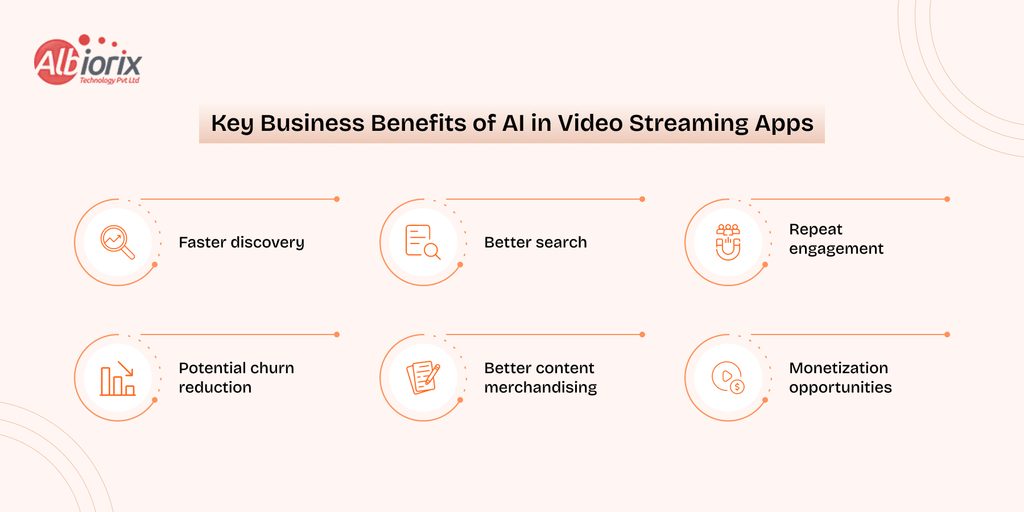
The value of AI should be assessed through measurable business outcomes rather than the number of features deployed.
| Business benefit | How it helps | Useful KPI |
|---|---|---|
| More relevant viewing | Matches titles to user interests | Recommendation click-through rate |
| Faster discovery | Reduces effort before playback | Time to first play |
| Better search | Connects queries with suitable titles | Search-to-play conversion |
| Repeat engagement | Encourages viewers to return | Weekly active viewers |
| Potential churn reduction | Helps subscribers find ongoing value | Subscriber retention and churn |
| Better content merchandising | Highlights relevant catalog titles | Plays by title or collection |
| Monetization opportunities | Supports relevant subscriptions or ad placements | Revenue per user and ad completion rate |
These metrics should be evaluated together. For example, a higher recommendation click-through rate does not necessarily indicate greater satisfaction if viewers frequently abandon the selected content.
Audience analytics can also help content teams identify underserved interests and make better-informed content acquisition decisions. Such insights are most useful when combined with editorial judgment, licensing constraints, and the platform’s business strategy.
Real-World Examples of AI Personalization
Established streaming services illustrate how personalization can support content discovery.
Netflix explains that its recommendation system considers member interactions, similar users’ preferences, title information, language, device, and viewing context. It also personalizes the selection and ordering of homepage rows. These are documented examples of personalization, not evidence that another platform will achieve identical results.
YouTube describes recommendations across its homepage and Up Next experience. Its published explanation identifies signals such as watch history, search history, subscriptions, likes, dislikes, and satisfaction feedback. Different surfaces can rely on different signals.
Amazon Prime Video has announced personalized recommendations developed with generative AI to help viewers discover relevant movies and series. This demonstrates how newer AI capabilities can complement established discovery interfaces.
The broader lesson is that personalization is not one isolated algorithm. It is a product capability that combines useful data, content organization, interface design, and ongoing evaluation.
Essential AI Features to Consider When Building a Streaming App
The right features depend on your audience, catalog, budget, and stage of growth.
For an initial release, prioritize features that solve immediate viewer problems:
- Personalized homepage rows using available viewing signals.
- Basic recommendations based on genres, preferences, and related titles.
- Search and filters for language, genre, and content type.
- Consistent content metadata and tagging.
- User profiles and preference controls.
- Analytics for playback, search, and recommendation interactions.
As the platform matures, consider hybrid recommendation models, semantic search, language-aware discovery, automated metadata enrichment, experimentation tools, and context-sensitive ranking.
A custom streaming app can tailor these capabilities to a specific audience, content catalog, and revenue model rather than adopting a generic feature set that may not fit the business.
Privacy settings, content moderation where appropriate, and controls for children’s profiles should be considered during product planning rather than added only after launch.
Business Considerations for AI-Powered OTT App Development
Successful OTT app development requires more than integrating an AI model. Businesses need a product strategy and technical foundation that support discovery, reliable playback, and sustainable operating costs.
Define the audience and monetization model
Identify your target viewers, content categories, supported regions, and devices. Decide whether revenue will come from subscriptions, advertising, transactional rentals or purchases, or a hybrid model.
These choices influence the recommendation experience. An ad-supported service, for example, must balance commercial objectives with viewer relevance and satisfaction.
Assess data readiness
Recommendation quality depends partly on the completeness and consistency of catalog metadata and interaction data. A small platform with limited viewing history may initially benefit more from explicit onboarding preferences and content-based recommendations than from a complex model trained on sparse data.
Plan architecture and scalability
Streaming platform development involves video ingestion, encoding, storage, content delivery, playback, account management, content management, analytics, and recommendation services.
AI recommendations cannot compensate for buffering, poor playback compatibility, or unreliable video delivery. Infrastructure planning should account for expected concurrent viewers, geographic coverage, and peak demand.
Evaluate cost, security, and maintenance
Costs vary with AI model selection, data pipelines, infrastructure, third-party services, integrations, and ongoing monitoring. Businesses must also consider licensing, content rights, privacy requirements, and security controls.
A phased implementation often makes more sense than building every advanced AI capability upfront. Launch with measurable priorities, validate user behavior, and expand when the data supports the investment.
How to Choose the Right Video Streaming App Development Company
A suitable video streaming app development company should understand both the viewing experience and the technical systems that support it.
Evaluate potential partners against these criteria:
- OTT and streaming experience: Ask about relevant architecture, video delivery workflows, content management, and supported devices.
- AI expertise: Discuss recommendation approaches, search capabilities, data requirements, and model evaluation.
- Scalability: Review how the proposed architecture handles growing catalogs, concurrent playback, and new regions.
- Privacy and security: Understand access controls, data handling, retention policies, and security testing.
- Analytics and experimentation: Confirm how recommendation quality and business outcomes will be measured.
- Transparent delivery: Request a clear scope, milestones, assumptions, cost breakdown, and post-launch support plan.
For businesses exploring Netflix-like app development, the goal should be to learn from familiar discovery patterns while creating a distinct product for a specific audience. Avoid copying protected branding, proprietary technology, or distinctive designs.
Albiorix Technology should explain trade-offs clearly and help prioritize features according to your business goals, rather than promising that adding AI alone will guarantee growth.
Looking for the Right Streaming Development Partner?
Discuss your streaming app requirements, AI features, integrations, and scalability goals with the Albiorix Technology team.
Talk to Our Team
The Future of AI in Video Streaming apps with Albiorix
Several capabilities are becoming increasingly relevant to streaming product roadmaps.
The future of video streaming is not just about what viewers watch, but how effortlessly they discover what they love. AI is transforming OTT platforms with intelligent content recommendations, conversational search, multilingual discovery, and personalized viewing experiences that help users find the right content at the right time. For streaming businesses, these capabilities create opportunities to boost viewer engagement, encourage repeat visits, improve retention, and stand out in an increasingly competitive market.
At Albiorix Technology, we help businesses explore AI-powered mobile apps development and custom software solutions to build smarter, more engaging video streaming applications. Whether you are launching a new OTT platform or upgrading an existing product, our focus is on identifying the right AI capabilities to match your audience, business objectives, and budget. From personalized discovery to scalable streaming solutions, we help you plan for innovation without unnecessary complexity.
Ready to take your streaming platform to the next level? Partner with Albiorix Technology to explore AI opportunities that enhance viewer experiences and support sustainable business growth.
Conclusion: Build a Smarter, More Discoverable Streaming Experience
AI can help video streaming businesses make large content libraries easier to explore, deliver more relevant recommendations, and understand viewer preferences. Its value depends on more than algorithm selection: quality metadata, reliable playback, thoughtful product design, privacy, and continuous measurement are equally important.
For companies planning OTT app development, the most effective approach is to begin with a clear audience and business model, introduce AI features that address real discovery problems, and expand as evidence and data maturity improve.
If you are planning a new streaming product or upgrading an existing platform, assess your product requirements, define a practical AI roadmap, and consult an experienced development partner to determine the right architecture and implementation priorities.
Connect with Our Experts!
FAQ
Frequently Asked Questions
AI improves video streaming apps by personalizing recommendations, enhancing search, and helping viewers discover relevant content faster. It can also help streaming businesses understand viewing behavior and improve content discovery.
AI recommendation systems analyze viewing history, user preferences, content metadata, and feedback to suggest relevant movies and shows. They may use collaborative filtering, content-based filtering, or hybrid models.
AI can help OTT platforms deliver relevant recommendations, personalized homepages, and smarter search results. These features may encourage repeat viewing and improve retention when combined with quality content and reliable streaming.
Essential features include personalized recommendations, intelligent search, content categorization, user preference profiles, and viewing analytics. Advanced platforms can add semantic search, multilingual discovery, and hybrid recommendation engines.
The cost depends on app complexity, supported devices, streaming infrastructure, AI features, integrations, and content licensing. A basic streaming app with simple recommendations requires a different budget from an enterprise OTT platform with advanced personalization.
Yes. AI can use relevant viewing patterns, preferences, and content information to tailor recommendations for individual viewers. Results depend on available data, recommendation methods, and privacy settings.
Choose a company with experience in streaming architecture, AI integration, video delivery, security, and analytics. Review relevant projects, technical proposals, development costs, and post-launch support before making a decision.
A traditional OTT app may rely mainly on categories, filters, and popular titles. An AI-powered streaming app can personalize recommendations, improve search relevance, and adapt content discovery to individual viewing preferences.
Published Blogs
Latest Blogs : Insights and Innovations from Our Blog
Stay Ahead in Tech: Dive into our Blogs for the Latest in Software, Web, and Mobile App Development. Explore cutting-edge technologies, industry trends, and insightful updates that keep you at the forefront of the digital landscape

Our Clients

Client Showcase: Trusted by Industry Leaders
Explore the illustrious collaborations that define us. Our client showcase highlights the trusted partnerships we've forged with leading brands. Through innovation and dedication, we've empowered our clients to reach new heights. Discover the success stories that shape our journey and envision how we can elevate your business too.










We’re here to help you


