






Table of Content
- What Are Product Development Services and What Do They Actually Cover?
- What Should a Product Development Strategy Decide Before Engineering Begins?
- What Does the Product Development Process Look Like From Idea to Launch?
- Real-Life Example: How Myntra Turns Everyday Friction Into Better Product Experiences
- Who Should Be Part of a High-Performing Product Development Team?
- What Really Determines Product Development Costs?
- When Does Product Engineering Become More Important Than Simply Developing Features?
- How Does Enterprise Software Product Development Differ From Building an MVP?
- How Should You Choose the Right Product Development Partner?
- A Takeaway for Business Leaders Before Starting Product Development
Key takeaways:
- Strategy comes before development: A strong product starts with a clearly defined business problem, target user, value proposition, and measurable outcome.
- Validation reduces expensive assumptions: Testing market demand and product feasibility early helps teams avoid investing heavily in features customers may not need.
- Planning connects vision with execution: Effective product development planning establishes priorities, scope, timelines, dependencies, and a realistic path from MVP to scale.
- The right team goes beyond developers: Successful products bring together product thinking, UX, engineering, quality, cloud, security, and business expertise.
- Cost depends on complexity, not feature count alone: Architecture, integrations, platforms, compliance, security, AI requirements, and scalability can significantly influence development investment.
- Engineering decisions shape long-term growth: Architecture and technology choices made early can affect performance, maintainability, security, and the ability to scale later.
- MVP and enterprise products require different priorities: MVPs emphasize validation and learning, while enterprise products demand stronger governance, integration, reliability, security, and scalability.
- Launch is the beginning of the product lifecycle: Strong Product Development Services continue beyond release through measurement, user feedback, optimisation, and ongoing product evolution.
A good idea is not automatically a good product. Businesses often know the problem they want to solve, but turning that opportunity into something customers will adopt, employees can rely on, and the business can scale is a much harder challenge.
Today, a product has to do more than work. It needs to solve a genuine user problem, deliver an intuitive experience, integrate with existing systems, protect sensitive data, perform reliably, and continue evolving as customer expectations change. Studies suggest that consumers worry about data privacy and security when using digital services, showing how expectations now extend far beyond features and functionality.
This is why businesses need Product Development Services. They bring product strategy, market validation, UX, engineering, testing, and continuous improvement into one coordinated process. Instead of committing significant budgets to assumptions, businesses can validate what deserves to be built, decide what should come first, and create the technical foundation needed for future growth.
The goal is not simply to take an idea and turn it into software. It is to reduce the distance between what the business wants to build, what customers actually need, and what can succeed in the market.
What Are Product Development Services and What Do They Actually Cover?
Closing that gap requires more than software development alone. It requires business strategy, user insight, design, and engineering to work together throughout the product lifecycle.
Product development typically covers everything from understanding the problem and validating market demand to defining scope, designing the experience, engineering and testing the product, launching it, and improving it using real-world feedback.
A digital product development company brings these capabilities together, while custom product development adapts the approach to specific users, systems, integrations, and growth goals.
The result is a continuous cycle of validate → build → learn → improve, rather than a one-time journey from requirements to release.
What Should a Product Development Strategy Decide Before Engineering Begins?
Before the first sprint begins, a product development strategy should give leadership five decisions to be confident in. These are five gates through which the idea must pass:
- Problem → Is it worth solving?
Confirm that the problem is real, recurring, and important enough to justify investment. - Market → Is there a place for it?
Identify who needs the product, what alternatives they use, and where the opportunity exists. - Value → Why will people choose it?
Define the outcome that makes the product genuinely useful or commercially relevant. - Scope → What deserves to be built first?
Separate MVP essentials from features that can wait until demand is proven. - Scale → What happens if it succeeds?
Plan for future users, integrations, security requirements, and operational complexity.
Why does validation matter?
40% of new-business failures are due to lack of product-market fit, according to McKinsey, making validation of customers and markets before heavy engineering investment critical.
It’s not about predicting everything. It’s to kill the expensive assumptions before they turn into expensive builds. Albiorix’s Product Development Services focus on prototyping and early validation before full-scale development.
Have a Product Idea but Too Many Decisions Ahead?
Turn early assumptions into a clear product roadmap with the right strategy, validation, design, and engineering expertise behind every decision.
Plan Your Product With Us
What Does the Product Development Process Look Like From Idea to Launch?
The best way to build a software product is to make sure every stage ends with something tangible: a decision, a document, or a working release.
- Discover: a clear problem statement backed by user and market research
- Validate: prototype feedback that confirms, or challenges, real demand
- Plan: a prioritised roadmap and a defined MVP scope
- Design: tested workflows and interface designs
- Build: secure, working product increments
- Test: QA, performance, and security sign-off
- Launch: a production release with monitoring in place
- Improve: a backlog shaped by real user data
Skipping a deliverable usually means the problem resurfaces later, at a higher cost. Treating these stages as connected rather than separate phases is what keeps the product moving from idea to launch without losing direction.
Now, let us take a look at a real life example of Myntra and how it utilizes AI across customer discovery and product development.
Real-Life Example: How Myntra Turns Everyday Friction Into Better Product Experiences
For a platform like Myntra, product development is not about launching an app and simply adding more features. It means continuously finding friction across the shopping and selling journey and building technology that removes it.
Myntra offers a recent example. The company has expanded AI across customer discovery, sizing, seller onboarding, catalogue management, customer support, and its own development processes.
For shoppers, 90% of monthly active users now experience personalised search, while its Size and Fit Intelligence covers around 85% of eligible apparel, helping customers make more informed sizing decisions. Its Contextual Styling Suite is also designed to move discovery beyond individual products by suggesting relevant looks and styling combinations.
The improvements extend beyond customers. Myntra’s AI-powered Seller Growth Hub has reduced seller onboarding from 10–15 days to around 1–2 days, while catalogue generation has fallen from roughly one day to four hours. AI-assisted development has also helped the company increase the speed of feature rollouts by 40%.
The product development pattern is clear:
Identify friction → Understand the user or business need → Build the right capability → Measure its impact → Keep improving
Myntra demonstrates that product development does not end when a platform reaches the market. Mature digital products continue evolving around real customer behaviour, operational bottlenecks, seller needs, and new technology.
For businesses, that is the larger lesson: the value of product development lies not in how many features are shipped, but in how effectively each improvement solves a real problem and strengthens the overall product experience.
Who Should Be Part of a High-Performing Product Development Team?
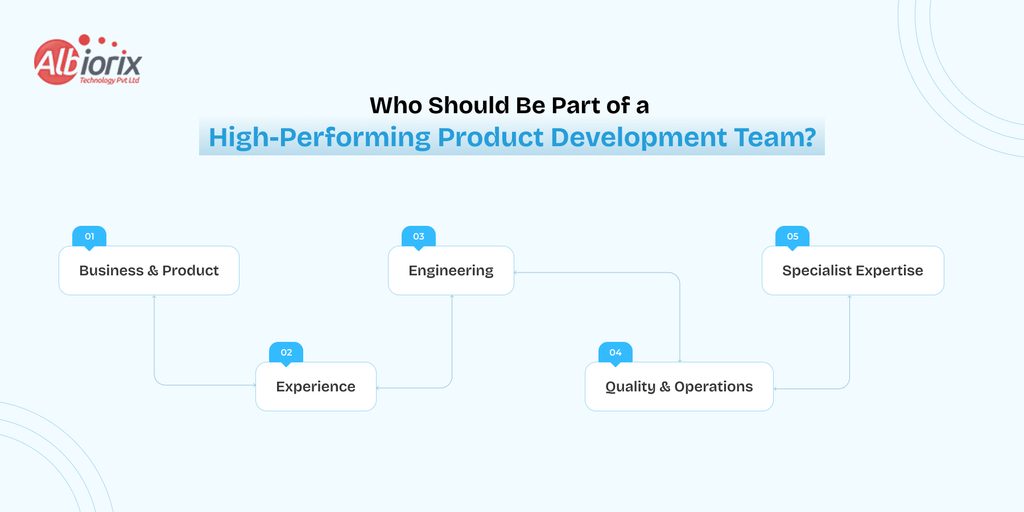
A strong product development team is not just a bigger engineering team. It brings together the people responsible for the system design, functionality and scalability.
Business & Product
Product Owner • Business Analyst • Product Manager
Direction, priorities, requirements
Experience
UX Researcher • UI/UX Designer
User journeys, usability, product experience
Engineering
Architect • Frontend & Backend Developers • Mobile Engineers
Architecture, development, integrations
Quality & Operations
QA • DevOps • Security Specialists
Testing, deployment, reliability, security
Specialist Expertise
AI • Data • Cloud Engineers
Added where the product or business case requires it
The objective is not to fill every position. The goal is to build the right combination of expertise relative to the maturity, complexity and growth aspirations of the product.
What Really Determines Product Development Costs?
Instead of asking “What is the cost of construction?” leadership teams should ask “What is the product being asked to accomplish?” That answer determines most of the costs of product development.
More investment is typically required when the product has:
- Complex workflows → Advanced features, automation, multiple user roles
- Experience demands → Custom UX, accessibility, multi-device experiences
- Connected systems → CRM, ERP, payment gateways, APIs, legacy platforms
- AI & data layers → Models, data pipelines, analytics, processing infrastructure
- Higher assurance → Security, compliance, testing, governance
- Scale requirements → Cloud infrastructure, performance, availability
- Long-term ownership → Monitoring, upgrades, support, continuous improvement
In simple terms:
Cost is shaped by what you build + how complex it is + how reliably it needs to operate.
The goal is not necessarily to build cheaper. It is to invest where the product creates measurable business value.
Know What You Want to Build, but Not What It Will Take?
Get a clearer view of the scope, technical requirements, priorities, and development effort before making a major product investment.
Plan Your Product Investment
When Does Product Engineering Become More Important Than Simply Developing Features?
Eventually adding fresh capabilities stops being the toughest task in creating a product. When uptake increases, the genuine difficulty turns into maintaining speed, safety, dependability, and ease of modification.
Here product engineering turns critical. Rising traffic pressures performance and infrastructure, fresh integrations raise architectural complexity, and bigger data volumes demand stronger security and governance. Meanwhile, regular releases need better automation, DevOps, and monitoring, yet growing engineering teams require maintainable code and consistent technical standards.
Thus attention moves away from “Which capability needs building soon?” toward “Will the system enable where commerce heads next?”.
How Does Enterprise Software Product Development Differ From Building an MVP?
The simplest method to grasp the distinction involves examining what every single item requires proving.
An MVP needs to prove the idea
It centers on core functions, quicker launch times, initial uptake, and client responses. Design elements and capabilities are intentionally restricted to only what is needed to verify if the item warrants additional funding.
A company item has to show that it works on a large level
Building enterprise software products needs to handle integrations, permissions based on roles, security rules, governance, dependability, speed, and future upkeep starting way back at the beginning of the cycle.
The decision changes with maturity
- MVP → Validate the opportunity
- Growth → Strengthen the foundation
- Enterprise → Scale with control
The aim shifts from showing “people require this” to making sure “the organization relies on this.”
How Should You Choose the Right Product Development Partner?
A proper partner needs to do much more than just turn requirements into actual code. They need to assist with deciding if these requirements actually work well for the product, the users, and the business too.
Before choosing a partner, ask:
- Product thinking: Are they challenging assumptions and helping to refine the roadmap?
- Practical history: Did they move items past models to actual application?
- Technical capacity: Are they able to manage design, connections, clouds, safety, and growth?
- Visibility of delivery: Will there be distinct ownership, communication, and progress clarity?
- Post-release ability: Will they enable tuning and later updates following launch?
The best Product Development Services ought to link business goals with actual tech choices, providing leaders clear views across the full product life cycle.
A Takeaway for Business Leaders Before Starting Product Development
A successful digital product is not defined by how quickly development begins. It is defined by how confidently the right product decisions are made before, during, and after the build.
Validate the problem before expanding the scope. Build around genuine user needs. Make technology decisions with tomorrow’s scale in mind. And treat launch as the beginning of learning, not the end of delivery.
With the right Product Development Services, businesses can bring strategy, experience, and engineering into one connected journey. At Albiorix Technology, we help organisations turn product ideas into scalable digital solutions designed around real business requirements and long-term growth.
Ready to Move From Product Decisions to Product Delivery?
Bring strategy, design, and engineering together to build a product that is ready for today’s users and tomorrow’s growth.
Build Your Product With Us
Connect with Our Experts!
FAQ
Product Development Services bring together product strategy, UX/UI design, software engineering, testing, deployment, and ongoing improvement to take a digital product from initial concept to market and beyond.
The typical stages include discovery, idea validation, planning, UX/UI design, development, testing, launch, and continuous improvement. The exact lifecycle varies according to product complexity, market requirements, and business goals.
Development timelines depend on scope, technical complexity, platforms, integrations, team size, and testing requirements. An MVP may require a shorter development cycle, while complex enterprise platforms generally require phased delivery over a longer period.
There is no universal development cost. Investment depends on features, UX complexity, technology choices, integrations, infrastructure, security, compliance requirements, team composition, and ongoing maintenance.
Product development covers the broader journey from idea validation and strategy through design, development, and launch. Product engineering focuses more deeply on the technical foundation required to keep the product scalable, reliable, secure, and maintainable.
It should define the customer problem, target market, value proposition, product priorities, MVP scope, success measures, technology considerations, roadmap, and approach to future growth.
An MVP can help startups test their most important assumptions with real users before committing resources to a larger build. The goal is to learn what customers value and use that evidence to guide subsequent investment.
Look beyond technical skills. Evaluate relevant product experience, strategic thinking, design and engineering capabilities, communication practices, security expertise, scalability experience, and the ability to support the product after launch.
Published Blogs
Latest Blogs : Insights and Innovations from Our Blog
Stay Ahead in Tech: Dive into our Blogs for the Latest in Software, Web, and Mobile App Development. Explore cutting-edge technologies, industry trends, and insightful updates that keep you at the forefront of the digital landscape

Our Clients

Client Showcase: Trusted by Industry Leaders
Explore the illustrious collaborations that define us. Our client showcase highlights the trusted partnerships we've forged with leading brands. Through innovation and dedication, we've empowered our clients to reach new heights. Discover the success stories that shape our journey and envision how we can elevate your business too.










We’re here to help you


