






Table of Content
- What Is Software Product Development?
- Software Product Development vs Custom Software Development
- Types of Software Products Businesses Can Build
- Software Product Development Process
- How Much Does Software Product Development Cost in 2026?
- How Long Does It Take to Develop a Software Product?
- How AI Is Changing Software Product Development in 2026
- Build In-House vs Outsource Software Product Development
- How to Choose a Software Product Development Company
- Best Practices for Successful Software Product Development
- Why Choose Albiorix Technology for Software Product Development?
- Final Thoughts
Summary
A strategic product development approach creates a scalable product with long-term business value.
Software product development is a strategic business process, not just coding.
Start by validating the idea, market demand, and customer needs.
Build an MVP with essential features to launch faster and reduce risks.
Choose a scalable, secure, and future-ready technology architecture.
Use customer feedback and data to continuously improve the product.
AI can add value through automation, intelligent workflows, personalization, and AI-powered features.
Businesses can build in-house, buy existing software, or partner with a development company.
The right technology partner can help reduce development complexity and accelerate time to market.
Software product development has become a strategic growth driver in 2026. AI, cloud computing, automation, cybersecurity, and changing customer expectations are reshaping how businesses turn ideas into scalable digital products. Whether you are a startup founder, CTO, product manager, or enterprise leader, successful product development requires more than writing code—it requires validating the right problem, defining a clear product strategy, building an effective MVP, and continuously improving the product after launch.
What Is Software Product Development?
Software product development is the process of researching, designing, building, launching, and continuously improving software intended for repeated use by a target market. Unlike simply developing software for one business requirement, product development focuses on creating a solution that delivers measurable value to multiple users or customers.
The goal is not just to build features. It is to solve a meaningful problem, achieve product-market fit, and create a product that can evolve with customer needs.
A typical product team combines product management, UX/UI design, engineering, QA, business strategy, and customer feedback. For example, instead of building an internal appointment system for one clinic, a company might develop a SaaS appointment platform that hundreds of clinics can subscribe to.
Software Product Development vs Custom Software Development
The key difference is who the software is designed for and how it will evolve.
| Factor | Product Development | Custom Software Development |
|---|---|---|
| Users | Multiple customers/market | Specific organization |
| Objective | Build a scalable product | Solve a defined business need |
| Business model | SaaS, license, usage-based | Usually project-based/internal |
| Roadmap | Continuously evolving | Based on client requirements |
| Scalability | Designed for broader adoption | Designed around one organization |
| Example | CRM SaaS platform | Custom CRM for one company |
A software product begins with a market problem and continues evolving after launch, while custom software is typically delivered around a specific organization’s requirements.
Types of Software Products Businesses Can Build
SaaS Products
SaaS products are cloud-based applications accessed through browsers or APIs, often using subscription or usage-based pricing. Multi-tenancy, billing, authentication, cloud infrastructure, and scalability are important considerations.
Enterprise Software
Enterprise products include ERP, CRM, workflow automation, analytics, compliance, and industry-specific platforms. They often require complex integrations, advanced security, role-based access, and scalable architecture.
Web Applications
Web applications operate through browsers and can support business processes such as e-commerce, collaboration, customer portals, marketplaces, and dashboards. Responsive UX, APIs, cloud deployment, and performance are critical.
Mobile Software Products
Businesses can develop native iOS and Android applications or use cross-platform frameworks. Mobile product development requires careful attention to mobile UX, performance, security, notifications, and scalability.
AI-Powered Software Products
AI-powered products can use generative AI, machine learning, recommendation engines, conversational interfaces, intelligent automation, and AI agents. Responsible AI, privacy, data quality, security, and human oversight should be considered from the beginning.
Developer Tools and APIs
APIs, SDKs, infrastructure platforms, and developer tools can become software products themselves. Their success depends heavily on documentation, developer experience, reliability, integrations, and scalable infrastructure.
Software Product Development Process
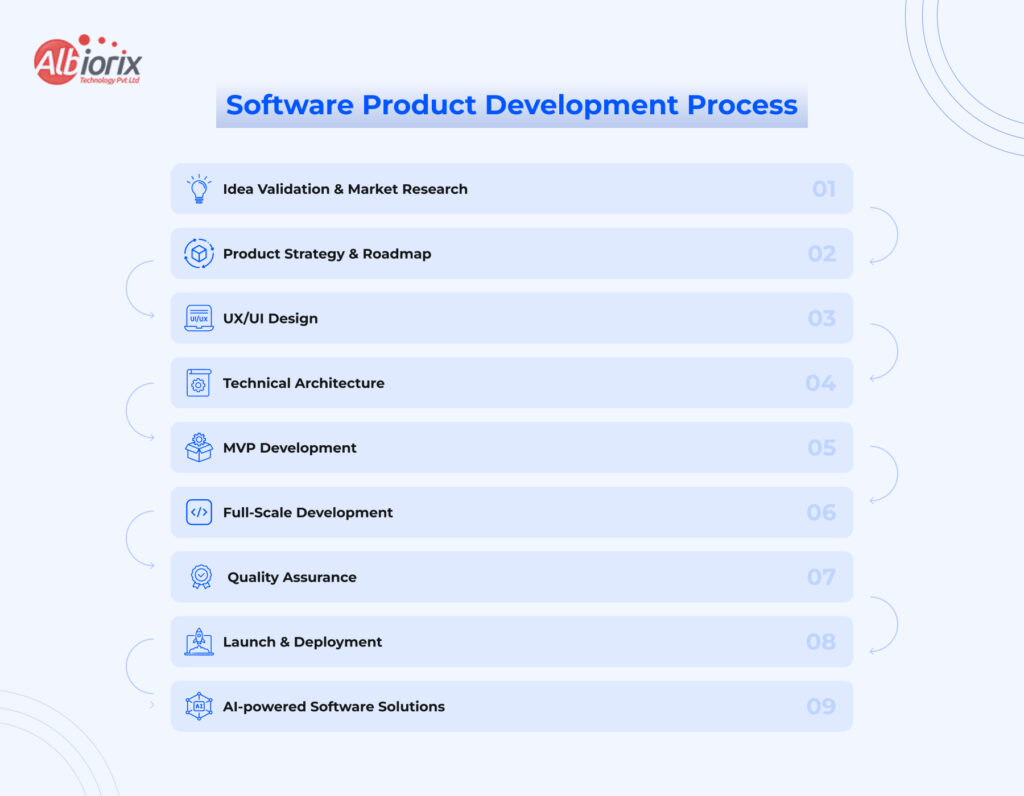
The software product development process varies by product complexity, industry, business model, and software product development methodology. A practical lifecycle includes these stages:
1. Idea Validation & Market Research
Start by identifying the problem rather than immediately defining features. Research target customers, competitors, market demand, pain points, and willingness to pay. Early validation reduces the risk of investing heavily in a product nobody needs.
2. Product Strategy & Roadmap
Define the product vision, business objectives, target users, KPIs, core features, and product roadmap. A strong software product development strategy connects every major feature to a measurable customer or business outcome.
3. UX/UI Design
Design user flows, wireframes, prototypes, interfaces, and design systems. Usability testing and accessibility checks help identify problems before development becomes expensive.
4. Technical Architecture
Choose the appropriate technology stack, database architecture, APIs, cloud infrastructure, security model, and third-party integrations. Architecture should support current requirements without creating unnecessary complexity.
5. MVP Development
An MVP development is the smallest usable version that tests the product’s core value proposition. The objective is learning—not building every planned feature. A focused MVP allows businesses to collect feedback and make better investment decisions.
Ready to Build Your MVP?
Turn your product idea into a focused, market-ready MVP with the right features, technology, and development roadmap:
[Get Your MVP Development Plan →]
6. Full-Scale Development
Once the core concept is validated, teams can expand functionality, integrations, performance, security, and scalability through iterative Agile development.
7. Quality Assurance
QA should run throughout the software product development lifecycle. Functional, integration, performance, usability, security, automated, and regression testing help maintain product reliability.
8. Launch & Deployment
Production deployment involves cloud infrastructure, CI/CD, monitoring, security checks, release management, and user onboarding. A successful launch also requires a clear go-to-market plan.
9. Post-Launch Product Development
Launch is not the end. Analytics, user feedback, bug fixes, feature improvements, A/B testing, security updates, performance optimization, and scaling should continuously shape the roadmap.
How Much Does Software Product Development Cost in 2026?
There is no universal software product development cost because scope, complexity, team composition, integrations, security, AI requirements, and platform choices can significantly change the budget.
Indicative 2026 ranges are:
- MVP/basic product: $40,000–$100,000+
- Mid-complexity product: $100,000–$300,000+
- Complex/enterprise-grade product: $300,000–$1M+
These are planning ranges, not fixed quotations. For comparison, the reference market guide places focused SaaS MVPs around $50,000–$120,000 and enterprise product MVPs around $200,000–$500,000, demonstrating how significantly product scope affects investment.
Major cost drivers include features, UX/UI, development location, team size, AI integrations, infrastructure, third-party services, compliance, and ongoing maintenance.
Get a Custom Software Product Development Estimate
Product development costs vary based on features, integrations, technology, AI requirements, and scalability. Get an estimate tailored to your product requirements:
Request a Project Estimate →
How Long Does It Take to Develop a Software Product?
A typical timeline can look like this:
- Discovery and validation: 2–6 weeks
- Strategy and UX/UI: 3–8 weeks
- MVP development: 2–5 months
- Testing and launch: 3–8 weeks
- Post-launch iteration: Continuous
A focused SaaS MVP can take roughly 8–16 weeks with a dedicated team, while larger enterprise products can require 12–24 months depending on scope, integrations, compliance, and organizational approvals.
How AI Is Changing Software Product Development in 2026
AI is increasingly becoming a product capability rather than simply a development tool.
Businesses can integrate AI into software products through:
- AI-powered assistants
- Intelligent search
- Predictive analytics
- Recommendation engines
- Generative AI
- AI agents
- Automated workflows
- Natural language interfaces
- Document intelligence
- Personalized user experiences
The strategic question is not whether a product should use AI simply because AI is popular. Instead, businesses should identify where AI can create measurable value.
For example, an AI agent development service may automate a multi-step workflow, while generative AI may improve customer support or content creation. Predictive models may help businesses identify patterns that would otherwise remain hidden.
AI should therefore be connected to a clear product objective, measurable KPI, and appropriate data strategy.
Build In-House vs Outsource Software Product Development
In-house development offers greater direct control, stronger domain knowledge, and long-term internal capability, but hiring and retaining specialized talent can be expensive and slow.
Outsourcing can provide faster access to engineering, UX, QA, cloud, and AI expertise with a more flexible cost structure.
A hybrid or co-development model can work well when a company owns the product vision but needs additional technical capacity. The best choice depends on budget, urgency, internal expertise, IP requirements, and long-term strategy.
How to Choose a Software Product Development Company
A specialized development partner can provide access to a multidisciplinary team without requiring a business to build the entire engineering organization internally.
This model can be particularly useful for startups, SMBs, and enterprises that need to accelerate product development while maintaining flexibility.
The right choice depends on your product complexity, internal capabilities, budget, timeline, IP requirements, and long-term strategy.
Best Practices for Successful Software Product Development
Successful products usually follow a disciplined but flexible approach:
- Start with a validated customer problem.
- Define measurable product and business goals.
- Prioritize a focused MVP.
- Use Agile and iterative development.
- Involve users early.
- Build architecture with future scalability in mind.
- Integrate security throughout development.
- Automate testing and deployment where practical.
- Use analytics to guide product decisions.
- Create continuous customer feedback loops.
- Use AI strategically rather than simply adding AI features.
- Maintain technical and product documentation.
- Budget for long-term maintenance and evolution.
The strongest software product development lifecycle treats launch as a milestone, not a finish line.
Why Choose Albiorix Technology for Software Product Development?
Albiorix Technology can support businesses across the product journey—from idea validation and product strategy to MVP development, launch, and ongoing scale.
Its capabilities can cover software product development services, UI/UX design, MVP development, full-cycle web and mobile development, AI-powered products, cloud architecture, QA, testing, maintenance, and post-launch support.
For businesses evaluating a new SaaS platform, enterprise application, mobile product, or AI-powered solution, the right approach is to align product goals, technology, user experience, security, and scalability from the beginning.
Final Thoughts
Software product development is no longer simply about transforming requirements into code. It is a strategic process that connects customer problems, product strategy, technology, design, engineering, and long-term business growth.
Whether you are launching a SaaS startup, developing an enterprise platform, modernizing an existing product, or introducing AI-powered capabilities, the decisions made before and during development can determine the product’s long-term success.
The smartest approach is to validate first, build strategically, launch with purpose, measure real-world performance, and continuously evolve the product.
Have a software product idea? Discuss your requirements with Albiorix Technology and explore a practical path from idea → validation → MVP → launch → scale.
Connect with Our Experts!
FAQ
Software product development is the end-to-end process of creating, launching, and continuously improving software designed for a target market. It includes discovery, strategy, UX/UI, architecture, development, QA, deployment, and post-launch optimization.
The main stages include idea validation, product strategy, UX/UI design, technical architecture, MVP development, full-scale development, quality assurance, launch, and continuous post-launch improvement.
Indicative costs can range from around $40,000 for a focused MVP to $1M or more for complex enterprise products. Actual pricing depends on features, technology, team size, integrations, AI requirements, security, and compliance.
A focused MVP may take approximately 2–5 months, while medium-complexity products can require 6–12 months and enterprise-grade products may take 12–24 months. Scope and complexity have the greatest impact on timelines.
Product development creates software intended for repeated use by a market or customer base, while custom software is usually created around the requirements of one organization. Product development therefore places greater emphasis on scalability, product-market fit, and continuous evolution.
In-house development can make sense when software is core intellectual property and a company has strong internal engineering capability. Outsourcing or co-development may be better when speed, specialized expertise, or flexible team capacity is more important.
AI can accelerate coding, testing, research, prototyping, documentation, and product personalization. It also enables AI-native products, intelligent automation, and AI agents. Human oversight remains essential for security, privacy, accuracy, governance, and responsible implementation.
Evaluate product experience, technical expertise, UX/UI capabilities, AI and cloud skills, QA, security, communication, pricing transparency, support, and relevant portfolio examples. Choose a partner based on product expertise and business outcomes—not simply the lowest hourly rate.
Published Blogs
Latest Blogs : Insights and Innovations from Our Blog
Stay Ahead in Tech: Dive into our Blogs for the Latest in Software, Web, and Mobile App Development. Explore cutting-edge technologies, industry trends, and insightful updates that keep you at the forefront of the digital landscape

Our Clients

Client Showcase: Trusted by Industry Leaders
Explore the illustrious collaborations that define us. Our client showcase highlights the trusted partnerships we've forged with leading brands. Through innovation and dedication, we've empowered our clients to reach new heights. Discover the success stories that shape our journey and envision how we can elevate your business too.










We’re here to help you


