






Angular is an in-demand and open-source framework that has come up with astonishing updates of the new version. Yes, you read it right.
Angular 15 is now live.
After the successful launch of Angular 14, Angular 15 is back with more and more exciting updates and allowing Angular developers in building robust applications.
Yeah, I know you all are too enthusiastic to see what’s new in Angular 15. So, let’s start to see what new updates have been introduced in the latest Angular version 15.
Key Takeaways
- Angular, the most popular front-end framework, has officially jumped into the new version of Angular 15.
- The Angular development team has primarily focused on stability concepts.
- We’ve highlighted a detailed overview of the latest features of Angular 15 along with the new updates that the Angular team at Google has included in the Angular 15 release.
- A step-by-step guide to upgrading from Angular 14 to Angular 15 is shown with an example.
What is New in Angular 15?
Angular 15 was released on 16th November 2022 and brought several useful improvements that developers had been hoping for.
One of the most notable updates is the simplified standalone components, which reduce the need for NgModules, making code cleaner and easier to manage. Angular 15 also improved server-side rendering and made the CLI faster and more efficient.
These updates help developers build more efficient applications with less setup. For anyone working with Angular, these changes make the framework easier to use and more powerful for modern web development.
Angular 15 came with some limelight and interesting new features like
- Stable standalone components API
- Develop a multi-route application
- Directive Composition API
- Stable “NgOptimizedImage” Image Directive
- Easily Reduce Boilerplate in Guards
- Better Stack Traces For Debugging Process
- CDK Listbox
- ESBuild Support of Angular 15
Sounds interesting, Right. These are the major updates that are introduced in the Angular 15 version. We’ve highlighted detailed information on all such major features of Angular latest version 15.
In this article, I hope that you have a clear idea of what is Angular and what it’s main used for.
Develop User-Friendly Web Applications with Angular 15
We have a team of Angular developers who are proficient in developing web and mobile apps using Angular version 15.
What are the Angular 15 Features?
Yeah! I know you all are too much excited to know about the inspiring features that are introduced in Angular 15. Let’s get a deep dive into all the technical aspects of current Angular version 15.
1. Stable Standalone Components API
Angular 15 introduced the Stable Standalone Components API, making it easier to build applications without using NgModules. This is a big change because it simplifies how developers structure and start Angular apps.
With this update, you can now bootstrap an Angular app using just one component, which makes development cleaner and faster. The standalone components also work fully with Angular features like HttpClient, routing, and Angular elements.
This update is ideal for both beginners and experienced developers. It provides a smoother learning path and reduces complexity in building modern Angular applications.
By becoming a stable feature in Angular 15, standalone components reflect the framework’s focus on performance and flexibility, and they are now supported across the entire ecosystem.
This means you can confidently use them in real-world projects, backed by Angular’s official guidance and documentation—making your development experience more efficient and reliable.
Copy
import {bootstrapApplication} from '@angular/platform-browser';
import {ImageGridComponent} from'./image-grid';

@Component({
 standalone: true,
 selector: 'photo-gallery',
 imports: [ImageGridComponent],
 template: `
   ... <image-grid [images]="imageList"></image-grid>
 `,
})
export class PhotoGalleryComponent {
 // component logic
}

bootstrapApplication(PhotoGalleryComponent);
In the above code, you can see that it mentions “standalone: true”. That’s an example of a standalone component API.
So, you do not have to declare components, directives, and pipes into NgModule. If you do that mistake, get ready to receive a big error on your screen.
With the help of stable Standalone APIs, you can effectively create Multi-Route Application
- By using the new router standalone APIS, it becomes easy for you to design and build a multi-route application for your business needs.
- Moreover, bundlers in Angular 15 are solely responsible for reducing the bundle size by reducing the unused features of the router, especially at the build time.
In case, if you want to import NgModule in your standalone component APIs of Angular application, do it by simply writing import: [module_name] and you are good to go.
Often, there exist many advantages to using the Angular framework, but Angular 15 possess more functionalities as compared to previous versions.
2. You Can Now Easily Develop a Multi-Route Application
Yes, you read it right. Angular 15 is now ready with an essential functionality named router standalone API that makes it easy for you to build multi-route applications.
First, let’s declare the root route for your Angular application.
Copy
export const appRoutes: Routes = [{
 path: 'lazy',
 loadChildren: () => import('./lazy/lazy.routes')
   .then(routes => routes.lazyRoutes)
}];
Next, you can declare lazyRoutes as:
Copy
import {Routes} from '@angular/router';

import {LazyComponent} from './lazy.component';

export const lazyRoutes: Routes = [{path: '', component: LazyComponent}];
Remember that you have to register the appRoutes in the bootstrapApplication method and call it using the ProvideRouter API, which is tree-shakable!
Copy
bootstrapApplication(AppComponent, {
 providers: [
   provideRouter(appRoutes)
 ]
});
3. Angular 15 Comes With Directive Composition API
All Angular developers working with leading AngularJS development company, including me, were waiting for a feature where we could easily reuse the directives.
And that’s what the Angular team made possible for us by including Standalone Directive Composition API and made our development experience smooth.
Want to know how? Directive Composition API makes code usability enhancement and boosts host elements with directives. However, always remember that Directive Composition works only with standalone directives.
Copy
@Component({
 selector: 'mat-menu',
 hostDirectives: [HasColor, {
   directive: CdkMenu,
   inputs: ['cdkMenuDisabled: disabled'],
   outputs: ['cdkMenuClosed: closed']
 }]
})
class MatMenu {}
You can see from the above code that the “MatMenu” selector has two hostDirectives: HasColor and CdkMenu.
It means that MatMenu can reutilize all the properties from these two directives. Simply put, it can be inherited with the inputs, outputs, and logic associated with the HasColor directive and only logic and input from CdkMenu.
4. Stable “NgOptimizedImage” Image Directive
In the Angular 14 version, we’ve seen that one of the best ways to load image performance was by using the NgOptimizedImage directive. But it’s good news for Angular developers that the option of Image directive has become stable now.
With the launch of Angular 15, there are some minor updates in NgOptimizedImage
- Automatic srcset Generation: You can now automatically generate srcset for uploading an appropriately sized image when requested. It’s going to minimize the image download time.
- Fill Mode [experimental]: This feature of Angular 15 eliminates the need for declaring image dimensions and will fill an image to its parent container. Trust me; it’s a pretty compelling model when the i image dimensions are unknown to web developers or you need to migrate the CSS background image to use the image directive.
Now, let’s see how we can use the standalone NgOptimizedImage directive.
You can use NgOptimizedImage inside your Angular component or NgModule.
Copy
import { NgOptimizedImage } from '@angular/common';

// Include it into the necessary NgModule
@NgModule({
 imports: [NgOptimizedImage],
})
class AppModule {}

// ... or a standalone Component
@Component({
 standalone: true
 imports: [NgOptimizedImage],
})
class MyStandaloneComponent {}
You just have to replace image src with ngsrc, especially when you’re using an Angular image directive within a specified component. It plays a vital role in determining the priority attribute to optimize the speed for the LCP images.
5. Easily Reduce Boilerplate in Guards
It’s a practical concept. So, let’s dive deep into the example without taking much time. First, we’ve defined guards to verify whether the user has logged in.
Copy
@Injectable({ providedIn: 'root' })
export class MyGuardWithDependency implements CanActivate {
 constructor(private loginService: LoginService) {}

 canActivate() {
   return this.loginService.isLoggedIn();
 }
}

const route = {
 path: 'somePath',
 canActivate: [MyGuardWithDependency]
};
Here, you can see that LoginService contains the main logic, wherein the guard – only isLoggedIn() is one trigger invoked. As many boilerplates are included in this code segment, need to reduce it to the maximum.
Thanks to Functional Router Guards, you can easily refactor code into the given-below code with the necessary boilerplates.
Copy
const route = {
 path: 'admin',
 canActivate: [() => inject(LoginService).isLoggedIn()]
};
One of the excellent parts about Functional Guards is that they are purely compostable.
So, it brings convenience to you in many ways, including building robust functionalities like factor-like functions, accepting a given configuration and returning a guard or function that resolves a matter.
6. Better Stack Traces For Debugging Process
Angular’s latest version has made debugging much easier by improving how stack traces are shown.
Now, when an error occurs, developers see clearer and more helpful messages that directly point to the problem in their own code, not in third-party libraries. This saves time and reduces confusion during development.
Previously, Angular’s stack traces often showed long and complex outputs, making it hard to spot the actual issue.
With this improvement, developers can now identify and fix bugs more quickly and confidently, making the development process smoother and more reliable.
First, let’s see the snippet for previous error indications:
Copy
ERROR Error: Uncaught (in promise): Error
Error
   at app.component.ts:18:11
   at Generator.next (<anonymous>)
   at asyncGeneratorStep (asyncToGenerator.js:3:1)
   at _next (asyncToGenerator.js:25:1)
   at _ZoneDelegate.invoke (zone.js:372:26)
   at Object.onInvoke (core.mjs:26378:33)
   at _ZoneDelegate.invoke (zone.js:371:52)
   at Zone.run (zone.js:134:43)
   at zone.js:1275:36
   at _ZoneDelegate.invokeTask (zone.js:406:31)
   at resolvePromise (zone.js:1211:31)
   at zone.js:1118:17
   at zone.js:1134:33
Developers were not able to understand the ERROR snippets due the following reasons:
- Third-party dependencies were solely responsible for such error message inputs.
- You were not getting any information related to where such user interaction encountered this bug.
- With an active and long collaboration with the Angular and Chrome DevTool team, it was pretty useful for the Angular community to perform integration with third-party dependencies (with the help of node_modules, zone.js, etc.); and thus, could achieve linked stack traces.
Now, with Angular 15, you can see the improvement in the stack traces as mentioned below:
Copy
ERROR Error: Uncaught (in promise): Error
Error
   at app.component.ts:18:11
   at fetch (async)
   at (anonymous) (app.component.ts:4)
   at request (app.component.ts:4)
   at (anonymous) (app.component.ts:17)
   at submit (app.component.ts:15)
   at AppComponent_click_3_listener (app.component.html:4)
The above code shows that error message information from where it got encountered,, so developers can directly go to that code part and fix it immediately.
7. Stable MDC-Based Components
MDC stands for Material Design Components, which are pre-built UI components that implement the Material Design specification. Angular provides a way to use MDC-based components in your application through the Angular Material library.
Angular Material is a UI component library for Angular that is built with Material Design principles in mind.
It provides a set of building UI components that can be easily integrated into your Angular application.
Angular Material design components typically uses MDC web components under the hood, which means that the components are built using the same CSS and JavaScript as the MDC components.
Some of the Angular Material components include buttons, cards, menus, dialogs, and many others. These components are fully customizable and can be styled to fit the look and feel of your application.
To use Angular Material in your application, you need to install the @angular/material package and automatically import components and the required modules in your application module. Here’s an example:
Copy
import { NgModule } from '@angular/core';
import { MatButtonModule } from '@angular/material/button';
import { MatCardModule } from '@angular/material/card';

@NgModule({
  imports: [
    MatButtonModule,
    MatCardModule
  ],
  exports: [
    MatButtonModule,
    MatCardModule
  ]
})
export class MaterialModule { }
8. CDK Listbox
CDK (Component Dev Kit) offers different behavior user interface primitives that help you build UI components.
The Angular v15 gets a new primitive called CDK Listbox, making it easy for the Angular developers to customize Listbox interactions drawn up by the WAI-ARIA Listbox pattern based on requirements.
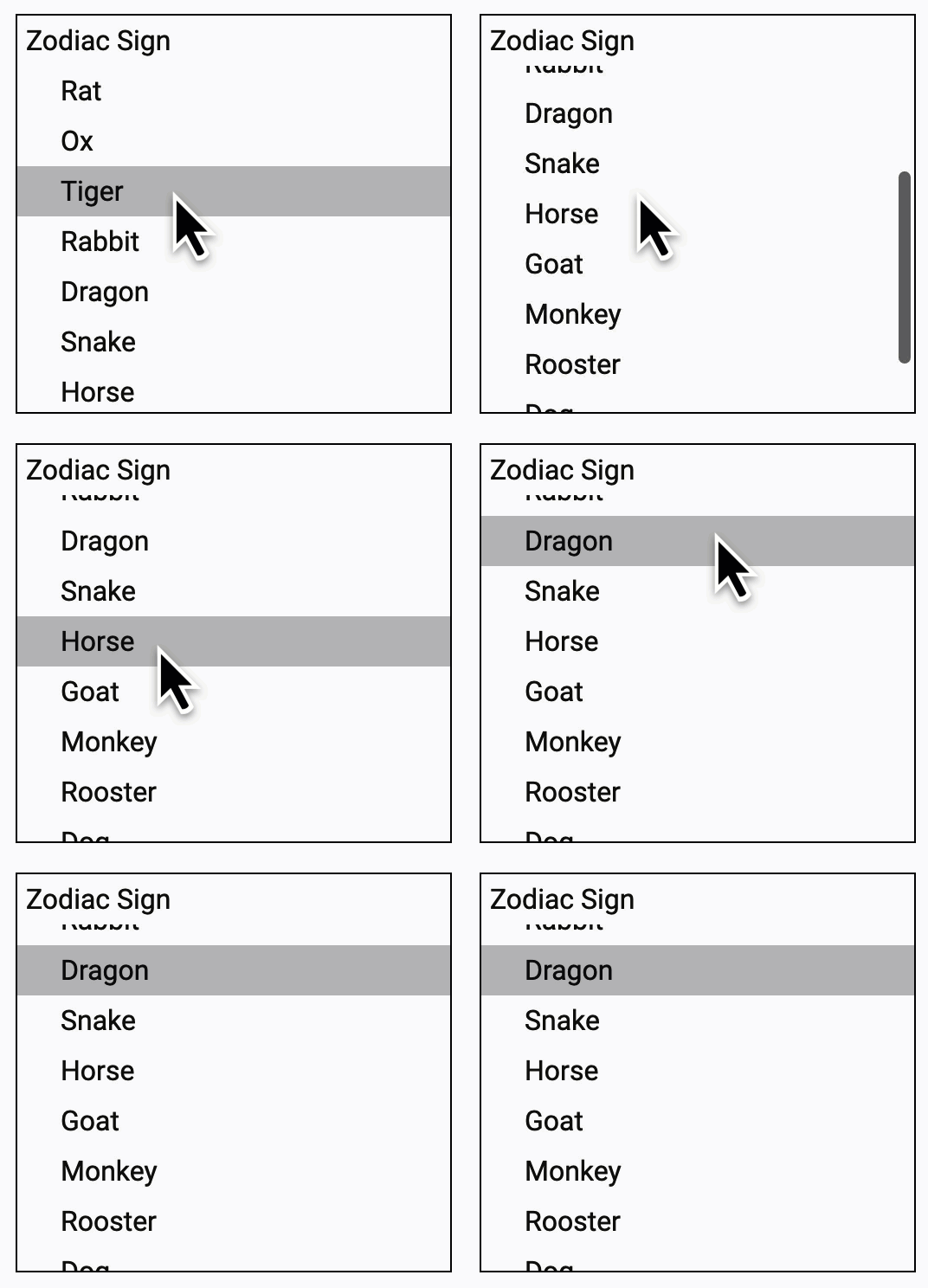
Here, the behavioral interactions have impressive features like keyboard interactions, bidi layout support, lazy loading, and focus management.
Moreover, it does not matter what you use; every directive creates associated ARIA roles with respective host Angular elements.
9. ESBuild Support of Angular 15
In the previous version of the Angular framework, you can efficiently support esbuild to effectively build a faster javascript bundler, enabling quick build done by simplifying the server-side rendering pipeline.
The Angular 15 comes up with new experimental support for the ng build –watch support, Sass, SVG template, and file replacement.
Now, let’s see the command for upgrading the angular.json builder is:
“builder”: “@angular-devkit/build-angular:browser-esbuild”
10. Functional Router Guards
Functional Router Guards in Angular help reduce boilerplate code by using a more streamlined and flexible approach to route protection.
Introduced with the standalone router APIs, these guards are tree-shakable, which means unused code is automatically removed—helping you keep the final bundle size smaller.
They also allow for easier refactoring and cleaner syntax, making your Angular applications more efficient and maintainable.
Related Post: Resolver in Angular
How to Install Angular 15?
Angular is one such robust framework that comes up with multiple Angular development tools. Installing Angular 15 on your system is very easy, you just need NPM installed in your system.
Command to install Angular 15: npm install – global @angular/cli@latest
How Can You Upgrade to Angular 15?
If you’re already using Angular version 14 or lower, and you want to upgrade to Angular 15, you need to type the following command.
Command: ng update @angular/cli @angular/core
Please follow Angular Update Guide
Upgrading from Angular 14 to Angular 15
- If you want to use Angular 15, the foremost thing to perfect is updating Node.js versions to either of the 14.20.x, 16.13.x and 18.10.x.
- Apart from Node.js updates, you need to mandatorily update the TypeScript version to 4.8 or later before approaching upgrading to Angular version 15.
- Simply provide the command: ng update @angular/core@15 @angular/cli@15 in the application project directory to make your Angular 15 application update.
- You can simply run ng update @angular/material@15 to update the Angular Material components.
- For Angular version 15, the primary role of the Angular compiler is to prefix your @keyframes in CSS with the component’s scope. So, it becomes essential to update all such instances to specifically define Keyframes programmatically using Angular compiler. To do that, you just need to use global stylesheets, or simply update or make minor change in the component’s view encapsulation.
- Removing enableIvy from the tsconfig.json file is an essential factor, as it is the only rendering engine in Angular 15, so it is not required.
- Angular 15 developers can effectively use decorators in base classes with child classes. It will simply inherit constructors and use Dependency Injection for the Angular app. So, you need to decorate the base classes with either @Injectable or @Directive otherwise, else get ready to view the error from the compiler.
- In Angular latest version 15, you can effectively call the setDisabledState, especially when a ControlValueAccessor is attached. It is made possible using FormsModule.withConfig or ReactiveFormsModule.withConfig.
- You just need to ensure that all ActivatedRouteSnapshot objects have a title property in your Angular code. In v15 of Angular, ActivatedRouteSnapshot’s required property typically requires the title property.
- In version 15 of Angular, you cannot configure relativeLinkResolution in the Router. It is primarily used to opt-out of the previous bug fix in the Angular 15 application that is now standard.
- It’s mandatory for you to simple update instances of the DATE_PIPE_DEFAULT_TIMEZONE token to use DATE_PIPE_DEFAULT_OPTIONS for time zone configuration. The DATE_PIPE_DEFAULT_TIMEZONE token is deprecated In Angular version 15.
- Existing instances of <iframe> may have security-sensitive attributes applied to them as an attribute or property binding. These security-sensitive attributes can appear in a template or in the host bindings of a directive. You need to such occurrences with regular updates for ensuring compliance with the new and stricter rules for <iframe> binding of the Angular 15 app.
- Injector.get() instances that use an InjectFlags parameter should be updated to use an InjectOptions parameter. Injector.get(InjectFlags )’s parameter is deprecated in v15.
- You need to change the instances of TestBed.inject() to use an InjectOptions parameter in Angular application. In Angular 15, the InjectFlags parameter of TestBed.inject() is deprecated.
- In Angular 15 version, you will find deprecation in using providedIn: ngModule for an @Injectable and InjectionToken. And also in using providedIn: ‘any’ for an @Injectable or InjectionToken.
- Likewise, you can effectively use the RouterLink directive for updating instances of the RouterLinkWithHrefdirective. In Angular 15, you’ll find deprecation with RouterLinkWithHref directive.
- In Angular Material v15, the refactorization of many Angular web components has been performed on the official MDC. It eventually affects the DOM and CSS classes of many components available in the Angular app 15.
- Once you upgrade your web application to Angular 15, you can quickly review your business application and its interactions to cope with the smooth functioning of all the application features including lazy loading functionality.
Related Post: Angular Best Practices
Conclusion
What are you waiting for? Upgrade to Angular 15 and grab the Angular 15 new features to build a robust and secure web application for your business needs.
Angular 16 is now available, and you can install it without obstructions. Still, if you find any issue in installing or planning to develop front-end development services, consult Albiorix now.
Connect with Our Experts!
FAQ
Frequently Asked Questions
Angular is a leading front-end JavaScript framework that helps you build robust web applications for your business needs.
Angular 15 is released with many new features that are stable like standalone components API and Directive composition API. So we can say that Angular 15 is stable.
Published Blogs
Latest Blogs : Insights and Innovations from Our Blog
Stay Ahead in Tech: Dive into our Blogs for the Latest in Software, Web, and Mobile App Development. Explore cutting-edge technologies, industry trends, and insightful updates that keep you at the forefront of the digital landscape



Our Clients

Client Showcase: Trusted by Industry Leaders
Explore the illustrious collaborations that define us. Our client showcase highlights the trusted partnerships we've forged with leading brands. Through innovation and dedication, we've empowered our clients to reach new heights. Discover the success stories that shape our journey and envision how we can elevate your business too.










We’re here to help you


