Summary: Different types of websites in 2026 serve various purposes, from ecommerce and business websites to blogs, booking platforms, and social media sites. Choosing the right website type is essential for achieving your business goals, improving user experience, and scaling your online presence. This guide covers 28 popular types of websites with examples and estimated costs to help businesses, startups, and individuals make informed decisions.
The Updated List for Common Types of Websites 2026
Planning to build an online presence?
The first big decision is choosing the right type of website, and understanding the Difference Between Website and Web Application plays a key role in making the right choice. This decision affects your design, features, timeline, and budget.
This 2026 guide covers 28 common website types, with examples and estimated costs. Whether you’re starting fresh or upgrading an existing site, this list will help you understand your options.
Websites are evolving quickly, especially with AI and interactive platforms becoming more popular. Let’s explore the most relevant website types in 2026.
Let’s dive in,
Types of Websites for Businesses and Entrepreneurs
1. eCommerce Website
An eCommerce website allows businesses to sell products or services directly online.
These sites feature product listings, shopping carts, secure payment gateways, and order management systems making them one of the most revenue-driven types of websites for businesses of all sizes.
Estimated Development Cost: $3,000 – $25,000+ depending on product volume, custom features, and platform choice (Shopify, WooCommerce, custom build).
A business website serves as a company’s primary digital identity showcasing services, team, location, contact information, and credibility. It’s often the first impression a potential client will have of your brand.
Estimated Development Cost: $1,500 – $10,000 depending on the number of pages, design complexity, and integration required.
A portfolio website is designed for creatives, freelancers, designers, photographers, and developers to showcase their best work. Clean visuals and easy navigation are the hallmarks of a great portfolio site.
Estimated Development Cost: $500 – $5,000 depending on interactivity, animations, and CMS integration.
Event websites are built specifically around a conference, concert, webinar, or any one-time or recurring event. They typically include registration, scheduling, speaker information, and ticketing features.
Estimated Development Cost: $1,000 – $8,000 depending on ticketing integrations, live streaming, and attendee management needs.
A personal website is your space on the internet to share your story, resume, blog, or ideas. It’s popular among professionals, influencers, authors, and thought leaders building a personal brand.
Estimated Development Cost: $300 – $3,000 depending on custom design and content features.
Membership websites restrict some or all content to registered, paying, or approved users. They’re widely used by online educators, fitness coaches, professional associations, and content creators.
Estimated Development Cost: $2,000 – $15,000 depending on subscription tiers, gated content, and payment gateway setup.
Nonprofit websites are designed to build trust, spread awareness, and drive donations or volunteer sign-ups. They focus on storytelling, impact reporting, and easy donation flows.
Estimated Development Cost: $1,000 – $8,000 depending on donation platform integration, event pages, and CMS needs.
A blog website is a content-driven platform where individuals or brands regularly publish articles, guides, or stories. Blogs remain one of the most powerful SEO and content marketing tools in 2026.
Estimated Development Cost: $500 – $4,000 depending on custom theme design, plugins, and monetization features.
An informational website exists to educate or inform visitors about a topic, service, or product without selling directly. Government portals, reference sites, and FAQs fall into this category.
Estimated Development Cost: $800 – $6,000 depending on the depth of content, search features, and multimedia elements.
Online forums are community-driven platforms where users ask questions, share knowledge, and discuss topics. They build organic engagement and can become powerful authority sites over time.
Estimated Development Cost: $1,500 – $10,000 depending on the scale of community features, moderation tools, and integrations.
Popular Types of Websites for Startups and Professionals
11. Community Website
Community websites bring people with shared interests together think alumni networks, hobby groups, or professional communities. They often combine social features, forums, and events in one platform.
Estimated Development Cost: $2,500 – $18,000 depending on social networking features, profiles, and content moderation needs.
A startup website is designed to pitch a new idea or product, attract early adopters, and raise funding. Speed, clarity, and compelling storytelling are the key ingredients of a successful startup website.
Estimated Development Cost: $2,000 – $12,000 depending on product demo integrations, investor decks, and launch campaign features.
Consulting websites highlight expertise, case studies, and services to attract high-value clients. A strong consulting site builds authority and generates qualified leads through strategic content.
Estimated Development Cost: $1,500 – $10,000 depending on lead generation tools, blog integration, and booking functionality.
Booking websites enable users to schedule appointments, reserve tables, book rooms, or purchase time slots. These are common in the hospitality, healthcare, fitness, and beauty industries.
Estimated Development Cost: $2,000 – $15,000 depending on the booking engine, real-time availability, and payment processing.
Petition websites collect digital signatures to support social, political, or community causes. They combine storytelling with action-driven calls to motivate people to take a stand.
Estimated Development Cost: $1,000 – $6,000 depending on signature verification, sharing tools, and campaign management features.
Examples of Websites for Education, Lifestyle and Entertainment
16. School Website
School and educational institution websites serve as information hubs for students, parents, and staff. They include admissions info, academic calendars, faculty details, and often integrate learning management systems (LMS).
Estimated Development Cost: $1,500 – $12,000 depending on portal integrations, parent dashboards, and multilingual support.
Hobby websites are passion projects built around specific interests cooking, gaming, gardening, photography, or crafts. They can evolve into monetized content platforms or brand-building tools.
Estimated Development Cost: $300 – $3,000 depending on design customization and content management needs.
Interactive websites engage users with quizzes, games, calculators, animations, or personalized experiences. They see higher engagement rates and time-on-site than static alternatives.
Estimated Development Cost: $3,000 – $20,000+ depending on the level of interactivity, animation complexity, and custom logic.
Entertainment websites deliver content designed to amuse, inform, or engage a broad audience think streaming platforms, humor sites, fan fiction hubs, or celebrity news portals.
Estimated Development Cost: $3,000 – $30,000+ depending on content delivery infrastructure, video streaming, and user personalization.
Wedding websites are created by couples to share their story, event details, RSVPs, gift registries, and photo galleries with guests. They’re both personal and highly functional.
Estimated Development Cost: $300 – $3,000 for custom-designed wedding sites; template-based options are cheaper.
Travel websites help users plan trips, compare destinations, book hotels and flights, and discover experiences. They combine rich visuals, search filters, and transaction features to inspire and convert.
Estimated Development Cost: $3,000 – $20,000 depending on booking engine integrations, dynamic search, and map features.
Directory websites list businesses, professionals, or services in a searchable, categorized format. They generate revenue through featured listings, subscriptions, or lead gen fees.
Estimated Development Cost: $2,000 – $12,000 depending on listing features, search functionality, and submission workflows.
A landing page website is a single-page, conversion-focused site built around one specific goal driving sign-ups, product purchases, or lead form submissions. Every element points to one CTA.
Estimated Development Cost: $500 – $5,000 depending on A/B testing tools, animation, and integration with marketing platforms.
News and magazine websites publish timely articles, opinion pieces, features, and multimedia content. They require robust CMS systems, fast load times, and strong ad or subscription monetization.
Estimated Development Cost: $3,000 – $25,000 depending on editorial tools, ad integrations, and personalization features.
Memorial websites celebrate the lives of loved ones who have passed, offering a digital space to share stories, photos, tributes, and obituaries. They’re deeply personal and increasingly popular.
Estimated Development Cost: $500 – $4,000 for a custom-designed, heartfelt memorial website.
Subscription websites offer recurring value in exchange for a monthly or annual fee access to premium content, software, curated products, or exclusive communities.
Estimated Development Cost: $2,500 – $15,000 depending on billing systems, content management, and tier structure.
Kid-friendly websites are designed with age-appropriate content, bright visuals, and simple navigation for children. They must comply with online privacy regulations (COPPA, GDPR) and prioritize a safe experience.
Estimated Development Cost: $2,000 – $10,000 depending on compliance requirements, animated elements, and interactive features.
Social media websites connect people through user-generated content, profiles, messaging, and shared communities. They are among the most technically complex types of websites to build but among the most impactful.
Estimated Development Cost: $10,000 – $100,000+ for a custom social platform; features and user scale drive cost significantly.
We Build Every Type of Website and provide services like Website Development
Now that you’ve explored all 28 different types of websites, here’s the most important thing to know: no matter which type of website you need, our expert team can build it for you tailored precisely to your business goals.
We are a full-service website development company with experienced developers, UI/UX designers, and digital strategists who have delivered websites across industries from eCommerce stores and SaaS platforms to nonprofit hubs and AI-powered portals
Every project we take on is built from a deep understanding of your audience, your brand, and your growth ambitions.
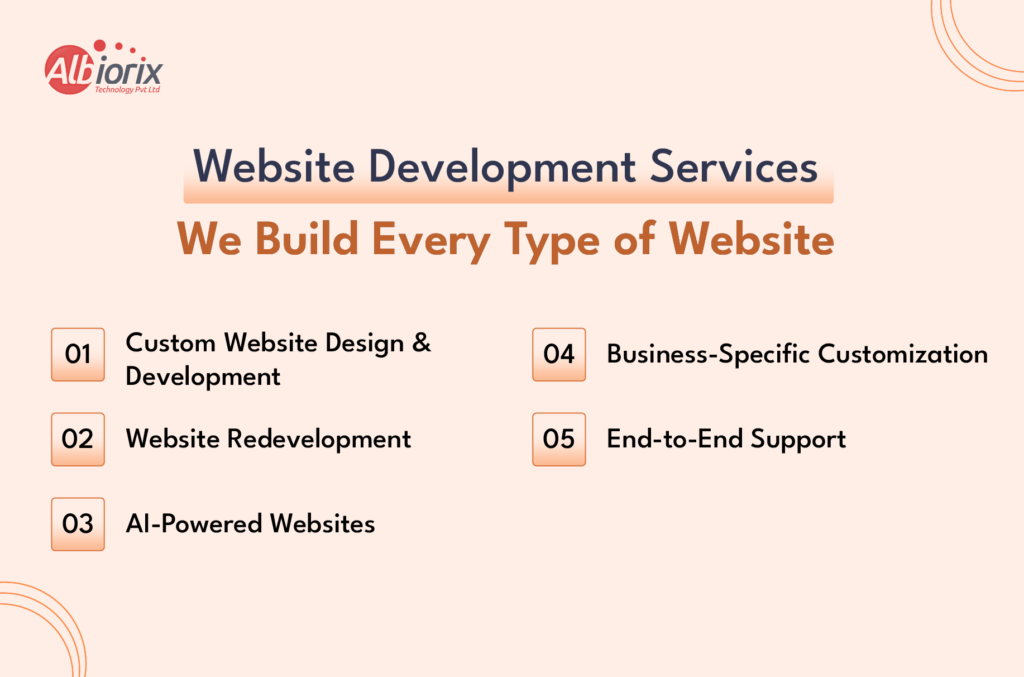
Here’s what we offer:
Custom Website Design & Development: We build websites from the ground up, not from cookie-cutter templates. Your site will look, feel, and perform exactly how your business demands.
Website Redevelopment: Already have a website that’s outdated or underperforming? We can completely redesign and rebuild it with modern technologies and better UX.
AI-Powered Websites: We develop AI-integrated websites for any business type. Whether you need an intelligent chatbot, personalized content delivery, recommendation engines, or predictive search, we build it.
Business-Specific Customization: We understand that every business is different. We customize every aspect of your website layout, color scheme, features, integrations, and user flows to match your exact needs.
End-to-End Support :From strategy and design to development, testing, and post-launch maintenance, we’re with you at every step.
Why Choose Us as Your Website Development Company?
There are plenty of website development companies out there. Here’s why businesses from early-stage startups to established enterprises choose to work with us:
We don’t just write code. We think about your customers, your competition, and your conversion goals.
We build websites that are fast, secure, mobile-first, and optimized for search engines including AI-driven search experiences that are becoming the new standard in 2026.
Whether you’re looking to launch your first website, overhaul an outdated one, or build a complex custom platform, we deliver results that matter to your business.
And with our AI-powered website development capabilities, your site won’t just be digital real estate it’ll be a smart, adaptive tool that grows with your business.
Let’s Build Something Remarkable Together. You’ve seen 28 types of websites and what they can do. Now it’s time to build yours.
Whether you’re a business owner, entrepreneur, startup founder, or an organization ready to grow online we are the development team you’ve been looking for.
Conclusion
Choosing the right type of website is the foundation of every successful digital strategy. Whether you’re building an eCommerce store, a community platform, a personal blog, or an AI-powered business portal, partnering with a website development company ensures the right website is built the right way to transform how your audience finds you, trusts you, and buys from you.
This updated list of 28 different types of websites in 2026 reflects how varied and dynamic the web has become. There is truly a website type for every purpose and with the right development partner, building yours doesn’t have to be complicated.
Ready to take the next step? Our team is standing by with the expertise, creativity, and technical skills to make it happen. Reach out today for your free quote and consultation.
Connect with Our Experts!
FAQ
FAQs - Types of Websites in 2026
In 2026, there are multiple types of websites designed for different purposes, including ecommerce websites, business websites, portfolio websites, blog websites, booking websites, and social media platforms. Each type serves a unique goal, from selling products to building communities or sharing information.
The best type of website depends on your business goals. For example, an ecommerce website is ideal for selling products online, while a business website works best for service-based companies. Many businesses also combine multiple types, such as adding a blog or booking system to improve engagement.
Website development costs in 2026 can range from ₹15,000 to ₹15,00,000 or more, depending on the type, features, and complexity. Simple websites like landing pages are more affordable, while advanced platforms like ecommerce or social media websites require higher investment.
Yes, modern website development allows full customization based on your business requirements. You can tailor the design, features, user experience, and functionality to match your brand identity and goals, including integrating AI-powered features.
Common examples of websites include ecommerce platforms like Amazon, business websites like Apple, blog websites like Medium, and social media platforms like Instagram. These examples show how different website types serve different industries and user needs.
Choosing the right type of website is crucial because it affects user experience, functionality, and business growth. A well-suited website helps you achieve your goals more efficiently, whether it’s generating leads, selling products, or building an online presence.