






Table of Content
- AI Development Cost by Project Type
- What Factors Drive AI Development Costs?
- AI Development Cost Breakdown by Type
- Hiring Models and Their Cost Implications
- Why Many Businesses Choose an AI Development Agency
- Is AI Development Worth the Investment?
- Hidden Costs to Budget For
- Stages of AI Development and What Each Stage Costs
- Conclusion
Summary: In 2026, AI development costs range from $10,000 for simple integrations. They can exceed $1 million for complex, enterprise-grade AI systems. Small projects generally cost $10k–$50k, while mid-level applications range from $50k–$250k. Key cost drivers include customized data training, infrastructure (GPU usage), and specialized AI talent.
A Complete Breakdown for Businesses, Startups & Enterprises
Artificial intelligence is no longer a technology of the future it is the competitive advantage of the present.
Businesses across the US and Australia are racing to integrate AI into their operations, products, and customer experiences. But one question comes up in almost every boardroom conversation:
“How much does AI development cost?” The honest answer: costs range from $10,000 for a simple AI feature to $500,000+ for an enterprise custom AI system.
The range is wide and for good reason. Costs depend on what you are building, how you are building it, and who is building it.
We created a AI development guide to breaks down costs and everything for you in plain language no jargon, no vague estimates.
By the end, you will know what drives enterprise AI development costs.
You will know what to budget for your project type.
You will also know how to make a smart AI development pricing decision for your business.
AI Development Cost by Project Type
Use this table for a fast overview before diving into the full breakdown below.
| AI Project Type | Estimated Cost | Timeline | Best for |
| AI Chatbot / Assistant | $10,000 – $80,000 | 4–12 weeks | Customer service, lead gen |
| Computer Vision System | $30,000 – $200,000 | 3–6 months | Manufacturing, retail, security |
| NLP / Text AI Solution | $20,000 – $150,000 | 6–16 weeks | Legal, healthcare, fintech |
| Predictive Analytics | $15,000 – $100,000 | 4–12 weeks | Finance, e-commerce, logistics |
| Generative AI App | $25,000 – $300,000 | 2–6 months | Content, marketing, design |
| Custom AI Model (LLM) | $100,000 – $500,000+ | 4–12 months | Enterprise, deep-tech, R&D |
| AI Integration / API | $5,000 – $50,000 | 2–8 weeks | SMBs, startups, MVP builds |
Get Your Exact AI Development Cost — Not Just Estimates
Every AI project is different, and generic price ranges won’t give you clarity. Share your requirements and receive a tailored cost estimate & timeline.
Contact Us!
What Factors Drive AI Development Costs?
Before looking at specific numbers, it helps to understand the key levers that push costs up or down.
Two businesses asking for an ‘AI chatbot’ can receive quotes that differ by $100,000 and both quotes can be entirely justified. Here is why.
AI Project Complexity
A basic rule-based chatbot is worlds apart from a context-aware AI assistant trained on your proprietary data. The more sophisticated the logic, the higher the build cost. Complexity also increases testing, debugging, and maintenance overhead.
AI Model Type: Custom vs Pre-Built
Using APIs from OpenAI, Google, or AWS is much cheaper than training a custom model from scratch.
However, pre-built models give you less control. They may also add ongoing API costs. Sometimes, they miss domain-specific accuracy.
AI Project Data Requirements
AI runs on data. If you must collect, clean, label, and organize large proprietary datasets before training, it adds major cost. This work often costs $10,000 to $50,000 alone. The exact amount depends on data volume and quality.
AI Project Team Composition and Location
An in-house US team of senior AI engineers can cost $150–$250 per hour. An experienced AI agency might charge $100–$180/hr. Offshore teams average $40–$80/hr.
Location has a massive impact on total project cost, though quality and communication also vary.
AI Project Integration Complexity
Connecting your AI solution to existing CRMs, ERPs, databases, APIs, and workflows adds engineering hours. The more legacy systems involved, the more expensive the integration.
Compliance and Security Requirements
Industries like healthcare (HIPAA), finance (SOC 2, GDPR), and legal services need extra security.
They also require audit trails and compliance testing.
These needs can add 15–30% to the total development cost.
Maintenance and Ongoing Improvement
AI models degrade over time as real-world data drifts from training data. Budget 15–25% of initial development cost annually for maintenance, retraining, and updates.
AI Development Cost Breakdown by Type
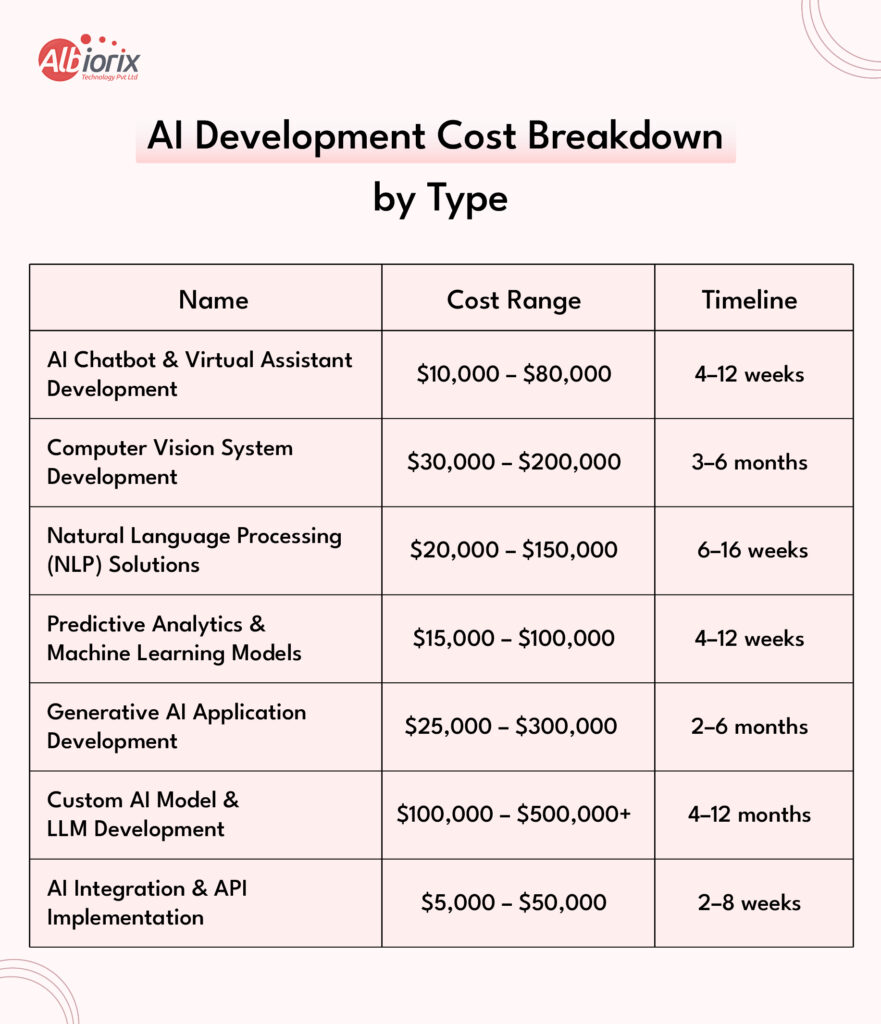
Below is an in-depth cost breakdown for the most common AI solutions businesses are building in 2026. Each section covers cost range, timeline, key cost drivers, and who it is best suited for.
AI Chatbot and Virtual Assistant Development
“Cost Range: $10,000 – $80,000 | Timeline: 4–12 weeks”
AI chatbots remain one of the most popular entry points for businesses investing in AI.
In 2026, AI chatbot development costs have evolved far beyond scripted flows. Modern AI assistants use large language models (LLMs). They understand context, remember conversation history, and respond naturally to nuanced queries.
Cost drivers include:
- Number of supported languages and conversation channels (web, WhatsApp, Slack, etc.)
- Whether the bot uses a pre-built LLM API or a fine-tuned custom model
- CRM and helpdesk integrations (Salesforce, Zendesk, HubSpot)
- Custom training data and domain-specific knowledge bases
- Admin dashboard, analytics, and conversation logging
A simple FAQ chatbot using GPT-4 API can be built for $10,000–$25,000. A sophisticated AI sales assistant with memory, lead qualification logic, and CRM integration will cost $50,000–$80,000 or more.
Computer Vision System Development
“Cost Range: $30,000 – $200,000 | Timeline: 3–6 months”
Computer vision AI allows machines to interpret and act on visual data from inspecting manufacturing defects to enabling autonomous checkouts in retail.
This is a more technical and costly AI category, mainly because it needs large, well-labeled image datasets.
Common applications include:
- Quality control and defect detection in manufacturing
- Facial recognition and access control systems
- Retail shelf monitoring and inventory tracking
- Medical imaging analysis (radiology, pathology)
- Autonomous vehicle perception and drone navigation
The biggest cost variable is data labeling. A typical computer vision model requires thousands of annotated images.
If you lack proprietary image data, collecting and labeling it can cost $15,000–$50,000. This is before any model code is written.
Natural Language Processing (NLP) Solutions
“Cost Range: $20,000 – $150,000 | Timeline: 6–16 weeks”
NLP solutions help machines understand, interpret, and generate human language.
From sentiment tools to document summary engines and contract review systems, NLP is in high demand. It supports legal, healthcare, finance, and customer experience teams.
Typical NLP use cases businesses are funding in 2026:
- Automated document classification and extraction
- Sentiment analyzing for customer feedback and social media
- AI-powered contract review and legal document analysis
- Clinical note summarization for healthcare providers
- Intelligent email routing and auto-response systems
Lower-end NLP projects that rely on existing transformer models (like BERT or GPT) via API cost $20,000–$50,000.
Specialized industries that require accuracy and domain knowledge can pay $100,000 to $150,000 for custom fine-tuned models.
Predictive Analytics and Machine Learning Models
“Cost Range: $15,000 – $100,000 | Timeline: 4–12 weeks”
Predictive analytics uses past data to forecast future outcomes. It can predict customer churn, equipment failures, demand spikes, fraud patterns, and revenue trends.
For data-rich businesses, this is often the AI investment with the fastest, most measurable ROI.
Cost variables:
- Data quality and preparation (often 40–60% of total project effort)
- Number of prediction targets and model complexity
- Frequency of retraining (real-time vs weekly batch)
- Dashboard and visualization requirements
- Integration with BI tools like Tableau, Power BI, or Looker
A solid demand forecasting model for an e-commerce business typically runs $20,000–$45,000.
A real-time fraud detection system for a financial institution can cost $80,000–$100,000. It needs high accuracy and millisecond inference speeds.high accuracy requirements and millisecond inference speeds, can reach $80,000–$100,000.
Generative AI Application Development
“Cost Range: $25,000 – $300,000 | Timeline: 2–6 months”
Generative AI is the technology behind tools like ChatGPT, Midjourney, and GitHub Copilot. It is the fastest-growing AI development category in 2026.
Businesses are building custom generative AI applications to automate content creation, accelerate software development, personalize marketing at scale, and reinvent internal knowledge management.
Popular generative AI builds in 2026:
- Branded AI writing assistants for marketing and content teams
- AI code generation and developer productivity tools
- Enterprise knowledge bases with AI-powered Q&A (RAG systems)
- AI image and video generation tools for creative industries
- Personalized product recommendation engines
The generative AI development cost range here reflects the diversity of applications. A team can deliver a Retrieval-Augmented Generation (RAG) system built on top of GPT-4 for $25,000–$60,000.
A fully custom generative AI platform can cost $200,000 to $300,000 or more.
It may include proprietary model fine-tuning, multi-modal features, and enterprise security.
Custom AI Model and LLM Development
“Cost Range: $100,000 – $500,000+ | Timeline: 4–12 months”
At the high end of the investment spectrum is custom AI model development. It involves building and training large models on proprietary data. It does not rely on third-party APIs.
This is the territory of enterprises, research organizations, and technology companies that need full control. They need unique competitive moats and no dependence on external AI providers.
Custom AI development cost makes sense when your use case needs domain knowledge that no existing model provides. It also fits when your data is too sensitive for a cloud AI provider. It can also work when inference volume is so high that API costs exceed ownership costs in 12–18 months.
AI Integration and API Implementation
“Cost Range: $5,000 – $50,000 | Timeline: 2–8 weeks”
Not every business needs a custom-built AI. Many startups and SMBs gain great value by utilizing a pre-built AI integration tool or adding existing AI APIs, like OpenAI and Google Gemini, into their workflows.
They can also use AWS Rekognition and Azure Cognitive Services in their products and workflows.
This is the fastest and most cost-effective path to adding AI capabilities.
Examples include adding AI search to an e-commerce platform. You can integrate speech-to-text into a video call tool. You can embed AI summaries into a document management system.
If your goal is an MVP or proof of concept, this is almost always the right starting point.
Start Your AI Project with a Free Expert Consultation
Skip the guesswork and connect with our AI specialists today. In just one session, you’ll get clarity on costs, timelines, and the right AI solution for your business.
Get Started!
Hiring Models and Their Cost Implications
Beyond what you build, how you build it and who builds it has an enormous impact on your total investment. Here are the three main paths, with honest pros and cons for each.
| Hiring Model | Hourly Rate (USD) | Best For | Watch Out For |
|---|---|---|---|
| In-house team (US/AU) | $120 – $250/hr | Long-term AI products | High fixed costs, slow to hire |
| AI Development Agency | $80 – $180/hr | End-to-end project delivery | Choose carefully — quality varies |
| Freelancers | $50 – $150/hr | Specific components or POCs | Coordination overhead, availability |
| Offshore Team | $30 – $80/hr | Cost-sensitive builds | Communication, timezone, quality risk |
Why Many Businesses Choose an AI Development Agency
For most businesses, a specialist AI agency is a good choice. This is especially true for companies without a machine learning engineering team. It offers a strong balance of speed, quality, and cost.
A good agency brings a full team, like ML engineers, data scientists, UI/UX designers, and DevOps. It also brings a proven delivery process and clear accountability through defined milestones and deliverables.
The key is choosing the right agency. Look for a proven portfolio of AI projects, transparent pricing, clear communication, and post-launch support.
A free first consultation is a good sign. The agency should ask detailed questions about your goals before giving a quote. This shows you are working with a serious team.
Is AI Development Worth the Investment?
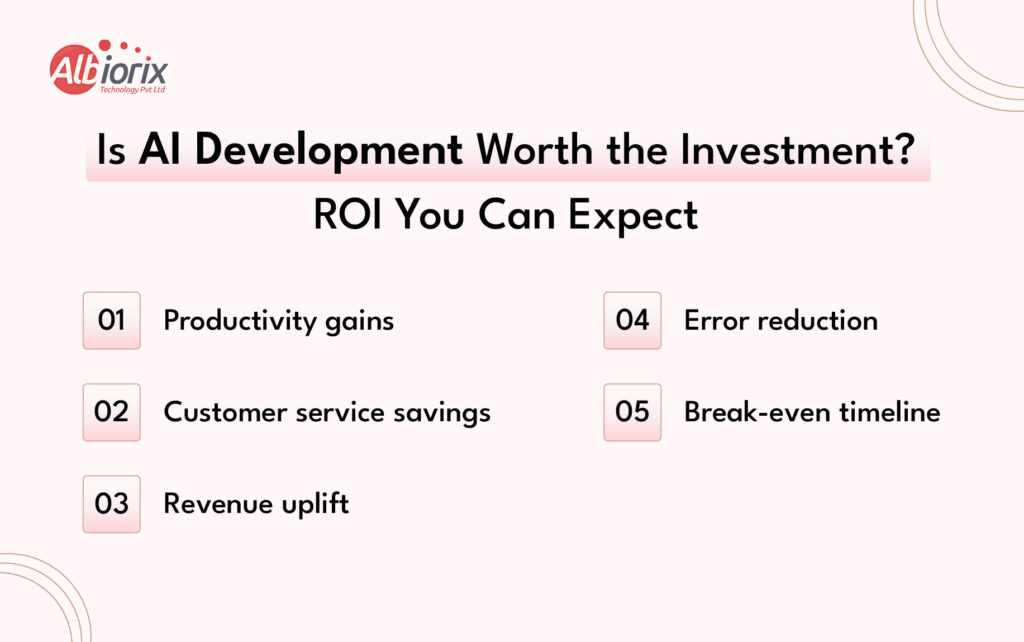
Cost without context is meaningless. Before approving any AI development budget, the real question is: what will this AI solution return?
- Productivity gains: McKinsey research finds AI automation can improve knowledge worker productivity by 20–45%. For a 50-person company, that is equivalent to gaining 10–22 additional full-time employees without increasing headcount.
- Customer service savings: Businesses using AI chatbots for tier-1 support report 30–50% lower support costs. Well-set-up chatbots keep customer satisfaction scores the same.
- Revenue uplift: AI-powered personalization in e-commerce lifts average order value by 10–30%. AI-driven lead scoring and qualification can improve sales conversion rates by 20–35%.
- Error reduction: In data-heavy fields like finance, healthcare, and logistics, AI cuts human errors by 60–90%. This leads to lower costs and less compliance risk.
- Break-even timeline: Most mid-sized AI projects reach ROI break-even within 6–18 months after launch. Customer-facing apps break even sooner. Complex internal systems often take longer.
| Pro tip for decision-makers: |
|---|
| Frame AI development as a capital investment, not an operating expense. The upfront cost gives you a competitive edge that grows over time. It also becomes harder for competitors to copy the longer you use it. |
Hidden Costs to Budget For
Many businesses are surprised by costs that emerge after the initial development phase. Here is what to plan for beyond the build cost:
- Cloud infrastructure and compute costs: AI workloads that use many GPUs can cost $2,000 to $15,000 per month. Costs on AWS, GCP, or Azure vary by usage volume and model complexity.
- Third-party API costs can be high. If your solution uses OpenAI, Anthropic, or Google AI APIs a lot, token costs can rise quickly. A high-volume chatbot can rack up $3,000–$20,000/month in API fees.
- Model retraining and drift monitoring: AI models need periodic retraining as real-world data changes. Budget 15–25% of initial build costs annually.
- User adoption and change management: Deploying AI is as much an organizational challenge as a technical one. Training staff, running change management, and managing resistance have a real cost.
- Security audits and compliance reviews: Especially for regulated industries, periodic security audits and compliance reviews ($5,000–$25,000/year) are non-negotiable.
Stages of AI Development and What Each Stage Costs
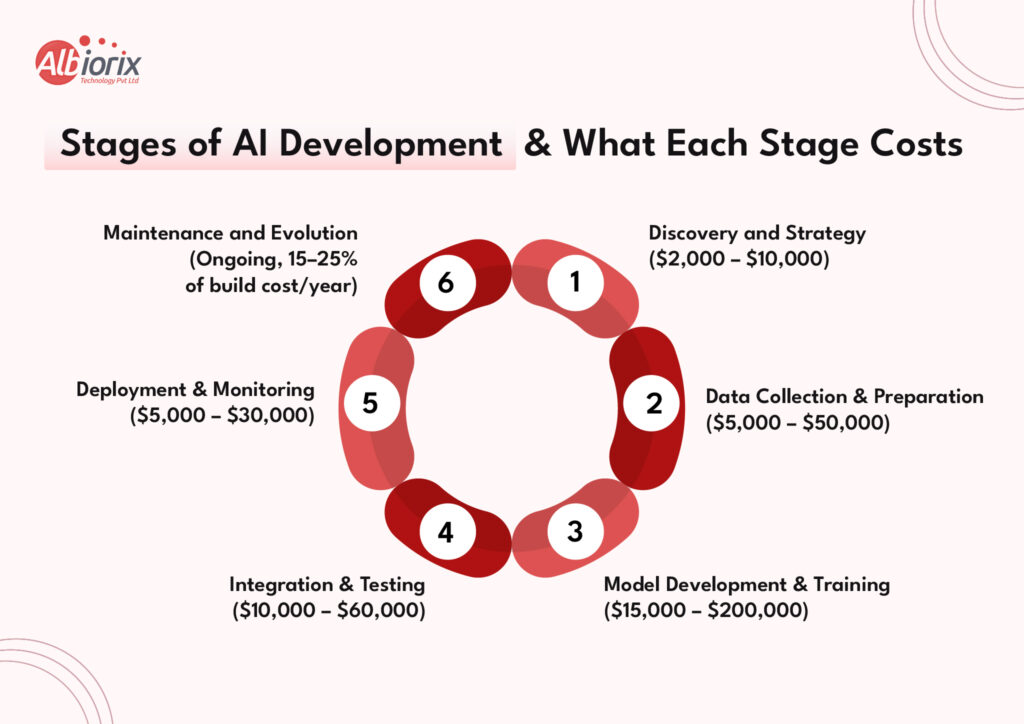
Understanding how AI app development costs are phased helps you plan your budget and manage risk. Most professional AI projects follow this structure:
Phase 1: Discovery and Strategy ($2,000 – $10,000)
Requirements gathering, feasibility study, data audit, technology selection, project roadmap. This phase helps you determine whether your idea is viable before you spend a cent on development. Some agencies offer this free as part of a scoping consultation.
Phase 2: Data Collection and Preparation ($5,000 – $50,000)
Sourcing, cleaning, labeling, and structuring training data. Often the most underestimated phase. Poor-quality data produces poor AI garbage in, garbage out.
Phase 3: Model Development and Training ($15,000 – $200,000)
Building the AI architecture, training on prepared data, iterating on model performance, and reaching target accuracy metrics. The core of the development investment.
Phase 4: Integration and Testing ($10,000 – $60,000)
Connecting the AI to your existing systems, APIs, and interfaces. Rigorous testing across edge cases, adversarial inputs, and real-world scenarios.
Phase 5: Deployment and Monitoring ($5,000 – $30,000)
Production deployment on cloud infrastructure, real-time monitoring, alerting, and performance dashboards. CI/CD pipelines for ongoing model updates.
Phase 6: Maintenance and Evolution (Ongoing, 15–25% of build cost/year)
Retrain on new data. Add new features. Apply security patches. Scale infrastructure as usage grows. Adapt to new AI capabilities as the technology landscape evolves.
How to Reduce AI Development Costs Without Cutting Corners
Smart AI investment is not about spending less, it is about spending right. Here are proven strategies:
- Start with an MVP: Build a focused, minimal viable AI product first. Validate it with real users before investing in scale, additional features, or model customization.
- Use pre-built models and APIs with care.
- Off-the-shelf AI APIs can deliver 80% of the value at 20% of the cost. Use them for non-differentiating functions, custom build only for your true competitive advantage.
- Invest in data quality early: Clean, well-labeled data dramatically reduces training cycles and costs. Cutting corners on data preparation creates expensive rework later.
- Choose a phased delivery model: Break large AI projects into milestone-based phases. This reduces financial risk, allows for course corrections, and keeps the team accountable.
- Negotiate a maintenance and support SLA: Ongoing support with your development partner is often 30–40% cheaper. It also costs less than hiring them ad hoc for each issue.
- Leverage open-source frameworks: Frameworks like TensorFlow, PyTorch, HuggingFace Transformers, and LangChain dramatically reduce build time and cost for experienced AI developers.
Conclusion
AI development costs in 2026 vary widely. They range from $5,000 for a simple API integration. They can exceed $500,000 for a custom enterprise AI platform.
The right investment for your business depends on your goals, your data setup, the problem’s complexity, and the value AI will bring.
What is clear is this: the cost of not investing in AI is growing every year. Businesses that move early build compounding advantages better data, more refined models, and deeper organisational AI capability that latecomers cannot easily replicate.
The smartest investment is a well-scoped first project: focused, measurable, and designed to prove value before scaling. Get that right, and every subsequent AI investment becomes easier to justify, faster to deliver, and higher in return.
Ready to Build Your AI Solution? Get a free, no-obligation project estimate from our AI development team. We work with businesses in the US and Australia to design, build, and scale AI solutions with clear results.
Connect with Our Experts!
FAQ
Frequently Asked Questions About AI Development Costs
A fully custom AI model — trained on proprietary data without relying on third-party APIs — typically costs between $100,000 and $500,000+, depending on model architecture complexity, dataset size, and required accuracy. This level of investment is best suited for enterprises or technology companies with long-term AI product strategies.
Absolutely. The rise of affordable LLM APIs and pre-built ML frameworks means startups can build meaningful AI features for $10,000–$50,000. The key is starting with a focused use case, using existing AI infrastructure where possible, and validating before scaling.
Integrating a pre-built AI API (like OpenAI, Google Gemini, or AWS AI services) into an existing product or workflow is the most cost-effective starting point, often achievable for $5,000–$20,000. This approach minimizes upfront investment while delivering real AI value.
Simple AI integrations and chatbots can be delivered in 4–8 weeks. Mid-complexity projects (NLP tools, predictive models) take 2–4 months. Custom AI platforms and large-scale systems typically require 4–12 months, including data preparation and testing.
Plan to spend 15–25% of your initial development cost each year on maintenance. This covers model retraining, performance monitoring, security updates, infrastructure costs, and incremental feature improvements.
For most businesses, an AI development agency offers better value for project-based work. Hiring a full in-house AI team (ML engineers, data scientists, MLOps engineers) costs $800,000–$1.5M annually in salaries alone in the US. Agencies deliver comparable expertise at a fraction of that cost for defined projects.
AI development agencies in both markets charge broadly similar rates ($80–$180/hr USD equivalent) for senior talent, though Australian firms may quote in AUD. US-based agencies often have larger teams and deeper specialization; Australian firms may offer more accessible collaboration due to timezone alignment with APAC markets.
Ask to see their AI-specific portfolio, request references from similar industry projects, clarify ownership of the trained model and training data, understand their post-launch support model, and ask how they handle model performance degradation over time. Any credible agency will welcome these questions.
Fixed-price engagements are possible for well-defined AI integration and chatbot projects. For custom model development, time-and-materials or milestone-based contracts are more appropriate, given the exploratory nature of training and tuning AI systems.
A mid-sized business exploring AI for the first time should budget $30,000–$80,000 for a meaningful first project with clear ROI potential. This is enough to build a production-ready AI chatbot, a predictive analytics model, or an NLP-powered document workflow — each delivering measurable business value within months of launch.
Published Blogs
Latest Blogs : Insights and Innovations from Our Blog
Stay Ahead in Tech: Dive into our Blogs for the Latest in Software, Web, and Mobile App Development. Explore cutting-edge technologies, industry trends, and insightful updates that keep you at the forefront of the digital landscape
Our Clients

Client Showcase: Trusted by Industry Leaders
Explore the illustrious collaborations that define us. Our client showcase highlights the trusted partnerships we've forged with leading brands. Through innovation and dedication, we've empowered our clients to reach new heights. Discover the success stories that shape our journey and envision how we can elevate your business too.










We’re here to help you


