





Table of Content
- NLP Explained And Why Your Business Should Care in 2026
- So, What Exactly is NLP (Natural Language Processing)?
- How Does NLP Actually Work?
- Why Should Businesses Pay Attention to NLP in 2026?
- Top NLP Use Cases for Businesses in 2026
- Which Industries Are Benefiting the Most?
- Common Myths About NLP — Let's Clear These Up
- What to Consider Before Integrating NLP into Your Business
- Ready to Put NLP to Work in Your Business? Let's Talk.
- Wrapping Up
Summary: Natural language processing (NLP) is the AI technology behind everything from chatbots and voice assistants to sentiment analysis and document automation. This guide breaks down how NLP works and walks businesses through the top use cases transforming industries in 2026. Whether you’re new to NLP or ready to implement it, here’s everything you need to know before your competitors do.
NLP Explained And Why Your Business Should Care in 2026
So, did you use NLP this morning? You might not be sure, but directly or indirectly you use NLP in your day-to-day life to a great extent.
When you asked Siri to set up a reminder for a certain task, search Google for information, or Gmail suggested an autocorrection in the email, that is NLP (Natural Language Processing).
Every time a machine understood what you meant, not just what you typed, that was natural language processing at work.
And here’s the thing: most businesses are already using them but not able to extract the maximum out of this technology.
In this blog on NLP, we will explain to you what NLP is, what are the uses of NLP, and how it can help your business scale in the age of artificial intelligence without any jargons and fancy words. It is a straight-talking guide on NLP and its uses in 2026.
So, let’s get started!
What is Natural Language Processing(NLP)?
The full form of NLP is Natural Language Processing. It is a branch of Artificial Intelligence that helps computers read, understand, analyze, and respond to human language.
NLP may sound simple, but it addresses a major challenge: enabling computers to process human language with the same nuance and understanding as people.
For example, consider this simple sentence: “I didn’t say she stole the money.” Depending on which word you stress, that sentence means seven different things. For humans, it is easy and effortless to navigate that nuance, but for computers, it is a nightmare. This is where NLP gets into action.
NLP bridges the gap between how humans communicate and how computers interpret language, enabling machines to understand and respond to us effectively.
Think of NLP as a universal translator but instead of converting English to French, it converts human meaning into machine understanding.
NLP in action, things you already use:
- Gmail’s spam filter and Smart Reply
- Google Search understanding questions, not just keywords
- Grammarly catching tone and intent, not just spelling
- Voice assistants like Alexa, Siri, and Google Assistant
- Google Translate preserving meaning across languages
NLP is not a recent invention. It has been in the market for decades. Researchers were experimenting with machine translation as far back as the 1950s. But what’s new in recent times is its ability to scale with modern AI solutions.
With the introduction of modern transformer-based models, including ChatGPT, Google Gemini, and Claude, NLP went from a clunky approximation of language understanding to something very impressive.
In 2026, NLP not just processes languages; it can now understand the intent as well.
How Does NLP Actually Work?
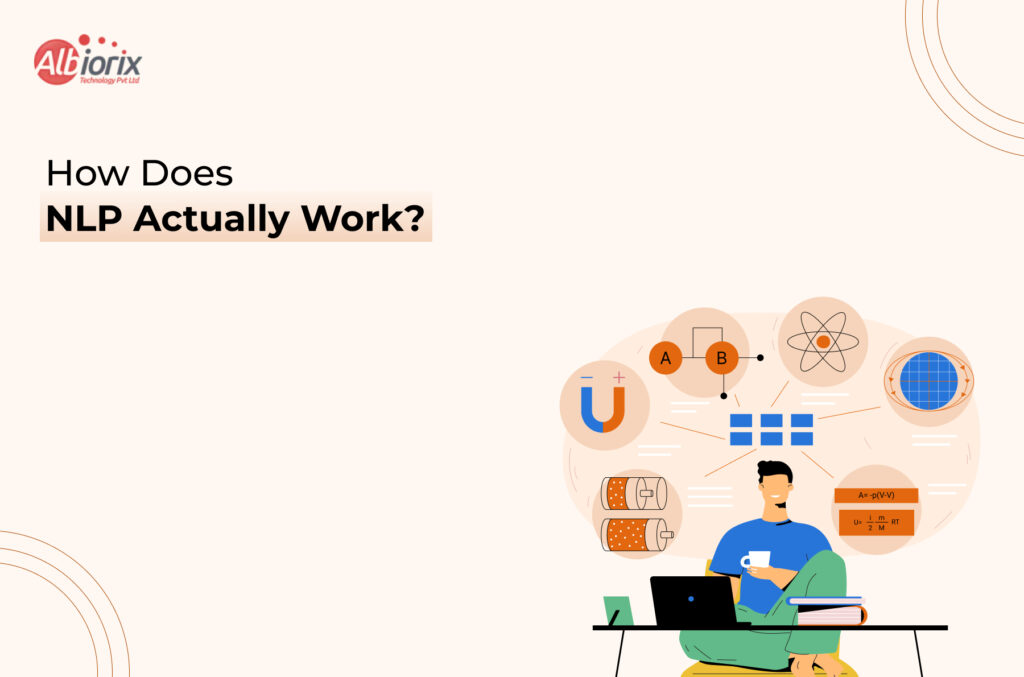
NLP sounds simple, but the way it processes is quite complex. For instance, let’s consider this sentence: “I saw the man with the telescope.”
Well, this sentence can have different meaning such as:
- Did you see a man through a telescope?
- Did the man have the telescope?
As a human, it is easy for you to understand the context of the sentence, but for computers, it is not. It will require NLP to understand the sentence and the context.
NLP teaches machines to work through that ambiguity using a set of steps a pipeline that breaks language down layer by layer.
To help you understand better, we have breakdown the entire process into different stage:
Stage 1: Tokenization: Breaking it Down:
In the very first stage, the machine splits your text into smaller pieces known as tokens. It breakdowns your sentence into words and sub words for better analysis. For example, “I love working with AI” is broken into small tokens – [I] [Love] [Working] [With] [AI].
Stage 2: Grammar and Sentence Structure:
In this step, NLP identifies how words are related to each other. Which word is the verb? Which word is the subject? This is the part of the problem where it understands the context/intent of the sentence. The sentence structure helps it to understand the context.
Stage 3: Meaning (Sematic Analysis):
In this step, NLP looks at what the words actually mean and importantly what they mean together. For instance, in this sentence, “he kicked the bucket” does not mean that a man has kicked the bucket. The NLP model is trained on large datasets, including idioms, synonyms, and nuance; thus, they behave like a well-read person.
Stage 4: Context (Pragmatic Analysis):
In this stage, NLP factors in the broader context. Who’s speaking? What came before this sentence? What’s the likely intent? This is where modern large language models (LLMs) like GPT-4, Claude, and Gemini genuinely shine. They hold context across long conversations and documents.
The evolution of NLP in three eras:
- Rule-Based NLP (1950s–1990s): Humans wrote the rules. “If a sentence contains X, do Y.” Rigid, brittle, limited.
- Machine Learning NLP (2000s–2017): Models learned from data instead of rules. Smarter, more flexible.
- LLM Era (2017–present): Transformer architecture changed everything. Models now understand language at near-human depth.
The key takeaway for businesses: modern NLP doesn’t just process what someone said. It understands what they meant and increasingly, what they’ll need next.
Not Sure Where NLP Fits in Your Business? Let’s Figure It Out Together.
Every business has a different starting point. Whether it’s cutting support response times or automating document-heavy workflows — we’ll help you.
Just a straight conversation.
Why Should Businesses Pay Attention to NLP in 2026?
The NLP market is growing from $38.3 billion in 2025 to $50.13 billion in 2026 a 30.9% jump in a single year. Cloud-based NLP deployment now holds 63.4% of the market, growing at nearly 25% annually.
That means an affordable, scalable NLP is available right now, without needing a data centre or a team of PhDs.
The real question isn’t “should we look at NLP?” It’s “how are we already falling behind competitors who’ve adopted it?”
Here’s what’s driving the urgency:
- Your customers generate enormous amounts of unstructured data every day reviews, support chats, survey responses, social media. Most of it goes unread. NLP reads all of it.
- Response time expectations have collapsed. Customers expect instant, relevant, personalized replies. Manual support can’t scale to meet that. NLP-powered systems can.
- Multilingual business is the norm now. If your business serves customers in multiple regions or aspires to, then NLP handles real-time multilingual communication without losing meaning in translation.
- Document-heavy industries legal, healthcare, finance are sitting on massive automation opportunities that NLP unlocks, cutting hours of manual work to minutes.
The businesses getting ahead right now aren’t necessarily the biggest. They’re the ones that identified one or two high-impact NLP use cases and moved fast. That’s the opportunity in 2026.
Top NLP Use Cases for Businesses in 2026
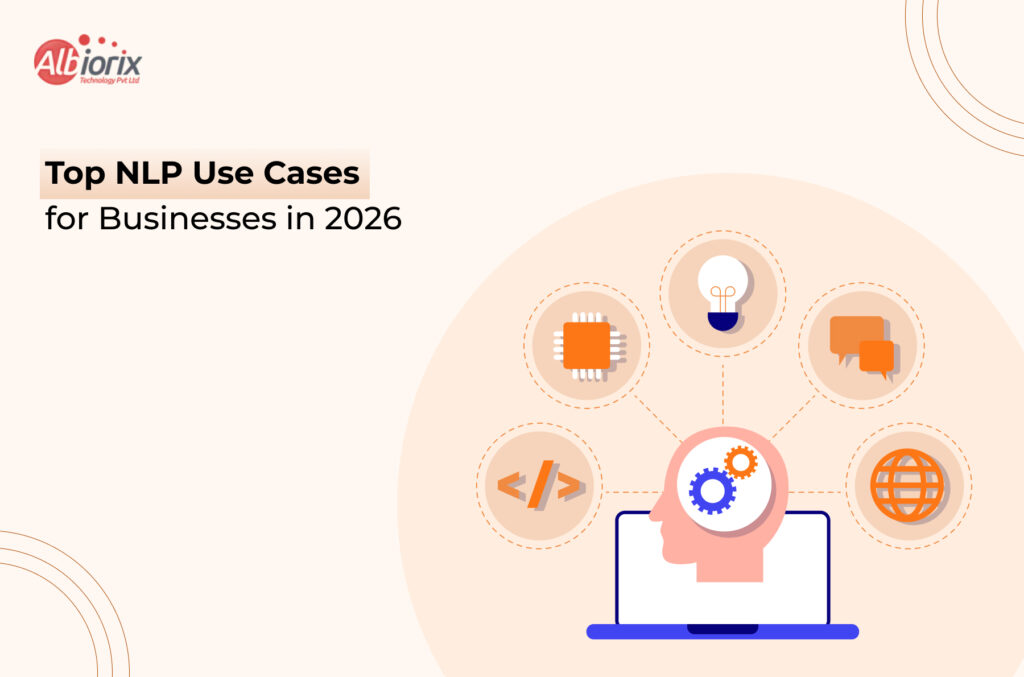
This is where it gets practical. Let’s look at what NLP is actually doing right now for businesses across industries.
Use Case 1: Smarter Customer Support (Chatbots & Virtual Agents)
Forget the frustrating chatbots of five years ago that could only handle three questions before saying “I’ll transfer you to an agent.”
Today’s NLP-powered support agents understand intent, detect emotion, handle multi-turn conversations, and escalate to humans only when it genuinely makes sense.
The global chatbot market is powered almost entirely by NLP. It has reached $6 billion in 2024 and is growing at 23.9% annually.
A customer typing “I’ve been waiting three weeks for my order, and I’m really frustrated” gets a very different response from a modern NLP system than from a keyword-matching chatbot. It detects the frustration, the urgency, and routes accordingly no script required.
Use Case 2: Sentiment Analysis: Know What Customers Actually Feel
Every business collects feedback. Product reviews, support tickets, social media comments, post-call surveys. Most of it sits in a folder somewhere, unread.
NLP-powered sentiment analysis reads all of it in seconds and tells you whether customer feeling toward your brand, product, or specific feature is positive, negative, or shifting.
More importantly, it flags patterns before they become crises. If sentiment around your new product drops sharply in week two, you know before it becomes a public story.
Banking, retail, and healthcare businesses are using this to catch issues faster than any manual monitoring system ever could.
Use Case 3: Document Intelligence & Automation
Contracts, invoices, patient records, regulatory filings every industry drowns in documents. NLP can extract, classify, and summarize key information from unstructured documents faster and more accurately than any human team.
Healthcare is leading this charge: NLP adoption in healthcare is growing at a 24.34% CAGR, with documented results like one health insurer cutting documentation time by 40% and processing claims 50% faster using AI models.
A legal firm can use NLP to flag risk clauses across 200-page contracts in minutes. A financial institution can automate compliance checks that previously took days.
Use Case 4: Multilingual Communication at Scale
Your customers speak different languages. Your teams might too. NLP-powered translation has moved far beyond word-for-word conversion. Modern systems preserve tone, context, cultural nuance, and intent across 100+ languages.
This matters enormously for businesses serving clients in the US, UK, Australia, and beyond. A customer complaint written in Australian slang and one written in formal British English should receive the same quality of response. With NLP, they do.
Use Case 5: Voice Search & Voice AI
The speech-based NLP market, including voice assistants, voice search, and voice command systems, was valued at $30.85 billion in 2025 and is projected to reach $128.5 billion by 2031. That’s a 26.84% CAGR.
For businesses, this means two things. First, if your content isn’t optimized for voice search, you’re invisible to a growing share of searchers.
Second, voice-based customer interfaces, for ordering, querying, and booking are becoming standard customer expectations, not a novelty.
NLP makes this possible by understanding natural spoken queries: “What’s the cheapest option that ships by Friday?” isn’t a keyword search. It’s a conversation.
Use Case 6: Smarter Internal Search & Knowledge Management
The average employee spends close to two hours a day searching for internal information past projects, policies, client documents, meeting notes. Traditional keyword search fails them constantly because people rarely remember the exact phrase they’re looking for.
NLP-powered semantic search finds what you mean, not just what you typed. Search for “how we handled the Northbrook client complaint last year” and get the right document, even if it was labelled “Northbrook account issue Q3.” The productivity gains across teams are immediate and measurable.
Use Case 7: Agentic AI: NLP That Doesn’t Just Understand It Acts
This is the 2026 frontier, and it’s where NLP is heading fast. Autonomous language agents are AI systems that don’t just respond to a query they plan, execute multi-step tasks, and complete goals with minimal human supervision.
Tell an agent: “Analyze last quarter’s sales and draft a board-ready summary report.” It retrieves the data, runs the analysis, generates the charts, writes the summary, and delivers a formatted document. No hand-holding. No step-by-step babysitting.
These agentic AI systems surged in 2025 and are being widely adopted by forward-thinking businesses in 2026.
They’re particularly powerful for recurring business workflows, including monthly reporting, competitive analysis, customer onboarding checks where the task is defined, but execution has always required human time.
Which Industries Are Benefiting the Most?
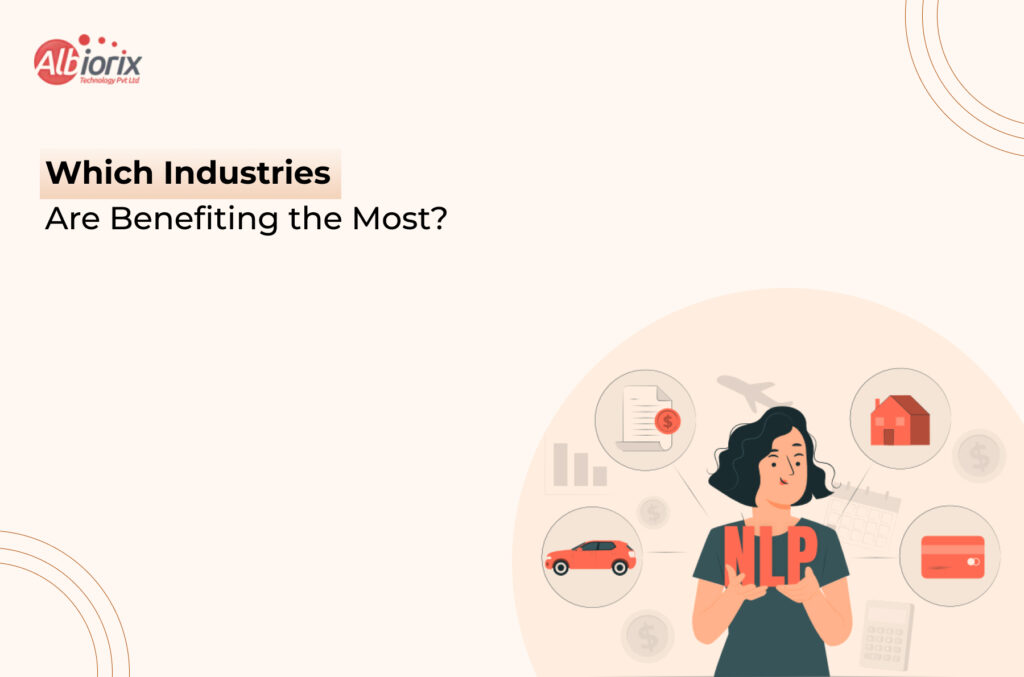
NLP isn’t industry-specific, but some sectors have moved faster than others, and the results are telling.
Use of NLP in Healthcare:
Clinical note analysis, patient triage automation, regulatory compliance checks, and drug safety monitoring are all being transformed by NLP.
The CHECK framework, for instance, reduced hallucinations in clinical language models from 31% to just 0.3% opening the door to compliance-ready healthcare automation that was previously too risky to deploy.
Use of NLP in Banking, Financial Services & Insurance (BFSI):
BFSI holds 21.1% of the NLP market. It is the largest share of any industry. The applications are wide: fraud detection from transaction language patterns, chatbot-led customer onboarding, compliance monitoring across communications, and document-heavy processes like loan application processing and insurance claims.
JP Morgan’s COIN system, which uses NLP to parse legal documents, famously completed 360,000 hours of manual legal work per year in seconds.
Use of NLP in E-Commerce & Retail:
Product search, review analysis, personalized recommendations, and customer service chatbots are table stakes in e-commerce now.
NLP enables the kind of search experience where a customer typing “affordable blue dresses for a summer wedding” gets exactly what they mean not just results containing the word “blue.”
Use of NLP in Legal:
Contract review, case research, document summarization legal work is document-heavy by nature, which makes it a perfect match for NLP automation.
Law firms using NLP are compressing due diligence timelines dramatically and reducing the risk of human error in document review.
Use of NLP in HR & Recruitment:
Resume screening, employee sentiment analysis, onboarding document processing NLP is reducing administrative burden in HR while also helping teams understand employee morale at scale through analysis of internal feedback and communications.
Custom NLP Solutions Built for Your Business. Not Off a Shelf.
Generic AI tools give generic results. We build NLP systems trained on your data, designed for your workflows, and integrated into your existing tech stack.
Get Started!
Common Myths About NLP Let’s Clear These Up
Businesses that haven’t adopted NLP yet often have one or more of these misconceptions holding them back. Let’s address them head-on.
MYTH 1: “NLP is only for big tech companies.”
REALITY: Cloud-based NLP APIs from Google, AWS, and Azure and custom solutions from specialist AI development firms have made NLP accessible to businesses of all sizes. You don’t need a proprietary data center. You need the right partner.
MYTH 2: “NLP will replace our customer service team.”
REALITY: NLP augments your team; it doesn’t replace it. It handles the high-volume, repetitive queries so your people can focus on complex, high-value interactions. The best outcomes come from human-AI collaboration, not substitution.
MYTH 3: “NLP only works in English.”
REALITY: Modern NLP models handle 100+ languages, including regional dialects and code-switching (switching between languages mid-sentence). For businesses serving global markets, multilingual NLP is a core capability, not a limitation.
MYTH 4: “It takes months to implement and costs a fortune.”
REALITY: Implementation timelines depend heavily on the scope and the expertise of your development partner.
A targeted NLP solution a sentiment analysis dashboard, a document extraction tool, a smart FAQ chatbot can be built, integrated, and live within weeks when you work with the right team.
What to Consider Before Integrating NLP into Your Business
Before jumping into NLP, it helps to ask the right questions. Here’s a practical starting checklist:
- Start with the problem, not technology. What specific business pain are you solving? Slow customer response? Unread feedback? Manual document processing? Define the use case first NLP is the tool, not the goal.
- Assess your data. NLP learns from data. Do you have customer interactions, documents, or feedback to work with? The more relevant data you have, the more accurately a custom model can be trained to your specific context.
- Decide: off-the-shelf or custom-built? Pre-built NLP tools (Google Natural Language API, AWS Comprehend, Azure Text Analytics) work for general tasks. If your use case is industry-specific say, legal contract review or clinical note analysis a custom-built solution trained on your data will significantly outperform any generic tool.
- Think about integration. How will the NLP solution connect to your existing systems your CRM, your helpdesk, your document management platform? Integration planning upfront saves significant rework later.
Choose the right AI development partner. NLP is a technical discipline. The difference between a well-built NLP integration and a poorly scoped one is enormous in terms of accuracy, speed, and ROI. Look for partners with documented NLP experience across relevant industries.
Ready to Put NLP to Work in Your Business? Let’s Talk
If you’ve read this far, you’re probably not asking “what is NLP?” anymore. You’re asking “where does it fit for us, and how do we start?”
That’s exactly what Albiorix Technology helps businesses figure out.
We’re an AI and software development company working with clients across Australia, the USA, and the UK. We build custom NLP solutions not generic tools repackaged under a different name, but systems designed around your specific workflows, industry requirements, and business goals.
What we build with NLP:
- NLP-powered customer service chatbots and virtual agents.
- Sentiment analysis dashboards for brand and product feedback.
- Document intelligence tools for contract review, invoice processing, and compliance automation.
- Semantic search and knowledge management systems.
- Multilingual communication tools for global businesses
- Agentic AI systems that automate multi-step business workflows
We don’t start with technology. We start with your problem.
Whether you’re exploring NLP for the first time or looking to expand an existing AI capability, we’ll help you.
Get in Touch
Wrapping Up
Natural language processing has moved from research labs to production environments to mainstream business infrastructure in less than a decade.
It’s the technology that lets machines understand not just what your customers are saying but what they mean, how they feel, and what they need next.
The businesses that will look back on 2026 as a turning point are the ones making that shift right now. They’re not waiting for technology to mature further.
They’re deploying it in customer service, in document automation, in voice interfaces, in intelligence systems that work while their team’s sleep.
The entry point doesn’t have to be complicated. Pick one problem. Find the right partner. Start there.
Connect with Our Experts!
FAQ
Frequently Asked Questions - NLP
NLP is the field of AI that teaches computers to read, understand, and respond to human language. It’s the technology behind chatbots, voice assistants, spelling and grammar tools, translation apps, and email spam filters. In short: it’s how machines figure out what you mean, not just what you literally typed.
Traditional software follows fixed rules — if input is X, output is Y. It breaks the moment the input doesn’t match what it was programmed to expect. NLP learns from data and handles language the way it actually works: messy, contextual, and full of nuance. It doesn’t need every scenario pre-programmed — it generalizes from experience.
The most widely adopted use cases in 2026 include customer service chatbots, sentiment analysis of reviews and feedback, document automation (contracts, invoices, reports), multilingual communication, voice search and voice interfaces, internal knowledge search, and agentic AI for multi-step workflow automation.
It depends on what you’re building. Pre-built cloud NLP APIs are very affordable and suitable for standard tasks. Custom NLP solutions — built for your specific data, industry, and workflows — require investment but typically deliver significantly higher accuracy and ROI. The right development partner will help you scope realistically for your budget.
Absolutely. Cloud-based NLP has removed the infrastructure barriers that once made this technology enterprise-only. A mid-sized e-commerce brand can deploy a sentiment analysis tool or a smart customer support chatbot without building anything from scratch. The democratization of NLP is one of the defining business tech trends of 2025 and 2026.
NLP is the broader field — it covers understanding, analysing, and processing human language. Generative AI is a subset that specifically focuses on creating new content (text, images, code, audio). Large language models like ChatGPT and Claude are generative AI systems built on NLP foundations. Think of NLP as the science and generative AI as one of its most powerful applications.
Published Blogs
Latest Blogs : Insights and Innovations from Our Blog
Stay Ahead in Tech: Dive into our Blogs for the Latest in Software, Web, and Mobile App Development. Explore cutting-edge technologies, industry trends, and insightful updates that keep you at the forefront of the digital landscape
Our Clients

Client Showcase: Trusted by Industry Leaders
Explore the illustrious collaborations that define us. Our client showcase highlights the trusted partnerships we've forged with leading brands. Through innovation and dedication, we've empowered our clients to reach new heights. Discover the success stories that shape our journey and envision how we can elevate your business too.










We’re here to help you


