






Table of Content
- Why This is The Right Time To Build an AI Product
- Start With the Problem, Not the Technology
- 5 Proven Ways to Identify AI Opportunities in Your Business
- Real-World AI Product Ideas Across Four Key Industries
- How to Validate an AI Product Idea Before You Build Anything
- From Idea to AI Product: What the Journey Actually Looks Like
- Conclusion
Summary: Identify AI product opportunities by mapping workflows to pinpoint bottlenecks, repetitive tasks, and high-volume data processes. Focus on areas requiring predictive insights, decision-making, or speed improvements. Evaluate potential AI use cases based on data availability, ease of verification, and potential for competitive advantage.
You’ve probably heard it a hundred times by now that “AI is changing everything.” And honestly? It is. But here’s the thing nobody talks about! most founders, business owners, and entrepreneurs have great AI product ideas right now, but they simply don’t know it yet.
It’s not that we don’t have opportunities, we do it’s everywhere, but the challenge is that how to look and how to cut through the noise and spot the real gaps in your industry, and turn a rough concept into something worth building.
Whether you’re a first-time founder, a startup team, or a business owner exploring what AI could do for your business, this guide is for you.
We’ll walk you through exactly how to identify AI opportunities in business, how to validate your idea, what the custom AI product development cost would be, and how to move from ‘what if’ to a product roadmap.
Why This is The Right Time To Build an AI Product
The opportunity is massive; in fact, McKinsey estimates that generative AI could add up to $4.4 trillion in annual value to the global economy by automating complex tasks.
Most of us believe we missed the chance to develop an innovative AI product. We believe that Big players like Google and Microsoft have already claimed ownership of every meaningful and practical AI product idea. But that’s not 100% true, and this claim is backed by the numbers.
With easy access to powerful language models, vision APIs, and machine learning infrastructure, the cost of custom AI product development has drastically decreased.
Once, when a team of dedicated AI engineers were required and took months, it can now be integrated in days. This easy accessibility of the resources is really good news, especially for startups.
Even in 2026, most industries are still largely untouched by meaningful AI innovation.
Tech companies are adopting AI at a rapid pace, but industries such as healthcare, logistics, retailers, finance, and many more are still using off-the-shelf or traditional software solutions to manage their everyday tasks.
That gap? That’s your opportunity.
AI startup trends in 2024 and into 2025 point clearly toward vertical AI, purpose-built tools designed for specific industries rather than general-purpose platforms.
The most exciting AI use cases for companies right now aren’t coming from Silicon Valley. They’re coming from people who deeply understand a particular problem and have the vision to apply AI to it.
If you know your industry well, you’re already ahead.
Stop Guessing, Start Building
Unsure if your industry idea is technically feasible? Our experts specialize in custom AI product development for niche markets.
Book a Free Strategy Sync
Start With the Problem, Not the Technology
When it comes to building an innovative AI product, most of us focus on technology and not the problem.
They think, “How can I use GPT-4 to build something?” or “What can I do with a computer vision model?” That approach almost always leads to a solution looking for a problem which is the hardest possible way to build something people actually want.
Flip it around. Start with the pain.
Ask yourself:
- Where does your industry bleed time? What tasks take hours that feel like they should take minutes?
- Where do people make the most errors and what does that cost?
- What information do people desperately need, but can never get fast enough
- What’s the thing that everyone in your sector complains about, but nobody has properly fixed?
These friction points are where AI problem-solving ideas are born. They’re not glamorous. They’re not “disruption” for its own sake. They’re just real problems that real people deal with every day and that AI is now genuinely capable of solving.
Once you find the problem, the technology choice becomes much clearer. And the product you build will have a much stronger foundation.
5 Proven Ways to Identify AI Opportunities in Your Business
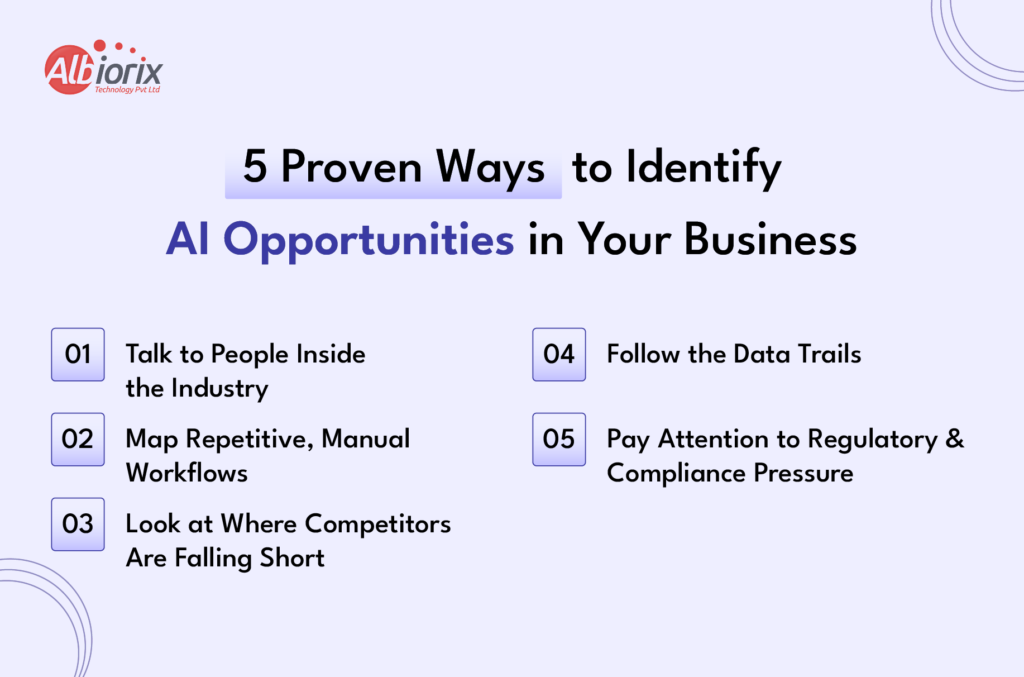
So how do you actually go about finding these gaps? Here are five approaches that work not just in theory, but in practice.
Talk to People Inside the Industry
This one sounds obvious, but it’s consistently underused. Spend time having real conversations not surveys, not cold research, but actual conversations with people who work in your target industry every day.
Ask them what takes up most of their time. Ask what they wish existed. Ask what they’ve tried that didn’t work. LinkedIn communities, industry forums, subreddits, trade events all of these are goldmines if you ask the right questions.
You’re not pitching at this stage. You’re listening. The best AI product opportunities almost always surface from patterns in what people say (and complain about) repeatedly.
Map Repetitive, Manual Workflows
Any task that a human performs the same way, over and over, dozens or hundreds of times that’s a candidate for automation or AI augmentation.
Think about data entry, report generation, customer query responses, document review, appointment scheduling, compliance checks. These are not exciting tasks. But they consume enormous amounts of time and money across almost every sector.
Ask: If you could wave a wand and never do this again, what would it be? That answer is often where an AI product idea is hiding.
Look at Where Competitors Are Falling Short
Check the reviews of existing tools in your space. Not the five-star ones the three-star ones. That’s where honest frustrations live.
What do people wish the product did? What features are constantly requested but never shipped? What do users say they have to do manually because the software “doesn’t quite handle it”?
These gaps are signals. They tell you where demand already exists but supply hasn’t caught up.
That’s one of the clearest ways to identify AI opportunities in business find where the current solution is good enough to prove the market, but not good enough to hold you back.
Follow the Data Trails
AI needs data to work well. So look at which industries are already generating large amounts of structured or unstructured data but not really leveraging it.
Healthcare has mountains of patient records, clinical notes, and diagnostic data. Logistics companies track thousands of shipments, routes, and delivery patterns.
Financial institutions process millions of transactions. Retailers log every click, cart addition, and purchase.
All of that data is potential fuel. The question is: what insights or predictions could be unlocked from it and who would pay for those insights?
Pay Attention to Regulatory and Compliance Pressure
Industries with heavy compliance requirements finance, healthcare, legal, HR are often desperate for better tools. Not because they want to be innovative, but because compliance is expensive, time-consuming, and risky when done manually.
AI products that reduce compliance burden, automate audit trails, flag anomalies, or generate regulatory documentation tend to sell themselves. The pain is acute, the cost of getting it wrong is high, and decision-makers already understand the value.
Real-World AI Product Ideas Across Four Key Industries
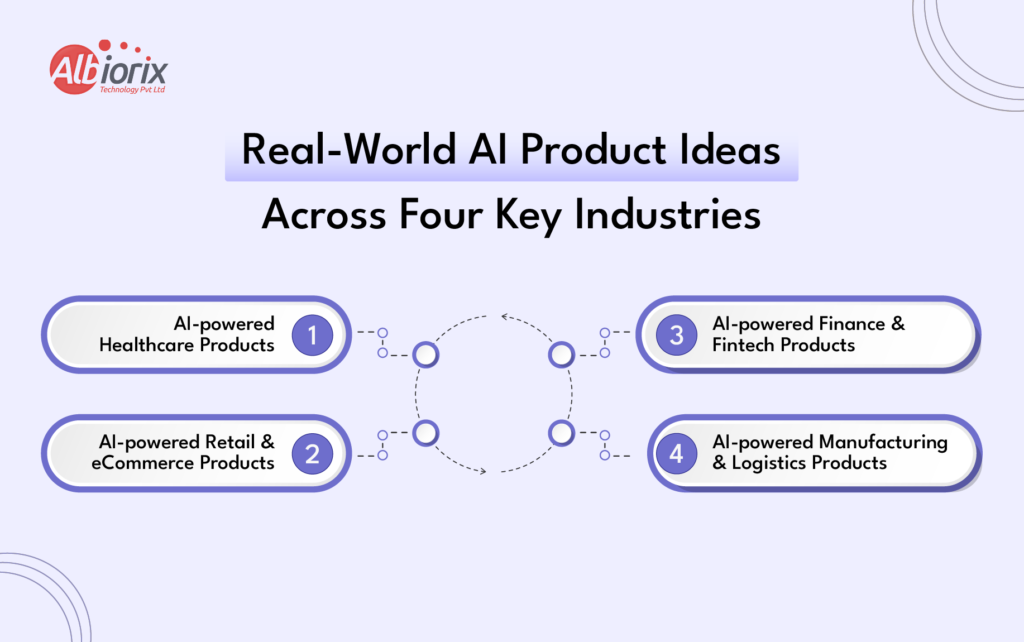
Sometimes the best way to get your own ideas flowing is to see what’s possible in practice. Here’s a snapshot of where AI product opportunities are ripe across four industries.
AI-powered Healthcare Products
Clinicians spend an alarming portion of their day on documentation rather than patient care. Clinicians spend an alarming portion of their day on documentation; AI healthcare software to reduce clinical burden, such as tools that summarise consultations, are addressing this directly.
Similarly, AI triage assistants that help patients describe their symptoms and get routed to the right care pathway are reducing pressure on front-desk staff.
There’s also growing demand for AI tools that help small practices manage prior authorisations, insurance claims, and billing anomalies, all areas where errors are costly and the work is deeply repetitive.
AI-powered Retail & eCommerce Products
In retail, personalization at scale remains one of the most compelling AI use cases in eCommerce for companies of all sizes.
An independent online retailer with 10,000 products doesn’t have the team to manually curate recommendations, but AI can do it dynamically, based on browsing behaviour, purchase history, and seasonal trends.
Returns prediction is another growing area: AI models that flag high-risk orders before they ship can meaningfully reduce return rates and the cost that comes with them.
Customer support automation, inventory demand forecasting, and dynamic pricing tools are equally promising for this sector.
AI-powered Finance & Fintech Products
SME lending is one of the most underserved areas in finance. Traditional credit assessments are slow, blunt instruments that don’t account for the nuanced financial behaviour of small businesses.
AI-powered credit scoring tools that analyse cash flow patterns, transaction history, and sector benchmarks can open up lending to businesses that would otherwise be declined.
On the compliance side, fraud pattern detection tools that learn from transaction behaviour and flag unusual activity in real time are in high demand from both banks and fintech startups.
There is also strong interest in AI agents vs traditional automation for assisting financial advisers with research and client communication.
AI-powered Manufacturing & Logistics Products
Realizing AI’s full potential requires more than just tech; it requires redesigning workflows to capture value, a shift that leading organizations are already prioritizing to see bottom-line impact.
Predictive maintenance is one of the clearest, most proven AI product ideas in manufacturing using sensor data from machinery to predict failures before they happen, saving companies from expensive unplanned downtime.
In logistics, AI route optimisation tools that factor in real-time traffic, weather, and delivery windows are delivering measurable fuel and time savings for mid-sized fleet operators who can’t afford enterprise software.
Quality control is another high-potential area: computer vision tools that inspect products on a production line faster and more consistently than a human inspector are being adopted at growing pace across food, automotive, and electronics manufacturing.
See Your Idea in Action
Don’t let your concept stay a “what if.” We help businesses in the USA, UK, and Australia turn industry pain points into functional MVPs.
Consult with Our AI Architects
How to Validate an AI Product Idea Before You Build Anything
You’ve spotted something that looks like an opportunity. Before you invest significant time or money, you need to know: is this real?
Validation doesn’t need to be complicated. In fact, the simpler you keep it at this stage, the better. Here’s a straightforward framework.
Step-1: Is this a real, recurring problem?
Not a one-off frustration. Not something that “would be nice” to fix. A genuine, recurring problem that costs people time, money, or risk on a regular basis.
You should be able to find at least 10–15 people who describe this same problem without you prompting them.
Step-2: Are people already spending to solve it?
If someone is already paying for a workaround even an imperfect one that’s strong validation. It means the problem is painful enough that people are motivated to address it.
No existing solution at all can sometimes mean there’s no real demand; it’s worth investigating why before assuming you’ve found a blank canvas.
Step-3: Can AI meaningfully improve on what exists?
This is where you honestly assess the technology fit. Does AI add genuine value here speed, accuracy, scalability, personalisation that a simpler tool can’t offer? If yes, you have something worth exploring further.
A simple landing page describing the product concept, shown to your target audience, can tell you an enormous amount about whether people are interested before you’ve written a single line of code.
Combine that with 10–15 honest customer interviews and you’ll have more clarity than most founders get after six months of building.
From Idea to AI Product: What the Journey Actually Looks Like
Once you’ve validated an opportunity, the next question is: what does the journey look like? You can follow our Generative AI development guide to see how a concept moves from scoping to a live environment.
The honest answer is that it’s more accessible than most people expect especially with the right support.
A typical AI product journey moves through a few key stages. It starts with a proper scoping and discovery phase, where the core problem, data requirements, and technical approach are mapped out clearly.
From there, an MVP (minimum viable product) is built a lean version of the product that does one thing really well and can be tested with real users.
Based on feedback, the product is refined, expanded, and eventually launched. Then it’s maintained, monitored, and improved over time.
What matters at every stage is staying close to the problem you’re solving. The AI products that succeed aren’t the ones with the most sophisticated models they’re the ones that stay ruthlessly focused on making someone’s life measurably easier.
Non-technical founders often worry that AI product development is out of reach without a computer science background. It doesn’t have to be. What you bring domain knowledge, industry relationships, and a deep understanding of the problem is often more valuable than technical skills at the early stage.
Conclusion
If reading this has sparked something even a rough, half-formed concept that’s worth paying attention to.
The best AI products started exactly there: with someone who knew their industry well, saw a problem that shouldn’t still exist, and decided to do something about it.
If you have an idea or concept that could genuinely make a difference in your industry, we’d love to hear about it.
Our team works with startups and businesses across Australia, the USA, Germany, and the UK helping take AI product ideas from initial concept all the way through to launch and beyond.
You don’t need a polished pitch or a technical spec. Just an idea and the belief that it could matter.
Connect with Our Experts!
FAQ
Frequently Asked Questions
Start by looking at your own industry experience. Where do you see time being wasted, errors being made, or information moving too slowly? The best AI product ideas almost always come from people who deeply understand a specific problem not from people who start with the technology.
Before building, check whether the problem is real and recurring, whether people are currently spending time or money trying to solve it, and whether AI genuinely improves on existing approaches. Simple tools like a landing page or 10–15 customer interviews can reveal a huge amount early.
Healthcare, finance, retail, logistics, and manufacturing are all rich with opportunity particularly for vertical AI tools built around specific, painful workflows. But the honest answer is that most industries still have significant unmet demand for practical, focused AI products.
An AI product is a purpose-built solution designed, developed, and maintained to solve a specific problem for a specific user. Using existing AI tools (like ChatGPT for personal productivity) is valuable, but it’s not a product. Building one means owning the solution and, eventually, the business around it.
Not necessarily. Domain expertise and a clear understanding of the problem you’re solving are often more valuable at the early stage. The right development partner can handle the technical execution while you focus on the vision, market, and users.
Published Blogs
Latest Blogs : Insights and Innovations from Our Blog
Stay Ahead in Tech: Dive into our Blogs for the Latest in Software, Web, and Mobile App Development. Explore cutting-edge technologies, industry trends, and insightful updates that keep you at the forefront of the digital landscape

Our Clients

Client Showcase: Trusted by Industry Leaders
Explore the illustrious collaborations that define us. Our client showcase highlights the trusted partnerships we've forged with leading brands. Through innovation and dedication, we've empowered our clients to reach new heights. Discover the success stories that shape our journey and envision how we can elevate your business too.










We’re here to help you


