





Summary: This guide provides a comprehensive roadmap for digital product development, covering key stages from initial market research and prototyping to MVP creation, testing, and full-scale deployment. It highlights strategic best practices for UI/UX design, technology stack selection, and agile management to minimize project risk and accelerate time-to-market. Additionally, the resource outlines realistic cost expectations and evaluation criteria for selecting the right software development partner to turn concepts into scalable digital solutions.
Every founder eventually hits the same wall: a big product vision and a limited budget to prove it works. That’s exactly the problem MVP development solves. A Minimum Viable Product (MVP) is the smallest version of your product that still delivers real value to early users enough to test your core assumption without spending months and six figures building features nobody asked for.
This guide covers what MVP development actually involves, how it differs from a prototype or proof of concept, the process from validation to launch, what it realistically costs in 2026, and how to evaluate an MVP development company before you sign a contract.
What Is MVP Development?
MVP development is the process of designing, building, and launching a lean, functional version of a product that includes only the features required to solve the core problem for your earliest users. The goal isn’t to ship something incomplete it’s to ship something focused.
The term comes from Eric Ries’s Lean Startup methodology: build, measure, learn, repeat. An MVP lets you validate demand, gather real usage data, and raise funding or internal buy-in before committing to a full-scale build. Done well, an MVP is not a stripped-down version of your final product it’s a focused experiment that happens to be shippable software.
MVP vs. Prototype vs. Proof of Concept vs. Beta
These four terms get used interchangeably, but they answer different questions and serve different audiences:
| Concept | Answers the question | Audience | Example |
|---|---|---|---|
| Proof of Concept (POC) | Can this be built at all? | Internal / technical team | A feasibility test for a complex integration |
| Prototype | How should it work and feel? | Internal + early feedback | A clickable Figma flow, no real backend |
| MVP | Do people actually want this? | Real early-adopter users | A working product with one core flow live |
| Beta | Is it stable enough to scale? | Broader, invite-only audience | A feature-complete release being hardened |
If you’re unsure which stage you’re at: a POC proves feasibility, a prototype proves usability, an MVP proves demand, and a beta proves stability at scale.
Common MVP Myths
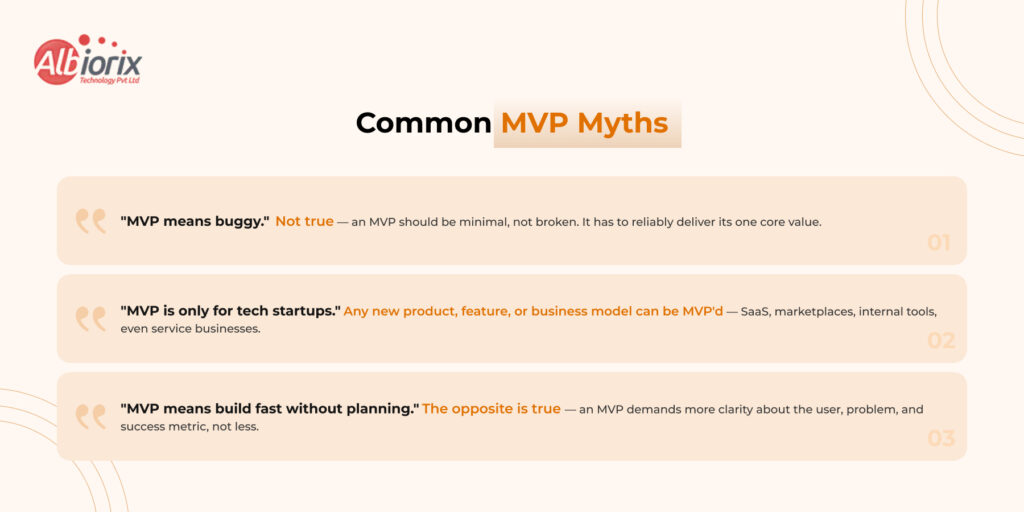
- “MVP means buggy.” Not true an MVP should be minimal, not broken. It has to reliably deliver its one core value.
- “MVP is only for tech startups.” Any new product, feature, or business model can be MVP’d SaaS, marketplaces, internal tools, even service businesses.
- “MVP means build fast without planning.” The opposite is true an MVP demands more clarity about the user, problem, and success metric, not less.
Why MVP Development Matters
MVP development exists to reduce uncertainty before you spend real money finding out the hard way. Three benefits show up consistently across companies that build this way:
Risk reduction
“No market need” is one of the most common reasons startups fail. An MVP is purpose-built to surface that risk early while it’s still cheap to change direction.
Cost efficiency
Defects and wrong assumptions caught during an MVP are far cheaper to fix than the same issues discovered after a full build. Smaller bets mean smaller losses when an assumption turns out to be wrong.
Faster learning loops
An MVP compresses the idea-to-feedback cycle. Instead of guessing what users want for six months, you’re watching real behavior within weeks, and every iteration is grounded in data instead of opinion.
The MVP Development Process, Step by Step
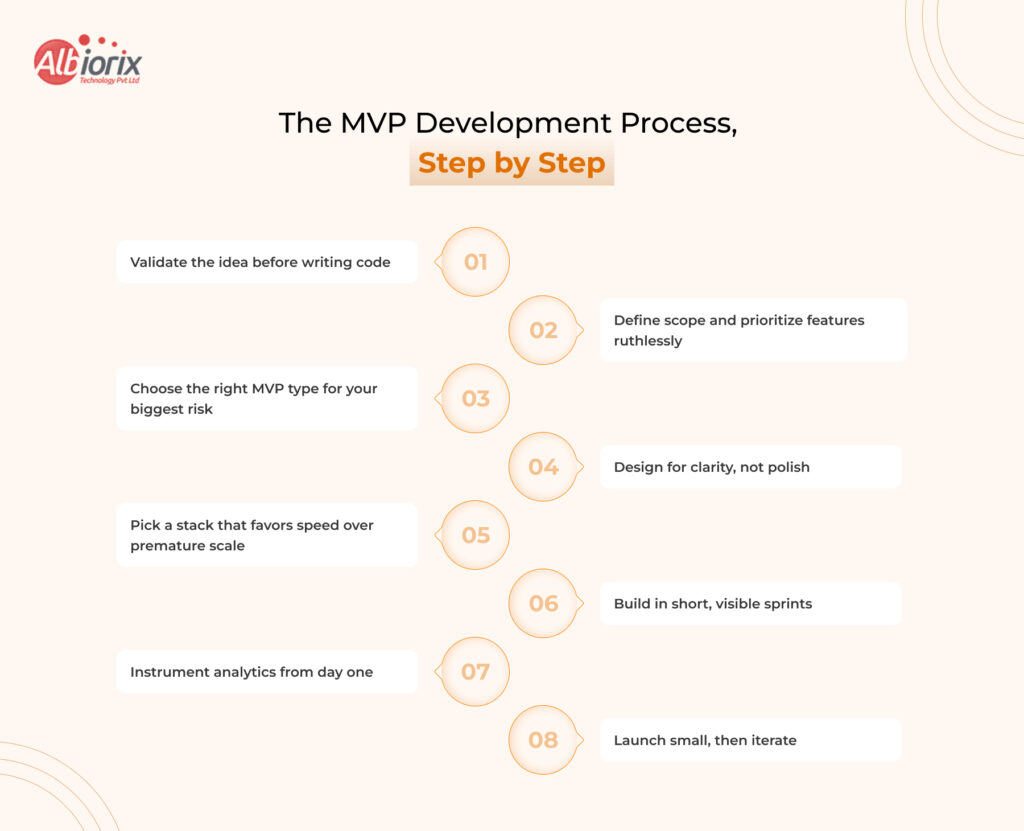
1. Validate the idea before writing code
Before any build starts, confirm the pain is real. Fast validation methods include a landing page with a waitlist, 10–15 user interviews, competitor gap analysis, or the strongest signal a paid pilot or pre-sale. Watch for commitment (“when can I try it?”), not compliments (“nice idea!”).
2. Define scope and prioritize features ruthlessly
Map every proposed feature against one question: does it directly serve the core problem? Frameworks like MoSCoW (Must / Should / Could / Won’t) or RICE scoring (Reach, Impact, Confidence, Effort) keep this honest. Most MVPs ship with 3–7 core features, not 20 cut dashboards, admin panels, multi-language support, and edge cases until version two.
3. Choose the right MVP type for your biggest risk
- Concierge MVP: you deliver the value manually behind the scenes best when the biggest risk is whether the outcome matters at all.
- Wizard-of-Oz MVP: the experience looks automated but is run manually best for testing a “magic” experience before building the real automation.
- No-code MVP: built on tools like Bubble or Webflow fastest and cheapest path to a real, usable product.
- Single-feature MVP: one feature that solves one painful problem the standard choice when you’re ready to write custom code.
4. Design for clarity, not polish
Start with wireframes for structure, a quick prototype for flow, and only then invest in visual polish. At MVP stage, UX has three jobs: get users to first value fast, make empty and error states self-explanatory, and stay usable on mobile.
5. Pick a stack that favors speed over premature scale
Don’t build what specialists have already solved use managed services for authentication, payments, transactional email, and analytics so your team’s time goes into the core value, not plumbing.
| Layer | Common MVP-stage choices |
|---|---|
| Web frontend | React, Vue.js, Next.js |
| Backend | Node.js, Python, PHP |
| Database | PostgreSQL, MongoDB |
| Mobile | Flutter or React Native for cross-platform speed; Swift / Kotlin only when native performance is required |
| Infrastructure | AWS, GCP, or Azure with serverless functions where possible |
| Auth, payments, analytics | Managed services (e.g. Auth0/Clerk, Stripe, Segment/PostHog) rather than custom builds |
6. Build in short, visible sprints
Two-week sprints keep the build adjustable: sprint one delivers the core flow end-to-end even if it’s rough, sprint two closes UX gaps and adds analytics, and an optional third sprint handles launch polish and onboarding. QA should focus on the critical user path rather than exhaustive edge-case coverage.
7. Instrument analytics from day one
Track sign-up completion, onboarding completion, core action started and completed (activation), and day-2/day-7 return visits. Without this instrumented before launch, the “learn” step in build-measure-learn never actually happens.
8. Launch small, then iterate
Soft-launch to a defined group of early users before going public it’s lower-risk and gives you room to fix what’s broken. In the first week after launch: fix anything blocking activation, talk to users daily even if it’s only two or three conversations, and resist adding new features until the core loop is solid.
MVP Development Cost in 2026
Cost depends heavily on scope, platform, and who builds it. As a general planning guide:
| MVP Type | Typical Cost Range | Timeline |
|---|---|---|
| No-code / lean validation build | $8,000 – $25,000 | 4–8 weeks |
| Standard custom MVP (web + mobile, core integrations) | $25,000 – $60,000 | 8–12 weeks |
| Complex MVP (AI features, marketplace logic, payments, compliance) | $60,000 – $150,000+ | 12–20 weeks |
Three factors move these numbers more than anything else: the number of user roles and platforms, how much custom backend logic you need versus off-the-shelf services, and whether the build team is a freelancer, an agency, or an in-house hire. Fixed-price engagements suit a well-scoped MVP; time-and-materials suits an MVP where requirements are still evolving. Always budget for post-launch iteration the real learning, and the real cost, often comes after the first release.
How to Choose the Right MVP Development Company
Not every custom software development company is equipped to build MVPs well it rewards speed and product judgment over exhaustive process. When evaluating a partner, weigh these criteria:
| Criteria | What to look for |
|---|---|
| Track record | Shipped MVPs with specific before/after outcomes not just enterprise project logos |
| Product thinking | A team that questions scope rather than agreeing to build everything you ask for |
| Technology fit | Genuine expertise in the stack your MVP needs, not a one-size-fits-all default |
| Pricing transparency | Milestone-based pricing with discovery, design, build, QA, and support clearly broken out |
| Delivery model | Agile sprints with visible progress every 1–2 weeks, not a black box until “done” |
| Post-launch continuity | A clear plan for what happens after validation can this team scale the codebase, or do you rebuild from scratch? |
At Albiorix, our MVP development services are built around exactly this: rapid, focused builds designed to validate first and scale second, using the latest AI, cloud, and integration tooling where it genuinely speeds up time-to-market. Explore our full product development services or talk to our team about scoping your MVP.
MVP Development Best Practices
Do this:
- Focus on one core problem and solve it well
- Build for scalability in principle, without over-engineering for scale you don’t have yet
- Implement analytics before launch, not after
- Plan and budget for post-launch iteration from day one
- Get real users testing early, even if the product is rough
Avoid this:
- Building a “minimum” product that’s actually a stripped-down version of the full product
- Treating the MVP as a throwaway prototype instead of production-lite code
- Skipping user research and validating assumptions instead of real behavior
- Launching without a feedback mechanism in place
- Letting perfect be the enemy of shipped
When to Move From MVP to Full-Scale Product
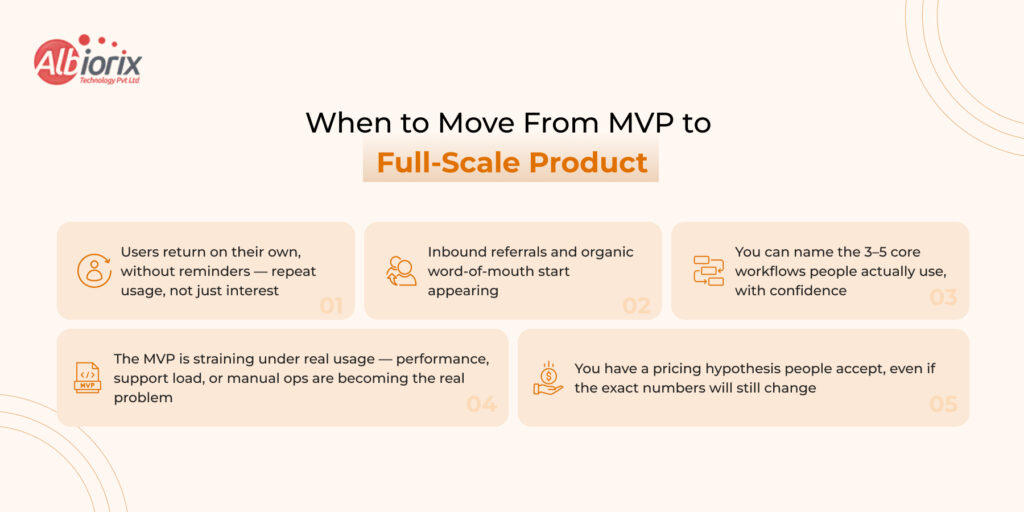
You’re ready to move beyond the MVP when the core unknowns are no longer unknown and the bottleneck shifts from “does anyone want this” to “can we scale adoption reliably.” Signals worth watching for:
- Users return on their own, without reminders repeat usage, not just interest
- Inbound referrals and organic word-of-mouth start appearing
- You can name the 3–5 core workflows people actually use, with confidence
- The MVP is straining under real usage performance, support load, or manual ops are becoming the real problem
- You have a pricing hypothesis people accept, even if the exact numbers will still change
Move too early and you risk building for edge cases before the core workflow is proven; move too late and you risk losing users to instability or an over-manual process. The rule of thumb: you’re ready when you can say who the MVP is for, what problem it solves, why people keep coming back, and what specifically needs to be built next to support scale.
Ready to Turn Your Idea Into a Scalable Digital Product?
TDon’t waste time and budget building features your users don’t need. Schedule a free 30-minute scoping session with our product experts to map out your MVP timeline, tech stack, and cost estimate.
Book Your Free MVP Strategy Session
Conclusion
An MVP isn’t a smaller version of your final product it’s the fastest, cheapest way to learn whether your idea deserves a final product at all. Define a clear target user, a specific problem, and a measurable outcome, then let the build-measure-learn loop do the rest. If you’re ready to scope your MVP, Albiorix can help you plan and build it right the first time.
Connect with Our Experts!
FAQ
MVP stands for Minimum Viable Product the simplest version of a product that still solves the core problem for early users and generates usable feedback.
Most MVPs take 6–16 weeks depending on complexity, platform count, and how settled the requirements are going in. No-code MVPs can launch in as little as 2–4 weeks.
Costs typically range from $8,000 for a lean no-code build to $150,000+ for a complex, multi-platform MVP with AI or compliance requirements. Most standard custom MVPs fall between $25,000 and $60,000.
A prototype is a clickable or visual representation used for feedback and design validation — it isn’t built on production-ready code. An MVP is a working, shippable product used by real customers, capable of evolving into the full product.
Freelancers can work for very simple, single-feature MVPs on a tight budget. Agencies typically offer broader skill coverage, more reliability, and continuity if the MVP needs to scale — which matters if you plan to raise funding on the strength of it.
Only features that serve the core value proposition: the primary workflow, basic onboarding, essential error handling, and analytics. Everything else — dashboards, admin panels, edge cases — belongs in a later iteration.
A validated MVP typically moves into a second phase: hardening the architecture, adding features that were deliberately deferred, and scaling infrastructure for real user volume — often with the same development partner that built the MVP, for continuity.
Published Blogs
Latest Blogs : Insights and Innovations from Our Blog
Stay Ahead in Tech: Dive into our Blogs for the Latest in Software, Web, and Mobile App Development. Explore cutting-edge technologies, industry trends, and insightful updates that keep you at the forefront of the digital landscape


Our Clients

Client Showcase: Trusted by Industry Leaders
Explore the illustrious collaborations that define us. Our client showcase highlights the trusted partnerships we've forged with leading brands. Through innovation and dedication, we've empowered our clients to reach new heights. Discover the success stories that shape our journey and envision how we can elevate your business too.










We’re here to help you


