






Table of Content
- Where LLMs Deliver Real Value in Financial Services?
- Choosing the Appropriate LLM Architecture for Financial Operations
- What It Takes to Implement LLMs in Financial Institutions?
- Managing Security, Compliance and AI Risks in Finance
- Measuring the Business Impact of Financial AI Investment
- How Albiorix Helps Financial Businesses Build Intelligent Digital Solutions?
- What's Next for LLMs in Financial Services?
- Building a Stronger Financial Future With Albiorix
Key takeaways
- Practical Business Applications: LLMs can support financial reporting, compliance reviews, customer assistance, lending documentation and insurance operations.
- Architecture Determines Reliability: Model selection, enterprise data integration and retrieval-augmented generation influence the accuracy and usefulness of financial AI systems.
- Implementation Requires More Than AI Models: Successful adoption depends on clean financial data, existing technology infrastructure, integration capabilities and controlled deployment.
- Security and Governance Are Essential: Financial institutions must address sensitive data protection, model accuracy, regulatory compliance and human oversight.
- Business Value Must Be Measurable: LLM investments should demonstrate improvements in operational efficiency, processing accuracy, service quality and return on investment.
- AI Is Moving Toward Greater Autonomy: Agentic AI could enable more sophisticated financial workflows, provided institutions establish appropriate operational controls.
Financial institutions face challenges of dealing with fragmented data, lots of documentation about compliance, and manual tasks which require time and human effort. Even though there are big investments being made by the industry to modernise infrastructure digitally, the ability to access relevant information amidst disparate systems continues to be a pain point for many banks and fintechs.
LLM in finance has huge potential here as it is capable of processing various types of financial documentations and retrieving required information from enterprise systems easily. In addition, it provides support for intricate workflows resulting in reduction of repetitive tasks for financial teams leading towards more informed decision-making.
However, financial institutions would need to explore specific use cases and how much value these could generate before implementing such solutions. This will involve understanding current system structure while ensuring all requirements are met delivering measurable business results.
Where LLMs Deliver Real Value in Financial Services?
Every day, financial organizations manage large amounts of paperwork and customer files among other regulatory data. The most valuable LLM use cases for financial services companies involve streamlining operations that rely heavily on manual efforts to extract data from documents, retrieve information or conduct reviews.
Financial Document Processing
With loan application forms, customer account statements, and contract documents being processed by financial institutions on different systems, leveraging LLM-powered document intelligence solutions helps extract relevant information, classify documents, find out missing details, and automate manual processes for faster turnaround time.
Banking and Customer Service
LLM applications in banking could enable AI assistants that provide access to authorized account information and explain various financial products while helping employees resolve customer requests more efficiently.
Risk and Compliance Operations
Compliance teams devote excessive time to sorting through ambiguous regulations and company rules. LLMs could streamline the process of comparing the latest regulations with current policies to highlight differences that may impact the company’s duties. They could then summarize relevant regulatory changes and draft initial compliance reports based on them.
Lending and Credit Assessment
LLM-powered tools could streamline analysis of financial statements, borrower records and supporting documents by organizing applicant data, pointing out documentation gaps and summarizing the results of credit assessments, freeing up time for lending pros to assess financial risk profiles and make critical decisions.
Financial Reporting and Research
LLMs are adept at pulling together disparate pieces of financial statements, disclosures and other documents and summarizing them for use in management reports. This reduces the amount of time finance professionals need to devote to preparing such reports but still allows them to validate financial information prior to its publication.
There’s also a lot of potential for using generative AI in financial services applications outside of stand-alone AI assistants. For example, financial institutions could create custom-built document intelligence platforms, compliance tools or reporting solutions designed specifically to integrate seamlessly with existing systems and tackle unique challenges within their operations.
Ready to Explore LLMs for Your Financial Business?
Discover how LLM-powered solutions can streamline financial workflows, simplify document processing, and improve access to business-critical information. Albiorix helps financial institutions identify the right AI use cases and build solutions aligned with their operational needs.
Discuss Your LLM Project
Choosing the Appropriate LLM Architecture for Financial Operations
The choice between one or more models comes down to the complexity of financial data, the existing infrastructure, security considerations, and use case of the solution. Financial institutions can’t expect that one particular model will satisfy all their needs with AI.
General-Purpose vs. Financial Domain-Specific LLMs
GPMs are excellent at handling document summarization, customer assistance, and internal knowledge retrieval. If you’re dealing with specialized terminology, financial research, and regulatory documentation, your best bet would likely be to go with financial domain-specific LLMs (provided that they perform as expected on those tasks).
You could even customize existing models if there’s justification for developing them further due to special workflows and performance considerations.
Using RAG to Retrieve and Verify Financial Information
RAG retrieves relevant information from approved sources, including financial records, regulatory documents, and internal policies. This ensures that responses are supported by verifiable references rather than depending only on the LLM’s existing knowledge base. It’s especially helpful for situations where financial info is either subject to frequent change or requires staying within controlled enterprise systems.
Integrating LLMs With Existing Financial Systems
For businesses wishing to implement AI on a grand scale, a good LLM architecture includes integrations with other banking programs, databases, and business systems through secure APIs. For example, a financial document assistant that retrieves loan documents, accesses borrower data, and prepares a combined review within a current lending application. It saves financial employees from having to switch back and forth, while keeping them responsible for giving the final approval.
In terms of choosing an appropriate model approach for your institution, you’ll have several options including using existing ones, building a custom one or leveraging the retrieval-based approaches outlined above. Technology partners like Albiorix guide you through this process and deliver fully-integrated financial AI applications based on your specific business needs, all without forcing organizations to rip out their existing infrastructure in the process.
What It Takes to Implement LLMs in Financial Institutions?
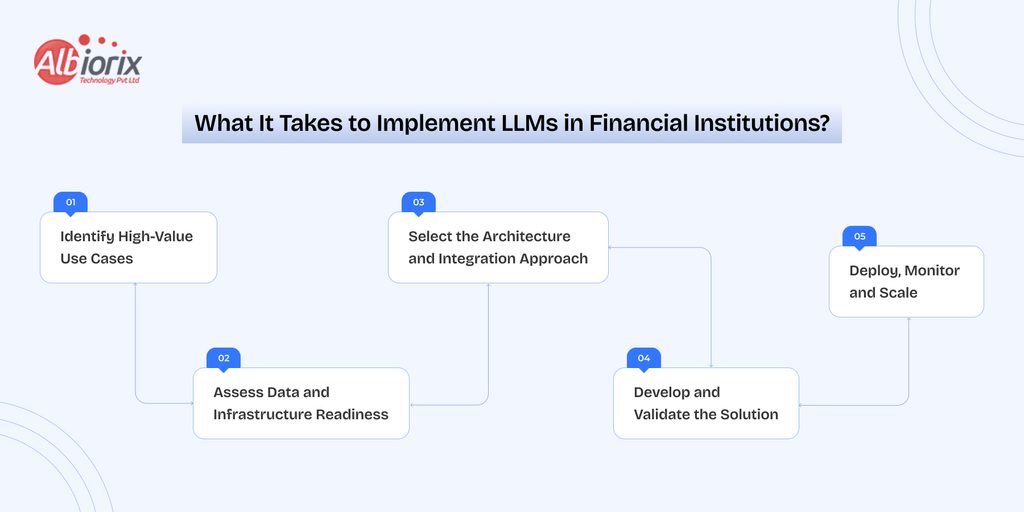
Successful use of LLM in finance requires clearly defined business goals and quality data along with effective integration into existing financial solutions. The systematic approach enables financial institutions to cope with the technical complexity and align investments with the practical priorities.
1. Identify High-Value Use Cases
- Prioritize workflows involving repetitive document reviews, reporting or information retrieval.
- Evaluate transaction volumes, processing costs and potential business impact.
- Define measurable objectives before development begins.
2. Assess Data and Infrastructure Readiness
- Review the quality, accessibility and sensitivity of financial data.
- Identify relevant databases, document repositories and existing applications.
- Address data inconsistencies and access limitations early.
3. Select the Architecture and Integration Approach
- Choose between existing LLM APIs, customized models and RAG-based solutions.
- Define how AI will connect with banking systems and internal workflows.
- Determine where custom development is needed to meet business requirements.
4. Develop and Validate the Solution
- Build a controlled pilot using realistic financial documents and scenarios.
- Measure extraction accuracy, processing time, cost per task and exception rates.
- Involve financial professionals in testing outputs and validating workflows.
5. Deploy, Monitor and Scale
- Introduce the solution into selected business operations before wider deployment.
- Track employee productivity, adoption and ongoing operating costs.
- Refine performance and integrations based on actual usage.
Effective financial services AI implementation depends on adapting LLM capabilities to established business processes. Custom AI development and enterprise integration help financial institutions move from isolated pilots to solutions that can support day-to-day operations.
Managing Security, Compliance and AI Risks in Finance
Integrating LLMs into financial operations introduces risks beyond conventional software systems. Inaccurate outputs, unauthorized data access and regulatory exposure can affect customer trust and business continuity. Financial institutions must therefore establish safeguards before deploying AI in sensitive workflows.
Below are some of the major LLM risks in finance and how to approach it:
| Risk Area | Recommended Approach |
|---|---|
| Hallucinations and Inaccurate Outputs | Validate responses against trusted financial records and flag uncertain results for human review. |
| Sensitive Data Exposure | Protect customer information through role-based access controls, data masking and encryption. |
| Prompt Injection | Treat retrieved documents as untrusted inputs and restrict unauthorized actions. |
| Regulatory Compliance | Maintain audit trails, documented approvals and AI-assisted activity records. |
| Model and Third-Party Risks | Monitor model performance, vendor dependencies and changes that affect reliability. |
Make Your Financial AI Investment Count
Build a clear roadmap for adopting AI with measurable business objectives, appropriate security controls, and a practical approach to integration. Identify opportunities where LLMs can deliver meaningful operational value while supporting your compliance requirements.
Discuss Your AI Strategy
Measuring the Business Impact of Financial AI Investment
The business value of LLMs becomes evident when financial institutions can demonstrate improvements in specific operations. Rather than measuring AI adoption alone, organizations should evaluate how these solutions influence processing costs, employee productivity and service delivery.
For instance, document intelligence solutions can be assessed through extraction accuracy, processing time and manual review effort. In customer service, relevant indicators include query resolution time, escalation rates and cost per interaction. Compliance teams can measure the time required to review regulatory documents and investigate flagged cases.
Evaluating the Return on Investment
A meaningful ROI assessment should compare these operational gains against the total cost of development, system integration, model usage, infrastructure, security and ongoing maintenance.
Financial institutions should establish performance benchmarks before deployment and evaluate results using actual business data. This helps distinguish measurable improvements from anticipated benefits.
The key consideration: A well-designed, business-specific LLM solution delivers value when its operational benefits justify its total cost and risk, not simply because it introduces advanced AI capabilities.
How Albiorix Helps Financial Businesses Build Intelligent Digital Solutions?
Albiorix combines AI engineering, fintech software development, and enterprise integration expertise to help financial institutions build secure, business-specific AI solutions that work with existing systems.
Our AI and Fintech Development Expertise
- LLM Development: Financial document intelligence, internal AI assistants and enterprise knowledge systems.
- AI Development: Intelligent financial applications and automated reporting workflows.
- AI Integration: Connecting LLMs with financial databases, APIs and existing platforms.
- Fintech Software Development: Custom banking, payment and financial management applications.
Project Spotlight: Crunch Finance Management App
Albiorix developed Crunch, an iOS and Android personal finance application featuring:
- Connected bank accounts, credit cards, loans and savings.
- Automated expense categorization and budgeting.
- Cash flow analysis, net worth tracking and financial benchmarking.
Crunch demonstrates our experience in financial data integration, analytics and application engineering, capabilities essential for developing reliable, AI-enabled financial solutions.
What’s Next for LLMs in Financial Services?
AI in finance moves beyond mere analytics to include systems that coordinate functions and manage complex operational flows.
Agentic AI makes it possible to automate various financial processes including document verification, transaction reconciliation and compliance reporting. It allows analysts to have an AI agent that retrieves necessary information, detects inconsistencies and offers solutions.
Nevertheless, this greater autonomy can only be achieved with appropriate controls in place as regards access to the system, financial decisions and human consent. Institutions should ensure that automation and accountability are used together in regulated environments.
The greatest potential lies in creating AI systems capable of performing specified financial workflows accurately while maintaining a high level of human oversight.
Building a Stronger Financial Future With Albiorix
More than just the capabilities of the model are necessary for the LLMs to flourish in the financial services industry. While the integration of reliable financial data and secure systems as well as AI governance in finance, is essential, the long-lasting value is only achieved when those technologies are applied to specific business challenges.
In a nutshell, financial institutions should prioritize developing AI technologies that are in sync with the current operations, comply with regulatory requirements, and are capable of showing measurable results. With vast experience of fintech engineering and custom AI development, Albiorix can help achieve that goal.
Build Smarter Financial Solutions With LLMs
Looking to modernize financial operations with AI? Albiorix helps businesses develop custom LLM applications, intelligent document processing solutions, and integrated fintech platforms designed around real business requirements.
Book an AI Consultation
Connect with Our Experts!
FAQ
Frequently Asked Questions
LLMs support financial document processing, compliance reviews, customer assistance, loan documentation analysis and reporting automation.
Financial institutions can use encryption, role-based access, private deployments, audit trails and human oversight to protect sensitive information and manage AI risks.
Existing models suit general tasks, while custom LLM solutions are useful when businesses require specialized workflows, financial data integration or greater control over deployment.
Costs depend on model selection, customization, infrastructure, API integrations, security requirements and ongoing maintenance. Get a free quote.
Timelines vary based on project scope, data readiness, integration complexity, regulatory requirements and testing needs.
Businesses can compare improvements in processing time, accuracy, employee productivity and operating costs against total development and maintenance expenses.
RAG connects LLMs with approved financial records, policies and regulatory documents to support contextually relevant responses with traceable sources.
Yes. Through secure APIs and enterprise integrations, LLMs can work with core banking platforms, financial databases and existing business applications.
Published Blogs
Latest Blogs : Insights and Innovations from Our Blog
Stay Ahead in Tech: Dive into our Blogs for the Latest in Software, Web, and Mobile App Development. Explore cutting-edge technologies, industry trends, and insightful updates that keep you at the forefront of the digital landscape
Our Clients

Client Showcase: Trusted by Industry Leaders
Explore the illustrious collaborations that define us. Our client showcase highlights the trusted partnerships we've forged with leading brands. Through innovation and dedication, we've empowered our clients to reach new heights. Discover the success stories that shape our journey and envision how we can elevate your business too.










We’re here to help you


