





Table of Content
- What Is an AI Agent? A Plain-English Definition
- What is the difference between AI Agent and Traditional Automation
- How AI Agent Development Works: The Development Lifecycle
- Real Enterprise Use Cases: Where AI Agents Deliver ROI
- Custom AI Agents vs. Off-the-Shelf AI Tools: Which Is Right for You?
- Enterprise AI Agent Implementation Guide: 5 Questions Before You Begin
- How to Choose an AI Agent Development Company in the USA
- Conlcusion
Summary: AI agents go beyond automation. They reason, adapt, and act as per the situation. This enterprise guide covers how AI agent development works, real industry use cases, and how US businesses can choose the right development partner.
Most enterprise automation tools do exactly what you tell them to do. AI agents do what needs to be done. And that’s the first and the basic difference between an automation tool and an AI Agent.
That difference might sound subtle, but for US enterprises navigating operational complexity, rising labor costs, and the pressure to scale without proportionally growing headcount, it is the difference between incremental efficiency and genuine transformation.
This informational guide on AI agents and AI agent development has the answer to every foundational question your leadership team is likely asking right now, such as:
- What is an AI Agent?
- What is AI Agent Development?
- How does it work in practice?
- Where does it deliver real enterprise ROI?
- When does custom development make more sense than off-the-shelf tools?
By the end, you will have a clear framework to evaluate whether AI agent development belongs in your next strategic roadmap.
What Is an AI Agent? A Plain-English Definition
An AI agent is a software system that automatically understands its environment, reasons about a goal, and determines the next steps to achieve that goal without any human intervention.
Unlike chatbots and IVR systems that follow the rules and predefined answers, an AI agent plans, adapts, and performs tasks on its own across multiple tools and data sources in real time.
Now, AI Agent Development is the process of designing, developing, and deploying these systems (aka AI Agents) to fulfill specific business objectives.
During the development process, these AI agents are integrated with enterprise data, APIs, and workflows so that they can operate accurately and reliably at scale.
Quick Definition:
An AI agent is an autonomous software system that perceives inputs, reasons through a goal, and takes multi-step actions to complete tasks with minimal human intervention.
Enterprise AI agent development involves building, integrating, and deploying these agents within existing business infrastructure to automate complex, decision-intensive workflows.
What is the difference between AI Agent and Traditional Automation
The basic and most crucial difference between an AI agent and a traditional automation tool is that an AI agent takes the decisions on its own to complete a task, whereas an automation tool strictly follows the rules and predefined script.
Below is the comparison table between AI agent and Traditional Automation.
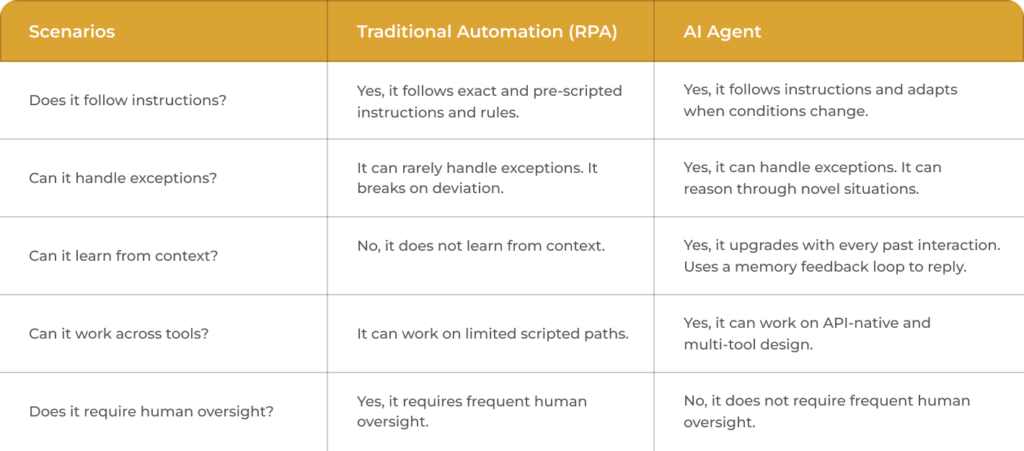
The analogy that resonates most with enterprise stakeholders: RPA is a calculator. An AI agent is a junior analyst who knows how to use a calculator, read a spreadsheet, send a follow-up email, and flag anything unusual; all without being asked twice.
Is your enterprise ready for AI Agents?
Not Sure? Book a free 30-minute consultation with our AI specialists at Albiorix Technology to find out.
Book a Free Consultation Call
How AI Agent Development Works: The Development Lifecycle
The AI agent development process is a bit tricky. However, every enterprise needs to understand the development lifecycle as it enables them to ask the right questions and set realistic expectations.
Here is how a well-structured AI agent development engagement typically unfolds:
- Setting the Goals: The first step in developing an AI agent is to define and set the goals, boundaries, and success metrics. You must have a clear picture of what an AI agent must do, what it must not do, and how you will know it is working well.
- Finalizing AI Model & Framework: The second step in AI agent development is to finalize the AI model and reasoning framework. Some of the most common choices for enterprise deployment are LangChain, AutoGen, CrewAI, GPT-4, and Claude.
- APIs & Data Integration: In the third step, you need to integrate CRM platforms, ERP systems, internal databases, and third-party services with your AI agent to respond accurately and reliably.
- Designing Memory & Reasoning Layer: Short-term context (within a task), long-term memory (across tasks), and the logic that governs how the agent prioritizes actions.
- Build and configure the action layer: The specific tools, APIs, and output channels the agent can use to complete tasks.
- Test in a sandboxed environment: Red-team the agent, test edge cases, and establish human-in-the-loop checkpoints for high-stakes decisions.
- Deploy, monitor, and iterate: Track performance against KPIs, capture drift, and continuously refine.
Estimated Timeline: According to the AI agent development experts at Albiorix Technology, building a focused single agent from a well-scoped workflow can take 8-12 weeks.
Whereas the time to develop multi-agent systems with deep enterprise integration typically takes 16 to 24 weeks.
If any AI development company or a vendor promises, an AI agent in two or three weeks is cutting corners on testing it before deployment. It can create significant downstream risk in the future.
Real Enterprise Use Cases: Where AI Agents Deliver ROI
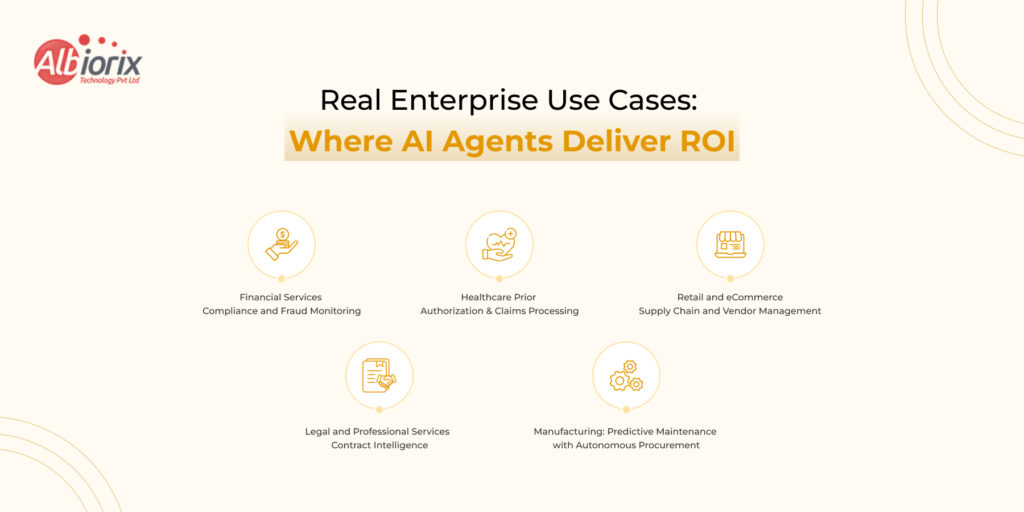
The highest-value AI agent deployments share a common trait: they target workflows that are high-frequency, rule-adjacent (mostly rule-based with enough exceptions to break RPA), and expensive in human time.
Here are five enterprise verticals where AI agent development is already generating measurable returns:
Financial Services — Compliance and Fraud Monitoring
AI agents continuously monitor transaction streams, flag anomalies against regulatory rules, cross-reference sanctions lists, and generate compliance reports tasks that previously required teams of analysts working in shifts. One mid-size US broker-dealer reduced compliance review time by 60% and cost by 30% after deploying a custom monitoring agent integrated with their core banking system.
Healthcare — Prior Authorisation and Claims Processing
Prior authorisation is one of healthcare’s most expensive administrative bottlenecks. Autonomous AI systems can retrieve patient records, match against payer criteria, draft authorisation requests, follow up with payers, and escalate to a clinician only when genuinely required. This reduces processing time from days to hours.
Retail and eCommerce — Supply Chain and Vendor Management
Custom AI agents for business automation in retail are handling demand forecasting, reorder triggering, vendor communication, and exception management all within a single automated loop. What once required a supply chain analyst’s daily attention now runs with a weekly human review cycle.
Legal and Professional Services — Contract Intelligence
Enterprise AI agents can ingest contracts, extract key clauses, flag deviations from standard terms, cross-reference prior agreements, and surface risk in minutes rather than the hours a paralegal team would need. Several AmLaw 200 firms are already piloting these deployments.
Manufacturing — Predictive Maintenance with Autonomous Procurement
Sensor data feeds an AI agent that predicts equipment failure windows, triggers maintenance work orders, and when parts inventory drops below threshold, it initiates a procurement workflow with pre-approved suppliers. No human touches the process until the maintenance technician shows up with the right parts already ordered.
See what AI agents can do for your industry
Our team has built custom AI automation solutions across finance, healthcare, legal, and manufacturing.
Call Us!
Custom AI Agents vs. Off-the-Shelf AI Tools: Which Is Right for You?
The honest answer: off-the-shelf tools like Microsoft Copilot, Salesforce Einstein, or ServiceNow’s AI capabilities are genuinely good for standardized workflows within their native ecosystems. If your needs map cleanly onto what these platforms offer, start there.
Custom AI agent development becomes the better investment when:
- Your workflows span multiple platforms that do not share a native integration layer.
- You have proprietary data that gives your agents a competitive advantage when trained into the system.
- Your compliance environment requires auditability, data residency controls, or model-level transparency that SaaS vendors cannot provide.
- You need the agent to take consequential actions such as approvals, financial transactions, and customer communications where off-the-shelf guardrails are too loose or too restrictive.
- The workflow involves exceptions, judgment calls, or contextual reasoning that exceeds the boundaries of a pre-packaged product.
Off-the-shelf is faster to deploy and lower in upfront cost. Custom development has higher initial investment but delivers differentiated capability, deeper integration, and long-term cost efficiency as the agent scales. The right decision depends on where your operational complexity sits.
Enterprise AI Agent Implementation Guide: 5 Questions Before You Begin
Before any enterprise begins an AI agent implementation, your leadership team should align on these five questions. They will shape vendor selection, architecture decisions, and governance design:
- What workflow are we targeting, and why is it the right first candidate? Start with high-frequency, high-cost, moderately complex processes. Avoid starting with mission-critical edge cases.
- What does success look like in 90 days, 6 months, and 12 months? Define KPIs before development begins — time saved per transaction, error rate reduction, cost per process, or escalation frequency.
- What data does the agent need, and who owns it? Data access, quality, and governance decisions will determine your deployment timeline more than any technical factor.
- What are the failure modes, and how are they caught? Every production agent needs a human-in-the-loop escalation path. Define the trigger conditions before go-live.
- Is our vendor model-agnostic or locked in? Enterprise needs evolve. A partner who can work across model providers protects you from single-vendor dependency as the AI landscape shifts.
How to Choose an AI Agent Development Company in the USA
The market for AI agent development services in the USA has expanded rapidly and so has the variance in quality. Here is what separates credible enterprise partners from vendors riding the hype wave:
What to Look For:
- Demonstrated experience with enterprise-grade integrations, and not just prototype demos.
- They must be able to work with OpenAI, Anthropic, Google, or open-source models depending on your requirements. and if you want to see how we Analyzed Our Last AI Projects and what worked for our clients.
- A clear post-deployment support model, because production AI agents require ongoing monitoring, retraining, and incident response.
- Compliance and data security credentials relevant to your industry such as SOC 2, HIPAA readiness, or FedRAMP depending on your sector.
- References from clients in your industry or with comparable integration complexity.
Red Flags to Watch For:
- Vendors who lead with the model name (“we use GPT-4”) rather than the use case outcome.
- No mention of testing, monitoring, or post-deployment support in their proposal.
- Cookie-cutter demos that do not reflect your actual workflow or data environment.
- Timelines under six weeks for complex multi-system integrations.
Conlcusion
At Albiorix Technology, our AI agent development solution and process starts with a structured discovery engagement, and not a sales pitch.
We map your existing workflows, identify the highest-ROI automation candidates, and propose an architecture that fits your data environment, compliance requirements, and integration landscape before a single line of code is written.
Our team has built AI automation solutions for enterprises across the USA, UK, Germany, and Australia, in industries from fintech to professional services.
Connect with Our Experts!
FAQ
Frequently Asked Questions
AI agent development for enterprises is the process of designing and deploying autonomous AI systems that can perceive data, reason about goals, and execute multi-step tasks within a company’s existing technology infrastructure, without requiring manual direction at each step. Enterprise deployments typically involve custom integrations with CRMs, ERPs, databases, and third-party APIs.
A chatbot responds to inputs. An RPA tool repeats scripted steps. An AI agent does both and more, it reasons through context, handles exceptions, uses multiple tools, and adapts when conditions change. The key distinction is autonomy: an agent can complete a multi-step workflow end to end, while chatbots and RPA require human intervention whenever they encounter something outside their script.
A focused single-agent deployment for a well-scoped workflow typically takes 8 to 12 weeks from discovery to production. Multi-agent systems with complex enterprise integrations require 16 to 24 weeks. Timeline is primarily driven by data access, integration complexity, and the number of human-in-the-loop checkpoints required by your compliance environment.
Financial services (compliance, fraud monitoring), healthcare (prior authorisation, claims), retail and eCommerce (supply chain, vendor management), legal and professional services (contract review), and manufacturing (predictive maintenance, procurement) are currently seeing the highest ROI from custom AI agent deployments. The common denominator is high-frequency workflows with enough complexity to break traditional RPA.
Look for an AI agent development company with demonstrated enterprise integration experience and not just demos. Prioritise model-agnostic partners who can work across providers, have a clear post-deployment support model, and hold industry-relevant compliance credentials. Ask for references from clients with similar workflow complexity. Avoid vendors who lead with model names rather than business outcomes.
Published Blogs
Latest Blogs : Insights and Innovations from Our Blog
Stay Ahead in Tech: Dive into our Blogs for the Latest in Software, Web, and Mobile App Development. Explore cutting-edge technologies, industry trends, and insightful updates that keep you at the forefront of the digital landscape
Our Clients

Client Showcase: Trusted by Industry Leaders
Explore the illustrious collaborations that define us. Our client showcase highlights the trusted partnerships we've forged with leading brands. Through innovation and dedication, we've empowered our clients to reach new heights. Discover the success stories that shape our journey and envision how we can elevate your business too.










We’re here to help you


