





Table of Content
- What Is a Dedicated Development Team?
- Why Demand for Dedicated Teams Is Growing
- Dedicated Team vs. Staff Augmentation vs. Fixed-Price vs. Freelancers
- Benefits of a Dedicated Development Team
- When a Dedicated Team Makes Sense and When It Doesn’t
- How Much Does a Dedicated Development Team Cost in 2026?
- Why So Many Outsourcing Engagements Underperform
- How to Hire a Dedicated Development Team: A 7-Step Process
- Red Flags When Choosing a Vendor
- How to Manage a Dedicated Development Team Remotely
- Common Mistakes to Avoid
- Hire Vetted Dedicated Developers by Expertise
- Why Companies Choose Albiorix for Dedicated Teams
When a project outgrows a freelancer’s bandwidth but doesn’t justify building an entire in-house department, most growing companies land on the same question: should we hire a dedicated development team?
The timing isn’t a coincidence. Technology roles are among the hardest in the world to fill. Korn Ferry’s global talent research projects a shortfall of roughly 4.3 million skilled technology workers by 2030, and estimates that the U.S. alone stands to lose around $162 billion in annual revenue if that gap isn’t closed.
Separately, industry surveys have found that a large majority of employers now report difficulty filling technical roles, and that specialized positions can sit open for well over a month before they’re filled. For a company trying to ship a product on a real deadline, that gap is exactly what a dedicated development team is built to close.
This guide covers what a dedicated team actually is, how it differs from staff augmentation and fixed-price outsourcing, what it costs in 2026 by region (with current market rate data), why so many outsourcing engagements underperform, and a step-by-step process for hiring a team without the risk that sinks a lot of first attempts.
What Is a Dedicated Development Team?
A dedicated development team is a group of developers — and usually QA engineers, a project manager, and a tech lead — who work exclusively on one client’s product for the full length of an engagement.
Unlike a freelancer or a project-based contractor, this team doesn’t rotate between clients. Your product is the only thing they work on, day in and day out, for as long as the engagement runs.
The vendor (in Albiorix’s case, that’s us) handles recruitment, payroll, benefits, equipment, and HR administration. You, the client, direct the actual work: you own the product roadmap, set sprint priorities, and run the team the way you would an in-house department, just without the overhead of being the legal employer.
Why Demand for Dedicated Teams Is Growing
Independent market research firms tracking the IT staff augmentation and outsourcing sector have put the global market size anywhere from roughly $300 billion to well over $800 billion depending on methodology and scope, with most projections agreeing on double-digit annual growth through the early 2030s.
The estimates vary widely because different firms define the category differently, but the direction is consistent: multiple reports point to a majority of enterprises already using staff augmentation or dedicated teams specifically to close skill gaps, not just to save money.
A few forces are driving that shift. Remote-first hiring has made geography far less of a constraint than it was even five years ago.
AI, cloud-native, and cybersecurity roles are growing faster than local universities and bootcamps can produce qualified graduates. And company leaders surveyed across multiple recent workforce studies increasingly cite speed to hire, not just cost, as their primary reason for looking outside their home market.
Dedicated Team vs. Staff Augmentation vs. Fixed-Price vs. Freelancers
These four models get used interchangeably in casual conversation, but they solve different problems. Picking the wrong one is one of the most common reasons outsourcing engagements disappoint.
| Model | Best For | Who Manages Work | Flexibility | Typical Commitment |
|---|---|---|---|---|
| Dedicated Team | Long-term products, evolving roadmaps, startups scaling fast | Client directs; vendor manages HR/ops | High — team composition can flex | 3+ months, often 12+ |
| Staff Augmentation | Filling a specific skill gap on an existing team | Client fully | Medium | 1–6 months |
| Fixed-Price Project | Well-defined scope, MVPs, one-off builds | Vendor, against a signed spec | Low — change requests cost extra | Project length |
| Freelancers | Small, isolated tasks or short sprints | Client | High but unreliable at scale | Days to weeks |
As a rule of thumb: if you can write a complete, unchanging spec today, use fixed-price. If you know roughly what you need but expect the plan to change as you learn, a dedicated team is the safer bet, because it’s built to absorb that kind of change without a renegotiation every sprint.
Benefits of a Dedicated Development Team
- Cost efficiency — current market rate data puts senior developer rates in Eastern Europe and Latin America at roughly 30–70% below equivalent US rates, and even further below in South Asia, once you’re comparing like-for-like seniority.
- Speed to start — an established partner with developers on bench can typically assemble and onboard a team in 2–4 weeks, compared with reported average fill times of well over a month for a single specialized technical hire through conventional recruiting.
- Full-time focus — unlike agencies juggling multiple clients or freelancers splitting time, the team works only on your product.
- Scalability without the HR burden — team size can flex up or down with weeks of notice, not a hiring or restructuring cycle.
- Access to a wider talent pool — particularly useful for niche stacks where local hiring markets are thin or expensive.
When a Dedicated Team Makes Sense and When It Doesn’t
Good fit
- You have a long-term product roadmap, not a single deliverable.
- Requirements will keep evolving — SaaS products, internal platforms, and apps with continuous release cycles are the classic case.
- You need to scale engineering capacity fast without a 3–6 month in-house hiring cycle.
- You want senior technical ownership without carrying that headcount permanently in-house.
Not a good fit
- The scope is small, fixed, and finishes in a few weeks — fixed-price is cheaper and simpler.
- Your organization can’t support daily standups or sprint planning with an external team.
- Budget is rigid and can’t flex month to month even slightly.
How Much Does a Dedicated Development Team Cost in 2026?
Cost is driven almost entirely by two things: where the team is based, and the seniority mix you need. Current 2026 market rate data from multiple developer-rate benchmarking sources puts typical hourly bill rates in these bands:
| Region | Typical Hourly Range (Mid–Senior) | Notes |
|---|---|---|
| North America | $78 – $150+/hr | Highest cost; strongest for roles needing tight in-house overlap |
| Western Europe | $40 – $90/hr (avg. ~$66/hr) | Premium region; UK, Germany, Netherlands lead |
| Eastern Europe | $37 – $70+/hr (avg. ~$37–45/hr) | Best overall value; strong English and EU-hours overlap |
| Latin America | $35 – $61/hr (avg. ~$50/hr) | Best nearshore fit for US time-zone overlap |
| India / South Asia | $15 – $50/hr | Lowest entry cost; largest talent pool and scale |
Translated into monthly blended team cost, a typical dedicated team of four (two mid-level developers, one senior lead, one QA engineer) sourced through an Eastern European or Latin American partner usually lands between $18,000 and $28,000 per month, all-in.
That’s roughly a third of what the same roster would cost hired locally in North America once payroll tax, benefits, tooling, and recruiting overhead are included.
What’s usually included
- Developer/QA salaries and benefits
- Recruitment and replacement if a team member leaves
- Project management tooling and standard dev infrastructure
- A dedicated tech lead or point of contact
What’s often billed separately
- Specialized software licenses specific to your product
- Third-party infrastructure costs (cloud hosting, CI/CD tooling beyond the basics)
- Travel, if any in-person collaboration is required
One caution worth building into any budget: several 2026 rate analyses note that cross-border compliance costs (statutory benefits, employer-of-record fees, local labor law requirements) can add 15–30% on top of the headline hourly rate depending on the country.
Ask any vendor to confirm whether their quoted rate is fully loaded before comparing it to a competitor’s number.
Why So Many Outsourcing Engagements Underperform
It’s worth being direct about the risk side of this decision.
The Standish Group’s long-running CHAOS research, based on tens of thousands of surveyed IT projects, has consistently found that a large share of software projects run over budget, miss deadlines, or get cancelled outright — in its most recent widely cited report, roughly three in ten projects were rated fully successful, half were rated “challenged” (late, over budget, or reduced in scope), and the rest were cancelled before completion.
Separate research from McKinsey has found that a meaningful share of large IT projects go so far over budget or schedule that they threaten the financial position of the company running them.
None of this is unique to outsourced or dedicated teams specifically — it’s a pattern across IT projects generally, in-house and external alike. But it’s exactly why the vetting and trial-sprint steps below aren’t optional formalities.
The research consistently points to the same root causes: unclear requirements, low client involvement, and picking a partner mainly on price. All three are avoidable with a deliberate hiring process.
How to Hire a Dedicated Development Team: A 7-Step Process
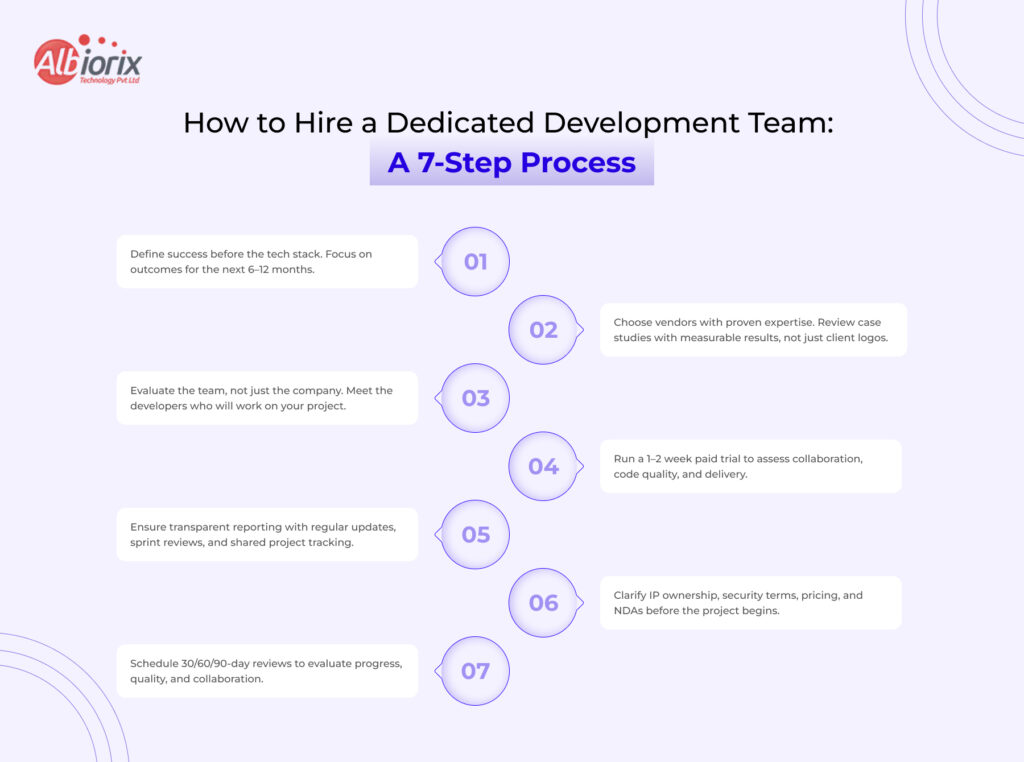
- Define the outcome, not just the tech stack. Write down what “success” looks like in 6 and 12 months — not only the languages and frameworks you assume you need.
- Shortlist 3–5 vendors with proven experience in your domain and stack. Ask for case studies with measurable outcomes, not just a logo wall.
- Vet the actual people, not just the company. Request CVs and short interviews with the specific developers who would join your team.
- Run a paid trial sprint (1–2 weeks) before signing a long-term contract. This is the cheapest way to surface communication style, code quality, and process fit before you’re locked in.
- Confirm reporting cadence up front: daily standups, sprint reviews, shared project management tooling, and a single named point of contact.
- Clarify IP ownership, NDAs, data security terms, and whether quoted rates are fully loaded, before kickoff, not after code is already being written.
- Set a 30/60/90-day review checkpoint to formally assess velocity, code quality, and communication, with an easy off-ramp if it isn’t working.
Red Flags When Choosing a Vendor
- Refuses to let you interview or vet the actual developers before signing.
- No clear, specific answer on IP ownership, data handling, or whether the rate is fully loaded.
- Won’t commit to named seniority levels for the team.
- Pushes a long contract with no trial period and no exit clause.
- Can’t produce a reference client in a similar industry or stack when asked.
How to Manage a Dedicated Development Team Remotely
Managing a dedicated team well doesn’t require different skills than managing an in-house team — it requires more deliberate structure, because you lose the hallway conversations that patch over small gaps.
Given how strongly the research above ties project failure to low stakeholder involvement, this is not a step to skip.
- Run daily standups, even if short, with cameras on where time zones allow.
- Use one shared project management tool — never let the vendor track work in a separate system you can’t see.
- Hold a weekly sprint review and a lightweight retro.
- Name a single point of contact on both sides.
- Document decisions in writing so context survives if a team member rotates off.
Common Mistakes to Avoid
- Treating it like a fixed-price project — skipping regular check-ins because “the team will just handle it.”
- Skipping the trial sprint to save two weeks, then discovering a communication or quality mismatch three months in.
- Under-specifying the outcome, leaving the team guessing at priorities.
- Not budgeting for management time — someone on your side still needs to own the roadmap.
- Choosing purely on lowest day rate — the research above shows cost-driven vendor se
lection is one of the clearest predictors of project trouble.
Hire Vetted Dedicated Developers by Expertise
Finding specialized talent shouldn’t delay your product roadmap. Whether you need to plug a specific skill gap or build an entire product team from scratch, Albiorix connects you with senior-level engineers across industry-leading frontend, backend, and mobile frameworks.
Explore our dedicated hiring options to find the exact expertise your project demands:
Frontend & Mobile Development
- Dynamic Web Apps: Scale your user interface by choosing to hire ReactJS developers who specialize in building high-performance, component-based applications.
- Enterprise Web Architecture: Build robust, structured single-page applications when you hire AngularJs developers for your complex corporate systems.
- Cross-Platform Mobile Apps: Deploy to both iOS and Android from a single codebase seamlessly when you hire Flutter app developers.
Backend & Full-Stack Engineering
- AI & Data-Driven Platforms: Accelerate your web applications, machine learning integration, or automation workflows when you hire Python developers.
- Enterprise-Grade Solutions: Ensure security, cloud readiness, and high availability for legacy or modern software architectures by choosing to hire ASP.NET developers.
- Rapid Startup Scaling: Build and iterate on your MVP at lightning speed when you bring on agile MVPs and hire RoR developers.
- Clean & Scalable PHP Apps: Keep your development organized, fast, and secure by opting to hire Laravel developers for your next web project.
Why Companies Choose Albiorix for Dedicated Teams
Albiorix Technology builds dedicated teams around specific stacks — including Angular, React, Node.js, Ruby on Rails, Laravel, Python, and ASP.NET — with senior engineers vetted before they’re ever presented to a client.
Teams are structured with a named tech lead, transparent sprint reporting, and the ability to scale up or down as your roadmap shifts, backed by contracts that don’t lock you into rigid, multi-year commitments.
Connect with Our Experts!
FAQ
Frequently Asked Questions
A dedicated development team is a group of developers and supporting roles — QA, a project manager, a tech lead — who work exclusively on one client’s product on an ongoing basis. The vendor handles recruitment, payroll, and HR, while the client directs day-to-day priorities.
Based on current 2026 market rate data, a typical four-person team (two mid-level developers, one senior lead, one QA engineer) costs roughly $18,000–$28,000/month through an Eastern European or Latin American partner, versus significantly more for an equivalent North American roster.
Staff augmentation fills a specific, usually short-term skill gap on a team the client already manages in full. A dedicated team is a more complete, longer-term unit built around an evolving product roadmap.
With an established partner that has developers on bench, a team can typically be assembled and onboarded within 2–4 weeks — considerably faster than typical fill times for a single specialized technical hire through conventional recruiting.
Through daily standups, one shared project management tool, weekly sprint reviews, and a single named point of contact — the same cadence used for an in-house team, adapted for time zone overlap.
Long-running industry research on IT project outcomes points to the same recurring causes: unclear requirements, low client involvement, and selecting a vendor mainly on price rather than fit. A trial sprint and a clear reporting cadence directly address all three. Ready to see what a dedicated team built around your stack would look like? Get in touch with Albiorix to talk through your roadmap and team composition.
Published Blogs
Latest Blogs : Insights and Innovations from Our Blog
Stay Ahead in Tech: Dive into our Blogs for the Latest in Software, Web, and Mobile App Development. Explore cutting-edge technologies, industry trends, and insightful updates that keep you at the forefront of the digital landscape



Our Clients

Client Showcase: Trusted by Industry Leaders
Explore the illustrious collaborations that define us. Our client showcase highlights the trusted partnerships we've forged with leading brands. Through innovation and dedication, we've empowered our clients to reach new heights. Discover the success stories that shape our journey and envision how we can elevate your business too.










We’re here to help you


