





Table of Content
- What Does AI Agent Development Actually Cost in the USA in 2026?
- What Factors Drive AI Agent Development Costs?
- Enterprise AI Agent Development Pricing: What Are You Actually Paying For?
- AI Agent Development Cost vs. ROI: Making the Business Case
- Custom AI Agent Development Cost: Build vs. Buy vs. Extend
- AI Automation Software Development Cost: Where Process Meets Intelligence
- AI Agent Consulting Cost: The Value of Expert Guidance
- How to Build a Budget That Holds Up
- Questions Executives Are Asking in 2026
- Why the Development Partner You Choose Matters as Much as the Budget
- The Bottom Line
- Albiorix Technology – An AI Agent Development Company
Summary: Every business in the USA wants to develop and integrate a custom AI agent into their existing system, but what scares them is the overall cost of AI agent development. Practically speaking, the development cost of an AI agent may sound high, but in the long run, it proves to be a smart investment. So, here is a detailed guide to help businesses and entrepreneurs in the USA better understand the cost of AI agent development.
Enterprise leaders across the USA are no longer asking whether AI agents are worth investing in. They are asking what is the cost of AI agent development in the USA, what they will get in return, where can I find a reliable AI agent development company, and which development approach best fits their business model.
This guide on the cost of AI agent development is built for that conversation. Whether you are a CTO evaluating vendors, a CFO signing off on a budget, or an operations head trying to quantify the business case, the numbers and frameworks here will help you move from question to decision.
Let us start with the answer most people come here looking for.
What Does AI Agent Development Actually Cost in the USA in 2026?
The short answer: AI agent development cost in the USA typically ranges from $20,000 to $500,000 or more, depending on complexity, integration depth, and whether you are building from scratch or extending an existing platform. To know the exact cost of development, you can contact an AI development company with your concept.
That is a wide range, and deliberately so. Here is a more useful way to think about it.
| Project Tier | Description | Estimated Cost (USD) | Timeline |
|---|---|---|---|
| Starter/PoC | Single-task agent, limited integrations, pre-built LLM stack | $20,000 to $50,000 | 4-8 weeks |
| Mid-tier | Multi-step agent with API integrations, custom workflows, basic analytics | $50,000 to $150,000 | 2-4 months |
| Enterprise-Grade | Multi-agent systems, enterprise data pipelines, security, compliance, custom UI | $150,000 to $300,000+ | 4-9 months |
| Full Ecosystem / Platform | Autonomous agents with orchestration, feedback loops, enterprise-wide deployment | $300,000 to $500,000+ | 6-12 months |
These figures reflect market rates as of 2026 for US-based and US-serving development firms. Offshore AI agent development companies or nearshore partners can reduce the development cost by 30%-60% percent. So, when building a business AI agent, explore all the possible options around you to get the best deal at smart prices.
What Factors Drive AI Agent Development Costs?
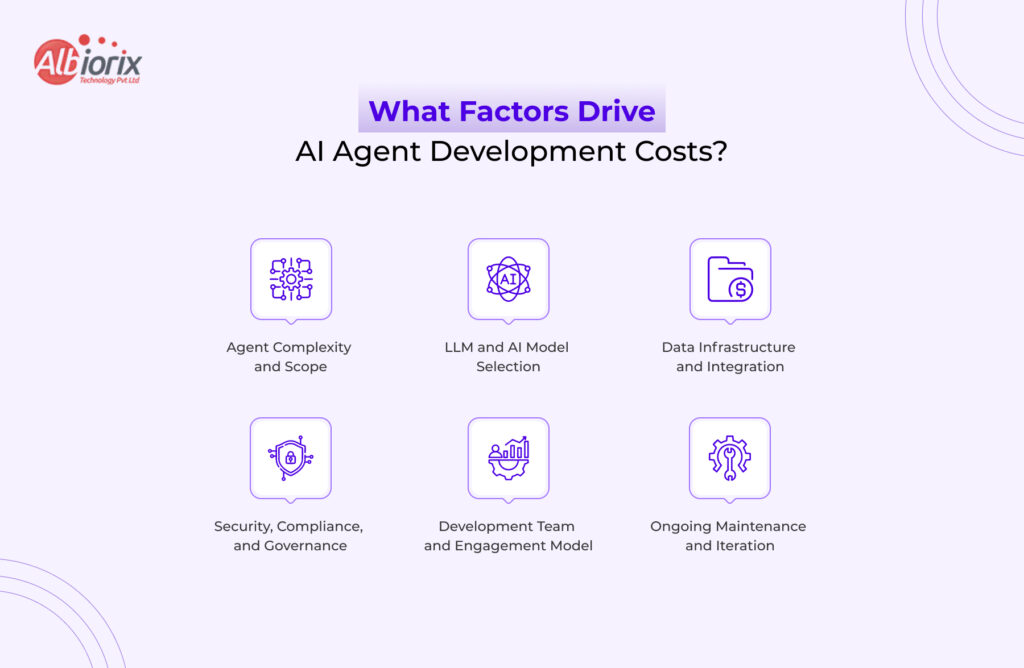
The development cost of an AI agent is arbitrary. Even the figures mentioned above in the comparison table may vary as per the project requirements. Thus, to know the exact or approx. cost of AI agent development in the USA, you must understand the factors that heavily influence the cost of development.
So, here are the factors that affect the cost of AI agent development in the USA:
Agent Complexity and Scope:
It is the most crucial factor that affects the cost of development. What your AI agent is supposed to do after development or what tasks it will handle will influence the cost of development. For instance, A single-purpose agent that qualifies sales leads operates in a fundamentally different engineering environment than a multi-agent system coordinating customer support, inventory updates, and billing simultaneously.
Key complexity factors include:
- Number of tasks and decision branches the agent must handle
- Whether the agent operates reactively (responding to triggers) or autonomously (proactive execution)
- The degree to which the agent must learn and adapt over time
- Whether multi-agent orchestration is required
LLM and AI Model Selection:
Once you have decided on the role of an AI agent in your organization, it’s time to finalize the AI model. The underlying model choice has a direct impact on both development cost and ongoing operational cost.
Enterprise teams in the USA generally choose from below listed AI Models:
- OpenAI GPT-4o/GPT-4 Turbo: It has strong general reasoning and broad ecosystem support.
- Anthropic Claude 3 Opus/Sonnet: It is preferred for nuanced analysis and long-context tasks.
- Google Gemini Ultra: It has strong multimodal capabilities and is useful for vision-integrated agents.
- Open-source models (Mistral, LLaMA 3): It has lower API costs and higher customization overhead.
Whichever the AI model you choose for your AI agent, it comes with fixed expenses such as model licensing fees, fine-tuning costs, and token-based API pricing. US enterprises running agents at scale have seen monthly API costs ranging from $5,000 to $80,000 depending on volume.
Data Infrastructure and Integration:
AI agents totally depend on your company’s data and provide information to perform certain tasks. Thus, the data you provide must be well-structured and streamlined. Connecting an agent to your CRM, ERP, internal databases, or real-time data streams required a lot of engineering work which may add to the overall development cost of AI agents.
Integration costs depend on:
- Number and type of enterprise systems (Salesforce, SAP, ServiceNow, etc.)
- Quality and accessibility of existing data
- Whether ETL pipelines or real-time data sync is required
- Custom API development versus pre-built connectors
Complex enterprise integration work alone can account for 30–40% of total project cost.
Security, Compliance, and Governance:
Enterprises operating in regulated industries such as finance, healthcare, legal, insurance face additional requirements that add to development cost but are non-negotiable.
- HIPAA, SOC 2, GDPR, CCPA compliance frameworks
- Role-based access controls and audit logging
- Data encryption, model output filtering, and PII handling
- Human-in-the-loop review workflows
You cannot build an AI agent in the USA unless it is highly secure, and you get a compliance license from the respective authorities. You can expect compliance-related requirments to add $15,000 to $60,000 to a mid-tier or enterprise-grade engagement.
Development Team and Engagement Model:
How and where your AI agent is built has a significant effect on cost. The three main models:
| Engagement Model | Typical Cost Range | Best for |
|---|---|---|
| US-based AI dev agency/firm | $120-$250/hr | High-stakes, compliance-heavy projects |
| Nearshore (Canads, Mexico, Eastern Europe) | $60-$100/hr | Mid-complexity with quality oversight |
| Offshore (India, Southeast Asia) | $30-$60/hr | Budget-sensitive projects with defined scope |
| Internal team build-out | High upfront (hiring + tooling) | Long-term capability ownership |
Ongoing Maintenance and Iteration:
AI agents are not set-and-forget deployments. They require continuous monitoring, model updates, prompt engineering refinements, and performance tuning. Budget 15–25% of your initial development cost annually for maintenance.
To see a full lifecycle breakdown of these numbers, you can consult our AI agent development cost guide. Some enterprises run ongoing AI agent consulting retainers at $5,000 to $20,000 per month for dedicated support.
Enterprise AI Agent Development Pricing: What Are You Actually Paying For?
When a development firm quotes $200,000 for an enterprise AI agent, it is worth understanding the line items behind that number. Here is a representative breakdown for a mid-to-large enterprise engagement:
| Component | Estimated Cost | % of Total |
|---|---|---|
| Discovery, architecture design, scoping | $15,000 to %25,000 | 8-12% |
| Core agent development (logic, prompting, orchestration) | $50,000 to $100,000 | 30-40% |
| LLM fine-tuning or RAG pipeline setup | $20,000 to $50,000 | 10-18% |
| UI/UX and admin dashboard | $15,000 to $30,000 | 8-12% |
| Testing, QA, red-teaming | $10,000 to $20,000 | 5-8% |
| Security, compliance, deployment | $15,000-$40,000 | 8-15% |
| Documentation and training | $50,000 to $15,000 | 3-5% |
| Enterprise integration (CRM, ERP, APIs) | $30,000 to $70,000 | 15-25% |
A well-structured statement of work should reflect these components explicitly. If a vendor is providing a single-line quote without this level of detail, ask for the breakdown before signing.
Want to know the development cost of an AI Agnet for your business?
Let’s discuss it for free. Schedule a free consultation call with our AI experts.
Call now!
AI Agent Development Cost vs. ROI: Making the Business Case
No CFO approves a $200,000 AI investment without a return on investment analysis. Here is how leading enterprises are quantifying the value.
Quantifiable ROI Drivers: The clearest ROI cases come from agents that replace or augment repetitive, high-volume tasks:
- Customer support agents: reduce per-ticket cost from $12–$25 to $0.50–$2.00, with measurable CSAT improvement.
- Sales development agents: increase qualified pipeline by 30–50% without proportional headcount growth.
- Finance and procurement agents: reduce invoice processing time by 70–80%, cutting human error and cycle time.
- IT operations agents: decrease mean time to resolution (MTTR) on routine incidents by 40–60%.
ROI Benchmarks by Investment Tier
| Investment Tier | Typical Payback Period | 3-Year ROI Range | Primary Value Driver |
|---|---|---|---|
| $20K – $50K (PoC) | 3–6 months | 200% – 400% | Headcount efficiency, revenue acceleration |
| $150K – $300K (Enterprise) | 9–18 months | 250% – 500% | Operational transformation, competitive advantage |
| $300K+ (Platform) | 12–24 months | 300% – 600%+ | Strategic capability, market differentiation |
Key Insight for Decision-Makers: The enterprises generating the highest ROI from AI agents are not necessarily those spending the most. They are the ones who start with a clearly scoped use case—taking the time to strategically identify AI product opportunities measure outcomes rigorously from day one, and iterate based on real performance data rather than theoretical projections.
Costs of Inaction: The ROI calculation is incomplete without factoring in the competitive cost of not investing. Across industries, enterprises that delayed AI adoption by 12–18 months in 2024–2025 saw measurable disadvantages:
- Customer churn to competitors offering faster, AI-powered service.
- Talent acquisition challenges as AI-literate engineers gravitate toward innovative employers.
- Loss of institutional knowledge that AI-augmented teams can capture and operationalise.
Custom AI Agent Development Cost: Build vs. Buy vs. Extend
Before committing to a full custom build, enterprise buyers should map their requirements against the available approaches:
Pre-Built AI Agent Platforms: Products like Microsoft Copilot Studio, Salesforce Agentforce, and ServiceNow AI Agent offer rapid deployment with lower initial investment ($10,000–$50,000 in setup and licensing). They work well when your use case fits their templates and your stack already includes their ecosystem.
– Limitations: constrained customisation, vendor lock-in, per-seat or consumption-based pricing that can escalate at scale.
Custom AI Agent Development: Custom development means building an agent tailored to your specific workflows, data, and business rules that give you full control over performance, behaviour, and IP ownership. This is the right choice when:
- Your use case is unique or competitively sensitive
- You need deep integration with proprietary internal systems
- Platform pricing becomes uneconomical at your anticipated volume
- You want to retain and build internal AI capability over time
The trade-off is higher upfront cost and longer time-to-value. A well-executed custom build, however, generates compounding returns that platform-based solutions rarely match.
Extending Existing AI Capabilities: A growing number of enterprises are augmenting their existing SaaS tools with custom AI layers — building agents that sit on top of platforms like Zendesk, HubSpot, or Workday. This hybrid approach costs $30,000–$100,000 and can deliver meaningful value within 60–90 days.
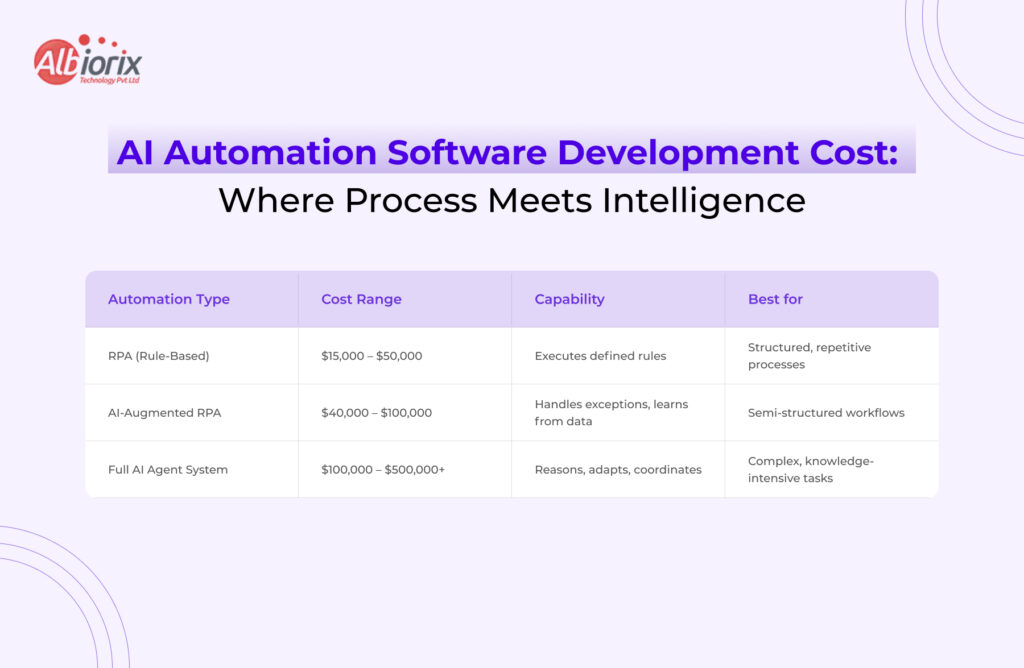
AI Automation Software Development Cost: Where Process Meets Intelligence
AI agents and AI automation are often conflated but represent distinct capability layers. Understanding the difference helps in accurate budgeting.
Traditional automation (RPA, scripted workflows) executes rules. AI-powered automation learns, adapts, and handles exceptions that rules-based systems cannot. The cost premium for AI automation over pure RPA reflects that intelligence layer.
For a deeper look into budgeting for these foundational layers, check out our guide on how much AI development costs across different software categories.
For enterprises already running RPA at scale, the question is often not whether to invest in AI agents but how to sequence the migration from brittle rule-based automation to intelligent, adaptive systems.
AI Agent Consulting Cost: The Value of Expert Guidance
Before a single line of code is written, the strategic and architectural decisions made in the consulting phase will determine the ceiling of your investment’s returns.
What AI Agent Consulting Covers:
- Use case identification and prioritization
- Technical feasibility assessment and risk analysis
- Architecture design (single agent vs. multi-agent, orchestration approach)
- LLM selection and evaluation
- Data readiness assessment and gap analysis
- Build vs. buy recommendation with vendor shortlist
- Change management and adoption planning
What AI Agent Consulting Costs:
| Engagement Type | Cost Range | Duration |
|---|---|---|
| Initial assessment / discovery sprint | $8,000 – $20,000 | 2–4 weeks |
| Full strategy and architecture engagement | $25,000 – $60,000 | 4–8 weeks |
| Ongoing advisory retainer | $5,000 – $20,000/month | Ongoing |
| Embedded consulting (with dev delivery) | Included in project scope | Project duration |
The enterprises that extract the most value from AI agent consulting are those that treat it as a strategic investment, not a checkbox exercise before the real work begins.
| A Note on Vendor Selection: When evaluating AI agent development companies in the USA, look beyond the portfolio to the team structure. Ask specifically: who writes the prompts, who architects the orchestration layer, who handles compliance, and what does post-deployment support look like? The answers will tell you more than any case study. |
|---|
How to Build a Budget That Holds Up
Internal budget proposals for AI agent initiatives fail most often because they underestimate three things: integration complexity, change management, and the cost of iteration post-launch.
Here is a reliable framework for building a budget that accounts for the full investment:
Step 1: Define the Use Case with Precision
Vague briefs produce vague quotes. Define the specific workflow the agent will handle, the systems it must connect to, the outcomes you will measure, and the volume it must operate at. This single step reduces scope creep risk significantly.
Step 2: Get Multiple Qualified Quotes
Solicit proposals from at least three development firms with verifiable AI agent experience. The spread in pricing will be instructive, but focus equally on the SOW structure, team composition, and their approach to testing and quality assurance.
Step 3: Allocate Contingency
Enterprise AI projects consistently exceed initial estimates due to data quality issues, integration surprises, and compliance requirements discovered mid-build. Budget a 20–25% contingency against your core development estimate.
Step 4: Model the Full Lifecycle Cost
Your Year 1 budget should include: development cost + API and infrastructure costs + maintenance retainer + internal team time for oversight and feedback. A project that looks like $100,000 often runs $130,000–$150,000 in the first year when the full cost picture is modelled.
Step 5: Set Measurable Milestones
Structure payments and evaluations against tangible deliverables: working agent demo, integration test pass, pilot deployment, full rollout. This protects your investment and keeps development teams accountable.
Questions Executives Are Asking in 2026
Based on conversations with enterprise buyers across the USA, these are the questions that consistently come up:
What is the average cost of AI agent development in the USA?
For a production-ready, enterprise-grade AI agent with real integrations and security requirements, the average falls between $80,000 and $200,000. Simpler deployments can be delivered for $20,000–$50,000. Complex multi-agent platforms can exceed $500,000.
How much should enterprises budget for AI agents?
A useful starting point: budget 0.5–1.5% of your annual IT spend for an initial AI agent initiative. For enterprises spending $10M annually on IT, that translates to $50,000–$150,000 — a range that can deliver a meaningful, measurable deployment.
How long until we see returns?
For well-scoped deployments, payback periods of 6–12 months are realistic. The key variable is not the size of the investment but the quality of the use case definition and the rigour of the measurement framework.
What if we start and the technology changes?
This concern is real but manageable. Build on modular, API-first architecture. Avoid deep vendor lock-in at the LLM layer. Structure contracts with clear handoff provisions. The enterprises most resilient to model evolution are those that own their data pipelines and orchestration logic, regardless of which underlying model powers them.
Internal build vs. external partner — which is smarter?
For most enterprises in 2026, a hybrid model makes the most sense: engage an experienced development partner for the initial build and architecture, while investing in internal AI literacy and oversight capability simultaneously. Pure in-house builds take 2–3x longer and cost more than most enterprises anticipate when fully loaded.
Have quesstions related to custom AI agent development?
Get in touch with the team of AI agent developers and get answers to all your questions for free.
Drop your questions!
Why the Development Partner You Choose Matters as Much as the Budget
The AI agent development market in the USA is crowded with vendors who have rebranded overnight as AI specialists. The criteria that separate credible partners from opportunists are:
- Demonstrated delivery of production AI agents (not just chatbots or demo environments).
- Deep engineering capability in LLM orchestration frameworks such as LangChain, LlamaIndex, AutoGen, and CrewAI.
- Experience with enterprise data security and compliance requirements.
- A structured discovery and scoping process before any development begins
- References from enterprise clients with comparable complexity and scale
- Transparent pricing with milestone-based payment structure
The right partner does not just build your agent — they transfer knowledge, document architecture, and leave your team better equipped to manage and evolve the system over time.
The Bottom Line
AI agent development cost in the USA in 2026 spans a wide range because business needs span a wide range. A PoC for a single process can be validated for $25,000. A platform that coordinates intelligent agents across an enterprise can require $500,000 or more.
What separates successful investments from expensive experiments is not the size of the budget. It is the quality of the use case definition, the rigour of the vendor selection process, the discipline of the measurement framework, and the commitment to iteration after launch.
Decision-makers who approach AI agent investment with the same analytical discipline they apply to any major operational investment will find that the returns are real, measurable, and in many cases, transformational.
Albiorix Technology – An AI Agent Development Company
Albiorix Technology is a USA-serving AI and software development company specialising in enterprise AI agent development, custom software solutions, and intelligent automation. We have an in-house team of AI agent developers who work with enterprise clients across the USA, the UK, and Australia to design, build, and deploy AI agents that deliver measurable operational value.
Whether you have an AI agent concept or questions about how an AI agent can streamline your business operations, boost productivity, and give you free time to focus on other business tasks, we are here to help. You will have every service related to AI agent development under one roof at Albiorix Technology.
To discuss your AI agent initiative, contact us or DM us on LinkedIn.
Connect with Our Experts!
FAQ
FAQs - AI Agent Development USA
The average cost of AI agent development in the USA in 2026 ranges from $20,000 to $500,000 or more. The cost of development depends on complexity and scope.
- A proof-of-concept or single-task agent typically costs $20,000 to $50,000.
- A mid-tier agent with API integrations and custom workflows costs $50,000 to $150,000.
- Enterprise-grade multi-agent systems with security, compliance, and enterprise data integration generally fall between $150,000 and $300,000.
Six key factors determine AI agent development cost.
- First, agent complexity: Whether the agent handles a single task or coordinates multiple autonomous workflows.
- Second, LLM and model selection: Enterprise models such as GPT-4o, Claude 3 Opus, or Gemini Ultra carry different API and licensing costs.
- Third, data integration depth: Connecting agents to enterprise systems like Salesforce, SAP, or ServiceNow adds significant engineering effort, often accounting for 30 to 40 percent of total project cost.
- Fourth, security and compliance requirements: Industries such as healthcare and finance require HIPAA, SOC 2, or GDPR compliance, adding $15,000 to $60,000.
- Fifth, the development engagement model: US-based firms charge $120 to $250 per hour, while offshore teams charge $30 to $60 per hour.
- Sixth, ongoing maintenance: It typically runs 15 to 25 percent of the initial development cost annually.
A practical starting point for enterprise AI agent budgeting is 0.5 to 1.5 percent of annual IT spend. For an enterprise with a $10 million annual IT budget, this translates to $50,000 to $150,000. It is sufficient for a well-scoped, production-ready AI agent deployment. Beyond the development cost, enterprises should also budget for API and infrastructure costs, an ongoing maintenance retainer of 15 to 25 percent of the build cost, and a contingency of 20 to 25 percent for integration surprises and scope changes. A fully loaded Year 1 cost for a $100,000 development project typically runs $130,000 to $150,000 when all components are accounted for.
Enterprises investing in AI agent development typically see payback periods of 6 to 18 months, depending on the use case and investment tier. A $20,000 to $50,000 proof-of-concept can deliver 150 to 300 percent ROI over three years through process automation and time savings. Mid-tier investments of $50,000 to $150,000 typically generate 200 to 400 percent ROI through headcount efficiency and revenue acceleration. Enterprise-grade deployments at $150,000 to $300,000 generate 250 to 500 percent ROI through operational transformation. The highest returns come from agents replacing high-volume; repetitive tasks such as customer support agents reducing per-ticket cost from $12 to $25 down to under $2, while finance automation agents reduce invoice processing time by 70 to 80 percent.
AI agent consulting in the USA costs between $8,000 and $60,000 for project-based engagements, and $5,000 to $20,000 per month for ongoing advisory retainers. An initial discovery and assessment sprint that covers use case identification, technical feasibility, and architecture recommendations may typically run $8,000 to $20,000 over two to four weeks. A full strategy and architecture engagement costs $25,000 to $60,000 over four to eight weeks. Consulting is a high-value investment before development begins, as the architectural and strategic decisions made at this stage directly determine the ceiling of the project’s returns. Enterprises that skip the consulting phase consistently face higher mid-project costs due to scope changes and integration surprises.
Published Blogs
Latest Blogs : Insights and Innovations from Our Blog
Stay Ahead in Tech: Dive into our Blogs for the Latest in Software, Web, and Mobile App Development. Explore cutting-edge technologies, industry trends, and insightful updates that keep you at the forefront of the digital landscape
Our Clients

Client Showcase: Trusted by Industry Leaders
Explore the illustrious collaborations that define us. Our client showcase highlights the trusted partnerships we've forged with leading brands. Through innovation and dedication, we've empowered our clients to reach new heights. Discover the success stories that shape our journey and envision how we can elevate your business too.










We’re here to help you


