






Table of Content
- What Is Green Software Engineering?
- Why Does Software Have a Carbon Footprint?
- What Is Carbon-Aware Computing?
- Energy Efficiency vs. Carbon Efficiency
- Core Principles of Green Software Engineering
- How to Build Energy-Efficient and Carbon-Aware Software
- Green Software Architecture Patterns
- How to Measure Software Carbon Footprint
- Green Software Engineering Best-Practices Checklist
- Benefits of Green Software Engineering
- Conclusion
Key Takeaways: Green Software Engineering
- Adopt green software engineering to build applications that use resources more efficiently.
- Optimize your code and algorithms to reduce unnecessary computation and energy consumption.
- Right-size your cloud infrastructure to minimize over-provisioning and improve resource utilization.
- Apply carbon-aware computing by scheduling flexible workloads when and where electricity has lower carbon intensity.
- Reduce software waste by cutting unnecessary processing, network requests, storage, and background tasks.
- Measure your software carbon footprint using energy consumption, carbon intensity, and Software Carbon Intensity (SCI).
- Design sustainable software architectures that balance efficiency, scalability, performance, reliability, and cost.
- Turn sustainability into an engineering practice by measuring, optimizing, and continuously improving software efficiency.
Green software engineering is the practice of designing, developing, deploying, and operating software in ways that reduce energy consumption, carbon emissions, and unnecessary use of computing resources while still meeting functional, performance, reliability, and business requirements.
It goes beyond writing efficient code. Green software engineering considers the complete software lifecycle, including algorithms, infrastructure, cloud resources, hardware utilization, networking, storage, workload timing, and measurement. This is particularly important in AI software development, where training and running AI models can require significant computational power, energy, and data-processing resources. As cloud computing, AI workloads, data-intensive applications, and digital services continue to increase demand for computing infrastructure, applying green software engineering principles can help make software development more sustainable and resource-efficient.
What Is Green Software Engineering?
Green software engineering applies sustainability principles to software engineering decisions.
The basic relationship is straightforward:
Software → computation → hardware → electricity → environmental impact
Software does not directly consume electricity; the hardware executing the software does. An inefficient application can therefore require more CPU or GPU cycles, memory, storage, networking, or provisioned infrastructure to deliver the same outcome.
Sustainable software engineering aims to reduce that impact without compromising the software’s required functionality.
Related concepts overlap but are not identical:
- Green software engineering: focuses specifically on reducing the environmental impact of software.
- Sustainable software engineering: takes a broader lifecycle-oriented view of sustainability in software development and operation.
- Green computing: focuses more broadly on environmentally responsible computing technologies and practices.
- Sustainable IT: encompasses technology infrastructure, hardware, operations, procurement, governance, and organizational sustainability.
The Green Software Foundation’s Software Carbon Intensity (SCI) methodology provides a standardized way to quantify software carbon emissions and encourages actions involving energy efficiency, hardware efficiency, and carbon awareness.
Why Does Software Have a Carbon Footprint?
Software has an environmental footprint because it runs on physical infrastructure.
A typical application can consume resources through:
- CPU and GPU processing
- Memory utilization
- Storage
- Network traffic
- Servers and virtual machines
- Data-center infrastructure
- Cooling systems
- End-user devices
- Hardware manufacturing and disposal
Two major categories are useful when discussing software emissions:
Operational carbon comes from the electricity consumed while software is running.
Embodied carbon refers to emissions associated with producing and eventually disposing of the physical hardware used by the software.
This distinction matters because optimizing software only for runtime energy does not capture the complete environmental impact.
The growth of computing makes efficiency increasingly relevant. The International Energy Agency reported that global data-center electricity demand increased significantly in 2025, while AI-focused data-center electricity use grew even faster. At the same time, energy use per AI task has been falling as efficiency improves.
The goal of green software is therefore not simply to “use less technology.” It is to deliver useful computing outcomes with fewer resources and lower associated emissions.
What Is Carbon-Aware Computing?
Carbon-aware computing is the practice of shifting software workloads to times or locations where electricity has lower carbon intensity, when those workloads are flexible enough to move.
Electricity does not have the same carbon intensity everywhere or at every moment. The emissions associated with consuming one kilowatt-hour can vary depending on the electricity generation mix.
Carbon-aware applications can therefore consider:
- Time-based carbon intensity
- Location-based carbon intensity
- Renewable-energy availability
- Grid conditions
- Workload flexibility
- Data-center location
For example, imagine a company running a batch analytics job that does not need to finish immediately. Instead of executing it at any available time, the system could schedule the workload for a period when the relevant electricity supply has a lower carbon intensity.
Similarly, a globally distributed application may have flexibility to process certain workloads in different regions.
This is called carbon-aware workload scheduling or workload shifting.
The important limitation is that not every workload can be moved. Real-time transactions, latency-sensitive applications, regulatory requirements, data residency, and reliability constraints can restrict scheduling options.
Energy Efficiency vs. Carbon Efficiency
Energy efficiency means using less energy to perform the same useful work. Carbon efficiency means reducing the carbon emissions associated with delivering that work.
These concepts are related but not interchangeable.
Suppose Application A consumes less electricity than Application B. If A operates on a much more carbon-intensive electricity grid, its carbon impact may not be proportionally lower.
That is why green software engineering considers both:
| Energy Efficiency | Carbon Efficiency |
|---|---|
| Reduces electricity consumption | Reduces emissions associated with computing |
| Focuses on resource efficiency | Considers energy and carbon intensity |
| Improved through code and infrastructure optimization | Can additionally use carbon-aware timing and location |
| Generally useful regardless of grid mix | Depends partly on electricity sources |
The strongest sustainability strategy often combines energy efficiency, hardware efficiency, and carbon awareness rather than optimizing only one dimension. This aligns with the Software Carbon Intensity approach developed by the Green Software Foundation.
Core Principles of Green Software Engineering
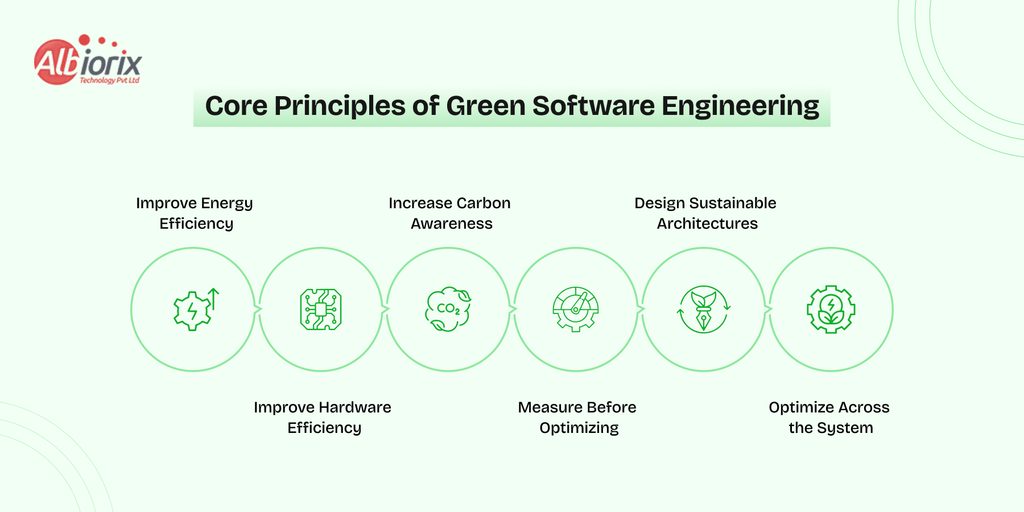
Effective green software engineering is measurement-driven and system-oriented.
1. Improve Energy Efficiency
Reduce the electricity required to perform useful work through efficient algorithms, code, infrastructure, and resource utilization.
2. Improve Hardware Efficiency
Use physical computing resources effectively rather than maintaining unnecessary capacity or underutilized infrastructure.
3. Increase Carbon Awareness
Where workloads are flexible, consider the carbon intensity of electricity by time and location.
4. Measure Before Optimizing
Establish measurable baselines for energy, resource consumption, and carbon intensity before making optimization decisions.
5. Design Sustainable Architectures
Architecture should account for utilization, workload characteristics, network traffic, storage, scaling behavior, and infrastructure requirements.
6. Optimize Across the System
A local optimization is not automatically a global improvement. Reducing CPU consumption could, for example, increase network traffic or storage requirements.
The Green Software Foundation’s SCI methodology formalizes these ideas around energy, carbon intensity, embodied emissions, and a meaningful functional unit.
How to Build Energy-Efficient and Carbon-Aware Software
Developers can incorporate sustainability directly into normal engineering practices.
Optimize Algorithms
Algorithmic efficiency can significantly affect computational requirements. Review expensive loops, unnecessary calculations, repeated processing, and inefficient data structures.
Improve Database Queries
Poorly designed queries can increase CPU, memory, and storage activity. Use appropriate indexing, avoid unnecessary queries, retrieve only required data, and optimize expensive operations.
Use Caching Effectively
Caching frequently requested data can reduce repeated computation and database access. However, caching should be designed carefully because excessive cache storage also consumes resources.
Reduce Network Transfers
Unnecessary network requests consume resources across servers, networks, and client devices. Reduce payload sizes, compress appropriate assets, batch requests when suitable, and avoid transferring data that the user does not need.
Optimize Images and Media
Large images and media files increase storage and network requirements. Responsive formats, compression, appropriate resolution, and lazy loading can reduce unnecessary data transfer.
Right-Size Cloud Resources
Over-provisioned virtual machines, databases, containers, and storage can waste resources. Match capacity to actual workload requirements and use autoscaling where appropriate.
Reduce Background Processing
Review scheduled jobs, polling, retries, logging, and background tasks. Eliminate work that provides little value and avoid running workloads more frequently than necessary.
Measure Resource Utilization
Monitor CPU, memory, storage, network traffic, cloud resources, and workload volume. Sustainability improvements should be based on measurable changes rather than assumptions.
Build More Efficient, Sustainable Software
Looking to reduce unnecessary computing costs, improve application efficiency, and build more sustainable software? Our engineering team can help you evaluate your architecture, optimize application performance, and implement efficient cloud solutions.
Talk to Our Software Experts
Green Software Architecture Patterns
There is no universally “greenest” architecture.
A monolith, microservices architecture, serverless platform, or edge architecture can be more or less sustainable depending on workload characteristics, utilization, infrastructure, and implementation.
Useful patterns include:
- Caching to avoid repeated computation
- Content delivery networks to reduce unnecessary long-distance delivery
- Autoscaling to match capacity with demand
- Right-sizing to avoid unused infrastructure
- Efficient storage to reduce unnecessary data retention
- Data reduction to minimize transfer and processing
- Workload scheduling for flexible batch workloads
- Edge computing where local processing meaningfully reduces network or centralized processing requirements
The right decision should consider performance, reliability, cost, scalability, security, latency, and sustainability together.
How to Measure Software Carbon Footprint
Measurement turns sustainability from a broad objective into an engineering metric.
One important methodology is Software Carbon Intensity (SCI), an ISO-accredited standard for measuring the carbon emissions of software applications. SCI expresses emissions as a rate per functional unit, such as a user, transaction, API call, or other meaningful unit of work.
Conceptually:
SCI = (E × I + M) / R
Where:
- E = energy consumed
- I = carbon intensity of electricity
- M = embodied emissions associated with hardware
- R = functional unit
This approach is useful because a total annual emissions number does not necessarily tell engineers whether an application is becoming more efficient.
For example, an application could report carbon emissions per:
- API request
- Transaction
- User
- Device
- Batch job
- Database operation
- ML workload
The SCI specification recommends defining the software boundary, selecting an appropriate functional unit, quantifying emissions, and reporting the methodology used.
For AI applications, the Green Software Foundation has also developed SCI for AI, extending the methodology to AI-specific lifecycle considerations including model development, training, deployment, and inference.
Green Software Engineering Best-Practices Checklist
Code
- Optimize computationally expensive operations.
- Use efficient algorithms and data structures.
- Remove unnecessary processing.
- Reduce redundant calculations.
Data
- Minimize unnecessary data transfer.
- Optimize storage.
- Compress suitable data.
- Cache frequently accessed information.
Cloud
- Right-size infrastructure.
- Improve resource utilization.
- Scale dynamically.
- Avoid unnecessary idle capacity.
- Consider carbon-aware scheduling for flexible workloads.
Architecture
- Minimize unnecessary services and dependencies.
- Reduce network and storage overhead.
- Choose architecture according to workload requirements.
- Evaluate lifecycle impacts rather than isolated components.
Measurement
- Establish an energy or carbon baseline.
- Define a meaningful functional unit.
- Track resource utilization.
- Measure before and after optimization.
- Monitor trends over time.
Benefits of Green Software Engineering
Green software practices can produce benefits beyond environmental objectives.
Efficient software can require fewer computing resources, potentially reducing infrastructure consumption and improving resource utilization. Optimization can also contribute to better application performance, lower operational waste, and longer useful life for some hardware resources.
For engineering organizations, sustainability can become part of normal technical decision-making alongside:
- Performance
- Cost
- Reliability
- Scalability
- Security
- Maintainability
This makes software sustainability less of a separate initiative and more of an engineering quality attribute.
Conclusion
Green software engineering is not simply about writing “green code.” It requires better decisions across algorithms, architecture, cloud infrastructure, hardware utilization, networking, storage, workload timing, and measurement.
The most effective approach is to measure software impact, identify the largest sources of energy management and carbon, optimize where the impact is meaningful, and validate the results.
For engineering teams, sustainability should become another measurable system characteristic—considered alongside performance, cost, reliability, scalability, and security.
The practical goal is simple: deliver the same or better software outcome with less unnecessary energy, fewer resources, and lower carbon impact.
Make Your Software More Sustainable
From efficient architecture and cloud optimization to AI workloads and sustainable development practices, build software that balances performance, cost, and environmental impact.
Start a Conversation
Connect with Our Experts!
FAQ
Green software engineering is the practice of designing, developing, deploying, and operating software to reduce energy consumption, carbon emissions, and unnecessary resource use while maintaining required functionality, performance, reliability, and business outcomes.
Carbon-aware computing shifts flexible workloads toward times or locations where electricity has lower carbon intensity. It uses information about grid carbon intensity and workload flexibility to reduce emissions without unnecessarily changing the software’s intended outcome.
Developers can reduce software carbon emissions by improving algorithmic efficiency, reducing unnecessary computation and network traffic, optimizing databases, right-sizing cloud resources, increasing hardware utilization, and using carbon-aware scheduling for workloads that can safely be moved in time or location.
Software Carbon Intensity is a standardized methodology for expressing software carbon emissions as a rate per functional unit. Its methodology accounts for energy consumption, electricity carbon intensity, embodied hardware emissions, and a defined unit of useful work.
Start by defining the software boundary and functional unit, then quantify energy consumption, relevant electricity carbon intensity, and embodied hardware emissions. SCI provides a structured methodology for calculating and reporting these factors as carbon emissions per functional unit.
Green software focuses specifically on reducing the environmental impact of software through engineering, architecture, infrastructure, and operational decisions. Green computing is broader and can include sustainable hardware, energy-efficient computing infrastructure, responsible disposal, and other environmentally responsible computing practices.
Energy efficiency reduces the electricity required to deliver software functionality. It can improve resource utilization and may reduce associated operational emissions and infrastructure demand. However, energy efficiency should be considered alongside carbon intensity and hardware impacts for a more complete sustainability assessment.
Published Blogs
Latest Blogs : Insights and Innovations from Our Blog
Stay Ahead in Tech: Dive into our Blogs for the Latest in Software, Web, and Mobile App Development. Explore cutting-edge technologies, industry trends, and insightful updates that keep you at the forefront of the digital landscape



Our Clients

Client Showcase: Trusted by Industry Leaders
Explore the illustrious collaborations that define us. Our client showcase highlights the trusted partnerships we've forged with leading brands. Through innovation and dedication, we've empowered our clients to reach new heights. Discover the success stories that shape our journey and envision how we can elevate your business too.










We’re here to help you


