





How Integrating AI In eCommerce Making It Better Then Ever

Since its inception in the 90s, the eCommerce industry has evolved and revolutionized the way we shop, offering convenience, variety, and global access to goods and services.

It began with robust eCommerce websites and sophisticated online stores, eventually shifting towards mobile apps—thanks to the smartphone revolution driven by Android and iOS.

Today, the e-commerce industry is becoming more streamlined, convenient, engaging, and personalized, with Artificial Intelligence (AI) playing a pivotal role.

In this blog, we will explore how Artificial Intelligence in eCommerce is transforming the future of online shopping and how the use of generative AI in eCommerce can help your business stay ahead of the curve.

Each decade brings a new shift in technology and trends, simplifying life for humans. As digital transformation peaks in 2025, Artificial Intelligence (AI) has emerged as a key driver of innovation in e-commerce.

By enhancing user experiences, streamlining operations, and providing valuable insights, AI is reshaping the future of online retail.

In this blog, we examine the evolution of eCommerce, the current role of AI in the industry, its benefits for both customers and shop owners, and future trends, particularly in mobile app development.

Also Read: eCommerce Software Development Guide

The Evolution of eCommerce: A Brief Overview

eCommerce has come a long way since its inception in the early 1990s.

Initially focused on catalog-based shopping through simple eCommerce websites and online stores, the industry has since evolved to incorporate personalized user experiences, omnichannel strategies, and seamless payment options.

The rise of online shopping and the smartphone revolution propelled the eCommerce industry to the next level in no time. Key milestones in the evolution of eCommerce include:

  • The rise of platforms like Amazon and eBay pioneered online marketplaces.
  • The shift to mobile commerce is driven by smartphone penetration and mobile apps.
  • The integration of advanced technologies like AI, IoT, and Blockchain to optimize operations and enhance user engagement.

These incredible advancements in eCommerce technologies have paved the way for the use of AI in eCommerce industry.

As eCommerce continues to evolve at a rapid pace, the integration of Artificial Intelligence is expected to bring mind-blowing features that deliver an exceptional shopping experience to end users.

Unlock the Power of AI in Your eCommerce Business Today!

Embrace the future of retail by integrating AI into your eCommerce strategy. Don’t miss out—take the first step toward transforming your business now!


Contact us today!

Fascinating Statistics on eCommerce and AI

Artificial Intelligence has revolutionized the eCommerce industry at its core. Many businesses are already leveraging AI, while others are in the process of integrating generative AI into their eCommerce operations to offer an enhanced shopping experience.

The growing use of AI in the retail industry can be attributed to several factors, including streamlining operations, automating repetitive tasks, increasing productivity, improving customer service, and boosting profit margins.

Considering the current AI use cases in eCommerce, it’s evident that the retail industry is significantly influenced by AI—especially generative AI.

The AI use in eCommerce market is projected to reach a value of $40.74 billion by 2030, growing at a CAGR of 23.9% from 2022 to 2030.

Data-driven insights offer a clearer understanding of AI’s impact and potential in the eCommerce space. Here are some noteworthy statistics:

  • The global eCommerce market is expected to reach $8.1 trillion by 2026.
  • AI in retail and eCommerce is predicted to surpass $20 billion by 2025.
  • The eCommerce AI market is expected to achieve $45.72 billion by 2032.
  • AI-driven product recommendations can boost conversion rates by up to 30%.
  • More than 60% of online shoppers prefer personalized experiences enabled by AI technologies.
  • Over 84% of online store owners have AI at the top of their priority list.

These figures highlight the importance of leveraging AI for eCommerce growth and innovation. Using AI in eCommerce is indispensable for businesses that want to stay competitive and drive long-term success.

Current Status of AI in eCommerce

Artificial Intelligence in retail has become an indispensable tool for e-commerce businesses, driving efficiency and personalization. Its current applications include:

  • Personalized Recommendations: AI algorithms analyze browsing history, purchase patterns, and preferences to suggest relevant products, enhancing the customer experience.
  • Chatbots & Virtual Assistants: Intelligent chatbots handle customer queries 24/7, reducing response times and improving satisfaction.
  • Dynamic Pricing: AI evaluates market trends, competitor pricing, and demand to optimize prices in real time.
  • Visual Search: Customers can upload images to find similar products, streamlining the shopping process.
  • Inventory Management: Predictive analytics powered by AI ensures optimal stock levels, reducing costs and preventing overstocking.

By incorporating these technologies, businesses can remain competitive and provide exceptional services to their customers.

How AI is Empowering eCommerce Business
How AI is Empowering eCommerce Business

Artificial Intelligence in retail offers countless benefits and numerous opportunities.

This remarkable technology is not only revolutionizing the way online shopping is conducted but also redefining the eCommerce industry by driving efficiency and personalization.

From optimizing business operations to enhancing customer interactions, AI in eCommerce is transforming the way the industry operates. Here are some of the key ways AI will empower eCommerce businesses in the coming years:

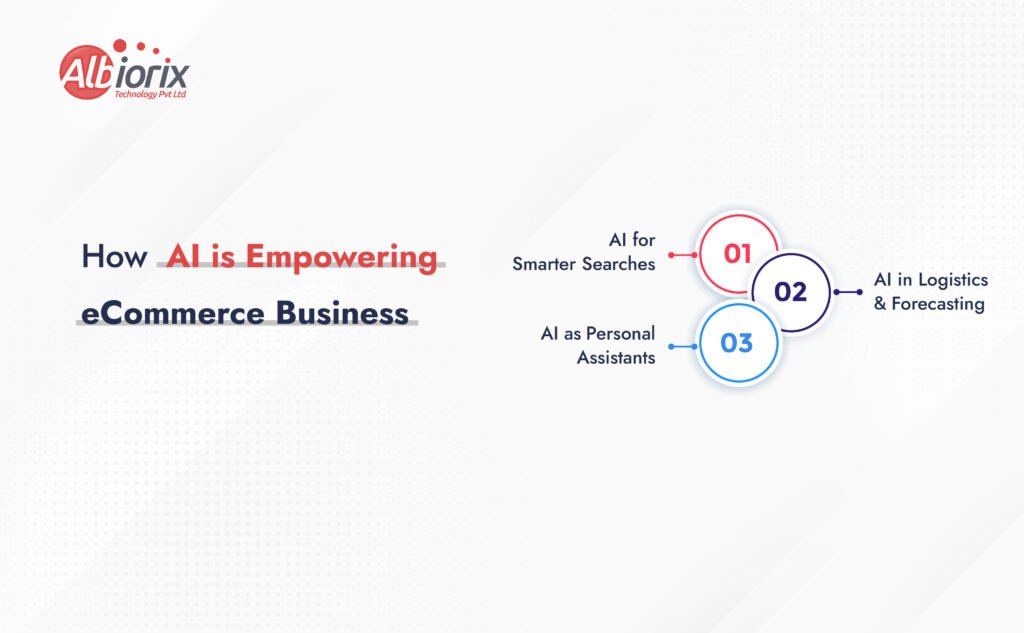
1. AI for Smarter Searches:

AI-powered search in eCommerce enhances personalized shopping experiences by understanding customer intent behind search queries, reducing bounce rates, and improving search relevance.

By analyzing online and offline data, machine learning algorithms identify patterns and provide contextual results. For example, a search for “hats” may display fascinators for an upcoming wedding instead of winter hats.

AI continually learns user preferences, enabling hyper-targeted recommendations like showing favorite brands for a “holiday clothes” search.

This precision helps address cart abandonment, which averages 70.21% globally, by delivering the right product at the right time, ultimately improving conversion rates.

2. AI in Logistics and Forecasting:

AI enhances both customer experience and business operations in eCommerce by optimizing logistics, inventory, and supply chain management.

By analyzing data from various sources using machine learning and optimization algorithms, AI identifies patterns and makes accurate predictions. Key applications include:

  • Inventory Management: Forecasts demand using historical sales data and market trends.
  • Seasonality Predictions: Predicts demand for events like Black Friday.
  • Pricing Optimization: Enables dynamic pricing based on supply and demand.

AI also automates repetitive tasks, improving warehouse efficiency and reducing costs. For example:

  • Supply Chain Management: AI improves logistics costs by 15% and inventory levels by 35%.
  • Delivery: With 99% of consumers prioritizing fast delivery, 42% of retailers aim to implement same-day delivery.

Overall, AI streamlines workflows cuts costs, and enhances operational efficiency.

3. AI as Personal Assistants:

AI-powered chatbots handle 70% of online customer interactions, and the rise of generative AI has further elevated eCommerce, now valued at $5.92 trillion.

Generative AI enhances conversational commerce, freeing teams to focus on higher-value tasks.

  • For shoppers: AI assistants handle complex queries 24/7, recommend products using retargeting campaigns, and provide real-time package tracking.
  • For retailers: AI helps overcome language barriers in the supply chain, detects counterfeit goods, and optimizes product descriptions through keyword analysis and A/B testing.

This innovation improves customer experience and boosts operational efficiency for retailers.

How AI in eCommerce Will Benefit Customers

AI-powered online stores and mobile apps have greatly enhanced the shopping experience for customers.

They provide personalized product development recommendations, smarter search results, and 24/7 support through AI-powered chatbots.

AI offers convenience with voice search, resolves issues faster with real-time updates, and ensures secure transactions through advanced fraud detection.

By understanding customer intent and preferences, Artificial Intelligence also delivers a seamless, efficient, and highly personalized shopping journey.

Key benefits for customers include:

  • Enhanced Personalization: AI delivers customized product recommendations based on individual preferences.
  • Faster Issue Resolution: Chatbots provide instant responses, addressing queries efficiently.
  • Secure Transactions: AI-based fraud detection ensures safe and reliable online shopping.
  • Improved Accessibility: Voice search and virtual assistants make eCommerce more inclusive for users with disabilities.

How AI in eCommerce Will Benefit Shop Owners

AI is equally beneficial for eCommerce businesses, helping them streamline operations and increase profitability.

AI in eCommerce offers significant advantages to shop owners by improving decision-making and boosting profitability.

It provides advanced analytics to understand customer behavior, enabling data-driven strategies for personalized marketing and inventory management. AI automates repetitive tasks, reduces operational costs, and optimizes pricing with real-time insights.

Additionally, AI-powered tools enhance customer support through chatbots, prevent fraud, and improve supply chain efficiency, helping shop owners deliver better services and drive business growth.
How AI in eCommerce Will Benefit Shop Owners

Key benefits for shop owners include:

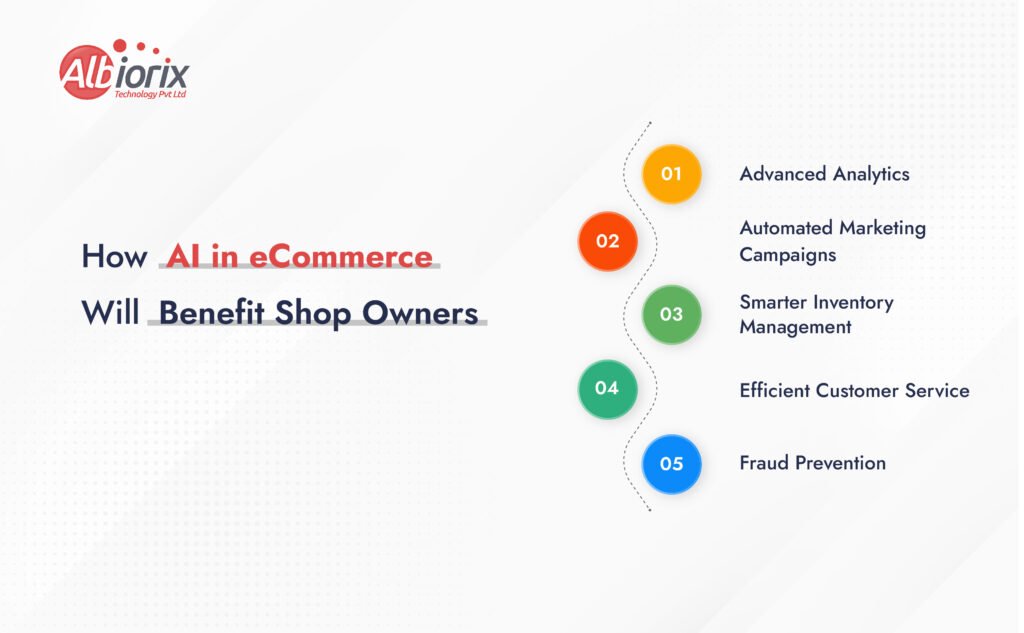
  • Advanced Analytics: AI provides deep insights into customer behavior, enabling data-driven decision-making.
  • Automated Marketing Campaigns: AI tools can create and optimize targeted campaigns, increasing ROI.
  • Smarter Inventory Management: Predictive analytics prevents overstocking and stockouts.
  • Efficient Customer Service: Chatbots reduce the workload on human agents and ensure round-the-clock support.
  • Fraud Prevention: AI algorithms identify suspicious activities, protecting businesses from potential losses.

The Future of AI in eCommerce

As technology evolves, AI will continue to play a pivotal role in shaping eCommerce trends. To embrace AI effectively, businesses will have to collaborate with AI eCommerce development companies like Albiorix Technology.

These AI development companies are known for offering AI-powered eCommerce software and apps so that you can deliver modern, futuristic, and highly personalized shopping experiences to your customers.

Looking at the current pace of AI integration in e-commerce, here are the Key developments:

  • Predictive Shopping: AI will anticipate customer needs, offering products before they even search for them.
  • Voice Commerce: Voice assistants like Alexa and Google Assistant will make online shopping faster and more convenient.
  • Augmented Reality (AR): AI-powered AR will allow customers to “try” products virtually before purchasing.
  • Sustainable AI Solutions: AI can optimize supply chains, reducing waste and promoting eco-friendly practices.

Despite these advancements, challenges like data privacy and ethical AI usage must be addressed to ensure sustainable growth.

How AI in eCommerce Will Continue to Evolve

AI’s potential in eCommerce extends beyond current applications, with emerging technologies promising even greater impact. For instance:

  • AI-powered Blockchain integration can enhance transparency and trust in transactions.
  • IoT devices will collect real-time data to improve personalization and inventory management.
  • AI will complement human creativity, enabling businesses to innovate and cater to evolving customer demands.

AI in eCommerce Mobile App Development

Mobile commerce is a significant driver of eCommerce growth, accounting for over 70% of online transactions. AI applications in eCommerce are going to set new benchmarks in online shopping.

It will redefine the retail industry by:

AI in eCommerce Mobile App Development
  • Personalized Notifications: AI tailors push notifications to individual preferences, increasing engagement.
  • Voice Search Integration: AI-powered voice assistants simplify product searches and purchases.
  • Real-time Inventory Updates: Customers can check product availability instantly.
  • Enhanced Security: AI ensures secure payment gateways and fraud detection.

By integrating AI into mobile apps, businesses can deliver a seamless and engaging shopping experience. 

Ready to Elevate Your eCommerce with AI? Let’s Get Started!

Leverage AI to stay ahead in the competitive eCommerce landscape. Contact us today to explore AI-driven solutions for your online store!


Contact us today!

Conclusion

AI is undoubtedly transforming the eCommerce landscape, benefiting both customers and shop owners with its innovative applications.

From personalized experiences to operational efficiency, the potential of AI is vast and ever-evolving. Businesses must embrace AI to stay competitive and meet the demands of modern consumers.

At Albiorix Technology, we specialize in creating cutting-edge AI-powered eCommerce solutions.

With our expertise in Custom Ecommerce Solutions, Ecommerce Development Australia, and Online Store Development Australia, we help businesses unlock their full potential.

Whether you need an AI-driven mobile app or a comprehensive eCommerce platform, our team of experts is ready to assist you. Contact us today to take your online store to the next level with the Best Ecommerce Development Company!

Odoo vs SAP vs NetSuite: Which One Is Better ERP?

Summary: Odoo, SAP, and NetSuite are top ERP solutions tailored to different business sizes and needs. Odoo offers the best affordability and flexibility for SMEs, NetSuite is superior for mid-market, high-growth, cloud-first companies, and SAP provides unmatched power and scalability for large enterprises and complex manufacturing.

Enterprise Resource Planning (ERP) solutions are comprehensive software systems designed to integrate and streamline a company’s core business processes, such as finance, human resources, supply chain, and customer relationship management.

By providing a unified platform, ERP systems enable organizations to reduce inefficiencies, improve decision-making, and, with the help of an Odoo Customization guide, enhance overall productivity.

As businesses face increasing pressure to stay competitive in dynamic markets, ERP solutions have become indispensable tools for achieving operational excellence.

According to recent research, 47% of companies globally rely on ERP (Enterprise Resource Planning) applications to streamline operations and improve efficiency.

This adoption is particularly pronounced in larger enterprises, with 70% of them leveraging ERP software to handle complex workflows. Impressively, 53% of organizations report positive outcomes post-implementation, showcasing its value in driving business success.

The ERP software market, valued at $51.61 billion in 2022, is projected to skyrocket, reaching a staggering $117.09 billion by 2030, underlining its transformative potential across industries.

Globally, the adoption of ERP systems is highest in regions such as North America, Europe, and Asia-Pacific, with countries like the United States, Germany, Japan, and India driving significant market demand.

Top ERP solutions in the market include industry leaders like Odoo, SAP, NetSuite, Oracle ERP Cloud, and Microsoft Dynamics 365, each catering to diverse business requirements and scales.

These platforms are shaping the future of business operations, making it vital for companies to choose the right ERP solution often with the guidance of an experienced software development company that understands their specific needs and goals.

In this blog, we will try to find out which ERP solution is best for your business in 2026.

What is an ERP Solution? What are Its Uses?

An ERP (Enterprise Resource Planning) solution is a software system that brings together essential business functions like finance, HR, inventory, sales, and supply chain into one centralized platform.

This integration helps businesses manage their operations more efficiently by providing accurate, real-time data across departments.

By using an ERP system, companies can reduce manual processes, avoid data duplication, and make better decisions. It also supports collaboration, improves productivity, and ensures everyone works with the same up-to-date information.

ERP solutions are valuable for businesses of all sizes—whether managing day-to-day tasks or supporting long-term planning making them a reliable tool for growth and efficiency.

Below are the Uses of ERP Solutions:

  1. Automating Processes: Streamline repetitive tasks across departments to save time and reduce errors.
  2. Improving Resource Management: Optimize the allocation of resources, including inventory, finances, and workforce.
  3. Enhancing Data Accuracy: Provide a single source of truth for better decision-making and forecasting.
  4. Boosting Collaboration: Foster collaboration by centralizing data and enabling seamless team communication.
  5. Enabling Scalability: Support business growth by adapting to increasing operational complexities.
  6. Ensuring Compliance: Help meet regulatory requirements with built-in compliance features and audit trails.
  7. Enhancing Customer Experience: Deliver personalized services with integrated customer relationship management tools.
  8. Real-Time Reporting: Generate insightful, real-time reports for strategic decision-making.
  9. Cost Reduction: Lower operational costs by identifying inefficiencies and optimizing workflows.
  10. Global Integration: Manage multiple locations, currencies, and languages for businesses operating internationally.

Top 3 ERP Solutions Providers in 2026

Top 3 ERP Solutions Providers

1. Odoo

Odoo is a modular, open-source ERP platform offering flexibility for businesses of all sizes.

Known for its cost-effective Community version, Odoo enables organizations to select and integrate only the modules they need, covering functions like accounting, inventory, HR, and eCommerce.

Its user-friendly interface and cloud or on-premises deployment options make it an ideal choice for small and medium-sized businesses.

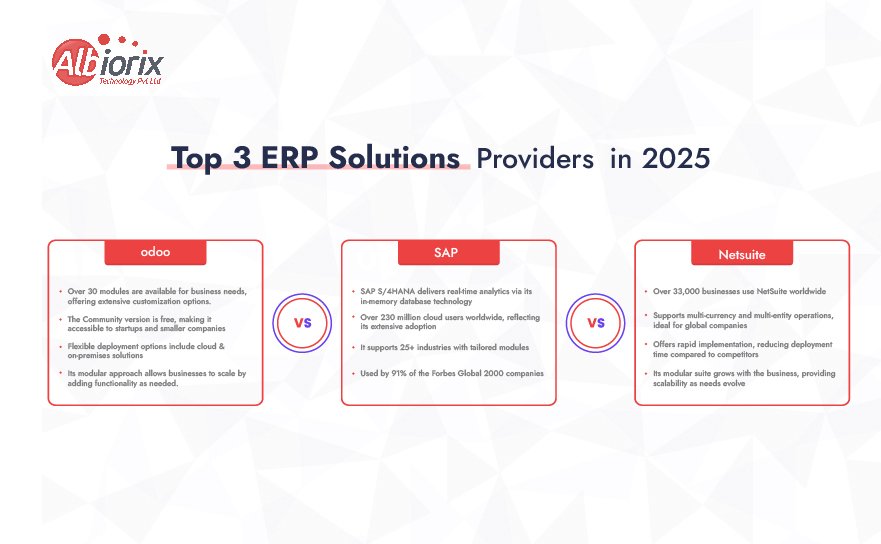
  1. Over 30 modules are available for business needs, offering extensive customization options.
  2. The Community version is free, making it accessible to startups and smaller companies.
  3. Flexible deployment options include cloud and on-premises solutions.
  4. Its modular approach allows businesses to scale by adding functionality as needed.

2. SAP

SAP’s flagship ERP system, SAP S/4HANA, is designed for large enterprises requiring robust, real-time data management and integration across multiple departments.

Its in-memory database and AI-driven features offer businesses enhanced agility and predictive analytics, making it a leader in enterprise-grade ERP solutions.

  1. SAP S/4HANA delivers real-time analytics via its in-memory database technology.
  2. Over 230 million cloud users worldwide, reflecting its extensive adoption.
  3. It supports 25+ industries with tailored modules.
  4. Used by 91% of the Forbes Global 2000 companies.

3. NetSuite

Owned by Oracle, NetSuite is a cloud-based ERP solution tailored for growing businesses. It’s all-in-one platform integrates ERP, CRM, and eCommerce functionalities, allowing seamless management of operations.

NetSuite is known for its scalability and robust financial management features.

  1. Over 33,000 businesses use NetSuite worldwide.
  2. It supports multi-currency and multi-entity operations and is ideal for global companies.
  3. Offers rapid implementation, reducing deployment time compared to competitors.
  4. Its modular suite grows with the business, providing scalability as needs evolve.

These three ERP solutions stand out for their adaptability, feature sets, and ability to cater to diverse industries and business sizes. The choice depends on organizational needs, budget, and scalability requirements.

Also Read: A Complete Introduction to Odoo and Its Benefits

Find the Perfect ERP Fit for Your Business

Ready to transform your business operations with the right ERP solution? Dive into the features of Odoo, SAP, and NetSuite to see which one aligns with your needs. Talk to us to take the next step toward streamlined processes and greater efficiency.


Contact us today!

Feature Comparison: Odoo Vs SAP Vs NetSuite

Odoo, SAP, and NetSuite offer powerful ERP solutions, each with its strengths. Odoo is highly customizable and affordable, making it ideal for small to medium-sized businesses with specific needs.

SAP, on the other hand, is tailored for large enterprises that require robust, industry-specific functionalities, particularly in sectors like manufacturing and finance.

NetSuite strikes a balance, providing scalable solutions with strong integration capabilities, making it a solid choice for growing global businesses, especially in eCommerce and retail.

Each platform offers unique features, and the choice depends on the size, industry, and specific requirements of the business.

Customization and Flexibility:

  1. Odoo: Offers a highly modular approach, allowing businesses to choose specific apps like CRM, inventory, or HR, customizing the system extensively. It’s ideal for niche industries needing tailored solutions.
  2. SAP: Features a more rigid structure, which works well for industries like manufacturing or finance requiring standardization. 
  3. NetSuite: Balances customization with out-of-the-box solutions, excelling in industries like retail and eCommerce.

Ease of Use:  

  1. Odoo: Its intuitive interface makes onboarding simple for smaller teams.
  2. SAP: The complexity of SAP’s functionalities requires significant training, making it more suitable for larger teams with dedicated IT staff. 
  3. NetSuite: Offers a user-friendly dashboard with minimal learning curves for most standard functionalities.

Pricing Models: 

  1. Odoo: Offers both free open-source and paid enterprise versions. Paid plans start at $20/user/month, making it the most cost-effective option.
  2. SAP: Pricing varies widely depending on the implementation. For instance, SAP Business One costs around $94/user/month, with additional licensing and maintenance fees.
  3. NetSuite: Subscriptions start at $99/user/month, but customization and implementation costs can make it expensive.

Scalability and Industry Fit:

  1. Odoo: Perfect for SMEs and startups looking for an affordable, scalable solution. Works well across industries like retail, services, and logistics.
  2. SAP: Tailored for large enterprises needing advanced functionalities like predictive analytics or IoT integrations. Particularly strong in manufacturing, healthcare, and banking sectors.
  3. NetSuite: Ideal for growing businesses with global operations due to its multi-currency and compliance support. Thrives in retail, wholesale distribution, and professional services.

Integration Capabilities:  

  1. Odoo: Odoo offers seamless connections with many third-party applications, enhancing its adaptability for businesses with diverse needs. Its API capabilities allow companies to link Odoo with other systems easily.
  2. SAP: Integration with other SAP systems is robust, but its integration with non-SAP solutions can be complex and expensive. It’s best suited for businesses that already rely heavily on SAP software.
  3. NetSuite: With native integrations for popular third-party applications (e.g., Salesforce, Shopify, and Amazon), NetSuite offers an excellent integration ecosystem.

Explore Odoo’s Advantages Here!

Looking for a customizable, scalable, and cost-effective ERP solution? Discover why Odoo is a game-changer for businesses of all sizes. Don’t wait—enhance your operations today!


Contact us today!

Market Trends and Adoption 

In 2025, the global ERP software market is poised for substantial growth, driven by the increasing demand for integrated business processes and real-time data analytics.

According to Grand View Research, the market size is projected to reach USD 123.41 billion by 2030, expanding at a CAGR of 11.7% from 2025 to 2030.

Small and medium-sized businesses (SMBs) are increasingly adopting cloud-based ERP solutions due to their scalability and cost-effectiveness.

Platforms like Odoo are gaining popularity for their flexible pricing models and open-source options, particularly in regions such as Europe, North America, and Southeast Asia.

Conversely, large enterprises continue to favor robust platforms like SAP and NetSuite, which offer advanced features including predictive analytics, IoT integration, and comprehensive compliance support.

Artificial Intelligence (AI) integration is a significant trend, with ERP systems increasingly incorporating AI to enhance decision-making, forecasting, and operational efficiency.

The rise of mobile ERP solutions is also notable, enabling employees to access enterprise resources remotely, thus supporting agile business operations. Reports indicate that the mobile ERP market is expected to grow at a CAGR of 9.5% from 2022 to 2030 .

As businesses navigate an increasingly digital landscape, the adoption of cloud-based, AI-integrated, and mobile-accessible ERP solutions is becoming essential for maintaining competitiveness and operational agility.

Pros and Cons: Odoo Vs SAP Vs NetSuite

Pros and Cons: Odoo Vs SAP Vs NetSuite

Also Read: How to Customize Odoo: 9 Expert Tips and Tricks for Success

Why is Odoo the Best ERP for Your Business?

Why is Odoo the Best ERP for Your Business

Odoo has emerged as a popular ERP solution due to its flexibility, cost-effectiveness, and ease of use. Its modular approach makes it an ideal choice for small to medium-sized businesses that require a scalable solution.

By offering a wide array of customizable modules, Odoo ensures that businesses can tailor their ERP system to meet their specific needs while remaining budget-friendly. Here are five key reasons to choose Odoo for your business: 

  1. Cost-Effective and Scalable: Odoo’s open-source version is free, and its paid enterprise version is priced competitively, making it a great choice for businesses on a budget.

    It’s also highly scalable, allowing businesses to expand their operations without having to switch to a new ERP system.
  2. Modular and Customizable: With over 30 main modules and more than 16,000 additional apps, Odoo provides businesses with the flexibility to pick and choose the features they need, whether it’s CRM, sales, or inventory management.

    This modular approach ensures that businesses only pay for what they use, reducing overall costs.
  3. User-Friendly Interface: Odoo’s intuitive and easy-to-navigate interface makes it accessible for users without extensive technical expertise.

    This ease of use accelerates the adoption process within companies, minimizing training time and maximizing efficiency.
  4. Integration Capabilities: Odoo integrates seamlessly with various third-party applications, enhancing its ability to work with existing systems.

    It offers native integrations with popular tools like Google, MailChimp, and Shopify, streamlining operations across different business functions.
  5. Active Community and Regular Updates: Being open-source, Odoo benefits from a vibrant community of developers and users.

    This active ecosystem constantly contributes to the improvement and update of the system, ensuring that businesses have access to the latest features and innovations.

With its cost-effectiveness, modular approach, and strong community support, Odoo stands out as a leading choice for businesses seeking a flexible, scalable ERP solution.

Also Read: Odoo Customization Services: Unlock the Full Potential of Odoo with Albiorix

Conclusion

Albiorix Technology specializes in offering tailored Odoo customization services that help businesses optimize their ERP systems to align perfectly with their specific needs.

Whether you’re looking to add custom features, integrate third-party applications, or enhance existing functionalities, our team of experts ensures seamless customization to enhance your workflow and boost efficiency.

Our Odoo customization services include: 

  1. Module Customization: Tailoring Odoo’s out-of-the-box modules to suit your unique business processes.
  2. Integration with Third-Party Applications: Connecting Odoo to your existing systems for a more cohesive ecosystem.
  3. User Interface Customization: Modifying the interface for a smoother user experience, optimized for your team.
  4. Reporting and Analytics: Customizing reporting features to provide valuable insights based on your business data.
  5. Ongoing Support and Maintenance: Ensuring your Odoo system remains up-to-date with the latest features and security updates.

Partner with Albiorix Technology for a fully customized Odoo ERP solution that fits your business requirements. Contact us today to learn how we can help you transform your business with Odoo!