






Table of Content
- Cost of AI Agent Development
- What is an AI Agent?
- 4 Types of AI Agents in 2026 and Their Cost Ranges
- AI Agent Cost by Type
- The Hidden Costs Most Companies Miss
- How to Reduce AI Agent Development Costs Without Cutting Corners
- What ROI Can You Realistically Expect?
- Build vs. Buy: A Quick Framework
- How Albiorix Approaches AI Agent Development
Summary: Building an AI agent in 2026 typically costs between $5,000 and $350,000+, depending on complexity. Basic agents (chatbots, RAG) cost $5k–$25k, mid-level agents run $40k–$120k, and complex, autonomous, or enterprise-grade systems often exceed $200,000. Monthly running costs for API fees and monitoring range from $500 to $15,000+.
Cost of AI Agent Development
Every business owner who is planning to explore or integrate artificial intelligence into their business has one question on their mind, and that is – “What is the cost of developing an AI Agent?” It is the most common question and has no boundaries.
Young entrepreneurs and established brands in the developed nations like the USA, Australia, Germany, and the UK have the same questions before making any decisions.
It is one of the most obvious questions that comes into the mind, and there is nothing wrong with it. But the exact answers to this question depend on many factors. So, the honest answer to the question “How much is the cost of AI agent development?” is – it depends on what you want.
If we talk about custom AI agent development from scratch, then, in 2026, the cost of development may range from $5000 for a simple rule-based chatbot to over $400,000 for a fully autonomous, multi-agent enterprise system.
However, if your project is mid-sized, then it may rank from somewhere between $25,000 to $120,000.
The real cost of AI agent development depends on several crucial factors, such as the type of agentic AI you want to build, how many systems you will need, how much autonomy it will require, and what happens after launch.
We are Albiorix Technology, an AI agent development company, and in this blog guide on the cost of AI agent development, we will provide a detailed breakdown of the costs.
So, next time when you are in a conversation with an AI agent development services provider, you will have things clear in your mind.
What is an AI Agent?
Well, before we get into the numbers and discuss the cost of AI agent development, first of all, let’s understand what an AI agent is, exactly. It is important to understand the difference between an AI and an AI agent.
An AI agent is not just a rule-based chatbot that follows scripts or instructions; it is different. An AI agent is capable of thinking, reasoning, planning, and using tools to fulfil assigned tasks on its own.
It can access external systems like CRMs and databases, update itself with every interaction, and perform multiple tasks at a single time. It does not need any human intervention at every step.
Let’s understand this with an example: An AI-powered chatbot can provide answers to all the pre-defined questions, whereas an AI agent can look up a customer’s order history, identify a billing issue, initiate a refund, and perform many more tasks at the same time without any human intervention.
This is called the capability gap, and this is the main difference between an ordinary Chatbot and an AI Agent.
4 Types of AI Agents in 2026 and Their Cost Ranges
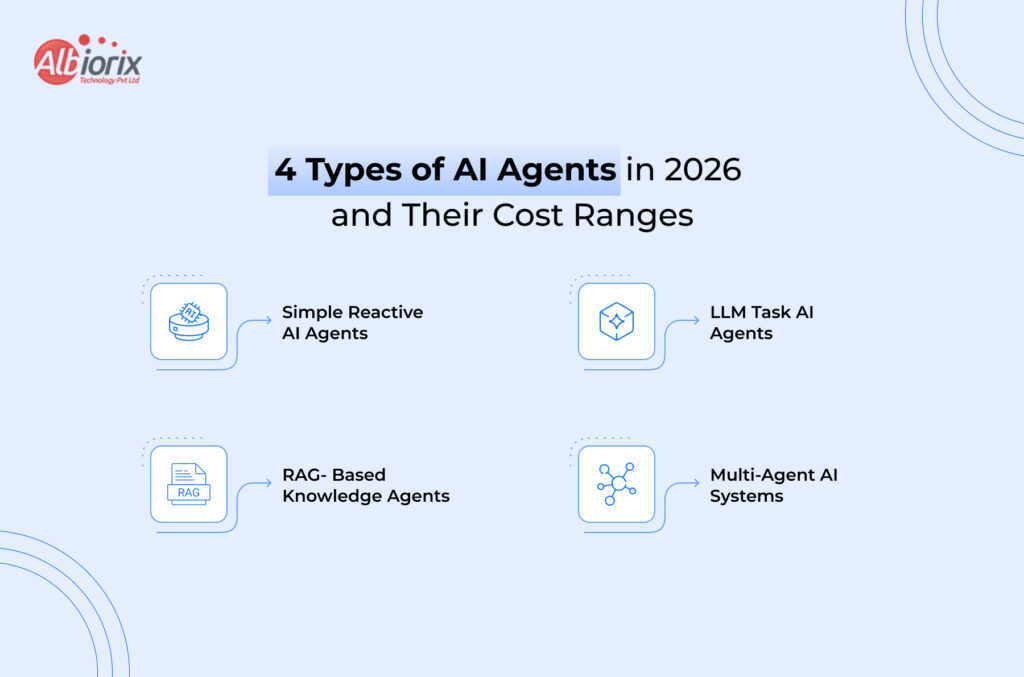
Depending on the role and uses, there are four most common types of AI Agents in 2026. And, the cost of development varies from one to another.
As stated earlier, the cost of AI agent development in 2026 totally depends on the type of agent you need for your business. Here’s the list of types of AI agents with their respective development cost (approx.)
Simple Reactive AI Agents:
The development cost of a simple reactive AI agent may range from $5,000 to $50,000.
These types of AI agents are typically used to handle predictable and rule-based tasks. Businesses use them as FAQ bots, appointment schedulers, and basic lead qualification assistants.
A Simple Reactive AI Agent uses fixed prompts; it does not have any memory, and it does not connect with any complex systems in the business.
These types of AI agents are best for automating a single, well-defined workflow. It uses technologies, including OpenAI API, basic webhook integrations, and no-code platforms.
LLM Task AI Agents
The development cost of LLM Task AI Agents may range between $50,000 to $120,000.
These types of agentic agents are used to handle multi-step conversations, for short term memory, and to connect to a few external tools or APIs. These AI agents do not follow any script; instead they reason to complete a task.
LLM Task AI Agents are best for customer support automation, internal HR assistants, and sales SDR bots. These types of AI agents are developed using technologies such as LangChain, GPT-4 or Claude, CRM API integrations.
RAG- Based Knowledge Agents
The development cost of RAG-based knowledge AI agents may range between $80,000 to $180,000.
RAG (Retrieval-Augmented Generation) agents pull from your company’s own documents, databases, or knowledge bases to give accurate, context-aware answers. They’re ideal when the agent needs to “know” your business deeply not just general knowledge.
These types of AI agents are best for legal document review, technical support, internal knowledge management, and more.
The technologies typically used to develop these agents are LangChain or LlamaIndex, Pinecone or Weaviate (vector databases), OpenAI or Claude.
Multi-Agent AI Systems
The development cost of a Multi-AI Agent System can range between $150,000 to $400,000.
Multi-Agent AI Systems are used by large organisations and businesses to automate tasks and enhance productivity. In this system, multiple specialised agents work together to complete various tasks within the organisation.
They are designed and developed to handle research, execute tasks, monitor outputs, and more. They work together like an organised system without any human intervention or inputs. Multi-Agent systems can run entire business workflows end-to-end with minimal human oversight.
These types of AI agents are best for complex back-office automation, supply chain decision-making, enterprise workflow orchestration, and more.
To develop such complex AI agents, the technologies that are used typically are AutoGen, CrewAI, LangGraph, custom orchestration layers, and enterprise API integrations.
💡 Next Step: Every enterprise system is unique. Share your specific use case with us during a Free 30-Minute Scoping Session and we’ll map out a definitive, architectural cost breakdown for your engineering team.
AI Agent Cost by Type
| Agent Type | Cost Range | Timeline |
|---|---|---|
| Simple Reactive Agent | $5,000 – $50,000 | 4–8 weeks |
| LLM Task Agent | $50,000 – $120,000 | 3–4 months |
| RAG Knowledge Agent | $80,000 – $180,000 | 3–5 months |
| Multi-Agent System | $150,000 – $400,000+ | 6–12 months |
What Actually Drives the Cost Up (or Down)?
Now, you might think that all of them are AI agents, then why there’s a huge difference in the overall development cost.
To understand the difference in the development cost of AI Agents, you have to understand the usefulness and implementation of each and every AI agent.
Level of Autonomy Required in an AI Agent:
If your AI agent needs to make more decisions on its own, then it will require more engineering, more testing, and in-depth work on overall safety.
This eventually increases the overall development cost. Contrary to this, if your AI agents need to make fewer and simpler decisions, then it will require comparatively low investment.
Number and Complexity of Integrations:
It is one of the biggest factors that impact the overall development cost of an AI Agent. Integrating an AI agent with your existing systems, such as CRM, ERP, legacy databases, and internal APIs, requires significant time and effort.
If your system is poorly documented or inconsistent, then it adds fuel to the fire. AI agent integration work can easily equal or exceed the core AI development cost.
LLM Model Choice:
If you are using premium AI models such as GPT-4 or Claude Opus for better reasoning, then the cost of AI agent development increases.
If you want a budget-friendly option, you can use open-source models like LLaMA 3 and Mistral for early-stage development. It can significantly reduce both development and running costs.
For businesses that don’t want to invest heavily in the initial stages, they can consider a hybrid approach. At the prototype stage, they can use open-source models, then switch to premium models only where performance requires.
Compliance and Security Requirements:
If you operate in healthcare, finance, or legal, or if you’re targeting enterprise clients in regulated markets expect compliance requirements (data residency, audit trails, access controls, HIPAA, GDPR) to add 20–40% to your total project cost.
On-Premise vs. Cloud Deployment:
Cloud deployment is faster and cheaper to start. On-premise deployment — where the model runs on your own infrastructure costs significantly more upfront but may be required for data-sensitive environments.
The Hidden Costs Most Companies Miss
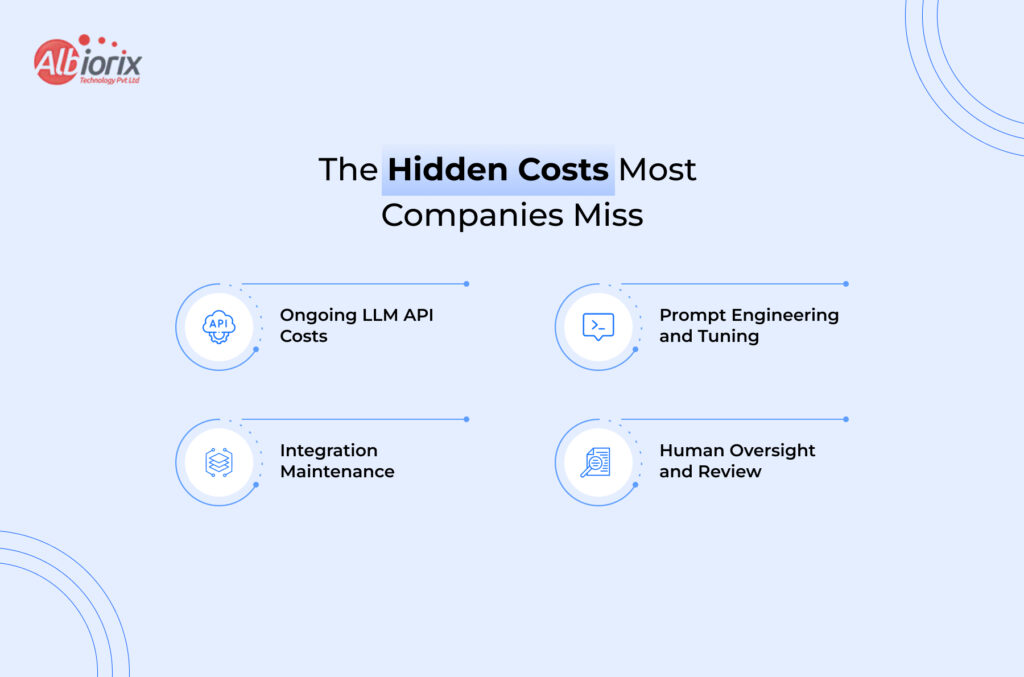
The build cost is only part of the total investment. Here’s what typically gets left out of early budgets:
Ongoing LLM API Costs:
Every time your agent processes a query, it consumes tokens. At scale, this adds up fast. Depending on usage volume and model choice, monthly operational costs typically run between $3,200 and $13,000.
It covers LLM API calls, vector database hosting, monitoring, and prompt maintenance. Thus, plan for this before you launch, not after.
Prompt Engineering and Tuning:
Getting an AI agent to behave consistently in production requires ongoing prompt refinement, evaluation, and optimization.
Most teams spend 10–20 hours per month on this after launch. It’s not optional it’s how you maintain quality as your data and workflows evolve.
Integration Maintenance
When the external systems your agent connects to update their APIs or change their data structure, your agent breaks. Budget for ongoing maintenance at roughly 20–30% of your initial development cost per year.
Human Oversight and Review
Even highly autonomous agents require human review pipelines for edge cases, error handling, and quality assurance especially in the first 6–12 months of deployment.
Talk to an AI Agent Expert, Free 30-Minute Call
Have questions about cost, timeline, or which type of AI agent fits your workflow? Skip the research rabbit hole. Book a 30-minute call with the Albiorix AI team.
Schedule My Call!
How to Reduce AI Agent Development Costs Without Cutting Corners
When it comes to custom AI agent development, you dont need to have an unlimited budget. You can build a valuable AI agent with proper planning and execution.
Here’s how experienced AI development company keeps cost under control:
- Start with a narrow scope: The most common (and expensive) mistake is trying to build a generalist agent in version one. A focused agent that does one task very well is faster, cheaper, and more reliable. You can expand from there.
- Use proven frameworks: LangChain, LangGraph, CrewAI, and AutoGen save weeks of engineering time. Selecting the right framework at the start can reduce backend engineering costs by 20–40%.
- Prototype with open-source models: Use LLaMA 3, Mistral, or Ollama for early development and evaluation. Move to OpenAI or Claude only when performance requirements justify the cost.
- Build observability from day one: Monitoring, prompt versioning, and feedback loops are significantly cheaper to implement during development than to retrofit after issues emerge in production.
- Choosing the right AI development company: Generic software agencies may quote lower rates but often underestimate the complexity of agentic systems. Working with a team that has shipped production AI agents before reduces rework, delays, and costly architecture pivots.
What ROI Can You Realistically Expect?
If scoped correctly, the business case of AI agents is very strong.
For well-defined, high-volume workflows, ROI timelines of 4–8 months are realistic. A mid-sized business automating 70% of customer service queries, for example, can save $80,000–$100,000 annually against a total agent investment of $30,000–$50,000 per year.
The highest-ROI use cases in 2026 include:
- Customer support automation: Reducing cost per ticket by 30–60%
- Back-office workflow automation: Eliminating manual data entry and handoffs
- Sales development: Qualifying leads and handling initial outreach at scale
- Internal knowledge management: Giving teams instant access to company documents and processes
The key is starting with a use case where the volume justifies the investment and the workflow is well-defined enough for an agent to handle reliably.
Build vs. Buy: A Quick Framework
Before committing to custom development, it is important to ask yourself – whether to build from scratch or buy a readymade AI agent from the market.
Both the options have their own pros and cons, and the selection of any one depends on many different factors, and the first factor is the development cost.
When you buy an AI agent, it uses the most common use cases in the market, including customer FAQs, appointment booking, simple lead qualification, and similar.
These off-the-shelf SaaS tools can be easily deployed in days and the cost may range from $500 – $5,000/month.
When you decide to custom build an AI agent from scratch, you already have an upper hand in the industry. Custom builds typically win on 3-year total cost of ownership for these scenarios.
Go for custom build if you have proprietary workflows, integrations that no SaaS tool supports, compliance requirements, or a need for the agent to deeply understand your business data.
Most businesses should start with an off-the-shelf tool to validate the use case, then invest in a custom build once results are proven.
How Albiorix Approaches AI Agent Development
At Albiorix, we’ve built production AI agents for clients across healthcare, fintech, logistics, and enterprise SaaS. Our team works with LangChain, AutoGen, CrewAI, LlamaIndex, Pinecone, Weaviate, and the full stack of modern agentic AI tools.
We don’t believe in one-size-fits-all pricing. Every estimate we provide is based on your actual workflow, your existing systems, and what the agent needs to do in production not just in a demo.
Our typical engagement starts with a scoping session where we help you:
- Define the right agent type for your use case
- Map out integration requirements and data readiness
- Build a realistic cost and timeline estimate
- Identify the highest-ROI starting point
Whether you’re ready to build or still evaluating whether an AI agent is the right investment, we’re happy to give you an honest assessment.
Connect with Our Experts!
FAQ
A simple rule-based agent typically costs between $5,000 and $50,000 depending on the number of integrations and the complexity of the conversation flows.
For most projects, integration work connecting the agent to your existing CRM, ERP, or internal APIs costs as much or more than the core AI development itself.
Simple agents can be built in 4–8 weeks. Mid-complexity agents take 3–5 months. Full multi-agent systems typically take 6–12 months.
Expect $3,200–$13,000 per month in operational costs covering LLM API usage, infrastructure, monitoring, and maintenance depending on usage volume and agent complexity.
Yes. Development teams in India, Eastern Europe, and Southeast Asia charge $20–$50/hour compared to $150–$250/hour for US-based teams — while delivering comparable quality for well-scoped projects.
Start by calculating the cost of the workflow you want to automate today — staff hours, error rates, delay costs. If the annual cost of the status quo exceeds the agent build + operating cost within 12–18 months, the ROI case is strong.
Published Blogs
Latest Blogs : Insights and Innovations from Our Blog
Stay Ahead in Tech: Dive into our Blogs for the Latest in Software, Web, and Mobile App Development. Explore cutting-edge technologies, industry trends, and insightful updates that keep you at the forefront of the digital landscape
Our Clients

Client Showcase: Trusted by Industry Leaders
Explore the illustrious collaborations that define us. Our client showcase highlights the trusted partnerships we've forged with leading brands. Through innovation and dedication, we've empowered our clients to reach new heights. Discover the success stories that shape our journey and envision how we can elevate your business too.










We’re here to help you


