




How AI Agents Are Transforming Sports Betting Apps

Summary: The AI revolution has taken the sports betting industry by storm. The use of popular AI models and generative AI solutions has increased in sports betting apps and software. Following a structured sports betting apps development guide can help businesses effectively integrate these technologies. The big sports betting brands in the USA and Australia have already integrated AI to offer an enhanced experience and make informed business decisions.

Introduction

The global sports betting market is no longer driven by instinct or luck — it’s being reshaped by intelligent, autonomous systems.

AI agents are now at the center of sports betting app development, powering everything from real-time odds computation to hyper-personalised user experiences.

Whether you’re a developer in the USA, an operator expanding into Australia, or a startup navigating Germany’s newly regulated market, understanding the role of AI agent development in sports betting apps is no longer optional — it’s a competitive necessity.

In this blog, we break down exactly how AI agents work inside sports betting platforms, what capabilities they unlock, and what it takes to build these systems for the world’s three fastest-growing betting markets.

The Market Opportunity Stats

Market Value in 2024Market ProjectionsUS Sports Betting MarketEngagement Via Mobile Apps
$100.9B Global sports betting market value in 2024$187.4B Projected market size by 2030 (11% CAGR)$149.6B US sports betting handle in 202590% Bets placed via mobile devices

These numbers tell a clear story: sports betting is a high-growth, mobile-first, and data-intensive industry. AI agents are the infrastructure that makes it all work at scale.

Want to increase the market share of your sports betting app?

Contact our team of AI developers to discuss how integrating AI can help boost growth in a competitive landscape.


Talk to AI experts

What Is an AI Agent for Sports Betting Apps?

An AI agent is not just a chatbot or a recommendation engine.

In the context of sports betting app development, an AI agent is an autonomous system that can perceive real-time data, reason about that data, make decisions, and take action — all without ongoing human input.

Unlike traditional algorithms that follow fixed rules, AI agents in sports betting apps:

  • Continuously learn from live data streams (player stats, weather, injuries, market movements)
  • Adapt their betting predictions and recommendations dynamically
  • Automate actions such as bet placement, odds adjustment, and fraud flagging
  • Operate across multiple tasks simultaneously — customer support, risk management, personalization

Key Insight:

AI agents in sports betting are the difference between a static platform and a living, adaptive system — one that gets smarter with every game played and every bet placed. 

7 Ways AI Agents Are Transforming Sports Betting App Development
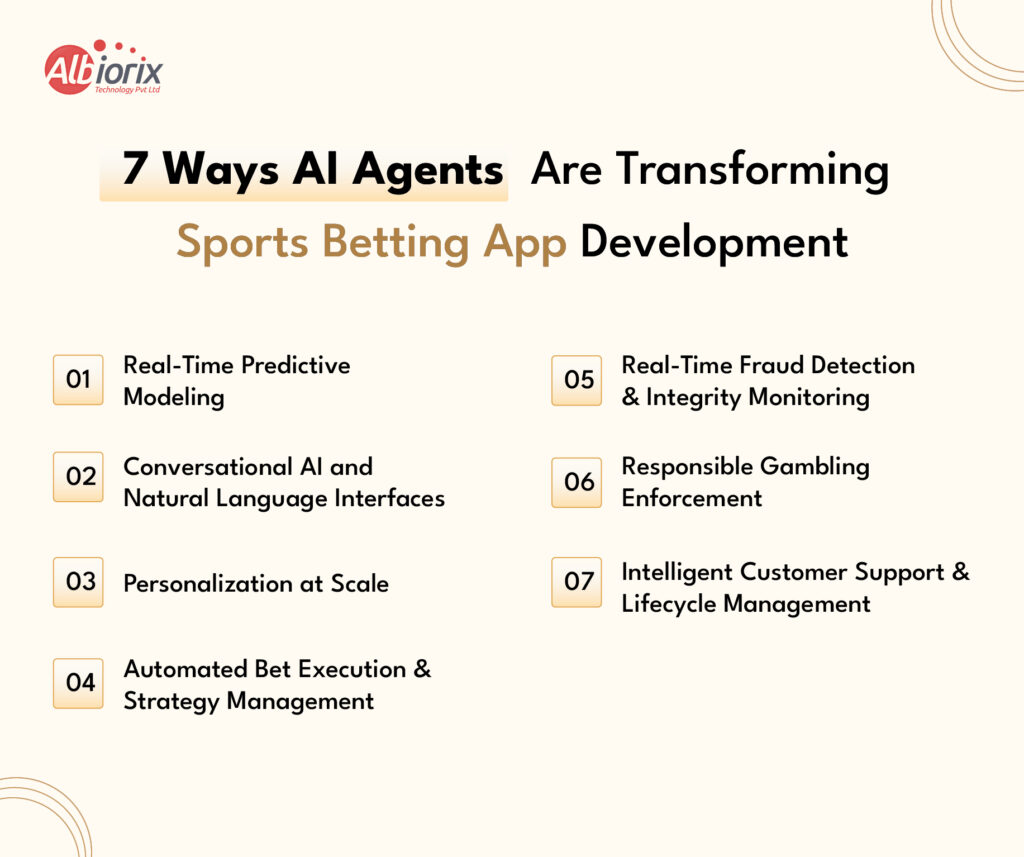
7 Ways AI Agents Are Transforming Sports Betting App Development

Real-Time Predictive Modeling

The most powerful application of an AI agent for sports betting apps is predictive accuracy.

Modern AI agents process historical performance data, player statistics, team dynamics, referee trends, and even environmental conditions like weather — and update predictions continuously during live events.

In 2025, AI-driven platforms are achieving up to 35% improvement in prediction accuracy compared to traditional statistical models.

Systems like those used by DraftKings can recalculate odds within milliseconds of an in-game event — a quarterback injury, a red card, or a missed penalty — giving both operators and bettors a decisive edge.

Market Data

The sports analytics market was valued at $854.5 million in 2023 and is forecast to reach $4.74 billion by 2030 (27.7% CAGR), making AI-powered prediction one of the most investable features in sports betting app development.

Conversational AI and Natural Language Interfaces

Gone are the days of navigating complex menus to place a bet. AI agents now power conversational interfaces that let users interact in plain language — by text or voice.

Imagine a bettor typing: “What are the best prop bets for the NBA game tonight?” and receiving an instant, personalized, data-backed response — with the option to execute the bet directly from the conversation.

Platforms like BetHarmony are already deploying AI agents that understand betting slang, support multiple languages, and execute complex parlay combinations through natural dialogue.

This is especially critical for operators targeting Germany and Australia, where localized language support dramatically improves user retention.

  • Supports multilingual communication for international markets (critical for Germany and Australia)
  • Voice-to-voice betting enables hands-free, in-game wagering
  • Reduces onboarding friction for new bettors in newly legalized markets


Personalization at Scale

AI agents analyze individual betting histories, preferences, and behavioral patterns to deliver hyper-personalized experiences. Rather than showing the same promotions and markets to every user, the platform adapts in real time.

Research shows that 60% of users prefer AI-personalized apps, leading to improved retention and increased bet volumes.

Platforms implementing personalized AI agent development have reported up to 30% improvement in user retention metrics.

  • Personalization features powered by AI agents include
  • Custom odds recommendations based on past behavior
  • Automated notifications for relevant sports events
  • Tailored promotional offers tied to individual betting patterns
  • Dynamic odds presentation based on a user’s preferred sports and markets

Automated Bet Execution and Strategy Management

AI sports betting agents can execute predefined betting strategies autonomously, removing emotional bias and enabling complex multi-leg strategies that would be impractical for manual execution.

This is the backbone of professional sports betting agent development: building systems that can identify value bets, monitor arbitrage opportunities across platforms, manage bankroll limits, and execute wagers at optimal timing — all within the rules of each jurisdiction.

Key Developer Note:
When building an AI agent for sports betting apps in the USA, ensure your automated execution features are compliant with state-level requirements.

In Australia, refer to the Interactive Gambling Act; in Germany, adhere to the Glücksspielstaatsvertrag (GlüStV) framework.

Real-Time Fraud Detection and Integrity Monitoring

AI agents are the first line of defense against match-fixing, fraudulent accounts, and suspicious betting patterns.

Systems like Sportradar’s Fraud Detection System (FDS) use machine learning to monitor thousands of betting markets simultaneously, flagging irregularities before they escalate.

For operators building sports betting apps in highly regulated markets like Germany or US states such as New Jersey and Pennsylvania, robust fraud detection is not just a feature — it’s a licensing requirement. 

AI-powered integrity tools can:

  • Detect sudden unexplained shifts in betting volumes
  • Cross-reference patterns against historical match-fixing data
  • Trigger automatic review workflows or account flags in real time
  • Integrate with KYC/AML systems for holistic compliance

Responsible Gambling Enforcement

One of the most socially significant applications of AI agent development in sports betting apps is responsible gambling.

AI agents can monitor individual user behavior in real time, identify early signs of problem gambling, and trigger interventions automatically.

This is increasingly a regulatory expectation.

The EU AI Act (effective February 2025) and Australia’s National Consumer Protection Framework both require platforms to implement safeguards that prevent exploitative personalization targeting vulnerable users. 

AI-powered responsible gambling tools include:

  • Behavioral tracking that flags loss-chasing patterns
  • Automated deposit limit enforcement and self-exclusion prompts
  • PlayScan-style risk scoring across user sessions
  • Regulatory-compliant affordability checks (especially relevant in Germany)


Intelligent Customer Support and Lifecycle Management

AI agents dramatically reduce the cost and latency of customer support in sports betting platforms. Operating 24/7, these systems handle everything from account inquiries and withdrawal processing to live bet assistance and dispute resolution.

For operators targeting multiple time zones — critical for USA (multiple time zones), Australia (AEST/AWST), and Germany (CET) — AI-powered support agents ensure consistent service quality without scaling human teams proportionally.

Beyond support, AI agents drive the entire user lifecycle: onboarding new users, re-engaging dormant bettors, and proactively surfacing upsell opportunities at the right moment in a session.

AI Agent Sports Betting Development: A Regional Breakdown
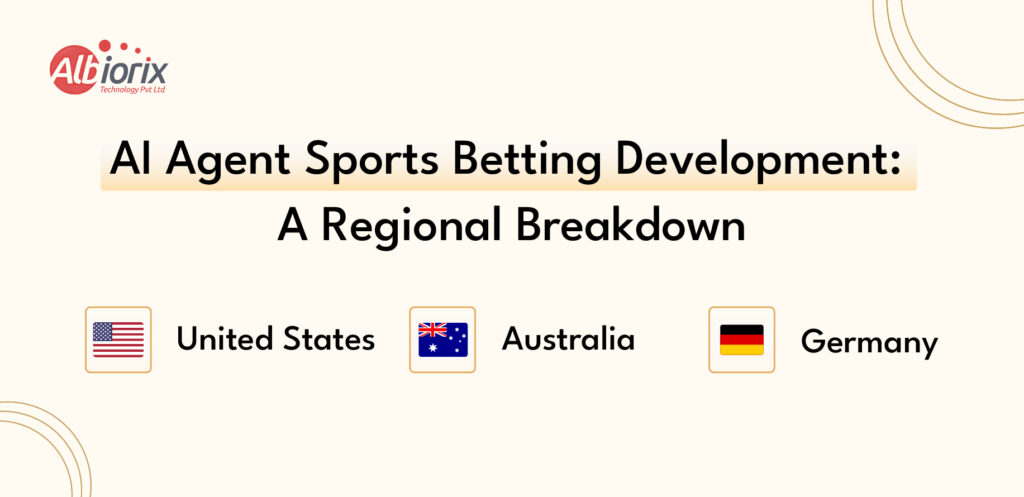
AI Agent Sports Betting Development: A Regional Breakdown

AI Agent Sports Betting Development: United States

The USA is the world’s most dynamic emerging market for sports betting.

Following the 2018 Supreme Court ruling that overturned the federal ban, 39 states and the District of Columbia have legalized sports betting, with more than 70% of the US population now having legal access.

US sports betting generated $149.6 billion in handle and $13.71 billion in revenue in 2025 alone. AI agent development in this market must account for: 

  • State-by-state licensing (New Jersey, Pennsylvania, Illinois each have unique requirements)
  • SAFE Bet Act proposals that may restrict manipulative AI targeting
  • Integration with major platforms like DraftKings and FanDuel APIs
  • NFL, BA, MLB, and college sports as primary markets driving live betting volume

The US market rewards AI agents that can operate with high-frequency real-time data given that 95% of bets are placed online and the majority during live game windows.

AI Agent Sports Betting Development: Australia 

Australia has one of the world’s most mature and regulated online betting markets.

Sports betting is legal nationally and governed by the Interactive Gambling Act 2001, with state-level licensing handled by bodies including the Northern Territory Racing Commission.

AI sports betting agents targeting Australia must support:

  • AFL, NRL, Rugby League, Cricket (Big Bash, Tests), and A-League as primary sports
  • Integration with dominant platforms including Sportsbet, TAB, Ladbrokes, and Bet365 Australia
  • National Consumer Protection Framework compliance (deposit limits, activity statements, bet confirmation tools)
  • Strong personalization for local sports culture and seasonal betting patterns


Australia’s mobile-first bettors and high sports engagement make it an ideal market for AI agents that specialize in live in-play betting and push notification management.

AI Agent Sports Betting Development: Germany

Germany’s sports betting market underwent significant regulatory transformation with the Glücksspielstaatsvertrag 2021 (Interstate Treaty on Gambling), which created a federally unified licensing framework. The market is strict but lucrative.

Key requirements for AI agent development for sports betting apps targeting Germany:

  • GlüStV-compliant licensing from the Gemeinsame Glücksspielbehörde der Länder (GGL)
  • GDPR and EU AI Act compliance for all data processing and user-targeting features
  • Mandatory responsible gambling tools including monthly deposit limits (€1,000 cap)
  • Support for German-language interfaces with localized Bundesliga, Champions League, and DFB-Pokal markets
  • Prohibition on live in-play betting on certain markets — AI agents must enforce geo-restricted bet types


Germany rewards platforms that combine rigorous compliance with premium user experience. AI agents that can enforce regulations programmatically — without degrading the UX — are a significant competitive advantage here.

Core Technology Stack for AI Sports Betting Agent Development

Building a robust AI agent for sports betting apps requires more than off-the-shelf machine learning. Here is the foundational technology architecture used by leading platforms in 2025:

Sr. NoLayer Technology/Tools
1Data Ingestion Real-time sports APIs (Sportradar, Stats Perform, Opta), web scraping, social media NLP feeds
2Machine LearningTensorFlow / PyTorch for predictive models; scikit-learn for statistical baselines; XGBoost for rapid odds recalculation
3AI Agent FrameworkLangChain / AutoGen for multi-step reasoning; OpenAI GPT-4 / Claude API for NLP interfaces
4Real-Time Processing Apache Kafka for event streaming; Redis for low-latency caching; Apache Flink for stream analytics
5Backend InfrastructureNode.js / Python FastAPI; microservices on AWS / Azure / GCP; PostgreSQL + TimescaleDB for time-series data
6Compliance LayerKYC/AML integrations (Onfido, Jumio); GDPR-compliant data pipelines; geo-restriction enforcement APIs
7Mobile/FrontendReact Native for cross-platform iOS/Android; WebSocket connections for live odds delivery

Challenges in AI Sports Betting Agent Development

Building AI agents for sports betting apps is complex. Development teams must navigate:

Data Quality and Latency

AI agents are only as good as their data. Partnering with certified sports data providers and building low-latency ingestion pipelines is non-negotiable, especially for live in-play betting features where odds can shift within seconds.

Regulatory Complexity Across Jurisdictions

A single platform targeting USA, Australia, and Germany must simultaneously comply with three distinct legal frameworks — each with its own licensing, advertising, responsible gambling, and data protection requirements.

AI agent development must embed compliance logic at the architecture level, not as an afterthought.

Model Bias and Transparency

If training datasets are unbalanced, AI agents can systematically favor certain teams or market outcomes.

Diverse training data, ongoing monitoring, and explainable AI features — which show users how recommendations are generated — are essential for both fairness and regulatory acceptance, particularly under Germany’s EU AI Act obligations.

Responsible Deployment

AI agents that learn individual behavioral vulnerabilities carry ethical obligations.

Platforms must implement the same intelligence that drives personalization to also enforce user protection — a dual mandate that requires thoughtful architecture and ongoing human oversight. 

How to Build an AI Agent for Sports Betting Apps: A Development Roadmap
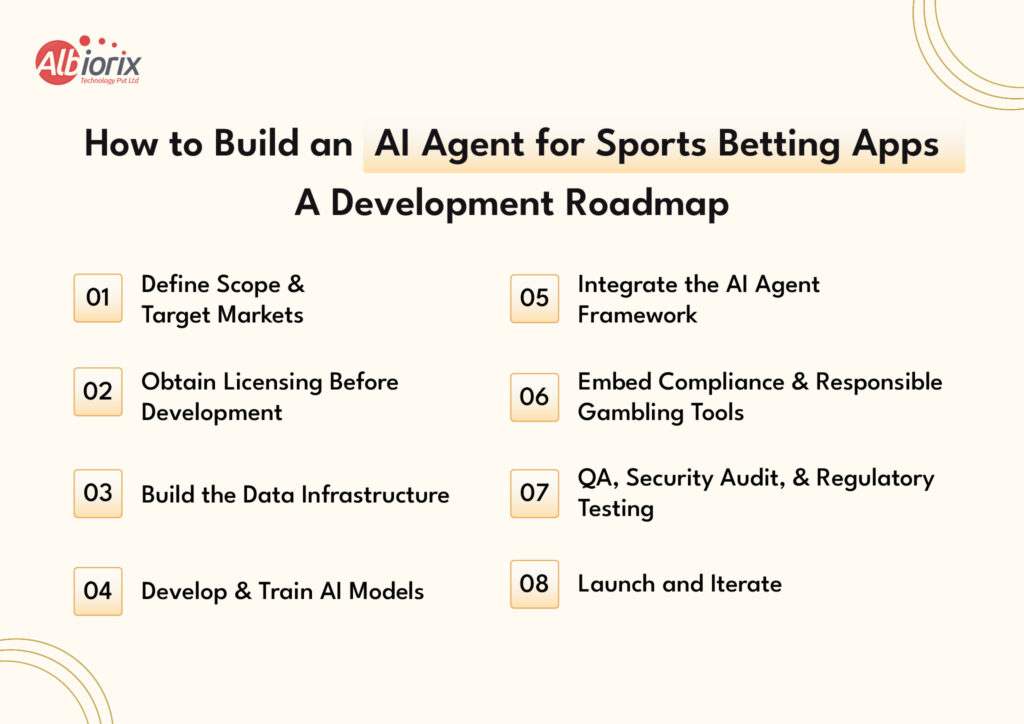
How to Build an AI Agent for Sports Betting Apps: A Development Roadmap
  1. Define Scope and Target Markets — Identify which sports, bet types, and jurisdictions the platform will support. This determines licensing requirements, data sources, and compliance architecture.
  2. Obtain Licensing Before Development — In the USA, this means state-by-state applications. In Australia, engage the Northern Territory Racing Commission or relevant state body. In Germany, apply to the GGL. Timeline: 3–12 months depending on jurisdiction.
  3. Build the Data Infrastructure — Integrate certified real-time sports data APIs. Establish event streaming pipelines capable of processing millions of data points per second during major sporting events.
  4. Develop and Train AI Models — Begin with foundational predictive models (match outcomes, player props). Layer in personalization engines and NLP interfaces. Use A/B testing frameworks to iterate model performance against live user data.
  5. Integrate the AI Agent Framework — Connect ML models to an agent orchestration layer that can reason, plan, and execute across multiple tasks: odds adjustment, user recommendation, fraud alert, and customer support simultaneously.
  6. Embed Compliance and Responsible Gambling Tools — Build KYC/AML flows, GDPR-compliant consent management, deposit limit enforcement, and behavioral monitoring into the core platform — not bolted on post-launch. 
  7. QA, Security Audit, and Regulatory Testing — Run compliance checks specific to each target region. Conduct penetration testing and verify that geo-blocking, age verification, and jurisdictional bet-type restrictions function correctly.
  8. Launch and Iterate — Start with a soft launch in one market. Use real user data to refine AI models continuously. Scale to additional markets once core performance and compliance are validated. 

Development Cost Range:
Custom AI-powered sports betting app development typically ranges from $65,000 to $300,000 USD depending on feature depth, AI integration complexity, and compliance requirements across markets.

The Future of AI Agents in Sports Betting 

The trajectory for AI agents in sports betting is clear. Several emerging developments will define the next phase of sports betting app development:

  1. Agentic Multi-Modal Systems: AI agents will process video feeds, audio commentary, and social media in real time — not just statistical data — to generate betting signals during live events.
  2. Autonomous Bankroll Management Agents: Fully autonomous agents that manage a user’s entire betting portfolio, adjusting stakes and strategy based on live market conditions and personal risk tolerance. 
  3. Decentralized AI Oracles: Integration with blockchain-based smart contracts to enable transparent, trustless AI-driven betting settlements — highly relevant for crypto-friendly markets.
  4. Regulatory AI: AI agents that monitor their own outputs for compliance violations in real time, automatically adjusting behavior based on jurisdictional rule sets — a critical advantage for multi-market operators. 
  5. Conversational Betting on Messaging Platforms: AI sports betting agents embedded directly into WhatsApp, Telegram, and social platforms, enabling bet placement through group chats — targeting Gen Z users in all three key markets. 

The global AI agent market itself is projected to grow from $5.1 billion in 2024 to $47.1 billion by 2030.

Sports betting is one of the most data-rich and decision-intensive industries in the world — making it one of the highest-value deployment environments for next-generation AI agent development.

Conclusion

AI agents are no longer a future-looking feature for sports betting apps — they are the present competitive standard.

Platforms that build intelligent, adaptive, real-time AI systems today will dominate the betting markets of tomorrow in the USA, Australia, Germany, and beyond.

Whether you’re looking to build a sports betting app from the ground up, integrate AI agent capabilities into an existing platform, or navigate the regulatory complexities of multi-market launches, leveraging Sports Betting Software Development Services can streamline the process and ensure scalability.

The investment in AI agent development delivers measurable returns: higher prediction accuracy, stronger user retention, lower fraud rates, and scalable compliance.

The sports betting industry is estimated to generate more than $221 billion between 2025 and 2029, powered in large part by the AI revolution.

The question is not whether AI agents will transform sports betting apps — they already are. The question is whether your platform will lead that transformation or follow it.
AI Agents vs Traditional Automation: What Is The Best Difference?

Some years back, the definition of Automation was eliminating tedious and repetitive tasks. But in 2026, the definition of automation has completely changed. With the technological revolution in every field and industry, automation is all about intelligence, adaptability, and real-time decision-making.

Partnering with an experienced AI Development Company can help organizations identify the right processes to automate, ensuring smarter, data-driven operations. Most businesses are automating many tasks and operations, but many of them are also confused about which tasks to automate to increase operational efficiency and productivity.

Traditional automation tools, including scripted bots, think RPA, and macros, are very popular among organizations in 2025. These automation tools have helped businesses in increasing efficiency and productivity. But with the arrival of Artificial Intelligence, traditional automation tools are now being replaced by smart, intelligent AI Agents. The latter are the new favorites of businesses across the globe because of their ability to learn, automate, and evolve on their own.

So, it’s 2026, and if you want your business to stay competitive and future–ready, then you have to understand the core difference between AI Agents Vs Traditional Automation. You have to understand the key difference and what’s the best option for your business.

In this blog post on AI Agents vs Traditional Automation, we will cover all the important topics, including AI-powered software solutions, adoption trends, and use cases that define the new era of intelligent automation.

What is Traditional Automation?

Definition of Traditional Automation:

Traditional automation is a rule-based system or bots that follow predefined instructions to complete repetitive and structured tasks. These tasks include data entry, invoice processing, report generating, and much more. The sole purpose of the traditional automation was to boost the operational efficiency and accuracy of any operations without or with minimal human intervention.

For many decades, traditional automation has been the backbone of many business processes. It helped businesses increase efficiency and productivity with fewer efforts and without constant monitoring. Some of the most used traditional automation forms were Robotic Process Automation, Rule-based Scripts, Macro-driven Tasks, Scheduled Batch Jobs, and Workflow Engines.

What Traditional Automation Does Well?

  • Traditional Automation automates repetitive, structured, and rule-based tasks.
  • Traditional Automation reduces errors and delivers consistent outputs.
  • Traditional Automation is faster than manual operations or human interventions.
  • Traditional Automation easily integrates with legacy software systems to remove manual steps.
  • Traditional Automation helps in cost reduction.

What are the Limitations of Traditional Automation?

Traditional Automation was extremely helpful to businesses, but it too had some limitations. Below are some of the most common limitations in the era of digital revolution:

  • Rigidity: In traditional automation tools, automation rules are hard to code. Therefore, any change in the input format or the exception path required manual intervention or reprogramming of the entire code.
  • No Learning: Traditional Automation tools do not learn from past behaviors. If there are any changes in the conditions or the required outputs, you need to update the software and workflows manually.
  • Limited to Structured Data: Most traditional automation software worked on fixed fields with formatted documents or APIs. Any unstructured text, image data, voice, or contextual understanding remained unsupported.
  • Heavy Maintenance: When a business grows or requires a change in the process, a traditional automation tool/software requires maintenance. It increases cost and often leads to delay.
  • No Real-time Decision: Traditional Automation tools and software normally work on predefined instructions via code. It cannot dynamically adjust to new incoming patterns, context or feedback loops.

Traditional Automation is the best for high-volume repetitive tasks. But, if you are a business with rapid changes in workflows, higher customer expectations, and regulatory shifts, then you need modern and adaptive AI automation tools – AI Agents.

Are you confused between AI Automation and Tradational Automation?

Talk to our expert team of AI developers to discover which solution best fits your goals and future growth. Book a free consultation today


Call now!

What Are AI Agents?

Definition of AI Agents:

An AI Agent is an intelligent software system that can understand context, learn from data, make decisions on its own, and act autonomously without any major human intervention. AI Agents are completely different from traditional automation tools/software. They can adapt to changes, handle complex or unstructured information, and keep improving from past experiences.

Powered by Artificial Intelligence, AI Agents are the next-gen layer of automation. AI Agents not only execute tasks, but it also perceives, reasons, learns, and adapts. It keeps improving itself with every past experience.

Businesses are now combining AI Agents with AI product development initiatives to create adaptive, intelligent enterprise tools that align with business goals.

What AI Agents can do?

Powered by Artificial Intelligence, AI Agent is a software entity that:

  • Understands context
  • Learns over time via data feedback loops
  • Makes decisions autonomously or semi-autonomously
  • Handles unstructured data
  • Communicates naturally
  • Adapts workflows in real time, not just follow static rules

Compared to traditional bots and automation software, AI Agents are designed and developed to evolve over time. Instead of following fixed logic, they can optimize the outcome as per the query.

What are the Core Capabilities of AI Agents?

AI agents are more powerful, scalable, and intelligent compared to traditional automation tools and software. Here are some of the core capabilities that make AI Agents the first choice in 2026:

  1. Adaptive Learning & Feedback Loops: AI Agents keep learning new things; thus, they improve over time. They improve as input data changes or new cases emerge.
  2. Contextual Decision Logic:  – Instead of “if-then” rules only, they can infer intents, handle ambiguous inputs, or escalate intelligently.
  3. Multimodal Data Handling: They might combine ecommerce transaction records with natural language feedback, images, or voice logs.
  4. Conversational Interaction: Instead of rigid structured dialogs, AI Agents can interact via natural-language chat / voice interfaces.
  5. Autonomous Orchestration: Orchestrating across multiple systems (CRM, ERP, email, scheduling) in a dynamic manner.

These capabilities enable AI Agents to go beyond automation → toward “Autonomous Workflows.”

AI Agents vs Traditional Automation — Key Differences

Here is a detailed comparison to highlight what business owners need to focus on:

FeatureTraditional AutomationAI Agents
Decision LogicHard-coded, rule-basedContextual, probabilistic, model-driven
Learning / AdaptationNoneContinuous learning from feedback & data
Data Types SupportedStructured, fixed schemaStructured + unstructured (text, voice, image)
Flexibility to ChangeLow — requires manual updatesHigh — self-adjusts based on inference & feedback
Scalability for ComplexityMedium — good for stable tasksHigh — can handle complex workflows & branching logic
Interaction StyleFixed UI or API triggersConversational / natural language + UI + backend logic
Response to ExceptionsFails or triggers manual interventionCan infer and route intelligently, request clarification, ask questions
Maintenance Over TimeHigh (rule updates, versioning)Lower (models retrained / auto-improve, fewer manual rule changes)
Speed of DeploymentFast for simple tasksSlower up-front due to model-training / design, but faster adaptation later
Governance & Oversight NeedsClear audit trail, easier auditsMore complex (ML explainability, model monitoring, ethics / bias)

Summary: AI Agents are not just a normal automation software or tool with a touch of Artificial Intelligence. They are a completely different approach that combines automation, intelligence, learning, and evolving. It can transform how business processes evolve over time.

Modern AI voice agent platforms are one example of this evolution, offering intelligent and conversational automation capabilities far beyond what traditional bots can achieve.

AI Agents Adoption Trends & Statistics (2025-2026)

AI Agents are becoming the first choice for businesses when it comes to automation. The AI-powered automation tools are not just helping businesses in streamlining operations but are also helping them reduce errors and increase customer satisfaction.

In industries like healthcare automation and IoT-enabled medical systems, AI Agents are revolutionizing workflows — from clinical data handling to predictive diagnostics — reducing human effort while increasing precision.

In 2026, the need for more advanced and intelligent AI agents will boom like never before. To help you understand better, we have collected AI Agents adoption data so that you can understand why AI agents are good for your business, and they are:

AI Adoption & Investment in 2026

  • According to a McKinsey report on AI in the Workplace, 92% of executives expect to increase their spending on AI over the next three years. Also, the same report says that around 55% expect investments in Artificial Intelligence to grow by at least 10%.
  • According to a report published by PwC, nearly 49% of technology leaders say AI is fully integrated into their company’s core business strategy. This report suggests that AI is not just an experimental project but a strategic priority.
  • According to a report by Exploding Topics, 78% of companies are already using at least one AI tool. It means more than 90% are already using AI or planning to adopt it in the near future.

Productivity & ROI Insights on AI Agents

  • According to an online report published by Per Vena Solutions, 54% of businesses that have implemented AI tools report measurable efficiency gains or cost reduction.
  • According to a report by Google (via Reuters-reported pilot), it was found that the use of Artificial Intelligence for administrative tasks saves almost 122 hours every week per worker in the UK pilot. It is potentially contributing to great economic gains.
  • According to the latest report by BCG, 5% of global companies (out of 1,250 surveyed) are currently deriving measurable value from AI investments. Following this, many more companies are planning to integrate AI agents and solutions into their business.

Real-World Use Cases of AI Agents in Business Automation

Real-World Use Cases of AI Agents in Business Automation

The AI revolution in 2025 has taken the business world by storm. Most organizations have already integrated AI agents into one or another business operation and are yielding great results. No matter what the size of your business, AI agents have the potential to improve the efficiency and productivity of your business by 2X.

Top Use Cases of AI Agents include AI in eCommerce for personalized product recommendations and AI in video game development for creating adaptive, player-responsive gaming experiences.

AI Agents are also reducing clinical burden in healthcare software by automating patient communication, data entry, and administrative tasks — freeing doctors and nurses to focus more on care delivery.

Top Use Cases of AI Agents in 2025:

  1. Customer Experience & Support:
    1. Sentiment-aware chatbots: The modern and intelligent AI Agents (AI Voice Agents) can easily detect the tone on the other side of the call. Based on the tone, it can escalate the issue or suggest retention offers.
    2. Automated Follow-up: The futuristic AI Agents (also called AI Voice Agents) can arrange automated follow-up calls based on customer feedback. Based on the past communication, it can predict churn.
  2. Finance & Accounting:
    1. Smart Invoice Verification: AI agents (tools and software) are using OCR + AI logic to flag suspicious invoices. They can also auto-resolve discrepancies.
    2. Fraud Detection: AI-powered tools and software can proactively monitor transaction patterns and flag abnormalities in real time. In this way, it keeps your business protected from any type of fraud.
  3. Supply Chain & Logistics:
    1. Dynamic Route Optimization: AI Agents in logistics are smart enough to adjust routes in real-time based on traffic, weather, delays, and customer priorities. It helps in any major delays, saves money, and increases customer satisfaction.
    2. Predictive Maintenance Agents: There are AI-powered software that constantly monitor equipment sensor data. If they experience any unusual fluctuations, it instantly suggests preemptive servicing.
  4. Human Resources:
    1. Candidate Screening: AI agents in Human Resources are helping companies in screening candidate profiles and scheduling interviews based on the screening. It ensures bias-aware evaluation.
    2. Sentiment Analysis: It also helps companies in analyzing the sentiments of the employees. Based on the sentiment analysis report, the company can decide on retention or training.
  5. Sales & Marketing Automation:
    1. Lead Scoring & Nurturing: AI agents in Sales and Marketing are monitoring lead behavior and triggering personalized outreach.
    2. Content Recommendations: AI-powered software for content writing and email writing suggests strong and powerful email content sequences based on engagement metrics.
  6. Operations/IT:
    1. Categorization & Remediation: AI Agents for Operations and IT triage IT tickets, escalate or even trigger fixes where safe.
    2. Documents and Workflows: There are AI agents for operations that digest regulatory updates and adjust internal policy workflows.

Every use case listed above demonstrates how AI Agents don’t just “execute” — they continuously optimize, learn from outcomes, and integrate with multiple systems. The use cases of AI agents and AI-powered software solutions are way too varied and unique in different industries.

Limitations of Traditional Automation vs AI Solutions

Traditional Automation was helpful to every industry before the arrival of AI solutions. It helped businesses optimize, automate, and streamline their day-to-day operations. However, with the evolution of AI-powered software solutions, companies are less preferring traditional automation because of its limitations.

Here’s a clear, business-friendly comparison table showing the limitations of traditional automation vs AI solutions (AI Agents):

AspectTraditional Automation (Limitations)AI Solutions / AI Agents (Advantages)
Learning & AdaptabilityStatic and rule-based; cannot learn from new data or exceptionsContinuously learns and adapts from data, feedback, and changing scenarios
Data HandlingWorks only with structured data (spreadsheets, forms, databases)Can process both structured and unstructured data like text, images, and voice
Decision-MakingExecutes predefined instructions; no reasoning abilityMakes context-aware, intelligent decisions in real time
ScalabilityDifficult to scale as rules must be manually updated for new casesScales effortlessly across departments with dynamic learning
MaintenanceRequires constant human intervention to update scripts or workflowsSelf-optimizes and reduces maintenance through autonomous learning
Error HandlingFails when input deviates from expected format; requires manual fixesDetects, corrects, and learns from errors automatically
FlexibilityRigid; limited response to changing business processes or conditionsFlexible and adaptive to new business logic, data sources, and user behavior
Business ValueImproves efficiency but limited innovation potentialDrives innovation, agility, and continuous process improvement
Decision SpeedOperates on predefined schedules or triggersResponds instantly using predictive analytics and real-time insights

Is your traditional automation tool falling short of your business needs?

It’s time to upgrade with an expert AI development company. We offer free consultation and a personalized quotation.


Contact us today!

Choosing Between AI Agents and Traditional Automation for Your Business

Choosing between AI Agents and traditional automation depends on your business operations and long-term goals. Traditional Automation might be an affordable solution for your business in 2026. However, if you want to keep your business future-ready, a custom AI solution is highly recommended. Integrating AI-powered business automation tools ensures scalability, intelligence, and adaptability across workflows.

Traditional Automation might be an affordable solution for your business in 2026. In the long run, if you want to keep your business ready for the future, then a custom AI solution is a must. So, integrating AI Agents/software is highly recommended.

Cost Comparison of AI Agents and Automation Systems

There might be a huge difference in the development cost of AI agents and traditional automation systems, but before taking your call, you must think about the future of your business, future trends, and the needs of your customers.

The development cost of a traditional automation tool in 2026 requires lower upfront investment. It also ensures quicker deployment in your existing system. However, in the long run, the overall cost may rise due to frequent updates, limited scalability, and periodic maintenance.

On the other hand, AI Agents’ development cost may involve higher initial setup costs, but they continuously learn and optimize operations, reducing manual intervention and maintenance over time. Their ability to adapt to new workflows and handle complex processes delivers a stronger return on investment (ROI) and greater cost efficiency at scale, especially for businesses aiming for sustainable, intelligent automation in the coming years.

The future of AI Agents in Process Automation in 2026 and Beyond

The future of AI Agents in process automation in 2026 and beyond is about moving from rule-based workflows to self-learning, autonomous systems. AI Agents or AI-powered software solutions will not only execute tasks but analyze, decide, and optimize processes in real time.

Powered by large language models and multimodal AI, they’ll enable self-optimizing business operations, human-AI collaboration, and predictive decision-making. In the coming years, AI Agents will evolve into digital co-workers, driving smarter, faster, and more adaptive business automation across every industry.

What Experts Say About AI Business Automation

A few decades back, the shift from manual work to traditional automation was considered revolutionary and incremental. But the shift from traditional automation to AI automation is considered transformational. A forward-thinking business owner will always choose AI agents and AI-powered software solutions as it offers the promise of automation that keeps evolving, adapting, and scaling intelligently.

If you want your organization to thrive in 2026 and beyond, now is the time to audit your automation stack, run targeted pilots, and begin embedding AI Agents into your core workflows.

Because the future of business isn’t just doing more with less — it’s doing smarter with evolving systems.

Conclusion

In conclusion, the future of business efficiency lies not in rigid, rule-based automation but in intelligent, adaptive AI Agents that evolve with your organization. By adopting AI Voice Agents and intelligent automation, businesses can unlock new levels of productivity, agility, and innovation — staying ahead in a world where speed and intelligence define success.

By adopting AI Agents and intelligent automation, businesses can unlock new levels of productivity, agility, and innovation — staying ahead of competitors in a world where speed and intelligence define success. The shift isn’t just about upgrading technology; it’s about future-proofing your business.

Now it’s a good time to Contact us to embrace AI-powered automation and lead the next era of smart, self-optimizing enterprises.

Best AI Voice Agent Platform: A Complete Guide With Features

Do you remember when was the last time you contacted customer support services and had a chance to chat with humans? Don’t remember right? Well, in recent times, especially after the AI Revolution, most of your first “Hello” was answered by a smart AI-driven chatbot.

The job of this AI-driven chat bot was to help you get the instant solutions for the problems/issues you were facing at that moment. Many businesses now collaborate with an ai development company to design these chatbots, as they form the first stage of modern customer support services. In the second stage, if your problems are not solved or answered appropriately, you will meet an advanced AI Voice Agent Platform. 

This technological shift from Humans to AI chatbots and from AI chatbots to AI Voice Agents is not just for the convenience of the company or the customers. But it is meant to develop an AI-powered custom support system that is faster, smarter, and able to provide a more personalized experience. This brand-new world of innovative customer support systems is called AI Voice Agent Platforms, where human-like conversation meets cutting-edge technology.   

The use of AI-powered voice agents is not limited to customer support services; it is offering a groundbreaking contribution in the world of call centers and other fields where voice agents are required around the clock. However, the question arises: what was the need to replace humans with AI-driven chatbots and AI voice agents?   

Today’s customers do not like to wait on the call or want to explain their problems repeatedly to different voice agents. What they expect is a quick, accurate, and friendly solution to the problem they are facing. And this is where the AI voice agents come into play. They are designed and developed to do exactly that.   

Advanced AI voice agents are designed to understand natural human speech, solve common queries instantly, and, in some cases, they can handle complex issues. An AI-powered tool with such capabilities for any business is a win-win situation. It helps them save money and improve customer satisfaction.   

In this blog guide about AI Voice Agent Platform, we will discuss every aspect of AI voice agent – what it is, what is the cost of AI voice agent development, AI voice agent trends in 2026, and much more.  

So, keep reading as we start with “What is an AI Voice Agent Platform?”. 

What is an AI Voice Agent Platform? 

There are still many individuals who get confused between the old-age IVR systems and an advanced voice AI agent platform. Let’s make it easier for you to understand.  

An AI voice agent is a software tool powered by Artificial Intelligence technologies that can listen and talk like humans. It is more advanced than AI Chatbots, and there is no need for you to type or press buttons for support services or replies. They are smarter and intelligent, and can easily listen, understand, and reply to your queries just like humans.   

AI voice agents in 2025 are very advanced, sophisticated, and intelligent. It can reply to questions, provide requested information, and even perform tasks like booking tickets. Voice AI agents are like talking to humans with artificial intelligence capabilities which are faster, smarter, and precise. With the advancement in Artificial Intelligence and related technologies, AI Voice Agents in 2026 are expected to surpass all human expectations. 

Let’s Elaborate a Little More for You!  

Imagine you are calling a customer care service center and are welcomed by a virtual assistant that sounds almost human. It can understand your questions, reply to you in real time, and detect your tone. It is what you call an AI Voice Agent Platform.   

Voice AI Agents are powered by the latest technologies such as artificial intelligence, natural language processing, and speech. This homogeneous mixture of technologies offers a tool to businesses that assist them to automate voice-based customer interactions. The next-gen AI voice agents in 2026 are envisioned to be more sophisticated, clever, and excellent at mimicking human way of talking. 

Ready to see how AI voice agents can revolutionize your customer service?


Let’s talk!

AI Voice Agents Platform in 2026   

The market of AI voice agents for customer support automation is growing exponentially. Businesses from different verticals are adopting it to offer more streamlined customer support services to their clients around the clock. Let’s have a look at some of the interesting forecasts related to AI voice agents in 2026:   

  1. By 2026, according to Gartner, 75% of customer service interactions will be done by AI-driven voice agents. Whether it is healthcare, tourism, entertainment, or any other domain, AI voice agents for customer support are expected to dominate the customer support field.   
  2. According to another report by Juniper Research, it is forecasted that AI-driven voice assistants will handle $80 billion worth of transactions annually by 2026. It is a massive growth in terms of numbers.    
  3. In a survey by Salesforce, more than 60% of the customers admitted that they would prefer a business that offers self-service options such as AI voice bots, as it helps them save time and provides instant solutions.    
  4. Companies that have adopted AI voice agents have reported up to a 30% reduction in customer support costs with improved customer satisfaction scores.    

The year 2026 is around the corner, and we will see AI voice agents being used for customer support automation across more and more industries. It is like having a customer support executive available 24/7 — more efficient, more patient, faster to respond, and always learning new things to serve you better.   

How does an AI Voice Agent Platform Work?  

In recent times, you might have spoken with voice AI agents—but have you ever wondered how an AI Voice Agent platform works? Did it ever cross your mind how AI can listen to you, understand your request, and respond just like a human?  

The complete working of an AI Voice Agent lies in a smart combination of speech recognition, natural language processing, and machine learning. These technologies work together in the background to deliver a seamless experience.  

We have broken down the entire process for a better understanding:  

  1. Speech Recognition: You speak, the AI interprets your voice and converts it into text using advanced speech-to-text technologies, then passes that text to the system.   
  2. Natural Language Processing (NLP): Next, (this is where the text process of speech to text, comes in), after the text is converted, Natural Language Processing starts. At this stage not only does the AI understand the text, but it implies the intent and context of your request. For example, if you say “I want to book a flight” the AI understands you want travel options not merely generic airline information.  
  3. Decision Making & Response Generation: After the intent is identified AI decides what happens next and generates a response, by sourcing information from a CRM or DataSource as prescribed.   
  4. Text to Speech: After the response is captured in text, the AI Voice Agent text to speech processes the response back out into natural sounding speech i.e., it sounds like you are speaking to a real live human at the other end. 

Some Interesting AI Voice Agents Facts  

  • An AI voice agent can respond to a customer’s inquiry in an astonishingly short amount of time—less than one second. In fact, some companies can reduce the average call handling time by as much as 40%.
  • AI voice agents continue to learn from every customer service response they give like a human learning from experience on the job. AI voice agents use machine learning to learn from past interactions, which can improve interactions in real-time.   
  • According to an Accenture, organizations applying and learning to adopt automation-driven processes can experience operational efficiencies of 30-35% in customer service.   
  • With advancements in technology, AI voice agent platforms are closing the gap between human-like communication and intelligent automation, enabling companies to provide reliable and faster customer interactions for each customer, while keeping the interaction accurate and frustration-free. 

Why Are AI Voice Agents So Popular Among Businesses in 2026?    

In recent years, AI voice agents have become one of the most popular technologies that is loved by businesses and customers. Businesses across industries like healthcare, travel, education, entertainment, etc. are increasingly adopting AI voice agents to take care of customer queries, streamline support, and improve overall efficiency.  

Compared to IVR systems and traditional chatbots, voice AI agents offer more natural and human-like ways of conversation with customers. They allow users to simply speak, get instant responses, and enjoy 24/7 availability without long wait times. One more reason why an AI voice agent is popular is its ability to learn and improve with every conversation.    

With each passing day, voice AI agents are gaining popularity due to their qualities of convenience, speed, and intelligence. They help businesses deliver smarter customer service while maintaining a high level of customer satisfaction.

Best Features Of AI Voice Agents

Why use AI Voice Agents

Artificial Intelligence (AI) voice agents are more versatile and intelligent than chatbots, and unlike traditional IVR systems, they don’t keep customers on hold. With the countless benefits they offer, AI voice agents are expected to become the first choice for businesses across industries by 2026, as they look to provide better services.  

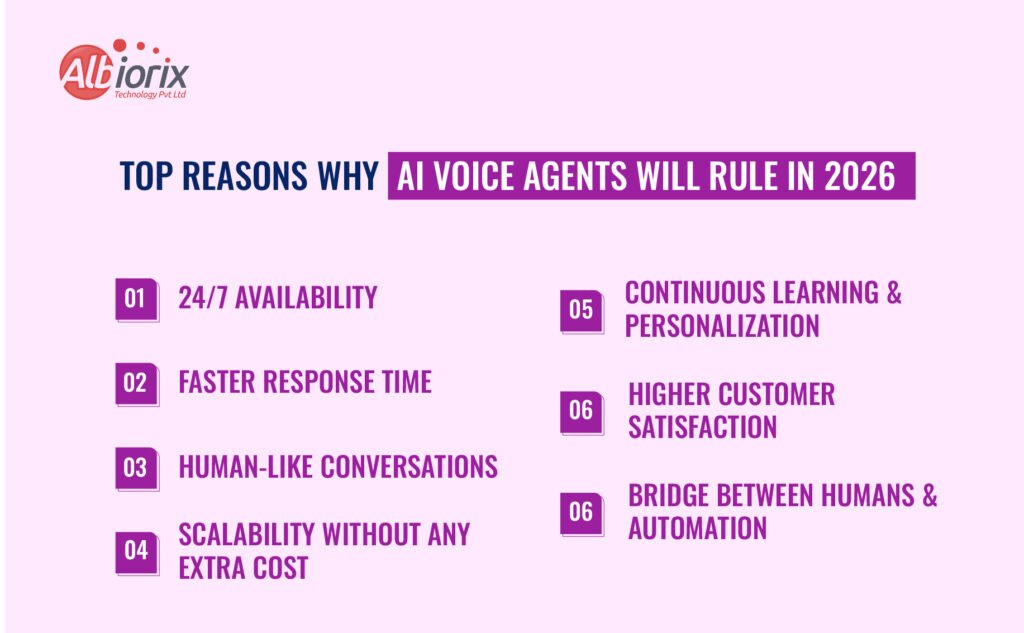
According to AI voice agent development companies, here are the top reasons why voice-activated AI assistants will dominate in 2026: 

  1. 24/7 Availability: It is one of the biggest advantages of AI voice agents. It can work tirelessly with the same productivity and efficiency. They also don’t need any breaks during working hours. AI voice agent platforms are always available to assist customers, whether it’s day or night.   
  2. Faster Response Time: According to a study, it is found that AI assistance is faster than humans in replying to queries and questions. This faster reply time reduces the average handling time by up to 40%. This faster reply directly boosts customer satisfaction and overall operational efficiency.     
  3. Human-like Conversations: AI voice agents are much more advanced than IVR systems and AI chatbots. It can easily mimic human-style conversation. AI voice agents allow people to speak naturally and get instant answers. The way talking feels like you are talking to a human on the other side.  
  4. Scalability Without Any Extra Cost: An AI voice agent platform can scale up easily with increasing requirements. If a business has an AI voice agent for customer support automation, then there is no need for them to hire new customer support executives. AI voice agents will automatically handle the high volume of calls at any time, without compromising service quality.     
  5. Continuous Learning & Personalization:  AI voice agents are very intelligent and smart. They keep learning new things from their past conversations and patterns. In this way, it keeps evolving and improving itself to offer better customer care services.    
  6. Higher Customer Satisfaction: According to the latest survey by Accenture, the companies that are using AI-driven automation in customer service have happier and satisfied customers. It is because the AI voice agent platform offers an instant solution to their queries. It also increased the operational efficiency by 30-35%.    
  7. Bridge Between Humans & Automation: Artificial intelligence combines the best of both worlds — human-like empathy and machine-like efficiency. This creates a seamless customer support experience that is fast, precise, and frustration-free.    

It’s 2025, and AI voice agents are constantly evolving. It is getting better with every passing day. It is becoming more intelligent, smarter, and faster. With 2026 around the corner, AI voice agent platforms are expected to deliver smarter customer services while maintaining a high level of customer satisfaction.   

List of Top Voice-activated AI Assistant Features in 2026  

Are you planning to develop a custom voice-activated AI assistant in 2026? If so, then you should contact an expert AI voice agent platform development company with prior experience in building such unique AI solutions.    

If you are trying to build an AI voice agent on your own or partnering with an AI development company nearby, don’t forget to integrate these features into your AI voice agent solution.   

  1. Hand-free Operations: This feature allows users to perform tasks without touching a screen or keyboard. This feature makes an AI voice agent highly convenient while doing other day-to-day tasks.    
  2. Natural Language Understanding (NLU): It is the second most important feature in AI Voice Agents in 2026. Your AI agent must not only understand the language, but it must be capable of understanding the intent and context behind a query.    
  3. Real-Time Responses: An AI voice agent platform must be capable of answering the questions/queries instantly. No matter what the topic of the query, it must be capable of replying in real-time with no wait time.    
  4. Personalization: Your AI voice agent must have a feature that allows it to provide personalized responses and recommendations to the users. It must keep learning new things from past conversations.    
  5. Multi-Language Support: Your AI assistance must be able to understand and reply in different languages. In this way, you can easily assist your global customer base.  
  6. Integration with Apps & Services: AI voice agents must be multitasking – they should be able to control smart home devices, calendars, events, or even make online purchases. Voice-activated AI assistants can be integrated with a wide range of platforms.    
  7. Voice Biometrics & Security: Your AI voice agent must be capable of voice recognition to authenticate users. This feature offers a secure and contactless login facility to users.    
  8. Task Automation: A modern AI voice agent platform must be capable of performing tasks on voice commands. It should be able to perform tasks such as setting reminders, booking cabs, searching for flight tickets, ordering food, etc., through voice commands. Also, it must be smart enough to automate repetitive tasks.     
  9. Continuous Learning: Your AI assistant must be capable of learning new things from past interactions. The feature of continuous learning will help it evolve and offer refined answers to the users.   
  10. Seamless Omnichannel Experience – Advanced AI voice agents can work across multiple devices (smartphones, smart speakers, cars, and wearables), offering a consistent user experience. 

Future-Proof Your Customer Support with AI

2026 is the era of AI-driven customer support. Don’t get left behind — build a next-gen AI voice agent with us.


Contact us

AI Voice Agent Platform Pricing in 2026 

Whether it’s software development, website development, or AI voice agent development in 2026, one of the most common questions that haunts every business is the development cost. Every one of you might wonder what the cost of AI voice agent development is in 2026? Even some of you might have asked Google: “How much does it cost to develop an AI voice agent platform in 2026?”   

Like any other digital solution, the overall cost of development depends on many factors. So, for you, let’s break down the development cost of AI voice agents in 2026:   

  1. Complexity of Features: If you want to develop a basic or simple AI voice agent, then it will cost you less. However, if you need an advanced voice agent with personalisation and other features, then it will cost you a lot.    
  2. Technology Stack: If you are using the existing APIs like Google Dialogflow CX or Amazon Lex, then your development cost will be less. But if you decide to build a completely custom AI engine, then it will cost you a lot.   
  3. Integrations: If you are integrating payment gateways or any third-party apps, then the development cost may rise high.   
  4. Deployment Scale: If you want to deploy an AI voice agent on a small business, then it will cost you less. However, if you want to deploy on a large enterprise, the cost may increase.   
  5. Security & Compliance: There are some industries, such as healthcare and finance that need high-level security and industry compliance. The development cost for such industries is usually higher.

Estimated Pricing for 2026: 

  1. Basic AI Voice Agent: $15,000 – $25,000 
  2. Mid-level Custom AI Voice Agent (with integrations & NLP): $30,000 – $60,000 
  3. Enterprise-Grade AI Voice Agent Platform: $70,000 – $120,000+

Businesses should also consider ongoing maintenance costs, cloud hosting charges, and AI model training expenses. 

How to Build an AI Voice Agent Platform?  

The use of an AI voice assistant is not limited only to customer support services. It can be implemented in a wide array of business processes and can benefit from it. So, if you are planning to build a personalized AI voice agent for your business, then here are some of the most common steps to follow.   

  1. Define the Purpose: At the time of custom AI agent development, the first thing that you must remember is the purpose. Why do you want to develop an AI assistant? What sort of tasks do you want to get done with the help of an AI voice agent? Based on the purpose, you can start the development process.    
  2. Choose the Right Technology: It is very important to choose the right technology to develop a custom AI voice assistant for your business. A voice agent works on three basic steps: listening, understanding, and replying. Therefore, you must choose the right AI technologies for the success of your AI voice agent.   
  3. Design smooth conversations: A good AI voice agent is the one that feels and sounds natural. And, to ensure this, you have to create a user-friendly conversation flow for your AI voice assistant. This smooth flow ensures that the customers don’t get frustrated or stuck amid the conversations.   
  4. Integrate with Business Systems: To ensure your developed AI voice agent is yielding the desired benefits for your business, connect it with your CRM, booking system, or payment gateway. When you connect the AI voice agent with your system, it not only talks but also takes action.    
  5. Ensure Security & Privacy: When you build a custom AI voice assistant for your business, ensure its safety from hacks and other online threats. Safety of the AI voice agent is the primary concern in 2026 because it will handle your sensitive information (like personal and financial) and add this information to its storage. Thus, to ensure the protection of the sensitive information, your AI voice assistant must be safe and secure.  
  6. Test and Improve: Once your AI voice agent is developed, it’s time to test it with real life scenarios. The more you test your voice agent, the better it will get with time. Periodic testing and updates will refine it for better conversations and higher customer satisfaction. 

AI voice agent development is a tricky job. It is the perfect blend of the latest technologies and thoughtful designs. However, it becomes easy when you find the right AI voice agent platform development company. To know the overall cost of AI voice agent development, please feel free to contact us.

Best AI Voice Agents for Call Centers in 2026

AI Voice Agents for Call Centers

When it comes to the adoption of AI voice agents in 2025, call centres across the world are at the forefront. It is because tailor-made AI voice assistants are faster, smarter, and cost-effective. Moreover, compared to traditional voice assistants like IVR and AI chatbots, AI voice agents guarantee a higher customer satisfaction ratio. These smart and intelligent custom-made AI voice agent platforms are not only reducing the call-handling time, but they are also serving customers with better efficiency and accurate solutions.    

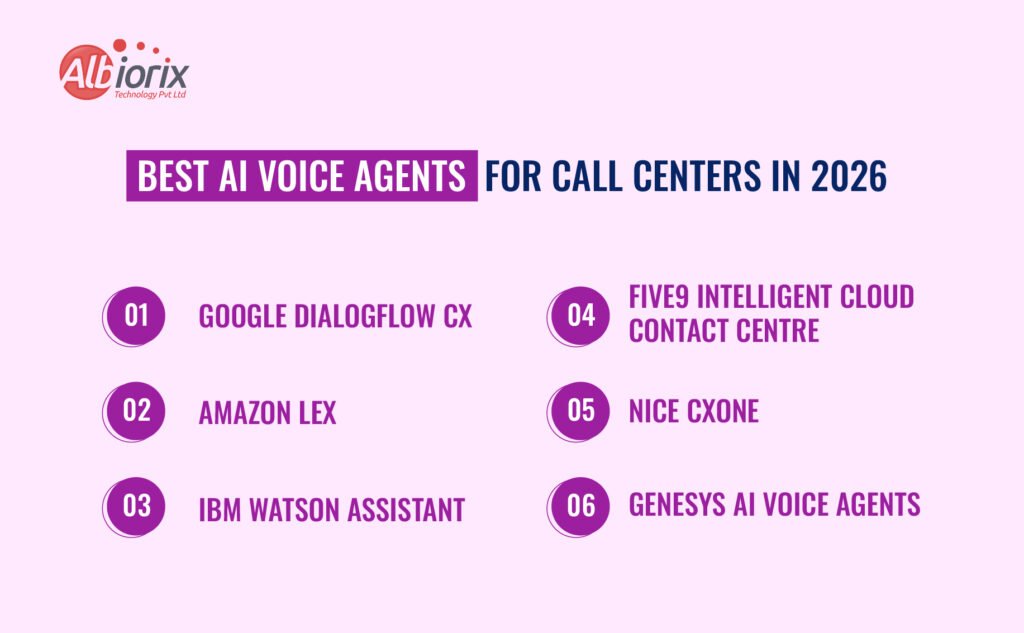
With so many call centres using AI voice agents for customer support automation, which are the best AI voice agents for call centres in 2026? Based on their adoption, usage rates, user-friendliness, and future trends, we have shortlisted the top AI voice agents that will rule the space in 2026.    

  1. Google Dialogflow CX: Owned and managed by Google, Dialogflow CX is the number one and best AI voice agent for customer support automation in 2026. This AI-powered voice assistant is designed to handle enterprise-level call centers. It is powered with all the latest AI technologies, like natural language understanding (NLU), multilingual support, and seamless integration with a telephony system. Google Dialogflow CX allows organizations to offer human-like conversations across channels.
  2. Amazon Lex: After Google’s Dialogflow CX, the second-best AI voice agent is Amazon Lex. This AI voice agent platform is built on the same technology stack that powers Alexa. This AI voice agent is used by call centers to automate and manage tasks such as bookings, order tracking, solving customer queries, and other simple day-to-day tasks. Amazon Lex can be integrated with AWS services for scalability.
  3. IBM Watson Assistant: This AI voice agent platform by IBM is characterised by its robust AI and amazing machine learning capabilities. Watson Assistant helps call centers to create personalized, context-aware conversations. This AI voice agent is designed to easily integrate with the existing CRM systems and call center software to offer smooth workflows and better resolutions.
  4. Five9 Intelligent Cloud Contact Centre: This AI voice agent platform is purposely designed and developed for call centers. With predictive AI, sentiment analysis, and real-time assistance, it enhances both customer and agent experiences while reducing costs.
  5. NICE CXone: It is one of the leading AI voice agent platforms in the customer experience space. Nice CXone offers AI-driven voice agents that focus on intelligent routing, quick resolutions, and automation of repetitive tasks. It is a perfect fit AI solution for large-scale call centers because of its analytics-driven approach.
  6. Genesys AI Voice Agents: This AI voice agent comes with a combination of conversational AI and omnichannel capabilities. This rare combination allows call centers to deliver consistent and personalized customer services across voice, chat, and digital platforms.

The above-listed are the top and best AI voice agents for call centers in 2026. These voice agents are expected to reshape and revolutionize the way businesses interact with their customers. If you are a call center or an organization looking for an AI voice agent platform, consider trying one of these solutions.   

However, if you have a plan to develop a custom AI voice agent platform with unique features and workflows, get in touch with the AI development experts at Albiorix Technology. 

Comparison of Top AI Voice Agents Platform of 2025

Sr. NoAI Voice Agent PlatformKey FeaturesBest For
1Google Dialogflow CXAdvanced NLU, multilingual support, seamless telephony integrationEnterprises needing scalable, global customer support
2Amazon LexBuilt on Alexa tech, AWS integration, supports chat & voiceCall centers wanting flexibility and easy integration with cloud apps
3IBM Watson AssistantContext-aware conversations, CRM integrations, strong analyticsBusinesses looking for personalized and AI-driven customer experiences
4Five9 Intelligent Cloud Contact CenterPredictive AI, sentiment analysis, real-time assistanceCall centers aiming to boost agent productivity and reduce costs
5NICE CXoneIntelligent routing, automation of repetitive tasks, analytics-drivenLarge-scale operations requiring advanced automation and reporting
6Genesys AI Voice AgentsOmnichannel capabilities, conversational AI, personalizationCall centers that need consistent customer service across multiple platforms

Empower Your Business with AI Voice Agents

Whether you want to integrate top AI voice agents into your CRM or develop a custom solution from scratch — we’ve got you covered.


Talk to Our Experts Today!

AI Voice Agent Integration with CRM Systems – An Expert Guide  

Are you planning to integrate an AI voice agent with your existing CRM system to supercharge customer service? But don’t know where to start? Don’t worry, expert help is here.   

Here is the simple step-by-step guide to follow:   

  1. Choose the Right AI Voice Agent: The first step is to find the right AI voice agent platform based on your business requirements and workflows. You can probably go with Google’s Dialogflow, Amazon Lex, or IBM Watson.   
  2. Connect to Your CRM: Most CRM systems, such as Salesforce, HubSpot, or Zoho, have APIs or ready-made connectors to integrate AI voice agents. Once you connect the AI voice agent, it will access your customers’ profiles, past interactions, and preferences. If you are facing any issues, contact the customer support services.    
  3. Map Customer Data: After the AI voice agent is integrated successfully with your CRM system, define what customer information the voice agent will use – such as names, order history, support tickets, etc. Based on the information you allow it to access, it will personalise the responses.      
  4. Automate Key Tasks: Set up the AI to perform simple tasks such as logging calls, updating records, scheduling appointments, or raising support tickets.   
  5. Test the Integration: Once all the connections are established properly, it’s time to test. During the trial, ensure the AI voice agent is retrieving all the details correctly and updating the responses in the CRM correctly.    
  6. Train & Improve: Over time, monitor performance and refine responses so the AI delivers smoother, more accurate experiences.   

Businesses can achieve faster resolutions, better personalization, and a seamless customer experience by integrating voice AI agents with their CRM systems. You can integrate AI voice agents on your own, and if you are facing any issues, you can take the help of companies like Albiorix Technology for help and support.

Best AI Voice Agent Development Company

Best AI Voice Agent Development Company | Albiorix

If you are a business planning to give a boost to your customer support services with the use of an AI voice agent platform, then the time is right. There are many voice AI agents that can fit your business criteria and budget. However, instead of off-the-shelf options, if you are planning to develop a custom AI voice agent platform, then there’s no better option than Albiorix Technology.    

Albiorix Technology is an AI voice agent development company with hands-on experience in building custom AI voice assistants for businesses. As a professional Voice AI development company, we will not only develop an AI voice agent platform for your business, but we will also ensure smooth integration with your existing CRM systems. From designing AI voice agents to deploying them, we are your one-stop AI development company. We focus on building secure, user-friendly platforms that grow with your business needs.   

We take pride in being among the trusted AI voice agent development companies in India, Australia, and the US. With years of experience in AI-driven solutions, our AI experts have successfully designed and developed a fully functional AI voice agent platform for our clients. Our AI solutions have enabled them to automate customer support and improve efficiency. From concept to deployment, we bring technical expertise, creativity, and a customer-first approach to every project.   

If you are looking to build or integrate an AI voice agent for your business, our team is here to help you every step of the way. Let’s create smarter, faster, and more human-like customer experiences together.