




Generative AI Development: A Ultimate Business Guide to GenAI Solutions in 2026

Summary: A Generative AI Development Company helps businesses build custom GenAI solutions that automate workflows, enhance productivity, and reduce development costs. In 2026, partnering with the right AI development company is essential for achieving long-term digital growth and operational efficiency.

Generative AI Development Company

Well, it’s 2026, and we are officially into the era of Generative AI. It is no longer a fancy word used by a top AI development company in the USA or India, nor is it a futuristic concept discussed in innovation labs somewhere in Germany or the UK.

It is real, and it is transforming the entire digital landscape. It is all around us and marks a thumping impression.

Generative AI is transforming how businesses operate, how new products are developed, and how customers are served more efficiently.

GenAI tools are used in many ways, including creating personalized content, developing marketing strategies, automating workflows, and assisting customers more efficiently without human intervention.

In short, it is transforming how businesses operate, innovate, and compete.

With the accelerated use of GenAI tools and software, businesses have realized that for higher efficiency and productivity, they cannot simply rely on standard and traditional GenAI tools offered in the market.

To achieve desired business goals in the long term, they must invest in Generative AI tool development, and it is possible only if they partner with an experienced Generative AI development company somewhere in India or the USA.

In this blog on GenAI Development Companies, we will thoroughly discuss different aspects of GenAI, GenAI apps, and how to find the right generative AI development companies that can help your business scale, even in the time of tough competition.

What is a Generative AI (GenAI)?

Well, there’s a lot of talk about the uses of Generative AI in different business operations, but what it is exactly – “What is GenAI”?

In easy-to-understand words, Generative AI (GenAI) is a branch of Artificial Intelligence systems that is used to create new content, including text, images, code, audio, video, and even synthetic data.

It can understand prompts, context, and intent to produce meaningful, high-quality, and original results in seconds.

Ready to Build Smarter with Generative AI?

Let’s build scalable GenAI solutions that give you a competitive edge in 2026 and beyond.


Contact us!

What are the Uses of Generative AI (GenAI)?

The use of GenAI in 2026 is seen across a wide range of business applications. For instance, when it comes to marketing, businesses can use generative AI to create personalized marketing campaigns, product descriptions, and social media captions.

Similarly, when it comes to custom software development, it helps software developers by writing code, debugging, and speeding up the development cycles.

There are many uses of GenAI in 2026, as it can be tailored to meet business requirements and long-term goals.

From automating repetitive tasks to enhancing creativity and decision-making, GenAI is becoming an integral part of modern business operations through intelligent automation systems.

Why Is GenAI So Popular in 2026?

GenAI is very popular among businesses because of its speed, scalability, and cost efficiency. With the increasing competition, businesses are under constant pressure to innovate faster at a lower development cost, and this is where GenAI comes to escape.

GenAI delivers at both fronts – it allows developers to do more with limited resources, reduce development time, reduce development expenses, and unlock new revenue opportunities.

Many enterprises are already seeing measurable results in how they reduce development cost using AI-driven workflows.

With the use of generative AI, a business can experience tangible productivity gains and competitive advantages.

Thus, due to these reasons and benefits, GenAI is popular among startups, mid-sized businesses, and large organizations across global markets.

Which Industries are Leveraging out of Generative AI Solutions?
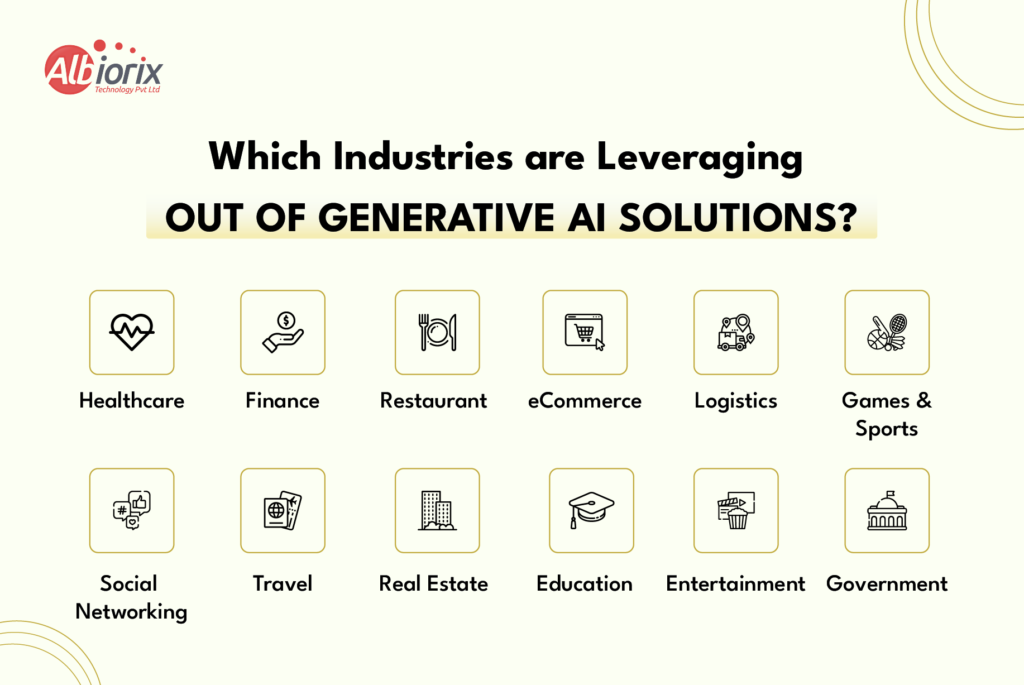
Industries that Leveraging Generative AI Solutions

One of the main reasons why Generative AI is getting popular is that it is no longer limited to tech companies. It is now integrated into daily operations across traditional and emerging industries.

GenAI is widely used to automate documentation, offer personalized customer services, automate repetitive tasks, and much more. Here’s how different sectors are using GenAI and the most common tools for driving adoption.

  1. Healthcare: Doctors, hospitals, and health-tech companies are at the top of the list when it comes to the use of generative AI. They use GenAI for clinical documentation, medical research summarization, patient communication, and diagnostic support through advanced AI healthcare software solutions.
  2. Finance: The use of GenAI in Fintech is also widespread. Banks and finance companies are using generative AI for fraud detection insights, automated reporting, risk analysis, and AI-powered customer assistants. The most common platforms used by them are Bloomberg (BloombergGPT) and Microsoft Copilot.
  3. Restaurant: The use of GenAI in restaurants is also very common. It is used for menu optimization, demand forecasting, generating marketing content, and AI chatbot integration to enhance customer engagement.
  4. eCommerce: When it comes to the use of Generative AI in the eCommerce industry, online retailers are not left behind. GenAI is used to generate product descriptions, get personalized recommendations, offer automated customer support services, and set dynamic pricing. The most common tools used are Shopify Magic and AI search powered by Adobe.
  5. Logistics: Most of the logistic companies are using GenAI to route optimization insights, predictive demand planning, and automated documentation. AI capabilities integrated within SAP and IBM platforms are widely used.
  6. Games and Sports: In the games and sports industry, GenAI is used to design games, create realistic characters, analyze matches, and find fan engagement content through advanced AI game development models.
  7. Social Networking: In social networking, GenAI is used for content moderation, generating captions, algorithm recommendations, and AI-generated filters. The social networking giants like Meta integrate generative AI to increase user engagement.
  8. Travel: The generative AI is used for itinerary planning, chatbot booking assistants, personalized recommendations, and automated customer communication using modern AI voice agents.
  9. Real Estate: Real estate firms use GenAI for virtual property descriptions, automated valuation insights, and AI-driven marketing campaigns. CRM and AI integrations within Salesforce help streamline client communication.
  10. Education: Educational institutions leverage GenAI for personalized tutoring, content creation, curriculum design, and automated grading systems. AI solutions powered by OpenAI and Google are widely adopted.
  11. Entertainment: Media and entertainment companies use GenAI for scriptwriting assistance, video editing, music generation, and digital avatar creation. Creative tools from Adobe and AI research from NVIDIA are shaping content production.
  12. Government: Public sector organizations apply GenAI for citizen service automation, policy documentation drafting, data analysis, and fraud detection. Enterprise AI solutions from IBM and Microsoft are commonly deployed.

Across industries, generative AI tools are becoming embedded in everyday workflows — not just as automation software, but as intelligent systems that enhance decision-making, productivity, and customer experience.

Top Tech Stack Used for Generative AI Solution Development

  1. Deep Learning Frameworks: Tensor Flow, PyTorch, Keras, Caffe, MXNet, DeepLearning4j Chainer, and Theano.
  2. Modules & ToolKits: OpenAI GPT, OpenAI DALL-E, NVIDIA  StyleGAN, NVIDIA NeMO, Fast.ai, DeepMind Sonet, and AllenNLP.
  3. Generative AI Models: GPT 3, GPT 4, DALL-E, VQ-VAE, VAE, WaveGAN, DeepDream, DeepArt, and Pix2Pix.
  4. Neural Networks: RNN, CNN, GAN, VAE, Transformers, LSTM Networks, RBM, DBM, and DRLN.
  5. Libraries: TensorFlow, PyTorch, Keras, OpenAI Gym, Theano, Caffe, MXNet, and Fast.ai.
  6. Image Classification Models: AlexNet, VGGNet, ResNet, Inception, MobileNet, DenseNet, Xception, and GoogLeNet.

Which AI Models Used to Develop Generative AI Solutions?
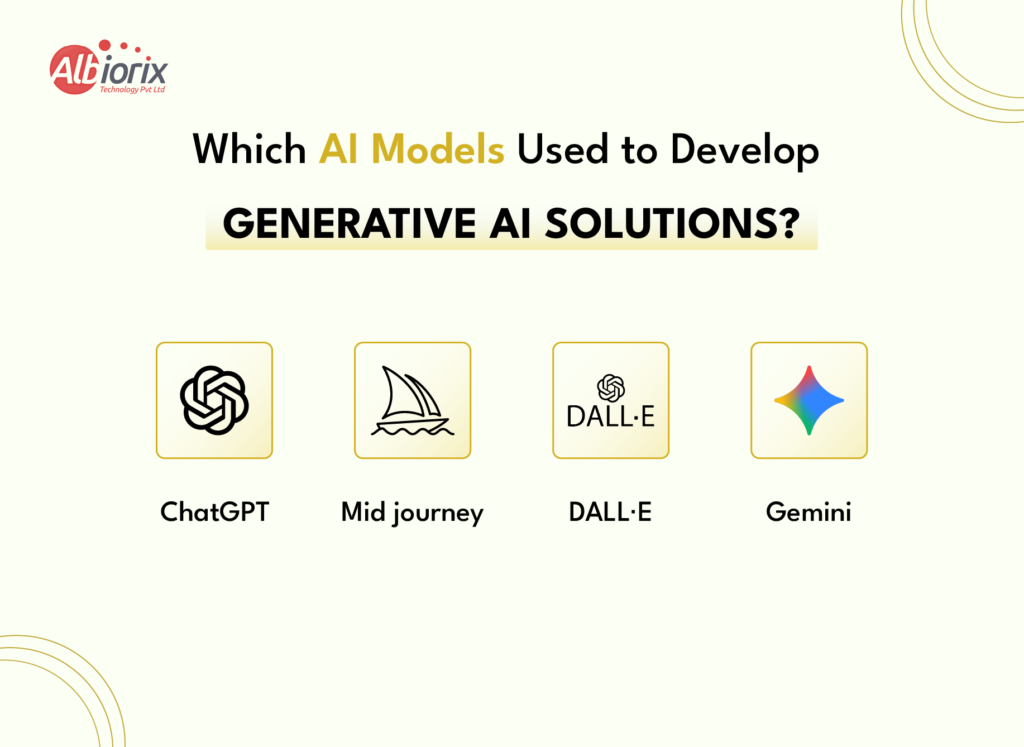
AI Models that Used to Develop Generative AI Solutions

Most generative AI development companies across the world are using some of the top-rated AI models to develop generative AI solutions for businesses.

These AI models help them build efficient and scalable GenAI business solutions that unlock new possibilities for automation, innovation, and personalization.

Most Common AI Models Used in 2026:

  1. GPT: Generative AI development companies integrated GPT3, GPT3.5, and GPT4 into business applications to create conversations, build smart and self-evolving chatbots, and enable natural language processing.
  2. Midjourney: It is an AI-powered image generator. Generative AI development services integrate Midjourney into existing systems of a business to allow them to enhance their creative journey. This GenAI integration allows them to create visually appealing and engaging images.
  3. DALL-E: A Generative AI Development company with expertise in DALL-E, assists businesses by integrating this AI model into their system so that they can create plausible images. It allows businesses to create original and engaging visuals.
  4. Gemini: Gemini is an intelligent AI-powered chatbot powered by LaMDA. With the use of this AI model, businesses can enhance user experience for their clients. Integrating the Gemini AI Model allows them to offer highly personalized and around-the-clock support services.

Top 4 Benefits of Generative AI Development for Your Business

  1. Increased Automation: Generative AI business solutions are known for increasing automation across various aspects of a business. AI-driven automated tools can easily handle repetitive tasks so that your team can be allocated to other productive work. GenAI automated solutions keep you ahead of the competition.
  2. Increased Productivity: GenAI can be used to boost the productivity of your existing team. The generative AI tools help in faster data analysis, decision-making, streamlining workflows, and resource allocation. It will help you achieve more in less time.
  3. Cost Optimization: When you use GenAI tools to automate tasks, reduce errors, and improve efficiency, your overall operational cost is reduced. Enterprises adopting AI-driven ERP systems are already experiencing how AI reduces ERP costs by 30% significantly.
  4. Enhanced Creativity: With the use of the latest GenAI tools, you can boost your creativity to the next level. You can create fresh images, original content, marketing ideas, and business development roadmaps with the help of GenAI solutions.

Generative AI Security Risks Businesses Must Know

Just like the two sides of a coin, along with the positive points, there are also some side effects of generative AI. With the use of GenAI solutions, generative AI security risks have also risen in 2026.

According to the data available on the web, more than 70% of the businesses reported an AI-related security incident in 2024.

Development isn’t just about building; it’s about protecting. See our latest Generative AI Security Risks Guide to secure your enterprise deployment.

The top 5 most common AI Security Risks are: 

  • Prompt Injection Attacks
  • Data Leakage and Model Exposure
  • Malicious AI-generated Code
  • Hallucinations Leading to Security Failures
  • Software Supply Chain Vulnerabilities

What Services Does a Generative AI Development Company Offer?
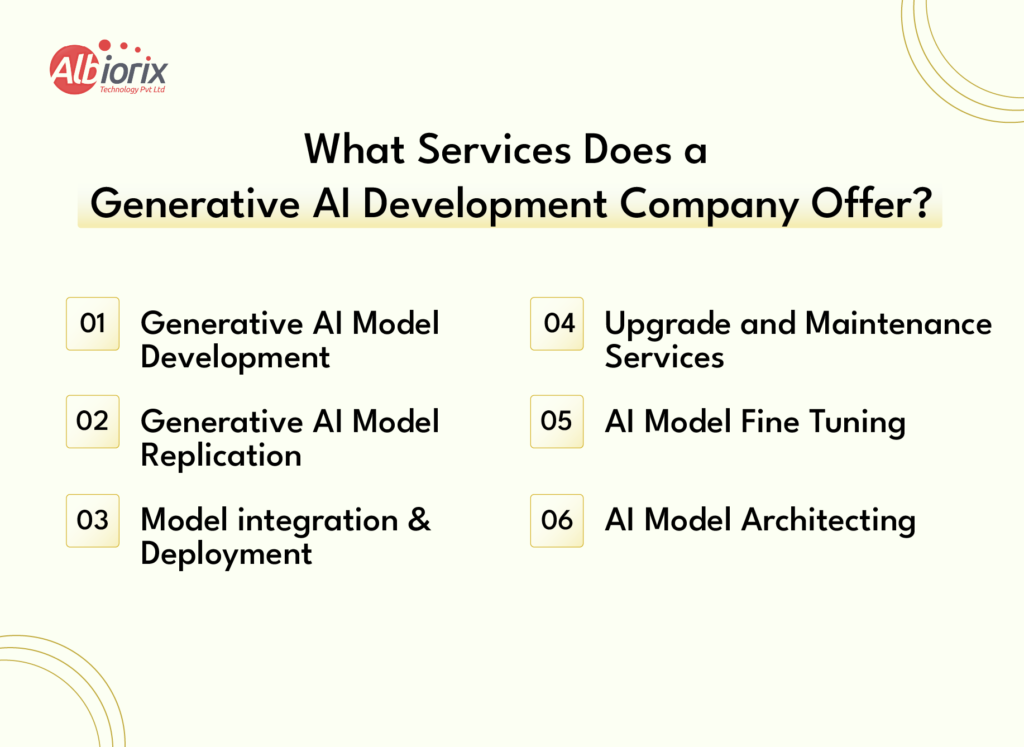
What Services Does a Generative AI Development Company Offer

Top Generative AI Development Services:

  1. Generative AI Model Development: Most AI development companies in India and the USA use machine learning algorithms to develop custom generative AI solutions as per the business requirements. They carefully configure and train these GenAI models to ensure high-quality outcomes.
  2. Generative AI Model Replication: Under the hood of Generative AI development services, some companies offer generative AI model replication services. They develop replicas of the top and most popular AI models, such as ChatGPT and DALL-E. This generative AI modelling service helps businesses with new business opportunities.
  3. Model integration and Deployment: An experienced AI development company integrates and deploys an AI model as per the business requirements. They carefully analyze your business requirements, long-term business goals, and targeted audiences to suggest the most suitable AI models.
  4. Upgrade and Maintenance Services: GenAI development companies also offer AI model upgrade and maintenance services. The sole purpose of these services is to help you stay ahead in the competitive market. They have a team of skilled GenAI developers to optimize the performance of your existing AI models/solutions.
  5. AI Model Fine Tuning: Generative AI development services are also used to fine-tune and optimize the existing AI models. By doing this, an AI model can adapt to the changing or domain-specific use cases and data sets. AI model fine-tuning and optimization improve accuracy and efficiency.
  6. AI Model Architecting: The team of generative AI developers can be hired to design and architect a new AI model for your business. It allows businesses to select a suitable neural network architecture and optimize hyperparameters.

What is the cost of generative AI development in 2026? 

Most businesses want to invest in generative AI development, but most of them are concerned about the cost of AI development.

The cost of generative AI development depends on many different factors. The initial investment may seem high at the moment, but in the long run, it will turn out to be a beneficial business decision.

AI Development Cost by Project Type: 

  1. AI Chatbot / Assistant: It may cost from $10,000 to $80,000
  2. Computer Vision System: It may cost from $30,000 to $200,000
  3. NLP / Text AI Solution: It may cost from $20,000 to $150,000
  4. Predictive Analytics: It may cost from $15,000 to $100,000
  5. Generative AI App Development: It may cost from $25,000 to $300,000

The above-mentioned is just a high-level and approximate. Cost of AI development. For the exact cost of custom AI development, get in touch with our team of AI engineers at Albiorix Technology.

Why is Albiorix the Best Generative AI Development Company?
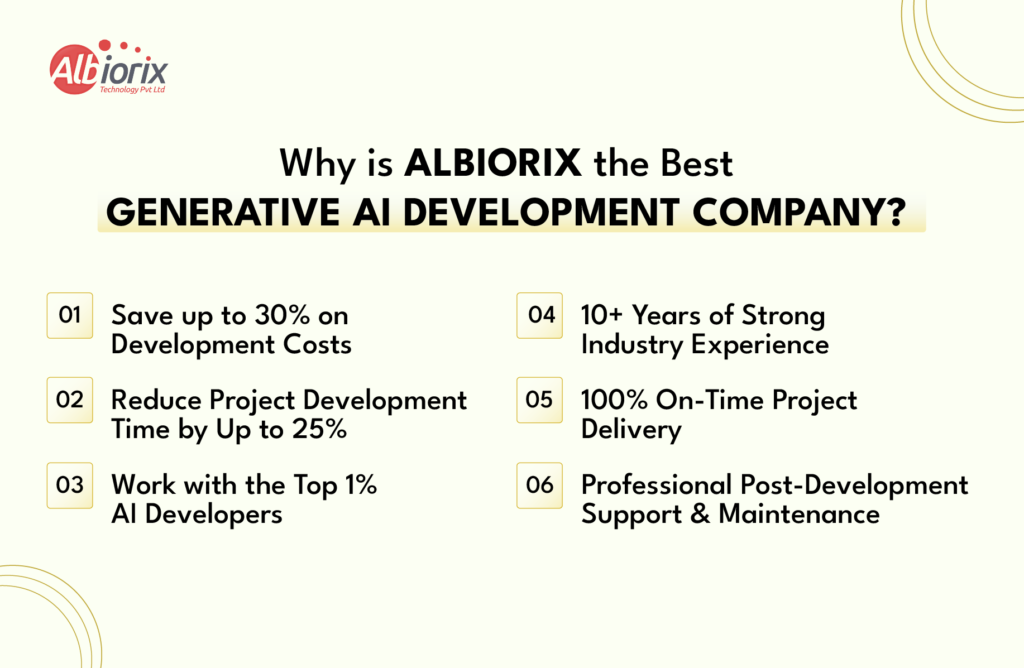
Why is Albiorix the Best Generative AI Development Company

In the era driven by Artificial Intelligence, choosing the right generative AI development services is extremely crucial for your business. It will decide the success and failure of your digital transformation journey.

Whether you are a startup looking to explore the potential of GenAI for the first time or an established brand looking to scale intelligent automation, you need more than just a team of generative AI developers. You need a strategic technology partner in the form of a generative AI app development company.

As an experienced Generative AI development company in India, we focus on delivering measurable business outcomes to our clients from Australia, the UK, Germany, and the USA. Here’s what makes us the most suitable AI development company for your business requirements:

  1. Save up to 30% on Development Costs: Our optimized AI development frameworks, reusable components, and strategic implementation approach help you significantly reduce overall development expenses without compromising on quality or performance.
  2. Reduce Project Development Time by Up to 25%: With streamlined workflows, agile methodologies, and AI-accelerated engineering practices, we ensure faster deployment so you can enter the market ahead of competitors.
  3. Work with the Top 1% AI Developers: Our team consists of highly skilled AI engineers, data scientists, and solution architects who bring deep expertise in GenAI models, LLM integration, and enterprise-grade AI solutions.
  4. 10+ Years of Strong Industry Experience: With over a decade of hands-on experience in AI and advanced technology development, we understand industry-specific challenges and deliver solutions aligned with real-world business needs.
  5. 100% On-Time Project Delivery: We follow structured project management frameworks and transparent communication processes to ensure every milestone is delivered as committed — without delays.
  6. Professional Post-Development Support & Maintenance: Our commitment does not end at deployment. We provide ongoing optimization, model fine-tuning, monitoring, and technical support to ensure your AI systems continue to perform at peak efficiency. 

If you are looking for scalable AI-powered systems, advanced AI voice agent developers and intelligent business automation experts can help you achieve your digital goals faster.

We are ready to help you build scalable AI solutions that drive real growth.

Conclusion

If you are a business that wants to stay competitive, offer your customers better services, and increase your ROI, then generative AI development is worth considering. To explore how it can fit into your strategy, Contact Us for expert consultation and next steps.

Most businesses in the USA, Australia, and the UK have already developed custom AI solutions or are planning to invest in generative AI development services.
AI Agents vs Traditional Automation: What Is The Best Difference?

Some years back, the definition of Automation was eliminating tedious and repetitive tasks. But in 2026, the definition of automation has completely changed. With the technological revolution in every field and industry, automation is all about intelligence, adaptability, and real-time decision-making.

Partnering with an experienced AI Development Company can help organizations identify the right processes to automate, ensuring smarter, data-driven operations. Most businesses are automating many tasks and operations, but many of them are also confused about which tasks to automate to increase operational efficiency and productivity.

Traditional automation tools, including scripted bots, think RPA, and macros, are very popular among organizations in 2025. These automation tools have helped businesses in increasing efficiency and productivity. But with the arrival of Artificial Intelligence, traditional automation tools are now being replaced by smart, intelligent AI Agents. The latter are the new favorites of businesses across the globe because of their ability to learn, automate, and evolve on their own.

So, it’s 2026, and if you want your business to stay competitive and future–ready, then you have to understand the core difference between AI Agents Vs Traditional Automation. You have to understand the key difference and what’s the best option for your business.

In this blog post on AI Agents vs Traditional Automation, we will cover all the important topics, including AI-powered software solutions, adoption trends, and use cases that define the new era of intelligent automation.

What is Traditional Automation?

Definition of Traditional Automation:

Traditional automation is a rule-based system or bots that follow predefined instructions to complete repetitive and structured tasks. These tasks include data entry, invoice processing, report generating, and much more. The sole purpose of the traditional automation was to boost the operational efficiency and accuracy of any operations without or with minimal human intervention.

For many decades, traditional automation has been the backbone of many business processes. It helped businesses increase efficiency and productivity with fewer efforts and without constant monitoring. Some of the most used traditional automation forms were Robotic Process Automation, Rule-based Scripts, Macro-driven Tasks, Scheduled Batch Jobs, and Workflow Engines.

What Traditional Automation Does Well?

  • Traditional Automation automates repetitive, structured, and rule-based tasks.
  • Traditional Automation reduces errors and delivers consistent outputs.
  • Traditional Automation is faster than manual operations or human interventions.
  • Traditional Automation easily integrates with legacy software systems to remove manual steps.
  • Traditional Automation helps in cost reduction.

What are the Limitations of Traditional Automation?

Traditional Automation was extremely helpful to businesses, but it too had some limitations. Below are some of the most common limitations in the era of digital revolution:

  • Rigidity: In traditional automation tools, automation rules are hard to code. Therefore, any change in the input format or the exception path required manual intervention or reprogramming of the entire code.
  • No Learning: Traditional Automation tools do not learn from past behaviors. If there are any changes in the conditions or the required outputs, you need to update the software and workflows manually.
  • Limited to Structured Data: Most traditional automation software worked on fixed fields with formatted documents or APIs. Any unstructured text, image data, voice, or contextual understanding remained unsupported.
  • Heavy Maintenance: When a business grows or requires a change in the process, a traditional automation tool/software requires maintenance. It increases cost and often leads to delay.
  • No Real-time Decision: Traditional Automation tools and software normally work on predefined instructions via code. It cannot dynamically adjust to new incoming patterns, context or feedback loops.

Traditional Automation is the best for high-volume repetitive tasks. But, if you are a business with rapid changes in workflows, higher customer expectations, and regulatory shifts, then you need modern and adaptive AI automation tools – AI Agents.

Are you confused between AI Automation and Tradational Automation?

Talk to our expert team of AI developers to discover which solution best fits your goals and future growth. Book a free consultation today


Call now!

What Are AI Agents?

Definition of AI Agents:

An AI Agent is an intelligent software system that can understand context, learn from data, make decisions on its own, and act autonomously without any major human intervention. AI Agents are completely different from traditional automation tools/software. They can adapt to changes, handle complex or unstructured information, and keep improving from past experiences.

Powered by Artificial Intelligence, AI Agents are the next-gen layer of automation. AI Agents not only execute tasks, but it also perceives, reasons, learns, and adapts. It keeps improving itself with every past experience.

Businesses are now combining AI Agents with AI product development initiatives to create adaptive, intelligent enterprise tools that align with business goals.

What AI Agents can do?

Powered by Artificial Intelligence, AI Agent is a software entity that:

  • Understands context
  • Learns over time via data feedback loops
  • Makes decisions autonomously or semi-autonomously
  • Handles unstructured data
  • Communicates naturally
  • Adapts workflows in real time, not just follow static rules

Compared to traditional bots and automation software, AI Agents are designed and developed to evolve over time. Instead of following fixed logic, they can optimize the outcome as per the query.

What are the Core Capabilities of AI Agents?

AI agents are more powerful, scalable, and intelligent compared to traditional automation tools and software. Here are some of the core capabilities that make AI Agents the first choice in 2026:

  1. Adaptive Learning & Feedback Loops: AI Agents keep learning new things; thus, they improve over time. They improve as input data changes or new cases emerge.
  2. Contextual Decision Logic:  – Instead of “if-then” rules only, they can infer intents, handle ambiguous inputs, or escalate intelligently.
  3. Multimodal Data Handling: They might combine ecommerce transaction records with natural language feedback, images, or voice logs.
  4. Conversational Interaction: Instead of rigid structured dialogs, AI Agents can interact via natural-language chat / voice interfaces.
  5. Autonomous Orchestration: Orchestrating across multiple systems (CRM, ERP, email, scheduling) in a dynamic manner.

These capabilities enable AI Agents to go beyond automation → toward “Autonomous Workflows.”

AI Agents vs Traditional Automation — Key Differences

Here is a detailed comparison to highlight what business owners need to focus on:

FeatureTraditional AutomationAI Agents
Decision LogicHard-coded, rule-basedContextual, probabilistic, model-driven
Learning / AdaptationNoneContinuous learning from feedback & data
Data Types SupportedStructured, fixed schemaStructured + unstructured (text, voice, image)
Flexibility to ChangeLow — requires manual updatesHigh — self-adjusts based on inference & feedback
Scalability for ComplexityMedium — good for stable tasksHigh — can handle complex workflows & branching logic
Interaction StyleFixed UI or API triggersConversational / natural language + UI + backend logic
Response to ExceptionsFails or triggers manual interventionCan infer and route intelligently, request clarification, ask questions
Maintenance Over TimeHigh (rule updates, versioning)Lower (models retrained / auto-improve, fewer manual rule changes)
Speed of DeploymentFast for simple tasksSlower up-front due to model-training / design, but faster adaptation later
Governance & Oversight NeedsClear audit trail, easier auditsMore complex (ML explainability, model monitoring, ethics / bias)

Summary: AI Agents are not just a normal automation software or tool with a touch of Artificial Intelligence. They are a completely different approach that combines automation, intelligence, learning, and evolving. It can transform how business processes evolve over time.

Modern AI voice agent platforms are one example of this evolution, offering intelligent and conversational automation capabilities far beyond what traditional bots can achieve.

AI Agents Adoption Trends & Statistics (2025-2026)

AI Agents are becoming the first choice for businesses when it comes to automation. The AI-powered automation tools are not just helping businesses in streamlining operations but are also helping them reduce errors and increase customer satisfaction.

In industries like healthcare automation and IoT-enabled medical systems, AI Agents are revolutionizing workflows — from clinical data handling to predictive diagnostics — reducing human effort while increasing precision.

In 2026, the need for more advanced and intelligent AI agents will boom like never before. To help you understand better, we have collected AI Agents adoption data so that you can understand why AI agents are good for your business, and they are:

AI Adoption & Investment in 2026

  • According to a McKinsey report on AI in the Workplace, 92% of executives expect to increase their spending on AI over the next three years. Also, the same report says that around 55% expect investments in Artificial Intelligence to grow by at least 10%.
  • According to a report published by PwC, nearly 49% of technology leaders say AI is fully integrated into their company’s core business strategy. This report suggests that AI is not just an experimental project but a strategic priority.
  • According to a report by Exploding Topics, 78% of companies are already using at least one AI tool. It means more than 90% are already using AI or planning to adopt it in the near future.

Productivity & ROI Insights on AI Agents

  • According to an online report published by Per Vena Solutions, 54% of businesses that have implemented AI tools report measurable efficiency gains or cost reduction.
  • According to a report by Google (via Reuters-reported pilot), it was found that the use of Artificial Intelligence for administrative tasks saves almost 122 hours every week per worker in the UK pilot. It is potentially contributing to great economic gains.
  • According to the latest report by BCG, 5% of global companies (out of 1,250 surveyed) are currently deriving measurable value from AI investments. Following this, many more companies are planning to integrate AI agents and solutions into their business.

Real-World Use Cases of AI Agents in Business Automation

Real-World Use Cases of AI Agents in Business Automation

The AI revolution in 2025 has taken the business world by storm. Most organizations have already integrated AI agents into one or another business operation and are yielding great results. No matter what the size of your business, AI agents have the potential to improve the efficiency and productivity of your business by 2X.

Top Use Cases of AI Agents include AI in eCommerce for personalized product recommendations and AI in video game development for creating adaptive, player-responsive gaming experiences.

AI Agents are also reducing clinical burden in healthcare software by automating patient communication, data entry, and administrative tasks — freeing doctors and nurses to focus more on care delivery.

Top Use Cases of AI Agents in 2025:

  1. Customer Experience & Support:
    1. Sentiment-aware chatbots: The modern and intelligent AI Agents (AI Voice Agents) can easily detect the tone on the other side of the call. Based on the tone, it can escalate the issue or suggest retention offers.
    2. Automated Follow-up: The futuristic AI Agents (also called AI Voice Agents) can arrange automated follow-up calls based on customer feedback. Based on the past communication, it can predict churn.
  2. Finance & Accounting:
    1. Smart Invoice Verification: AI agents (tools and software) are using OCR + AI logic to flag suspicious invoices. They can also auto-resolve discrepancies.
    2. Fraud Detection: AI-powered tools and software can proactively monitor transaction patterns and flag abnormalities in real time. In this way, it keeps your business protected from any type of fraud.
  3. Supply Chain & Logistics:
    1. Dynamic Route Optimization: AI Agents in logistics are smart enough to adjust routes in real-time based on traffic, weather, delays, and customer priorities. It helps in any major delays, saves money, and increases customer satisfaction.
    2. Predictive Maintenance Agents: There are AI-powered software that constantly monitor equipment sensor data. If they experience any unusual fluctuations, it instantly suggests preemptive servicing.
  4. Human Resources:
    1. Candidate Screening: AI agents in Human Resources are helping companies in screening candidate profiles and scheduling interviews based on the screening. It ensures bias-aware evaluation.
    2. Sentiment Analysis: It also helps companies in analyzing the sentiments of the employees. Based on the sentiment analysis report, the company can decide on retention or training.
  5. Sales & Marketing Automation:
    1. Lead Scoring & Nurturing: AI agents in Sales and Marketing are monitoring lead behavior and triggering personalized outreach.
    2. Content Recommendations: AI-powered software for content writing and email writing suggests strong and powerful email content sequences based on engagement metrics.
  6. Operations/IT:
    1. Categorization & Remediation: AI Agents for Operations and IT triage IT tickets, escalate or even trigger fixes where safe.
    2. Documents and Workflows: There are AI agents for operations that digest regulatory updates and adjust internal policy workflows.

Every use case listed above demonstrates how AI Agents don’t just “execute” — they continuously optimize, learn from outcomes, and integrate with multiple systems. The use cases of AI agents and AI-powered software solutions are way too varied and unique in different industries.

Limitations of Traditional Automation vs AI Solutions

Traditional Automation was helpful to every industry before the arrival of AI solutions. It helped businesses optimize, automate, and streamline their day-to-day operations. However, with the evolution of AI-powered software solutions, companies are less preferring traditional automation because of its limitations.

Here’s a clear, business-friendly comparison table showing the limitations of traditional automation vs AI solutions (AI Agents):

AspectTraditional Automation (Limitations)AI Solutions / AI Agents (Advantages)
Learning & AdaptabilityStatic and rule-based; cannot learn from new data or exceptionsContinuously learns and adapts from data, feedback, and changing scenarios
Data HandlingWorks only with structured data (spreadsheets, forms, databases)Can process both structured and unstructured data like text, images, and voice
Decision-MakingExecutes predefined instructions; no reasoning abilityMakes context-aware, intelligent decisions in real time
ScalabilityDifficult to scale as rules must be manually updated for new casesScales effortlessly across departments with dynamic learning
MaintenanceRequires constant human intervention to update scripts or workflowsSelf-optimizes and reduces maintenance through autonomous learning
Error HandlingFails when input deviates from expected format; requires manual fixesDetects, corrects, and learns from errors automatically
FlexibilityRigid; limited response to changing business processes or conditionsFlexible and adaptive to new business logic, data sources, and user behavior
Business ValueImproves efficiency but limited innovation potentialDrives innovation, agility, and continuous process improvement
Decision SpeedOperates on predefined schedules or triggersResponds instantly using predictive analytics and real-time insights

Is your traditional automation tool falling short of your business needs?

It’s time to upgrade with an expert AI development company. We offer free consultation and a personalized quotation.


Contact us today!

Choosing Between AI Agents and Traditional Automation for Your Business

Choosing between AI Agents and traditional automation depends on your business operations and long-term goals. Traditional Automation might be an affordable solution for your business in 2026. However, if you want to keep your business future-ready, a custom AI solution is highly recommended. Integrating AI-powered business automation tools ensures scalability, intelligence, and adaptability across workflows.

Traditional Automation might be an affordable solution for your business in 2026. In the long run, if you want to keep your business ready for the future, then a custom AI solution is a must. So, integrating AI Agents/software is highly recommended.

Cost Comparison of AI Agents and Automation Systems

There might be a huge difference in the development cost of AI agents and traditional automation systems, but before taking your call, you must think about the future of your business, future trends, and the needs of your customers.

The development cost of a traditional automation tool in 2026 requires lower upfront investment. It also ensures quicker deployment in your existing system. However, in the long run, the overall cost may rise due to frequent updates, limited scalability, and periodic maintenance.

On the other hand, AI Agents’ development cost may involve higher initial setup costs, but they continuously learn and optimize operations, reducing manual intervention and maintenance over time. Their ability to adapt to new workflows and handle complex processes delivers a stronger return on investment (ROI) and greater cost efficiency at scale, especially for businesses aiming for sustainable, intelligent automation in the coming years.

The future of AI Agents in Process Automation in 2026 and Beyond

The future of AI Agents in process automation in 2026 and beyond is about moving from rule-based workflows to self-learning, autonomous systems. AI Agents or AI-powered software solutions will not only execute tasks but analyze, decide, and optimize processes in real time.

Powered by large language models and multimodal AI, they’ll enable self-optimizing business operations, human-AI collaboration, and predictive decision-making. In the coming years, AI Agents will evolve into digital co-workers, driving smarter, faster, and more adaptive business automation across every industry.

What Experts Say About AI Business Automation

A few decades back, the shift from manual work to traditional automation was considered revolutionary and incremental. But the shift from traditional automation to AI automation is considered transformational. A forward-thinking business owner will always choose AI agents and AI-powered software solutions as it offers the promise of automation that keeps evolving, adapting, and scaling intelligently.

If you want your organization to thrive in 2026 and beyond, now is the time to audit your automation stack, run targeted pilots, and begin embedding AI Agents into your core workflows.

Because the future of business isn’t just doing more with less — it’s doing smarter with evolving systems.

Conclusion

In conclusion, the future of business efficiency lies not in rigid, rule-based automation but in intelligent, adaptive AI Agents that evolve with your organization. By adopting AI Voice Agents and intelligent automation, businesses can unlock new levels of productivity, agility, and innovation — staying ahead in a world where speed and intelligence define success.

By adopting AI Agents and intelligent automation, businesses can unlock new levels of productivity, agility, and innovation — staying ahead of competitors in a world where speed and intelligence define success. The shift isn’t just about upgrading technology; it’s about future-proofing your business.

Now it’s a good time to Contact us to embrace AI-powered automation and lead the next era of smart, self-optimizing enterprises.

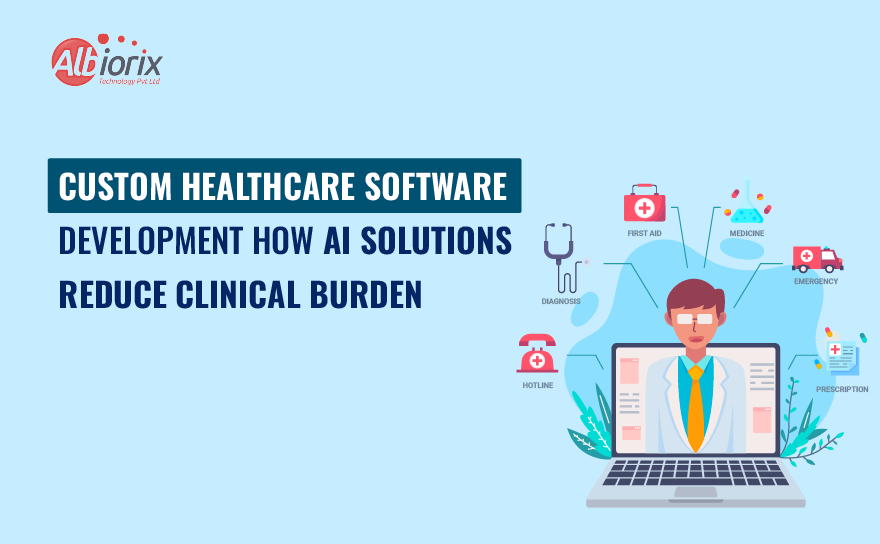
How Custom AI Healthcare Solutions will be used in a better Way To reduce clinical burden

Some years back, before the digital revolution took over the healthcare industry, doctors and other medical staff were busy completing a lot of tasks manually. From penning down the patient’s name to prescribing the medicines on a piece of paper, everything was done manually. These manual tasks not only reduced efficiency but also often delayed the treatment cycle.  

Since the start of the digital revolution and custom healthcare software development, a majority of tasks are now simplified or automated. We have many healthcare software solutions like (EHRs)/EMRs, Telemedicine Software, Remote Patient Monitoring (RPM) Software, Medical Billing Software, Medical Billing Software, Hospital Management Systems (HMS), Health Tracking Apps and more that are helping doctors, medical staff, and hospitals to enhance patient care and speed up the treatment process.  

However, after the arrival of Artificial Intelligence, things are getting even smarter, streamlined, and human intervention is reduced to a greater extent. AI-powered healthcare software solutions are not only automating the day-to-day tasks and operations, but they are also helping doctors and hospitals in diagnosing problems in the early stage and recommending the best course of action for the patient.  

The need for custom healthcare software development has not transformed into AI-powered mHealth solutions, as they are more useful and productive. In this blog, we will help you understand why AI software solutions for healthcare are important and how they are reducing the clinical burden on doctors, medical staff, hospitals, and even patients. So, let’s start with some basics about Custom Healthcare Software. 

What is Custom Healthcare Software?

A custom healthcare software solution refers to digital applications and platforms that are ideally designed and developed to meet the specific needs of doctors, medical staff, patients, hospitals and people associated with the healthcare industry. They are completely different from the readymade and off-the-shelf healthcare solutions offered in the market. Custom healthcare software is built as per the personalized requirements to meet the specific workflows and compliance needs of the organization.   

These custom solutions are designed and developed to solve the exact challenges faced by the healthcare services providers – such as managing patient records, streamlining clinical workflows, improving communication, allowing remote care, etc.  

Some of the most common examples of custom healthcare software are:  

  • Electronic Health Records (EHR/EMR): This software is designed and developed to digitise patient records so that they can be accessed anytime/anywhere.   
  • Telemedicine Platforms: These mHealth solutions are for virtual doctor-patient consultations. It allows doctors to attend to patients virtually via video calls. 
  • Hospital Management Systems (HMS): This amazing healthcare tool is used to manage appointments, billing, staff, and inventory. 
  • Patient Engagement Apps: These types of digital apps are used for scheduling, reminders, health tracking, and communication. 
  • AI-Powered Diagnostic Tools: These types of healthcare solutions are used for early disease detection and treatment recommendations. 

There are more types of healthcare software solutions, and the sole reasons behind their popularity and growth are that they are tailor-made, they can scale as the business grows, they follow all the industry standards, easily blend with the existing healthcare system, and help in better patient care.   

Take a look at this Telemedicine App, Covantex, Designed and Developed by our in-house team of software developers.

Transform Healthcare with AI-Powered Software Solutions!

Partner with a trusted healthcare software development agency that has delivered innovative AI-driven healthcare apps for hospitals, clinics, and startups worldwide.


Get in touch!

What are AI-Powered Healthcare Software Solutions?

Now, as you have the basic idea about what custom healthcare software solutions are and why they are so popular, let’s move forward with understanding AI-powered healthcare software solutions.  

AI-powered healthcare software solutions are modern and advanced digital healthcare tools that integrate Artificial Intelligence into them. They are powered with modern Artificial Intelligence technologies such as Machine Learning, Natural Language Processing, and Computer Vision, to name a few. Compared to standard or traditional healthcare software and apps, these solutions go beyond simple automation by allowing systems to analyze medical data, learn from patterns, and offer intelligent insights that assist doctors, hospitals, and patients.   

AI-powered healthcare software solutions have levelled up patient care and are assisting doctors and hospitals in many ways. For doctors, it is helping them in faster and more accurate diagnoses, enhancing patient care, and offering personalized treatment to every patient. For patients, it is cost-saving and time-saving. 

What’s Better: AI-Powered Healthcare Software vs. Traditional Healthcare Software

The digital revolution has taken the healthcare industry by storm. Some years back, standard ways of treatment and patient care were replaced by basic healthcare software and mobile apps. And now, these standard healthcare solutions are being vigorously replaced by smarter, efficient, and intelligent AI-driven healthcare software solutions.   

It is because the conventional systems mainly focus on digitization and basic process automation. But AI-driven platforms take it a step further by enabling intelligent decision-making, predictive insights, and personalized care.   

In the comparison chart below, we will try to understand who’s better in 2025:

Sr. No Aspect  Traditional Healthcare Software  AI-Driven Healthcare Software  
Data Entry Manual input of patient records, time-consuming Automated with voice recognition & NLP, faster and accurate 
Decision Support Limited to preset rules, no learning capability Real-time clinical decision support using predictive analytics & machine learning 
Diagnostics Relies on human expertise alone Assists doctors with AI-driven imaging analysis & early disease detection 
Workflow Efficiency Repetitive tasks handled manually, higher workload Automates scheduling, billing, and reporting, reducing clinical burden 
Patient Engagement Basic appointment reminders, one-way communication Smart chatbots, virtual health assistants, and personalized patient interactions 
Scalability Static, needs manual upgrades for new features Continuously learns & adapts with new medical data and AI models 
Accuracy Prone to human error in records and reporting AI algorithms enhance accuracy and minimize errors 
Personalization Generic treatment recommendations Tailored treatment plans based on patient history and predictive analytics 

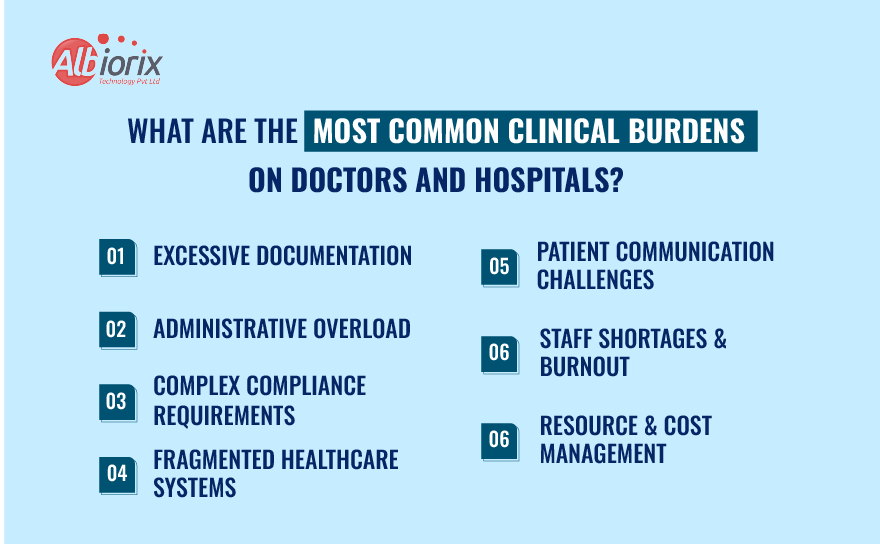
What are the Most Common Clinical Burdens on Doctors and Hospitals?

What are the Most Common Clinical Burdens on Doctors and Hospitals?

Even though the healthcare industry is revolutionising and modernising, there are still many tasks and challenges that are exhausting and draining the doctors and medical staff. These challenges are not only time-consuming and exhausting, but they are also affecting the quality of patient care.   

Here’s the list of Key Clinical Burdens Faced by Healthcare Professionals in 2025:   

  • Excessive Documentation: From patients’ basic details to a complete health record, there’s a lot of document work from start to end. This manual data entry work into the EHR is time-consuming and hectic. It also reduces a doctor’s efficiency and reduces the time he/she can spend with patients.   
  • Administrative Overload: Apart from managing the patient’s personal and health records, some of the administrative tasks, such as billing, insurance claims, and scheduling staff, cause a lot of stress and increase clinical burdens.   
  • Complex Compliance Requirements: With the digital revolution in the healthcare industry, the laws and compliance are also getting stricter. Doctors and healthcare professionals have to constantly monitor the healthcare regulations, such as HIPAA, GDPR, HL7/FHIR, etc., which ultimately add pressure on them. 
  • Fragmented Healthcare Systems: Different systems in hospitals work independently without any coordination or connectivity. This lack of connectivity between EHRs, labs, and pharmacies forces providers to duplicate work and delays care.   
  • Patient Communication Challenges: Every patient visiting the hospital has different types of queries, and answering all of them is a challenging task for doctors and other medical staff. This type of clinical burden of managing a large number of patient queries, reminders and follow-ups is also creating a lot of load on doctors and staff.   
  • Staff Shortages & Burnout: Another clinical burden that doctors and medical staff face is staff shortages. With rising demand and lesser qualified staff, overworked doctors and medical staff face higher burnout risks.   
  • Resource & Cost Management: Many hospitals across the globe struggle to balance between supplies, budget, and resources. This is one of the most common types of clinical burden experienced by doctors and hospitals.   

How AI Solutions Reduce Clinical Burden

Standard or traditional healthcare software and apps have streamlined and simplified many processes in the healthcare industry. Still, some tasks are tiring up doctors, medical staff, and hospitals. However, with the arrival of Artificial Intelligence Technologies, things are getting much smoother, automated and organized. AI-driven software solutions are helping doctors and hospitals create more efficient patient care plans.    

This productive shift from traditional software solutions to AI-driven software solutions is reducing burnout among doctors and healthcare staff. It is also assisting them in increasing productivity and patient satisfaction.    

Today, in 2025, AI is at the core of healthcare software development. It allows doctors and hospitals to design smart and intelligent healthcare tools that meet their unique workflows. Instead of struggling with traditional, off-the-shelf healthcare systems, doctors and hospitals can use tailor-made AI software and intelligent apps that directly address their pain points.

Key Ways AI Software Solutions are Reducing Clinical Burden   

  • Automated Clinical Documentation: With the use of AI-driven voice recognition and natural language processing tools, the doctor-patient conversation can be converted and saved into the EHR. This saves a lot of time.    
  • Streamlined Administrative Workflows: Everyday tasks like billing, insurance claiming, and scheduling patient appointments can be automated with intelligent healthcare software solutions. This will free staff and let them focus on more productive work.    
  • Decision Support for Clinicians: Smart and intelligent AI-driven software solutions help doctors and hospitals in analysing patients’ data in real-time so that they can offer more accurate diagnoses and treatment plans. It reduces cognitive overload on doctors and healthcare staff.    
  • Remote Patient Monitoring (RPM): With the help of healthcare app development services, wearable devices, and AI analytics monitors, patients who cannot visit the hospitals can be treated remotely. It saves the time of the patient and the doctors.    
  • Predictive Analytics for Risk Management: AI-powered predictive analytics tools help doctors and hospitals to predict chronic illness progression, forecast readmissions, and treatment outcomes. It allows them to act early before the illness becomes serious and reduces their workload.    
  • Enhanced Patient Communication: There are plenty of AI-driven chatbots and virtual assistants on the web that are helping doctors and hospitals to manage routine queries, appointment reminders, and periodic follow-ups. It minimises the strain on hospital staff.   
  • Resource and Capacity Optimization: Hospitals and doctors can use AI-based custom healthcare software development to reduce the clinical burden and optimize staffing schedules, bed management, and resource allocation. It can increase operational efficiencies. 

Ready to Build Smarter Healthcare Applications?

Our healthcare app development services are designed to accelerate efficiency and improve patient experiences.


Contact us!

Traditional vs. AI-Powered Healthcare Software Solutions

Sr.  Aspects  Traditional Healthcare Software Solutions AI-Powered Healthcare Software Solutions 
Data Entry & Documentation It requires manual input which may lead to errors. It also consumes a lot of time. With automated data capture & voice-enabled documentation, it reduces workload and errors. 
Patient Diagnosis & Decision Support It totally depends on doctors’ manual assessment. It is time-consuming. It has AI algorithms to analyze patient history, lab reports, and imaging. It supports faster, more accurate diagnoses. 
Administrative Tasks Everyday tasks like appointment scheduling, billing, and reporting require staff intervention. With smart automation, it streamlines appointment scheduling, billing, and report generation. It frees the resources and saves time. 
Patient Engagement Limited to physical visits and follow-up calls. There are AI-driven apps that allow remote monitoring and personalized reminders. It also provides 24/7 virtual assistance. 
Scalability This software struggles to handle increasing patient loads effectively. This AI healthcare software is scalable. They adapt to growing patient demands seamlessly. 
Clinical Decision-Making It is based on limited, manually retrieved patient data. It can provide real-time analytics and predictive insights to support evidence-based decisions. 
Operational Efficiency This software is of high costs due to staff dependency and repetitive workflows. AI software solutions work on reduced costs with improved efficiency. It can easily automate repetitive processes. 

AI is the Future of the Healthcare Industry

Over time, we have seen the shift from paperwork to software, and from software to AI-driven intelligent healthcare software. The future of the healthcare industry lies in smart, patient-centric, and productive AI software solutions.    

One more reason why AI-driven healthcare software solutions are looked upon as the future of the healthcare industry is that they not only reduce the clinical burdens of doctors, medical staff, and hospitals, but they also deliver results that are faster, accurate, safer, and personalized.    

But for an AI-powered software solution for a hospital, you will need the help of the right healthcare software development agency. The latter will help you stay competitive in this rapidly evolving digital landscape that is driven by Artificial Intelligence.    

At Albiorix Technology, we bring years of proven expertise in delivering healthcare app development services. Our AI healthcare software is tailored to the unique needs of hospitals, clinics, and medical professionals. In the past few years, our team of AI experts has built numerous AI-driven healthcare apps and software like MeTime, Daisy, Covantex, and My Formatic that streamline workflows, improve decision-making, and enhance patient engagement.   

If you are a doctor, a member of the medical staff, or a hospital looking for a healthcare software development agency nearby, then we are the best option. We hold experience and expertise in designing and implementing next-gen healthcare apps and platforms. Our AI-powered solutions can help you transform your practice while reducing clinical and administrative burdens. Together, we can shape a smarter and more resilient healthcare future.