




Types of Healthcare Software for Hospitals, Clinics, and Startups Everything You Need To Know

We are almost into 2026, and the healthcare industry is going through one of the most significant digital transformations.

With the arrival of fast and affordable internet services, advanced smartphones, and artificial intelligence, the traditional ways of treatment and healthcare are being replaced by more advanced, intelligent types of healthcare software and mobile applications.

From electronic health records to telemedicine and AI-driven diagnostics, different types of healthcare software are now the backbone of modern medical systems.

These healthcare software and mobile applications are not only liked by doctors and hospitals but are equally admired by patients all across the globe.

As we are getting closer to 2030, hospitals, clinics, and doctors across the USA and Australia are increasingly adopting innovative healthcare software development solutions.

These healthcare mobile apps and software are helping them improve patient outcomes, streamline operations, and ensure regulatory compliance.

According to a research by Grand View Research, the global healthcare IT market is expected to reach $1.3 trillion by 2030 with a growing rate of 18.7%.

This motivating growth in the healthcare industry is due to digital-first initiatives growing patient expectations, and the rapid evolution of technologies such as AI, IoT, and cloud computing.

In this blog on healthcare software solutions, we’ll explore the different types of healthcare software, their business impact, and how AI is redefining the healthcare software landscape in 2026.

We’ll also uncover how Albiorix Technology—a trusted AI development company—helps global organizations design scalable, secure, and intelligent digital health platforms.

What is Healthcare IT Software?

Healthcare Software is a broad term. Any digital system or platform designed and developed to manage medical data, improve patient care, and streamline healthcare operations can be called healthcare software.

The latter helps doctors, hospitals, pharmacies, clinics, and other healthcare providers to run efficiently and offer better services.

Modern healthcare software development covers appointment scheduling, record management, predictive analytics, and much more.

It empowers healthcare teams to make data-driven decisions, automate repetitive workflows, and maintain compliance with standards such as HIPAA (US) and APP (Australia’s Privacy Principles).

Types of Healthcare Software Solutions

There are many different types of healthcare software on the market. Some are used to offer virtual consultations, some to maintain patient data, and more. Depending on their uses, here are 14 types of healthcare software expected to dominate in 2026.

EHR and EMR Software:

Electronic Health Record (EHR) and Electronic Medical Record (EMR) Software serve as the digital backbone of healthcare organizations. They store patient histories, diagnoses, and test results securely for authorized access.

Stats: According to HIMSS, over 96% of hospitals in the US now use certified EHR systems. Popular examples include Epic, Cerner, and Allscripts.

Key Benefits: EHR and EMR software help hospitals centralize patient data, reduce errors, and improve coordination, forming a vital part of healthcare app development today.

Hospital Management Software (HMS):

Hospitals manage thousands of patients and daily operations, relying on robust hospital management systems to streamline these tasks. HMS simplifies admissions, appointments, inventory, and scheduling.

  1. Popular Tools: There are many HMS tools offered in the market, but MedStar HIS and eHospital Systems are very popular. The market is not shifting towards AI-powered Hospital Management Software.
  2. Key Benefits: Resource optimization and real-time dashboards help hospitals operate efficiently through custom healthcare software solutions.

Practice Management Software (PMS):

PMS, Practice Management Software, is an extremely useful healthcare software in 2025 for all, from smaller clinics to private practices.

This exclusive mHealth software solution automates appointments, billings, insurance claims, and many other tasks. Managing these time-consuming tasks allows healthcare providers to focus on patient care.

  1. Popular Tools: There are many different types of Practice Management Software available in the market, but Kareo, NextGen, and DrChrono are among the top 3 PMS in 2025.
  2. Best For: Clinics, dental offices, and mental health centers that benefit from simplified daily operations supported by healthcare CRM development.

Medical Billing Software:

Revenue cycle management is one of the most challenging parts of healthcare. Billing and coding software automates claim submissions and ensures compliance with payer regulations.

Medical billing software systems help healthcare providers to efficiently manage the billing and payment cycles.

  1. Stats: Over 88% of hospitals plan upgrades to reduce claim rejections. This growing need aligns with the impact of AI in healthcare for faster, smarter billing automation.
  2. Popular Tools: Almost every hospital and healthcare service provider is using one or the other billing software, but AdvancedMD, AthenaCollector, and CareCloud are the most popular medical billing software in 2025.

    These healthcare software solutions ensure faster payments, reduced denials, and real-time tracking.

Telemedicine and Telehealth Platforms:

After the COVID-19 pandemic, telehealth has become the new normal in the healthcare industry. These platforms allow doctors and patients to connect virtually for consultations, prescriptions, and follow-ups.

  1. Stats: In Australia, telehealth claims surged by over 1,800% between 2020 and 2023 (Australian Digital Health Agency). Around 44% of U.S. patients had a virtual visit in the previous 12 months (as of a 2024 survey), and of those, 94% are willing to use it again.
     
  2. Popular Tools: There are many different types of telemedicine software in the market, but doctors, hospitals, and other healthcare professionals prefer Teladoc, Doxy.me, and Amwell

    These virtual platforms highlight how mobile apps transform healthcare by offering accessibility and cost efficiency.

Remote Patient Monitoring (RPM) Software:

RPM software systems collect and transmit patient vitals, including heart rate, glucose levels, and oxygen saturation, to healthcare providers in real-time.

By using RPM software, doctors and healthcare organizations can diagnose health issues in less time and effort.

  1. Stats: Over 70 million patients globally use RPM tools. Such progress is part of the future of healthcare apps driven by connected care.
  2. Popular Tools: Some of the most popular Remote Patient Monitoring software in 2025 are Livongo, Validic, and CareSimple. These types of RPM software are extremely useful in chronic disease management and post-surgery recovery.

Healthcare CRM Software:

Healthcare CRM software is designed and developed to improve patient engagement through targeted communication, reminders, and personalized outreach.

This type of mHealth software solution keeps doctors and patients connected. It helps doctors and healthcare organizations improve retention and better patient relationships.

Popular Tools: Salesforce Health Cloud and Zoho Health CRM. This technology supports healthcare mobile app development by maintaining patient relationships and retention.

    Medical Imaging and Diagnostics Software:

    These types of healthcare software solutions are in huge demand in 2025. Many doctors and healthcare organizations use medical imaging and diagnostics software to process and analyze medical imaging data such as MRIs, CT scans, and X-rays.

    These healthcare solutions not only save time but also offer highly accurate results. The demand for AI-powered medical imaging and diagnostics software is expected to surge in 2026.

    1. Popular Tools: Siemens Syngo, Arterys, and Aidoc. Such innovation illustrates AI in healthcare advancements enhancing precision diagnostics.
    2. Key Benefits: This type of software helps in faster diagnosis and reduced human error. Now, neither doctors nor patients have to wait long for the medical reports.

    Pharmacy Management Software:

    This type of software solution is designed and developed to help both retail pharmacists and hospital pharmacies. It helps them to maintain and manage drug inventory and prescriptions.

    1. Popular Tools: PioneerRx and Liberty Software. These tools are part of AI healthcare software evolution reducing medication errors and ensuring compliance.
    2. Key Benefits: This software helps in streamlining inventory and minimizing medication errors. Retail pharmacists and hospital pharmacies can easily keep an eye on available stocks.

    Clinical Decision Support Systems (CDSS):

    CDSS is a modern, technology-driven healthcare software solution that helps doctors and healthcare organisations in making informed courses of treatment based on patients’ clinical profiles and medical knowledge.

    This type of mHealth software uses patient health data, clinical guidelines, and other healthcare information to assist doctors in diagnosis and treatment recommendations.

    1. Popular Tools: Elsevier, ClinicalKey, and UpToDate. These systems benefit from the growing IoT and AI in healthcare integration improving diagnostic precision.
    2. Key Benefits: Clinical Decision Support Systems work on evidence-based decision-making; thus, they help in improving care with higher accuracy. It helps reduce treatment errors.

    Healthcare Analytics and BI Tools:

    This type of healthcare IT software converts healthcare data into actionable insights to support better decision-making. It reduces the chances of human errors.

    These types of healthcare software are used in hospitals for Predictive analytics, cost optimization, and population health tracking.

    1. Stats: According to Deloitte, it has been found that more than 92% of healthcare executives believe analytics will be crucial to their organization’s success by 2026.
    2. Popular Tools: Power BI, Qlik Sense, and Tableau. This move toward predictive analytics highlights AI’s impact on healthcare in enabling data-driven care.

    Laboratory Information Management Systems (LIMS):

    These types of healthcare software solutions are used in 2025 for managing and tracking samples, generating reports, managing data within a laboratory, and improving laboratory efficiency.

    These types of healthcare IT software ensure speed and accuracy.

    1. Popular Tools: LabWare and STARLIMS. These solutions represent the product development innovation behind modern lab automation.
    2. Key Benefits: These types of healthcare software in 2025 help in Efficient lab management and compliance.

    Healthcare Learning Management Systems (LMS):

    These types of healthcare software in the USA and Australia are used to train healthcare staff.

    Healthcare organisations and hospitals make use of these types of healthcare software to create, deliver, and track training for employees.

    LMS platforms deliver courses, track certifications, and maintain compliance records.

    Popular Tools: HealthStream and Docebo. Such eLearning platforms are transforming user interfaces in healthcare apps to enhance usability and compliance.

    Healthcare ERP Software:

    These types of healthcare IT software solutions can also be called healthcare management software.

    The primary role of these types of mHealth solutions is to integrate and automate various tasks of a healthcare organization, including finance, human resources, supply chain, and patient management, to name a few.

    These types of healthcare software in 2025 are ideal for large hospital networks.

    1. Popular Tools:  Oracle Healthcare Cloud and SAP S/4HANA. These enterprise platforms show the evolution of healthcare app development trends in managing large-scale operations.
    2. Key Benefits: These types of healthcare software solutions offer enterprise-level visibility and cost control.

    Comparison of Top Healthcare Software Categories

    Software TypePrimary FunctionIdeal UsersExample
    EHR / EMRCentralized medical dataHospitals & ClinicsEpic, Cerner
    HMSEnd-to-end hospital opsLarge hospitalsMedStar HIS
    PMSScheduling & billingPrivate clinicsKareo, NextGen
    TelemedicineVirtual carePatients & ProvidersTeladoc
    Billing SoftwareRevenue managementAdmin staffAthenaCollector
    AnalyticsData insightsHealthcare execsPower BI
    AI SoftwarePredictive careHospitals, LabsIBM Watson Health

    The Role of Different Types of Healthcare Software

    The Role of Different Types of Healthcare Software

    There are many different types of healthcare software used in hospitals, each serving a critical purpose. Some solutions manage day-to-day operations, while others streamline clinical workflows and enhance the treatment process.

    By 2026, AI healthcare software and cloud solutions will drive a new era of precision care, automating tasks and enabling smart decision-making.

    Different types of healthcare software in 2026 will not just be a convenience — they will be strategic business enablers.

    1. Enhancing Patient Experience: Post-COVID-19 pandemic, patients expect digital convenience, and that’s where different types of healthcare IT software come into play.

      From online bookings to virtual consultations, different types of software systems help create a seamless experience that builds trust and loyalty.
    2. Operational Excellence: Hospital management software solutions in 2026 are expected to play a crucial role in automating many tasks within the industry. This task automation will reduce overall burden, lower cost, and offer a high level of patient care.
    3. Data-Driven Decision Making: With analytics and AI, healthcare organizations can identify trends, predict disease outbreaks, and make proactive decisions that save lives.
    4. Regulatory Compliance and Security: With the arrival of SaaS based healthcare software and Cloud-based software solutions, healthcare professionals and healthcare organizations do not have to worry about security and compliance.

      Whether it is HIPAA in the USA or APP in Australia, modern healthcare software solutions protect patient data and reduce legal risks.
    5. Interconnected Ecosystems: Modern healthcare software promotes interoperability—allowing seamless data exchange between hospitals, pharmacies, and insurance providers.

    Build or Upgrade Your Healthcare Software with Confidence

    Whether you’re developing a new healthcare software systems from scratch or enhancing your existing one, Albiorix Technology is here to help. We bring expertise, innovation, and reliability to every project.


    Let’s innovate together

    Role of AI-Powered Healthcare Software

    Artificial Intelligence is redefining the healthcare industry faster than ever. By 2026, AI-powered healthcare software will become the cornerstone of predictive, preventive, and personalized medicine.

    1. Predictive Analytics and Diagnostics: AI algorithms can analyze vast datasets to detect patterns—helping doctors identify potential health issues before they escalate. AI can reduce diagnostic errors by up to 40%, according to a Harvard Medical School study.
    2. Automated Administrative Workflows: AI chatbots and voice assistants are now handling routine queries, scheduling, and patient intake—saving hospitals thousands of work hours annually.
    3. AI in Medical Imaging: Deep learning models can detect tumors or anomalies in radiology scans with accuracy rates surpassing 95%.
    4. Virtual Nursing Assistants: AI-powered nursing assistants offer around-the-clock patient support, reducing the burden on medical staff and enhancing care continuity.
    5. Personalized Treatment Plans: Using AI and genomics, healthcare software can now suggest personalized treatment pathways based on individual genetic profiles.

    This innovation-driven transformation reflects how AI is redefining healthcare globally.

    Conclusion

    The digital transformation of healthcare is here. From EHRs to predictive analytics, software now defines how organizations operate and deliver care. Providers in the USA and Australia are moving toward data-driven, patient-centered systems.

    Partnering with a leader like Albiorix ensures innovation, compliance, and scalability in your journey toward modern healthcare solutions. Learn how Albiorix Technology drives healthcare innovation for organizations worldwide.

    Albiorix Technology — Your Trusted Healthcare Software Development Partner

    With over a decade of expertise in healthcare software development services, Albiorix builds secure, HIPAA-compliant, and AI-driven mHealth solutions across domains.

    Our team specializes in building robust, HIPAA-compliant, and AI-integrated mHealth solutions across healthcare domains.

    Whether you need a telemedicine app, EHR system, or AI analytics dashboard, we bring a blend of domain knowledge, technical expertise, and innovation to every project.

    Why Albiorix Technology for Healthcare Software Development Services?

    Why Albiorix Technology for Healthcare Software Development Services
    1. Proven Expertise: 10+ years of experience in healthcare software projects.
    2. Security-First Approach: Healthcare Software Solutions with HIPAA, GDPR, and APP compliance.
    3. Technology Stack: .NET, Angular, React, Node.js, Python, and AI frameworks.
    4. End-to-End Delivery: From concept and UX design to deployment and support. We also offer support and maintenance services.
    5. Client-Centric Approach: Agile collaboration and transparent communication.
    6. Experience: Hands-on experience of developing different types of healthcare software solutions. Have a look at our portfolio.

    Contact Albiorix Technology today to discuss your healthcare software needs and get a free consultation. Partner with the best healthcare software development company and lead the path of innovative healthcare in 2026.

    Healthcare’s future in 2026 and ahead is digital. The question is: Are you ready to innovate?
    Healthcare AI Software Development Cost: 2026 Guide

    Summary: Healthcare AI software development cost runs $25,000 to $2,000,000+, depending on solution type, compliance needs, and integration complexity. This guide breaks down real pricing for hospitals, clinics, and health-tech startups across Australia, Germany, and USA, plus a practical budgeting framework. What should yours cost?

    In 2026, the penetration and integration of Artificial Intelligence in Healthcare is beyond one’s imagination. From big hospitals to small clinics, it is everywhere and helps doctors, hospitals, and other medical professionals to offer better treatment and care to their patients.

    For example, hospitals in Houston are using AI triage tools that flag deteriorating patients 36 hours before a clinical event. In Melbourne, aged-care networks are deploying predictive models that can reduce hospital readmissions by up to 22%.

    Radiology centers in Munich are reading chest CTs with AI assistance in less than 90 seconds. There are plenty of similar examples where AI in Healthcare is doing magic for both doctors and patients.

    With so many benefits of using AI in Healthcare, CFOs, CTOs, and operations leads across the world are now asking is not whether to build healthcare AI — it is how much it will cost, what they get for that budget, and which development partner can be trusted with PHI-grade data.

    In this detailed guide on “Healthcare AI Software Development Cost”, we will answer all three questions. We will break down AI software development costs across all major solution types, explain what drives prices up or down, and provide a realistic planning framework.

    Whether you are a 50-bed community hospital in Adelaide (Australia), a digital health startup in Berlin (Germany), or a large health system in Chicago (United States of America), this detailed guide on Healthcare AI Software Development Cost will answer all your questions.

    Who Are We? We, Albiorix Technology, an AI Development Company, have been building HIPAA-compliant and GDPR-aligned AI systems and custom healthcare software development solutions since 2020. Take a look at our portfolio to learn more about our potential as an AI development company.

    Let’s Talk About Development Cost Before You Commit!

    Every healthcare AI project is different. Our consulting team offers a free 45-minute scoping call to give you a project-specific estimate.


    Book your free estimate call

    What Does Healthcare AI Software Development Cost?

    The development cost of Healthcare AI software typically ranges between $25,000 to $2,000,000+ with a timeline ranging from 6 weeks to 24 months. There are many factors that directly or indirectly affect the development cost of AI software, because healthcare AI is not a single thing.

    Cost Breakdown by Use Case (2026)

    • Proof of Concept/MVP: It usually costs around $25, 000 to $80,000.
    • Clinical Decision Support tool: It usually costs around $80,000 to $200,000.
    • AI-Powered EHR Module/Add-on: It usually costs around $120,000 to $350,000.
    • Medical Imaging AI Platform: It usually costs around $250,000 to $700,000.
    • Remote Patient Monitoring System: It usually costs around $150,000 to $400,000.
    • Full AI Healthcare Platform: It usually costs around $500,000 to $2,000,000+.

    Look at the detailed breakdown of Cost Along with the Timeline:

    Solution Type  Typical Cost Range (USD) Timeline 
    Proof of Concept/MVP $25,000 – $80,000 6 – 12 weeks 
    Clinical Decision Support Tool $80,000 – $200,000 3 – 6 months 
    AI-Powered EHR Module / Add-on $120,000 – $350,000 4 – 8 months 
    Medical Imaging AI Platform $250,000 – $700,000+ 6 – 14 months 
    Remote Patient Monitoring System $150,000 – $400,000 4 – 9 months 
    Full AI Healthcare Platform $500,000 – $2,000,000+ 12 – 24 months 

    The cost of developing the AI healthcare software discussed above in the table reflects the all-in development cost. It includes everything from discovery, architecture, model training, UI/UX, compliance engineering, QA, and deployment.

    However, with these costs, you must be prepared for additional costs after deployment, such as regular maintenance, model retraining, and regulatory submissions.

    If an AI healthcare software development company in India offers you a development quote without asking about your EHR stack, data availability, user volumes, or compliance jurisdiction, then you’d better be cautious. Context determines cost in healthcare AI more than in almost any other software category.

    What are the Factors That Affect the Cost of Healthcare AI Software Development?

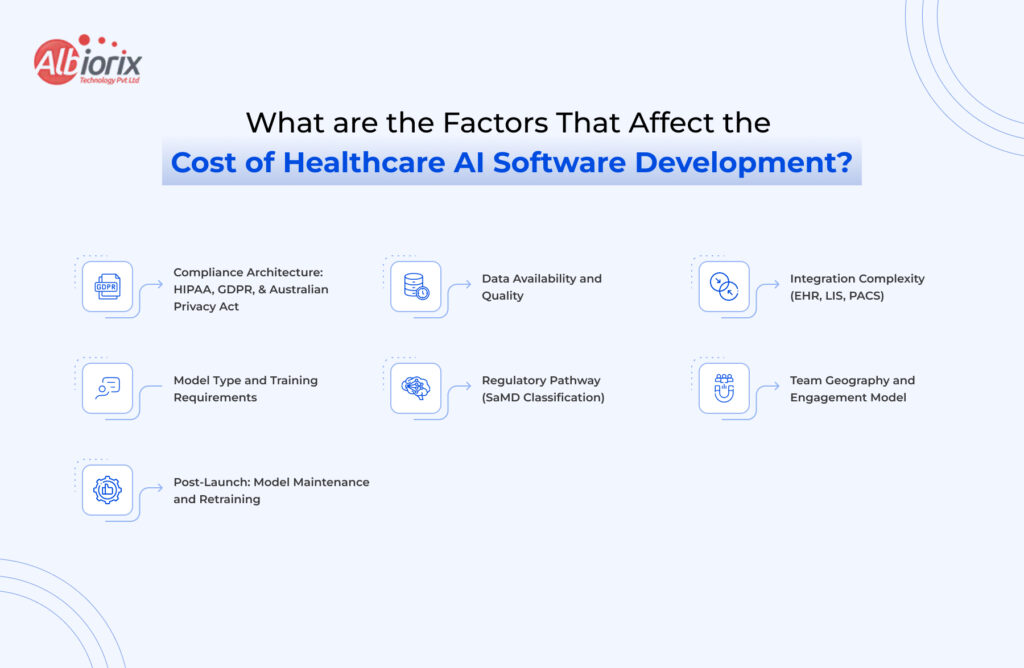
    There are seven main factors that directly affect the AI healthcare software development costs, including Compliance Architecture, Data Availability and Quality, Integration Complexity, Model Type and Training Requirements, Regulatory Pathway, Team Geography and Engagement Model, and Model Maintenance and Retraining.

    It is very important to understand what moves the needle on price, as it gives you real leverage in scoping conversations. Now, let’s discuss these 7 factors affecting the cost of development in detail.

    Compliance Architecture: HIPAA, GDPR, and Australian Privacy Act

    One of the major factors that affects the cost of development is Compliance Architecture. A system that needs to be HIPAA-compliant requires encrypted data pipelines, audit logging, role-based access controls, Business Associate Agreements (BAAs) with every sub-processor, and penetration testing before go-live. You cannot ignore compliance engineering, as they are mandatory.

    For instance, if you are developing an AI healthcare software for Germany or the European Union (EU), then GDPR adds a second compliance layer; similarly, for Australia, there is the Privacy Act 1988 and the My Health Records Act that governs clinical data.

    So, if you are building a HIPAA-compliant AI software, then always add 25-35% to the base development cost. Treating it as an afterthought may cause financial disruption in the end.

    Data Availability and Quality

    AI models are only as good as the data they learn from. If the data in your organization is well structured, precisely labelled, and in usable format, then the development moves faster and costs less. If data is siloed across systems, inconsistently coded, or needs de-identification and annotation before training can begin, you can expect significant added scope.

    Clinical annotation is expensive. Having clinicians label X-ray findings, validate diagnosis codes, or review NLP output for accuracy is a real cost, and skipping it produces unreliable models. Budget $15,000–$60,000 for data preparation on a mid-size project, depending on volume and complexity.

    Integration Complexity (EHR, LIS, PACS)

    Healthcare AI Software system does not work alone or in isolation. It communicates with your Electronic Health Records (EHR), Laboratory Information System (LIS), PACS (for imaging), billing platform, and other existing systems to deliver correct outputs. Integration with systems like Epic, Cerner, Meditech, or SAP Health using HL7 FHIR, SMART on FHIR, or legacy HL7 v2 adds meaningful development time and costs.

    A clean FHIR R4 integration with a modern EHR might add $15,000–$40,000 to a project. A bespoke connector to a legacy system with no standard API can easily add $60,000–$120,000 and several months of timeline.

    Model Type and Training Requirements

    Different hospitals and doctors require different types of AI Healthcare software; thus, the cost of development varies with requirements and complexity. For instance, the development cost of rules-based risk scoring tools is less compared to that of a deep learning model trained to detect pulmonary nodules in CT scans.  Natural language processing for clinical notes, computer vision for pathology slides, and predictive models for sepsis onset all carry different compute, data, and validation requirements.

    Pre-trained foundation models (like fine-tuned versions of Med-PaLM or BioGPT) can reduce training time and cost significantly — but they still require domain adaptation, safety evaluation, and clinician validation before clinical deployment.

    Regulatory Pathway (SaMD Classification)

    If your AI system qualifies as a Software as a Medical Device (SaMD), you face a regulatory pathway — FDA 510(k) or De Novo in the US, CE marking under MDR in the EU, or TGA registration in Australia. This is not a development cost per se, but it affects scope: you will need clinical evidence generation, predicate identification, quality management system documentation (ISO 13485), and regulatory submission support.

    FDA submission alone can add $100,000–$500,000 to a project when you factor in clinical study design, regulatory consulting, and submission preparation. Plan for this early.

    Team Geography and Engagement Model 

    Healthcare AI consulting services are priced very differently depending on where your development team is based. A US-based AI development company may charge you approximately $150-$250 per hour, whereas a team of AI healthcare software developers in Germany or Europe may range from $80-$180 per hour. An AI development company in India working for US, EU, and Australian clients charges $35-$75 per hour with no compromise on quality and performance.

    At Albiorix Technology, we have a team of AI professionals who understand US and EU healthcare standards better and deliver solutions optimized for efficiency and accuracy. This is how we deliver HIPAA-compliant AI systems at a price point that makes sense for mid-market health systems and digital health startups.

    Post-Launch: Model Maintenance and Retraining 

    Healthcare AI is not deploy-and-forget. Patient populations shift. Clinical protocols change. Model performance drifts over time — a phenomenon called model degradation. Plan for quarterly performance reviews and at minimum annual retraining for production clinical AI systems.

    Ongoing maintenance costs typically run 15–25% of initial development cost per year. If you built a $200,000 system, budget $30,000–$50,000 annually for maintenance, monitoring, and model updates.

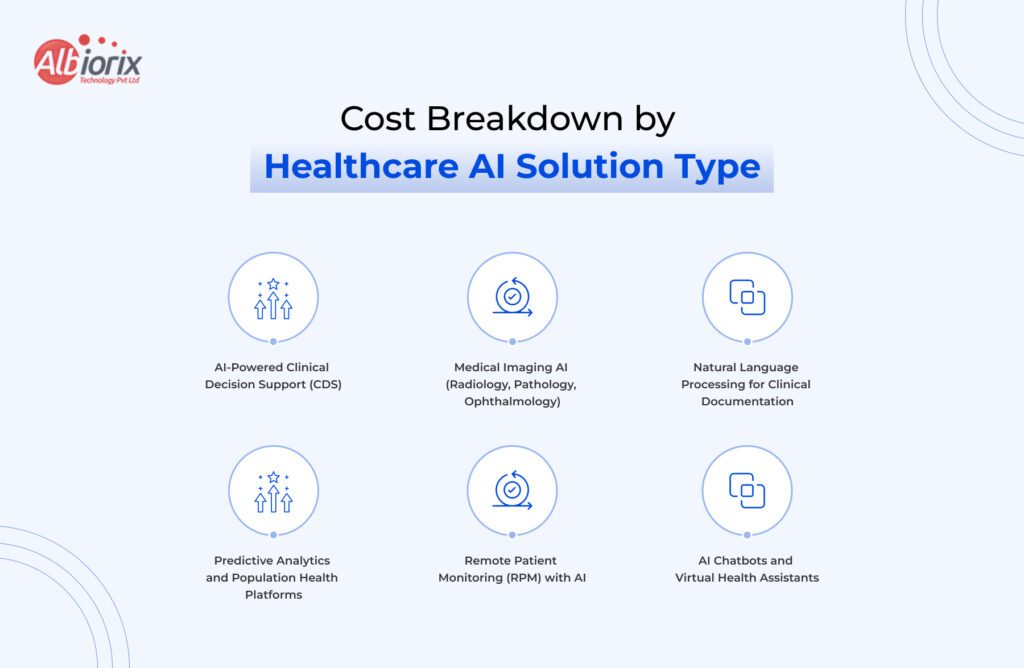
    Cost Breakdown by Healthcare AI Solution Type

    A healthcare AI application cost depends on the type of solution required for your clinic or hospital. We will talk about different types of healthcare AI solutions and break down their overall development cost.

    AI-Powered Clinical Decision Support (CDS)

    Clinical decision support tools surface relevant information at the point of care — flagging drug interactions, prompting sepsis alerts, or recommending appropriate diagnostic pathways based on presenting symptoms and patient history. These are often the best entry points for organizations new to healthcare AI.

    Typical build: $80,000–$200,000. The range is wide because some CDS tools are essentially sophisticated rules engines, while others incorporate machine learning models trained on millions of patient encounters.

    For hospital systems in the US, CDS tools integrated with Epic or Cerner via SMART on FHIR apps have become a well-trodden path — and there is meaningful reusability across clients. If your clinical focus overlaps with work we have done before, that benefits your budget.

    Medical Imaging AI (Radiology, Pathology, Ophthalmology) 

    AI-assisted imaging interpretation is one of the most technically mature and commercially validated areas of healthcare AI. FDA-cleared algorithms now exist for detecting diabetic retinopathy, triaging chest X-rays for urgent findings, and screening mammograms. Building one from scratch, however, is a significant undertaking.

    A radiology AI platform — covering algorithm development, PACS integration, a radiologist review workflow, and performance reporting — typically costs $350,000–$700,000 for a production-ready system. If you are building on top of a validated foundation model and focusing on a narrow anatomical region, costs can be brought down to $150,000–$300,000 for an MVP.

    Annotation is the hidden cost here. Labelling CT scans with confirmed pathology findings, reviewed and approved by board-certified radiologists, can run $0.50–$5.00 per image depending on complexity — and you need tens of thousands of labelled images for a reliable model.

    Natural Language Processing for Clinical Documentation 

    Clinical NLP is the process of extracting structured data from unstructured physician notes, automating coding, and generating draft discharge summaries. All this is done to reduce the documentation burden on clinical staff.

    A dedicated NLP tool for a documentation task might cost $60,000–$150,000. A powerful and comprehensive clinical documentation system that can record and structure the entire patient encounter can cost $300,000–$800,000.

    Predictive Analytics and Population Health Platforms 

    Predicting readmission risk, identifying patients likely to develop chronic conditions, or stratifying a patient population for proactive outreach — these are population health AI applications that typically operate on large, longitudinal datasets.

    Healthcare AI platform development in this category generally runs $150,000–$500,000, depending on data availability, the number of predictive models required, and whether you need patient-facing features (like a mobile app for care plan adherence). For regional health networks in Australia managing chronic disease across large geographies, these platforms have shown particularly strong ROI in reducing avoidable ED presentations.

    Remote Patient Monitoring (RPM) with AI 

    RPM platforms collect continuous data from wearables, home devices, or patient-reported outcomes — and apply AI to detect deterioration, adjust care plans, or trigger clinical escalations. Post-pandemic, demand for these systems has accelerated significantly across all three of our target markets.

    A full RPM platform — device SDK integration, data pipeline, AI alerting engine, clinician dashboard, patient mobile app, and EHR integration — typically runs $200,000–$450,000. Simpler versions focused on a single condition or device category can be built for $80,000–$180,000.

    AI Chatbots and Virtual Health Assistants 

    AI-powered patient engagement tools — symptom checkers, appointment scheduling bots, medication reminder assistants — sit at the lower end of the cost spectrum and often make excellent starting points for organizations exploring healthcare AI.

    A well-built, HIPAA-compliant healthcare chatbot integrated with your patient portal or EHR runs $40,000–$120,000 depending on conversation complexity. If you’re building this for a smartphone ecosystem, refer to our healthcare mobile app development guide for compliance specifics.”

    For German clients, multilingual capability (German, Turkish, and English at minimum) is often a requirement.

    Not Sure Which Solution Type Fits Your Needs?

    Our healthcare AI consulting services team can help you evaluate options. We work with health systems, clinics, payers, and digital health startups across the US, Germany, and Australia.


    Start a free Consultation!

    What HIPAA-Compliant AI Development Actually Costs 

    We hear from clients who have received proposals from vendors who treat compliance as a checkbox — a brief reference to encryption and access controls. That is not HIPAA compliance. Here is what genuine HIPAA-compliant AI software cost actually includes: 

    • Encrypted data storage and transmission (AES-256 at rest, TLS 1.3 in transit)
    • PHI de-identification pipeline (Safe Harbor or Expert Determination method per HIPAA §164.514)
    • Role-based access control with minimum necessary access enforcement
    • Comprehensive audit logging with tamper-evident records
    • Business Associate Agreement (BAA) with all sub-processors and cloud providers
    • Workforce training documentation for your organization’s HIPAA obligations
    • Breach notification protocols and incident response procedures
    • Annual risk assessment and remediation documentation
    • Penetration testing and vulnerability assessment pre-launch

    A properly scoped HIPAA compliance architecture adds $25,000–$80,000 to a typical project and saves you from the $100–$50,000 per violation penalties that OCR has issued for preventable breaches. The cost of getting it wrong always exceeds the cost of getting it right. 

    For clients in Germany, GDPR compliance engineering carries similar investment with additional requirements around data processing records, privacy-by-design documentation, and the DPIA process for high-risk processing activities. Our team has handled combined HIPAA-GDPR architectures for clients who process data across US and EU jurisdictions. 

    Market Context: Healthcare AI Investment in the US, Germany & Australia 

    The three markets we serve most actively have distinct dynamics that affect both the opportunity and the regulatory environment.

    Healthcare AI Investment in the United States:

    The US healthcare AI market is the largest and most mature globally. The FDA has cleared over 950 AI/ML-enabled medical devices as of mid-2025, and CMS reimbursement pathways for AI-assisted procedures are gradually expanding. 

    The dominant themes in enterprise health system investment are ambient clinical documentation, sepsis prediction, and prior authorization automation. HIPAA compliance is non-negotiable, and the enforcement environment has become significantly more active with OCR settlements averaging $500,000 in 2024. 

    Healthcare AI Investment in the Germany: 

    Germany’s Digital Care Modernization Act (DiGAV/DiGA pathway) creates a structured reimbursement route for digital health applications, including AI-powered tools that meet defined quality and data protection standards. 

    This is one of the most progressive regulatory frameworks for digital health globally. GDPR compliance is rigorously enforced by the BSI and state-level data protection authorities. For AI systems processing patient data, combining GDPR compliance with DiGA quality criteria is increasingly the baseline expectation. 

    Healthcare AI Investment in the Australia: 

    The Australian government’s investment in AI in healthcare has accelerated through the Australian Digital Health Agency’s National Digital Health Strategy. The TGA’s therapeutic goods framework for SaMD is aligned with IMDRF guidance and is increasingly active in regulating AI-powered clinical tools. 

    The My Health Records system creates both an opportunity — rich longitudinal data — and a compliance obligation for systems that access or interact with MHR data.

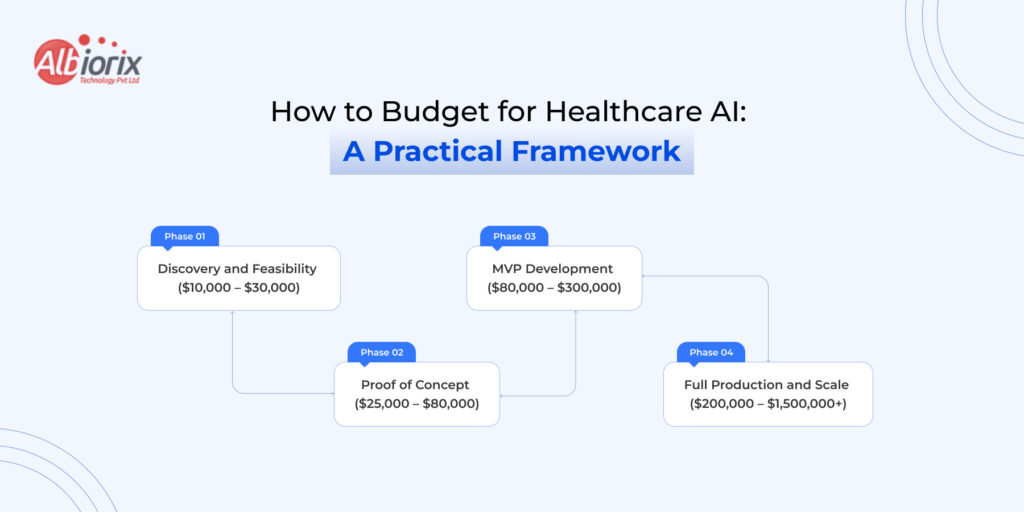
    How to Budget for Healthcare AI: A Practical Framework

    For organizations planning their first healthcare AI initiative, here is a phased budgeting framework that reduces risk and delivers value incrementally. 

    Phase 1 – Discovery and Feasibility ($10,000 – $30,000) 

    Before writing code, invest in understanding your data, your clinical use case, and your technical environment. A structured discovery engagement produces a scope document, data readiness assessment, compliance requirements mapping, and a realistic build estimate. This phase routinely saves clients $50,000–$200,000 by surfacing problems before they become expensive surprises. 

    Phase 2 – Proof of Concept ($25,000 – $80,000) 

    A focused POC validates the core AI capability — does the model perform at clinically acceptable accuracy on your data? This is not a production system. It is evidence that the investment is justified before the full build. 

    Phase 3 – MVP Development ($80,000 – $300,000) 

    A minimum viable product that can be used by clinical staff in a controlled environment. Full compliance architecture, core EHR integration, and the primary AI functionality. Enough to demonstrate value and gather real-world performance data. 

    Phase 4 – Full Production and Scale ($200,000 – $1,500,000+) 

    Additional features, multi-site deployment, regulatory submission support, advanced analytics, and the operational infrastructure to run a clinical AI system at scale. 

    What AI Healthcare Platform Development Looks Like at Albiorix 

    We are an AI Healthcare software development company, not a strategy consultancy, so when we talk about AI healthcare platform development, we are talking about engineering teams who have actually built these systems. 

    Our healthcare AI software development practice covers

    • Full-stack development of AI-powered clinical applications (web, mobile, API-first)
    • Machine learning model development, training, and validation for clinical datasets 
    • HIPAA and GDPR compliance architecture and security engineering 
    • HL7 FHIR integration with Epic, Cerner, Meditech, and other major EHRs 
    • DICOM and PACS integration for medical imaging AI
    • Cloud infrastructure design on AWS, Azure, and GCP with healthcare-grade security
    • Post-deployment model monitoring, drift detection, and retraining pipelines 
    • Regulatory documentation support for FDA SaMD submissions and CE marking 

    We have delivered projects for clients ranging from 12-person digital health startups to regional hospital networks with 3,000+ beds. Our pricing reflects the efficiency of a well-run, experienced team, not the overhead of a large consulting firm. 

    What Are The Cons When Evaluating Healthcare AI Development Partners

    Not all healthcare AI vendors are equal, and the stakes of choosing wrong are higher in healthcare than almost any other sector. Here are the warning signs we see most often:  

    • No mention of HIPAA, GDPR, or relevant data protection frameworks in their proposal 
    • No clinical validation methodology — how will they demonstrate the model actually works? 
    • Fixed-price proposals for complex AI projects with poorly understood data (a recipe for scope creep) 
    • No healthcare domain references or case studies in their portfolio 
    • Inability to explain their approach to model bias and fairness evaluation 
    • No discussion of model maintenance, drift, and ongoing performance monitoring 
    • Offshore teams with no compliance expertise for your jurisdiction 

    Ask any prospective vendor: who on your team has built a HIPAA-compliant AI system before? What was the clinical validation process? Can I speak to a reference client in a similar healthcare setting? Their answers will tell you a great deal. 

    Conclusion

    Albiorix Technology has been building production healthcare AI systems since 2017 — for hospitals, clinics, payers, and digital health companies across the US, Germany, and Australia. Our team combines clinical domain knowledge, compliance expertise, and engineering depth that is rare in a single partner.

    If you are planning a healthcare AI initiative — whether you are at the “what’s possible?” stage or ready to scope a full build — we would like to hear about it. Our engagement starts with a free, no-obligation 45-minute discovery session where we focus on your specific clinical goal, your technical environment, and what a realistic budget looks like for your project.