



Top-Rated Healthcare CRM Software Development Service For Better Growth

We are almost into 2026, and at this point in time, most doctors, healthcare professionals, and healthcare organizations have understood that healthcare CRM software development is no longer a nice-to-have thing.

It’s a central pillar of the modern-day healthcare industry that helps them offer a next level of patient care.

Healthcare CRM systems are the need of time, and looking at the current market trends in the future belongs to the more advanced and custom-made, AI-powered healthcare CRM software. 

In the last few years, especially after the arrival of Artificial Intelligence and Machine Learning, the digital health landscape has exploded.

Individual practitioners and large-scale hospitals in 2025 depend on healthcare software solutions and CRM systems to offer enhanced patient care and manage their day-to-day tasks. This has also led to the rise in the need for healthcare CRM software development services.

But what’s fueling this rapid rise in custom healthcare CRM demand? 

Healthcare CRMs are of great use to doctors and healthcare organizations. It helps them streamline and manage tasks, including appointment flows, access to patient histories, patient care gaps, treatment reminders, teleconsultation, and much more.

It helps them improve patient care, course of treatment, and patient satisfaction in an organized way.   

With so many benefits of healthcare CRM systems, most organizations have shifted to a more integrated, patient-centric, and productive platform known as Healthcare CRM software. It helps them turn fragmented data into coordinated proactive care.

Why is Healthcare CRM System Booming?

Over time, the healthcare industry has evolved a lot. Pen and paper got replaced by standard software, and now off-the-shelf software is being replaced by futuristic CRM systems.  

It has become a useful tool for everyone associated with the healthcare industry. Here are some numbers that will help you understand why Healthcare CRM software is in high demand in the market:   

  1. Healthcare organizations using CRM systems have reported up to a 42% reduction in missed appointments.   
  2. Many healthcare organizations and individual practitioners saw a 35% improvement in patient satisfaction.   
  3. According to a report published by Research Gate, the implementation of CRM systems in medical facilities improved patient data accessibility by 42% and redundant administrative workflows dropped by 49%.   
  4. After the implementation of the Healthcare CRM system, some healthcare organizations reported that patient retention increased by 41%.   
  5. Facilities leveraging CRM reported up to a 25% reduction in operational costs and a 33% boost in revenue-cycle efficiency.   
  6. As of 2024, roughly 48% of new healthcare CRM installations include AI-driven analytics modules — up from ~23% in 2020. Market Growth Reports  
  7. Around 67% of healthcare providers globally reported using CRM solutions for population-health management initiatives. 

Why Every Healthcare Organization Will Need a Custom Healthcare CRM in 2026?

As we move into 2026, healthcare organizations are entering a new era where patient expectations, regulatory demands, and digital-health innovations are evolving faster than ever.

In such a fast-evolving digital landscape, off-the-shelf and traditional CRM systems may not be able to keep up with this shift.

Hospitals, clinics, multi-specialty networks, and even individual practitioners now require tailor-made CRM systems that align with their unique workflows, data models, and patient-care goals.  

A custom healthcare CRM empowers organizations to centralize patient data, automate communication, streamline appointment management, and deliver more coordinated, personalized care.

It also easily integrates with legacy systems such as EHRs, telehealth platforms, billing systems, lab portals, and pharmacy networks to create a unified ecosystem that streamlines operations and increases customer satisfaction.    

Custom CRMs in 2026 also bring powerful advantages such as advanced analytics, AI-driven predictions, automated follow-ups, and personalized care pathways.

These capabilities not only reduce administrative load but also help healthcare professionals make faster, smarter decisions. Such an AI-powered healthcare CRM system is a necessity in 2026 and beyond. 

Key Benefits of a Tailor-Made Healthcare CRM
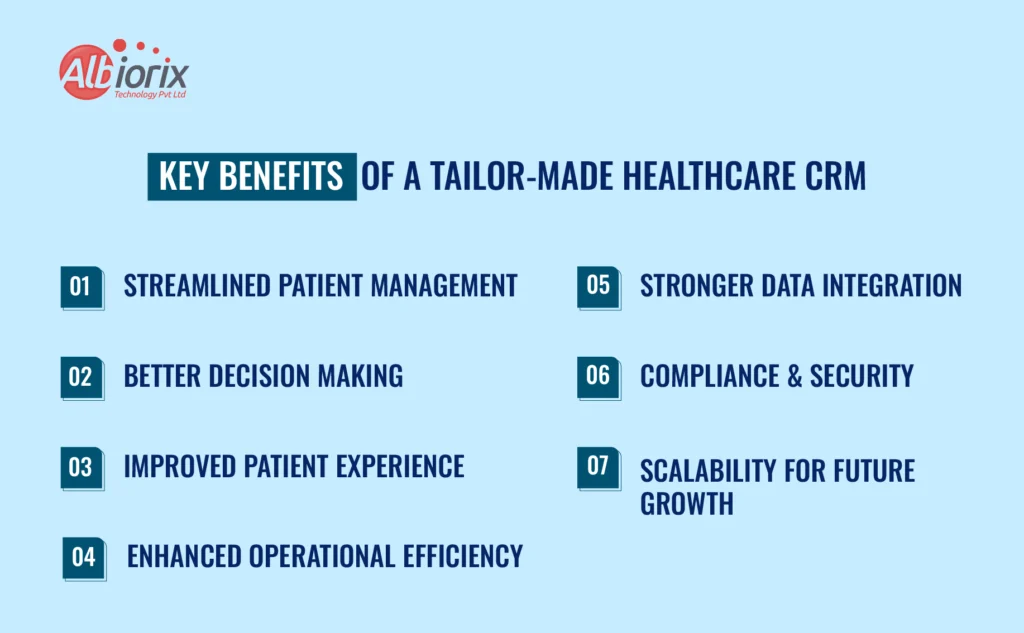
Key Benefits of  Healthcare CRM software
  1. Streamlined Patient Management: A CRM system allows you to automate repetitive tasks such as appointment scheduling, setting reminders, making patient follow-ups, and scheduling patient care.   
  2. Better Decision Making: An AI-powered Healthcare CRM software offers you detailed insight into care gaps, possible risks, and treatment options. A set of predefined data helps in making informed and patient-centric decisions.   
  3. Improved Patient Experience: Healthcare CRM systems help in offering enhanced patient care and treatment. It allows doctors and hospitals to establish personalized communication and a faster response to patients’ questions and queries.   
  4. Enhanced Operational Efficiency: When almost all tasks are automated and streamlined, you can focus on your core tasks like patient care and treatment. It increases operational efficiency.   
  5. Stronger Data Integration: A CRM system designed and developed keeping in mind your legacy system easily integrates with EHRs, billing, labs, and telemedicine systems into one unified platform.  
  6. Compliance & Security: Top healthcare software development companies like Albiorix Technology are known for developing custom workflows ensuring HIPAA, GDPR, and region-specific regulatory compliance.  
  7. Scalability for Future Growth: It can easily adapt to new services, departments, and digital health expansions. 

In 2026 and beyond, the healthcare industry will be more digital, data-driven, and patient-centric. Therefore, you will need a custom healthcare CRM to ensure smooth and streamlined operations.

A CRM system is no longer a luxury; it is the backbone of a modern healthcare ecosystem that ensures better outcomes, higher satisfaction, and sustained operational excellence.

Can a custom-made healthcare CRM software help your business grow?

Absolutely yes! A CRM system built around your unique workflows can help your practice or healthcare organization flourish in multiple ways.


Get yours today!

What types of healthcare CRM software you need as a Healthcare Professional? 

There are many different types of healthcare CRM software systems. For doctors, hospitals, clinics, and healthcare organizations, they must handpick the right CRM system based on their workflows, size, and patient care models.

There are many different types of readymade CRM systems available on the market, but a custom-made solution is the best fit.   

Here are the Most Common Types of CRM Systems

  1. Operational Healthcare CRM: This type of CRM system is used to manage day-to-day processes such as appointments, reminders, billing, and patient registrations.   
  2. Analytical Healthcare CRM: This type of healthcare CRM system is used to gather and analyze patient data. It collects data such as patients’ visits, medical history, and past interactions.   
  3. Collaborative Healthcare CRM: This type of healthcare CRM system is used to connect different doctors and departments in a hospital. It keeps all the doctors, nurses, and other supporting staff on the same page.   
  4. Patient Engagement CRM: This type of CRM system is used to manage patient communication. It helps improve patient satisfaction and strengthens long-term patient relationships.   
  5. Referral Management CRM: This type of CRM system is used to track referrals between primary care providers, specialists, and hospitals. It prevents referrals from leaking and speeds up patient routing and treatment.   
  6. Population Health CRM: This type of CRM system allows doctors and hospitals to monitor a group of patients based on risk factors, health conditions, and locations, and care requirements.   
  7. Telehealth-Integrated CRM: This type of healthcare CRM software makes it easy to centralize virtual consultations, scheduling, patient communication, and video-visit data. It makes remote care simple and consistent.   
  8. AI-Powered Healthcare CRM: This type of CRM system is powered by artificial intelligence. It assists doctors and hospitals in prediction, risk scoring, treatment options, and more. It increases accuracy and reduces manual effort for faster treatment.   

Need a CRM System? Try Our Healthcare CRM Software Development Services 

In 2026, if you are willing to modernize your hospital, clinic, or healthcare practice with a futuristic and AI-powered CRM system, then our healthcare CRM software development services are here to help.

Our custom CRM development services can help you modernize operations, streamline patient management, and develop a fully connected ecosystem that will take your practice to the next level.  

As a trusted healthcare CRM software development company with 10+ years of industry experience, we build tailor-made CRM solutions designed as per your unique workflows, specialty, and patient care needs.

We will ensure that the CRM system we develop fully accompanies the way you work.  

Whether you need a CRM for patient engagement, multi-department coordination, referral tracking, or data-driven decision-making, we deliver fully customized, scalable, and secure systems that integrate seamlessly with EHR/EMR platforms, telehealth tools, labs, billing systems, and more. 

Custom Healthcare CRM Solutions We Can Develop  
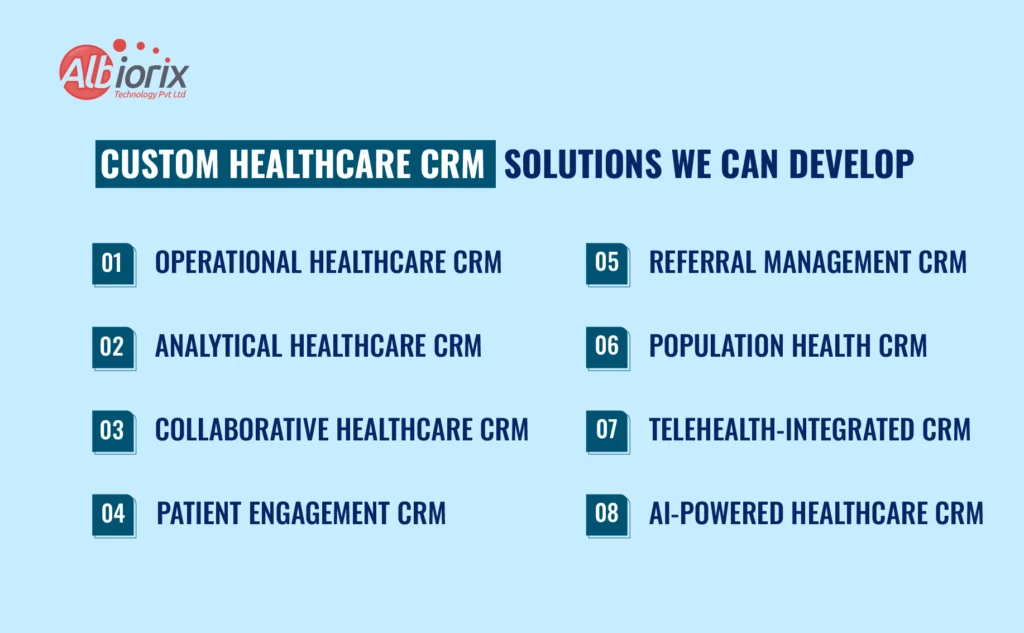
Custom Healthcare CRM Solutions
  1. Operational Healthcare CRM: If you need a CRM system that can automate appointment scheduling, patient follow-ups, visit reminders, and daily workflows, then our operational healthcare CRM development services are just right for you.   

  2. Analytical Healthcare CRM: If you are a hospital or a healthcare organization that needs a CRM system with real-time dashboards, AI-insights, and predictive analytics for smarter clinical decisions, then get in touch with us.

    Our Analytical Healthcare CRM development is perfect for you.   

  3. Collaborative Healthcare CRM: If you are a large healthcare organization or a hospital looking for a CRM system that can effortlessly connect all the doctors, nurses, pharmacists, billing teams, and labs for uninterrupted collaboration, then Collaborative Healthcare CRM is the best option.
     
  4. Patient Engagement CRM: Do you need a custom healthcare CRM software for your hospital or clinic that can enhance your communication with the patients through chats, SMS, apps, telehealth links, etc.?

    Then we can develop a patient engagement CRM system for your hospital and clinic.  
     
  5. Referral Management CRM: Our referral management CRM system is a tool that will help you track inbound and outbound referrals.

    It will eliminate leakages and speed up patient routing and the treatment process.   

  6. Population Health CRM: Does your hospital or healthcare organization need a smart tool to manage the chronic care program efficiently and identify at-risk patient groups? Then our population health CRM system is the smart option.   

  7. Telehealth-Integrated CRM: We are among the top healthcare CRM software development companies that can design and deliver a smart and intelligent telehealth-integrated CRM system for your clinics, hospitals, and healthcare organizations.

    It will help you offer high-quality virtual patient care.  

  8. AI-Powered Healthcare CRM: Integration of Artificial Intelligence can make your CRM system more intelligent and future-ready.

    Get in touch with our team of AI experts to build an AI-powered healthcare CRM system that can use intelligent automation for triage, predictions, personalization, and workflow optimization.   

When it comes to healthcare CRM software development, Albiorix Technology stands second to none. Our team of software developers can build any type of CRM system with any sort of complication from scratch.  

Every CRM system we build is HIPAA-ready, scalable, user-friendly, and engineered to support the future of healthcare.

If your organization is planning to upgrade or build a system from scratch, we can help you create a CRM that drives efficiency, enhances patient experience, and supports long-term growth.

Albiorix Technology – Among the Top Healthcare Software Development Companies in India 

As the healthcare industry undergoes massive technological reforms, it is important that you also adopt and integrate these reforms into your existing system to offer better patient care.

Whether you are an individual practitioner, a clinic, or a healthcare organization, you must welcome these changes with open arms.   

To adopt and integrate these technological reforms, you will need the help of an experienced healthcare software development services provider like Albiorix Technology.

The latter has a proven track record of designing and developing simple to complex mHealth solutions as per the business needs.   

We are among the top healthcare CRM software development companies in India. Our CRM solutions are trusted by some of the top doctors, hospitals, clinics, startups, and global healthcare organizations.   

With years of domain expertise, a strong team of healthcare software developers, and a proven track record of delivering secure, scalable, and intuitive medical software, we help organizations accelerate their digital transformation and enhance patient care across every touchpoint. 

As one of the most reliable healthcare software development companies in India, we specialize in building fully customized healthcare solutions ranging from CRM platforms and EMR/EHR systems to telehealth apps, patient engagement tools, AI-driven analytics solutions, and workflow automation platforms.

Our development approach focuses on regulatory compliance (HIPAA, GDPR), clinical accuracy, interoperability, and long-term scalability. 

Healthcare Software Development Companies in USA and Australia 

Doctors, hospitals, and healthcare organizations in the USA and Australia are rapidly adopting advanced digital solutions.

These healthcare software solutions help them manage patient demands, automate workflows, follow regulatory requirements, and shift towards value-based patient care.   

Ranked among the top healthcare software development companies in the USA and Australia, Albiorix Technology plays a crucial role in helping these hospitals, clinics, and medical enterprises modernize their systems and deliver more efficient, patient-centric care.

Our healthcare software development services allow them to own custom solutions that are secure, compliant, and scalable.   

Our team has hands-on experience in building healthcare solutions, including EMR/EHR platforms, healthcare CRM systems, telehealth applications, patient engagement tools, AI analytics engines, and workflow automation platforms.

With strong expertise in HIPAA, HL7/FHIR standards, and regional healthcare regulations, we ensure that organizations can seamlessly integrate technology without compromising safety, reliability, or clinical accuracy.  

For hospitals and healthcare organizations looking for top healthcare software development companies in the USA and Australia, Albiorix Technology is the right technology partner.

We have a talented team, proven domain experience, and globally trusted engineering practices to offer you top-tier healthcare CRM software solutions.   

Conclusion

As the healthcare industry continues its rapid digital evolution, the need for intelligent, secure, and fully customized mHealth software solutions has never been more critical.

From enhancing patient experiences to optimizing clinical workflows and enabling data-driven decision-making, modern healthcare CRM and healthcare software systems are reshaping how hospitals, clinics, and practitioners deliver care.  

Whether you operate in the USA, Australia, or anywhere around the world, investing in the right technology partner can determine how future-ready your organization truly is.

By choosing a trusted healthcare software development company, you position your organization to embrace innovation, improve operational efficiency, and build a more connected, patient-centric future in 2026 and beyond. 

If you have an idea that can revolutionize patient care and the entire healthcare industry, then we have the talent to convert our ideas into digital solutions.

To discuss your ideas with our experts, please schedule a free consultation or call us at (+91) 991-308-8360. You can also DM us on LinkedIn.

Healthcare CRM Software Development: Taking Patient Care to the Next Level

The rapid pace of technological advancements is reshaping every industry, from product development to logistics and entertainment, and the healthcare sector is no exception.

As the healthcare industry undergoes its technological transformation, the need for personalized and seamless patient care has become the call of the time.

Healthcare CRM software development is one of the solutions that revolutionize how healthcare providers engage with patients, optimize operations, and manage patient data.

By combining cutting-edge technology with patient relationship management, healthcare CRM solutions are elevating the quality of care, increasing patient satisfaction, and improving overall efficiency.

Even if we look at the global statistics, the healthcare CRM software market was valued at $17.9 billion in 2023 and is projected to surge to $30.7 billion by 2030, reflecting a robust CAGR of 8.0% from 2023 to 2030.

This remarkable growth underscores the healthcare industry’s acknowledgment of CRM technology as a vital asset.

Its ability to streamline patient management, enhance communication with partners, and enable more efficient healthcare delivery makes it essential to advancing patient care and operational efficiency.

These inspiring trends indicate the industry’s growing prominence of custom healthcare CRM software development.

The increasing adoption of healthcare CRM solutions by hospitals and healthcare professionals highlights a shift toward more patient-centric models, where technology streamlines administrative tasks and enhances the patient experience.

At Albiorix Technology, a leading healthcare CRM software development company, we are dedicated to offering a comprehensive look at healthcare CRM solutions.

This blog will delve into CRM software development, explore the benefits of custom healthcare CRM systems, discuss the overall development costs, and much more.

Transform Your Patient Care with Cutting-Edge Healthcare CRM Solutions

Ready to elevate your healthcare services? Streamline operations, improve patient engagement, and ensure seamless care delivery. Contact us today to learn how we can build the perfect solution for you!


Contact Us Today

What is Healthcare CRM Software?

Healthcare CRM software (Customer Relationship Management) is a specialized tool that helps hospitals, clinics, and healthcare providers manage relationships with patients, staff, and partners.

It centralizes patient information, making communication and coordination easier across the entire organization.

One key benefit of healthcare CRM is its ability to provide real-time insights. It automatically generates health reports and analytics, helping healthcare professionals understand patient behavior, track provider performance, and improve internal operations.

Beyond data, CRM software automates routine tasks like appointment scheduling, billing, and follow-up reminders. This saves time, reduces manual errors, and ensures patients get timely care.

With CRM, healthcare providers see higher patient satisfaction, fewer missed appointments, and better workflow efficiency. It helps doctors and staff stay organized, while patients enjoy a smoother, more connected experience.

As more hospitals worldwide adopt CRM solutions, it’s clear they play a vital role in improving both patient care and healthcare business operations.

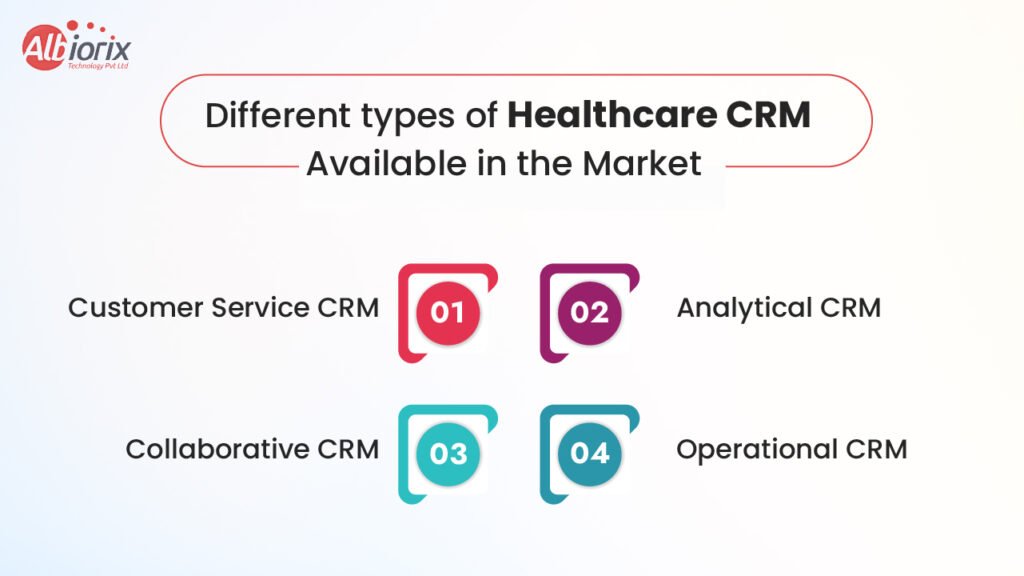
Different types of Healthcare CRM Available in the Market

By now, you’ve likely grasped the core purpose of healthcare CRM software development—how it empowers healthcare organizations and enhances the user experience.

A healthcare CRM can handle various tasks, from data aggregation and operational support to corporate data analytics and more.

Based on its functionalities, there are five main types of healthcare CRM solutions, which are outlined below:

  1. Customer Service CRM: The primary purpose of Customer Service CRM in healthcare is to elevate the patient experience by offering personalized and efficient support. It includes systems for managing service tickets, live chats, and feedback. By promptly addressing patient inquiries, complaints, and comments, healthcare providers can build stronger relationships, resulting in higher patient satisfaction.
  2. Analytical CRM: Analytical CRM is designed to gather and store valuable patient data for future use, enabling healthcare organizations to communicate with patients in a more targeted manner. This personalized approach fosters greater patient trust, as individuals feel they are being treated uniquely, which in turn enhances patient retention and strengthens long-term relationships between patients and healthcare providers. For those seeking professional assistance, CRM consulting services offer expert guidance in implementing these systems effectively.
  3. Collaborative CRM: Collaborative CRM focuses on ensuring seamless communication and information sharing within a healthcare organization, extending to external partners such as patients, suppliers, and other stakeholders. This system enables constant collaboration on patient care strategies, appointment scheduling, and treatment coordination. By enhancing teamwork and communication, healthcare organizations can significantly improve the overall patient experience through better care coordination.
  4. Operational CRM: Operational CRM tools are designed to automate and streamline various administrative tasks within a healthcare organization, including appointment scheduling, patient registration, billing management, and inventory tracking. By taking over these routine functions, operational CRM frees healthcare staff from time-consuming administrative duties, allowing them to focus on delivering high-quality patient care and ensuring smooth daily operations.

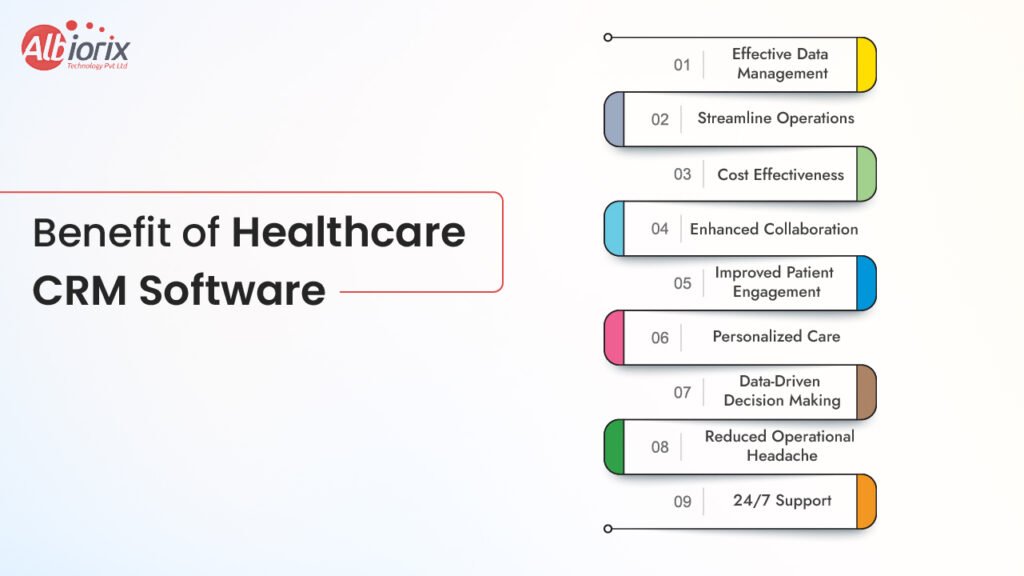
Image Based on the Below Content

Benefit of Healthcare CRM Software

Healthcare CRM software is revolutionizing the healthcare industry by significantly improving patient care.

Leading healthcare organizations and professionals worldwide are adopting healthcare CRM systems to enhance patient experiences, boost efficiency, improve accuracy, and streamline operations.

Let’s delve into the exceptional benefits that a robust healthcare CRM solution brings to the industry, with a primary focus on patient care.

  1. Effective Data Management: In healthcare, effective data management means organizing patient information in a way that supports safe, high-quality care. CRM software helps by centralizing medical histories, treatment plans, and billing into one secure system. This ensures doctors and staff always have accurate, up-to-date data at their fingertips. By improving access and coordination, healthcare providers make better clinical decisions while protecting sensitive information with strict security measures, ensuring compliance with privacy regulations and enhancing overall patient care.
  2. Streamline Operations: Healthcare CRM software benefits patients and plays a pivotal role in reducing operational workload and improving staff productivity. Features like automated appointment scheduling, referral management, and inventory tracking significantly reduce staff workload and minimize errors, freeing up valuable time for healthcare teams to focus on patient care.
  3. Cost Effectiveness: Compared to traditional methods, healthcare CRM systems are far more cost-effective. By seamlessly integrating with Electronic Health Record (EHR) systems and other healthcare IT infrastructure, CRM solutions facilitate smooth data exchange and enhance cross-departmental collaboration. This optimization of workflows and decision-making ultimately leads to cost savings, contributing to the long-term financial sustainability of healthcare providers. Additionally, improved efficiency and reduced errors translate into better resource utilization and lower overall costs of healthcare delivery.
  4. Enhanced Collaboration: Healthcare CRM software significantly improves collaboration among healthcare staff, doctors, and everyone involved in patient care. With features that enable secure messaging, task assignments, and seamless sharing of patient information, teams can work together more effectively on treatment plans, share updates, and provide continuous care. This enhanced teamwork results in more coordinated care, reduced redundancy, and a holistic approach to supporting patients.
  5. Improved Patient Engagement: Engaging patients and delivering personalized care are critical factors in driving positive health outcomes. CRM software offers features that elevate patient interactions, such as appointment reminders, telehealth services, and secure patient portals. These capabilities empower patients to participate actively in their healthcare, fostering stronger provider relationships and better adherence to treatment plans.
  6. Personalized Care: With powerful data analytics capabilities, healthcare providers can tailor communications and care plans based on individual preferences, demographics, and medical histories. This personalized approach creates meaningful patient experiences, improving satisfaction, loyalty, and overall health outcomes.
  7. Data-Driven Decision Making: Data-driven decision making in healthcare means using accurate patient data and analytics to guide clinical and operational choices. CRM software simplifies this by providing real-time insights on patient behavior, treatment outcomes, and staff performance.
    With these insights, healthcare providers can make informed decisions that improve patient care, streamline operations, and enhance resource management. By relying on trusted data rather than assumptions, organizations ensure better outcomes, higher efficiency, and a more personalized healthcare experience for every patient.
  8. Reduced Operational Headache: By automating tedious and repetitive tasks, healthcare CRM software boosts team productivity while minimizing the risk of errors. Automating routine tasks frees up valuable time and resources, allowing staff to focus on more critical responsibilities. This results in increased efficiency, fewer mistakes, and the ability to accomplish more with fewer resources.
  9. 24/7 Support: Human availability is not always constant, but CRM chatbots can fill the gap by providing round-the-clock assistance to patients. These chatbots can offer essential medical advice anytime, ensuring patients receive support whenever needed, further enhancing the overall patient experience.

Boost Efficiency with AI-Powered Healthcare CRM Software

Take patient management to the next level with our AI-powered Healthcare CRM software. We offer innovative and affordable AI-powered solutions that fit your healthcare organization’s goals. Get in touch and start transforming your practice now!


Contact Us Today

Features of healthcare CRM Solutions

As a healthcare professional, you have many options when it comes to integrating CRM software into your operations. The choice ultimately depends on the unique needs of your organization.

However, there are a few key features that every healthcare CRM should have to maximize its effectiveness.

  1. Healthcare Automation: Healthcare CRM systems streamline administrative tasks and enhance productivity through comprehensive automation. By automating workflows, a hospital CRM system can help make clinical practices more efficient and accurate, allowing you to handle more patients effectively. It simplifies patient management, improves medical billing, and speeds up payment processing by closing gaps that cause delayed payments.
  2. Patient Data Management: One of the standout features of healthcare CRM software is its ability to manage vast amounts of patient data automatically. With just a few clicks, physicians can access real-time data from multiple sources, helping them make informed decisions quickly. This technology enables doctors to visualize patient cases, generate custom reports, and gain valuable insights to improve care.
  3. HIPAA Compliance: Healthcare organizations use CRM software to track patients, manage billing, optimize workflows, and boost patient engagement. Given the sensitivity of medical data, patients may be hesitant to share personal information. Therefore, any healthcare CRM must comply with HIPAA regulations to protect patient privacy. Ensure that your CRM solution includes data access safeguards, scalability, and automated data backups to maintain HIPAA compliance.
  4. Task Tracking: As organizations grow, so do their marketing and promotional activities. One key to successful marketing is building rapport with patients through targeted outreach. Healthcare CRM software tracks every task in the advertising department, providing real-time progress reports and helping manage promotional strategies efficiently. With task tracking, you can ensure your marketing campaigns run smoothly, making necessary adjustments as needed.
  5. Patient Portal: A healthcare CRM’s patient portal is designed entirely with patients in mind. It fosters trust and strengthens the relationship between healthcare providers and their patients. The portal allows patients to access their medical records, including test results, scans, and consultation notes, from anywhere. By giving patients up-to-date information about their health, this feature promotes greater awareness and enhances patient-doctor communication.

What is the cost of Healthcare CRM Software Development

Developing a healthcare CRM requires a dedicated effort, with a range of features and expertise integrated by your chosen development team.

Typically, the cost of building a healthcare CRM solution can range from $50,000 to $300,000, depending on several key factors. Let’s break these down in more detail:

  1. Complexity of Required Features: One of the most influential factors is the complexity of the features you want in your healthcare CRM solution. The more advanced the functionalities, the higher the development cost. Basic features like patient management tools are relatively cost-effective, while enterprise-level solutions with advanced analytics, workflow automation, and seamless EHR integration will push the costs higher. The scope of these functionalities will shape the overall budget.
  2. Development Team Size & Expertise: The size and expertise of your development team will also impact costs. Depending on the complexity of the project and the features you need, you’ll need to assemble a skilled team. Developer costs vary based on their experience level, domain expertise, and the number of hours they dedicate to your project. Specialized skills often command higher rates, but they can also ensure a more efficient development process.
  3. Deployment Model: Your choice between cloud-based Software-as-a-Service (SaaS) and on-premise deployment also affects the total cost. Cloud-based solutions typically have lower upfront costs but come with recurring subscription fees, while on-premise options may require a higher initial investment but offer reduced long-term operational expenses. Your decision here should balance your organization’s financial planning and infrastructure capabilities.
  4. Integration and Data Migration: Integrating the CRM software with existing IT infrastructure, such as EHRs, billing systems, and other healthcare applications, can be complex and costly. Migrating historical patient records into the new system is another challenging and expensive task. Keep in mind, the actual development costs will be heavily influenced by your organization’s unique needs, the project scope, and its overall complexity. To get an accurate cost estimate, it’s always wise to consult with a healthcare IT consulting company specializing in CRM solutions. They can provide a tailored cost breakdown that suits your specific requirements.

Emerging Trends in Healthcare CRM Software Development

As the demand for personalized patient care grows, healthcare CRM software continues to evolve with new technologies and trends.

One major trend is the integration of AI-driven predictive analytics, which helps healthcare providers anticipate patient needs and deliver proactive care.

Another key development is omnichannel patient engagement, enabling seamless communication across phone, email, chat, and mobile apps.

Furthermore, wearable device integration is gaining popularity, allowing CRM systems to collect real-time health data directly from patients.

This not only enhances remote monitoring but also improves chronic disease management. These innovations are shaping the future of healthcare CRM, making it more intelligent, patient-centric, and efficient.

Importance of Data Security in Healthcare CRM

In healthcare, data privacy is non-negotiable. With the rise of digital health records and CRM platforms, robust data security measures have become essential.

Modern healthcare CRM systems are designed to comply with HIPAA, GDPR, and other global data protection regulations.

Key security features include data encryption, role-based access control, and regular security audits.

Additionally, implementing multi-factor authentication (MFA) adds an extra layer of protection against unauthorized access.

These practices ensure that sensitive patient information remains secure, fostering trust between healthcare providers and their patients.

Role of CRM in Telemedicine and Remote Patient Monitoring

The surge in telemedicine has highlighted the importance of healthcare CRM in managing remote patient interactions.

A well-designed CRM system supports virtual consultations, remote follow-ups, and digital health record management, ensuring continuity of care beyond physical clinics.

By centralizing communication and health data, CRM software helps healthcare professionals deliver personalized care remotely.

Features like automated appointment reminders, secure messaging, and virtual health assessments improve patient engagement and reduce no-show rates in telehealth services.

Future Outlook: The Next Frontier of Healthcare CRM

Looking ahead, the future of healthcare CRM is set to be even more intelligent and predictive. Innovations like AI-powered virtual health assistants, blockchain for secure data sharing, and real-time patient feedback loops are on the horizon.

These advancements will not only enhance patient-provider relationships but also enable precision medicine, where treatments are tailored to individual genetic profiles and lifestyle factors.

Healthcare organizations that adopt these cutting-edge CRM technologies will be better equipped to offer holistic, patient-centered care in an increasingly digital world.

Albiorix Technology Can Built a Powerful Healthcare CRM Software for You

At Albiorix Technology, we understand that effective patient management is crucial for modern healthcare organizations.

With over a decade of experience in the industry, we excel in Healthcare CRM Software Development and are committed to delivering solutions that transform how healthcare providers manage patient interactions and streamline operations.

Why Choose Albiorix Technology for Your Healthcare CRM Solutions?

  1. Over 10 Years of Industry Experience: With more than 10 years of expertise in the field, Albiorix Technology has a deep understanding of the healthcare landscape. Our extensive experience allows us to develop Healthcare CRM Solutions that are not only sophisticated but also tailored to meet the specific needs of healthcare providers.
  2. Skilled Team of App Developers: Our team of app developers is highly skilled in creating robust and scalable CRM systems. We have successfully worked on various projects, leveraging our knowledge and technical expertise to deliver CRM solutions that enhance operational efficiency and patient care.
  3. Proven Track Record: We have a proven track record of handling similar projects with remarkable success. Our experience includes developing Healthcare CRM Software for a range of healthcare organizations, ensuring that we understand the unique challenges and requirements of the industry. Have a look at our portfolio for some amazing and landmark healthcare projects.
  4. AI-Powered CRM Solutions: In addition to traditional CRM features, we offer the development of AI-powered Healthcare CRM Software. Our advanced solutions integrate artificial intelligence to provide predictive analytics, automate tasks, and enhance patient engagement, taking your CRM capabilities to the next level.
  5. Affordable Services: At Albiorix Technology, we believe that top-quality CRM solutions should be accessible. Our services are competitively priced, offering you the best value without compromising on quality. We are dedicated to delivering effective solutions that fit within your budget.

Transform your healthcare operations with Albiorix Technology’s Healthcare CRM Solutions. Whether you need a basic CRM system or an advanced AI-powered solution, we are here to help you achieve your goals efficiently and affordably.

Contact us today to learn more about how we can tailor our solutions to meet your specific needs and drive your healthcare practice forward.