




Top 10 Best Web Development Trends In 2026

Custom website development is considered the backbone of the IT industry. It is the process of developing custom websites for businesses and web application development that meet different business purposes and objectives.

We are officially into 2026, and this year is looked upon as a year of drastic evolution in the landscape of custom website development.

This evolution will be powered by state-of-the-art technologies such as metaverse, AI, blockchain, and IoT, to name a few, aligned with web development trends.

Looking at the current market scenarios and growth speed, the global web development market is expected to reach $124 billion by 2030.

This growth will be powered by trending technologies like AI integration, no-code/low code, and the expansion of serverless architecture, PWAs, and more, influenced by software development trends.

In this blog, we will talk about web development trends that will shape the industry in 2026 and beyond.

If you are a business owner or a part of the IT industry, then you must stay prepared to embrace these web development trends in 2026 for the best results in website development, mobile app development, and custom software development.

So, let’s talk about web development trends in 2026!

List of Top 10 Web Development Trends in 2026
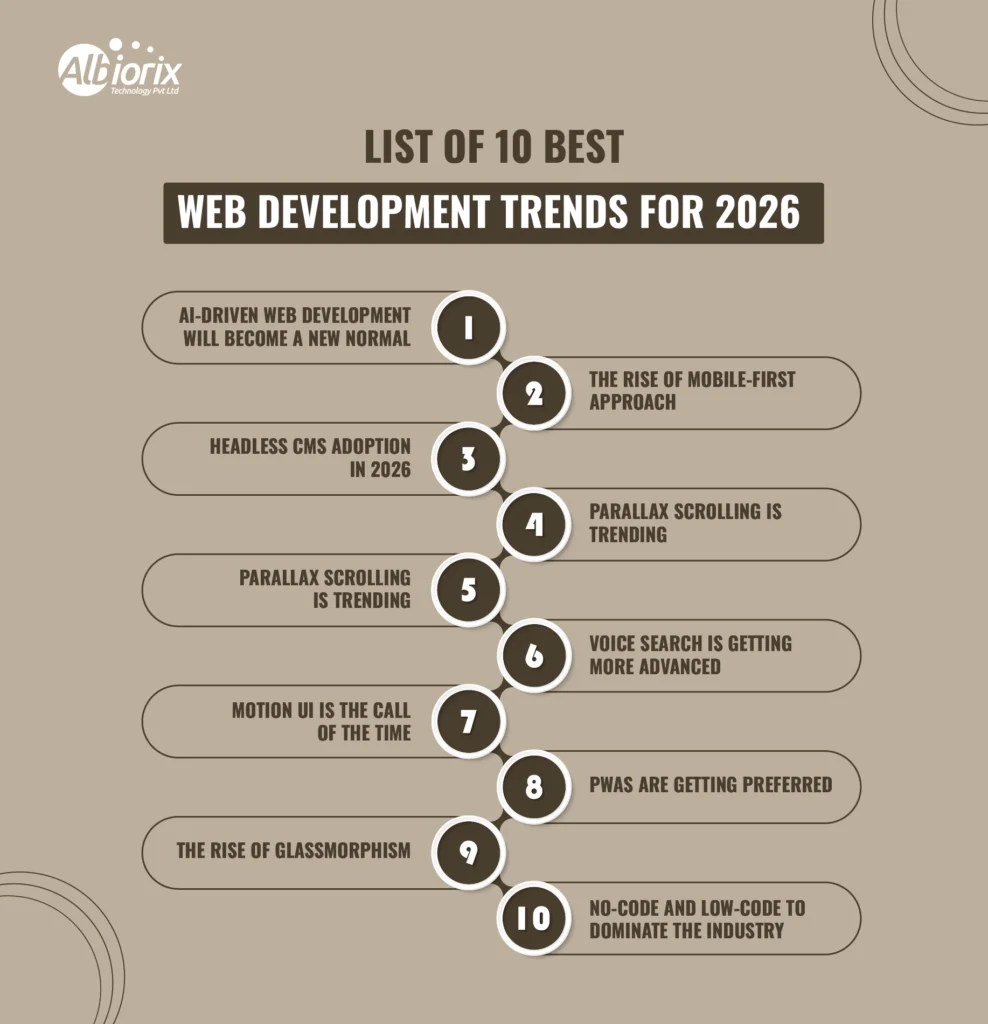
List of Top 10 Web Development Trends in 2026

Below is the list of web development trends that will shape the industry in 2026 and beyond!

1. AI-Driven Web Development Will Become a New Normal

Well, if you look at the use of Artificial Intelligence in current web, mobile and software solutions, then you will understand that AI is here to stay for a long time.

Thus, Artificial Intelligence is going to become the new normal in the web development industry, similar to patterns seen in digital transformation trends.

AI is expected to shape 2026 with deep integrations in the development lifecycle. Instead of building every component manually, many businesses are using systems that can automate code generation, testing, optimization, and UI creation.

According to a survey by McKinsey, the results showed that more than 44% of companies plan to use AI to assist with development workflows. These numbers are expected to rise by 60% by 2026.

The increasing use of AI-powered tools such as IDEs, generative UI builders, smart debugging tools, and automated QA systems is helping developers build websites much faster with fewer errors.

Below are some of the top use cases:

  1. It can auto-generate UI components as per the guidelines
  2. It can assist in code refactoring
  3. It can provide the performance score before launch
  4. It can automate accessibility audits
  5. It can fix SEO issues to better rankings in SERPs.

There’s a misinterpretation that AI will replace humans. But, in this case, artificial intelligence will not replace humans; it will amplify their capacities, save time and effort.

In 2026 and beyond, AI and automation in web development will become the new normal for businesses seeking to develop highly scalable and intelligent websites.

2. The Rise of Mobile-First Approach

In 2025, more than 87% of the world population is using smartphones, which roughly estimates around 7.1 billion to 7.3 billion people.

This data clearly proves that we live in a world driven by smartphones, where more than 80% of users access the internet through their smartphones.

According to a report released by Stocklytics, in 2025, mobile web traffic soared to 62.7% 2025, approximately 10% higher than the previous year.

Thus, if you are a business looking to develop a website in 2026, then your web solution must be optimized for smartphone users across the globe.

This extremely high usage of smartphones also indicates that along with a website, your business must also have a mobile to ensure success. To make sure, your website solution is mobile friendly, you must:

  1. Add CSS queries to make sure screen elements adjust per the device
  2. Focus more on vertical screen orientations
  3. Have meta viewport tags that can rescale the websites
  4. Use web layout models like Flexbox

The mobile-first trend is also here to stay because smartphones are never going to go out of fashion. Thus, businesses should ensure their websites are mobile-friendly.

3. Headless CMS Adoption in 2026

To accommodate the changing needs of the end-users, companies are not shifting from old CMS systems to headless CMS platforms.

According to a report published by Storyblok, more than 80% of companies are using headless CMS for faster development and content flexibility.

Headless CMS Adoption is Exploding because:

  1. It allows content to be pushed to apps, websites, smart devices, etc.
  2. It allows developers to choose the front-end framework of their choice.
  3. It reduces the website’s load time.
  4. It helps the marketing team in promoting the content without disturbing the code.

This website development trend is now powering some of the high-performing websites on the web. It is the first choice of websites, such as eCommerce websites and media platforms, where flexible content systems are required.

Thus, it is among the top 5 web development trends in 2026.

4. Parallax Scrolling is Trending

It is the latest trend in the world of custom website development. Parallax Scrolling means the content in the background of a webpage moves at a separate speed that the content in the foreground while scrolling.

It is complicated for developers to add parallax scrolling on the webpage; especially for mobile devices. It is because most mobile screens do not support parallax scrolling yet.

However, it will not stop website developers from adding parallax scrolling to new websites and web applications.

5. Integration of Chatbots 2.0 in Websites

With the arrival of Artificial Intelligence, the use of Chatbots has increased drastically. The chatbots allow businesses to offer customer support services around the clock without any deep human intervention.

In 2025, chatbots are used to offer support services in banking, sales, online shopping, requirement gathering, and more. In a short span of time, chatbots have evolved a lot and become an indispensable part of many businesses.

AI-powered chatbots are becoming smart and intelligent with every past conversation. The use of AI, ML DL, and NLP have enhanced their potential to handle complex conversations with humans. These are the reasons; they do not require regular training or upgrades.

6. Voice Search is Getting More Advanced

The next big web development trend to follow in 2026 is Search by Voice. The voice search feature was first introduced by Google to help people find the exact services/products/information without typing any lengthy keywords or phrases.

In 2026, the Voice Search is looked upon as one of the core features of the website. There are virtual assistants like Apple Siri, Google Voice Search, and Amazon Alexa, to name a few, to boost the voice search features.   

According to information available over the web, nearly half of all online searches are done by voice – especially from smartphones and smart speakers. More than 71% of users prefer voice search over typing lengthy quotes as it is fast and convenient.

7. Motion UI is the Call of the Time

Motion UI is the call of the time because modern web users are expecting a fluid and intuitive experience without sacrificing usability. Motion UI is the first choice of many industries.

According to a report published by Almanac, more than 68% of websites added motion UI (micro animations or motion animations) on their website and observed approximately a 20% rise in web traffic.

Capabilities of Motion UI are:

  1. It can add micro animations
  2. It can add smooth transitions
  3. It can add scroll-triggered effects
  4. It can add interactive icons
  5. It can add hover-based behavior

As it offers an engaging and personalized experience to web users, this trend is among the most popular web development trends in 2026. It is highly preferred by SaaS websites, eCommerce websites, and Consumer-facing websites to influence audiences.

8. PWAs are Getting Preferred

The full form of PWA is Progressive Web Apps. It is one of the youngest web development trends in 2026. However, it is getting stronger with time. It is gaining popularity among large businesses and organizations.

Modern businesses love PWAs because they offer the best of both worlds. It provides the flexibility of traditional apps and the user-friendliness of standalone apps. Additionally, PWA apps can be used even without an active internet connection on any device.

Because of the benefits it offers, most of the web development experts believe that PWAs will someday completely replace the standard web apps in use today.

9. The Rise of Glassmorphism

The world of custom web development is evolving at a very fast pace, and it is becoming increasingly competitive. Developers and designers are constantly looking for new ways to impress their clients with innovative solutions.

In this race to stand out, several new and creative design features have been introduced—and one of them is called Glassmorphism.

Some developers and designers also refer to it as glass texture. This design style adds depth and visual richness to web interfaces. It allows designers to create web solutions that give users the feeling of looking through frosted or transparent glass.

Glassmorphism was first introduced by Apple in 2020, followed by Microsoft, and this trend is expected to grow significantly in 2026.

The main reason behind its popularity is that it makes UI elements like sliders, buttons, and cards stand out while maintaining a clean and modern look.

10. No-Code and Low-Code to Dominate the Industry

As the digital world is revolutionizing very fast, the use of no-code and low-code tools are rising rapidly.

According to a report by Research from Gartner, 75% of new web applications by 2027 will be powered by no-code and low-code platforms. This is a huge prediction for any tool.

No-code and Low-code tools will be used to develop:

  1. Landing pages
  2. Internal tools
  3. Automated Workflows
  4. Business dashboards
  5. ECommerce prototypes

Some of the most popular no-code and low-code platforms in 2026 are Bubble, Wix studio, Webflow, and framer.

This trend is not expected to replace custom web development in 2026, but it will surely speed up the development process with less errors.

Conclusion

No matter what trends come and go, the process of custom website development is and will remain a complex task for someone who is not that tech-savvy. If you need expert support to simplify the process, Contact Us to get the right guidance and solutions.

Albiorix Technology has experience delivering future-ready solutions across industries, including insights gained from platforms like sports betting apps.

Thus, if you feel like you’re confused or have questions in your mind, get them cleared today! Talk to our experts, discuss the feasibility of your idea, and get a free quotation instantly.

We offer web development services at a global level – we have clients from major parts of the world, including the US, UK, Europe, and Australia.
Web Application Development:A Complete Guide For Beginners In 2025

Nowadays, almost all businesses and enterprises are greatly interested in web development investment. The primary reason behind this is its vast scope for growth.

The future of web development is increasing rapidly as almost every business sector needs a robust website. It may be in any form, like taking its goods and services online, so web development definitely plays a vital role in this context.

Companies are searching for the best professionals with expertise in building websites to improve their global website presence.

And it’s because an excellent team of web designers and developers effortlessly personifies their technical skills with creativity to craft captivating sites that would surely excite online users.

What is a Web Application?

A web application sometimes referred to as a web app, is nothing but a computer program that uses a web browser to deal with a particular function. A web application is a client-server program comprising client and server sides.

Do you know that there are about 1.5 billion active websites available globally and still counting?

The user enters data through the client-side (front-end), while the server-side (back-end) of the application stores and processes the information.

Some of the leading examples of typical web apps are

  • Shopping carts
  • Content management systems
  • Online forms
  • Google Docs

Both enterprise businesses and individuals usually develop web applications to fulfil different purposes. Web apps help integrate the tailored experience of native apps and hybrid apps with easy access on a website browser from any device.

For example, LinkedIn, Basecamp, MailChimp, and even Facebook, have web apps that provide immersive and tailored experiences like a native app directly from the browser.

Hence, web application development is gaining popularity in almost all industries, including banking, eCommerce, education, healthcare, and more.

Searching for Bespoke Software Solutions for Your Business?

Albiorix has a team of dedicated and talented web app developers that are always ready to provide the best possible web solutions for business needs.

Contact Us

How Does a Web Application Work?

Web applications are typically accessed over a network and you do not need to download any specific software or tool. Instead, you have an option to access web applications through browsers like Google Chrome, Mozilla Firefox, Opera, or Safari.

Generally, a web application has three essential components:

  • Web Server
  • Application Server
  • Database

The web server manages requests from the client, the application server processes requests, and the database stores the information.

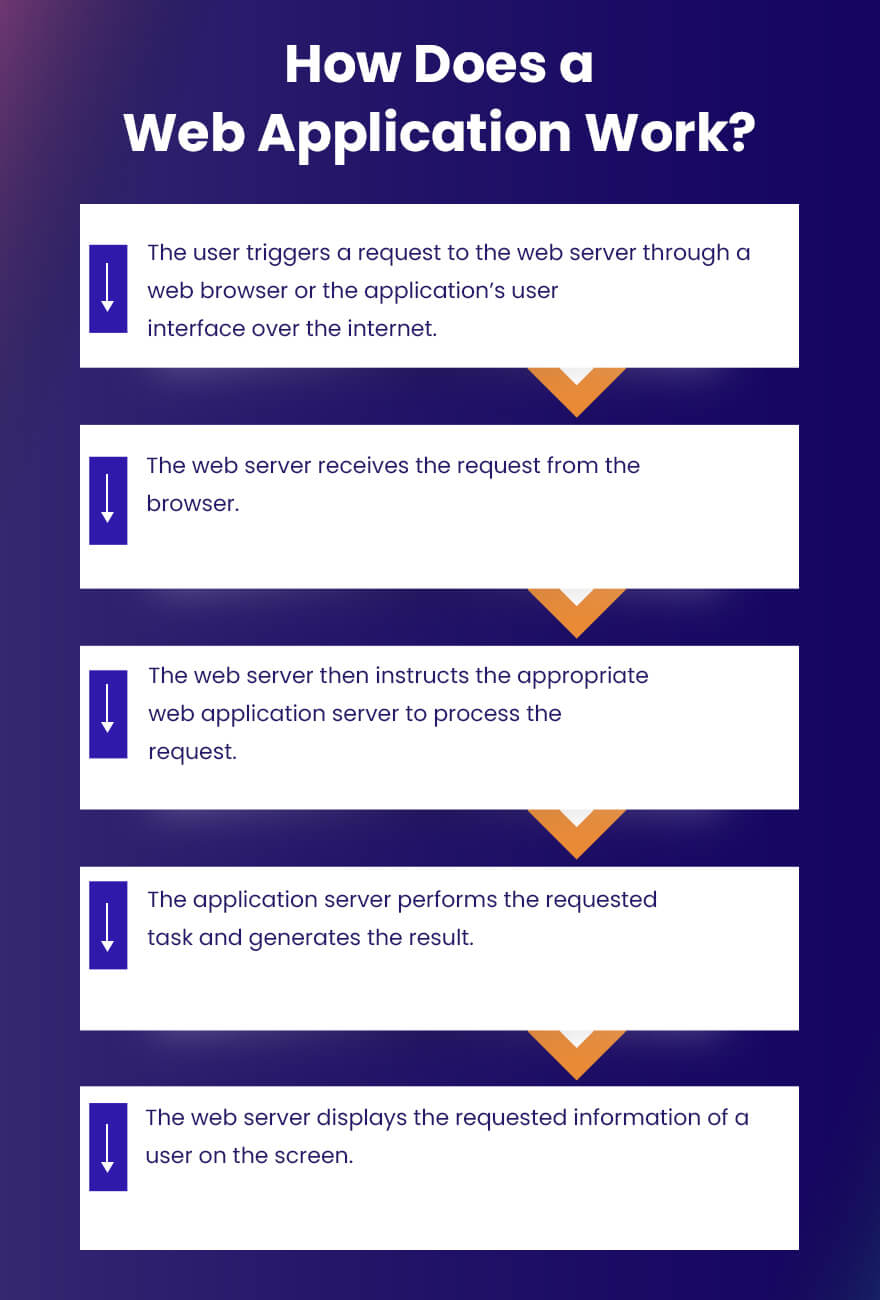
The working of a web application goes like this:

how does a web application work

Web apps or websites are generally coded with the help of JavaScript, HTML, or Cascading Style Sheets (CSS) for client-side programming (front-end). On the other hand, ASP.NET, PHP, Java, and Ruby are commonly used for server-side functionality.

Want To Make a Responsive Website?

Albiorix is a web development company that builds high-performing web apps that empowers your business.

Contact Us

What is Web Application Development?

Web application development is nothing but the process to develop an application using client-side and server-side programming that is accessible over the web browser.

And, if we talk about the development process of the web application, then you need to understand the following flow of web application development:

  • The developer tries to find a solution to a specific problem.
  • Designing the web app by choosing the appropriate web development framework.
  • Next, the developer tests the solution.
  • Finally, deployment of the web application takes place.

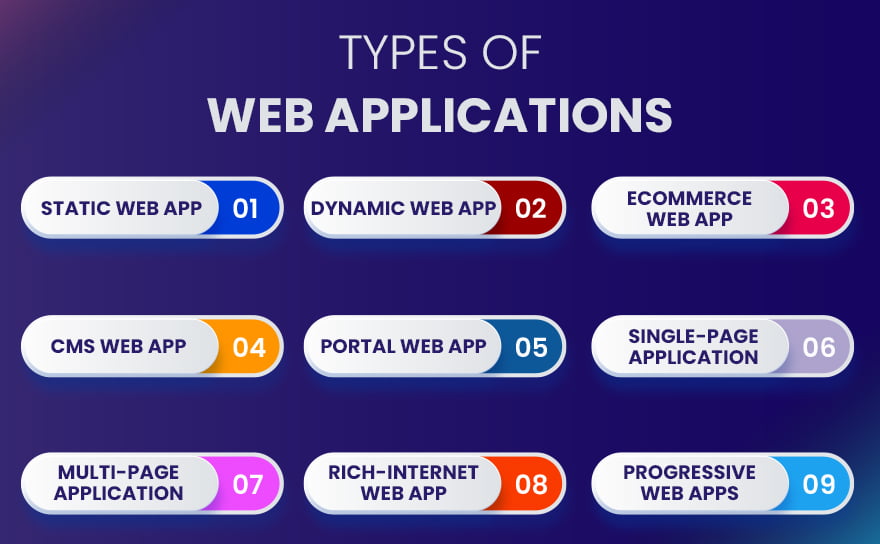
What are the Different Types of Web Applications?

types of web applications

Static Web Application

There is no interaction between the user and the server is known as a static web application. It will simply display the content directly to the user’s browsers irrespective of fetching data from the server side.

Static web apps are developed specifically using simple HTML, CSS, and JavaScript to display relevant content.

To put it simply, GIFs, videos, and animations are the best examples of attracting and engaging visitors for robust web application development. Static web apps are pretty simple and easy to manage.

A company website or a person’s portfolio website are examples of static web apps

Dynamic Web Application

An application that directly interacts with the client to generate real-time data based on the user’s request is referred to as a dynamic web application.

The dynamic web application has multiple interactive elements and functions to enhance user engagement. However, compared to static web applications, web apps that are dynamic are more complex, especially on a technical level.

You’ll come across different platforms that play an essential role in building web apps that are purely dynamic. Some of the common technologies are PHP, ASP.NET, and others.

Facebook is the best example of a dynamic web application. It allows you to log in, communicate with friends, and use the application efficiently.

eCommerce Web Application

An application that takes the form of a store or shop typically promoting buying or selling products online is an eCommerce Web Application.

Some of the core features of an eCommerce web application include:

  • Electronic payment integration
  • Transaction integration
  • Effective management panel for administrators where you can efficiently perform operations like listing/updating/deleting products and managing orders/payments
  • Personal cabinet for potential users

In addition, eCommerce apps are typically centred around leading web technologies like electronic payment gateways, inventory management systems, mobile commerce, supply chain management, and the internet market.

Best examples of eCommerce websites include Amazon, eBay, Walmart, Swiggy, Zomato, etc.

CMS Web App

With the help of content management system (CMS) software, you can quickly create, manage, and modify content on a website, portal, or any other digital platform.

However, it does not require any specific technical knowledge of web programming languages or markup languages.

CMS is the best option for creating personal blogs, corporate blogs, media sources, etc. Let’s highlight the most commonly used content management systems:

  • WordPress: is a well-known and trusted option among individuals and professionals for developing a website. Multiple plugins, themes, and online tutorials are available to build unique and responsive traditional websites irrespective of backup of any technical support.
  • Joomla: is an open-source CMS platform with an intuitive interface that plays a significant role in helping users create, manage, and modify content on a website and blogs.
  • Drupal: is a free CMS with an adaptable interface for designing and building online communities in the application. You can widely use this platform for making personal blogs, online news pages, media, corporate blogs, professional blogs, etc.

Portal Web Application

An application that only allows authenticated and authorized users to access the company’s data is known as a Portal web application.

First of all, let’s understand what a portal is.

Portals allow you to create a personal profile where you can easily add multiple details like chats, emails, comments, and forums with the aim of publishing content on the website. It is the best option for various businesses and enterprises.

The members of the portal are only allowed to access data. So, once the users sign into the portal, the service provider tracks the user’s website activity.

You’ll come across multiple types of web portals that are often associated with different industries.

  • Education portals
  • Student portals
  • Employee portals
  • Banking portals
  • Patient portals

Related Post: Difference Between Website and Web Application

Single-Page Application

A dynamic application that allows you to communicate within a browser without any obstruct directly is a Single-Page Application (SPA).

As compared to standard web applications, requests and responses typically occur quickly. It is made possible by SPA, which executes business logic on the internet browser rather than the server.

During the application deployment process, the SPAs are easy to debug and build the application. While browsing an email app, the headers and sidebars stay intact while accessing your inbox.

Most social network sites, emails, and online video/audio players benefit swiftly from single web applications and agility. Gmail, Paypal, Netflix, Twitter, Google Maps, etc., implement single-page applications.

Are You Planning To Develop Web Application?

Create seamless one-page web applications with Albiorix web development solutions.

Contact Us

Multi-Page Application

As the name suggests, Multi-page applications or MPAs include multiple pages for the application. It simply reloads the complete web page directly from the server whenever a user navigates to a different page.

MPAs are specifically developed using different languages like HTML, CSS, JavaScript, AJAX, jQuery, etc. Moreover, such applications play an essential role in their scalability with no entire page limits and provide vast information about company products.

Examples of MPA s include catalogues, web portals, business web applications, and online stores.

Related Post: jQuery vs Angular

Rich-Internet Web Applications

An application with the same features and appearance as a desktop application is Rich Internet Application.

Such applications primarily include multiple functionalities and are more engaging and faster than standard web-based applications. However, such apps depend on customer-side plugins due to browser limitations.

These applications are built using tools like AJAX, Java, JavaFX, Adobe Flash, and Adobe Flex, the topmost tools used to make Rich Internet applications. The excellent part of this application is that you can use it offline.

Rich internet web apps are visually appealing and provide a great user experience.

Examples of rich-internet web applications are Google Docs, Youtube, and Google Maps.

Progressive Web Apps

A well-known type of web app that looks similar to mobile apps is Progressive Web App (PWA). It is also known as cross-platform web applications.

It uses the latest browser Application Programming Interfaces (APIs) and progressive enhancement methods to offer a native mobile development experience.

PWA’s primary goal is to enhance mobile applications and web applications’ speed and versatility in the face of slow internet connections or lacking internet access. So, you need a stable internet connection for better productivity.

Some notable examples of progressive web applications are MakeMyTrip, Forbes, OLX, and Starbucks.

We Follow Agile Methodology For Web App Development

We offer end-to-end services across a range of platforms, web technologies, and design methodologies to Transform Your Business Through Technology.

Contact Us

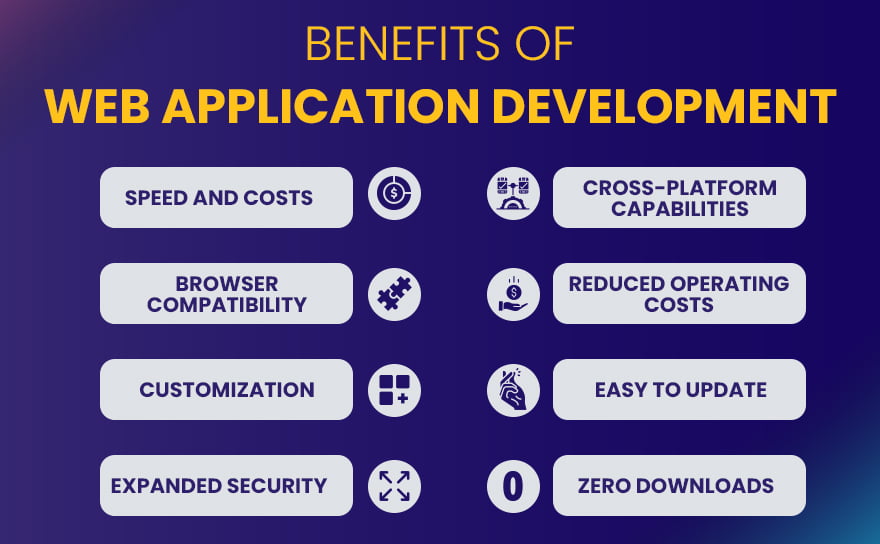
Top Benefits of Web Application Development

benefits of web application development

Web application comes along with an array of benefits for businesses and users.

Speed and Costs

Compared to building a robust native application, the web application development process is faster and more economical. So, web application development for building native apps is the preferred choice for many businesses involved in accelerating time-to-market.

Cross-Platform Capabilities

The applications developed for web browsers can efficiently run on any operating system. The good part of typical web application development is that it supports cross-platform capabilities.

Web applications can quickly adapt well to Android, iOS, Mac OS, Windows, and other mobile phones. In addition, the user’s device responsiveness to web applications helps eliminate OS dependencies.

Browser Compatibility

A web application will have its own accessible URL that allows you to run the app on the device’s browser.

Nowadays, you’ll come across many modern web applications that are compatible with all browsers, such as Google Chrome, Internet Explorer, Firefox, and Bing. Hence, software compatibility challenges are never roadblocks.

Reduced Operating Costs

The first question that generally hits on our mind is how much does it cost to build a website. The answer is that it entirely depends on your business requirements and the number of web app developers you want to hire for your needs.

Web app development is an excellent choice for many business owners as it is solely responsible for reducing operating costs.

Moreover, it eliminates unnecessary expenses such as hardware purchases, constant device updates, and maintenance of numerous systems.

Customization

Custom web application development typically comes up with various benefits that can easily be the best features for other users.

In addition, such apps are accessible via browsers and help reduce unnecessary expenses and save time as only required features need to be developed.

Moreover, it helps you improve business processes, transactions and brand awareness, communicate your brand ideology and help you gain a competitive edge in the chosen target market of the digital world.

Easy to Update

Updating the web application, it’s an easy and ongoing process as it involves only servers to upgrade your website services. There is no involvement in the usage of the front-end development to update.

Expanded Security

You can effectively deal with deploying and building web applications on dedicated servers, and also you can monitor and manage the server by only experienced server administrators.

Similar to desktop applications, monitoring hundreds or thousands of client computers is made easy for you. Moreover, it ensures tighter security and identifies any potential breaches that could slip off.

Zero Downloads

You do not have to go to any app store, such as Apple App Store or Google Play Store, to download web applications. Eventually, it helps save money since having a direct link through a web app is free.

Related Post: Web Application Architecture

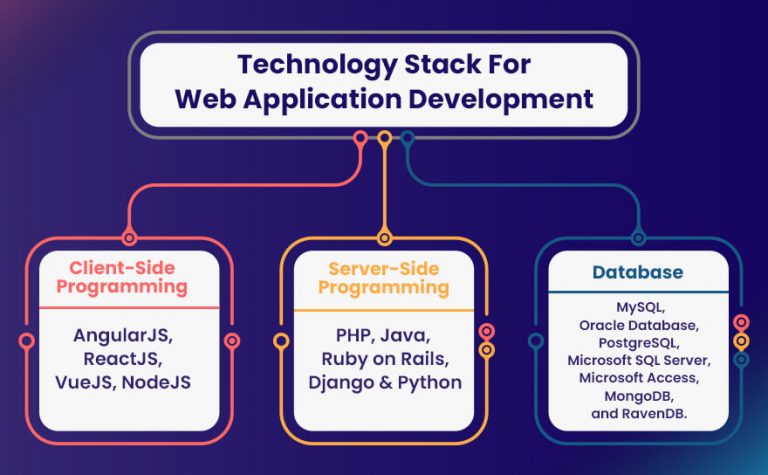
Tech Stack For Web Application Development

Tech Stack For Web Application Development

Client-Side Programming

  • AngularJS:A popular front-end framework by Google, Angular JS is suitable for building dynamic web apps and mobile apps, using HTML for static web pages. Many leading AngularJS development company typically uses this technology to create robust and secure web applications for your business needs.
  • ReactJS:This is a robust and widely used JS and web application framework for developing large-scale and complex dynamic web apps and mobile apps.
  • Vue JS: Fairly new, this JS framework does wonders for applications. Vue JS provides an ecosystem of assisting libraries and an affordable primary library for applying huge complex web page apps.
  • Node JS: It is a cross-platform, open-source JS runtime that runs on the V8 engine and is designed to build scalable network applications.

Server-Side Programming

  • PHP: A popular general-purpose scripting language that helps you build dynamic and interactive websites for your business needs. Moreover, it is a robust tool that is fast, flexible, and pragmatic, designed explicitly for web app development.
  • Java: Leveraged especially for Android app development, desktop app, and web app development. It is a multi-purpose programming language that typically offers excellent security and stability to your web project.
  • Ruby on Rails: An open-source, general-purpose, object-oriented programming language that plays an essential role to build highly secure and fast web applications.
  • Django & Python: Python is flexible, advanced, and has a low learning curve. This programming language covers back-end web app development. Python, along with its framework Django, can meet backend development tasks efficiently.

Database Technology

MySQL is one of the most preferred databases used by multiple developers globally for web application development.

Apart from MySQL, other well-known database technologies like Oracle Database, PostgreSQL, Microsoft SQL Server, Microsoft Access, MongoDB, and RavenDB are currently hitting the market.

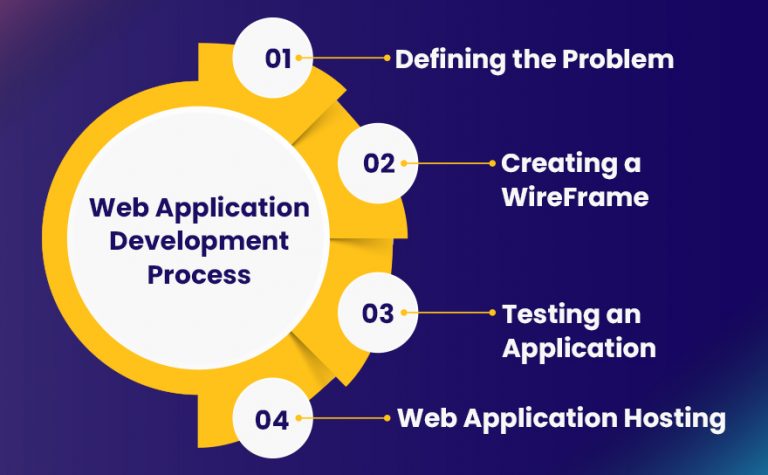
Concept of Web Application Development Process

web application development process

Suppose you plan to design and build web applications for your business needs.

In that case, whether it may be in-house or outsourced to a company like Albiorix, it’s important to understand the web application development functionality involved in detail.

Website development becomes easy once you have a basic understanding of the web development flow. Let’s explore the steps of the web app development process, and remember that steps may vary depending on your business needs.

Step 1: Defining The Problem

First, you need to be ready with all your project requirements. Such requirements should meet the basic needs of your web application and acquire all the essential information for your business needs.

A common problem will opt for a good head-start to the project, and it becomes a boon to help you identify the best solution for your needs. Moving further, you must clarify the website’s purpose and end goals.

The web developers need to answer the below questions for the planning phase of the web application functionality.

  • What is the basic need of the app you want to build?
  • Have you identified the features and functions that should be integrated into your web application?
  • Who will be the target audience of your product?

Step 2: Creating a WireFrame

The next step is developing a robust wireframe, or we can say a detailed prototype, that helps you to communicate the solution to specific target users.

So, the developers need to start by preparing the blueprint of design elements of the web apps, especially to target a specific audience. Such wireframe plays a vital role in getting a mesmerizing user experience to the web application.

The wireframe is then made available to intended users, taken their feedback into consideration, and finally iterated until they’re satisfied. Once you’ve finalized the design process, the next step is to build the application.

The subsequent steps will happen in this essential phase.

  • The developers have to identify the details of data and data types required for the application to create a database for storage.
  • The developers create the front-end applications, typically based on the parameters approved by the users interact during the wireframing process. It becomes essential for the developers to determine the framework for front-end development.
  • The web app developers create user interaction with the server.
  • Developers, especially during web app development, either code from scratch or use web application frameworks like front-end and back-end development frameworks to make responsive websites. Such web application frameworks plays a vital role to design and build web solutions for your business needs.
  • Based on the application type, that is, client-side/ server-side/ single-page, programming is done.

Step 3: Testing an Application

One of the primary steps of the web application development process is testing an application. Moreover, it’s an essential step of the software development lifecycle and is considered an inevitable part of the software development functionality.

The testing of the web application is generally performed for usability, compatibility, functionality, security, and, most importantly, app performance by the testing (QA) crew.

The primary role of the QA (Quality Assurance) squad is to eliminate bugs and ensure that the application works without any glitches.

The Testing process determines any possible improvements and upgrades to make in the future to make the application more responsive. Once you’re done with the testing process, the final implementation of the web application starts.

At Albiorix, we help you perform all the mandatory software and usability testing to ensure that your web app functions seamlessly. We also provide training and support to use the apps effectively.

Step 4: Web Application Hosting

You must buy a domain and choose a hosting provider to create a server location for the app. We help you choose shared hosting, dedicated hosting, or cloud hosting based on your requirements.

Be it a simple website or a complex web application, every digital product needs routine checks and enhancements.

Maintenance of the application or website includes:

  • Ongoing QA testing
  • Bug fixes and improvements
  • Addressing changes and adding features based on user feedback
  • Providing regular updates and technical support

Hire Web Developers from Albiorix

We have a team of dedicated web developers who are experts in analyzing and deploying the need for complex web development projects.

Contact Us

Conclusion

Hope you got a clear vision of the in-depth guide about web application development.

To summarize, Web application development is an essential aspect for any organization to lead the digital space and reach out to more customers in the future.

Albiorix is a custom software development company that comprises multiple development services ranging from software customization to building Web, Mobile, Enterprise, and Cloud applications across various industries.