






Table of Content
- Why Is Python Popular in Fintech?
- Key Benefits of Python for Fintech App Development
- What Can You Build with Python in Fintech?
- Best Python Technologies for Fintech App Development
- Is Python Always the Best Choice for Fintech?
- When Should Your Business Choose Python for Fintech Development?
- Python vs. Other Technologies for Fintech Development
- Conclusion
TL;DR: Key Takeaways
- Python supports rapid fintech product development through readable syntax and mature frameworks.
- Its data and AI/ML ecosystem is particularly valuable for fraud detection, risk management, analytics, and financial modeling.
- Django, FastAPI, Pandas, NumPy, and scikit-learn support different layers of fintech development.
- Python can support scalable fintech architectures but may not be ideal for every ultra-low-latency workload.
- A hybrid or polyglot architecture can combine Python with other technologies where performance requirements demand it.
Choosing the right technology stack is one of the most important decisions when building a fintech product. Financial applications need more than attractive interfaces—they must process sensitive data, integrate with banking and payment systems, support analytics, manage risk, and evolve as regulations and customer expectations change. Python for fintech app development has become a popular option because it combines development speed with a mature ecosystem for data science, artificial intelligence, APIs, automation, and backend engineering. However, Python is not automatically the right choice for every fintech workload. The better question is where Python creates the most business and technical value. This guide explores its advantages, use cases, technologies, limitations, and the situations where businesses should consider Python.
Why Is Python Popular in Fintech?
Python is popular in fintech because it brings together backend development, financial data analysis, automation, and machine learning within one broad ecosystem. Developers can use frameworks such as Django, FastAPI, and Flask for application services while relying on libraries such as Pandas and NumPy for data processing.
For businesses, this ecosystem can reduce development complexity. Teams can prototype an idea, connect external financial APIs, build analytical capabilities, and introduce AI-driven features without maintaining completely separate technology stacks for every function.
Python also benefits from a large developer community and a mature open-source ecosystem. For businesses, this makes it easier to hire Python developers, access specialized fintech development expertise, maintain existing applications, and add new features as the product evolves. This strong talent pool can also help organizations reduce development bottlenecks and scale their fintech products more efficiently over time.
Key Benefits of Python for Fintech App Development
1. Faster Development and Time to Market
Python’s readable syntax and mature frameworks can accelerate fintech application development. Teams can use established components rather than building common functionality from scratch.
This is particularly useful for fintech startups developing an MVP or businesses testing a new financial service. Faster iteration allows product teams to validate features, respond to user feedback, and prioritize investments based on actual product requirements.
2. Powerful Financial Data Analysis and Modeling
Fintech applications often depend on large volumes of financial data. Python provides a strong foundation for processing, analyzing, and modeling that information.
Pandas supports structured data manipulation, while NumPy provides numerical computing capabilities. SciPy can support scientific and statistical workloads.
Together, these tools can help teams build financial analytics, forecasting workflows, reporting systems, financial models, and data-driven decision-making tools.
3. Strong AI and Machine Learning Capabilities
One of Python’s biggest advantages in fintech is its AI and machine learning ecosystem. Libraries such as scikit-learn, PyTorch, and TensorFlow can support the development of machine learning models for financial applications.
Potential use cases include:
- Fraud detection and prevention
- Credit scoring
- Risk prediction
- Transaction monitoring
- Predictive analytics
- Customer personalization
- Financial forecasting
This makes Python particularly attractive when AI and data intelligence are central to the product roadmap.
4. Flexible API and Backend Development
Modern financial applications rarely operate in isolation. They often need to communicate with banking systems, payment gateways, identity platforms, financial data providers, and other third-party services.
Frameworks such as Django, FastAPI, and Flask can support REST APIs, backend services, integrations, and microservice architectures.
For example, FastAPI can be useful when a fintech product needs modern API services, while Django provides a broader framework for building feature-rich web applications.
Planning a Fintech App? Let’s Discuss Your Requirements
Talk to our fintech development experts about the right technology stack for your application:
Talk to Our Fintech Experts
5. Cost Efficiency
Python can contribute to cost efficiency through its open-source ecosystem, reusable libraries, developer availability, and relatively fast development process.
Lower complexity can also make applications easier to maintain and modify. However, development cost depends on factors such as product scope, integrations, security requirements, compliance obligations, team composition, and architecture. Python itself does not guarantee a lower project cost.
6. Scalability and Architectural Flexibility
Python can be used as part of scalable fintech architectures, including cloud-based systems and microservices.
A growing fintech platform might separate authentication, payment processing, analytics, risk services, and other functions into independent services. Python can power several of these components while integrating with databases, queues, APIs, and cloud infrastructure.
The important distinction is that Python is not automatically scalable simply because it is Python. Scalability depends on architecture, infrastructure, database design, caching, monitoring, traffic patterns, and engineering practices.
7. Security and Maintainability
Financial applications require careful attention to security. Python does not make a fintech application secure by itself, but its mature development ecosystem can support disciplined engineering practices.
Production fintech systems should consider authentication and authorization, API security, dependency management, encryption, testing, logging, monitoring, vulnerability management, and compliance requirements.
Readable code can also make long-term maintenance easier when combined with strong development standards, automated testing, documentation, and code review.
8. Large Developer Ecosystem
Python has a broad developer ecosystem spanning web development, data science, AI, automation, and enterprise software.
For fintech companies, this can make it easier to assemble teams with complementary skills. A business may need backend developers, data engineers, machine learning specialists, and API developers, and Python can appear across several of these disciplines.
What Can You Build with Python in Fintech?
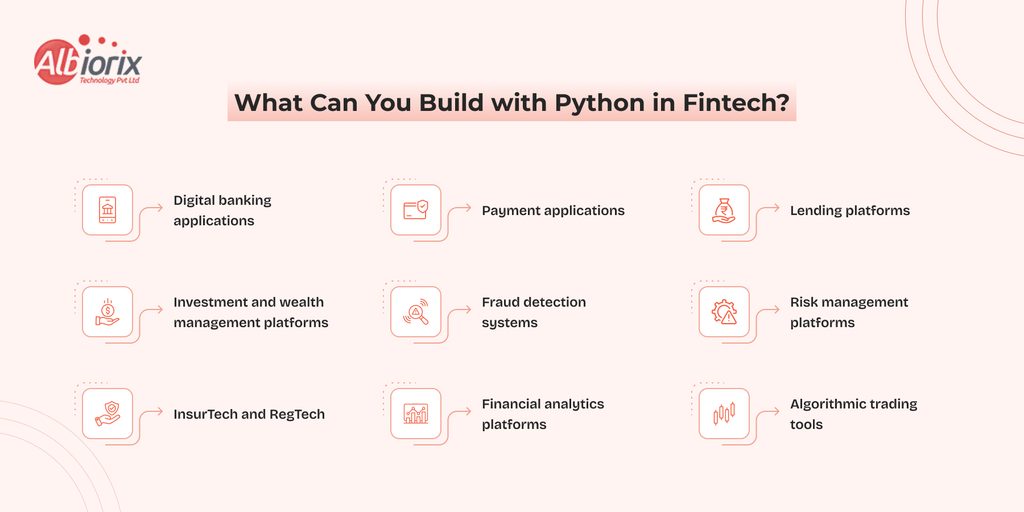
Python Development can support a wide range of fintech applications, although the appropriate architecture depends on the product.
Digital banking applications: Python can power backend services, APIs, automation, and data-driven features.
Payment applications: Python can support payment-related APIs, transaction workflows, integrations, and supporting services.
Lending platforms: Teams can use Python for credit scoring, financial analysis, risk modeling, and automated decision-support systems.
Investment and wealth management platforms: Python is useful for portfolio analytics, financial modeling, predictive analysis, and robo-advisor capabilities.
Fraud detection systems: Machine learning models can analyze transaction patterns and identify potentially suspicious activity.
Risk management platforms: Python’s data and statistical ecosystem can support risk analysis and predictive modeling.
InsurTech and RegTech: Python can support analytics, automation, compliance workflows, and transaction monitoring.
Financial analytics platforms: Pandas, NumPy, and related tools make Python suitable for processing and analyzing financial datasets.
Algorithmic trading tools: Python is widely useful for research, modeling, strategy development, and analysis, although execution systems with extreme latency requirements may require other technologies.
Best Python Technologies for Fintech App Development
| Technology | Purpose in Fintech | Business Benefit |
|---|---|---|
| Django | Web applications and backend services | Faster development of structured applications |
| FastAPI | APIs and backend services | Efficient API development and integration |
| Flask | Lightweight web services | Flexibility for focused services |
| Pandas | Financial data processing | Faster analysis and reporting |
| NumPy | Numerical computing | Supports financial calculations and modeling |
| SciPy | Scientific/statistical workloads | Useful for advanced analytical tasks |
| scikit-learn | Machine learning | Supports predictive models and fraud/risk use cases |
| PyTorch/TensorFlow | AI and deep learning | Enables advanced AI-driven financial applications |
Is Python Always the Best Choice for Fintech?
No. Python is powerful, but it is not the ideal technology for every fintech component.
Ultra-low-latency workloads, high-frequency trading execution, CPU-intensive services, and certain performance-critical transaction systems may benefit from technologies such as C++ or other specialized approaches.
A fintech software service can also use a polyglot architecture. For example, Python might handle machine learning, analytics, APIs, automation, and orchestration while another language handles a highly performance-sensitive component.
The right decision should be based on workload characteristics rather than choosing a language simply because it is popular.
When Should Your Business Choose Python for Fintech Development?
Python is particularly attractive when your fintech product requires:
- AI or machine learning
- Financial data analysis
- Financial modeling
- Fraud detection
- Risk management
- Rapid MVP development
- API integrations
- Automation
- Predictive analytics
- Frequent product iteration
Businesses should consider alternative technologies when extremely low latency, specialized hardware optimization, or specific performance requirements dominate the architecture.
Turn Your Fintech Idea Into a Scalable Product
Get expert guidance on architecture, Python development, AI/ML, APIs, security, and integrations:
Discuss Your Fintech Project
Python vs. Other Technologies for Fintech Development
There is no universal winner between Python, Java, Node.js, C++, or JavaScript/TypeScript.
Choose Python when data science, AI/ML, financial analytics, rapid development, automation, and API development are important parts of the product.
Consider Java when a project requires a mature enterprise ecosystem and large-scale backend services with specific organizational or architectural requirements.
Consider C++ when extremely low latency and high-performance computing are critical.
Consider Node.js or TypeScript when the product benefits from a JavaScript/TypeScript-centered development environment and highly asynchronous API workloads.
In many production fintech systems, the strongest architecture may combine multiple technologies rather than forcing every component into one language.
Conclusion
Python is a strong choice for fintech app development when a product depends on financial data, AI/ML, analytics, automation, API integrations, or rapid product iteration. Its mature ecosystem can help businesses build and evolve digital banking, lending, payment, investment, fraud detection, and risk management solutions efficiently.
If you are planning a fintech application, start by defining the business requirements and technical priorities before choosing the technology stack. An experienced fintech development team can help determine where Python provides the most value and design an architecture that balances speed, scalability, security, maintainability, and long-term business growth.
Ready to Build Your Fintech Application?
Let’s evaluate your requirements and determine where Python can deliver the most value for your fintech product:
Get a Fintech Development Consultation →
Connect with Our Experts!
FAQ
Yes. Python is well suited to many fintech applications because it supports backend development, APIs, financial data analysis, automation, and AI/ML. It is especially valuable for products involving fraud detection, risk modeling, analytics, and data-driven financial services.
Python is used in financial technology because its ecosystem supports both software development and data-intensive workloads. Developers can use frameworks such as Django and FastAPI alongside tools such as Pandas, NumPy, and machine learning libraries.
Python can be used to build secure fintech applications, but the language itself does not guarantee security. Security depends on architecture, secure coding practices, authentication, authorization, dependency management, infrastructure, testing, monitoring, and applicable compliance requirements.
Yes. Python can support banking application backends, APIs, automation, analytics, transaction-related services, and AI-driven features. However, banking systems often use multiple technologies, so Python may be one component within a broader architecture.
Python can participate in scalable fintech architectures using appropriate infrastructure, databases, caching, APIs, queues, and service decomposition. Scalability depends on the overall architecture and workload. Python may not be the best choice for every extremely latency-sensitive component.
Django, FastAPI, and Flask are common choices for different backend requirements. Django is useful for structured web applications, FastAPI is well suited to API services, and Flask offers a lightweight approach. The best framework depends on the product architecture and engineering requirements.
Python can support payment applications through backend services, payment gateway integrations, APIs, transaction workflows, and supporting analytics. Payment systems still require careful architecture, security controls, monitoring, testing, and compliance considerations.
There is no single fixed cost. The budget depends on application complexity, features, integrations, security requirements, compliance needs, team size, AI/ML capabilities, and infrastructure. Python can influence development efficiency, but the complete product scope determines the overall investment.
Published Blogs
Latest Blogs : Insights and Innovations from Our Blog
Stay Ahead in Tech: Dive into our Blogs for the Latest in Software, Web, and Mobile App Development. Explore cutting-edge technologies, industry trends, and insightful updates that keep you at the forefront of the digital landscape


Our Clients

Client Showcase: Trusted by Industry Leaders
Explore the illustrious collaborations that define us. Our client showcase highlights the trusted partnerships we've forged with leading brands. Through innovation and dedication, we've empowered our clients to reach new heights. Discover the success stories that shape our journey and envision how we can elevate your business too.










We’re here to help you


