




Better Reasons to use Angular for Web Development

Developed in 2009 by Misko Hevery and Adam Abrons, AngularJS made a groundbreaking entry into the development world in 2010, capturing attention with its innovative approach.

Fast forward over a decade, and AngularJS has evolved, shedding its JavaScript origins to become the widely embraced Angular, now powered by TypeScript.

Currently, over 4 million websites use Angular. It is one of the top choices for custom web development. Its appeal lies in its efficiency, rapid development capabilities, and seamless integration into various platforms.

Web app developers and entrepreneurs alike are drawn to Angular for crafting robust and scalable web applications.

As a platform, Angular boasts an extensive array of features and functionalities, propelling it to the forefront as the preferred choice for enterprise-scale web development projects.

The question arises: what sets Angular apart from its competitors? Delve into the discussion ahead as we explore the distinctive features, functionalities, capabilities, and compelling reasons to “Choose Angular for Your Next Web Development”.

What is Angular?

Angular stands out as a robust and user-friendly front-end framework crafted by Google, empowering developers to craft dynamic and responsive web applications.

This tool excels in facilitating the creation of seamless user experiences, particularly through the development of single-page web applications (SPAs), making it an indispensable asset in the realm of modern web development.

Furthermore, Angular’s open-source nature contributes to its strength, fostering a large and vibrant community. This community support translates into extensive documentation and assistance for developers navigating the intricacies of the framework.

Since its initial launch, Angular has undergone significant evolution, marked by several major updates. Currently, the framework is advancing with Angular 16 released and v17 in the pipeline.

These updates underscore Angular’s commitment to remaining at the forefront of contemporary web development practices.

Angular – The Framework for Modern Web Experiences!

Craft modern, user-friendly web experiences effortlessly with Angular. From its comprehensive toolset to its robust community support, Angular is the framework that defines modern web development.
The smart choice for your projects – Angular!

Reasons Why Angular is the Best for Web Development

Choosing a front-end framework for web development is a crucial decision, and Angular has gained popularity for several reasons.

Here are some key factors that make Angular a compelling choice for web development projects:

Reasons-Why-Angular-is-the-Best-for-Web-Development

1. Modularity and Code Organization

Angular promotes a modular approach to building applications. The framework is based on components, which are self-contained and reusable building
blocks. This makes it easier to organise and maintain code, especially in large and complex projects.

2. Two-Way Data Binding

Angular utilizes two-way data binding, meaning that user interface changes automatically update the underlying data model and vice versa. This simplifies the development process and reduces the amount of boilerplatecode needed to keep the UI and data in sync.

3. Dependency Injection

Angular comes with a built-in dependency injection system. This helps manage the components’ dependencies and promote the development of loosely coupled and more maintainable code. Dependency injection also facilitates unit testing by making it easier to mock and test individual components.

4. TypeScript Integration

Angular is built with TypeScript, a superset of JavaScript that adds static typing. This brings enhanced tooling, autocompletion, and compile-time error checking to the development process, resulting in more robust and maintainable code.

5. Official Support from Google

Angular is developed and maintained by Google. This backing provides stability and assurance that the framework will be well-supported and updated with the latest features and security patches.

6. Powerful CLI (Command Line Interface)

Angular’s CLI simplifies the process of creating, building, testing, and
deploying Angular applications. It comes with a range of commands that automate common development tasks, streamlining the workflow for developers.

7. Rich Ecosystem and Third-Party Libraries

Angular has a vibrant ecosystem with a wide range of third-party libraries and extensions. This can save development time and effort, as developers can leverage existing solutions for common functionalities.

8. Cross-Platform Development

With technologies like Angular Universal and Angular for NativeScript,
developers can use Angular to build not only web applications but also server-side rendered applications and mobile apps, providing a comprehensive solution for cross-platform development.

9. Community Support

Angular has a large and active community of developers. This means that finding solutions to common problems, accessing tutorials, and staying updated with best practices are made easier through community contributions and support.

10. Mature and Well-Documented

Angular has been around for a while, and it has evolved into a mature and well-documented framework. The documentation is comprehensive, making it easier for developers to understand the framework and find answers to their questions.

    These features make it a strong contender, especially for large-scale applications where modularity, maintainability, and a comprehensive ecosystem are critical considerations.

    What are the Limitations of Angular?

    While Angular is a powerful and widely used front-end framework for web development, it’s important to consider some potential drawbacks. Below are some of the challenges that you might face at the time of Angular development:

    1. One notable concern is the sharp learning curve, especially for beginners, due to its complex architecture and various concepts such as modules, decorators, and dependency injection. The framework’s extensive structure may lead to initial development delays as developers grasp these intricacies.
    2. Second, the generated code in Angular applications can be bulkier compared to other frameworks, potentially impacting performance, especially in scenarios where bandwidth is limited.
    3. The third consideration is that frequent updates and changes in Angular versions may necessitate adjustments in existing projects, which can be time-consuming.

    Despite these drawbacks, the benefits of Angular often outweigh the cons, and the framework continues to be a popular choice for building sophisticated web applications.

    However, if you are still confused about whether Angular is the best for custom web development or not, then a free consultation is just a call away.

    Experienced Angular developers can suggest the most suitable solutions based on your requirements and budget. Get connected for free, today!

    Different Types of Websites Developed Using Angular

    Albiorix stands out as a top-rated Angular development company. Our team of experienced Angular developers has successfully developed a wide range of Angular development projects across various industries and domains.

    Possessing deep technical expertise and a solid understanding of key Angular concepts, our talented developers excel in designing, developing, and rigorously evaluating enterprise-grade Angular applications.

    Based on our experience, below are the different types of websites that can be developed using Angular:

    • Single Page and Enterprise Applications
    • Fintech and Entertainment Websites
    • E-commerce Websites
    • Content Management Systems (CMS)
    • Social Networking Platforms
    • Data Dashboards and Analytics Tools
    • Educational Platforms
    • Real-Time Applications
    • Travel and Booking Websites
    • Portfolio Websites and Blogs
    • Government and NGO Websites

    Angular is a powerful and versatile framework for web development that can be applied to a diverse range of web development projects, from small interactive websites to large-scale enterprise applications.

    Ready to supercharge your web development?

    Choose Angular and witness the difference. From enhanced performance to a modular architecture, Angular provides the tools you need for a seamless development journey.

    Power Up Your Development Journey!

    Conclusion

    Considering developing a website or web application with Angular but unsure if it’s the ideal fit for your project? No need to worry. Reach out to our team of skilled Angular developers and project managers for a comprehensive evaluation.

    Through a complimentary consultation call, we’ll delve into your project details, goals, and expectations.

    Based on this discussion, we’ll help determine whether Angular aligns seamlessly with your future endeavours or if an alternative approach might be more suitable.

    Share your contact details with us using the Contact Us form or call us at +1 (912) 528-5566 or (+61) 489-940-484.

    Don’t just build for today, build for the future! Angular ensures your web projects are not only cutting-edge but also future-proof.

    Make the smart choice – choose Angular for your next web development endeavour and stay ahead of the curve. | Future-Proof Your Web Projects with Angular!

    We are also active on social media platforms such as LinkedIn and Facebook, you can also drop us a message over there.

    How Mobile Apps Are Improving the Healthcare Industry

    Healthcare mobile application development is on the rise, and the foremost reason behind its booming demand is the ease and convenience it offers to healthcare service providers and patients.

    Especially after the COVID-19 pandemic, the integration of medical mobile apps and software has significantly helped and streamlined the healthcare industry.

    It has introduced the next level of convenience and efficiency that has transformed the way individuals engage with healthcare services.

    The everyday use of healthcare software and mobile apps has simplified appointment scheduling and many other tasks, allowing users to book and manage their medical appointments and treatments with ease.

    As a result of all these benefits, a drastic spike has been observed in the need for bespoke healthcare IT consulting services.

    And, if you are a medical professional looking for ways to efficiently serve your patients and join the ongoing trends, then it’s time to contact a healthcare mobile app and software development company.

    In this blog, we will discuss healthcare apps and software, how it is shifting the global healthcare market, and more. However, let’s first understand what mobile healthcare apps and software are.

    What Are Mobile Healthcare Apps and Software?

    Mobile healthcare apps and software refer to applications and digital tools designed to provide health-related services and information through mobile devices such as smartphones and tablets.

    These Healthcare applications cover a broad spectrum of functionalities, ranging from appointment scheduling and medication management to telemedicine services and health monitoring.

    Mobile healthcare apps and medical software aim to empower users by offering convenient access to health resources, facilitating remote consultations with healthcare professionals, and promoting proactive health management.

    They often integrate with wearable devices to track vital signs and activity levels, fostering a comprehensive approach to personal health.

    These apps contribute to the digitization of healthcare, enhancing patient engagement, streamlining processes, and ultimately improving the accessibility and efficiency of healthcare services in the modern, interconnected world.

    Why Medical App Development and Healthcare App Development Are in Demand?

    Why The call for mobile healthcare apps has become imperative in today’s fast-paced and interconnected world due to their ability to address critical healthcare needs with unparalleled accessibility and convenience.

    With the ubiquity of smartphones, these apps offer users the power to manage their health proactively, providing features such as remote consultations, medication tracking, and health data monitoring at their fingertips.

    In an era where timely access to healthcare is crucial, mobile healthcare apps bridge gaps, enabling individuals to schedule appointments, receive medical advice, and monitor their well-being from the comfort of their homes.

    The urgency for such applications is underscored by the potential to enhance healthcare accessibility, streamline processes, and empower users to take charge of their health in an increasingly digital and interconnected landscape.

    Global Healthcare Market Statistics are Impressive

    According to Statista, in 2023, the current number of smartphone users in the world today is 6.92 billion, meaning 85.74% of the world’s population owns a smartphone.

    This amazing data is the reason why every industry is forced to adopt the smartphone revolution, and the global healthcare industry is no exception.

    The penetration of mobile apps and software is deep in the healthcare and medical industry.

    Every doctor, patient, hospital, and medical professional is using mobile apps and software to ease their day-to-day tasks and to offer a more precise treatment to their patients.

    If we look at the statistics at Statista, the worldwide healthcare market is projected to reach $57.86 billion by the year 2023, exhibiting a compound annual growth rate (CAGR) of 10.40% from 2023 to 2027.

    This growth is anticipated to culminate in a market size of $85.95 billion by the end of 2027.

    Additionally, according to data on Statista, there were approximately more than 51K apps on the Apple App Store and 52K healthcare apps on the Google Play Store in the first quarter of 2022.

    Mobile healthcare apps are here to stay as they offer a range of features to improve health outcomes, increase access to healthcare services, and enhance overall well-being.

    Curious about implementing mobile solutions in your healthcare practice?

    Schedule a consultation with our experts to explore how mobile apps can enhance your services. Contact us to book your session!
    Schedule a Consultation

    How Mobile Apps Are Changing the Healthcare Industry?

    Now, as we have gone through the healthcare mobile apps data and statistics that are motivating, let’s understand why mobile healthcare apps and healthcare software are gaining so much popularity among healthcare professionals and patients equally.

    What are the benefits of healthcare apps that lead to the exponential use of apps and software across the world? Let’s find out.

    How Mobile Apps Are Changing the Healthcare Industry
    1. Convenient Access to Information: Users can easily access medical information, track health metrics, and view personalized health data from the convenience of their mobile devices.
    2. Appointment Scheduling and Reminders: Mobile apps streamline the appointment scheduling process, allowing users to book, reschedule, or cancel appointments with healthcare providers. Reminders and notifications help patients stay on track with their appointments and follow-up care.
    3. Telemedicine and Virtual Consultations: Healthcare apps facilitate virtual consultations, enabling patients to consult with healthcare professionals remotely, reducing the need for in-person visits. This feature is particularly beneficial for individuals with mobility issues or those in remote locations.
    4. Medication Management: Apps provide medication reminders, helping users adhere to prescribed medication schedules. Medication tracking features assist both patients and healthcare providers in monitoring and managing medication adherence.
    5. Health Monitoring and Wearable Integration: Integration with wearables allows users to monitor and track vital signs, physical activity, and other health metrics in real-time. Continuous health monitoring enables early detection of potential issues and promotes proactive health management.
    6. Personalized Wellness Plans: Many healthcare apps offer personalized wellness plans based on individual health goals. Users can access tailored fitness routines, nutrition advice, and other resources to support their overall well-being.
    7. Health Records and Data Security: Users can maintain digital health records, providing a centralized repository for medical history, test results, and other essential information. Robust security measures are implemented to safeguard sensitive health data and ensure compliance with privacy regulations.
    8. Mental Health Support: Some apps focus on mental health, offering features such as stress management tools, meditation exercises, and access to mental health professionals. Mental health tracking features help users monitor their emotional well-being and seek timely support.
    9. Educational Resources: Healthcare apps often provide reliable and accessible health information, empowering users to make informed decisions about their health. Educational content covers a wide range of topics, promoting health literacy among users.
    10. Community Engagement: Some apps foster community engagement by connecting users with similar health interests or conditions. Support forums and community features provide a platform for users to share experiences and seek advice
    11. Chronic Disease Management: Apps equipped with features for tracking symptoms and managing chronic conditions empower individuals to actively participate in their healthcare. Remote monitoring capabilities enhance the management of chronic diseases, reducing the need for frequent in-person visits.

    In summary, Mobile Healthcare Apps and software contribute to a patient-centric approach by offering convenience, accessibility, and personalized health solutions. These apps play a crucial role in preventive care, chronic disease management, and overall health promotion.

    What are The Different Types of Healthcare Apps and Software Offered in the Market?

    Numerous mobile Healthcare apps and software populate the market, with new ones continuously emerging and evolving.

    These applications serve various purposes, catering to health professionals, patients, and medical facilities based on their specific functionalities.

    To provide a glimpse into the diverse landscape, let’s explore some of the most prevalent types of healthcare applications:

    Healthcare Apps and Software Offered in the Market

    Healthcare Apps for Patients

    Explore a range of innovative applications designed to enhance your well-being:

    1. Health Monitoring Apps: Seamlessly track and analyze various aspects of your health.
    2. Assistive Reminder Apps: Stay on top of your healthcare routine with helpful reminders and prompts.
    3. Wellness and Fitness Companions: Discover applications that go beyond basic fitness tracking, providing holistic wellness support.
    4. Apps for Tracking Women’s Health: Tailored solutions to monitor and manage women’s health, promoting a proactive approach.
    5. Self-Diagnostic Tools: Empower yourself with reliable tools for self-assessment and preliminary health insights.
    6. Exercise Monitoring Applications: Elevate your fitness journey with apps dedicated to tracking and optimizing your workouts.
    7. Apps for Mental Well-Being: Prioritize your mental health with interactive and supportive applications.
    8. Dietary Tracking Companions: Effortlessly monitor your nutritional intake and make informed choices for a healthier lifestyle.

    Healthcare and Medical Apps for Institutions

    Efficiently manage various aspects of healthcare operations with specialized apps:

    1. Appointment Management Apps: Streamline your scheduling processes for seamless patient appointments.
    2. Billing Management Apps: Simplify financial tasks and enhance accuracy in billing procedures.
    3. Clinical Assistance App with EHR and EMR Access: Access comprehensive Electronic Health Records (EHR) and Electronic Medical Records (EMR) through a user-friendly clinical assistance application.
    4. Inventory Management Apps: Optimize and control your inventory with dedicated applications designed for healthcare institutions.

    Medical and Healthcare Apps for Medical Professionals

    Elevate your practice with specialized applications designed for medical professionals:

    1. Remote Monitoring Apps: Stay connected and monitor patient health remotely with intuitive applications.
    2. Appointment Management Apps: Effortlessly organize and optimize your schedule for seamless patient appointments.
    3. Telemedicine Apps: Embrace the future of healthcare delivery through innovative telemedicine applications.
    4. Video Conferencing Apps: Foster efficient communication and collaboration with dedicated video conferencing solutions.

    Mobile healthcare apps and software are of many different types, and they keep on evolving with new features and functionalities.

    The mobile healthcare app development industry cannot be bound within the boundary as it keeps evolving with the latest technological evolutions.

    See the future of healthcare in action!

    Request a demo of our mobile health solutions to experience firsthand how technology is transforming patient care. Schedule your demo now!

    Request a Demo

    Why As a Medical Professional You Need a Custom Healthcare App and Software?

    Healthcare app development and mobile healthcare software development is the call of the time. It helps you offer enhanced treatment and care to your patients but also offers you a much-needed competitive edge over your competitors.

    In the dynamic landscape of healthcare, the need for custom healthcare apps and software tailored to the unique requirements of medical professionals is increasingly evident.

    These customized solutions offer streamlined workflows, improved patient care, and enhanced operational efficiency.

    A custom healthcare app can centralize patient records, facilitate seamless communication, and provide tools for diagnostics and treatment planning, ultimately saving time and reducing administrative burdens.

    Additionally, personalized software allows medical professionals to stay abreast of the latest advancements, ensuring that their practice aligns with the ever-evolving standards of patient care.

    By investing in a custom healthcare app, medical professionals can optimize their work processes, enhance patient outcomes, and contribute to the overall advancement of healthcare services.

    Contact a Healthcare Software Development Company

    If you need innovative and tailored solutions to meet the evolving demands of the healthcare industry, consider reaching out to a healthcare software development company.

    These specialized firms possess the expertise to design and develop cutting-edge software solutions that address the unique challenges and requirements of the healthcare sector.

    Whether looking for custom healthcare apps, patient management systems, or advanced diagnostic tools, a software development company can provide comprehensive and reliable solutions.

    By engaging with such experts, you ensure that your healthcare software aligns with industry standards, enhances operational efficiency, and ultimately contributes to delivering high-quality patient care.

    Contact a healthcare software development company today to explore how technology can elevate your healthcare services.

    Conclusion

    Do you want to develop a HIPPA and GDPR-compliant mobile app and software?

    Albiorix Technology invites you to experience the cutting-edge solutions of HIPAA and GDPR-compliant mobile apps and software at cost-effective rates.

    Our team of mobile app developers is committed to data security and privacy aligning with the stringent requirements of HIPAA and GDPR standards, ensuring that your sensitive health and personal information is handled with the utmost care.

    If you are worried about the Healthcare mobile app development cost and don’t want to get started without any concrete discussion, then we are here to offer you a free, no-obligation quote and app analysis.

    By obtaining a free quote, you can explore the tailored offerings of Albiorix Technology, guaranteeing not only innovative and user-friendly mobile applications but also a steadfast commitment to regulatory compliance.

    Why wait? Elevate your digital experience with our secure and compliant solutions by requesting a free quote today. For a free quote, share your app requirements with us or talk to our talented mobile app development team at +1 (912) 528-5566 or (+61) 489-940-484.

    For custom mobile healthcare app development, you can also drop us a message on Facebook and LinkedIn, and we will get back to you at the earliest.

    How To Hire Angular Developers: Key Tips You need to know

    Angular is one of the most popular and trending open-source TypeScript frameworks used for web app development and mobile application development. Its popularity is increasing because more and more amazing solutions are being created with Angular.

    It’s versatile and can be used for different web development tasks to enhance your app or website with the features you need.

    Angular is not limited to custom web and app development, but you can hire angular developers to create a wide range of robust software solutions as per your business needs that too without breaking your bank account.

    Custom Angular Development is the call of the time, especially if you are looking for bespoke software solutions for your business. You have to hire an angular developer to work on this flexible and feature-rich framework.

    The team of experienced Angular developers can easily create Single-Page Applications (SPAs) in no time with multiple functionalities backed with an engaging user interface.

    However, the real questions arise: How to find the best Angular Development Company or from where to hire talented Angular developers over the web?

    We are Albiorix, a custom software development company, and we are here to help you find the most talented pool of angular developers for your next digital venture.

    So, stay tuned to this blog on “Things to Things You Should Know Before Hiring Angular Developers”. First of all, let’s understand in detail “What is Angular?

    What is Angular?

    Angular is a term that refers to the newer versions that came after AngularJS or Angular 1. It’s the latest and most advanced platform for building responsive and interactive websites.

    The history of Angular goes back to 2009 when Google engineers Adam Abrons and Misko Hebery created the first version called Angular 1, which was officially released in 2010.

    Since then, the Angular team has released several versions. The initial version, AngularJS, was used for creating dynamic single-page applications.

    In 2016, Google completely reworked the AngularJS framework and introduced Angular 2, and all subsequent versions are collectively referred to as Angular. Do you want to see some of the sample work of Angular Development? Have a look at Our Portfolio.

    Difference between Angular and AngularJS

    The main difference between Angular and AngularJS is that Angular is a complete rewrite and a more modern version of AngularJS. Angular is designed to be faster, more efficient, and suitable for building complex, dynamic web applications.

    AngularJS, on the other hand, is the original version, and it’s older and less powerful in comparison. Angular provides a more robust and structured framework for web development, while AngularJS is best for simpler, less demanding projects.

    AngularJS vs Angular: Which to Choose?

    If you are about to build a new web application for your business, it’s best to go with Angular, especially if you need Server-Side Rendering (SSR) and component-based JavaScript frameworks.

    For existing AngularJS websites, it’s still a viable option, especially for advanced web apps and Blockchain solutions.

    AngularJS is also good for building single-page apps that provide a great user experience. However, in terms of performance, Angular is significantly faster than AngularJS, about five times faster. It also supports all mobile devices, while AngularJS doesn’t.

    Angular offers more language choices like TypeScript, JavaScript, PureScript, Dart, and others, whereas AngularJS only supports JavaScript.

    Thus, you need to make the choice based on your project requirements or contact an Angular Software Development company for guidance.

    For more detailed information on Angular vs AngularJS read our blog now and pave the way for a brighter, more efficient future in frontend development!

    Let’s Discuss Your Angular Project

    Schedule a consultation with our experts today. We’re eager to hear about your project, offer insights, and discuss how our talented developers can bring your vision to life. Let’s build something extraordinary together.
    Empower Your Project – Contact Us!

    Things You Should Know Before Hiring Angular Developers

    Angular developers specialize in creating fast and efficient software with interactive frontends for web and mobile applications.

    They work closely with backend developers to make sure the single-page application (SPA) meets the defined requirements and technical standards. Thus, for powerful angular software development, you must hire talented developers.

    Below are some of the aspects that you need to consider before hiring angular developers:

    Things You Should Know Before Hiring Angular Developers
    1. Skills and Expertise: Ensure that the developers have a strong understanding of Angular and its related technologies like TypeScript, HTML, and CSS. Check their experience with the specific version of Angular you intend to use. Instead of hiring an Angular Developer, you can also ask for a free trial of 10-15 days (about 2 weeks).
    2. Cost and Budget: Consider your budget and negotiate a reasonable rate with the developers. Keep in mind that experienced developers may charge higher rates. Many top Angular development companies offer cost-effective Angular software development services.
    3. Knowledge of Angular Ecosystem: For robust Angular Software Development, familiarity with Angular libraries, tools, and extensions is valuable. Check if they can integrate third-party libraries and plugins when needed.
    4. Version Compatibility: Ensure that the developers are up to date with the latest Angular version and its features, as using an outdated version may cause compatibility issues.
    5. Portfolio and Projects: When you are in talks with an Angular Development Company, review their previous work and projects to assess their abilities and see if they align with your project’s requirements.
    6. Problem-Solving Skills: Angular developers should be skilled at troubleshooting and solving complex issues that may arise during development.
    7. Communication Skills: Effective communication is crucial for collaboration and project success. Make sure the developers can communicate with your team and understand your project’s goals. Moreover, efficient communication ensures development in the right direction.
    8. Performance Optimization: Angular developers should be capable of optimizing the performance of your application, ensuring it runs smoothly and efficiently.
    9. Security Awareness: Security is vital in web development. Verify that the developers follow best practices for securing your Angular application and handling sensitive data.
    10. Timeframe: Discuss the project’s timeline and confirm that the developers can meet your deadlines. If development is getting delayed due to one or the other reasons, make sure you are aware of it.

    Hiring Angular Developers is Easy With Albiorix

    If you are planning to hire an angular developer or a team of angular developers, then Albiorix is the ultimate destination. Here, we have a team of experienced, skilled, and certified angular developers for web and mobile application development.

    Flexible and unique hiring models make us an even more customer-centric angular development services provider over the web. Whether you want to hire a single developer or an entire team, we have a plan for fitting your budget and project requirements.

    To hire angular developers, please call us at +1 (912) 528-5566 (US) or (+61) 489-940-484 (Aus) or share your details with us. To have a look at our previous angular software development work, please visit our portfolio.

    For more such technology blogs, kindly follow us on LinkedIn.

    Future Of Sports Betting Apps: Latest Trends and Best Innovations

    Betting apps are mobile applications designed for sports enthusiasts and gamblers to place bets on various sporting events and activities worldwide.

    These apps provide a convenient and user-friendly platform for individuals to wager money on the outcome of games, races, or other sporting events, all from the palm of their hand.

    Sports betting apps typically offer many betting options, including pre-match and in-play betting and access to real-time odds and statistics.

    They have become an integral part of the modern sports betting landscape, offering users the flexibility to bet anytime and anywhere, making the sports betting experience more accessible and engaging.

    The world of sports betting has been evolving rapidly, and much of this transformation is driven by technological advancements.

    On-demand sports betting app development has witnessed significant growth in recent years, and it continues to redefine the way people engage with sports.

    Below are some inspiring numbers by Statista that will inspire you to find a betting app development company or plan a sports betting app and software to help you earn a name and fame in online betting.

    Online Gambling – Worldwide

    • It is estimated that the revenue generated by the online gambling industry will reach a whopping US$95.05 billion in 2023.
    • By 2027, the market volume is projected to reach US$131.90bn with an annual growth rate (CAGR 2023-2027) of 8.54%.
    • In the Online Gambling market, the number of users is expected to amount to 233.7m by 2027.
    • User penetration will be 2.3% in 2023 and is expected to hit 2.9% by 2027.
    • The average revenue per user (ARPU) is expected to be US$0.54k.
    • Compared to other countries, the United States is expected to generate the highest revenue of US$19,140.00m in 2023.
    • With a projected rate of 46.8%, the user penetration in the Online Gambling market is highest in Canada.

    Data Source: Online Sports Betting – India | Statista Market Forecast

    We are Albiorix (a top app development company), and we’ll explore the future of sports betting apps, including the latest trends and innovations shaping this dynamic industry. So, stay tuned till the end.

    What Are Future Trends of Betting Apps and Software?

    The future of sports betting app development will be marked by technological advancements and a continued emphasis on responsible gambling.

    These apps will provide users with more immersive and engaging experiences, making sports betting more dynamic and interactive.

    The future of sports betting app development promises to be active and marked by several key trends that will shape the industry.

    These are some of the significant upcoming trends to look out for:

    Future-Trends-of-Betting-Apps-and-Software

    1. Augmented Reality (AR) and Virtual Reality (VR)

    Best sports betting apps and software are expected to incorporate AR and VR technologies to offer immersive experiences.

    Users may be able to place bets and watch sporting events through virtual stadiums, creating a more interactive and engaging betting environment.

    To develop such apps with immersive experiences, you must find betting app development services with notable industry experience.

    2. Artificial Intelligence (AI) and Machine Learning

    AI will play a significant role in the future of betting apps. AI algorithms will be used for data analysis to provide personalized recommendations and odds forecasting and to identify and assist problem gamblers, promoting responsible gambling.

    Integrating the elements of AI and Machine Learning will ensure the success of your custom sports betting app development.

    3. Blockchain Integration

    The transparency and security of blockchain technology are likely to be embraced by the betting industry.

    Blockchain can ensure fair play, secure transactions, and eliminate fraudulent activities, making it a valuable addition to betting apps and software.

    If you want to learn more about blockchain integration in betting apps and software, ask the betting apps and software developers.

    4. Cryptocurrency Adoption

    With the growing popularity of cryptocurrencies, more betting apps are expected to accept digital currencies as a payment option.

    This trend provides users with greater security and anonymity in their betting transactions. Look at some betting apps and platforms we developed for our clients.

    5. In-Play Betting

    Live or in-play betting is already a significant trend, but it’s expected to become even more prevalent. Users can place bets on various aspects of a game as it unfolds, enhancing the excitement and engagement of sports betting.

    6. Social Betting Communities

    Sports betting apps and software may incorporate social features, allowing users to share their bets, strategies, and experiences with friends or a broader community.

    This creates a consistency of companionship and rivalry among the users.

    7. Live Streaming and Content Integration

    sports betting apps and software development will continue to integrate live streaming of sporting events and sports-related content, providing users with a one-stop platform for both betting and viewing their favourite sports.

    Many sports betting apps and software development companies excel in developing personalized betting apps and platforms.

    8. Global Expansion

    The global sports betting market is growing, and sports betting apps and software are expanding to cater to a diverse international audience. Users can access a broader range of sports and betting options worldwide.

    9. User Experience and Interface Innovations

    Sports betting apps will focus on delivering seamless and intuitive user experiences. The design and interface will become more user-friendly, making it easier for novice and experienced bettors to navigate the apps and place bets.

    In our portfolio, you will find some landmark sports betting apps and software developed by our team of skilled software developers.

      Revolutionize Your Business with Custom Software

      Unlock new possibilities for your business. Explore bespoke software solutions tailored to your needs.

      Let’s innovate together!

      DIY Sports Betting App and Software Tips

      DIY sports betting apps and software development is a complex endeavour that involves legal considerations, data management, and programming skills.

      If you have the necessary technical expertise and are aware of the legal regulations in your area, here is a high-level overview of the steps to create a custom betting app:

      1. Concept and Planning

      • Define your app’s niche and target audience.
      • Research the legal requirements and regulations for sports betting apps in your region.
      • Create a detailed business plan and budget.

      2. Legal and Regulatory Compliance

      • It is highly recommended to consult legal experts to ensure full compliance with relevant laws and avoid legal issues.
      • If required, make sure to obtain all the necessary licenses and permits.

      3. Market Research

      • Analyze your competition.
      • Identify unique features and services your app will offer.

      4. Design and User Experience (UX/UI)

      • To develop your app, you need to create wireframes and design prototypes.
      • Ensure an intuitive and user-friendly interface.

      5. Data Management and Security

      • Develop a secure database to store user information and betting data.
      • Implement encryption and security measures to protect user data and financial transactions.

      6. Platform Selection

      • Choose the platform(s) for your app (iOS, Android, web, etc.).
      • Learn the relevant programming languages and frameworks (e.g., Swift for iOS, Java/Kotlin for Android).

      7. App Development

      • Code the app according to your design and functionality requirements.
      • Implement features such as user registration, payment processing, odds calculation, and live updates.

      8. Integration with Payment Systems

      • Integrate secure payment gateways for depositing and withdrawing funds.
      • Implement responsible gambling features, including spending limits and self-exclusion options.

      9. Testing

      • Thoroughly test the app for functionality, performance, and security.
      • Address any bugs or issues.

      10. Quality Assurance (QA)

      • Conduct user testing and gather feedback for improvements.

      11. Deployment

      • Launch your app on your chosen platform(s).
      • Make it available for download or use through app stores.

      12. Monitor and Analyze

      • Keep an eye on app performance and user engagement.
      • Analyze user data to make data-driven decisions.

        Remember that a sports betting app development also comes with significant responsibilities and potential legal issues, so it’s crucial to consult with legal experts throughout the process.

        However, if you need to gain prior knowledge of app and software development, then consulting a betting app development company is highly recommended.

        Software development companies like Albiorix already have such apps in their portfolio.

        How a Betting App Development Company Can Help?

        A Betting App Development Company can be a valuable partner in helping you create and launch your own betting app.

        They have teams of mobile app developers, app designers, and UI/UX experts to bring your ideas to life in the most engaging manner.

        Here are ways in which such an app development company can assist you:

        Betting App Development Company

        1. Expertise and Experience

        Top betting app development companies have specialized knowledge and extensive experience in creating betting and gambling applications.

        They understand the complexities and regulations associated with the industry, helping you navigate legal requirements.

        Many software development companies, such as Albiorix, have developed such apps for their clients.

        2. Legal Compliance

        With years of industry presence, these software companies are well-versed in the legal and regulatory aspects of the betting industry.

        They can guide you through the process of obtaining necessary licenses and ensure your app complies with local and international gambling laws.

        3. Custom Betting App & Software Development

        Experienced betting app development companies can tailor the app to your specific needs. They work with you to define the features, design, and functionality that align with your business goals and target audience.

        You can also ask them to create a clone of your favourite betting app. Moreover, outsourcing a sports betting app to a mobile app development company can save you time and resources compared to building an in-house development team from scratch.

        4. User Experience (UX/UI)

        They have talented UX/UI designers who can create a user-friendly and visually appealing interface. This is crucial for retaining and engaging users. It keeps your customers coming back for more every time.

        5. Data Security

        Ensuring the security of user data, financial transactions, and sensitive information is paramount. These companies implement advanced security measures and encryption to protect your users and your business.

        6. Quality Assurance (QA)

        Thorough testing and quality assurance are essential. Betting app and software development agencies perform extensive testing to identify and fix any issues or bugs before the app’s launch.

        7. Platform Compatibility

        They can develop apps for various platforms, including iOS, Android, and the web, ensuring a broader reach. If you need a native app or a cross-platform app, you will have everything under one roof.

        Additionally, they hold expertise in developing sports betting apps with scalability in mind, allowing you to expand and adapt your platform as your user base grows.

        8. Maintenance and Support

        After launch, these companies can provide ongoing maintenance, updates, and customer support to address user inquiries and technical issues. You can hire dedicated app developers to ensure 100% uptime of your app.

        9. Marketing Assistance

        Some development companies may offer marketing services to promote your app effectively, leveraging their industry insights and connections.

          If you have an innovative betting app or software idea bubbling in your mind, then a mobile app development company can help you with it.

          An app and software development company can offer substantial assistance. However, you’ll still need to be actively involved in the project, provide a clear vision of your app, and address business-related aspects such as marketing and customer service.

          When you partner with a software development company, it guarantees peace of mind.

          Conclusion

          When it comes to the cost of betting app development, there are many aspects that you need to consider.

          If you have an app idea and are looking for cost-effective betting app development services, then get in touch with the best mobile app developers over the web.

          Get in touch with experts to know the exact cost of betting app and software development and the overall development time.

          To share your requirements with experts, please call us at +1 (912) 528-5566 (US) or (+61) 489-940-484 (AUS) or share your contact details with us using the contact us form on the website.

          If you are available on LinkedIn or Facebook, you can drop your contact details or questions.

          How Many Ways Digital Transformation Is Helping in Expanding eCommerce Development

          What is Digital Transformation?

          Digital transformation means using technology in every part of a business, which makes a significant change in how it does things and serves its customers.

          It’s also about creating a cultural shift where organizations keep trying new things and are fearless in failure.

          With the evolution of new technology trends, digital transformation has penetrated deep into every industry, helping them offer better customer experience while lowering their operational costs.

          Most industries are getting better because of digital transformation, but technology, energy, and eCommerce companies are getting the most benefits.

          During the COVID-19 pandemic, technology and energy companies made the most changes quickly, with 78% and 77% improvements, while eCommerce and retail companies also improved by 70% after the pandemic.

          One of the best examples of digital transformation is how it’s changed how we shop online.

          It’s a whole different experience from going to a physical store. But with digital transformation, comparing products online has given us access to a much more comprehensive range of items at better prices.

          Nowadays, even when we visit a physical store, we often check eCommerce websites for product options, variety, and price comparisons.

          In this blog about “Digital Transformation and the eCommerce Industry,” we’ll talk about the positive changes that digital transformation has brought to eCommerce, future digital transformation trends, and how you can accommodate these trends in 2024.

          But first, let’s take a quick look at the need for digital transformation in the eCommerce industry.

          What Was The Need for Digital Transformation in the eCommerce Industry?

          With easy and affordable eCommerce website development, shopping online has become a regular activity today for end-users.

          eCommerce industry is one of the most happening industries where customer engagement is higher and financial transactions are record-breaking every year.

          Thus, to offer an enhanced shopping experience, there was a need for digital transformation in the online shopping industry. Furthermore, customers’ expectations of online shopping have raised the need for digital transformation in eCommerce development.

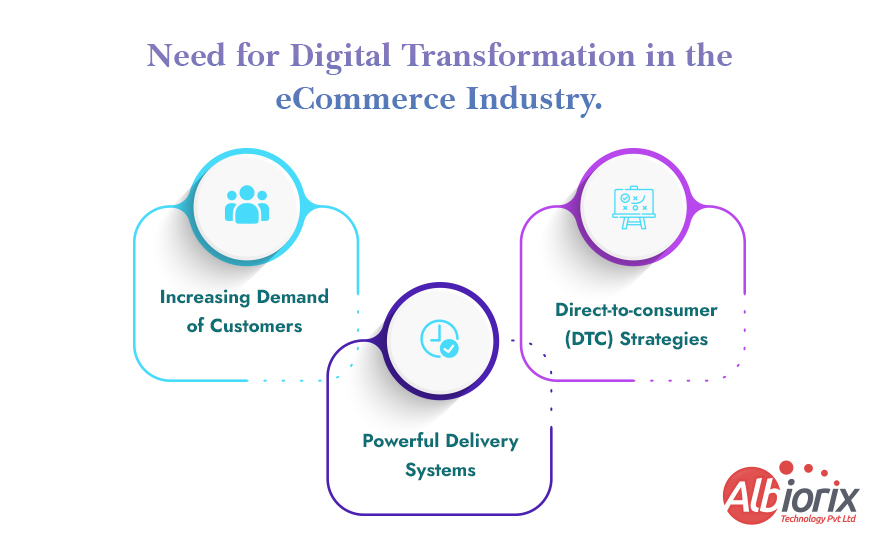
          Below are the top 3 reasons that are driving digital transformation across the eCommerce industry:

          1. Increasing Demand of Customers

          Today, convenience is more important than sticking with one brand when it comes to online shopping. Customers want reasonable prices, easy pick-up and delivery, on-time orders, and simple returns.

          All these growing demands make companies use new technologies to meet customers’ expectations. And that’s where you desperately need digital transformation. It helps store owners meet every need of the digital generation.

          2. Powerful Delivery Systems

          Online shopping made it easy to return items if they were wrong or defective. But now, customers expect to get their correct orders on time from the beginning.

          Getting the incorrect orders might upset customers and hurt business. So, having a solid delivery and supply system is a big reason why companies choose digital transformation.

          Digital Transformation allows businesses to integrate powerful and flexible delivery systems into their online stores.

          3. Direct-to-consumer (DTC) Strategies

          As competition grows, brands try to sell their products directly to customers, using strategies that go straight to the consumer.

          By letting customers connect directly with the brand on its own platform instead of through online shopping middlemen, companies can save money, provide better prices to customers, and make more money.

          Customers also get a better experience when they interact directly with the brand.

          Digital Transformation has made it easy for brands to stay connected with their customers and build a loyal customer base.

          Increase ROI with Our eCommerce Expertise

          Your eCommerce success is our priority. Reach out for a free consultation and discover how our expertise can maximize your return on investment.


          Let’s Chat!

          How Digital Transformation Is Revolutionizing The eCommerce Industry?

          Digital transformation is reshaping eCommerce website development in profound ways. It’s not just about shopping online; it’s about a complete overhaul of how businesses operate and connect with customers.

          The shift towards convenient and personalized shopping experiences, driven by technologies like AI and data analytics, has become the new norm.

          The good thing is that even the eCommerce app development company is open-handedly welcoming the digital changes and offering eCommerce solutions accordingly.

          From seamless ordering and fast, reliable deliveries to advanced recommendation engines, digital transformation enhances every aspect of the eCommerce journey.

          This revolution is not only redefining customer expectations but also allowing businesses to adapt quickly, stay competitive, and thrive in the ever-evolving digital landscape.

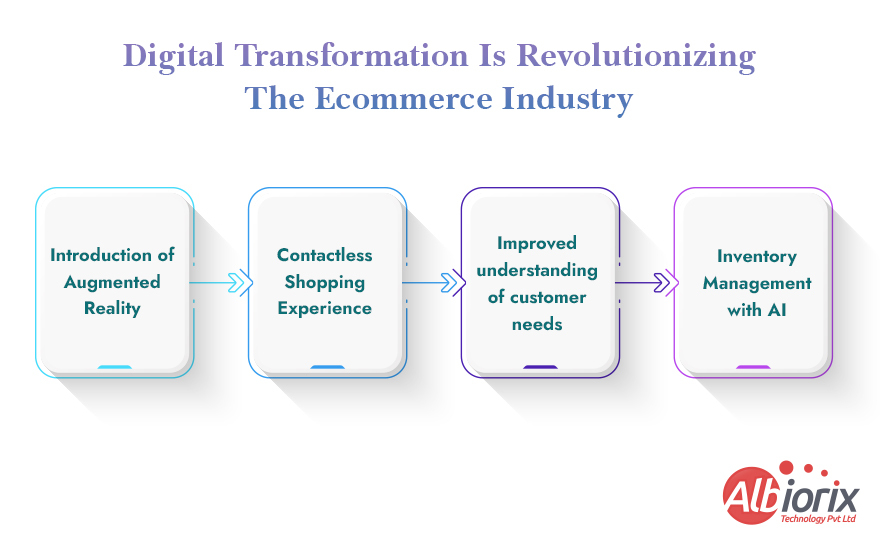
          Below are some of the main aspects where digital transformation is making a significant impact in the eCommerce development, and they are:

          1. Introduction of Augmented Reality

          Augmented reality is the technology that allows users to help visualize the product in the place it is intended for.

          For example, Rebecca Minkoff, an industry leader in accessible luxury handbags, accessories, footwear, and apparel, has been using 3D images and AR features since the end of 2019.

          With 3D modelling and AR features, potential Rebecca Minkoff customers can understand how big their wanted purse actually is and if the colour truly matches their taste and style.

          At Albiorix, we have helped many eCommerce business owners by providing AR/VR-compatible web solutions for higher customer engagement.

          2. Contactless Shopping Experience

          The pandemic pushed retailers to offer safer, contactless shopping experiences, which improved online shopping and led to the adoption of contactless payments.

          It has also highlighted the importance of giving customers a personalized online experience, showing dedication to the end user and creating a satisfying customer journey.

          3. Improved Understanding of Customer Needs

          Data is the key resource for digital transformation strategy. Algorithms can help retailers prepare better by forecasting demands more accurately and seizing new opportunities.

          Seamless interfaces enable the eCommerce business to simplify the process, gaining more insights into various stages of the eCommerce process, from market demand to inventory to supply to productivity and more.

          Data can also reveal more details about customer behaviour at a granular level.

          4. Inventory Management with AI

          Artificial intelligence has penetrated deep into the eCommerce industry. It is a game changer. AI goes beyond optimizing prices; it offers valuable insights and efficiencies that keep businesses competitive.

          Store managers, by using AI in their operations, enhance the customer experience. This is achieved by tailoring products and services to the unique needs and preferences of each location.

          It allows them to keep track of everything happening in and around their warehouses, ensuring success in today’s fast-paced market.

          Revamp Your Existing Store or Create a New One

          Whether you want to give your current online store a makeover or build one from scratch, our team is ready to help. Connect with us for a free consultation.


          Talk to Us!

          Digital Transformation Trends in 2024 for the eCommerce Industry

          Digital Transformation is expected to reform and revolutionize the eCommerce website development industry drastically. It will extraordinarily change the face of online shopping for both – customers and online store owners.

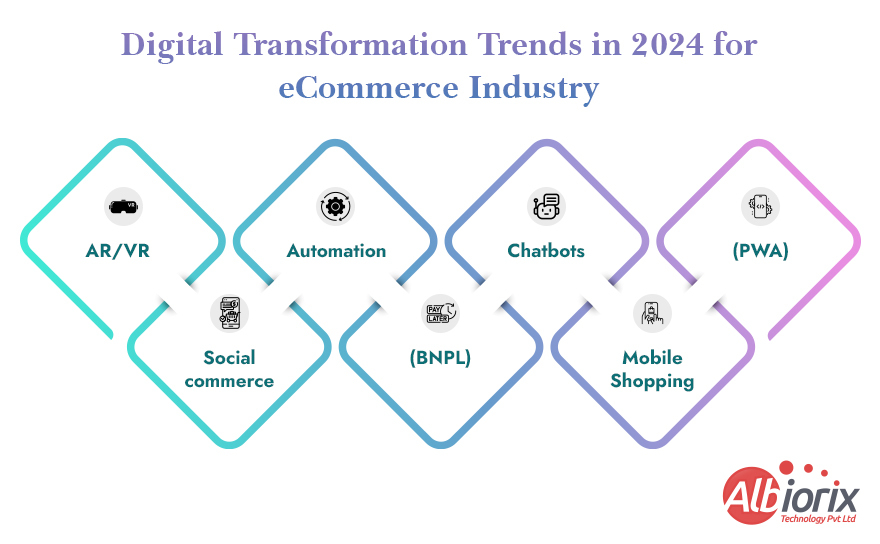
          If you own an online store and want to step up with Digital Transformation, then here are the top trends to look for in 2024:

          • AR/VR: As we’re aware, AR/VR is making waves in the tech world, and eCommerce is embracing this trend. It represents the future of online shopping, elevating the experience to be more immersive and engaging. AR allows customers to visualize how a product will appear or fit before buying it. Moreover, adding personalized recommendations to the shopping journey enhances its value and boosts customer satisfaction. Notably, this also decreases the number of product returns, saving time and reducing frustration for both customers and retailers.
          • Automation: Automation has become an essential strategy for businesses across various industries, and eCommerce is no exception. It’s rapidly extending its reach to every aspect, including marketing, warehousing, and supply chain management, among others. Take supply chain management, for instance, where automation ensures that there are no product shortages at any time. Automating your marketing strategy can enhance lead generation and conversion rates. Automated marketing has led to 77% of marketers generating more leads and 56% achieving higher conversion rates.
          • Chatbots: In the same way, AI and chatbots have become integral in the process of digital transformation. They make it simpler to offer personalized experiences by quickly addressing customer inquiries, creating a sense of uniqueness for each customer. This trend is expected to persist, adapting to market changes to meet customer needs consistently. According to data, eCommerce customers are the most receptive to chatbot responses, with 34% of users finding chatbots useful in providing personalized experiences.
          • Progressive Web Applications (PWA): This technology is quite like a regular mobile app but is constructed using web technologies such as JavaScript, HTML, and CSS. Its main features include push notifications, the ability to access it even when offline, and quick access from your smartphone’s home screen. Big players in eCommerce, like Alibaba and Walmart, serve as successful examples of digital transformation. They have seen increased revenues and better conversion rates by using progressive web apps. Implementing these apps can boost conversion rates by an impressive 93.3%.
          • Social commerce: Social networking platforms are more than just places to chat; they’re also becoming eCommerce hubs. Online stores now let you do everything from ordering products to making payments right on platforms like Facebook. This trend is expected to keep growing. Statista predicts that revenue generated through social media platforms will reach $2.9 trillion by 2026, a substantial increase from the estimated $992 billion in the current year.
          • Buy-now-pay-later (BNPL): Buy Now, Pay Later (BNPL) is a popular choice among millennials, offering them shopping flexibility and various advantages. Customers can avoid credit card interest fees by choosing this payment option and also have the freedom to buy items that might not typically fit their budget. According to a report, the global BNPL industry is expected to reach $680 billion in transactions by 2025.
          • Mobile Shopping: Mobile shopping is not going anywhere! As technology advances, online shopping through mobile has become a common choice for consumers. Recent studies show that eCommerce, or retail mobile shopping, will reach $270 billion by 2025. eCommerce has become a popular way for people to shop online as more people use mobile devices. The convenience and accessibility that eCommerce offers consumers are the main reasons for its growth.

          Start Selling 24/7 – Contact Us for a Custom eCommerce Solution!

          Don’t limit your business to regular hours. Contact us for a customized eCommerce solution that allows you to sell your products or services 24/7.


          Get in on the Action

          Conclusion

          Digital transformation is the process of using digital technologies to create new or modify existing business processes, products, and customer experiences.

          An eCommerce website development company plays a pivotal role in facilitating your journey through digital transformation.

          They bring the technical expertise and innovative solutions required to modernize and optimize your online business.

          These experts create robust eCommerce development solutions that seamlessly integrate cutting-edge technologies such as AI, chatbots, and progressive web apps, enhancing the customer experience.

          Furthermore, they enable adopting strategies like Buy Now, Pay Later (BNPL) and implementing social commerce capabilities, adapting your business to changing market trends.

          In essence, an eCommerce app development company acts as a crucial partner in leveraging digital transformation, ensuring your business remains competitive and future-ready in the evolving online landscape.

          If you have any questions related to digital transformation or how it can help your online store flourish, get in touch with our eCommerce development experts.

          For a free consultation, call us at +1 (912) 528-5566 (US) & (+61) 489-940-484 (AUS) or share your details with us using the contact us form on the website. You can also share your contact details on LinkedIn and Facebook as well.

          Offshore Software Development: A Complete Guide for Businesses

          As global competition accelerates, businesses are increasingly turning to offshore software development services to stay agile, scalable, and cost-effective.

          Offshoring enables companies to collaborate with highly skilled developers in countries such as India — a region well-known for its world-class technical expertise, strong software engineering talent, and significant cost savings.

          While many organizations pursue offshoring primarily for cost efficiency, managing distributed or offshore teams can be challenging.

          Face-to-face interactions may only happen once or twice a year, making it difficult to track progress, maintain consistency, and ensure high-quality output.

          This is where partnering with the right offshore software development company becomes a game changer.

          A reliable offshore partner provides dedicated, full-time developers and manages everything from recruitment to infrastructure, letting you focus entirely on core business goals.

          What Is an Offshore Software Development Company?

          An offshore software development company helps organizations set up dedicated teams of skilled developers in a remote location, offering access to a wider talent pool, lower development costs, and end-to-end support.

          For example, a business in Australia, the US, or Europe can quickly build a top-class web app development or mobile app development team in India at a fraction of the local cost. This also provides benefits such as:

          • Better cost effectiveness
          • Faster scalability
          • Access to specialized software solutions
          • Stronger quality assurance processes
          • Round-the-clock productivity enabled by time zone advantages

          Your offshore partner also manages legal compliance, HR support, data protection policies, IT infrastructure, and ongoing developer engagement Model— ensuring smooth project execution.

          Top Qualities to Look for in an Offshore Software Development Company

          1. A Highly Experienced Development Team

          One of the major benefits of offshore software development is access to global tech talent that may not be available domestically. Countries like the US, UK, and Australia face severe shortages of experienced developers.

          Partnering with the right offshore provider helps you choose the top offshore software development companies with proven experience, technical strength, and the ability to deliver within defined project requirements.

          Always evaluate:

          • The company’s tech expertise
          • Their portfolio
          • Experience in your industry
          • Availability of senior engineers
          • Their ability to offer full-time dedicated teams

          2. Flexibility and Scalability

          Your offshore partner should provide easy scalability — whether you need one engineer or an entire extended team.

          Because offshore contracts often span several years, pick a partner that understands your:

          • Short-term development goals
          • Long-term product roadmap
          • Future resourcing needs
          • Budget constraints
          • Technical complexity

          A good partner ensures uninterrupted expansion without compromising quality or speed.

          3. Strong Data Protection Policies

          Security is one of the biggest concerns when hiring an offshore software development company. When sharing sensitive business data with a team thousands of kilometres away, airtight data protection processes are essential.

          Ensure the company follows:

          • ISO-compliant security frameworks
          • NDA-driven confidentiality
          • Secure infrastructure
          • Regular audits
          • Strict access protocols

          A secure framework ensures peace of mind throughout the engagement.

          4. Premium Quality Software Solutions

          A mature offshore partner prioritizes quality assurance across development cycles. This includes:

          • Transparent communication
          • Structured sprint planning
          • Efficient bug tracking
          • Performance reviews
          • Continuous improvement

          This leads to better collaboration, faster issue resolution, and high-quality, stable releases.

          Innovate Globally with Our Offshore Experts

          Expand your horizons with our offshore development. Let’s innovate together!


          Contact Us

          3 Questions to Ask Before Hiring an Offshore Software Development Company

          1. What Are Your Custom Software Development Rates?

          Compare pricing not just on cost, but value. While offshore partners — especially in India — typically offer lower rates, ensure that:

          • Costs match the team’s experience
          • There are no hidden expenses
          • Monthly costs are clearly defined
          • Infrastructure and HR support are included

          Evaluate how pricing aligns with cost savings and the overall return on investment.

          2. How Will You Analyze My Software Development Requirements?

          A reliable offshore partner performs detailed requirement analysis before starting work. They must understand:

          • Your business goals
          • Success metrics
          • Technical challenges
          • Required team size and roles
          • Past and current project requirements

          If the company struggles to understand your needs, they may not be the right long-term partner.

          3. How Soon Can You Start My Project?

          Delivery speed depends on talent availability and required technical expertise. However, an experienced offshore provider can quickly assemble:

          • Full-time developers
          • Specialized engineers
          • Cross-functional in-house teams
          • Project-ready squads

          If the company cannot provide a clear timeline, delays and financial risks may follow.

          Why Choose Albiorix as Your Offshore Software Development Company?

          Partnering with Albiorix makes hiring offshore developers efficient, reliable, and scalable. With over a decade of proven expertise, we help businesses build full-time dedicated teams tailored to their exact needs.

          Why Albiorix stands out:

          • 10+ years of industry presence
          • 100+ seasoned IT professionals
          • 1000+ successful project deliveries
          • 97% on-time project completion
          • 98% client retention rate
          • 100% scalable and modern software solutions
          • Affordable pricing
          • Comprehensive support & maintenance

          Whether you want rapid deployment or cost-effective software solutions, Albiorix helps you maximize results with minimal effort.

          Conclusion

          Whether you are in a hurry to deploy your idea or want a cost-effective software solution for your business, get in touch with Albiorix for a free analysis of your requirements.

          Contact us or call us at (+61) 489-940-484 / +1 (912) 528-5566 for a free quote and consultation with software development experts. You can reach us on LinkedIn and Facebook, and we will respond promptly.

          Hybrid Mobile App Development For Business: A Full Guide

          In 2025, custom mobile app development for your business is no longer an option but a strategic imperative. With an ever-increasing reliance on smartphones and the convenience they offer, businesses must adapt to meet the evolving needs of their customers.

          A mobile app is a direct communication channel that enhances accessibility, engagement, and customer satisfaction.

          It allows your business to stay competitive, reach a wider audience, and capitalize on the latest technology trends, ensuring that you remain at the forefront of your industry.

          As the digital landscape expands in 2025, investing in hybrid mobile application development has become essential to business growth and long-term success.

          In this blog, we will discuss hybrid mobile apps for business, what hybrid mobile apps are, and why hybrid mobile apps are the best strategy businesses should consider in 2025. Let’s start by understanding why businesses in 2025 will need mobile applications.

          Reasons Why a Business Needs a Mobile App in 2025?

          Thanks to the smartphone revolution, almost everything in the world is at the tip of the finger.

          Everything has been made easy and convenient for the end-users, from shopping for clothes online, reserving a table online, and booking your holidays to online education.

          Smartphones (Hybrid Mobile Apps) have become an indispensable part of our lives.

          These pocket-sized programs offer a wide range of functionalities, from communication to entertainment, productivity, and beyond.

          Thus, if you are a business owner planning to expand your wings in 2025 and ahead, then it’s time to hire mobile app developers or find the best mobile app development company.

          reasons-why-a-business-needs-a-mobile-app-in-2024

          Here are a few more reasons why a business needs a mobile app in 2025:

          1. Enhanced Customer Engagement: Hybrid mobile apps provide a direct and engaging way to connect with customers, offering push notifications, personalized content, and interactive features.
          2. Accessibility: With the majority of consumers using smartphones, having hybrid mobile apps ensures easy access to your products or services anytime and anywhere.
          3. Brand Visibility: Hybrid mobile apps offer a prominent presence on users’ devices, serving as a constant reminder of your brand and its offerings.
          4. Competitive Edge: In a highly competitive market, having a mobile app sets your business apart and demonstrates your commitment to staying ahead of the curve.
          5. Wider Audience Reach: Hybrid mobile apps can reach a broader audience, including tech-savvy users who prefer app-based interactions over traditional websites.
          6. Streamlined User Experience: Apps provide a user-friendly interface and faster loading times, enhancing the overall customer experience.
          7. Data Collection: Hybrid mobile apps allow you to gather valuable data on user behaviour and preferences, enabling better-targeted marketing strategies.
          8. Sales and Revenue: Hybrid mobile apps can boost sales through features like in-app purchases, easy payment methods, and mobile-exclusive promotions.
          9. Customer Loyalty: A well-designed app can foster customer loyalty through rewards, loyalty programs, and a seamless shopping experience.
          10. Adaptability: Hybrid mobile apps can adapt to changing technology trends, such as incorporating AR, VR, or AI, keeping your business relevant and innovative.
          11. Operational Efficiency: Apps can streamline internal processes, improving productivity and enabling better communication within the organization.
          12. Global Reach: Hybrid mobile apps facilitate international expansion by reaching users worldwide and breaking down geographical barriers.

          To conclude, hybrid mobile apps from a top mobile app development company offer a multifaceted advantage to businesses, from enhancing customer engagement and loyalty to boosting revenue and staying competitive in the rapidly evolving digital landscape.

          Already have an app idea for your business?

          Let’s bring it to life. We have strong expertise in designing and building Mobile Apps for all business verticals.
          Get a free quote

          Hybrid Mobile Apps Development Statistics for Businesses

          The points mentioned above represent some of the common and general advantages of having a mobile application in 2025.

          However, as a mobile app development company, we’ve gathered a collection of statistics that should inspire you to consider mobile app development in 2025 as a strategic business move.

          Please take a moment to review these compelling statistics below:

          • There are 6.3 billion smartphone users.
          • People spend 88% of their mobile time using apps.
          • Mobile apps are expected to generate over $935 billion in revenue.
          • 21% of Millennials open an app 50+ times per day.
          • 49% of people open an app 11+ times each day.
          • The average user uses 10 apps per day and 30 apps each month.
          • The Apple App Store has 1.96 million apps available for download.
          • The Google Play Store has 2.87 million apps available for download.

          Most Popular Google Play Store App Categories

          Mobile applications are the call of time. Regardless of your industry or business size, the integration of native or hybrid mobile app development is a critical component of your success strategy in 2025.

          To gain a clearer understanding, we have categorized app types (Google Play Store), illustrating why your business requires a hybrid mobile app in 2025.

          • Business Apps
          • Shopping
          • Video Players & Edit
          • Travel & Local
          • Social Media Apps
          • Weather
          • Productivity
          • Music & Audio
          • Entertainment
          • News & Magazines
          • Photography
          • Books & Reference
          • Lifestyle
          • Personalization
          • Tools
          • Communication
          • Weather

          In 2025, mobile application development trends will impact virtually every business. Hence, it is essential to recognize the evolving landscape and equip your business with a mobile application to stay relevant and competitive.

          Difference Between Native App and Hybrid App Development

          Bespoke mobile app development is something you can afford to ignore in 2025.

          However, if you are considering contacting a mobile application development services company, then you need first to understand what is best for your business – Native Mobile App Development or Hybrid Mobile App Development.

          Let’s understand the difference between the two:

          1. Native App

          A native app is a software application specifically designed and developed for a particular operating system, such as iOS or Android (It means developing an OS-specific mobile app).

          These apps are written in platform-specific programming languages (Swift or Objective-C for iOS, Java or Kotlin for Android) and offer optimized performance and seamless integration with the device’s features.

          2. Hybrid App

          Hybrid apps are mobile applications that combine elements of both native and web applications. They are built using web technologies such as HTML, CSS, and JavaScript and are then wrapped in a native shell to enable them to run on various platforms.

          Hybrid apps offer cross-platform compatibility, meaning a single codebase can be deployed on both iOS and Android, making development more cost-effective and efficient.

          Hybrid apps are popular for business and content-focused applications, offering a balance between cost-efficiency and functionality.

          Why Hybrid Mobile App is A Good Strategy for Your Business in 2025

          In 2025, choosing a hybrid mobile app for your business is a strategic decision with numerous benefits.

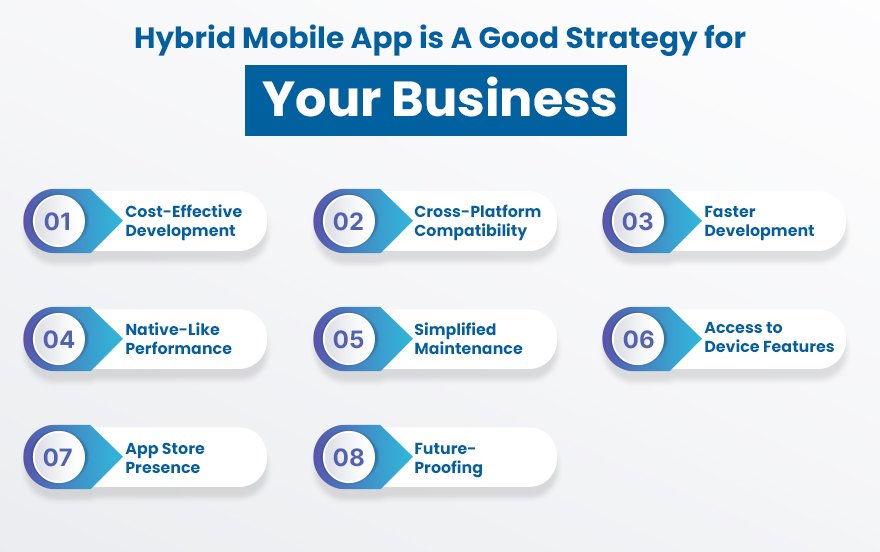
          Hybrid apps offer cost-effectiveness, cross-platform compatibility, faster development, and the ability to access native device features.

          They simplify maintenance and updates while providing a native-like user experience.

          With hybrid apps, your business can reach a broader audience, stay competitive, and adapt to the ever-evolving mobile landscape, making it an excellent choice for ensuring growth and success in the digital realm of 2025.

          Hybrid-Mobile-App-is-A-Good-Strategy-for-Your-Business

          1. Cost-Effective Development: One of the primary reasons to consider hybrid mobile apps development in 2025 is their cost-effectiveness.

          Developing native apps for multiple platforms can be expensive and time-consuming.

          In contrast, hybrid apps are created using web technologies such as HTML, CSS, and JavaScript, allowing mobile app developers to write code once and deploy it across different platforms.

          This significantly reduces development costs, making it a budget-friendly option for businesses.

          2. Cross-Platform Compatibility: Hybrid apps are known for their cross-platform compatibility. With the help of frameworks like React Native, Ionic, and Flutter, app developers can build hybrid apps that work seamlessly on both iOS and Android devices.

          This approach allows businesses to reach a wider audience without investing in separate native app development, simplifying maintenance and updates.

          3. Faster Development and Deployment: In the fast-paced world of technology, speed is of the essence. Hybrid app development accelerates the process, as a single codebase can be used for multiple platforms.

          This results in faster development and quicker deployment, enabling businesses to respond promptly to changing market trends and customer demands.

          4. Native-Like Performance: Historically, hybrid apps were criticized for their performance compared to native apps. However, advancements in technology and the development of powerful frameworks have bridged this performance gap.

          Hybrid apps can now offer a native-like user experience with smooth animations, responsiveness, and access to device features, making them an attractive option for app developers and users alike.

          5. Simplified Maintenance: Maintaining multiple native apps can be a complex and resource-intensive task. With hybrid apps, updates and bug fixes can be applied to the shared codebase, ensuring consistency across all platforms.

          This simplifies the maintenance process, reducing the workload for developers and the potential for user frustration caused by inconsistent app experiences.

          6. Access to Device Features: Hybrid apps leverage plugins and APIs to access device features like the camera, GPS, and push notifications, enabling them to provide a rich and interactive user experience.

          This access to native device functionalities ensures that hybrid apps can offer the same features and capabilities as their native counterparts.

          7. App Store Presence: Hybrid apps can be published on popular app stores like Apple App Store and Google Play Store, just like native apps.

          This allows businesses to take advantage of the exposure and discoverability that these platforms offer, contributing to increased user engagement and brand visibility.

          8. Future-Proofing: As technology continues to evolve, hybrid app development is continually improving. Frameworks are regularly updated, providing access to the latest features and enhancements.

          By choosing custom hybrid mobile app development in 2025, businesses can future-proof their digital presence and adapt to the changing mobile landscape.

          In conclusion, hybrid mobile apps will be a strong contender in the mobile app development arena in 2025. They offer a cost-effective, cross-platform, and efficient solution for businesses looking to expand their digital footprint.

          With native-like performance, simplified maintenance, and access to device features, hybrid apps provide a compelling alternative to native app development, making them a smart choice for developers and businesses aiming to thrive in the ever-competitive mobile app market.

          Ready to Bring Your App Idea to Life?

          Hire an Experienced Team of Hybrid App Developers to build an App for your business.

          Hire Mobile App Developer Today!

          What is the Cost of Hybrid Mobile App Development?

          The cost of hybrid mobile app development can vary significantly based on several factors. Key determinants include the complexity of the app, the features and functionalities it incorporates, the development team’s expertise, and the project’s timeline.

          Generally, hybrid app development tends to be more cost-effective than native app development due to code reusability across platforms.

          However, for an accurate estimate, it’s advisable to consult with a development firm, as costs can range from a few thousand dollars for a simple app to several hundred thousand dollars for a complex, feature-rich application.

          You can also contact a mobile app development company for a free quote and to discuss the scope of your app idea.

          Get a Free Hybrid Mobile App Development Quote

          Hybrid mobile apps have become an integral part of our daily lives, offering convenience, accessibility, and functionality.

          In the ever-evolving landscape of app development, hybrid mobile apps are gaining popularity as a cost-effective and efficient solution for businesses and app developers alike.

          If you are planning to power your business in 2025 with the help of a hybrid mobile app development, then get a free quote and consultation from experts at Albiorix.

          We will not only provide you with a free quote, but we will also share inputs to make your app idea a landmark app solution in your industry.

          For a free app development quote, please get in touch with us or call us at (+61) 489-940-484 / +1 (912) 528-5567. You can also drop us a message on LinkedIn and Facebook, and we will get back to you at the earliest.

          On-Demand Betting Apps and Software Development For New Business

          In the ever-evolving digital technology landscape, few industries have experienced a meteoric rise in the world of sports betting apps.

          As the thrill of sports meets the convenience of smartphones, these sports betting apps and software have emerged as game-changers, altering the way enthusiasts engage with their favourite pastimes.

          The intense craze for online betting has fueled the need for top betting app development companies that can design and deliver productive betting apps and software while staying cost-effective.

          Welcome to the exciting world of sports betting apps and software development, where the possibilities are as limitless as the boundaries of human competition.

          In this informative blog, we will discuss betting apps, what they are, what is the market for betting apps, what are the betting app trends in 2026, and how a sports betting app development company can help you own the best sports betting software.

          First of all, let’s start with an introduction to sports betting apps/software.

          What is a Sports Betting App or Software?

          A sports betting app or software is a digital platform that allows users to place bets on various sports events through their smartphones, tablets, or computers.

          These apps are built to provide a smooth and secure experience, offering live scores, real-time odds, and multiple betting options for popular sports like football, cricket, basketball, and horse racing.

          In addition to user-friendly features, such as secure payments and account management, many sports betting apps also support live or in-play betting, giving users the chance to place bets while the game is ongoing.

          For businesses aiming to enter the betting industry, sports betting app development services help create customized platforms that include backend management systems, odds integration, payment gateways, and compliance tools.

          These services ensure that the app not only meets user expectations but also adheres to regulatory standards.

          Whether you are a sports fan seeking an interactive betting experience or a business exploring opportunities in online gaming, sports betting apps backed by professional development services offer a reliable and engaging way to participate in sports betting.

          Do you want to know the development cost of a sports betting app?

          Get a free quote today.

          What is the Market for On-demand Betting App Development?

          The market for on-demand betting app development is experiencing steady growth worldwide, driven by the increasing popularity of online sports betting, esports, and virtual games.

          With more users seeking the convenience of betting from their mobile devices, businesses are investing in custom betting apps that offer real-time betting, live streaming, and secure payment options.

          According to industry insights, the global online betting market is projected to cross $150 billion by 2028, with mobile apps playing a significant role in this growth.

          The demand is especially strong in regions where online betting is legally regulated, such as parts of Europe, North America, and Asia.

          For entrepreneurs and businesses, this opens opportunities to tap into a high-engagement, high-revenue sector.

          Partnering with expert sports betting app development services allows businesses to create tailored platforms that meet user expectations, ensure compliance with local laws, and provide a smooth betting experience.

          As user habits shift toward on-demand services, the betting industry is adapting quickly. Investing in on-demand betting app development helps businesses stay competitive and meet the evolving needs of tech-savvy users.

          What Are the Reasons Behind the Demand/Popularities of Sports Betting App?

          In today’s digital world, sports betting has witnessed a popularity surge for many reasons. The widespread adoption of smartphones and the easy availability of the Internet are the top reasons for the popularity of sports betting apps and software.

          The thirst for sports betting apps has skyrocketed, granting users effortless accessibility to their cherished sports events and betting possibilities wherever and whenever they desire.

          Below are a few more reasons for the popularity of on-demand sports betting apps and software, and they are:

          1. Convenience: Sports betting apps offer a convenient way for users to place bets from their smartphones or computers, eliminating the need to visit physical betting locations. This convenience is highly appealing to both casual and serious bettors.
          2. Accessibility: Sports betting mobile apps provide easy access to sports betting, enabling users to place bets anytime and from anywhere with an internet connection. This accessibility caters to the on-the-go lifestyle of modern consumers.
          3. Real-time Information: Sports betting platforms offer real-time data, including live scores, odds, and in-play wagering options. Users can stay updated on events and make informed betting decisions as games unfold.
          4. Variety of Sports: Betting apps often cover a wide range of sports and events, catering to diverse interests. Users can bet on popular sports like football, basketball, and soccer, as well as niche events like eSports or horse racing.
          5. Promotions and Bonuses: Many sports betting apps provide promotions, bonuses, and loyalty programs to attract and retain users. These incentives encourage user engagement and contribute to the demand.
          6. Live Betting: The ability to place bets while a game or event is in progress, known as live betting or in-play wagering, has gained popularity. Sports betting software and apps often offer these features, enhancing their appeal.
          7. Emerging Technologies: Sports betting apps integrate emerging technologies such as blockchain for secure transactions, artificial intelligence for odds optimisation, and virtual reality for immersive experiences. These innovations enhance the overall user experience and drive demand.

          The need for sports betting apps is continually growing due to their convenience, accessibility, real-time features, and the evolving betting landscape.

          As a result, sports betting apps remain in high demand among sports enthusiasts and bettors seeking engaging and secure ways to participate in the excitement of sports betting.

          Many sports betting app development companies like Albiorix have hands-on experience in creating on-demand betting platforms at affordable rates.

          Do you have a unique betting app idea in your mind? Bring it to life with experts.

          We Can Help!

          Sports Betting App Trends in 2025

          In 2026, sports betting apps are set to embrace the below-listed trends to provide users with more exciting, personalised, and responsible betting experiences while keeping up with the ever-evolving technology landscape.

          1. Cryptocurrency Integration: As the adoption of cryptocurrencies like Bitcoin and Ethereum continues to rise, sports betting apps are expected to integrate these digital currencies for transactions. This gives users enhanced privacy, security, and flexibility in betting activities.
          2. Esports Betting on the Rise: Esports betting is set to gain even more prominence in 2026. Betting apps are likely to expand their offerings to include a broader range of esports events, appealing to the growing audience of competitive gaming enthusiasts.
          3. Virtual Reality (VR) Betting Experiences: Virtual reality is poised to transform how users engage with sports betting. VR betting platforms may offer immersive experiences, allowing users to feel like they are in an actual sportsbook or stadium while placing their bets.
          4. Artificial Intelligence for Personalization: Betting apps increasingly use AI to analyse user data and preferences, enabling them to offer personalised betting suggestions and promotions. This enhances the user experience and encourages more engagement.
          5. Responsible Gambling Tools: With a focus on user well-being, sports betting apps will continue to improve accountable gambling features. This includes self-exclusion options, deposit limits, and educational resources to promote responsible betting practices.
          6. Live Streaming and Betting Integration: Many sports betting apps offer live events streaming. In 2024, this feature may become more tightly integrated with in-play betting options, allowing users to watch and wager on games simultaneously.
          7. Advanced Data Analytics: Data-driven insights will play a pivotal role in providing users with valuable information for their bets. Advanced data analytics and predictive modelling will help bettors make informed decisions.
          8. Social Betting Communities: Sports betting apps may create social features enabling users to share their bets, tips, and experiences with fellow sports enthusiasts. This fosters a sense of camaraderie and engagement.
          9. Regulatory Compliance: With the evolving landscape of gambling regulations, sports betting apps will continue to adapt and ensure full compliance with local and international laws. This will enhance the trustworthiness of these platforms.
          10. Cross-Platform Accessibility: Betting apps will strive to offer a consistent and seamless experience across various devices, including smartphones, tablets, and desktops, allowing users to switch between platforms effortlessly.

          Role of a Sports Betting App Development Company

          The role of a sports betting software development company is pivotal in the creation, launch, and ongoing success of sports betting applications.

          A sports betting app development company acts as a comprehensive partner in the entire app development lifecycle.

          From concept to deployment, they provide expertise in design, development, legal compliance, and ongoing support, ensuring the success of sports betting apps in a competitive and regulated industry.

          Role-of-a-Sports-Betting-App-Development-Company-1

          These companies play several critical roles:

          1. Conceptualisation and Planning: Sports betting app development companies work with clients to conceptualise the app’s core idea, defining its target audience, features, and overall strategy. They help plan the project, set objectives, and map out a development roadmap. Let’s discuss the scope of your betting app over a free consultation call. Contact us.
          2. Market Research: They conduct extensive market research to identify trends, competition, and regulatory requirements. This data informs the development process and ensures that the app is aligned with market demands.
          3. Legal and Regulatory Compliance: Developing a sports betting app necessitates a deep understanding of complex legal and regulatory frameworks. App development companies ensure that the app adheres to these regulations, obtains the necessary licenses, and operates within the law.
          4. Platform Selection: They guide clients in choosing the right platform for their app, considering factors such as iOS, Android, or cross-platform development. The choice impacts the app’s accessibility and reach.
          5. User Experience (UX) and User Interface (UI) Design: App development companies create a visually appealing and user-friendly design for the app, focusing on providing an intuitive and engaging experience for users.
          6. Mobile App/Software Development: They handle the technical aspects of app or software development, including coding, database management, payment integration, and real-time data updates. The development process ensures the app’s functionality, security, and scalability. You can hire full-stack developers to build a betting app as per your business ideas and trends.
          7. Quality Assurance: App development companies conduct rigorous testing to identify and resolve bugs, glitches, and performance issues. This ensures the app’s reliability and user satisfaction.
          8. Deployment and Launch: They assist in launching the app on various app stores and platforms, ensuring that it complies with the respective guidelines and standards.
          9. Ongoing Maintenance and Updates: After the app is live, these companies continue to provide maintenance and support services, addressing issues, releasing updates, and ensuring the app remains up-to-date and secure.
          10. Marketing and Promotion: Many app development companies also offer marketing and promotional services to help clients increase the app’s visibility and attract users. This includes strategies like social media marketing, partnerships, and advertising.

          Do you want to create a clone of your favourite betting app? We can help!

          Ask Us!

          Sports Betting App/Software Development On Your Mind? Get a Free Quote Today

          If you’re seeking excellence in sports betting apps and software development, look no further than Albiorix.

          With our experienced team of developers, in-depth market knowledge, and a commitment to innovation, we’re ready to transform your vision into a dynamic and engaging sports betting app.

          Moreover, we also have prior experience in creating white-label betting apps for our clients coming from different parts of the world. Get in touch with us to learn more about our already-developed apps and software.

          Contact Albiorix today to explore the endless possibilities and create a winning app that stands out in this competitive industry. Your success is our goal, and we’re here to make it happen.

          You can also share your requirements with us over LinkedIn and Facebook.

          Better Mobile Enterprise Trends To Look For In 2026

          We live in an age where businesses try hard to stay relevant to their goals. Most businesses are updating and improving their product lines and services to ensure survival, growth, and maintaining the top position in their respective industries.

          One more thing that modern businesses are focusing on is “Enterprise Mobility”.

          Enterprise Mobility is a powerful progressive tool that helps organizations reach new heights. But what exactly is enterprise mobility, and why is it a global trending topic among businesses and enthusiast entrepreneurs?

          Let’s understand. In this blog, we will discuss key enterprise mobility trends to watch out for in 2026, so stay tuned.

          With Enterprise Mobility, businesses don’t have to be concerned about being restricted by office spaces, chained to a desk, or held back by outdated technology. They can work together as a team, no matter where they are.

          Companies that understand the importance of enterprise mobility trends are smoothly navigating this significant change.

          They’re using these trends to grow their business and become even stronger. It offers incredible flexibility and connectivity to modern businesses looking to scale up without restricting their resources within the office premises. So, let’s start with an in-depth introduction to Enterprise Mobility.

          What is Enterprise Mobility?

          The concept of Enterprise Mobility revolves around allowing employees to work remotely. It refers to the ability of businesses and their employees to work and access essential information and applications from various locations outside of a traditional office setting.

          The system facilitates team communication regardless of physical location.

          It involves using devices like smartphones, tablets, and laptops, often connected to the internet, to perform work-related tasks.

          Enterprise Mobility allows for flexibility, increased productivity, and improved communication within a company, as employees can collaborate and access necessary resources even when they are not physically present in the office.

          Whether you run a multinational firm, a growing SMB, or an ambitious start-up, Enterprise Mobility is a hot and trending topic among modern businesses and organizations that don’t want to confine their business operations within the four walls and want their team to communicate from all parts of the world flawlessly.

          As stated above, it will lead your business to a new era of flexibility and connectivity.

          So, after defining Enterprise Mobility, it’s time to understand Enterprise Mobility trends in 2026 and what businesses need to do to accommodate these trends.

          Enterprise Mobility Trends in 2026

          In the ever-evolving landscape of technology, enterprise mobility is a concept that continues to shape the way businesses operate.

          The year 2026 is poised to bring about significant shifts in the realm of enterprise mobility, with trends set to redefine how companies function.

          Enterprise Mobility trends 2026

          Let’s delve into Enterprise Mobility trends in 2026.

          1. The Rise of 5G Connectivity

          As we step into 2026, the deployment of 5G technology is set to become the backbone of enterprise mobility.

          This advanced network infrastructure will offer lightning-fast data speeds, low latency, and seamless connectivity, empowering businesses to unlock new possibilities in mobile applications and services.

          5G connectivity will revolutionize how businesses and organizations connect and communicate with their employees. Introducing 5G to your business will give your business a competitive edge.

          2. Internet of Things

          The Internet of Things (IoT) is no longer a futuristic concept. It’s becoming an integral part of enterprise mobility by helping businesses in data collection and decision-making processes.

          In 2026, businesses will increasingly leverage IoT to enhance efficiency, monitor assets, and improve decision-making processes. IoT will be at the forefront, from smart factories to connected offices, giving your business a competitive edge to stay ahead of time.

          3. Artificial Intelligence

          Artificial Intelligence (AI) will play a pivotal role in enterprise mobility trends for 2026. Even in 2025, the use of AI has increased to a greater extent and is helping businesses make more intelligent and wiser decisions.

          AI-driven automation will streamline various business processes, such as customer service, data analysis, and supply chain management. It will not only boost efficiency but also reduce operational costs.

          4. Data Analytics

          The power of data analytics cannot be underestimated. In 2026, businesses will rely heavily on data-driven insights to make informed decisions.

          The integration of analytics tools into mobile applications will enable real-time monitoring and adaptive strategies.

          5. Augmented Reality

          Augmented Reality is not limited to the gaming industry. In 2026, businesses will adopt AR to enhance productivity and improve customer experiences.

          ECommerce giants like Amazon have already invested a lot in Augmented Reality and made AR available to their customers, which helps them to create interactive shopping experiences.

          From training and simulations to remote technical support, AR will find applications in various domains, revolutionizing the way we work. AR is a powerful and flexible tool to enhance virtual collaboration.

          6. Remote Work Revolution

          The COVID-19 pandemic accelerated the shift toward remote work, which led to the end of the conventional way of working in the office.

          This trend will continue to evolve in 2026 as the option to work remotely is gaining popularity and attracting more candidates.

          As businesses recognize the benefits of remote work, they will invest in technologies that enable remote collaboration, secure data access, and efficient communication.

          7. Enhanced Customer Experiences

          Customer-centricity remains a top priority for businesses. In 2026, enterprises will focus on leveraging mobile technology to create personalized and engaging experiences for their customers.

          They will develop a robust app ecosystem for their customers to offer a wholesome shopping experience. Mobile apps will be tailored to meet individual needs and preferences, enhancing brand loyalty.

          8. Voice Assistance

          A computer program that can understand and respond to human speech is known as a voice-activated assistant. Smartphones equipped with voice recognition software, like Google Assistant, simplify work tasks and boost enterprise mobility.

          Using voice assistant technology can make routine tasks more efficient, ultimately improving employee productivity.

          Secure Mobility: Protecting Your Enterprise in an Ever-Changing Landscape.

          Concerned about mobile security? Let us assess and enhance your enterprise’s security posture. Contact us for a comprehensive security audit.

          Don’t Miss Out

          Business Enterprise Mobility Trends With Albiorix?

          The technological landscape is evolving at a rapid pace.

          As a business, if you want to keep up with the changing environment and stay competitive, then you will need to hire mobile app developers from an experienced and reliable software development partner like Albiorix Technology.

          For more than 10+ years, we have been assisting businesses in adopting and leveraging enterprise mobility trends in several ways, and no one understands Enterprise Mobility trends better than us.

          How Businesses Can Accommodate With Enterprise Mobility trends

          As a business, if you want to accommodate enterprise mobility 2026 trends, then below are the ways we can help you with:

          1. Customized Mobile App Development: We can help you create tailored mobile applications that align with a business’s specific needs and goals.

            These apps can enhance employee productivity, customer engagement, and overall operational efficiency. Have a look at our cost-effective mobile application development services for businesses of all sizes.

          2. Integration of Mobility Solutions: Not only custom mobile app development, but we are also committed to helping businesses integrate mobility solutions.

            We can integrate mobility solutions into existing systems, making it seamless for employees to access critical data and applications from anywhere, ensuring a smooth transition to enterprise mobility.

          3. Security Measures: Our developers prioritize data security and implement robust measures to protect sensitive information.

            This is crucial in a mobile work environment where data can be accessed from various locations and devices. If you want to know what security measures we take for data protection and privacy, contact us.

          4. Maintenance and Support: We offer ongoing support, updates, and maintenance to keep the mobility solutions running smoothly and up to date with the latest industry trends.

            We are there for you 24/7 to ensure 100% uptime of your mobility solutions.

          5. Consultation and Strategy: We provide valuable insights and strategies for businesses looking to capitalize on emerging enterprise mobility trends.

            Additionally, we also help companies make informed decisions regarding technology adoption and how to implement them effectively.

          6. Mobility Solutions Training: In required cases, we offer training sessions to help employees maximize the benefits of mobility solutions and ensure that they are used to their full potential.

          Conclusion

          Albiorix is a software development company assisting businesses in adopting and thriving in the ever-evolving landscape of enterprise mobility.

          We provide the technical expertise, tailored solutions, and ongoing support necessary to make the most of these enterprise mobility trends in 2026.

          In conclusion, the year 2026 is set to be a transformative year for enterprise mobility, and if you want to embrace these trends to stay competitive in the dynamic world of enterprise mobility, then feel free to contact us.

          For a free consultation, please call us at +61 489 940 484 / +1 (912) 528-5566 or share your details with us, and we will get back to you at the earliest.

          You can also like us on Facebook and get connected on LinkedIn to stay informed with Enterprise Mobility Trends in 2026 and other tech news.