




What is an AI Agent Development for US Enterprises

Summary: AI agents go beyond automation. They reason, adapt, and act as per the situation. This enterprise guide covers how AI agent development works, real industry use cases, and how US businesses can choose the right development partner.

Most enterprise automation tools do exactly what you tell them to do. AI agents do what needs to be done. And that’s the first and the basic difference between an automation tool and an AI Agent.

That difference might sound subtle, but for US enterprises navigating operational complexity, rising labor costs, and the pressure to scale without proportionally growing headcount, it is the difference between incremental efficiency and genuine transformation.

This informational guide on AI agents and AI agent development has the answer to every foundational question your leadership team is likely asking right now, such as:

  • What is an AI Agent?
  • What is AI Agent Development?
  • How does it work in practice?
  • Where does it deliver real enterprise ROI?
  • When does custom development make more sense than off-the-shelf tools?

By the end, you will have a clear framework to evaluate whether AI agent development belongs in your next strategic roadmap.

What Is an AI Agent? A Plain-English Definition

An AI agent is a software system that automatically understands its environment, reasons about a goal, and determines the next steps to achieve that goal without any human intervention.

Unlike chatbots and IVR systems that follow the rules and predefined answers, an AI agent plans, adapts, and performs tasks on its own across multiple tools and data sources in real time.

Now, AI Agent Development is the process of designing, developing, and deploying these systems (aka AI Agents) to fulfill specific business objectives.

During the development process, these AI agents are integrated with enterprise data, APIs, and workflows so that they can operate accurately and reliably at scale.

Quick Definition:

An AI agent is an autonomous software system that perceives inputs, reasons through a goal, and takes multi-step actions to complete tasks with minimal human intervention.

Enterprise AI agent development involves building, integrating, and deploying these agents within existing business infrastructure to automate complex, decision-intensive workflows.

What is the difference between AI Agent and Traditional Automation

The basic and most crucial difference between an AI agent and a traditional automation tool is that an AI agent takes the decisions on its own to complete a task, whereas an automation tool strictly follows the rules and predefined script.

Below is the comparison table between AI agent and Traditional Automation.
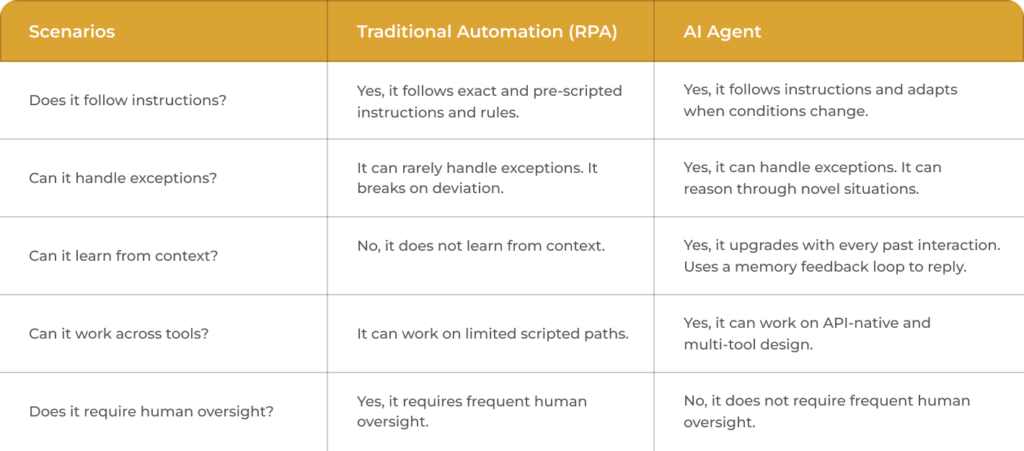
AI Agent vs Traditional Automation

The analogy that resonates most with enterprise stakeholders: RPA is a calculator. An AI agent is a junior analyst who knows how to use a calculator, read a spreadsheet, send a follow-up email, and flag anything unusual; all without being asked twice.

Is your enterprise ready for AI Agents?

Not Sure? Book a free 30-minute consultation with our AI specialists at Albiorix Technology to find out.


Book a Free Consultation Call

How AI Agent Development Works: The Development Lifecycle

The AI agent development process is a bit tricky. However, every enterprise needs to understand the development lifecycle as it enables them to ask the right questions and set realistic expectations.

Here is how a well-structured AI agent development engagement typically unfolds:

  • Setting the Goals: The first step in developing an AI agent is to define and set the goals, boundaries, and success metrics. You must have a clear picture of what an AI agent must do, what it must not do, and how you will know it is working well.
  • Finalizing AI Model & Framework: The second step in AI agent development is to finalize the AI model and reasoning framework. Some of the most common choices for enterprise deployment are LangChain, AutoGen, CrewAI, GPT-4, and Claude.
  • APIs & Data Integration: In the third step, you need to integrate CRM platforms, ERP systems, internal databases, and third-party services with your AI agent to respond accurately and reliably.
  • Designing Memory & Reasoning Layer: Short-term context (within a task), long-term memory (across tasks), and the logic that governs how the agent prioritizes actions.
  • Build and configure the action layer: The specific tools, APIs, and output channels the agent can use to complete tasks.
  • Test in a sandboxed environment: Red-team the agent, test edge cases, and establish human-in-the-loop checkpoints for high-stakes decisions.
  • Deploy, monitor, and iterate: Track performance against KPIs, capture drift, and continuously refine.

Estimated Timeline: According to the AI agent development experts at Albiorix Technology, building a focused single agent from a well-scoped workflow can take 8-12 weeks.

Whereas the time to develop multi-agent systems with deep enterprise integration typically takes 16 to 24 weeks.

If any AI development company or a vendor promises, an AI agent in two or three weeks is cutting corners on testing it before deployment. It can create significant downstream risk in the future.

Real Enterprise Use Cases: Where AI Agents Deliver ROI
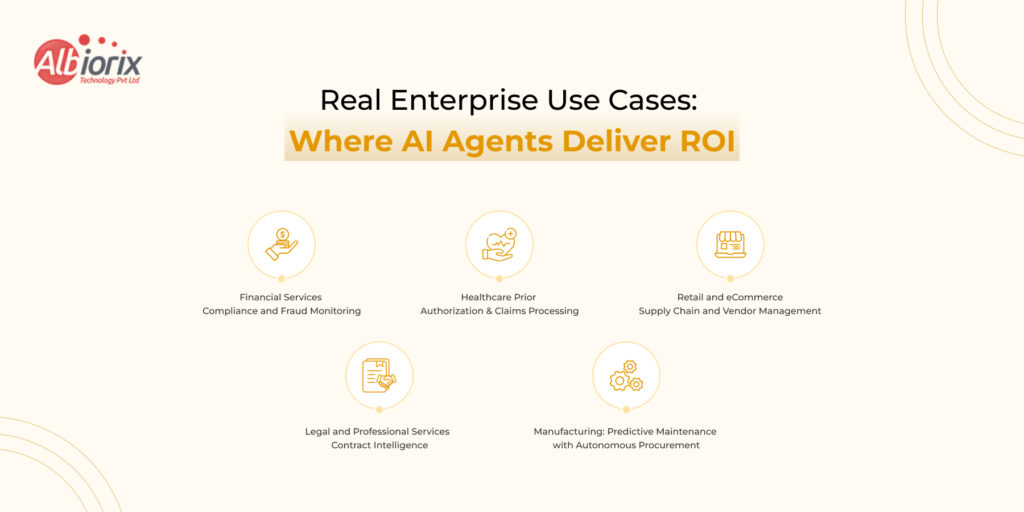
Real Enterprise Use Cases: Where AI Agents Deliver ROI

The highest-value AI agent deployments share a common trait: they target workflows that are high-frequency, rule-adjacent (mostly rule-based with enough exceptions to break RPA), and expensive in human time.

Here are five enterprise verticals where AI agent development is already generating measurable returns:

Financial Services — Compliance and Fraud Monitoring

AI agents continuously monitor transaction streams, flag anomalies against regulatory rules, cross-reference sanctions lists, and generate compliance reports tasks that previously required teams of analysts working in shifts. One mid-size US broker-dealer reduced compliance review time by 60% and cost by 30% after deploying a custom monitoring agent integrated with their core banking system.

Healthcare — Prior Authorisation and Claims Processing

Prior authorisation is one of healthcare’s most expensive administrative bottlenecks. Autonomous AI systems can retrieve patient records, match against payer criteria, draft authorisation requests, follow up with payers, and escalate to a clinician only when genuinely required. This reduces processing time from days to hours.

Retail and eCommerce — Supply Chain and Vendor Management

Custom AI agents for business automation in retail are handling demand forecasting, reorder triggering, vendor communication, and exception management all within a single automated loop. What once required a supply chain analyst’s daily attention now runs with a weekly human review cycle.

Legal and Professional Services — Contract Intelligence

Enterprise AI agents can ingest contracts, extract key clauses, flag deviations from standard terms, cross-reference prior agreements, and surface risk in minutes rather than the hours a paralegal team would need. Several AmLaw 200 firms are already piloting these deployments.

Manufacturing — Predictive Maintenance with Autonomous Procurement

Sensor data feeds an AI agent that predicts equipment failure windows, triggers maintenance work orders, and when parts inventory drops below threshold, it initiates a procurement workflow with pre-approved suppliers. No human touches the process until the maintenance technician shows up with the right parts already ordered.

See what AI agents can do for your industry

Our team has built custom AI automation solutions across finance, healthcare, legal, and manufacturing.


Call Us!

Custom AI Agents vs. Off-the-Shelf AI Tools: Which Is Right for You?

The honest answer: off-the-shelf tools like Microsoft Copilot, Salesforce Einstein, or ServiceNow’s AI capabilities are genuinely good for standardized workflows within their native ecosystems. If your needs map cleanly onto what these platforms offer, start there.

Custom AI agent development becomes the better investment when:

  • Your workflows span multiple platforms that do not share a native integration layer.
  • You have proprietary data that gives your agents a competitive advantage when trained into the system.
  • Your compliance environment requires auditability, data residency controls, or model-level transparency that SaaS vendors cannot provide.
  • You need the agent to take consequential actions such as approvals, financial transactions, and customer communications where off-the-shelf guardrails are too loose or too restrictive.
  • The workflow involves exceptions, judgment calls, or contextual reasoning that exceeds the boundaries of a pre-packaged product.

Off-the-shelf is faster to deploy and lower in upfront cost. Custom development has higher initial investment but delivers differentiated capability, deeper integration, and long-term cost efficiency as the agent scales. The right decision depends on where your operational complexity sits.

Enterprise AI Agent Implementation Guide: 5 Questions Before You Begin

Before any enterprise begins an AI agent implementation, your leadership team should align on these five questions. They will shape vendor selection, architecture decisions, and governance design:

  1. What workflow are we targeting, and why is it the right first candidate? Start with high-frequency, high-cost, moderately complex processes. Avoid starting with mission-critical edge cases.
  2. What does success look like in 90 days, 6 months, and 12 months? Define KPIs before development begins — time saved per transaction, error rate reduction, cost per process, or escalation frequency.
  3. What data does the agent need, and who owns it? Data access, quality, and governance decisions will determine your deployment timeline more than any technical factor.
  4. What are the failure modes, and how are they caught? Every production agent needs a human-in-the-loop escalation path. Define the trigger conditions before go-live.
  5. Is our vendor model-agnostic or locked in? Enterprise needs evolve. A partner who can work across model providers protects you from single-vendor dependency as the AI landscape shifts.

How to Choose an AI Agent Development Company in the USA
The market for AI agent development services in the USA has expanded rapidly and so has the variance in quality. Here is what separates credible enterprise partners from vendors riding the hype wave:

What to Look For:

  1. Demonstrated experience with enterprise-grade integrations, and not just prototype demos.
  2. They must be able to work with OpenAI, Anthropic, Google, or open-source models depending on your requirements. and if you want to see how we Analyzed Our Last AI Projects and what worked for our clients.
  3. A clear post-deployment support model, because production AI agents require ongoing monitoring, retraining, and incident response.
  4. Compliance and data security credentials relevant to your industry such as SOC 2, HIPAA readiness, or FedRAMP depending on your sector.
  5. References from clients in your industry or with comparable integration complexity.

Red Flags to Watch For:

  1. Vendors who lead with the model name (“we use GPT-4”) rather than the use case outcome.
  2. No mention of testing, monitoring, or post-deployment support in their proposal.
  3. Cookie-cutter demos that do not reflect your actual workflow or data environment.
  4. Timelines under six weeks for complex multi-system integrations.

Conlcusion

At Albiorix Technology, our AI agent development solution and process starts with a structured discovery engagement, and not a sales pitch.

We map your existing workflows, identify the highest-ROI automation candidates, and propose an architecture that fits your data environment, compliance requirements, and integration landscape before a single line of code is written.

Our team has built AI automation solutions for enterprises across the USA, UK, Germany, and Australia, in industries from fintech to professional services.
What Is Agentic AI: A Comprehensive Guide

Summary: Agentic AI refers to autonomous systems that can reason, plan, and take actions to achieve complex, multi-step goals with minimal human supervision. Unlike generative AI, which creates content upon request, agentic AI actively uses tools and adapts to environments. Key features include high autonomy, adaptability, and goal-oriented, proactive workflows.

If you’ve been following the AI space lately, you’ve probably noticed that the conversation has shifted. It’s no longer just about chatbots or content generators.

Businesses are now asking a bigger question: What if AI could actually get things done on its own? That’s exactly what Agentic AI is about.

Whether you are a startup founder, a business owner, or an entrepreneur, you should understand Agentic AI in 2026.

As we provide Agentic AI development services, we’ve helped businesses in Australia, the USA, and the UK. We help them move from curiosity to real AI-powered operations.

This guide covers what you need to know. It explains what Agentic AI is. It shows how it differs from generative AI.

What is an Agentic AI?

Agentic AI refers to AI systems that can plan, decide, and act on their own.

They can complete complex, multi-step tasks without constant human guidance.

Think about how you’d assign a task to a capable employee. You give them the goal, maybe some guidelines, and they figure out the rest. They research, make decisions, use tools, handle obstacles, and come back with results.

Agentic AI works the same way. You give it an objective, and it takes independent actions to achieve it.

This is very different from the AI most people are familiar with. People ask questions to most AI models, and the models give you answers. Agentic AI completes the assigned tasks. It doesn’t just respond; it operates.

At its core, an Agentic AI system combines:

  • A large language model (LLM) or a set of AI models. It works as a brain
  • Tools and APIs used to interact with the world (search engines, databases, code executors, email clients, etc.)
  • A memory layer to retain context across steps
  • A planning and reasoning engine that breaks goals into actionable steps
  • A feedback loop that lets it evaluate its own outputs and correct course

The result? AI that doesn’t just answer questions, it executes workflows, manages processes, and drives outcomes.

How Do AI Agents Work?

To understand the power of AI agents and why they are in huge demand, you have to understand their way of working. An AI agent follows a continuous loop that normally looks like this:

  1. Perceive: The agent takes in information. This could be a user instruction, data from a database, output from another tool, or even real-time web data.
  2. Think: The agent uses an AI model, often a large language model. It reasons about the current state. It considers what it knows and what it must do next.
  3. Plan: It breaks the task into smaller, executable steps and decides which tools or sub-agents to use.
  4. Act: It takes action calling an API, writing code, sending an email, querying a database, or triggering another agent.
  5. Reflect: It evaluates whether the action moved it closer to the goal. If not, it adjusts its plan and tries again.

This loop continues until the task is complete. What makes this remarkable is that the agent isn’t following a rigid script.

Understanding this cycle is key to seeing the AI agents vs traditional automation difference, where agents handle the ‘Reflect’ step that rules-based systems cannot.

It adapts in real time. It handles unexpected inputs. It makes judgment calls along the way.

Multi-agent systems take this further. Instead of one agent doing everything, you have a network of specialized agents.

One that researches, one that analyzes, one that writes, one that executes, all coordinated by an orchestrator agent. This reflects how high-performing teams structure themselves in the real world.

Difference between Agentic AI vs Generative AI

There are many businesss that still get confused between the Agentic AI and Generatve AI. Both are very different. Let’s clear it up so you can choose what’s right for your business.

What is Generative AI?

A generative AI is an AI that generates content such as text, images, code, audio, etc. You enter a detailed prompt and it responds with the output.

The best and the most popular example of Generative AI is ChatGPT. It’s reactive and operates in a single turn. Give it an input, get an output.

What is Agentic AI?

An Agentic AI is an AI that operates over multiple steps, across time, using tools, and can initiate actions without being prompted at every step.

Comparision Between Generative AI and Agentic AI

FeatureGenerative AIAgentic AI
Primary FunctionGenerates ContentExecutes Tasks & Workflows
Interaction ModelSingle-turn or ConversationalMulti-step, Goal-driven
Tool UseLimited or NoneExtensive (APIs, Databases, Code, etc.)
AutonomyLow – Needs human input per stepHigh – Operates independently
MemoryLimited to Context WindowLong-term Memory Across Sessions
Best for Content Creation, Q&A, SummarizationProcess Automation, Complex Workflows

To explain this simply, Generative AI answers your questions, while Agentic AI completes tasks for you.

For businesses, they must not only use AI models that answer questions. They also need AI agents that help them run their business efficiently.

Key Components of Agentic Architecture

If Agentic AI impresses you and you want to develop it, you should understand its core architecture.

Here’s what makes up a well-designed agentic system:

  1. LLM/AI Models as the Core Reasoning Engine: The foundation of any AI agent is a strong language model. It can also be a mix of AI models. These models handle natural language understanding, reasoning, and planning.
  2. The choice of model matters enormously depending on your use case. Some tasks benefit from large frontier models; others can run efficiently on smaller, fine-tuned machine learning models.
  3. Tool Layer: Agents are only as useful as the tools they can access. A tool can be anything the agent can call. They call it a web search API, a code execution tool, a CRM system, a database, a calendar, or a custom app. The richer the tool layer, the more capable your agent becomes.
  4. Memory System: Human professionals remember past interactions and learn from them. Good agentic systems do too. Memory in agentic architecture typically comes in three forms:
    • In-context memory: What the agent can see in its current session
    • External memory: A vector database or knowledge store the agent can query 
    • Episodic memory: A record of past interactions and outcomes
  5. Orchestration Layer: In multi-agent systems, an orchestrator decides which agents handle tasks. It manages communication between them. It also tracks progress toward the overall goal. Think of it as the project manager of your AI team.
  6. Feedback & Reflection Mechanism: Strong agent systems include ways to review their own outputs. They check for errors, mismatches, or weak results. They can self-correct without human help.
  7. Safety and Guardrails: Autonomous systems need boundaries. A robust agentic architecture uses role-based access controls, action approval thresholds, audit logs, and fail-safes. It ensures agents do only what they are authorized to do.

Advantages of Agentic AI for Businesses

There are many options in the market, but why are businesses investing heavily in agentic systems in 2026? Using agentic AI has many benefits.

These benefits go far beyond what traditional automation can deliver. They also go far beyond what generative AI can deliver.

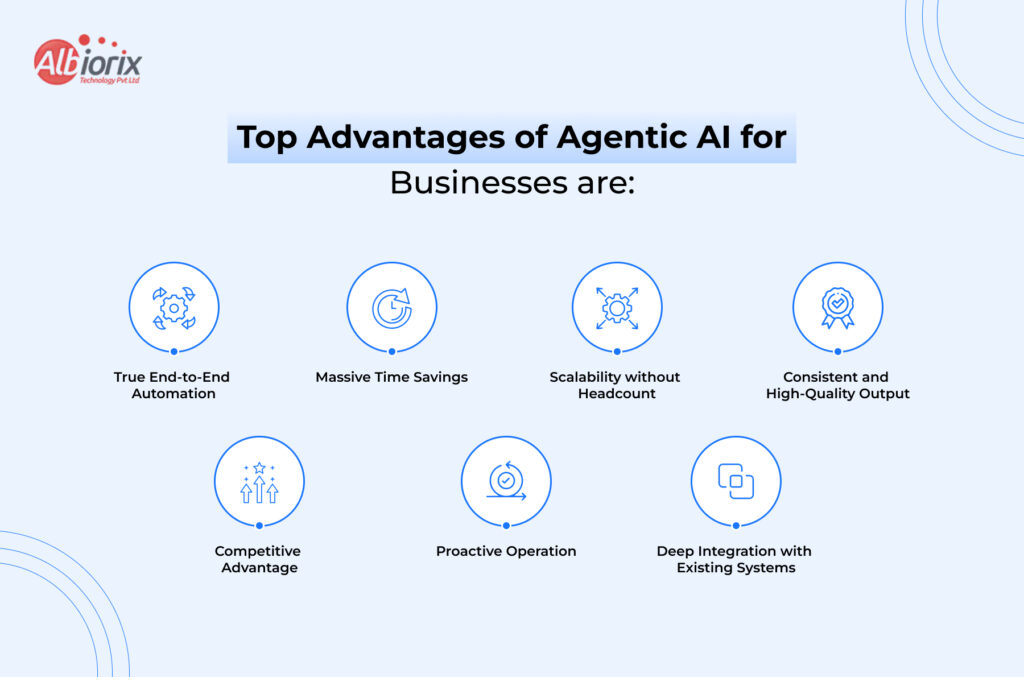
Top Advantages of Agentic AI for Businesses are:

Top Advantages of Agentic AI
  1. True End-to-End Automation: Rule-based automation breaks when something unexpected happens. Agentic AI can manage exceptions, adapt to new information, and complete complex workflows without human help.
  2. Massive Time Savings: A whole team of experts can complete a task that takes several days in just a few hours. Well-trained and developed AI agents are so excellent that they can complete tasks in minutes.

    Beyond just saving time, these systems significantly reduce development costs using AI by automating the most labor-intensive parts of the software lifecycle.

  3. Scalability without Headcount: In an organisation, you will need different resources to complete tasks. Whereas in the case of Agentic AI, a single AI agent can handle 10 tasks efficiently. Thus, there is no need to scale up your team. This specifically helps startups and small businesses with limited budgets.
  4. Consistent and High-Quality Output: Human teams have good days and bad days. AI agents execute with the same precision and consistency every time. It can deliver the same quality output with reduced errors, improved reliability, and high quality at scale.
  5. Proactive Operation: Generative AI or automated software solutions wait for instructions to perform tasks. Whereas, designers and trainers can build agentic AI to monitor conditions and take proactive action. It can flag anomalies, initiate outreach, or escalate issues.
  6. Deep Integration with Existing Systems: Modern and advanced agentic systems can easily connect with your existing systems. It can connect to your CRM, ERP, data warehouses, and communication platforms. It adds a layer of smart automation across your whole operation.
  7. Competitive Advantage: Businesses that deploy agentic AI now are building capabilities their competitors don’t have. The compounding advantage of AI-powered operations is hard to overstate.

Want to see what Agentic AI could do for your business specifically?

Book a free strategy call with our team. We have helped companies in Australia, the USA, and the UK build AI solutions that actually deliver ROI.


Contact Us

Top Industries Using Agentic AI in 2026

Well, the AI revolution has taken every industry by storm. As a result, agentic AI is no longer a niche technology. Organizations are deploying it across virtually every major sector.

Here are the top 12 industries leading the charge:

  1. Financial Services: In the FinTech industry, AI agents autonomously handle fraud detection, credit risk assessment, regulatory compliance monitoring, and personalised financial advisory at scale.
  2. Healthcare: In the Healthcare industry, agentic AI systems are managing patient intake, automating clinical documentation, coordinating care pathways, and supporting diagnostic workflows. It helps reduce workloads on hospitals and doctors.
  3. eCommerce & Retail: AI agents handle end-to-end customer journeys from personalised product recommendations to order management, returns processing, and dynamic pricing adjustments.
  4. Customer Support/Retail: Retailers are also moving beyond text to autonomous AI voice agents to provide hands-free customer assistance.
  5. Legal: Law firms and legal tech platforms use AI agents for contract review and due diligence.
    • They also use them for case law analysis and document drafting.
    • This cuts the time spent on routine tasks.
  6. Real Estate: Agents autonomously qualify leads, schedule property viewings, generate market analysis reports, and manage post-sale documentation workflows.
  7. Manufacturing & Supply Chain: Agentic systems monitor supply chain disruptions, optimise procurement, predict equipment failures, and coordinate logistics across global networks.
  8. Marketing & Advertising: AI agents run multi-channel campaigns on their own. They write copy, A/B test creatives, adjust bids, analyse performance, and improve results.
  9. Media & Entertainment: In data-heavy sectors, we are seeing specialized use cases like AI agents in sports betting apps that manage real-time odds and user engagement.
  10. Human Resources: AI agents are changing how HR teams work. They help with sourcing and screening candidates. They also support onboarding, policy compliance, and performance tracking.
  11. Education & EdTech: Agentic AI powers adaptive learning platforms that personalise curriculum, monitor student progress, provide tutoring, and generate learning content dynamically.
  12. Software Development: AI agents can write, test, debug, and document code. Some systems can ship full features on their own. They need a clear specification.

How to Build Agentic AI Systems

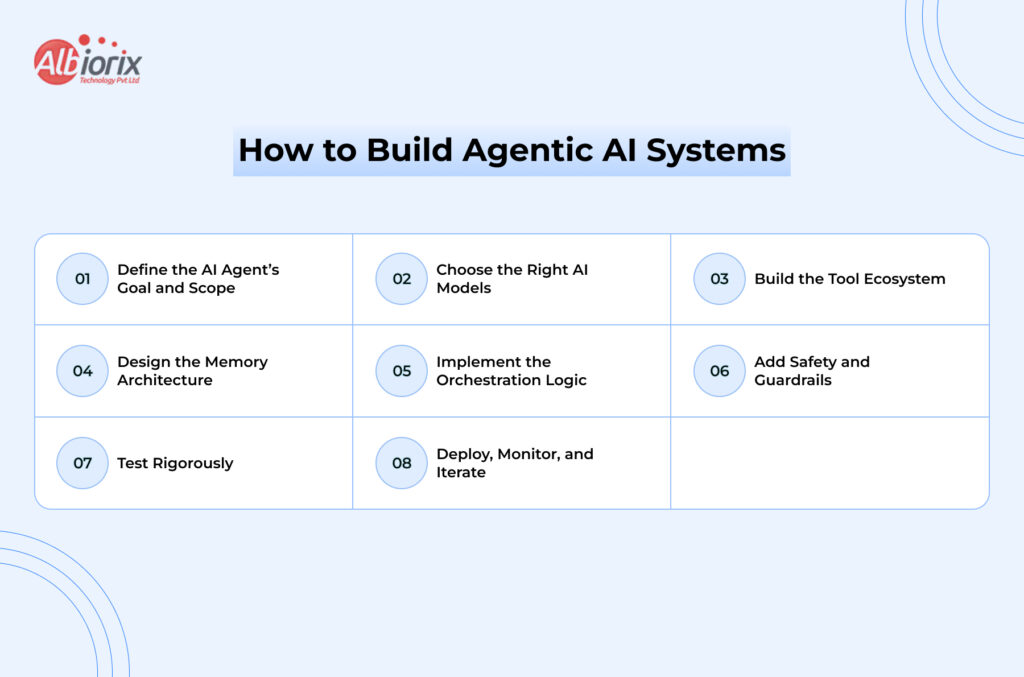
How to Build Agentic AI Systems

Building a functional agentic AI system requires careful planning and the right technical foundation. Here’s how the process typically unfolds:

Step 1: Define the AI agent’s goal and scope. Before you write any code, be clear on what you want it to do.

What is its primary objective? What decisions is it allowed to make? What actions should always require human approval? The clearer your scope, the better your agent will perform.

Step 2: Choose the Right AI Models: Select the underlying language models and machine learning models based on your use case.

For reasoning-heavy tasks, you’ll want frontier models. For high-volume, lower-complexity tasks, fine-tuned smaller models may be more cost-effective. Often, a combination of models works best a powerful model for planning, a faster one for execution.

Step 3: Build the Tool Ecosystem: Define every external system and API your agent will need to interact with. Map out permissions, authentication, and rate limits. Build or configure tool wrappers that the agent can call cleanly.

Step 4: Design the Memory Architecture: Decide how your agent will store and retrieve information. Short-term context, long-term vector memory, and episodic records each serve different purposes.

The right memory architecture is often what separates a useful agent from a frustrating one.

Step 5: Implement the Orchestration Logic: If you’re building a multi-agent system, design the coordination layer. Define how agents communicate, assign tasks, and handle conflicts or failures.

Step 6: Add Safety and Guardrails: Define what your agent is not allowed to do. Implement hard stops, escalation paths, and audit logging. This is non-negotiable in enterprise deployments.

Step 7: Test Rigorously: Agentic systems behave differently than traditional software. Test for edge cases, adversarial inputs, tool failures, and unexpected sequences of events. Red-team your own system.

Step 8: Deploy, Monitor, and Iterate: Launch in a controlled environment first. Monitor behavior closely, collect feedback, and refine the agent’s instructions, tools, and logic iteratively.

Building these systems is complex; if you prefer to work with experts, explore our Agentic AI development services to accelerate your deployment.

How to Integrate Agentic AI into Your Business

You don’t have to overhaul your entire operation to start benefiting from agentic AI. Here’s a practical approach to integration:

  • Start with a high-impact, focused use case.
  • Find a process that is repetitive and time-consuming.
  • It should be data-heavy and handled by people today.
  • They should follow a fairly predictable set of steps. Common starting points include lead qualification, customer support triage, invoice processing, or competitive research.
  • Audit your existing data and systems: AI agents are only as good as the data they can access.Before you deploy, ensure your key systems have accessible APIs. Make sure your data is reasonably clean. Confirm your team knows what data the agent will use.
  • Before deployment, check for API availability; our agentic AI integration services can help map these connections to ensure your data flows securely.
  • Define human-in-the-loop touchpoints: Even highly autonomous agents need clear escalation points.
  • These are cases where they pause and ask a human for input. Designing these thoughtfully is what makes agentic AI safe and trustworthy in real operations.
  • Integrate gradually: Connect the agent to one system at a time. Validate behavior at each step before expanding its access and responsibilities. This staged rollout approach reduces risk and builds internal confidence.
  • Train your team: Agentic AI changes how people work, not just what AI does. Invest in helping your team learn to work with agents, interpret their outputs, and know when to override them.
  • Measure and optimize: Define clear success metrics before you launch task completion rate, time saved, error rate, cost per workflow. Review them regularly and use them to guide improvements.

Why Choose Albiorix Technology as Your Agentic AI Development Partner

There are many agentic AI development companies in the USA, Australia, and the UK. Albiorix Technology is an end-to-end agentic AI development company.

We have a team of AI engineers who know the industry well. They also have a deep understanding of agentic systems.

Whether you need Custom AI agent development or Agentic AI integration, our AI developers can help.

Our team has the experience and expertise to deliver smoothly.

These solutions help businesses streamline operations and boost productivity. In our portfolio, you will find AI-powered mobile apps and websolutions like DUCO, Daisy, Deal Signal, and more.

Our Agentic AI Development services are available to businesses in Australia, the USA, and the UK. We have worked across time zones.