




What is an AI Agent Development for US Enterprises

Summary: AI agents go beyond automation. They reason, adapt, and act as per the situation. This enterprise guide covers how AI agent development works, real industry use cases, and how US businesses can choose the right development partner.

Most enterprise automation tools do exactly what you tell them to do. AI agents do what needs to be done. And that’s the first and the basic difference between an automation tool and an AI Agent.

That difference might sound subtle, but for US enterprises navigating operational complexity, rising labor costs, and the pressure to scale without proportionally growing headcount, it is the difference between incremental efficiency and genuine transformation.

This informational guide on AI agents and AI agent development has the answer to every foundational question your leadership team is likely asking right now, such as:

  • What is an AI Agent?
  • What is AI Agent Development?
  • How does it work in practice?
  • Where does it deliver real enterprise ROI?
  • When does custom development make more sense than off-the-shelf tools?

By the end, you will have a clear framework to evaluate whether AI agent development belongs in your next strategic roadmap.

What Is an AI Agent? A Plain-English Definition

An AI agent is a software system that automatically understands its environment, reasons about a goal, and determines the next steps to achieve that goal without any human intervention.

Unlike chatbots and IVR systems that follow the rules and predefined answers, an AI agent plans, adapts, and performs tasks on its own across multiple tools and data sources in real time.

Now, AI Agent Development is the process of designing, developing, and deploying these systems (aka AI Agents) to fulfill specific business objectives.

During the development process, these AI agents are integrated with enterprise data, APIs, and workflows so that they can operate accurately and reliably at scale.

Quick Definition:

An AI agent is an autonomous software system that perceives inputs, reasons through a goal, and takes multi-step actions to complete tasks with minimal human intervention.

Enterprise AI agent development involves building, integrating, and deploying these agents within existing business infrastructure to automate complex, decision-intensive workflows.

What is the difference between AI Agent and Traditional Automation

The basic and most crucial difference between an AI agent and a traditional automation tool is that an AI agent takes the decisions on its own to complete a task, whereas an automation tool strictly follows the rules and predefined script.

Below is the comparison table between AI agent and Traditional Automation.
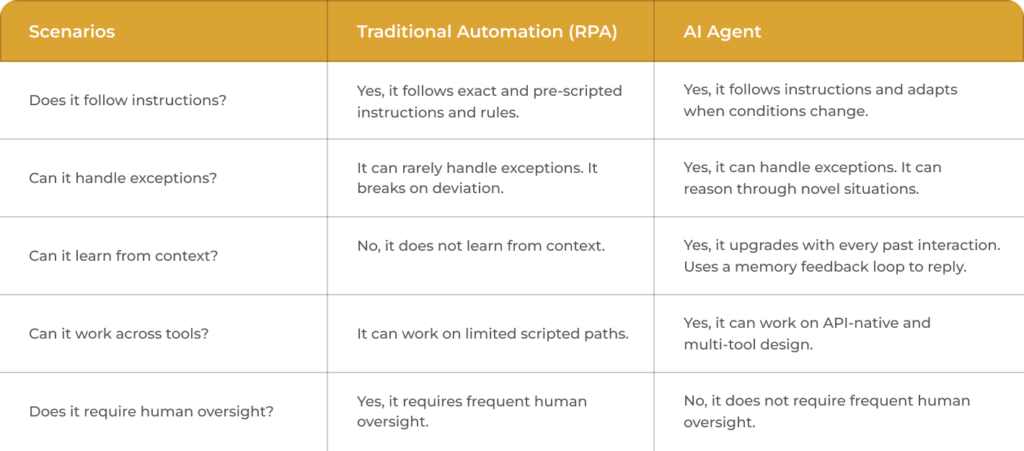
AI Agent vs Traditional Automation

The analogy that resonates most with enterprise stakeholders: RPA is a calculator. An AI agent is a junior analyst who knows how to use a calculator, read a spreadsheet, send a follow-up email, and flag anything unusual; all without being asked twice.

Is your enterprise ready for AI Agents?

Not Sure? Book a free 30-minute consultation with our AI specialists at Albiorix Technology to find out.


Book a Free Consultation Call

How AI Agent Development Works: The Development Lifecycle

The AI agent development process is a bit tricky. However, every enterprise needs to understand the development lifecycle as it enables them to ask the right questions and set realistic expectations.

Here is how a well-structured AI agent development engagement typically unfolds:

  • Setting the Goals: The first step in developing an AI agent is to define and set the goals, boundaries, and success metrics. You must have a clear picture of what an AI agent must do, what it must not do, and how you will know it is working well.
  • Finalizing AI Model & Framework: The second step in AI agent development is to finalize the AI model and reasoning framework. Some of the most common choices for enterprise deployment are LangChain, AutoGen, CrewAI, GPT-4, and Claude.
  • APIs & Data Integration: In the third step, you need to integrate CRM platforms, ERP systems, internal databases, and third-party services with your AI agent to respond accurately and reliably.
  • Designing Memory & Reasoning Layer: Short-term context (within a task), long-term memory (across tasks), and the logic that governs how the agent prioritizes actions.
  • Build and configure the action layer: The specific tools, APIs, and output channels the agent can use to complete tasks.
  • Test in a sandboxed environment: Red-team the agent, test edge cases, and establish human-in-the-loop checkpoints for high-stakes decisions.
  • Deploy, monitor, and iterate: Track performance against KPIs, capture drift, and continuously refine.

Estimated Timeline: According to the AI agent development experts at Albiorix Technology, building a focused single agent from a well-scoped workflow can take 8-12 weeks.

Whereas the time to develop multi-agent systems with deep enterprise integration typically takes 16 to 24 weeks.

If any AI development company or a vendor promises, an AI agent in two or three weeks is cutting corners on testing it before deployment. It can create significant downstream risk in the future.

Real Enterprise Use Cases: Where AI Agents Deliver ROI
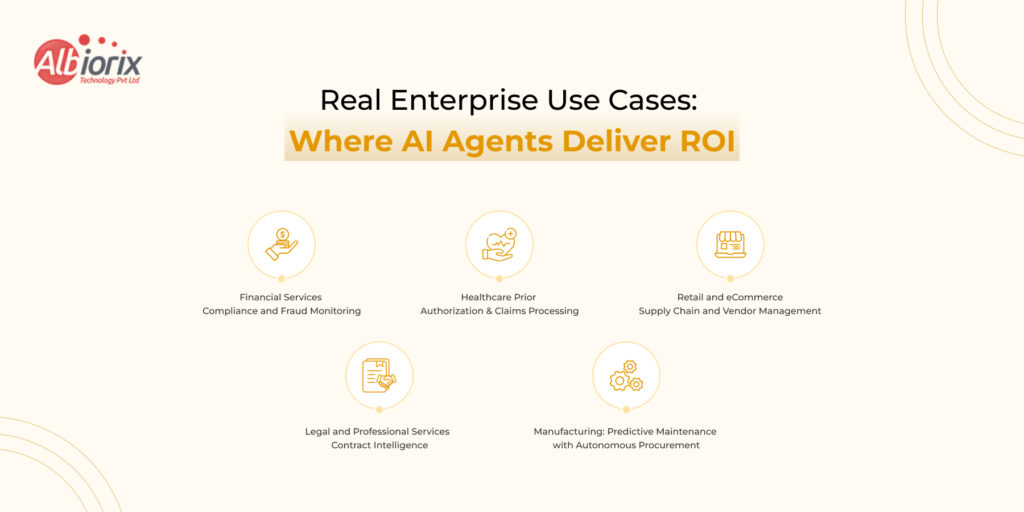
Real Enterprise Use Cases: Where AI Agents Deliver ROI

The highest-value AI agent deployments share a common trait: they target workflows that are high-frequency, rule-adjacent (mostly rule-based with enough exceptions to break RPA), and expensive in human time.

Here are five enterprise verticals where AI agent development is already generating measurable returns:

Financial Services — Compliance and Fraud Monitoring

AI agents continuously monitor transaction streams, flag anomalies against regulatory rules, cross-reference sanctions lists, and generate compliance reports tasks that previously required teams of analysts working in shifts. One mid-size US broker-dealer reduced compliance review time by 60% and cost by 30% after deploying a custom monitoring agent integrated with their core banking system.

Healthcare — Prior Authorisation and Claims Processing

Prior authorisation is one of healthcare’s most expensive administrative bottlenecks. Autonomous AI systems can retrieve patient records, match against payer criteria, draft authorisation requests, follow up with payers, and escalate to a clinician only when genuinely required. This reduces processing time from days to hours.

Retail and eCommerce — Supply Chain and Vendor Management

Custom AI agents for business automation in retail are handling demand forecasting, reorder triggering, vendor communication, and exception management all within a single automated loop. What once required a supply chain analyst’s daily attention now runs with a weekly human review cycle.

Legal and Professional Services — Contract Intelligence

Enterprise AI agents can ingest contracts, extract key clauses, flag deviations from standard terms, cross-reference prior agreements, and surface risk in minutes rather than the hours a paralegal team would need. Several AmLaw 200 firms are already piloting these deployments.

Manufacturing — Predictive Maintenance with Autonomous Procurement

Sensor data feeds an AI agent that predicts equipment failure windows, triggers maintenance work orders, and when parts inventory drops below threshold, it initiates a procurement workflow with pre-approved suppliers. No human touches the process until the maintenance technician shows up with the right parts already ordered.

See what AI agents can do for your industry

Our team has built custom AI automation solutions across finance, healthcare, legal, and manufacturing.


Call Us!

Custom AI Agents vs. Off-the-Shelf AI Tools: Which Is Right for You?

The honest answer: off-the-shelf tools like Microsoft Copilot, Salesforce Einstein, or ServiceNow’s AI capabilities are genuinely good for standardized workflows within their native ecosystems. If your needs map cleanly onto what these platforms offer, start there.

Custom AI agent development becomes the better investment when:

  • Your workflows span multiple platforms that do not share a native integration layer.
  • You have proprietary data that gives your agents a competitive advantage when trained into the system.
  • Your compliance environment requires auditability, data residency controls, or model-level transparency that SaaS vendors cannot provide.
  • You need the agent to take consequential actions such as approvals, financial transactions, and customer communications where off-the-shelf guardrails are too loose or too restrictive.
  • The workflow involves exceptions, judgment calls, or contextual reasoning that exceeds the boundaries of a pre-packaged product.

Off-the-shelf is faster to deploy and lower in upfront cost. Custom development has higher initial investment but delivers differentiated capability, deeper integration, and long-term cost efficiency as the agent scales. The right decision depends on where your operational complexity sits.

Enterprise AI Agent Implementation Guide: 5 Questions Before You Begin

Before any enterprise begins an AI agent implementation, your leadership team should align on these five questions. They will shape vendor selection, architecture decisions, and governance design:

  1. What workflow are we targeting, and why is it the right first candidate? Start with high-frequency, high-cost, moderately complex processes. Avoid starting with mission-critical edge cases.
  2. What does success look like in 90 days, 6 months, and 12 months? Define KPIs before development begins — time saved per transaction, error rate reduction, cost per process, or escalation frequency.
  3. What data does the agent need, and who owns it? Data access, quality, and governance decisions will determine your deployment timeline more than any technical factor.
  4. What are the failure modes, and how are they caught? Every production agent needs a human-in-the-loop escalation path. Define the trigger conditions before go-live.
  5. Is our vendor model-agnostic or locked in? Enterprise needs evolve. A partner who can work across model providers protects you from single-vendor dependency as the AI landscape shifts.

How to Choose an AI Agent Development Company in the USA
The market for AI agent development services in the USA has expanded rapidly and so has the variance in quality. Here is what separates credible enterprise partners from vendors riding the hype wave:

What to Look For:

  1. Demonstrated experience with enterprise-grade integrations, and not just prototype demos.
  2. They must be able to work with OpenAI, Anthropic, Google, or open-source models depending on your requirements. and if you want to see how we Analyzed Our Last AI Projects and what worked for our clients.
  3. A clear post-deployment support model, because production AI agents require ongoing monitoring, retraining, and incident response.
  4. Compliance and data security credentials relevant to your industry such as SOC 2, HIPAA readiness, or FedRAMP depending on your sector.
  5. References from clients in your industry or with comparable integration complexity.

Red Flags to Watch For:

  1. Vendors who lead with the model name (“we use GPT-4”) rather than the use case outcome.
  2. No mention of testing, monitoring, or post-deployment support in their proposal.
  3. Cookie-cutter demos that do not reflect your actual workflow or data environment.
  4. Timelines under six weeks for complex multi-system integrations.

Conlcusion

At Albiorix Technology, our AI agent development solution and process starts with a structured discovery engagement, and not a sales pitch.

We map your existing workflows, identify the highest-ROI automation candidates, and propose an architecture that fits your data environment, compliance requirements, and integration landscape before a single line of code is written.

Our team has built AI automation solutions for enterprises across the USA, UK, Germany, and Australia, in industries from fintech to professional services.
How Much It Cost to Build an AI Agent in 2026? A Complete Pricing Breakdown

Summary: Building an AI agent in 2026 typically costs between $5,000 and $350,000+, depending on complexity. Basic agents (chatbots, RAG) cost $5k–$25k, mid-level agents run $40k–$120k, and complex, autonomous, or enterprise-grade systems often exceed $200,000. Monthly running costs for API fees and monitoring range from $500 to $15,000+.

Cost of AI Agent Development

Every business owner who is planning to explore or integrate artificial intelligence into their business has one question on their mind, and that is – What is the cost of developing an AI Agent? It is the most common question and has no boundaries.

Young entrepreneurs and established brands in the developed nations like the USA, Australia, Germany, and the UK have the same questions before making any decisions. 

It is one of the most obvious questions that comes into the mind, and there is nothing wrong with it. But the exact answers to this question depend on many factors. So, the honest answer to the question “How much is the cost of AI agent development?” is – it depends on what you want.

If we talk about custom AI agent development from scratch, then, in 2026, the cost of development may range from $5000 for a simple rule-based chatbot to over $400,000 for a fully autonomous, multi-agent enterprise system.

However, if your project is mid-sized, then it may rank from somewhere between $25,000 to $120,000.

The real cost of AI agent development depends on several crucial factors, such as the type of agentic AI you want to build, how many systems you will need, how much autonomy it will require, and what happens after launch.

We are Albiorix Technology, an AI agent development company, and in this blog guide on the cost of AI agent development, we will provide a detailed breakdown of the costs.

So, next time when you are in a conversation with an AI agent development services provider, you will have things clear in your mind.

What is an AI Agent?

Well, before we get into the numbers and discuss the cost of AI agent development, first of all, let’s understand what an AI agent is, exactly. It is important to understand the difference between an AI and an AI agent.

An AI agent is not just a rule-based chatbot that follows scripts or instructions; it is different. An AI agent is capable of thinking, reasoning, planning, and using tools to fulfil assigned tasks on its own.

It can access external systems like CRMs and databases, update itself with every interaction, and perform multiple tasks at a single time. It does not need any human intervention at every step.

Let’s understand this with an example: An AI-powered chatbot can provide answers to all the pre-defined questions, whereas an AI agent can look up a customer’s order history, identify a billing issue, initiate a refund, and perform many more tasks at the same time without any human intervention.

This is called the capability gap, and this is the main difference between an ordinary Chatbot and an AI Agent.

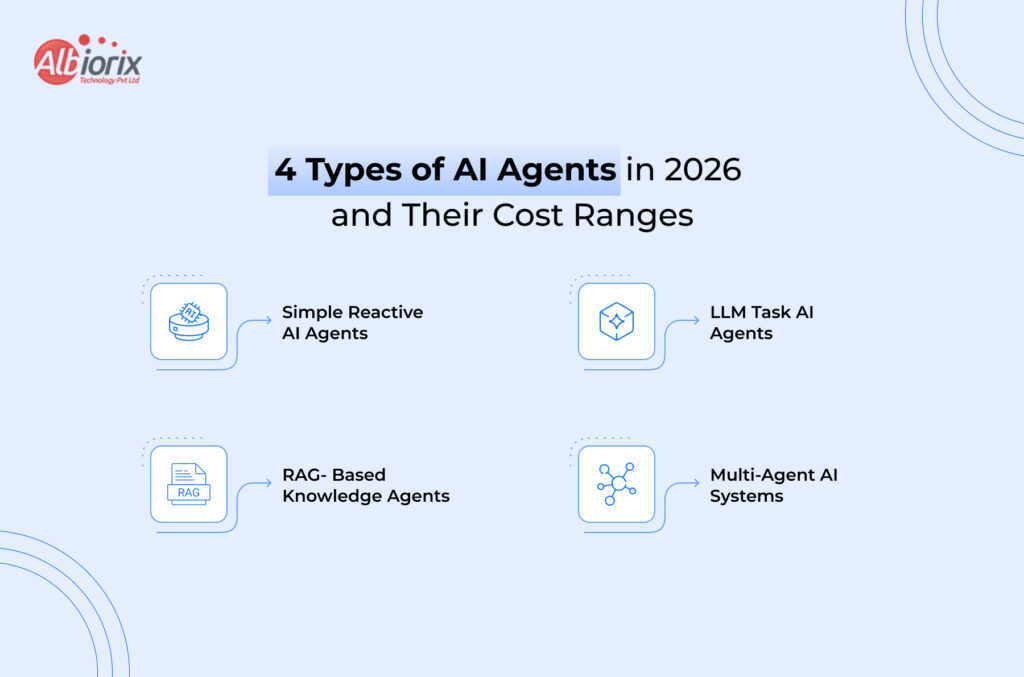
4 Types of AI Agents in 2026 and Their Cost Ranges

4 Types of AI Agents in 2026 and Their Cost Ranges

Depending on the role and uses, there are four most common types of AI Agents in 2026. And, the cost of development varies from one to another. 

As stated earlier, the cost of AI agent development in 2026 totally depends on the type of agent you need for your business. Here’s the list of types of AI agents with their respective development cost (approx.)

Simple Reactive AI Agents: 

The development cost of a simple reactive AI agent may range from $5,000 to $50,000.

These types of AI agents are typically used to handle predictable and rule-based tasks. Businesses use them as FAQ bots, appointment schedulers, and basic lead qualification assistants.

A Simple Reactive AI Agent uses fixed prompts; it does not have any memory, and it does not connect with any complex systems in the business. 

These types of AI agents are best for automating a single, well-defined workflow. It uses technologies, including OpenAI API, basic webhook integrations, and no-code platforms.

LLM Task AI Agents

The development cost of LLM Task AI Agents may range between $50,000 to $120,000.

These types of agentic agents are used to handle multi-step conversations, for short term memory, and to connect to a few external tools or APIs. These AI agents do not follow any script; instead they reason to complete a task.

LLM Task AI Agents are best for customer support automation, internal HR assistants, and sales SDR bots. These types of AI agents are developed using technologies such as LangChain, GPT-4 or Claude, CRM API integrations.

RAG- Based Knowledge Agents

The development cost of RAG-based knowledge AI agents may range between $80,000 to $180,000. 

RAG (Retrieval-Augmented Generation) agents pull from your company’s own documents, databases, or knowledge bases to give accurate, context-aware answers. They’re ideal when the agent needs to “know” your business deeply not just general knowledge. 

These types of AI agents are best for legal document review, technical support, internal knowledge management, and more.

The technologies typically used to develop these agents are LangChain or LlamaIndex, Pinecone or Weaviate (vector databases), OpenAI or Claude.

Multi-Agent AI Systems

The development cost of a Multi-AI Agent System can range between $150,000 to $400,000. 

Multi-Agent AI Systems are used by large organisations and businesses to automate tasks and enhance productivity. In this system, multiple specialised agents work together to complete various tasks within the organisation.

They are designed and developed to handle research, execute tasks, monitor outputs, and more. They work together like an organised system without any human intervention or inputs. Multi-Agent systems can run entire business workflows end-to-end with minimal human oversight.  

These types of AI agents are best for complex back-office automation, supply chain decision-making, enterprise workflow orchestration, and more.

To develop such complex AI agents, the technologies that are used typically are AutoGen, CrewAI, LangGraph, custom orchestration layers, and enterprise API integrations.

Estimate Your AI Agent Cost

Estimated Starting Investment:

$5,000

Get an Exact Quote →

💡 Next Step: Every enterprise system is unique. Share your specific use case with us during a Free 30-Minute Scoping Session and we’ll map out a definitive, architectural cost breakdown for your engineering team.

AI Agent Cost by Type

Agent TypeCost RangeTimeline
Simple Reactive Agent $5,000 – $50,0004–8 weeks
LLM Task Agent$50,000 – $120,0003–4 months
RAG Knowledge Agent$80,000 – $180,0003–5 months
Multi-Agent System$150,000 – $400,000+6–12 months

What Actually Drives the Cost Up (or Down)? 

Now, you might think that all of them are AI agents, then why there’s a huge difference in the overall development cost.

To understand the difference in the development cost of AI Agents, you have to understand the usefulness and implementation of each and every AI agent.  

Level of Autonomy Required in an AI Agent: 

If your AI agent needs to make more decisions on its own, then it will require more engineering, more testing, and in-depth work on overall safety.

This eventually increases the overall development cost. Contrary to this, if your AI agents need to make fewer and simpler decisions, then it will require comparatively low investment. 

Number and Complexity of Integrations: 

It is one of the biggest factors that impact the overall development cost of an AI Agent. Integrating an AI agent with your existing systems, such as CRM, ERP, legacy databases, and internal APIs, requires significant time and effort.

If your system is poorly documented or inconsistent, then it adds fuel to the fire. AI agent integration work can easily equal or exceed the core AI development cost. 

LLM Model Choice:  

If you are using premium AI models such as GPT-4 or Claude Opus for better reasoning, then the cost of AI agent development increases.

If you want a budget-friendly option, you can use open-source models like LLaMA 3 and Mistral for early-stage development. It can significantly reduce both development and running costs. 

For businesses that don’t want to invest heavily in the initial stages, they can consider a hybrid approach. At the prototype stage, they can use open-source models, then switch to premium models only where performance requires. 

Compliance and Security Requirements: 

If you operate in healthcare, finance, or legal, or if you’re targeting enterprise clients in regulated markets expect compliance requirements (data residency, audit trails, access controls, HIPAA, GDPR) to add 20–40% to your total project cost. 

On-Premise vs. Cloud Deployment: 

Cloud deployment is faster and cheaper to start. On-premise deployment — where the model runs on your own infrastructure costs significantly more upfront but may be required for data-sensitive environments.

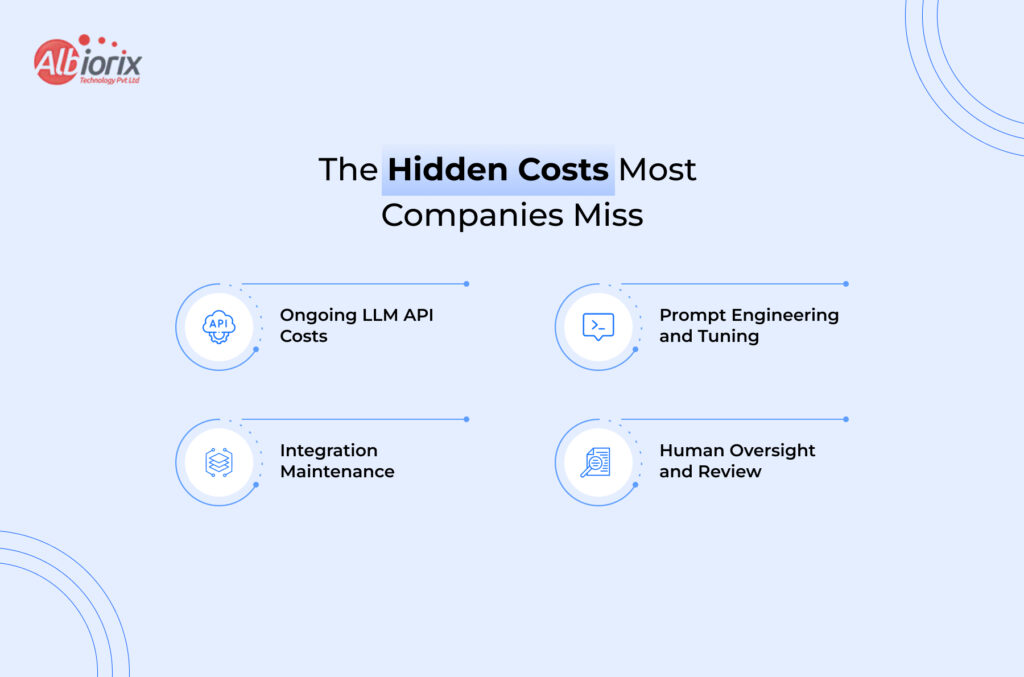
The Hidden Costs Most Companies Miss

The Hidden Costs Most Companies Miss

The build cost is only part of the total investment. Here’s what typically gets left out of early budgets: 

Ongoing LLM API Costs: 

Every time your agent processes a query, it consumes tokens. At scale, this adds up fast. Depending on usage volume and model choice, monthly operational costs typically run between $3,200 and $13,000.

It covers LLM API calls, vector database hosting, monitoring, and prompt maintenance. Thus, plan for this before you launch, not after. 

Prompt Engineering and Tuning:  

Getting an AI agent to behave consistently in production requires ongoing prompt refinement, evaluation, and optimization.

Most teams spend 10–20 hours per month on this after launch. It’s not optional it’s how you maintain quality as your data and workflows evolve. 

Integration Maintenance 

When the external systems your agent connects to update their APIs or change their data structure, your agent breaks. Budget for ongoing maintenance at roughly 20–30% of your initial development cost per year. 

Human Oversight and Review

Even highly autonomous agents require human review pipelines for edge cases, error handling, and quality assurance especially in the first 6–12 months of deployment.

Talk to an AI Agent Expert, Free 30-Minute Call

Have questions about cost, timeline, or which type of AI agent fits your workflow? Skip the research rabbit hole. Book a 30-minute call with the Albiorix AI team.


Schedule My Call!

How to Reduce AI Agent Development Costs Without Cutting Corners 

When it comes to custom AI agent development, you dont need to have an unlimited budget. You can build a valuable AI agent with proper planning and execution. 

Here’s how experienced AI development company keeps cost under control: 

  1. Start with a narrow scope: The most common (and expensive) mistake is trying to build a generalist agent in version one. A focused agent that does one task very well is faster, cheaper, and more reliable. You can expand from there. 
  2. Use proven frameworks: LangChain, LangGraph, CrewAI, and AutoGen save weeks of engineering time. Selecting the right framework at the start can reduce backend engineering costs by 20–40%. 
  3. Prototype with open-source models: Use LLaMA 3, Mistral, or Ollama for early development and evaluation. Move to OpenAI or Claude only when performance requirements justify the cost. 
  4. Build observability from day one: Monitoring, prompt versioning, and feedback loops are significantly cheaper to implement during development than to retrofit after issues emerge in production. 
  5. Choosing the right AI development company: Generic software agencies may quote lower rates but often underestimate the complexity of agentic systems. Working with a team that has shipped production AI agents before reduces rework, delays, and costly architecture pivots. 

What ROI Can You Realistically Expect? 

If scoped correctly, the business case of AI agents is very strong. 

For well-defined, high-volume workflows, ROI timelines of 4–8 months are realistic. A mid-sized business automating 70% of customer service queries, for example, can save $80,000–$100,000 annually against a total agent investment of $30,000–$50,000 per year. 

The highest-ROI use cases in 2026 include: 

  • Customer support automation: Reducing cost per ticket by 30–60% 
  • Back-office workflow automation: Eliminating manual data entry and handoffs 
  • Sales development: Qualifying leads and handling initial outreach at scale 
  • Internal knowledge management: Giving teams instant access to company documents and processes 

The key is starting with a use case where the volume justifies the investment and the workflow is well-defined enough for an agent to handle reliably. 

Build vs. Buy: A Quick Framework 

Before committing to custom development, it is important to ask yourself – whether to build from scratch or buy a readymade AI agent from the market. 

Both the options have their own pros and cons, and the selection of any one depends on many different factors, and the first factor is the development cost. 

When you buy an AI agent, it uses the most common use cases in the market, including customer FAQs, appointment booking, simple lead qualification, and similar.

These off-the-shelf SaaS tools can be easily deployed in days and the cost may range from $500 – $5,000/month. 

When you decide to custom build an AI agent from scratch, you already have an upper hand in the industry. Custom builds typically win on 3-year total cost of ownership for these scenarios.

Go for custom build if you have proprietary workflows, integrations that no SaaS tool supports, compliance requirements, or a need for the agent to deeply understand your business data. 

Most businesses should start with an off-the-shelf tool to validate the use case, then invest in a custom build once results are proven.

How Albiorix Approaches AI Agent Development

How Albiorix Approaches AI Agent Development

At Albiorix, we’ve built production AI agents for clients across healthcare, fintech, logistics, and enterprise SaaS. Our team works with LangChain, AutoGen, CrewAI, LlamaIndex, Pinecone, Weaviate, and the full stack of modern agentic AI tools

We don’t believe in one-size-fits-all pricing. Every estimate we provide is based on your actual workflow, your existing systems, and what the agent needs to do in production not just in a demo. 

Our typical engagement starts with a scoping session where we help you: 

  • Define the right agent type for your use case 
  • Map out integration requirements and data readiness 
  • Build a realistic cost and timeline estimate 
  • Identify the highest-ROI starting point 

Whether you’re ready to build or still evaluating whether an AI agent is the right investment, we’re happy to give you an honest assessment. 

Talk to the Albiorix AI team!

What Is Agentic AI: A Comprehensive Guide

Summary: Agentic AI refers to autonomous systems that can reason, plan, and take actions to achieve complex, multi-step goals with minimal human supervision. Unlike generative AI, which creates content upon request, agentic AI actively uses tools and adapts to environments. Key features include high autonomy, adaptability, and goal-oriented, proactive workflows.

If you’ve been following the AI space lately, you’ve probably noticed that the conversation has shifted. It’s no longer just about chatbots or content generators.

Businesses are now asking a bigger question: What if AI could actually get things done on its own? That’s exactly what Agentic AI is about.

Whether you are a startup founder, a business owner, or an entrepreneur, you should understand Agentic AI in 2026.

As we provide Agentic AI development services, we’ve helped businesses in Australia, the USA, and the UK. We help them move from curiosity to real AI-powered operations.

This guide covers what you need to know. It explains what Agentic AI is. It shows how it differs from generative AI.

What is an Agentic AI?

Agentic AI refers to AI systems that can plan, decide, and act on their own.

They can complete complex, multi-step tasks without constant human guidance.

Think about how you’d assign a task to a capable employee. You give them the goal, maybe some guidelines, and they figure out the rest. They research, make decisions, use tools, handle obstacles, and come back with results.

Agentic AI works the same way. You give it an objective, and it takes independent actions to achieve it.

This is very different from the AI most people are familiar with. People ask questions to most AI models, and the models give you answers. Agentic AI completes the assigned tasks. It doesn’t just respond; it operates.

At its core, an Agentic AI system combines:

  • A large language model (LLM) or a set of AI models. It works as a brain
  • Tools and APIs used to interact with the world (search engines, databases, code executors, email clients, etc.)
  • A memory layer to retain context across steps
  • A planning and reasoning engine that breaks goals into actionable steps
  • A feedback loop that lets it evaluate its own outputs and correct course

The result? AI that doesn’t just answer questions, it executes workflows, manages processes, and drives outcomes.

How Do AI Agents Work?

To understand the power of AI agents and why they are in huge demand, you have to understand their way of working. An AI agent follows a continuous loop that normally looks like this:

  1. Perceive: The agent takes in information. This could be a user instruction, data from a database, output from another tool, or even real-time web data.
  2. Think: The agent uses an AI model, often a large language model. It reasons about the current state. It considers what it knows and what it must do next.
  3. Plan: It breaks the task into smaller, executable steps and decides which tools or sub-agents to use.
  4. Act: It takes action calling an API, writing code, sending an email, querying a database, or triggering another agent.
  5. Reflect: It evaluates whether the action moved it closer to the goal. If not, it adjusts its plan and tries again.

This loop continues until the task is complete. What makes this remarkable is that the agent isn’t following a rigid script.

Understanding this cycle is key to seeing the AI agents vs traditional automation difference, where agents handle the ‘Reflect’ step that rules-based systems cannot.

It adapts in real time. It handles unexpected inputs. It makes judgment calls along the way.

Multi-agent systems take this further. Instead of one agent doing everything, you have a network of specialized agents.

One that researches, one that analyzes, one that writes, one that executes, all coordinated by an orchestrator agent. This reflects how high-performing teams structure themselves in the real world.

Difference between Agentic AI vs Generative AI

There are many businesss that still get confused between the Agentic AI and Generatve AI. Both are very different. Let’s clear it up so you can choose what’s right for your business.

What is Generative AI?

A generative AI is an AI that generates content such as text, images, code, audio, etc. You enter a detailed prompt and it responds with the output.

The best and the most popular example of Generative AI is ChatGPT. It’s reactive and operates in a single turn. Give it an input, get an output.

What is Agentic AI?

An Agentic AI is an AI that operates over multiple steps, across time, using tools, and can initiate actions without being prompted at every step.

Comparision Between Generative AI and Agentic AI

FeatureGenerative AIAgentic AI
Primary FunctionGenerates ContentExecutes Tasks & Workflows
Interaction ModelSingle-turn or ConversationalMulti-step, Goal-driven
Tool UseLimited or NoneExtensive (APIs, Databases, Code, etc.)
AutonomyLow – Needs human input per stepHigh – Operates independently
MemoryLimited to Context WindowLong-term Memory Across Sessions
Best for Content Creation, Q&A, SummarizationProcess Automation, Complex Workflows

To explain this simply, Generative AI answers your questions, while Agentic AI completes tasks for you.

For businesses, they must not only use AI models that answer questions. They also need AI agents that help them run their business efficiently.

Key Components of Agentic Architecture

If Agentic AI impresses you and you want to develop it, you should understand its core architecture.

Here’s what makes up a well-designed agentic system:

  1. LLM/AI Models as the Core Reasoning Engine: The foundation of any AI agent is a strong language model. It can also be a mix of AI models. These models handle natural language understanding, reasoning, and planning.
  2. The choice of model matters enormously depending on your use case. Some tasks benefit from large frontier models; others can run efficiently on smaller, fine-tuned machine learning models.
  3. Tool Layer: Agents are only as useful as the tools they can access. A tool can be anything the agent can call. They call it a web search API, a code execution tool, a CRM system, a database, a calendar, or a custom app. The richer the tool layer, the more capable your agent becomes.
  4. Memory System: Human professionals remember past interactions and learn from them. Good agentic systems do too. Memory in agentic architecture typically comes in three forms:
    • In-context memory: What the agent can see in its current session
    • External memory: A vector database or knowledge store the agent can query 
    • Episodic memory: A record of past interactions and outcomes
  5. Orchestration Layer: In multi-agent systems, an orchestrator decides which agents handle tasks. It manages communication between them. It also tracks progress toward the overall goal. Think of it as the project manager of your AI team.
  6. Feedback & Reflection Mechanism: Strong agent systems include ways to review their own outputs. They check for errors, mismatches, or weak results. They can self-correct without human help.
  7. Safety and Guardrails: Autonomous systems need boundaries. A robust agentic architecture uses role-based access controls, action approval thresholds, audit logs, and fail-safes. It ensures agents do only what they are authorized to do.

Advantages of Agentic AI for Businesses

There are many options in the market, but why are businesses investing heavily in agentic systems in 2026? Using agentic AI has many benefits.

These benefits go far beyond what traditional automation can deliver. They also go far beyond what generative AI can deliver.

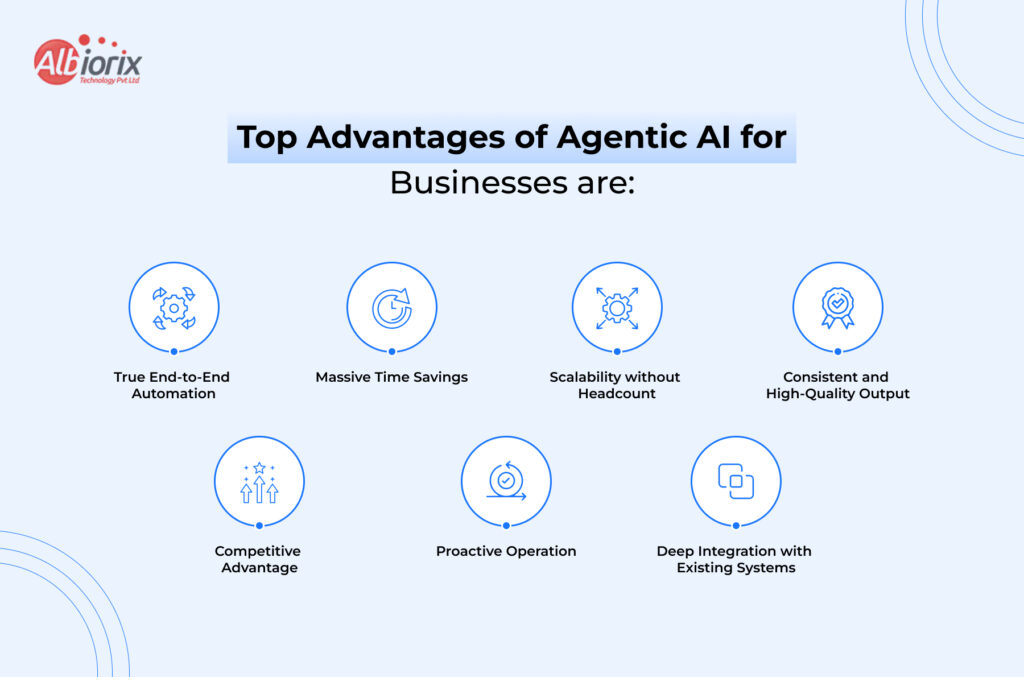
Top Advantages of Agentic AI for Businesses are:

Top Advantages of Agentic AI
  1. True End-to-End Automation: Rule-based automation breaks when something unexpected happens. Agentic AI can manage exceptions, adapt to new information, and complete complex workflows without human help.
  2. Massive Time Savings: A whole team of experts can complete a task that takes several days in just a few hours. Well-trained and developed AI agents are so excellent that they can complete tasks in minutes.

    Beyond just saving time, these systems significantly reduce development costs using AI by automating the most labor-intensive parts of the software lifecycle.

  3. Scalability without Headcount: In an organisation, you will need different resources to complete tasks. Whereas in the case of Agentic AI, a single AI agent can handle 10 tasks efficiently. Thus, there is no need to scale up your team. This specifically helps startups and small businesses with limited budgets.
  4. Consistent and High-Quality Output: Human teams have good days and bad days. AI agents execute with the same precision and consistency every time. It can deliver the same quality output with reduced errors, improved reliability, and high quality at scale.
  5. Proactive Operation: Generative AI or automated software solutions wait for instructions to perform tasks. Whereas, designers and trainers can build agentic AI to monitor conditions and take proactive action. It can flag anomalies, initiate outreach, or escalate issues.
  6. Deep Integration with Existing Systems: Modern and advanced agentic systems can easily connect with your existing systems. It can connect to your CRM, ERP, data warehouses, and communication platforms. It adds a layer of smart automation across your whole operation.
  7. Competitive Advantage: Businesses that deploy agentic AI now are building capabilities their competitors don’t have. The compounding advantage of AI-powered operations is hard to overstate.

Want to see what Agentic AI could do for your business specifically?

Book a free strategy call with our team. We have helped companies in Australia, the USA, and the UK build AI solutions that actually deliver ROI.


Contact Us

Top Industries Using Agentic AI in 2026

Well, the AI revolution has taken every industry by storm. As a result, agentic AI is no longer a niche technology. Organizations are deploying it across virtually every major sector.

Here are the top 12 industries leading the charge:

  1. Financial Services: In the FinTech industry, AI agents autonomously handle fraud detection, credit risk assessment, regulatory compliance monitoring, and personalised financial advisory at scale.
  2. Healthcare: In the Healthcare industry, agentic AI systems are managing patient intake, automating clinical documentation, coordinating care pathways, and supporting diagnostic workflows. It helps reduce workloads on hospitals and doctors.
  3. eCommerce & Retail: AI agents handle end-to-end customer journeys from personalised product recommendations to order management, returns processing, and dynamic pricing adjustments.
  4. Customer Support/Retail: Retailers are also moving beyond text to autonomous AI voice agents to provide hands-free customer assistance.
  5. Legal: Law firms and legal tech platforms use AI agents for contract review and due diligence.
    • They also use them for case law analysis and document drafting.
    • This cuts the time spent on routine tasks.
  6. Real Estate: Agents autonomously qualify leads, schedule property viewings, generate market analysis reports, and manage post-sale documentation workflows.
  7. Manufacturing & Supply Chain: Agentic systems monitor supply chain disruptions, optimise procurement, predict equipment failures, and coordinate logistics across global networks.
  8. Marketing & Advertising: AI agents run multi-channel campaigns on their own. They write copy, A/B test creatives, adjust bids, analyse performance, and improve results.
  9. Media & Entertainment: In data-heavy sectors, we are seeing specialized use cases like AI agents in sports betting apps that manage real-time odds and user engagement.
  10. Human Resources: AI agents are changing how HR teams work. They help with sourcing and screening candidates. They also support onboarding, policy compliance, and performance tracking.
  11. Education & EdTech: Agentic AI powers adaptive learning platforms that personalise curriculum, monitor student progress, provide tutoring, and generate learning content dynamically.
  12. Software Development: AI agents can write, test, debug, and document code. Some systems can ship full features on their own. They need a clear specification.

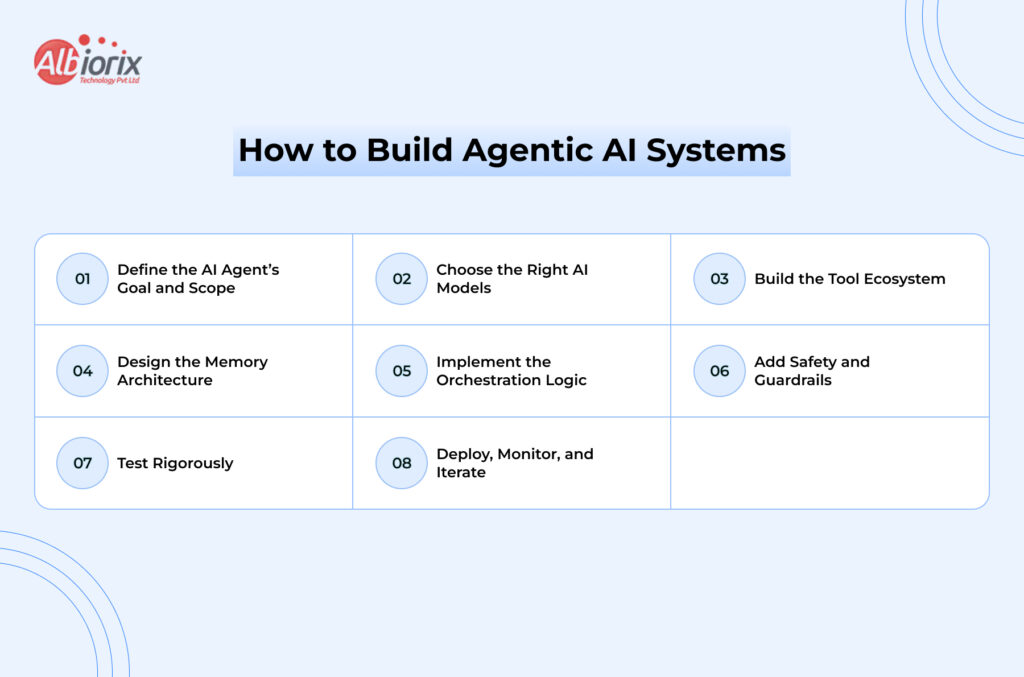
How to Build Agentic AI Systems

How to Build Agentic AI Systems

Building a functional agentic AI system requires careful planning and the right technical foundation. Here’s how the process typically unfolds:

Step 1: Define the AI agent’s goal and scope. Before you write any code, be clear on what you want it to do.

What is its primary objective? What decisions is it allowed to make? What actions should always require human approval? The clearer your scope, the better your agent will perform.

Step 2: Choose the Right AI Models: Select the underlying language models and machine learning models based on your use case.

For reasoning-heavy tasks, you’ll want frontier models. For high-volume, lower-complexity tasks, fine-tuned smaller models may be more cost-effective. Often, a combination of models works best a powerful model for planning, a faster one for execution.

Step 3: Build the Tool Ecosystem: Define every external system and API your agent will need to interact with. Map out permissions, authentication, and rate limits. Build or configure tool wrappers that the agent can call cleanly.

Step 4: Design the Memory Architecture: Decide how your agent will store and retrieve information. Short-term context, long-term vector memory, and episodic records each serve different purposes.

The right memory architecture is often what separates a useful agent from a frustrating one.

Step 5: Implement the Orchestration Logic: If you’re building a multi-agent system, design the coordination layer. Define how agents communicate, assign tasks, and handle conflicts or failures.

Step 6: Add Safety and Guardrails: Define what your agent is not allowed to do. Implement hard stops, escalation paths, and audit logging. This is non-negotiable in enterprise deployments.

Step 7: Test Rigorously: Agentic systems behave differently than traditional software. Test for edge cases, adversarial inputs, tool failures, and unexpected sequences of events. Red-team your own system.

Step 8: Deploy, Monitor, and Iterate: Launch in a controlled environment first. Monitor behavior closely, collect feedback, and refine the agent’s instructions, tools, and logic iteratively.

Building these systems is complex; if you prefer to work with experts, explore our Agentic AI development services to accelerate your deployment.

How to Integrate Agentic AI into Your Business

You don’t have to overhaul your entire operation to start benefiting from agentic AI. Here’s a practical approach to integration:

  • Start with a high-impact, focused use case.
  • Find a process that is repetitive and time-consuming.
  • It should be data-heavy and handled by people today.
  • They should follow a fairly predictable set of steps. Common starting points include lead qualification, customer support triage, invoice processing, or competitive research.
  • Audit your existing data and systems: AI agents are only as good as the data they can access.Before you deploy, ensure your key systems have accessible APIs. Make sure your data is reasonably clean. Confirm your team knows what data the agent will use.
  • Before deployment, check for API availability; our agentic AI integration services can help map these connections to ensure your data flows securely.
  • Define human-in-the-loop touchpoints: Even highly autonomous agents need clear escalation points.
  • These are cases where they pause and ask a human for input. Designing these thoughtfully is what makes agentic AI safe and trustworthy in real operations.
  • Integrate gradually: Connect the agent to one system at a time. Validate behavior at each step before expanding its access and responsibilities. This staged rollout approach reduces risk and builds internal confidence.
  • Train your team: Agentic AI changes how people work, not just what AI does. Invest in helping your team learn to work with agents, interpret their outputs, and know when to override them.
  • Measure and optimize: Define clear success metrics before you launch task completion rate, time saved, error rate, cost per workflow. Review them regularly and use them to guide improvements.

Why Choose Albiorix Technology as Your Agentic AI Development Partner

There are many agentic AI development companies in the USA, Australia, and the UK. Albiorix Technology is an end-to-end agentic AI development company.

We have a team of AI engineers who know the industry well. They also have a deep understanding of agentic systems.

Whether you need Custom AI agent development or Agentic AI integration, our AI developers can help.

Our team has the experience and expertise to deliver smoothly.

These solutions help businesses streamline operations and boost productivity. In our portfolio, you will find AI-powered mobile apps and websolutions like DUCO, Daisy, Deal Signal, and more.

Our Agentic AI Development services are available to businesses in Australia, the USA, and the UK. We have worked across time zones.

What Are AI Voice Agents? Powerful Reasons Your Business Needs One

Artificial Intelligence (AI) is gradually becoming an indispensable part of businesses and business operations.

Its wide range of uses and implementation is helping businesses provide enhanced customer services, streamline operations, increase productivity, and earn more ROI with equal efforts. Custom AI development is revolutionizing every touchpoint of communication.

One more sector that is totally revolutionizing and automating with Artificial Intelligence is customer support with AI Voice Agents.

Most of the big brands are using AI Voice Agents instead of human customer support executives to offer better services, and that too around the clock.

According to Juniper Research, AI-powered voice assistants will handle over 8.4 billion voice-based customer service interactions annually by 2026—up from 2.8 billion in 2022.

That’s a 3X surge in just four years. In another research, it is found that Voice traffic from Contact-Centre-as-a-Service (CCaaS) platforms is projected to increase from 24 billion in 2025 to more than 39 billion by 2029. (Data Source: Juniper Research)

At the heart of this revolution lies the AI Voice Agent—a smart, responsive, and human-like voice system designed to automate phone conversations.

Unlike outdated IVR systems, AI Voice Agents understand natural language, detect intent, and engage in real-time, intelligent conversations with users.

These AI Agents are increasingly being used for AI Calls across industries, offering a level of service that’s faster, more consistent, and incredibly scalable.

Whether it’s scheduling appointments, resolving support queries, or confirming transactions—AI Voice Agents are reshaping the way businesses communicate.

And as demand continues to grow, companies are turning to expert partners—like us—to develop and deploy tailored AI Voice Agent solutions that deliver both performance and ROI.

So, let’s understand what an AI voice agent is, how it can help your business grow, and how you can integrate it with your business.

What is an AI Voice Agent?

An AI Voice Agent is a virtual assistant powered by artificial intelligence. It can talk to humans in a natural, conversational way over the phone or voice channels.

Unlike pre-recorded messages or rigid scripts, AI Voice Agents can understand what a person is saying, interpret the intent behind the words, and respond in real-time—just like a human would.

While traditional IVRs (Interactive Voice Response systems) rely on touch-tone inputs and fixed options (“Press 1 for Sales, Press 2 for Support“), AI Voice Agents offer dynamic, two-way conversations using natural language processing (NLP) and machine learning.

They don’t just follow commands—they learn, adapt, and respond intelligently.

Similarly, compared to standard chatbots that operate primarily via text, AI Agents with voice capabilities offer a more personalized and human-like experience, making them ideal for customer-facing roles where tone and responsiveness matter.

Industries such as healthcare, finance, eCommerce, travel, and telecom are rapidly adopting AI Voice Agents to streamline operations, enhance customer satisfaction, and reduce operational costs.

From answering queries and booking appointments to conducting surveys and handling transactions, these intelligent agents are proving invaluable across the board.

To understand how AI is reshaping industries, explore the impact of AI in healthcare and AI in eCommerce.

How AI Voice Agents Are Transforming Business Communication

How AI Voice Agents Are Transforming Business Communication

In an era where speed, personalization, and availability define customer expectations, AI Voice Agents are emerging as game-changers.

By enabling natural, real-time conversations, these intelligent AI systems are reshaping how businesses handle voice-based interactions. It not only helps businesses offer fast support services, but it also makes them available round the clock.

Whether it’s answering support calls or guiding customers through transactions, AI Calls are elevating communication to a whole new level. Here’s why AI Voice Agents are transforming business communication:

  • 24/7 Availability: AI Voice Agents operate round the clock, ensuring customers get assistance any time of day—without the need for human intervention.
  • Reduced Wait Time: Unlike traditional phone systems, AI Calls eliminate long queues by instantly attending to multiple customers simultaneously.
  • Human-Like Interaction: With advanced NLP and voice modulation, AI Voice Agents create natural, engaging, and emotionally aware conversations that feel more human than robotic.
  • Cost Efficiency: Businesses can scale their customer communication without proportionally increasing costs.
  • Scalability: AI Voice Agents handle thousands of interactions with minimal resources.
  • Brand Consistency: AI Voice Agents deliver standardized responses that align with your brand tone and reduce the risk of human errors.
  • Multilingual Support: These agents can communicate in multiple languages, allowing businesses to serve diverse audiences across geographies.
  • Actionable Insights & Data: Every AI Call can be analyzed to extract insights, measure performance, and identify opportunities for improvement in service delivery.

These features are helping businesses build seamless, real-time customer engagement, similar to advancements seen in AI in video game development where immersive, intelligent experiences drive interaction.

Areas Where AI Voice Agents are Actively Contributing

As businesses across sectors embrace digital transformation, AI Voice Agents are becoming essential tools for streamlining voice interactions.

Their ability to engage in intelligent, context-aware conversations makes them ideal for automating high-volume tasks.

According to the data on the internet, AI voice agents are actively contributing to all the major industries to offer modern customer support services.

From handling routine inquiries to enhancing customer satisfaction, AI Calls are creating a measurable impact across industries. Here are some key areas where AI Voice Agents are making a difference:

  • Customer Support: AI Voice Agents can handle Tier-1 support queries, provide instant answers, and escalate complex issues to human agents—reducing wait times and improving customer experience.
  • Appointment Scheduling: From doctor visits to service bookings, AI Voice Agents can interact with customers, check availability, and confirm appointments without manual intervention.
  • Order Confirmations: Businesses use AI Calls to send voice-based confirmations, shipping updates, and delivery notifications—keeping customers informed in real time.
  • Voice-Based Surveys: AI Voice Agents can conduct automated, interactive voice surveys post-purchase or service to gather customer feedback and insights at scale.
  • Lead Qualification: In sales and marketing, AI Voice Agents can make outbound AI Calls, ask qualifying questions, and route warm leads to the appropriate sales teams.
  • Payment Reminders & Notifications: Financial institutions and service providers use AI Voice Agents to send timely reminders, reducing missed payments and enhancing customer engagement.

The areas where AI voice agents are used are increasing by leaps and bounds. And soon, you will find more industries and sectors adopting these AI-powered voice agents to offer more streamlined customer services to their clients.

From healthcare to eCommerce, and from travel to entertainment, AI voice agents are drastically changing the face of customer service.

Key Features Required in AI Voice Agents

It requires a lot of planning to build a successful AI Voice Agent. It goes beyond voice recognition-it requires intelligent systems capable of understanding context, learning from interactions, and adapting to changing business needs.

These agents should be designed with a strong foundation in AI to ensure scalability, accuracy, and customer satisfaction.

When you are hiring a trusted AI development company like Albiorix Technology, they will prioritize these core qualities when crafting high-performing voice solutions.

Here are the top qualities every advanced AI Voice Agent should possess:

  • Autonomous Decision Making: AI Voice Agents should independently analyze user intent and take appropriate actions without constant human supervision.
  • Dynamic Skill Expansion: Agents must be able to scale their capabilities over time, such as learning new workflows, handling new tasks, or integrating with new systems.
  • Multimodal Understanding: Top-tier agents process voice, text, and contextual data to ensure more accurate, human-like responses. 
  • Custom Workflow Architecture: Each business has unique needs—AI Voice Agents should support customizable workflows aligned with specific processes and goals.
  • Built-in Human Feedback: A smart feedback mechanism allows human agents to review, correct, and enhance responses, improving accuracy and performance over time.
  • Continuous Learning and Improvement: Using machine learning, the agent should evolve based on new data, user behaviour, and interaction history for ongoing refinement.

An AI voice agent development company will accommodate all these features to ensure you have a timeless AI voice solution that speaks your business just like you do.

Let’s Build an AI Voice Agent With All the Good Features Business Needs.


Let’s build your first AI

Core Technologies Behind Custom AI Voice Agents Development

Developing intelligent and responsive AI Voice Agents requires a blend of advanced technologies that work together to understand, interpret, and engage in human-like conversations.

A reliable AI Agent Development Company leverages these core technologies to deliver custom AI Agent Development Services that meet the complex communication needs of modern businesses.

Here are the foundational technologies that power AI Voice Agents:

  • Natural Language Processing: NLP enables AI Voice Agents to understand spoken language, interpret user intent, and respond contextually—bridging the gap between human communication and machine logic.
  • Automatic Speech Recognition: ASR converts spoken words into text in real time, allowing the voice agent to capture and process voice inputs with high accuracy, even across different accents and dialects.
  • Text-to-Speech: TTS allows AI Voice Agents to convert textual responses into natural-sounding speech, creating seamless two-way conversations with users.
  • Machine Learning & Generative AI: These technologies enable AI Voice Agents to learn from historical data, improve their responses, and generate dynamic replies that mimic human thought processes.
  • Cloud Communication Platforms (Twilio, Dialogflow, Amazon Lex, etc.): These platforms provide the infrastructure and APIs to integrate voice capabilities, manage call flows, and deploy AI Voice Agents at scale across different environments.

These technologies also underpin innovations like AI healthcare software solutions that enhance patient engagement and operational efficiency.

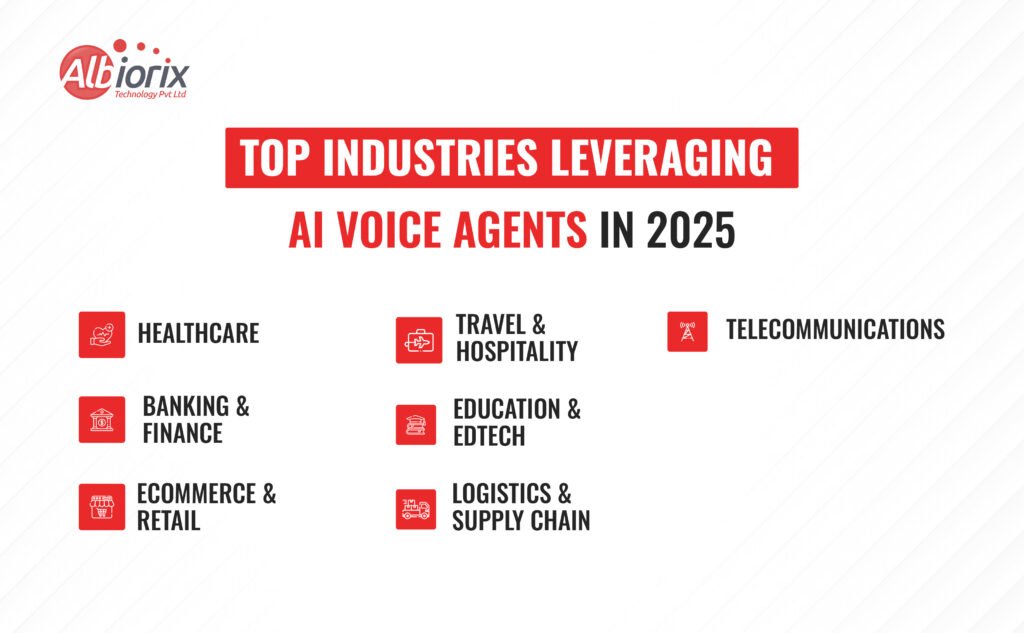
Top Industries Leveraging AI Voice Agents in 2025

Top Industries Leveraging AI Voice Agents in 2025

As businesses strive to offer faster, more personalized, and round-the-clock service, AI Voice Agents are becoming indispensable across various sectors.

Their ability to manage large volumes of AI Calls with precision and human-like interaction makes them a preferred solution for enhancing customer communication and operational efficiency.

Here are key industries actively leveraging AI Voice Agents:

  • Healthcare: Automates appointment reminders, provides medication updates, and engages patients with personalized health messages—all without human staff intervention.
  • Banking & Finance: Enhances security and convenience through real-time transaction alerts, account updates, and fraud detection via interactive AI Calls.
  • eCommerce & Retail: Offers voice-based order tracking, product recommendations, and customer support, boosting engagement and post-purchase satisfaction.
  • Travel & Hospitality: Manages flight and hotel bookings, provides multilingual assistance, and handles itinerary changes for global travellers.
  • Telecommunications: Assists with service activations, troubleshooting, and billing queries—reducing call center burden while improving service quality.
  • Education & EdTech: Delivers reminders about classes, deadlines, and announcements while providing instant support for students and parents.
  • Logistics & Supply Chain: Notifies customers of shipment status, delivery schedules, and route updates, enabling smoother last-mile delivery experiences.

It is just a small list of companies that have vigorously started using AI voice agents in their day-to-day operations.

More and more businesses and sectors are gradually joining the trends, giving rise to the need for custom AI voice agent development.

5 Steps to Build an AI Voice Agent

Creating an intelligent and efficient AI Voice Agent requires a strategic approach that combines technical expertise with a deep understanding of business needs.

A trusted AI Agent Development Company follows a structured process to ensure the solution aligns with operational goals, customer expectations, and long-term scalability.

The steps to develop a custom AI voice agent may vary from company to company, but here’s how expert AI Agent Development Services typically approach the development process:

Step-1. Business Requirement Analysis: The first step is to understand your business model, communication challenges, and specific use cases where an AI Voice Agent can add value.

Step-2. Choosing the Right Tech Stack: Selecting the appropriate technologies—including NLP engines, speech recognition tools, cloud platforms, and APIs—is crucial for building a reliable and scalable solution.

Step-3. Designing Voice Flows & Training Datasets: Voice interaction flows are mapped based on user intent, while training datasets are curated to teach the agent how to understand and respond naturally.

Step-4. Integration with Backend Systems: The AI Voice Agent must seamlessly connect with CRMs, ERPs, ticketing tools, or databases to perform real-time actions and retrieve information dynamically.

Step-5. Testing and Deployment: Rigorous testing ensures accuracy, responsiveness, and stability. Once validated, the AI Voice Agent is deployed and monitored for performance improvements.

If you want to learn more about the process/steps involved in developing a custom AI voice solution for your business, then get in touch with us.

Our AI experts are here to help with everything you need to power your business in the AI landscape.

If you’re planning your first build, consider exploring best AI voice agent platforms to guide your selection.

DIY AI Agent Development vs. Professional AI Agent Development Services

Sr. NoCriteriaDIY ApproachHiring a Professional AI Agent Development Company
1Technical Expertise RequiredHigh—requires in-house expertise in NLP, ASR, TTS, and integrationsNo internal AI expertise needed—experts handle end-to-end delivery
2Development TimeLonger due to learning curve and experimentationFaster turnaround with proven frameworks and reusable components
3Customization & ScalabilityLimited, unless you have advanced development capabilitiesFully customizable and scalable based on your business needs
4Integration with SystemsComplex—requires manual handling and testingSeamless integration with CRMs, ERPs, and third-party platforms
5Quality & PerformanceInconsistent; depends on team skillsetHigh-performance, enterprise-grade AI Voice Agents
6Post-launch SupportMay lack structured monitoring and ongoing optimizationDedicated support, performance monitoring, and continuous improvements
7Overall CostLower upfront, but potentially higher long-term maintenance costsOptimized investment with higher ROI and reduced long-term risks

DIY or Professional AI Development Company?

Discuss with experts to find the best AI-driven solutions for your business.


Contact Our Developers

Why Partner with a Professional AI Agent Development Company

Building effective and scalable AI Voice Agents requires more than just technical tools—it demands a deep understanding of voice technology, business logic, and user behaviour.

It is where partnering with a professional AI Agent Development Company becomes essential.

A skilled partner brings:

  • Experience and Expertise: With hands-on experience in deploying voice AI solutions across industries, a professional team understands what works—and what doesn’t. This helps avoid costly trial and error.
  • Scalability and Reliability: Expert teams ensure that your AI Voice Agent grows with your business—handling increasing call volumes, new use cases, and multi-channel demands without compromising performance.
  • Custom-Built vs Off-the-Shelf: While off-the-shelf solutions may work for simple use cases, they often lack flexibility and long-term adaptability. Custom-built AI Voice Agents are designed around your exact business needs, processes, and goals.
  • Faster Time-to-Market: With ready-to-use frameworks and optimized workflows, a professional team can get your AI Voice Agent up and running in significantly less time.
  • Seamless Integration: Whether it’s your CRM, ERP, or support ticketing tools, a capable development team ensures smooth integration—minimizing disruption and maximizing efficiency.
  • Security Assurance: A reputable AI Agent Development Company prioritizes data privacy, regulatory compliance, and secure deployment—critical for industries like finance and healthcare.

Top-rated AI development companies such as Albiorix Technologies have already developed plenty of AI-powered solutions for their clients coming from Australia, Europe and the US.

Our team of experts ensures your solution is future-ready, secure, and built for long-term success.

We specialize in delivering end-to-end AI Agent Development Services, from concept to deployment.

If you visit our portfolio, you will find a collection of scalable AI Voice Agent solutions and other AI-driven solutions for our clients—helping them automate voice interactions, reduce operational costs, and enhance customer experience.

AI Agent Development Services Albiorix Technology Offers

AI Agent Development Services Albiorix Technology Offers

As a leading AI Agent Development Company, we provide a comprehensive suite of services to help businesses build, deploy, and scale intelligent AI Voice Agents that align perfectly with their goals.

Whether you’re starting from scratch or enhancing an existing solution, our end-to-end capabilities ensure long-term success and innovation. Here’s what we offer:

  • AI Agent Consulting Services: We help you identify the right use cases, define goals, and build a strategic roadmap for successful AI Voice Agent implementation.
  • AI Agent Development Services: Our team designs and develops custom AI Voice Agents using cutting-edge NLP, ML, and speech recognition technologies tailored to your specific business needs.
  • AI Agent Integration Services: Seamless integration of your AI agents with CRMs, ERPs, telephony systems, and other business applications for smooth workflows.
  • AI Agent Design Services: We craft intuitive and human-like voice interaction flows that ensure a natural and engaging user experience.
  • AI Agent Security Services: Security-first development with data encryption, compliance management (GDPR, HIPAA, etc.), and role-based access controls to keep your AI Calls secure.
  • AI Agent Model Upgrade Services: We keep your AI Voice Agents up-to-date by training and upgrading models with the latest data and feature enhancements.
  • Support and Maintenance Services: Ongoing monitoring, optimization, and support to ensure consistent performance, availability, and improvement over time.

Conclusion

The growing reliance on intelligent automation has made AI Voice Agents a strategic necessity for modern businesses.

They’re not just about handling calls—they’re about delivering smarter conversations, faster resolutions, and exceptional customer experiences at scale.

From handling support queries to driving engagement through personalized interactions, AI Agents can simplify complex workflows and add real value across departments.

Businesses that adopt voice AI early are positioning themselves ahead of the curve in both innovation and efficiency.

Get in touch with our team to explore how our expert-led AI Agent Development Services can help you design and deploy custom AI Voice Agents that elevate your communication strategy and drive results.

Cost of AI Agent Development: A Decision-Maker’s Guide

Summary: Every business in the USA wants to develop and integrate a custom AI agent into their existing system, but what scares them is the overall cost of AI agent development. Practically speaking, the development cost of an AI agent may sound high, but in the long run, it proves to be a smart investment. So, here is a detailed guide to help businesses and entrepreneurs in the USA better understand the cost of AI agent development.

Enterprise leaders across the USA are no longer asking whether AI agents are worth investing in. They are asking what is the cost of AI agent development in the USA, what they will get in return, where can I find a reliable AI agent development company, and which development approach best fits their business model.

This guide on the cost of AI agent development is built for that conversation. Whether you are a CTO evaluating vendors, a CFO signing off on a budget, or an operations head trying to quantify the business case, the numbers and frameworks here will help you move from question to decision.

Let us start with the answer most people come here looking for.

What Does AI Agent Development Actually Cost in the USA in 2026?

The short answer: AI agent development cost in the USA typically ranges from $20,000 to $500,000 or more, depending on complexity, integration depth, and whether you are building from scratch or extending an existing platform. To know the exact cost of development, you can contact an AI development company with your concept.

That is a wide range, and deliberately so. Here is a more useful way to think about it.

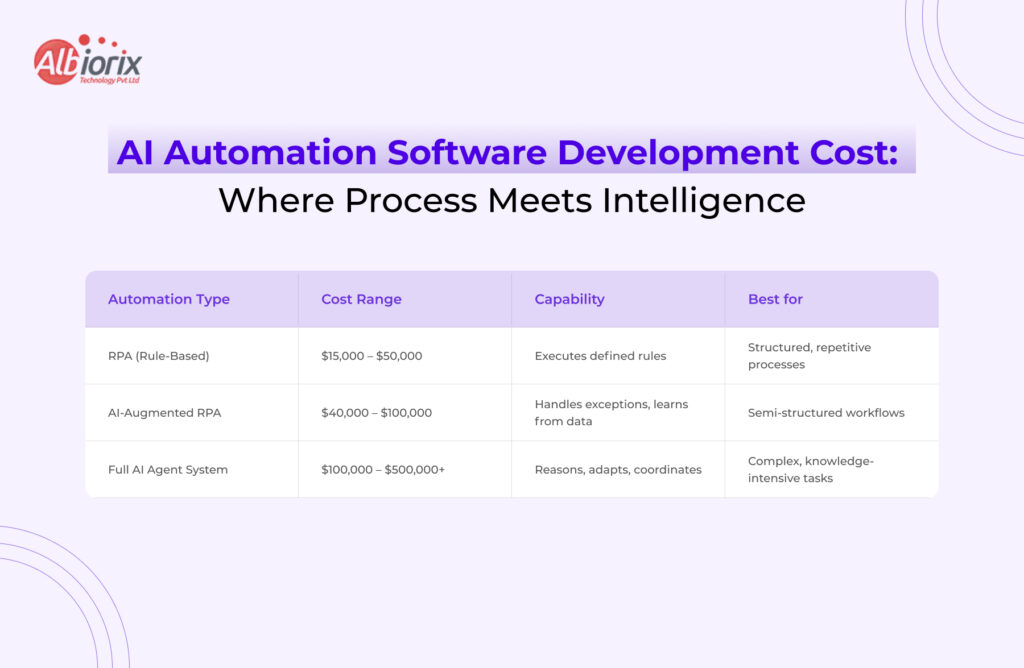
Project TierDescriptionEstimated Cost (USD)Timeline
Starter/PoCSingle-task agent, limited integrations, pre-built LLM stack$20,000 to $50,0004-8 weeks
Mid-tierMulti-step agent with API integrations, custom workflows, basic analytics$50,000 to $150,0002-4 months
Enterprise-GradeMulti-agent systems, enterprise data pipelines, security, compliance, custom UI$150,000 to $300,000+4-9 months
Full Ecosystem / PlatformAutonomous agents with orchestration, feedback loops, enterprise-wide deployment$300,000 to $500,000+6-12 months

These figures reflect market rates as of 2026 for US-based and US-serving development firms. Offshore AI agent development companies or nearshore partners can reduce the development cost by 30%-60% percent. So, when building a business AI agent, explore all the possible options around you to get the best deal at smart prices.

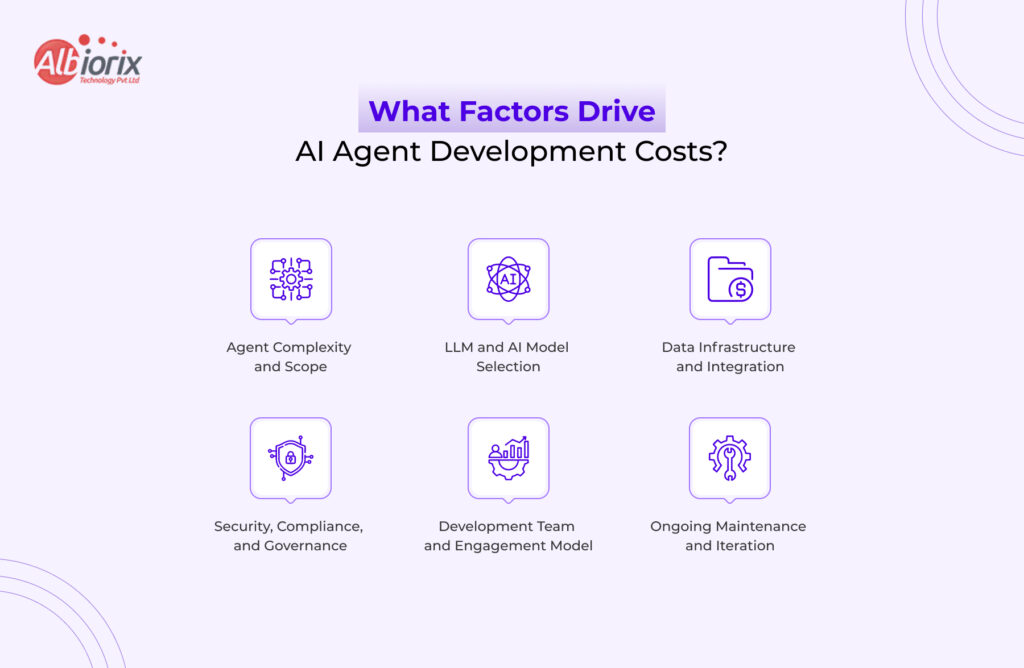
What Factors Drive AI Agent Development Costs?

What Factors Drive AI Agent Development Costs

The development cost of an AI agent is arbitrary. Even the figures mentioned above in the comparison table may vary as per the project requirements. Thus, to know the exact or approx. cost of AI agent development in the USA, you must understand the factors that heavily influence the cost of development. 

So, here are the factors that affect the cost of AI agent development in the USA:

Agent Complexity and Scope:

It is the most crucial factor that affects the cost of development. What your AI agent is supposed to do after development or what tasks it will handle will influence the cost of development. For instance, A single-purpose agent that qualifies sales leads operates in a fundamentally different engineering environment than a multi-agent system coordinating customer support, inventory updates, and billing simultaneously.

Key complexity factors include:

  • Number of tasks and decision branches the agent must handle
  • Whether the agent operates reactively (responding to triggers) or autonomously (proactive execution)
  • The degree to which the agent must learn and adapt over time
  • Whether multi-agent orchestration is required

LLM and AI Model Selection:

Once you have decided on the role of an AI agent in your organization, it’s time to finalize the AI model. The underlying model choice has a direct impact on both development cost and ongoing operational cost.

Enterprise teams in the USA generally choose from below listed AI Models:

  • OpenAI GPT-4o/GPT-4 Turbo: It has strong general reasoning and broad ecosystem support.
  • Anthropic Claude 3 Opus/Sonnet: It is preferred for nuanced analysis and long-context tasks.
  • Google Gemini Ultra: It has strong multimodal capabilities and is useful for vision-integrated agents.
  • Open-source models (Mistral, LLaMA 3): It has lower API costs and higher customization overhead.

Whichever the AI model you choose for your AI agent, it comes with fixed expenses such as model licensing fees, fine-tuning costs, and token-based API pricing. US enterprises running agents at scale have seen monthly API costs ranging from $5,000 to $80,000 depending on volume.

Data Infrastructure and Integration:

AI agents totally depend on your company’s data and provide information to perform certain tasks. Thus, the data you provide must be well-structured and streamlined. Connecting an agent to your CRM, ERP, internal databases, or real-time data streams required a lot of engineering work which may add to the overall development cost of AI agents.

Integration costs depend on:

  • Number and type of enterprise systems (Salesforce, SAP, ServiceNow, etc.)
  • Quality and accessibility of existing data
  • Whether ETL pipelines or real-time data sync is required
  • Custom API development versus pre-built connectors

Complex enterprise integration work alone can account for 30–40% of total project cost.

Security, Compliance, and Governance:

Enterprises operating in regulated industries such as finance, healthcare, legal, insurance face additional requirements that add to development cost but are non-negotiable.

  • HIPAA, SOC 2, GDPR, CCPA compliance frameworks
  • Role-based access controls and audit logging
  • Data encryption, model output filtering, and PII handling
  • Human-in-the-loop review workflows

You cannot build an AI agent in the USA unless it is highly secure, and you get a compliance license from the respective authorities. You can expect compliance-related requirments to add $15,000 to $60,000 to a mid-tier or enterprise-grade engagement.

Development Team and Engagement Model:

How and where your AI agent is built has a significant effect on cost. The three main models:

Engagement ModelTypical Cost RangeBest for
US-based AI dev agency/firm$120-$250/hrHigh-stakes, compliance-heavy projects
Nearshore (Canads, Mexico, Eastern Europe)$60-$100/hrMid-complexity with quality oversight
Offshore (India, Southeast Asia)$30-$60/hrBudget-sensitive projects with defined scope
Internal team build-outHigh upfront (hiring + tooling)Long-term capability ownership

Ongoing Maintenance and Iteration:

AI agents are not set-and-forget deployments. They require continuous monitoring, model updates, prompt engineering refinements, and performance tuning. Budget 15–25% of your initial development cost annually for maintenance.

To see a full lifecycle breakdown of these numbers, you can consult our AI agent development cost guide. Some enterprises run ongoing AI agent consulting retainers at $5,000 to $20,000 per month for dedicated support.

Enterprise AI Agent Development Pricing: What Are You Actually Paying For?

When a development firm quotes $200,000 for an enterprise AI agent, it is worth understanding the line items behind that number. Here is a representative breakdown for a mid-to-large enterprise engagement:

ComponentEstimated Cost% of Total
Discovery, architecture design, scoping$15,000 to %25,0008-12%
Core agent development (logic, prompting, orchestration)$50,000 to $100,00030-40%
LLM fine-tuning or RAG pipeline setup$20,000 to $50,00010-18%
UI/UX and admin dashboard$15,000 to $30,0008-12%
Testing, QA, red-teaming$10,000 to $20,0005-8%
Security, compliance, deployment$15,000-$40,0008-15%
Documentation and training$50,000 to $15,0003-5%
Enterprise integration (CRM, ERP, APIs)$30,000 to $70,00015-25%

A well-structured statement of work should reflect these components explicitly. If a vendor is providing a single-line quote without this level of detail, ask for the breakdown before signing.

Want to know the development cost of an AI Agnet for your business?

Let’s discuss it for free. Schedule a free consultation call with our AI experts.


Call now!

AI Agent Development Cost vs. ROI: Making the Business Case

No CFO approves a $200,000 AI investment without a return on investment analysis. Here is how leading enterprises are quantifying the value.

Quantifiable ROI Drivers: The clearest ROI cases come from agents that replace or augment repetitive, high-volume tasks:

  • Customer support agents: reduce per-ticket cost from $12–$25 to $0.50–$2.00, with measurable CSAT improvement.
  • Sales development agents: increase qualified pipeline by 30–50% without proportional headcount growth.
  • Finance and procurement agents: reduce invoice processing time by 70–80%, cutting human error and cycle time.
  • IT operations agents: decrease mean time to resolution (MTTR) on routine incidents by 40–60%.

ROI Benchmarks by Investment Tier

Investment TierTypical Payback Period3-Year ROI RangePrimary Value Driver
$20K – $50K (PoC)3–6 months200% – 400%Headcount efficiency, revenue acceleration
$150K – $300K (Enterprise)9–18 months250% – 500%Operational transformation, competitive advantage
$300K+ (Platform)12–24 months300% – 600%+Strategic capability, market differentiation

Key Insight for Decision-Makers: The enterprises generating the highest ROI from AI agents are not necessarily those spending the most. They are the ones who start with a clearly scoped use case—taking the time to strategically identify AI product opportunities measure outcomes rigorously from day one, and iterate based on real performance data rather than theoretical projections.

Costs of Inaction: The ROI calculation is incomplete without factoring in the competitive cost of not investing. Across industries, enterprises that delayed AI adoption by 12–18 months in 2024–2025 saw measurable disadvantages:

  • Customer churn to competitors offering faster, AI-powered service.
  • Talent acquisition challenges as AI-literate engineers gravitate toward innovative employers.
  • Loss of institutional knowledge that AI-augmented teams can capture and operationalise.

Custom AI Agent Development Cost: Build vs. Buy vs. Extend

Before committing to a full custom build, enterprise buyers should map their requirements against the available approaches:

Pre-Built AI Agent Platforms: Products like Microsoft Copilot Studio, Salesforce Agentforce, and ServiceNow AI Agent offer rapid deployment with lower initial investment ($10,000–$50,000 in setup and licensing). They work well when your use case fits their templates and your stack already includes their ecosystem.

– Limitations: constrained customisation, vendor lock-in, per-seat or consumption-based pricing that can escalate at scale.

Custom AI Agent Development: Custom development means building an agent tailored to your specific workflows, data, and business rules that give you full control over performance, behaviour, and IP ownership. This is the right choice when:

  • Your use case is unique or competitively sensitive
  • You need deep integration with proprietary internal systems
  • Platform pricing becomes uneconomical at your anticipated volume
  • You want to retain and build internal AI capability over time

The trade-off is higher upfront cost and longer time-to-value. A well-executed custom build, however, generates compounding returns that platform-based solutions rarely match.

Extending Existing AI Capabilities: A growing number of enterprises are augmenting their existing SaaS tools with custom AI layers — building agents that sit on top of platforms like Zendesk, HubSpot, or Workday. This hybrid approach costs $30,000–$100,000 and can deliver meaningful value within 60–90 days.

AI Automation Software Development Cost: Where Process Meets Intelligence

AI agents and AI automation are often conflated but represent distinct capability layers. Understanding the difference helps in accurate budgeting.

Traditional automation (RPA, scripted workflows) executes rules. AI-powered automation learns, adapts, and handles exceptions that rules-based systems cannot. The cost premium for AI automation over pure RPA reflects that intelligence layer.

For a deeper look into budgeting for these foundational layers, check out our guide on how much AI development costs across different software categories.

For enterprises already running RPA at scale, the question is often not whether to invest in AI agents but how to sequence the migration from brittle rule-based automation to intelligent, adaptive systems.

AI Agent Consulting Cost: The Value of Expert Guidance

Before a single line of code is written, the strategic and architectural decisions made in the consulting phase will determine the ceiling of your investment’s returns.

What AI Agent Consulting Covers:

  • Use case identification and prioritization
  • Technical feasibility assessment and risk analysis
  • Architecture design (single agent vs. multi-agent, orchestration approach)
  • LLM selection and evaluation
  • Data readiness assessment and gap analysis
  • Build vs. buy recommendation with vendor shortlist
  • Change management and adoption planning

What AI Agent Consulting Costs:

Engagement TypeCost RangeDuration
Initial assessment / discovery sprint$8,000 – $20,0002–4 weeks
Full strategy and architecture engagement$25,000 – $60,0004–8 weeks
Ongoing advisory retainer$5,000 – $20,000/monthOngoing
Embedded consulting (with dev delivery)Included in project scopeProject duration

The enterprises that extract the most value from AI agent consulting are those that treat it as a strategic investment, not a checkbox exercise before the real work begins.

A Note on Vendor Selection: When evaluating AI agent development companies in the USA, look beyond the portfolio to the team structure. Ask specifically: who writes the prompts, who architects the orchestration layer, who handles compliance, and what does post-deployment support look like? The answers will tell you more than any case study.

How to Build a Budget That Holds Up

Internal budget proposals for AI agent initiatives fail most often because they underestimate three things: integration complexity, change management, and the cost of iteration post-launch.

Here is a reliable framework for building a budget that accounts for the full investment:

Step 1: Define the Use Case with Precision

Vague briefs produce vague quotes. Define the specific workflow the agent will handle, the systems it must connect to, the outcomes you will measure, and the volume it must operate at. This single step reduces scope creep risk significantly.

Step 2: Get Multiple Qualified Quotes

Solicit proposals from at least three development firms with verifiable AI agent experience. The spread in pricing will be instructive, but focus equally on the SOW structure, team composition, and their approach to testing and quality assurance.

Step 3: Allocate Contingency

Enterprise AI projects consistently exceed initial estimates due to data quality issues, integration surprises, and compliance requirements discovered mid-build. Budget a 20–25% contingency against your core development estimate.

Step 4: Model the Full Lifecycle Cost

Your Year 1 budget should include: development cost + API and infrastructure costs + maintenance retainer + internal team time for oversight and feedback. A project that looks like $100,000 often runs $130,000–$150,000 in the first year when the full cost picture is modelled.

Step 5: Set Measurable Milestones

Structure payments and evaluations against tangible deliverables: working agent demo, integration test pass, pilot deployment, full rollout. This protects your investment and keeps development teams accountable.

Questions Executives Are Asking in 2026

Based on conversations with enterprise buyers across the USA, these are the questions that consistently come up:

What is the average cost of AI agent development in the USA?

For a production-ready, enterprise-grade AI agent with real integrations and security requirements, the average falls between $80,000 and $200,000. Simpler deployments can be delivered for $20,000–$50,000. Complex multi-agent platforms can exceed $500,000.

How much should enterprises budget for AI agents?

A useful starting point: budget 0.5–1.5% of your annual IT spend for an initial AI agent initiative. For enterprises spending $10M annually on IT, that translates to $50,000–$150,000 — a range that can deliver a meaningful, measurable deployment.

How long until we see returns?

For well-scoped deployments, payback periods of 6–12 months are realistic. The key variable is not the size of the investment but the quality of the use case definition and the rigour of the measurement framework.

What if we start and the technology changes?

This concern is real but manageable. Build on modular, API-first architecture. Avoid deep vendor lock-in at the LLM layer. Structure contracts with clear handoff provisions. The enterprises most resilient to model evolution are those that own their data pipelines and orchestration logic, regardless of which underlying model powers them.

Internal build vs. external partner — which is smarter?

For most enterprises in 2026, a hybrid model makes the most sense: engage an experienced development partner for the initial build and architecture, while investing in internal AI literacy and oversight capability simultaneously. Pure in-house builds take 2–3x longer and cost more than most enterprises anticipate when fully loaded.

Have quesstions related to custom AI agent development?

Get in touch with the team of AI agent developers and get answers to all your questions for free.


Drop your questions!

Why the Development Partner You Choose Matters as Much as the Budget

The AI agent development market in the USA is crowded with vendors who have rebranded overnight as AI specialists. The criteria that separate credible partners from opportunists are:

  • Demonstrated delivery of production AI agents (not just chatbots or demo environments).
  • Deep engineering capability in LLM orchestration frameworks such as LangChain, LlamaIndex, AutoGen, and CrewAI.
  • Experience with enterprise data security and compliance requirements.
  • A structured discovery and scoping process before any development begins
  • References from enterprise clients with comparable complexity and scale
  • Transparent pricing with milestone-based payment structure

The right partner does not just build your agent — they transfer knowledge, document architecture, and leave your team better equipped to manage and evolve the system over time.

The Bottom Line

AI agent development cost in the USA in 2026 spans a wide range because business needs span a wide range. A PoC for a single process can be validated for $25,000. A platform that coordinates intelligent agents across an enterprise can require $500,000 or more.

What separates successful investments from expensive experiments is not the size of the budget. It is the quality of the use case definition, the rigour of the vendor selection process, the discipline of the measurement framework, and the commitment to iteration after launch.

Decision-makers who approach AI agent investment with the same analytical discipline they apply to any major operational investment will find that the returns are real, measurable, and in many cases, transformational.

Albiorix Technology – An AI Agent Development Company

Albiorix Technology is a USA-serving AI and software development company specialising in enterprise AI agent development, custom software solutions, and intelligent automation. We have an in-house team of AI agent developers who work with enterprise clients across the USA, the UK, and Australia to design, build, and deploy AI agents that deliver measurable operational value.

Whether you have an AI agent concept or questions about how an AI agent can streamline your business operations, boost productivity, and give you free time to focus on other business tasks, we are here to help. You will have every service related to AI agent development under one roof at Albiorix Technology.

To discuss your AI agent initiative, contact us or DM us on LinkedIn.