




Best AI Integration Tools, Platform and Strategy For Business

Summary: AI Integration is in huge demand. It is helping businesses automate tasks, enhance support services, and analyze data for business decisions. Amid the many AI integration tools on the market, we offer a guide to help you find the best AI solution for your business. From top AI models to GenAI Solutions, let’s find the right AI tools for your business in 2026.

The Growing Adoption of AI Integration in Businesses

Artificial Intelligence is one of the widely used business tools in 2026.

Organizations in developed nations like the USA, Australia, Germany, and the UK use AI and generative AI solutions.

They automate business operations, improve customer service, and support data-driven decisions.

They are amplifying their business productivity and ROI by using artificial intelligence.

In 2026, AI integration is very common among businesses. They are adding AI to their current systems. This will improve efficiency. It will automate decisions. It will also help them find deeper insights in their data.

This shift is driving the growing demand for AI integration across industries.

According to statistics, over 80% of businesses will likely add AI tools to their operations by 2027.

Many large organizations already use AI models and GenAI solutions for automation, predictive analytics, and customer service tools.

As a result, there is strong demand for professional AI integration services. This demand is high in the USA, Australia, and across Europe.

As AI technologies continue to evolve, businesses are increasingly partnering with experienced AI development companies to implement scalable and reliable solutions.

In this guide, we explain how AI integration works. We cover why businesses are adopting it. We review the best tools and platforms available. We also show how organizations can implement AI in their operations.

What is AI Integration?

AI Integration is the process of incorporating Artificial Intelligence technologies into your existing/traditional business systems, workflows, and applications.

The main purpose of AI integration with existing business systems is to automate tasks, analyze data, and improve decisions.

Many businesses globally have already integrated AI, and many on the verge of integrating it. But what is AI integration?

Businesses prefer AI integration services because it is less expensive than developing a custom AI solution from scratch.

Organizations add AI features to tools they already use. These tools include CRM platforms, marketing software, customer support systems, and data analytics platforms.

AI integration allows businesses to leverage the power of AI and improve their ROI by multiple folds.

For Example, Artificial Intelligence is integrated into a CRM system to automatically analyze customer behavior and predict purchasing patterns.

Similarly, AI-powered chatbots or voice assistants can be added to customer service platforms. They handle routine questions and provide instant responses.

Businesses increasingly rely on technologies explained in AI voice agent technology to automate support interactions.

Modern AI integration often involves technologies such as machine learning, natural language processing (NLP), predictive analytics, and computer vision.

These technologies allow businesses to process large volumes of data, detect patterns, and generate actionable insights in real time.

With professional AI integration services, companies can connect AI models to their existing systems. These systems include databases, APIs, cloud platforms, and enterprise apps. This helps create smarter, automated business operations.

Ready to Integrate AI into Your Business Operations?

Our team specializes in building scalable AI solutions that improve efficiency, enhance customer experiences, and drive long-term business growth.


Talk to AI Experts

Why Do Businesses Need AI Integration?

Businesses are integrating AI into their existing system to automate workflows, make informed decisions, and deliver personalized customer experiences. It helps them stay more productive, competitive, and evolve faster.

AI Integration is increasing among businesses of all sizes. Below are some of the most important benefits of AI integration for modern businesses.

  1. Smarter Data Driven Decisions: AI integration helps businesses process and analyze large amounts of unstructured data. It turns that data into a meaningful set of structured data. Organizations exploring intelligent automation strategies often compare types of AI voice agents to enhance data-driven decision systems.
  2. Improved Business Efficiency: One of the biggest reasons for AI integration is improved efficiency. With the help of AI Integration, businesses can automate representative tasks, including data entry, reporting, and customer responses. Companies implementing intelligent automation frequently explore reducing development cost strategies using AI tools.
  3. Better Customer Experience: With AI chatbots and AI voice agents, you do not need humans for customer support. These AI tools help businesses deliver faster, accurate, and more personal customer support at any time.
  4. Better Marketing Performance: With AI integration, marketing teams can analyze customer behavior, predict SEO trends, and plan their strategy. Organizations implementing conversational automation often evaluate AI voice platforms to scale customer support efficiently.
  5. Scalable Business Operations: With help from an experienced AI integration company, organizations can build scalable AI systems. These systems can evolve as their business grows. AI-driven automation helps businesses manage increased demand without significantly expanding operational costs.
  6. Competitive Advantage: Businesses that adopt AI early gain a strong competitive edge. Many companies now work with experienced AI voice developers to build advanced conversational automation systems.

Top Businesses Using AI Integration

Top Businesses Using AI Integration

Leading organizations in the USA, Australia and Europe are actively investing in AI integration to uplift and automate their operations and business productivity.

Here are some of the most prominent businesses using AI integration in 2026.

  1. Amazon: The eCommerce giant, Amazon, is using advanced AI integration for product recommendations and logistics optimizations. It also uses AI-powered chatbots and AI-powered voice agents to offer personalized customer support.
  2. Google: Google, the search giant, uses AI across its ecosystem. It helps users find the best results. It has integrated AI in search algorithms, advertising platforms, cloud services, and productivity tools.
  3. Microsoft: The tech giant, Microsoft, uses AI integration in enterprise solutions. It uses AI integration in cybersecurity, cloud computing, and business productivity platforms. Tools like Copilot leverage AI to enhance workplace efficiency.
  4. Netflix: The OTT giant, Netflix, uses AI integration to recommend movies and shows. It also uses AI to analyze user behavior and suggest personalized content. It helps Netflix significantly improve viewer engagement and retention.
  5. Shopify: Shopify integrates AI into e-commerce operations by helping businesses automate product recommendations, customer insights, customer support, and marketing strategies for online stores.

AI innovation is also changing industries like gaming. Companies use AI in product development to speed up innovation cycles.

Which Are the Top AI Tools for Small Business Operations

Which Are the Top AI Tools for Small Business Operations

The top AI integration tools for small business operations are ChatGPT, Zapier AI, and HubSpot AI.

Other popular tools include Jasper AI, Notion AI, and Grammarly AI.

Whether small or large, AI tools are becoming an integral part of business operations. It helps them automate processes, improve customer communication, and gain useful insight from the collected data.

Modern AI integration tools allow businesses to implement intelligent automation without requiring complex technical infrastructure.

Many organizations studying modern AI implementations begin with resources like the Generative AI development guide to understand architecture and deployment models.

Below are some of the most popular tools for AI integration used by small businesses.

  1. ChatGPT: It is one of the widely used AI integration tools in 2026. Businesses use ChatGPT to automate customer support, generate marketing content, and much more.
  2. Zapier AI: This AI tool allows businesses to connect multiple applications and automate workflows. It uses AI-powered triggers and automation features to do so.
  3. HubSpot AI: It provides AI-driven tools for marketing automation, lead scoring, email personalization, and CRM management. It is a very useful tool for businesses.
  4. Jasper AI: This AI tool is widely used by marketing teams. It is commonly used to create content, marketing strategies, marketing campaign ideation, and more.
  5. Grammarly AI: Grammarly helps businesses maintain professional communication through AI-powered grammar checking, tone suggestions, and writing improvements.
  6. Notion AI: This AI tool is different from the above one. It helps businesses organize information, generate documentation, automate summaries, and manage workflows.

No-Code AI Integration Platforms You Should Try

No-Code AI Integration Platforms You Should Try

If your business does not have an in-house AI team or an AI integration partner, try a no-code AI integration platform.

These No-Code AI integration platforms are equally useful and valuable. These platforms assist businesses in implementing AI solutions without writing complex code.

Below are some of the Top Platforms for AI Integration in 2026:

  1. Make: This no-code AI tool helps businesses build strong AI automation workflows across many apps without writing code.
  2. Peltarion: This no-code AI tool helps businesses train and deploy AI models. It supports predictive analytics and machine learning use cases.
  3. Obviously AI: This no-code AI tool helps businesses build predictive models. It uses simple data uploads and visual interfaces.
  4. Akkio: This no-code AI platform lets businesses create predictive insights from their data without any coding.
  5. Levity: This no-code AI platform helps businesses automate repetitive tasks such as document classification and email processing.

How to Choose the Right AI Integration Platform

Amid many AI models and GenAI tools in the market, it is important to choose the right AI tool for your business. As a business, you must carefully choose an AI tool that fits your business operations and long-term business goals.

Here are some practical tips to find the right AI integration platform.

  1. Evaluate Business Objectives: Before selecting an AI platform, businesses should clearly define their goals. Companies planning AI transformation often review insights about AI development costs to better understand budget planning.
  2. Check Integration Capabilities: There are many AI platforms in 2026. Choose one that integrates easily with your existing systems.
  3. Consider Scalability: Scalability is a key feature of an AI platform. Choose an AI tool that can scale and grow with your business needs.
  4. Assess Data Security: Online hacking and theft are rising. Choose an AI tool with strong data protection and cybersecurity standards.
  5. Hire Expert AI Integration Services: Working with experienced AI integration services providers ensures smoother deployment, customization, and long-term technical support. Businesses also explore strategies like AI reducing ERP costs when integrating AI into enterprise platforms.

Looking for a Reliable AI Integration Company?

Our experts help organizations unlock the full potential of artificial intelligence and build smarter, future-ready digital ecosystems.


Talk to us

AI Integrations for Marketing, CRM and Workflow Automation

AI integration is helping businesses improve efficiency across multiple operational areas such as marketing, customer relationship management, and internal workflow automation.

  1. AI Integration for Marketing: AI helps marketing teams analyze customer behavior, personalize campaigns, and optimize advertising strategies. Businesses can use AI to automate content creation, audience targeting, and campaign performance analysis.
  2. AI Integration for CRM: AI-powered CRM systems help businesses review customer interactions. They can predict buying patterns. They also improve sales forecasts. AI also assists sales teams in identifying high-value leads and improving conversion rates.
  3. AI Integration for Workflow Automation: AI enables businesses to automate repetitive operational tasks such as document processing, reporting, approvals, and internal communications. This significantly improves organizational efficiency and productivity.

How to Successfully Integrate AI: Steps to Follow

Implementing AI integration requires a structured strategy to ensure successful adoption across business operations.

  1. Identify business challenges that AI can solve
  2. Evaluate available data sources
  3. Select the right AI tools and platforms
  4. Develop AI models and integration architecture
  5. Integrate AI with existing business systems
  6. Test AI performance and accuracy
  7. Train employees to work with AI tools
  8. Continuously monitor and optimize AI systems

Following these steps helps organizations build reliable and scalable AI-powered business environments.

Albiorix Technology for AI Integration Services

Albiorix Technology for AI Integration Services

Businesses looking to implement AI successfully often partner with an experienced AI integration company like Albiorix Technology.

Here are some strong reasons to choose Albiorix Technology for AI integration services.

  1. Expertise in AI Development: Albiorix Technology has extensive experience in building AI-powered applications across industries including healthcare, fintech, retail, and SaaS platforms.
  2. Custom AI Integration Solutions: The company provides tailored AI integration strategies based on specific business needs rather than offering generic AI implementations.
  3. Seamless System Integration: Albiorix helps integrate AI with existing enterprise systems, cloud platforms, APIs, and third-party tools.
  4. Scalable AI Infrastructure: The team builds scalable AI systems that can support business growth and evolving technology requirements.
  5. Strong Data Security Standards: Albiorix follows modern data security and compliance practices to ensure safe handling of sensitive business information.
  6. End-to-End AI Development Support: From AI strategy consulting to deployment and ongoing optimization, Albiorix provides complete AI development and integration services.

Best AI Integration Services in the USA

Demand for AI integration services in the USA is rising fast.

Businesses want to modernize their operations with smart technologies.

Organizations across industries including healthcare, finance, retail, logistics, and SaaS are actively investing in AI-driven automation and data analytics solutions.

Healthcare organizations in particular are seeing major improvements in diagnostics and efficiency through AI in healthcare implementations.

Companies are increasingly adopting AI-powered CRM systems, predictive analytics platforms, and automated customer service solutions to enhance efficiency and customer satisfaction.

However, implementing AI successfully requires technical expertise, strategic planning, and deep understanding of business workflows. This is why many companies partner with experienced providers like Albiorix Technology for AI integration services.

Albiorix Technology offers comprehensive AI integration solutions tailored to the needs of modern businesses. If you would like to learn more about these solutions or discuss your project requirements, Contact Us for expert guidance.

Their team specializes in integrating machine learning models, automation tools, and AI-powered analytics platforms into existing enterprise systems.

By leveraging advanced technologies such as natural language processing, predictive analytics, and generative AI, Albiorix helps businesses unlock new growth opportunities.

For organizations seeking reliable AI integration services, partnering with an experienced technology company ensures faster implementation, optimized performance, and long-term scalability.

With the right AI integration strategy, businesses in the USA can significantly improve operational efficiency, customer engagement, and data-driven decision-making.

What Is The Average Cost of AI Development In USA?

Summary: The upfront cost of AI development may feel like an expensive deal at the moment, but not investing in AI development may cost you even more than this. If you are a business looking for AI development services in the USA, then this blog is just right for you. We will discuss the cost of AI development in the USA, how to control the development cost, and many other important aspects.

Custom AI Development Cost in the USA

We are now in 2026, and at this stage, we can no longer say that Artificial Intelligence is an experimental technology.

It is considered a powerful business tool that can enhance your productivity, automate tasks, and increase your ROI.

Use of AI or AI-powered tools is now a competitive advantage. And this is the reason why there is a huge need for AI development companies across the globe.

The use of Artificial Intelligence, or the AI-powered generative models, is making life easy for every industry.

It is used for predictive analysis in the fintech industry, to provide better treatment in the healthcare industry, and to suggest optimized routes in the logistics industry.

The use and implementation of AI vary according to the business needs, but the outcome remains the same.

Businesses across developed nations, like the United States, are at the forefront of using and integrating AI into their day-to-day operations.

They are using AI models or custom generative AI software to enhance productivity. But one question consistently arises before any implementation begins:

What is the actual cost of AI development in the USA?

The cost of AI development may differ in different locations, and there are many reasons for it.

If you are evaluating AI development services USA, planning to hire AI developers, or exploring custom AI solutions, this guide will give you a practical, transparent breakdown of:

  • Average AI development costs in the U.S.
  • Factors that influence pricing
  • Hidden costs businesses overlook
  • Cost comparison: in-house vs agency vs remote developers
  • Whether outsourcing to India makes financial sense
  • Future AI market forecasts and why delaying investment may be risky

Have an idea that can change the course of your business, but are worried about the development cost?

At Albiorix Technology, you can discuss your idea with AI experts and get a free quote instantly. We don’t charge – it’s a free consultation.


Talk to AI experts.

What is the Average Cost of AI Development in the USA?

The average cost of generative AI development in the USA depends on many different aspects.

If you are evaluating structured Generative AI development guide insights, planning to hire AI developers, or exploring custom AI solutions, this guide will give you a practical, transparent breakdown.

Small AI Projects (Proof of Concept or MVP)

Small AI projects are those projects that are usually developed to validate an idea before getting into full-scale development with a huge investment.

The objective of these types of AI projects is to solve specific business challenges with limited functionality and faster development cycles.

The estimated development cost of such small AI Projects is somewhat from $25,000 to $75,000.

These projects typically include:

  • AI chatbots
  • Basic recommendation systems
  • Workflow automation tools
  • AI integrations using existing APIs
  • Pilot generative AI implementations

Many startups begin with AI chatbot integration to validate customer engagement strategies before scaling further.

Mid-Level AI Solutions

Mid-level or Medium-sized AI solutions move beyond experimentation and aim to create measurable operational impact. A Mid-level AI solution involves custom data pipelines, deeper model training, and integration with enterprise systems.

The estimated development cost of a mid-sized AI solution is somewhat from $80,000 to $200,000.

These include:

  • Predictive analytics platforms
  • AI-powered SaaS features
  • Computer vision solutions
  • NLP-driven applications
  • Industry-specific custom AI solutions

Many enterprises optimize budgets by applying strategies explained in reducing development cost using AI-driven engineering models.

Enterprise-Grade AI Systems

These types of custom AI systems are highly complex, strategic, and time-consuming. They are a multi-layered platform designed for scalability, compliance, and long-term automation.

Enterprise-grade AI solutions are designed for the whole organisation and not for one or two departments.

The estimated development cost of an enterprise-grade AI solution is somewhat from $250,000 to $1M+.

Examples include:

  • Healthcare AI diagnostics systems
  • Large-scale fraud detection engines
  • Custom LLM-based enterprise assistants
  • AI platforms are integrated across multiple departments

Healthcare organizations increasingly invest in AI in healthcare to improve diagnostics, compliance, and patient care efficiency.

Hourly Cost of Hiring AI Developers in the US

Hourly Cost of Hiring AI Developers in US

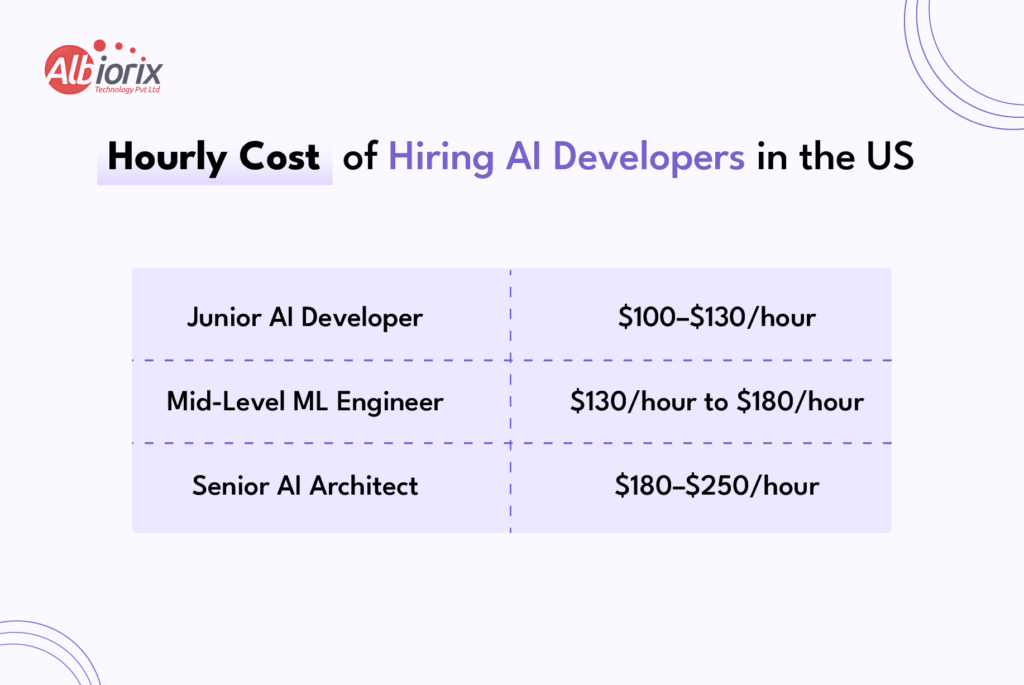
The cost of hiring an AI Developer in the USA depends on many different factors. These factors are an AI developer’s expertise, specialisation, industry experience, and much more.

In the major cities in the United States, the cost of hiring AI developers may be even higher due to high demand and low supply.

Additionally, specialised skills like deep learning architecture or generative AI engineering command premium pricing. Along with all these factors, businesses must also consider indirect costs such as benefits, taxes, and long-term retention strategies.

If you plan to hire AI developers directly, here’s what you can expect:

  • Junior AI Developer: The cost of hiring Jr. AI developers may range from $100–$130/hour. These developers are capable of handling tasks such as data preprocessing, model support tasks, and implementation under supervision.
  • Mid-Level ML Engineer: The cost of hiring Mid-level AI developers may range from $130/hour to $180/hour. These AI developers can design, develop, and deploy ML pipelines for production-ready AI features.
  • Senior AI Architect: The cost of hiring Sr. AI developers may range from $180–$250/hour. The role of Sr. AI architect is to lead AI strategy, system architecture, and complex model design decisions.

This makes AI development services in the USA among the most premium in the global market.

If you are planning to develop a custom AI solution for your business, then remember that the only hiring cost of developers is not the overall development cost of an AI solution. There are still different factors that influence the final budget.

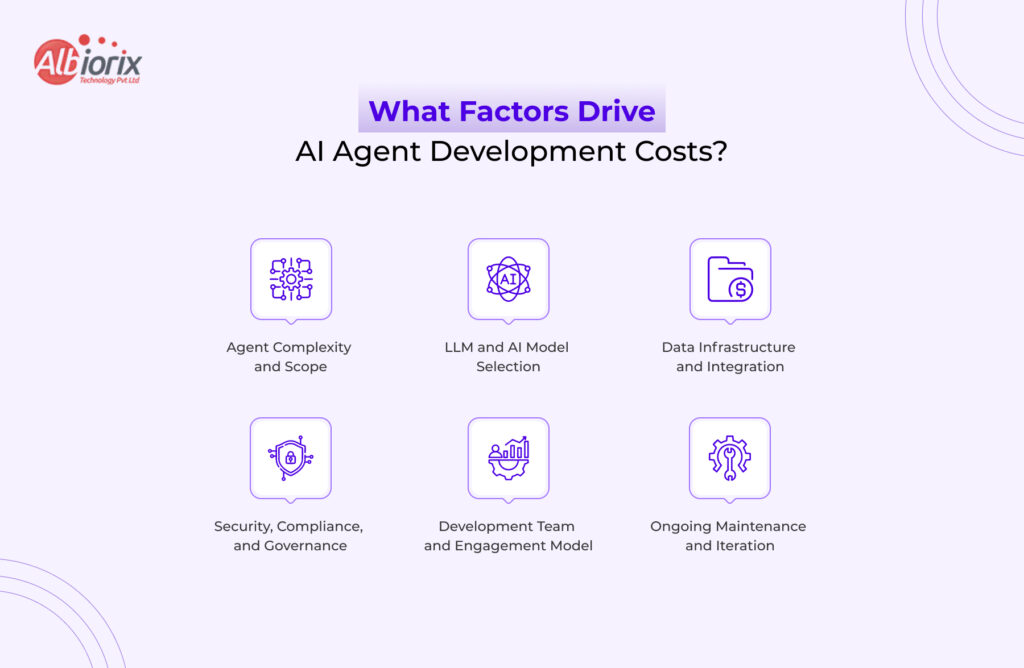
Key Factors That Affect the Cost of AI Development

Key Factors That Affect the Cost of AI Development

The cost of AI development may vary from business to business as their use cases are different from each other. Moreover, the level of customization required in the solution also differs.

Understanding these cost drivers helps businesses create realistic budgets and avoid unexpected overruns.

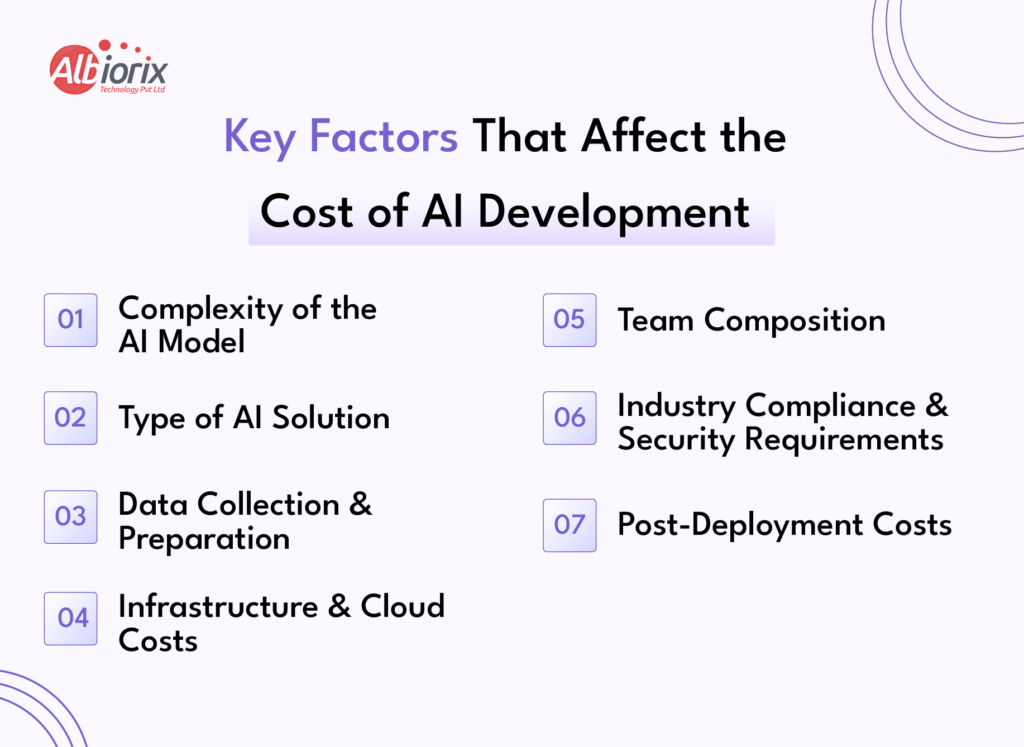
Factors Affecting the Cost of AI Development:

Complexity of the AI Model: The complexity of an AI model directly affects the cost of AI development. It also impacts the overall development time. More advanced and complex models need deeper experimentation and validation cycles.

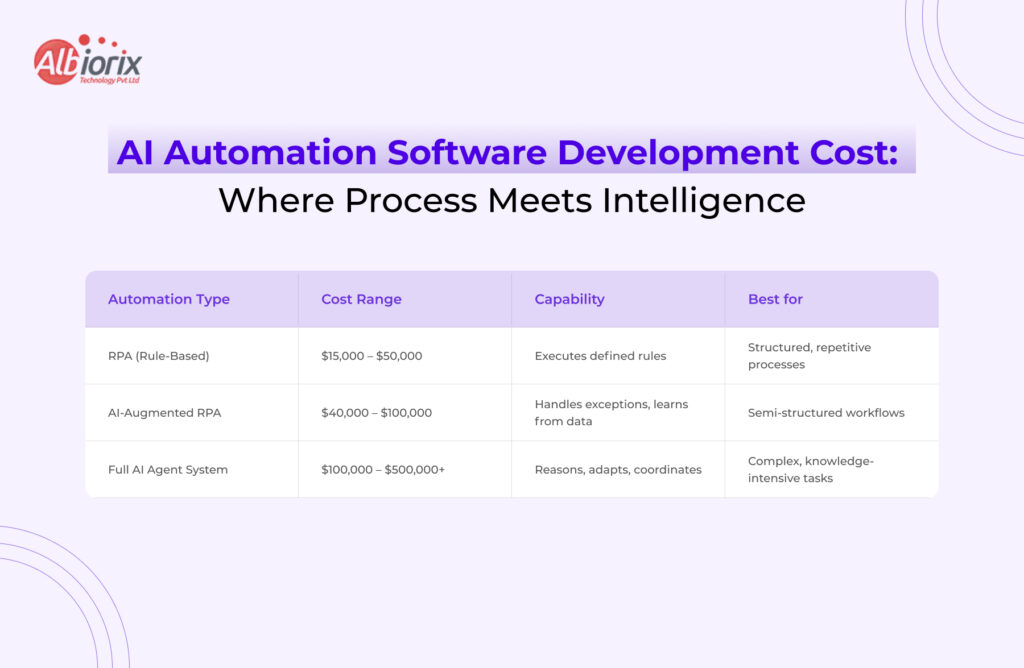
A rule-based automation system costs significantly less than a custom-trained generative AI model.

  • API-based generative AI integration: Lower cost
  • Fine-tuned LLM: Moderate cost
  • Fully custom large language model: Very high cost

Businesses comparing AI vs automation solutions often notice major cost differences depending on intelligence depth.

Type of AI Solution: AI solutions for different industries require different types of specialization and expertise on different frameworks. Each domain has unique data and infrastructure requirements.

Different AI domains require different expertise:

  • Machine Learning (ML)
  • Natural Language Processing (NLP)
  • Computer Vision
  • Generative AI development services
  • Reinforcement Learning

Generative AI development services are currently among the fastest-growing and most investment-heavy segments due to compute and training requirements.

Data Collection & Preparation: Data readiness determines project success. If data is unstructured, incomplete, or inconsistent, additional effort is required before model training begins.

Data is often the largest hidden cost.

Expenses may include: 

  • Data acquisition
  • Data cleaning
  • Labeling
  • Annotation
  • Storage
  • Compliance validation

In healthcare environments, structured AI healthcare software requires extensive data cleaning and compliance validation.

Infrastructure & Cloud Costs: AI applications require scalable computing environments capable of handling large datasets and model training processes. GPU-based processing significantly increases infrastructure expenses.

AI systems require:

  • GPU-enabled servers
  • Cloud platforms (AWS, Azure, GCP)
  • Scalable data pipelines
  • Ongoing compute power for retraining

Enterprise-level AI infrastructure can cost thousands of dollars per month even after deployment.

Team Composition: When it comes to custom AI development, you will need a team of different experts. Along with AI developers, you will require domain experts and operational oversight.

 A typical AI development team may include:

  • AI Architect
  • Data Scientist
  • Machine Learning Engineer
  • Backend Developer
  • DevOps Engineer
  • UI/UX Designer
  • QA Specialist

The broader the team structure, the higher the total investment.

Industry Compliance & Security Requirements: Regulated industries face additional scrutiny and validation procedures. These increase both development and legal review costs.

Certain industries significantly increase AI costs:

  • Healthcare (HIPAA compliance)
  • Fintech (regulatory security audits)
  • Insurance (risk governance)
  • Enterprise SaaS (data privacy standards)

Compliance adds both technical and legal expenses.

Post-Deployment Costs: Artificial Intelligence keeps evolving, and so does your business; therefore, you will need professional support and maintenance services to ensure optimum performance of your AI solution. Continuous monitoring ensures accuracy and reliability

Ongoing costs include:

  • Model monitoring
  • Performance optimization
  • Drift detection
  • Retraining cycles
  • Infrastructure scaling

Annual maintenance can range from 15–25% of the initial development cost.

Hidden Costs Businesses Often Overlook

At the time of AI development, many businesses believed that the cost was what they estimated at the beginning.

However, there are some hidden costs of custom AI development, including experimentation, iteration, and scaling. These factors also add to the overall cost of development.

AI is not a one-time project but an evolving system. Budget planning must include flexibility for testing, optimisation, and change management.

Here are overlooked expenses:

  • Failed experimentation cycles
  • Bias mitigation and fairness testing
  • Security vulnerability assessments
  • Data governance implementation
  • Scaling adjustments
  • Continuous model improvement

A realistic AI development cost strategy accounts for long-term operational expenses, not just launch budgets.

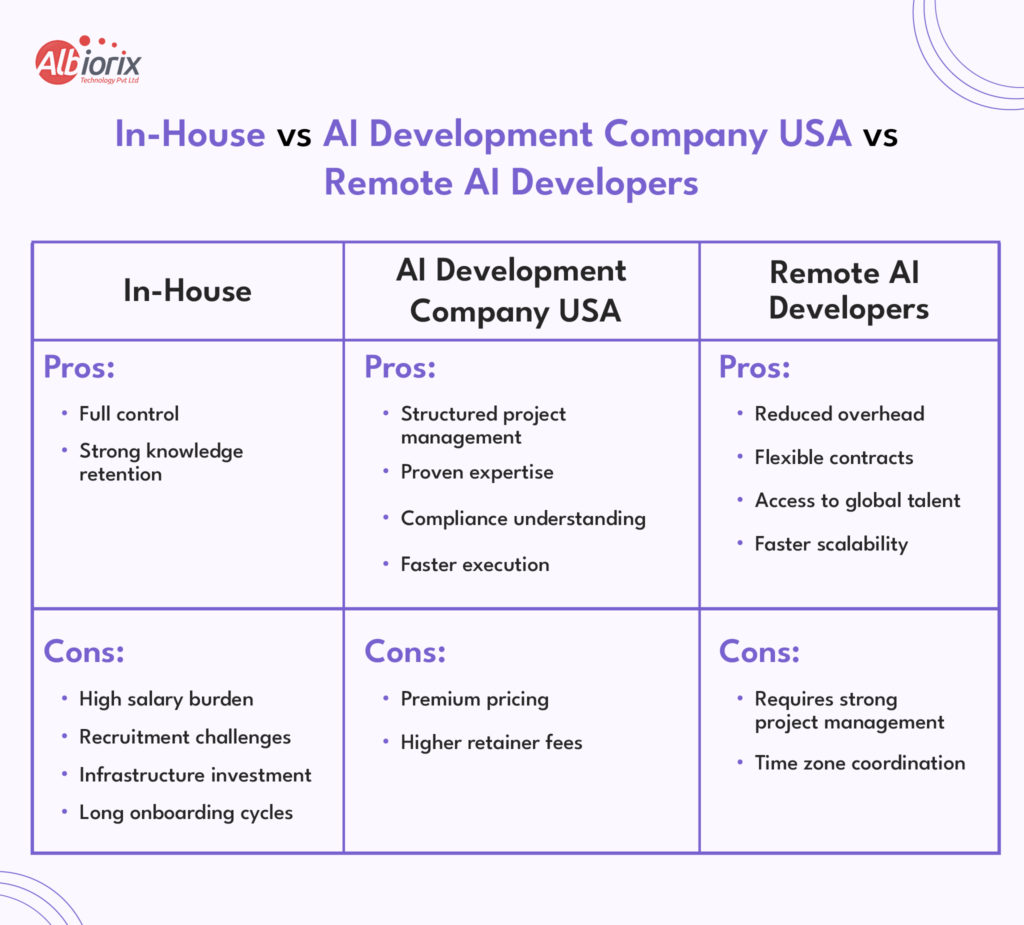
In-House vs AI Development Company USA vs Remote AI Developers

In-House vs AI Development Company USA vs Remote AI Developers

When a company plans to develop an AI solution for its business, there are different engagement models to choose from. Selecting the right engagement model is important for cost-cutting.

Each engagement model has different levels of control, flexibility, and scalability. Businesses must carefully choose the engagement model based on their business requirements, long-term goals, and future AI roadmap.

In-House Team of AI Developers

Building an internal team offers full strategic ownership but requires significant investment and time.

Pros:

  • Full control: You will have full control over the team. You can manage priorities, architecture decisions, and timelines internally.
  • Strong knowledge retention: Your AI expertise will stay within your organisation for the long term.

Cons:

  • High salary burden: You will have to pay competitive salaries to your AI developers, which can increase operational costs.
  • Recruitment challenges: AI talent is scarce and highly competitive in 2026; thus, you have to work hard to find the right resource.
  • Infrastructure investment: You have to build internal data and computing environments.
  • Long onboarding cycles: When you hire a resource, it takes some time for him/her to accommodate the project and align with business processes.

If we compare this engagement model with other available options, this model is a little expensive.

AI Development Company USA

Partnering with an AI Development company in the USA provides structured execution and specialised expertise.

Pros:

  • Structured project management: AI development companies in the USA have established workflows to reduce project delays.
  • Proven expertise: You can have access to experienced AI professionals with case studies.
  • Compliance understanding: AI development agencies in the USA have an in-depth understanding of industry-specific regulations.
  • Faster execution: As they have dedicated teams of AI developers under one roof, they can easily accelerate delivery timelines.

Cons:

  • Premium pricing: The USA-based AI development companies charge higher rates.
  • Higher retainer fees: Ongoing support may require monthly commitments.

The idea of partnering with a USA-based AI development company is a good choice if there is no limitation on the development cost. It is an Ideal choice for enterprises prioritising reliability over cost minimisation.

Hire AI Remote Developers

In 2026, many businesses will hire AI remote developers to save money and boost delivery time without compromising expertise. This model allows flexible scaling based on project requirements.

Pros:

  • Reduced overhead: There is no need to invest in office infrastructure or hire full-time AI developers with full-time benefits.
  • Flexible contracts: You can scale resources up or down as per the project requirements.
  • Access to global talent: You are free to hire AI developers from any part of the world. You can have access to a broader talent pool beyond local markets.
  • Faster scalability: You can quickly expand teams for large projects.

Cons:

  • Requires strong project management: When hiring remote AI developers, you will need to have clear communication and coordination skills.
  • Time zone coordination: Scheduling across regions may require planning.

For startups and mid-sized businesses, this often provides the best balance between cost and performance.

How to Reduce the Cost of AI Development

When you think about cutting the cost of development that does not mean you have to compromise with the quality or sideline some of the important features. Cost cutting means developing intelligently.

With the help of strategic planning and phased implementation, businesses can reduce the overall AI development cost in 2026.

Tip to Reduce AI Development Cost:

Start with an MVP: If you are having a limited budget for AI development, then always start with MVP. The MVP development focuses only on core functionalities required to validate the concept. It saves you from over-investment on unnecessary features.

Use Pre-Trained Models: Training an AI model for your business from scratch can be an expensive deal; thus, you can use pre-trained AI models. Using the already trained AI models and frameworks can reduce cost and efforts.

Rather than training from scratch:

  • Use existing LLMs
  • Fine-tune open-source models
  • Integrate APIs for generative AI

Enterprises modernizing internal systems often explore how AI reduces ERP costs before committing to large-scale AI infrastructure.

Define Clear Business Objectives: Make sure you are 100% clear about what you want to develop, because unclear scope creeps in and increases the development costs. Measurable KPIs ensure focused development.

Before hiring AI developers, clarify:

  • What business problem are we solving?
  • What measurable ROI do we expect?
  • How will success be defined?

Hybrid Hiring Model (US + Offshore): A hybrid structure combines strategic oversight with cost-efficient execution. It allows businesses to maintain quality while reducing hourly expenditure.

Keep strategic architecture and oversight in the US while leveraging offshore technical execution.
This dramatically reduces cost without sacrificing quality.

Should You Outsource Generative AI Development Services to India?

If you want to have an advanced AI solution for your business, then outsourcing AI development to India is also one of the best options. Over the last two to three decades, India has evolved as a hub of the software industry.

India has become one of the leading hubs for AI engineering talent.

Businesses building next-gen digital ecosystems often combine enterprise modernization strategies from enterprise software development with AI outsourcing models to optimize budgets.

Cost Comparison of AI Development

Hourly differences significantly impact total project budgets, especially for long-term engagements. Over a six-month AI project, the savings can be substantial.

  • US AI Developers: $100–$250/hour
  • India AI Developers: $30–$70/hour
  • Potential savings: 50–70%

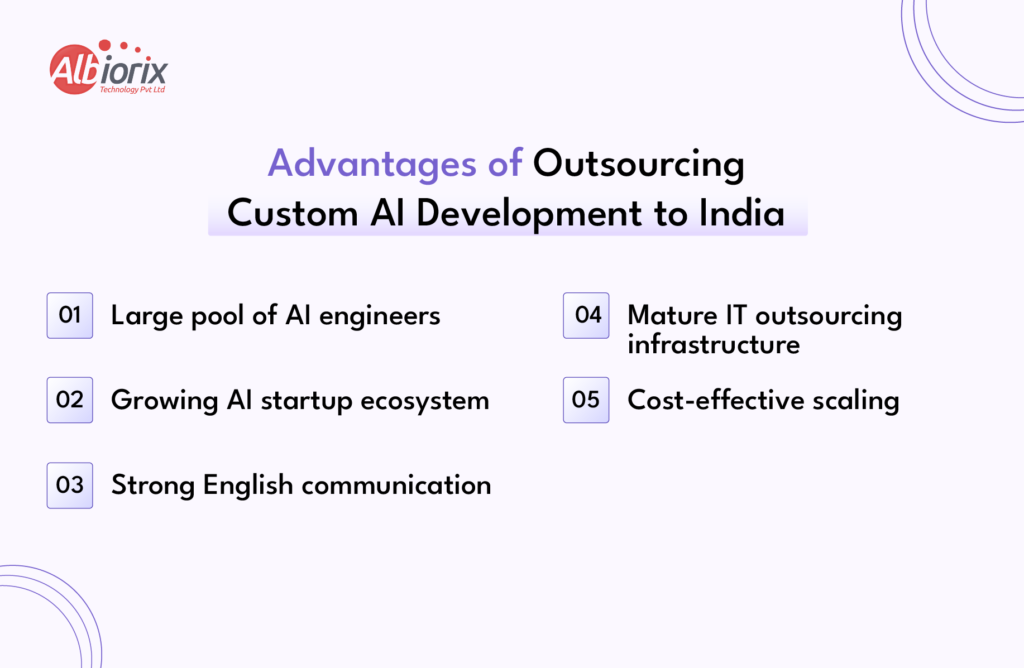
Advantages of Outsourcing Custom AI Development to India

Advantages of Outsourcing Custom AI Development to India

India is the growing hub of AI development. In the last five years, India’s AI ecosystem has grown rapidly with strong academic and technical foundations.

You can easily hire remote AI developers or partner with an AI development company with a strong portfolio.

Advantages of AI Development in India:

  • Large pool of AI engineers
  • Growing AI startup ecosystem
  • Strong English communication
  • Mature IT outsourcing infrastructure
  • Cost-effective scaling

If total outsourcing is not on your list, then you can also adopt a hybrid model. It means, US leadership with offshore AI development.

The Future of AI Market Forecast and Business Impact

Due to the benefits it offers to businesses worldwide, the use and adaptation of AI is increasing faster than any other digital transformation in the past decade.

Businesses that have already invested in AI are dominating their industries and motivating others to integrate AI as early as possible. The long-term economic impact of AI is expected to reshape global markets.

Industry projections indicate:

  • The global AI market is expected to surpass $1.5 trillion by 2030.
  • 70–80% of enterprises are expected to integrate AI into core operations within the next decade.
     
  • Generative AI alone is projected to add trillions of dollars to global GDP.
  • Up to 40% of business processes may become AI-automated within the next 10 years.

Let’s examine sector-specific growth:

  • Healthcare: AI-assisted diagnostics and predictive care systems are expected to become mainstream, improving treatment accuracy and reducing hospital costs.
  • Fintech: AI-driven fraud detection and risk modeling continue to expand, reducing financial crime losses globally.
  • Retail: Hyper-personalization and AI-powered inventory forecasting are redefining customer experience.
  • Manufacturing: Predictive maintenance is reducing downtime and optimizing production efficiency.
  • Games & Entertainment: AI-driven immersive experiences and AI in game development are transforming digital storytelling.
  • Education: Adaptive AI learning systems are personalizing student experiences at scale.
  • Logistics: AI-driven route optimization and supply chain forecasting are reducing delivery times and operational costs.
  • Real Estate: AI-powered property valuation and predictive market analytics are improving investment decisions.

The message is clear: businesses that delay AI adoption risk falling behind more agile competitors.

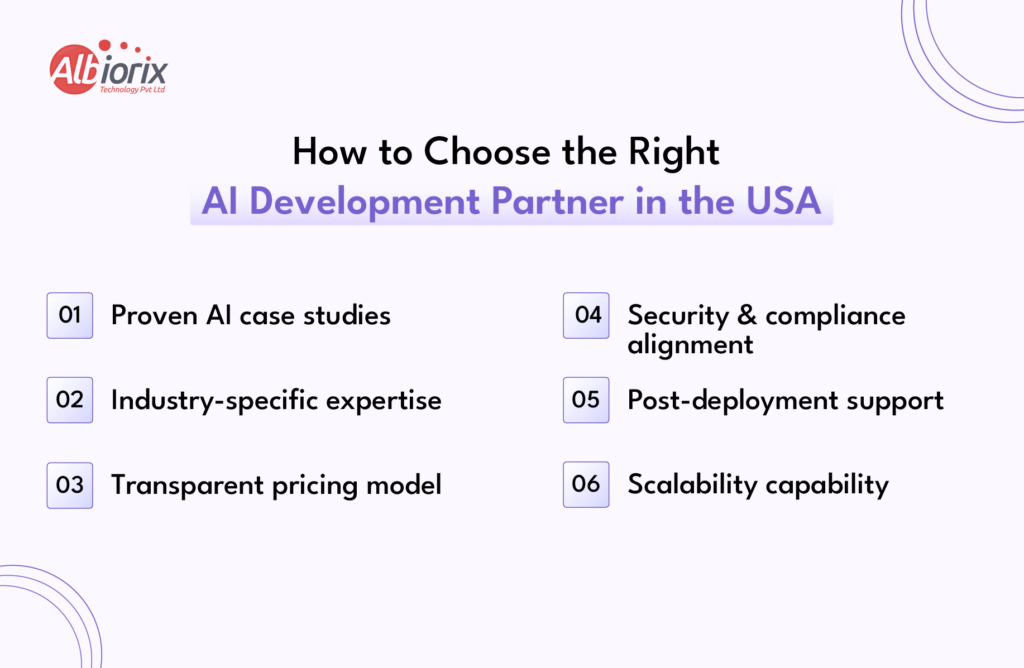
How to Choose the Right AI Development Partner in the USA

How to Choose the Right AI Development Partner in USA

Whether you want to develop an AI model or are in search of generative AI development services, finding the right partner is very important. It determines long-term success.

Along with the technical expertise in the AI domain, strategic alignment is also essential. Businesses should evaluate cultural fit, communication transparency, and long-term collaboration potential.

If you are evaluating generative AI development services in the USA, consider:

  • Proven AI case studies: The company you are planning to hire must demonstrate real-world implementation experience.
  • Industry-specific expertise: They must have familiarity with sector challenges in your domain.
  • Transparent pricing model: Make sure you are not charged with any hidden or surprise costs.
  • Security and compliance alignment: The AI development company you partner with must protect data integrity and the privacy of your business.
  • Post-deployment support: Along with the generative AI development services, the company must also be able to provide continuous optimisation and monitoring services.
  • Scalability capability: They must be able to scale as your business grows.

If you would like expert guidance tailored to your business needs, you can directly contact our AI experts for a free consultation.

Conclusion 

As said earlier, AI is no more an experimental word, it is real and reshaping competitive landscapes across industries. Businesses that approach AI strategically gain operational leverage and market differentiation. 

The cost of AI development in the USA ranges from $25,000 to over $1 million depending on complexity, data requirements, and scale.

But the more important question is:

What is the cost of not investing in AI?

As industries become increasingly automated and data-driven, AI adoption is shifting from optional innovation to operational necessity.

Whether you choose an AI Development company USA, hire AI developers in-house, or hire AI remote developers using a hybrid model, the key is strategic planning, phased investment, and ROI alignment.

The future of business is intelligent. The only question is how soon you adapt.

How AI Reduces ERP Development Costs by 30%

Summary: The use of AI in ERP development is very common. Almost every business and organisation across the world follows this trend. It helps them save on development costs. In this blog, we will discuss how the use of AI in custom ERP system development can help businesses save time and money. We will also discuss how AI in ERP development will shape the industry trends.

Cost of ERP System Development

For modern businesses in 2026, ERP systems have become an indispensable part of their day-to-day operations, and integrating AI development services can further enhance automation, analytics, and decision-making capabilities.

There are many traditional and ready-made ERP software systems offered in the market, but they do not fulfill all your business requirements at once.

Custom ERP development is one of the best solutions, but it is also an expensive deal. The cost of ERP system development may often break your budget.

Along with the expensive development cost, companies also face problems such as complex customization, integration with legacy systems, lengthy development cycles, and continuous maintenance costs.

All these factors collectively make ERP development a time-consuming and financially demanding process.

Most companies in 2026 are seeking an ERP software solution that is fast, intelligent, and cost-effective. They need systems that can improve productivity and ROI without increasing budgets.

It is where AI in ERP development is making a real difference. Artificial intelligence helps automate tasks, optimize development processes, reduce manual effort, and improve decision-making across the ERP lifecycle.

In 2025, businesses that used AI-driven development approach report a 30% reduction on the overall ERP development cost.

While the exact amount saved on the ERP development may vary from project to project, the trend is clear – use of Artificial Intelligence can help in reducing development cost, development time, minimise errors, and lowering operational costs.

Businesses that adopt AI early often gain competitive advantages through faster deployment, better analytics, and more efficient workflows.

As ERP systems continue evolving, AI is becoming not just an option but a strategic necessity for cost-effective enterprise software development.

What is an ERP System?

There’s a lot of talk about ERP systems and their uses. But what is it exactly, and how is it useful to a business in increasing its productivity?

ERP stands for Enterprise Resource Planning. It is a software system that helps businesses manage core operations, including finance, HR, inventory, sales, supply chain, and customer relationships in one integrated platform.

In simple words, an ERP system connects different business operations/departments effectively so that the data flows smoothly across departments in an organization.

By 2025, the adoption ratio of ERP systems will be widespread across different industries. According to the reports, most of the large and medium-sized businesses and organizations are using some form of ERP system to increase productivity.

In fact, adoption among small businesses is also growing quickly due to cloud-based solutions.

Here’s how ERP systems help businesses:

  • It helps them improve operational efficiency
  • It provides them with real-time business insights
  • It helps them enhance internal collaboration across departments
  • It helps them reduce manual work and data duplication
  • It supports them in making better business decisions

There are many different types of ERP systems available on the market. Some of the most popular ERP systems in 2026 are on-premises ERP, cloud ERP, hybrid ERP, and industry-specific ERP solutions.

Some of the most widely used ERP software solutions include offerings from SAP, Oracle, and Microsoft. These platforms support global enterprises with advanced automation, analytics, and integration capabilities.

Overall, ERP works as the digital backbone of modern businesses. It helps them streamline operations, reduce costs, and scale efficiently.

Build Smarter ERP Systems with AI — Reduce Costs, Improve Efficiency

Partner with Albiorix Technology to develop custom AI-powered ERP solutions tailored to your business goals.


Contact Us

What Is AI in ERP Development?

AI in ERP development refers to the use of artificial intelligence, machine learning, and automation technologies throughout the ERP development lifecycle.

Use of AI in planning and design, development, testing, deployment, and maintenance. The use of AI in custom ERP development is to increase efficiency, reduce development costs, and build an intelligent enterprise solution.

Use of AI in ERP System Development

  • Planning: Artificial Intelligence is used to analyze business requirements, historical data, and industry trends. This information supports business plan projects, estimates development costs, and uses available resources smartly.
  • Development: When it comes to custom ERP solution development, there are AI-assisted coding tools to speed up the development process. Developers use these tools to write code faster and deliver error-free solutions in less time. AI automation reduces repetitive tasks, shortens development cycles, and improves software quality.
  • Testing: AI-driven testing tools are more accurate and faster. They can detect bugs faster and automatically, run predictive test scenarios and ensure better performance before ERP launch. AI-powered testing reduces manual testing time.
  • Deployment: AI supports smoother deployment through automated configuration, performance monitoring, and predictive risk analysis. It minimizes downtime and deployment errors.
  • Maintenance: After an ERP system is launched, AI can be used to monitor its performance, predict failures, automate updates, and improve security. It reduces maintenance costs and operational disruptions.

Overall, ERP development with the help of AI can deliver measurable results. It can save money, time, and effort. It can guarantee enterprise software with high performance, amazing scalability, and great safety.

Why Traditional ERP Development Is Expensive

Traditional ERP development often requires significant time, skilled manpower, and continuous maintenance.

It required constant involvement of various teams, including development teams, testing teams, and other resources, to successfully complete a project. This dependence of different teams increases the development cost and overall development time.

Traditional ERP development is expensive compared to AI development because of the following reasons:

  • Customisation complexity: Developing an ERP solution as per the unique business needs is a tricky job. It requires extensive planning and development efforts.
  • Manual development and testing costs: Instead of AI, when a team of developers is used to develop a solution and QA experts to test it, the overall development time and cost increase.
  • Integration challenges: Along with the development and testing, one more thing that takes time is integrating ERP with legacy systems, CRMs, and third-party tools. It requires a lot of tech expertise and patience.
  • Long deployment cycles: Traditional implementations can take months or years, increasing operational costs.
  • Maintenance overhead: Post-development support and maintenance services are very important to uphold the performance of the system. Continuous updates, bug fixes, and performance monitoring by humans add long-term expenses.

These are some of the most common issues that affect the overall cost of ERP development in traditional style.

How AI Lowers Software Development Costs in ERP

How AI Lowers Software Development Costs in ERP

Artificial intelligence can improve the efficiency of the ERP development lifecycle.

Where traditional development methods require different development teams to work on a single project, an AI-powered development tool can execute different tasks, including planning, development, testing, deployment, and maintenance.

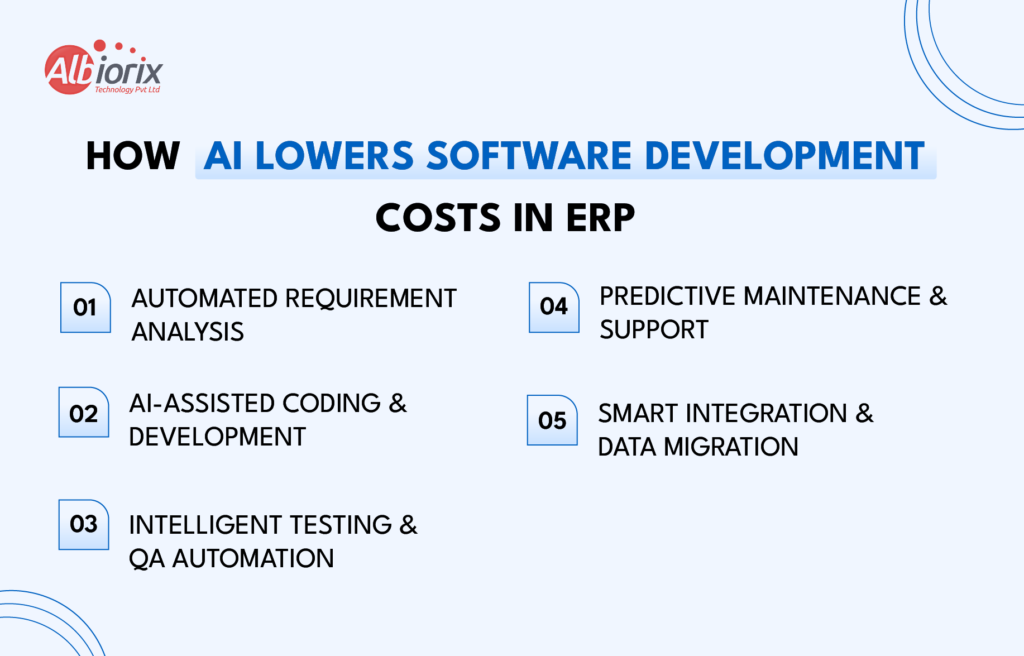
Here’s how AI lowers software development costs:

  • Automated Requirement Analysis: Smart and intelligent AI can easily and clearly analyze business data and user behavior to define accurate development requirements. All this is done in a span of time that reduces rework and development delays.
  • AI-Assisted Coding & Development: There are AI-powered coding tools that assist developers in speeding up the development process. These tools also help them with code optimization and error reduction. It improves productivity while lowering development costs.
  • Intelligent Testing & QA Automation: Automated testing tools detect issues early, reducing costly post-launch fixes. AI testing also ensures better system reliability.
  • Predictive Maintenance & Support: AI predicts potential system failures and recommends preventive actions. This reduces downtime and maintenance expenses.
  • Smart Integration & Data Migration: Artificial Intelligence can simplify data mapping, data migration, and system integration. It makes ERP implementation more efficient and faster.
     

The use of AI in ERP development results in faster and more efficient solutions. These capabilities result in measurable cost savings in enterprise software projects.

Key Areas Where AI Delivers ERP Cost Savings

The use of AI in ERP System development not only saves money during the development lifecycle, but it also helps even after the deployment. Businesses that have adopted AI have reported improved efficiency and lower operational expenses.

Some of the key areas where AI helps in saving money are:

  • Faster development timelines: AI-powered development tools and automation collectively accelerate coding, testing, and deployment. It means faster development and shorter time to market.
  • Reduced human errors: AI coding minimises mistakes during development that lead to costly fixes.
  • Optimised infrastructure usage: Smart resource allocation lowers hardware and cloud costs.
  • Lower long-term operational costs: Predictive maintenance reduces downtime and support expenses.
  • Enhanced decision intelligence: AI analytics improve business efficiency and profitability.

These factors contribute significantly to overall AI cost savings in enterprise software.

Also Read: Use of AI in Web Development

ROI of AI in ERP Development

Instead of following traditional development methods, if you invest in AI, the revenue will be immediate and long-term.

Businesses that have invested in AI for ERP and web development have seen productivity gains, reduced operational costs, and faster time to market. ROI of AI in ERP development will boost your business growth at double the speed.

Key ROI aspects include:

  • Short-term vs long-term ROI: Initial AI investment may be higher than the traditional methods, but in the long run, the revenue and savings are substantial.
  • Quantifying savings: Companies measure ROI through reduced development time, fewer errors, and increased productivity.
  • Case-style scenario: For example, a mid-sized manufacturer adopting AI-driven ERP testing reduced deployment time by 25% and maintenance costs by nearly 20%.
  • Metrics to track: Development cost per module, downtime reduction, productivity improvement, and system performance KPIs.

In 2026, businesses need to understand the long-term benefits of investing in AI. The ROI of AI in ERP development can help businesses in many ways.

Affordable ERP Development Solutions Using AI

Affordable ERP Development Solutions Using AI

If you examine current development trends, AI is used in the development of almost every digital product. From websites to mobile apps, AI in digital product development is doing magic for developers and businesses alike.

The use of AI in ERP system development can help businesses save a lot of money, deliver a flawless product, and shorten time to market.

Not only big businesses or organizations, but even small businesses and startups can use AI in ERP development without worrying about a massive development budget.

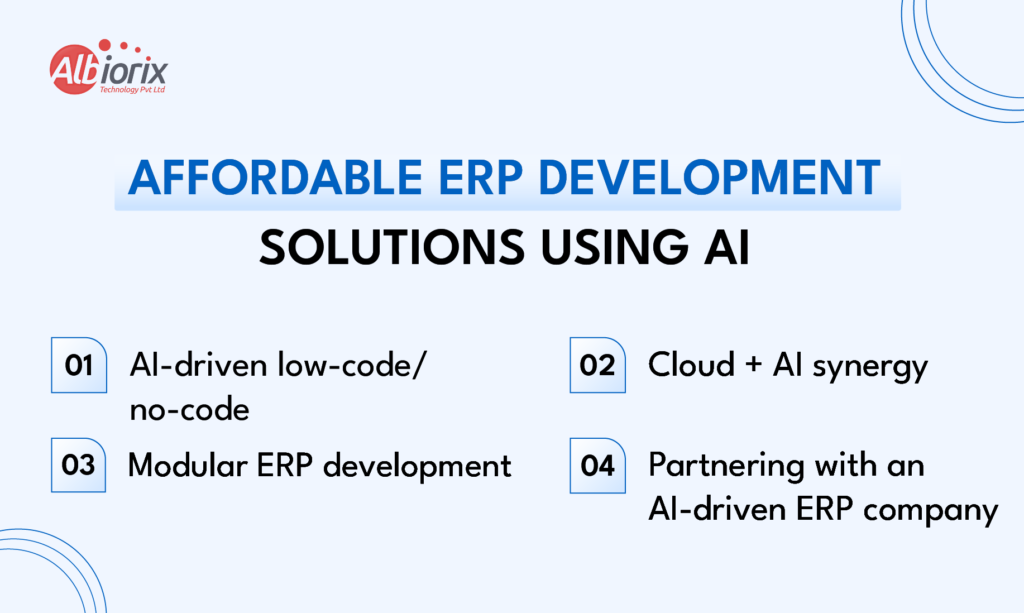
Affordable approaches include:

  • AI-driven low-code/no-code: With a no-code/low-code approach, the ERP development becomes faster.
  • Cloud + AI synergy: With the use of scalable cloud infrastructure, businesses can reduce upfront investment.
  • Modular ERP development: AI-powered development tools allow businesses to develop and implement features gradually.
  • Partnering with an AI-driven ERP company: Expert AI-development companies ensure efficient implementation.

These strategies enable affordable ERP development solutions while maintaining quality and scalability.

For AI in ERP Development, Contact Albiorix Technology

For AI in ERP Development, Contact Albiorix Technology

In 2026, businesses are not looking for ordinary or traditional ERP solutions. They need a custom ERP software solution that is scalable, efficient, and cost-effective. And you are one of them, then you are in the right place.

Albiorix Technology is an AI development company in USA; we are among the top companies using and implementing AI in digital solutions for different businesses and industries.

Being one of the top-rated AI development companies, we help organizations in Australia, the USA, and across Europe build custom ERP solutions powered by AI and modern automation tools.

Our expertise spans AI-powered websites, mobile applications, and digital products designed specifically for business needs. If you are planning an AI-driven ERP implementation, our team can support you from strategy to deployment.

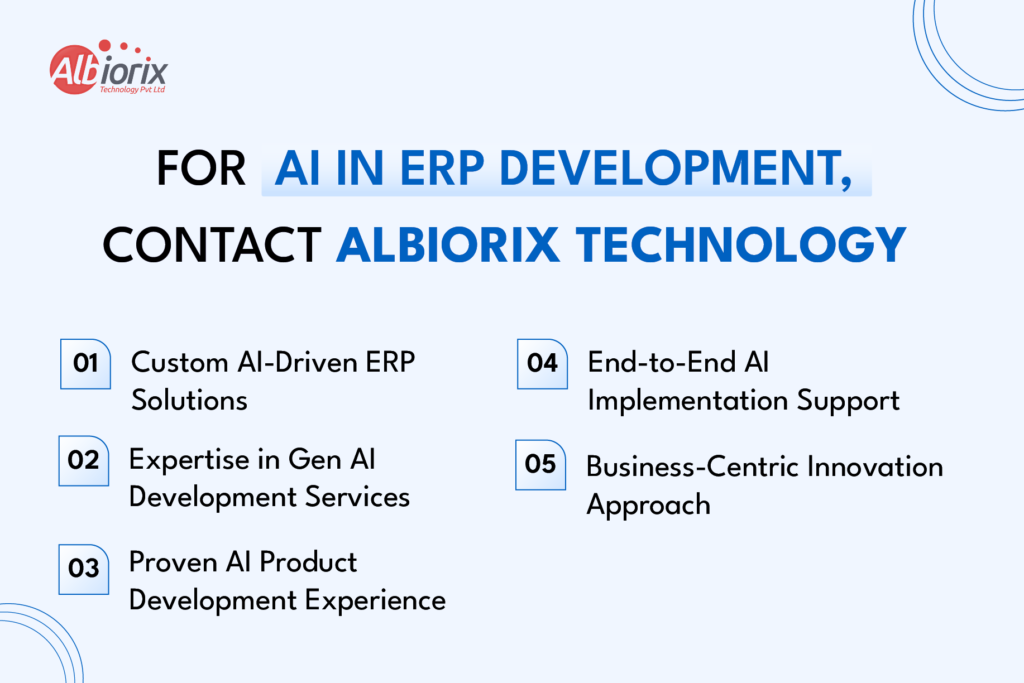
Why Albiorix Technology for AI Development:

  1. Custom AI-Driven ERP Solutions: At Albiorix Technology, we hold expertise in designing and developing ERP systems as per your business workflows. We use AI automation to improve efficiency, reduce costs, and enhance decision-making.
  2. Expertise in Gen AI Development Services: Our team of AI developers holds expertise in developing intelligent applications using generative AI technologies.
  3. Proven AI Product Development Experience: In the last 10 years, we have successfully developed AI-powered websites, mobile apps, and digital solutions that align with real business requirements.
     
  4. End-to-End AI Implementation Support: We are a complete AI development company in USA. Our in-house team of Gen AI developers is known for offering services like AI consultation, AI development, AI planning, AI integration, etc.
  5. Business-Centric Innovation Approach: Being one of the most trusted AI development companies, we focus on ROI, scalability, security, and long-term performance for enterprise solutions.

Conclusion

Artificial Intelligence is rapidly transforming the digital landscape around every business. ERP development using AI tools is trending as it helps improve efficiency and reduce costs.

From automated coding to predictive maintenance, AI helps organisations achieve faster implementation and better performance. To discover how these capabilities can transform your operations, Contact Us for expert guidance and tailored solutions.

Businesses that have adopted AI-driven ERP solutions have reported significant cost benefits.

They have also experienced reduced development timelines, lower maintenance expenses, and improved operational productivity. These advantages directly impact competitiveness and profitability.

Companies that leverage AI today are better positioned to build resilient, future-ready enterprise systems while maintaining cost efficiency.

How AI-Powered Software Development Reduces Costs

Summary: Artificial Intelligence is transforming how businesses build and scale software. This blog explores how AI-powered software development helps reduce costs, accelerate product delivery, and improve operational efficiency.

It also covers real-world benefits, industry adoption trends, and how businesses can successfully implement AI-driven development to stay competitive in today’s digital landscape.

AI-Powered Software Development

Artificial Intelligence is not just a fancy word. It has taken the digital world by storm. Every industry and business is integrating AI-powered software solutions to automate and streamline their operations and please their clients.

In recent years, AI and its associated tools and technologies have become an integral part of every business, whether small or large. It is now known as a strategic business enabler.

Many organizations across industries are increasingly integrating Artificial Intelligence into their software development process to reduce costs, speed up development time, enhance product quality, and offer better customer experience.

In 2026, modern businesses (including startups and young entrepreneurs) are not asking the questions like “Should We Use AI?” Instead, they are asking, “How can we use AI-powered digital products to Stay Competitive in the Market?”

It is because AI-Powered development services are not only helping them optimize and automate their business operations, but they are also helping them reduce the operational costs and accelerate time to market.

We are Albiorix Technology, and we develop AI-Powered Software solutions that help businesses save money, automate boring tasks, improve business operations, offer better customer services, and more.

We are an AI Development company that skillfully combines human expertise with AI-driven tools, automation frameworks, and modern development practices to help businesses build intelligent, scalable, and cost-efficient digital solutions.

What AI in Software Development Really Means

Most of the top-rated software development companies in India, Australia and the USA are using intelligent tools and automation to enhance the software lifecycle.

The use of AI in software development doesn’t mean replacing; instead, it helps the development teams work faster, smarter, and more productively.

  • AI automates code suggestions that improve developer productivity
  • AI-powered testing detects bugs at the early stages of development
  • Predictive analysis using AI helps in developing better products
  • AI-powered chatbots and automation features
  • AI-powered faster deployment through smart DevOps automation
  • Data-driven optimization for performance improvements

These are some examples of the use of Artificial Intelligence in software development. The amazing capabilities of AI help software developers deliver reliable digital products while controlling development costs.

Ready to Build Smarter Software with AI?

Whether planning a new digital product, optimizing an existing platform, or exploring AI integration, expert guidance can make the difference.


Talk to AI Experts

How AI Helps Reduce Software Development Cost

One of the biggest reasons companies invest in AI development services is cost optimization. Software projects traditionally require significant time, manpower, and infrastructure.

AI helps streamline these processes.

  • AI automates repetitive coding and testing tasks
  • With the use of AI tools, lean development teams become more productive
  • Early bug detection by AI tools saves teams from rework
  • Faster development with the use of AI tools shortens time-to-market
  • Infrastructure optimization lowers operational expenses
  • Improved planning using AI analytic tools reduces project delays

Software development using AI tools allows businesses to achieve better ROI without compromising quality. Organizations partnering with experienced AI development companies often find they can scale innovation while maintaining predictable budgets.

How AI-Driven Software Development Helps Businesses

How AI-Driven Software Development Helps Businesses

The adoption of AI in software development has rapidly increased in recent years because of many good reasons.

The advancements in machine learning models, cloud computing, and automation platforms have acted as a catalyst in the AI adoption process.

Here’s How AI-Driven Software Development Helps Businesses:

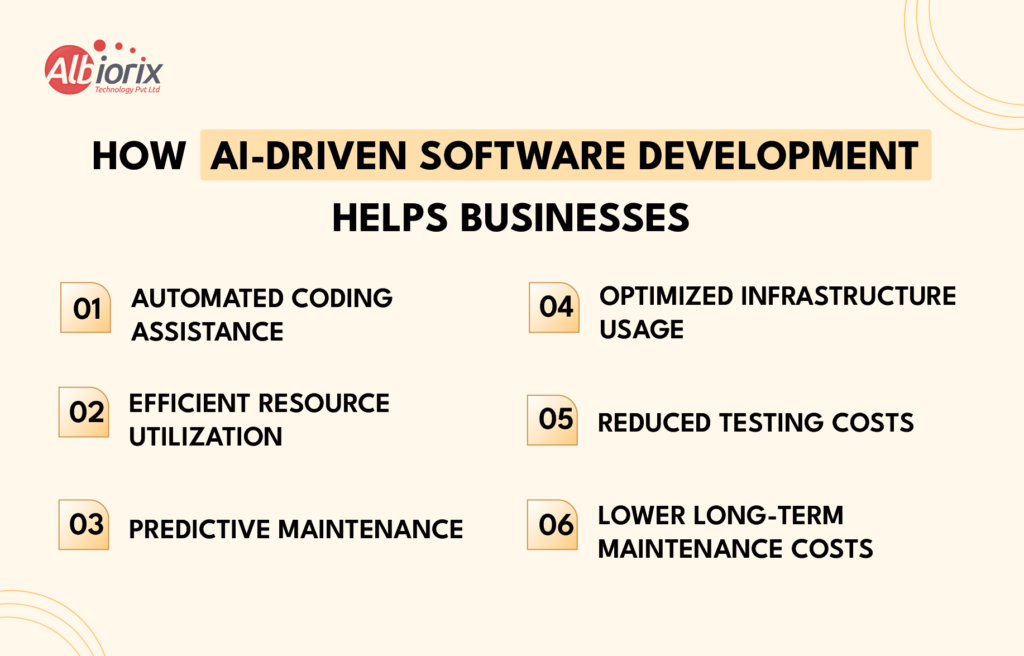
1. Reduce Technology Costs by Up to 30%:

Artificial Intelligence creates smarter development workflows, which reduce manual efforts, overall development cost, and maintenance costs.

Key advantages include:

  • Automated Coding Assistance: There are AI-powered coding tools that assist developers in accelerating the development cycles and reducing repetitive tasks.
  • Efficient Resource Utilization: AI-powered development tools minimize the need for large development teams.
  • Predictive Maintenance: Artificial Intelligence identifies issues at the early stages and prevents them from becoming expensive.
  • Optimized Infrastructure Usage: AI helps reduce cloud costs through intelligent resource allocation.
  • Reduced Testing Costs: AI-powered automated testing improves accuracy while lowering QA expenses.
  • Lower Long-Term Maintenance Costs: AI monitoring prevents recurring technical debt.

The right use of AI-powered development tools helps businesses increase their ROI and saves them from development hiccups.

2. Stabilize Your Product with a Lean, Expert Team:

With the help of AI-powered software development tools, a lean team can also deliver a premium-quality software solution faster without compromising reliability.

What this means for your business:

  • Improved Code Quality: AI can analyze and detect bugs at the early stages for better code quality.
  • Better Performance Optimization: AI can detect bottlenecks during the initial phases of development and suggest optimization points for better performance.
  • Faster Issue Resolution: It can predict and resolve issues faster to avoid any downtime.
  • Continuous Monitoring: AI systems can monitor the application 24*7 for consistent and optimum performance.
  • Scalable Architecture Guidance: It can help developers build a scalable architecture for future-ready systems.
  • Reduced Risk of Failures: AI’s intelligent testing improves product stability.

A lean AI-enabled development team can deliver better outcomes than large traditional teams. It can save you up to 30% on the overall development cost while shortening your application time to market.

3. Replace Expensive In-House Development Costs:

When you have the right set of AI software development tools, then there is no need to maintain a large internal team of software developers, which can cost you a lot.

AI-powered outsourcing benefits include:

  • Access to Specialized AI Talent: There will be no need to hire full-time experts.
  • Flexible Engagement Models: You can scale your development team as per the project requirements and timelines.
  • Faster Project Delivery: With the use of pre-trained AI workflows, you can easily accelerate the development of lifecycles.
  • Reduced Hiring Costs: You can save a lot of money on recruitment, training, and other retention expenses.
  • Focus on Core Business Goals: Let experts handle technical execution.
  • Better Technology ROI: Get enterprise-level expertise cost-effectively.

This approach helps businesses stay agile while controlling operational expenses.

4. Accelerate Development Using AI Tools:

AI tools are transforming software development speed and efficiency.

Examples of AI acceleration:

  • Automated code suggestions and generation
  • Smart debugging tools
  • Automated UI testing
  • AI-driven documentation generation
  • Predictive analytics for product improvements
  • Continuous performance optimization

These capabilities enable faster time-to-market — a critical competitive advantage.

Industry-Wise AI Adoption Trends

AI Trends Adoption

According to trends and data available on the web, not only are IT companies adopting AI at a faster pace, but industries including healthcare, entertainment, tourism, fintech, and education are among the forerunners.

Almost every industry is integrating artificial intelligence in its software development and digital transformation initiatives.

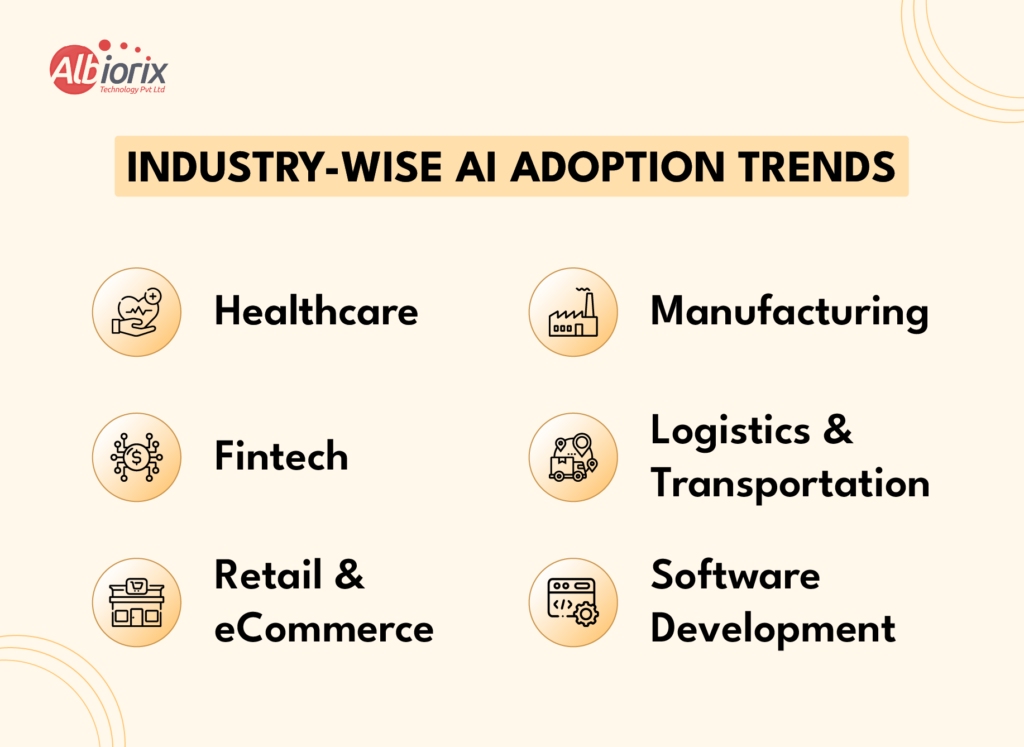
  • Healthcare: AI-powered healthcare software and applications are used in predicting diagnostics, patient monitoring, and healthcare automation. Intelligent AI mHealth apps improve patient care and clinical decision-making.
  • Fintech: AI-powered fintech software and systems are used for fraud detection, risk analysis, and customer personalization. Automation of operations using AI improves efficiency.
  • Retail & eCommerce: AI offers a personalized shopping experience for each customer. Moreover, AI chatbots and AI-powered voice agent virtual assistants enhance customer engagement and satisfaction.
  • Manufacturing: Predictive maintenance reduces downtime. AI-powered automation improves operational efficiency.
  • Logistics & Transportation: AI in logistics and transportation is used to optimize routes, track delivery, and manage fleet. It reduces overall headaches and improves supply chain resilience.
  • Software Development: Use of AI in custom software development is trending. It accelerates coding, testing, and deployment. Intelligent DevOps improves productivity and product quality.

Organizations that are adopting AI in their day-to-day operations early are gaining significant competitive advantages.

In 2026, if you are keen to give your business a boost with an AI-powered software solution, get in touch with the team of the best AI software developers at Albiorix Technology.

Custom AI Solutions for Your Business & Your Customers

Custom AI solutions can help streamline operations, enhance customer experiences, and drive smarter decision-making.


Contact Us

The Future of AI in Software Development

The use of AI and AI tools in custom software development is growing rapidly. The emerging trends in the market suggest even deeper integration of AI across the development cycles.

Trends: Future of AI in Software Development

  • AI-assisted coding will soon become an industry standard
  • There will be hyper-automation across all  business operations
  • There will be integration of AI with cloud-native architectures
  • There will be an increased focus on ethical and responsible AI
  • AI will be used for smarter predictive analytics for product innovation
  • There will be continuous optimization through machine learning feedback

Businesses investing early in AI-driven development solutions are likely to gain significant competitive advantages in the coming years.

Choosing the Right AI Development Company

When it comes to custom gen AI software development, you will need the help of the best AI development company nearby.

With numerous options available on the internet, it is essential to find the right development partner. It is because not all IT companies have the same level of expertise or business understanding.

Qualities of a Trusted AI Development Company:

  • They will have proven experience in AI-powered software development
  • Their in-house teams will have a strong understanding of business objectives
  • They will be extremely transparent with pricing and timelines
  • They will follow agile development practices for flexibility
  • They will follow all the data security rules and compliance standards
  • They will be committed to long-term maintenance and support services

A reliable software development partner will not only focus on technology but also on delivering tangible business outcomes. Albiorix Technology is one such AI/ML development company with a collection of landmark projects in its portfolio.

Our AI Development Services for Businesses

We are an AI-focused software development company in India. We are among the forerunners in AI adoption and have delivered many landmark AI-powered digital solutions for our clients.

Our AI development services are built differently. Our approach combines deep technical expertise, industry insights, and a strong business-centric mindset.

When we are developing a custom AI solution for our clients, our goal is not only to implement AI tools but also to deliver a practically useful solution that helps businesses and accelerate business growth.

Every AI initiative is aligned with measurable outcomes, so organizations can see tangible value rather than experimental results.

What Sets Us Apart as an AI Development Company

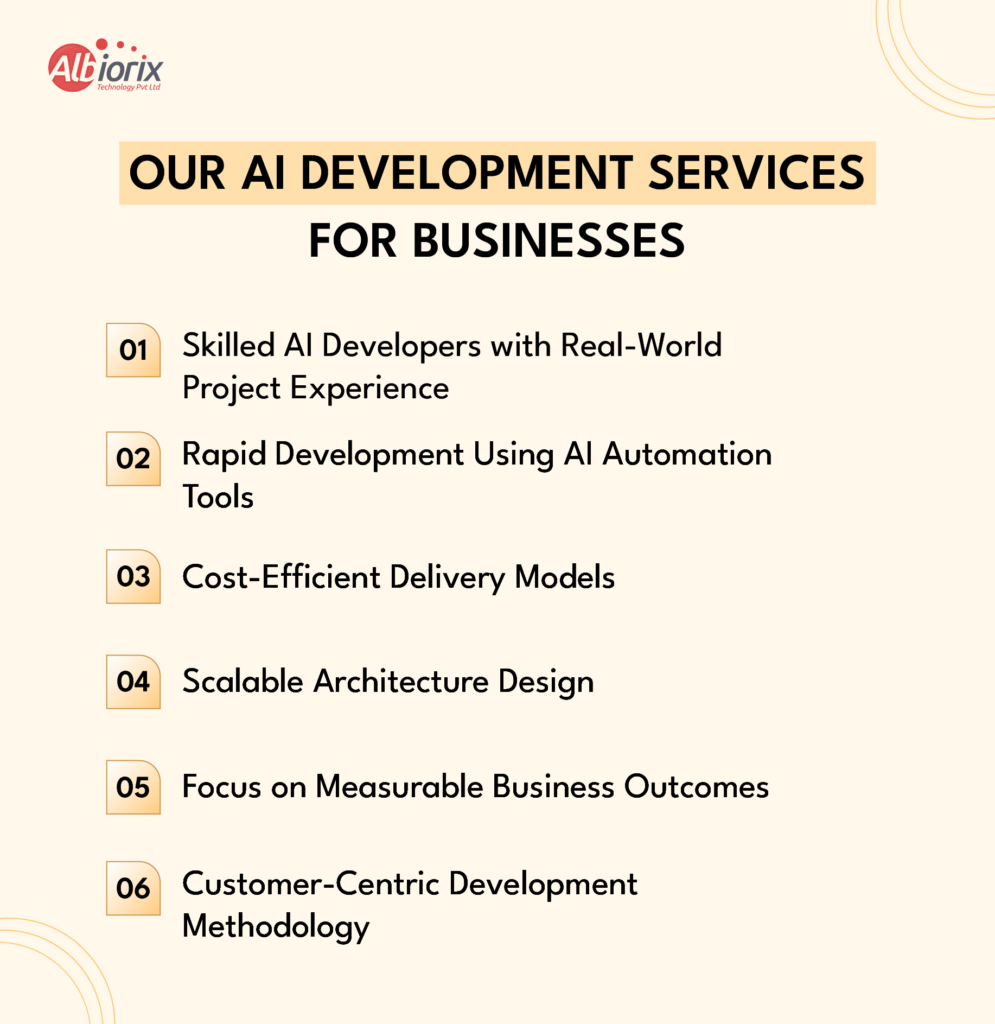
  • Skilled AI Developers with Real-World Project Experience: Our in-house team of AI engineers, data scientists, and software developers brings hands-on expertise across industries. With this experience, we develop AI Solutions that are practical, scalable, secure, and align with your real business needs and goals.
  • Rapid Development Using AI Automation Tools: The use of AI tools in software development aims to shorten development lifecycles. Our lean team of developers holds expertise in all the modern AI tools that can accelerate coding, testing, and deployment. The smart use of AI automation tools reduces manual effort, speeds up delivery timelines, and allows businesses to launch products faster without compromising quality.
  • Cost-Efficient Delivery Models: The use of AI tools not only shortens development time but also helps businesses save on development costs. Moreover, our flexible engagement models help organizations save more. AI-driven workflows enable our in-house lean development teams to maintain high productivity while optimizing operational costs.
  • Scalable Architecture Design: Our AI solutions for businesses are designed with future growth in mind. Scalable architecture design ensures that a system can handle a large volume of data, high web traffic, and scale as per the future growth requirements of a business.
  • Focus on Measurable Business Outcomes: Success is defined by clear business metrics, including cost savings, improved efficiency, faster delivery, and enhanced customer experience. Our AI solutions convert your investments into real ROI.
  • Customer-Centric Development Methodology: Close collaboration with clients ensures transparency, faster feedback cycles, and solutions tailored to specific business goals. The focus remains on solving customer challenges rather than simply delivering technology.

Why Choose Albiorix Technology for AI Development in India

Why Choose Albiorix Technology for AI Development in India

In 2026 and beyond, integrating AI in your business is mandatory for future growth. However, AI Adoption is not as easy as it sounds. It is about achieving measurable business impact using the latest tools and technologies.

We are Albiorix Technology – an AI development company. We help businesses adopt and integrate AI in their business operations for enhanced productivity and customer satisfaction.

Whether you need a custom AI software solution from scratch or want an AI tool to boost your business operations, we have an AI solution for every business under one roof.

We help organisations leverage AI to reduce development costs, accelerate delivery, and build scalable digital solutions with real business value.

Reasons Why Albiorix Technology for AI Solutions in India:

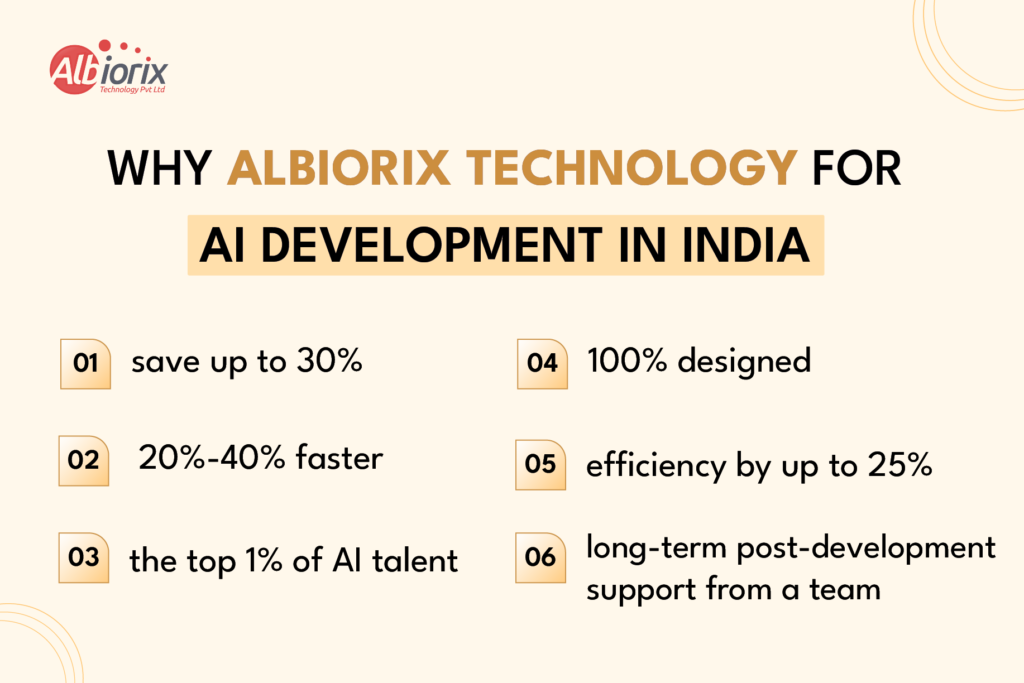
  • You can save up to 30% on Development Costs. We use AI-driven workflows and optimised delivery models to reduce overall technology spending.
  • You can get your project launched approximately 20%-40% faster than the estimated time. Our AI-assisted development strategy accelerates coding, testing, and deployment cycles.
  • You can work with the best lean team of AI developers in India. Get access to the top 1% of AI talent without hiring costs or any recruitment overhead.
  • You get scalable Business AI Solutions built for future growth. Our AI architecture is 100% designed to support expansion without major rework.
  • You can improve your operational efficiency by up to 25%. Our AI automation solutions can reduce manual processes and increase productivity.
  • You receive long-term post-development support from a team of the best AI developers. This continuous improvement ensures your AI systems stay effective and competitive.

    Conclusion

    AI-powered software development company is reshaping how businesses build, scale, and optimize digital products.

    From reducing development costs and improving efficiency to accelerating innovation and enhancing customer experiences, AI has become a critical business differentiator.

    If you’re ready to integrate AI into your strategy, Contact Us to explore the right solutions for your business. Organizations that strategically adopt AI today will lead tomorrow’s digital economy.

    If you’re looking to reduce development costs, build future-ready applications, and leverage AI effectively, partnering with an experienced AI development company can make all the difference.

    How Gaming Apps Reshaping The Future

    Welcome to the dynamic world of gaming apps, where innovation and excitement collide to create immersive digital experiences. It’s 2025, and at this point, the future of gaming apps is incredibly exciting and filled with surprises for gamers.

    With the introduction of new game development technologies, gaming trends, and artificial intelligence, you can expect cutting-edge graphics, immersive virtual reality, social interactions, seamless cross-platform gaming and much more without extra effort.

    Moreover, future gaming apps will not only captivate you with amazing graphics and virtual reality but also offer richer social interactions and immersive gameplay experiences.

    Mind-blowing features like real-time multiplayer action, seamless in-game chats, and collaborative play will make the gaming experience more unique, engaging, and power-packed.

    With the arrival of AR, VR, and cloud gaming, gamers will have an immersive gaming experience anytime and anywhere. The future of gaming apps is truly exhilarating, and it’s going to be a blast.

    Future of Gaming Apps: Trends

    In this blog, we delve deep into the latest trends shaping mobile gaming, review top gaming apps across genres, explore vibrant online gaming communities, and highlight the diverse landscape of popular gaming genres.

    So, Let’s embark on a journey to uncover the future of gaming apps together and the excitement it holds for gamers across the globe.

    Mobile Gaming App Trends 2025 and Ahead

    As we step into 2025, the mobile gaming landscape continues to evolve at a rapid pace, driven by technological advancements, changing user behaviours, and industry innovations.

    2025 is going to be a revolutionary year for the gaming industry and gamers.

    We dive into the latest trends shaping the world of mobile gaming apps, offering insights into emerging technologies, gaming genres, user experiences, and market dynamics.

    Let’s uncover the key trends defining mobile gaming in 2025 and beyond.

    1. Metaverse Integration: The concept of the metaverse has gained significant traction, blurring the lines between virtual and real-world interactions.

    Mobile gaming apps are embracing metaverse elements, offering immersive social experiences, virtual economies, and interconnected gaming worlds.

    Titles like “Roblox” and “Decentraland” showcase the potential of metaverse integration, where players can create, explore, and socialize in expansive digital realms using their mobile devices.

    2. Cross-Platform and Cloud Gaming: Seamless gaming experiences across devices are becoming the norm, thanks to advancements in cross-platform compatibility and cloud gaming technology.

    Players can now start a game on their mobile devices and seamlessly continue on consoles or PCs.

    Services like Xbox Cloud Gaming and NVIDIA GeForce Now are expanding access to high-quality gaming experiences on mobile platforms (for both iOS and Android), overcoming hardware limitations.

    3. NFTs and Play-to-Earn Mechanics: Non-Fungible Tokens (NFTs) have revolutionized ownership and monetization in the gaming industry.

    Mobile gaming apps are incorporating NFTs for in-game assets, collectibles, and player-driven economies.

    Play-to-earn mechanics, popularized by games like “Axie Infinity,” empower players to earn real-world rewards through gameplay, fostering a new era of gaming as a source of income and investment.

    4. AI-Powered Personalization: Artificial Intelligence (AI) algorithms are enhancing personalized gaming experiences, catering to individual preferences, skill levels, and playstyles.

    Gaming apps leverage AI for dynamic difficulty adjustment, content recommendations, and adaptive gameplay mechanics.

    Games intelligently adapt challenges, rewards, and narratives based on player interactions, creating immersive and engaging experiences for diverse audiences.

    5. Hyper-Casual and Social Gaming Experiences: Hyper-casual games continue to dominate app stores, offering simple yet addictive gameplay experiences tailored for quick sessions and broad audience appeal.

    Social gaming features such as live streaming, in-game events, and community challenges foster social connections among players, driving engagement and retention in mobile gaming ecosystems.

    6. Next-Level Gaming Graphics: In the pursuit of ultra-realistic graphics, gaming apps have come a long way.

    Big brands like Nvidia and AMD have made great strides in creating graphics cards that allow for high-fidelity images in games and techniques like ray tracing.

    Using these advanced cards, game developers will have the capability to create games featuring highly realistic and detailed graphics, thereby enhancing the overall immersive experience for players.

      Unlock the Next Generation of Gaming Apps!

      Don’t miss out on the groundbreaking advancements revolutionizing gaming apps in 2025. Dive into the future of gaming and unleash unparalleled experiences now!


      Get Started

      Gaming App Development Steps

      Gaming app development is a multifaceted process crucial for bringing a game from initial idea to market success.

      Below are the key steps involved in mobile game development:

      • Conceptualizing a Gaming App: The journey begins with conceptualizing the game idea, which involves brainstorming, market research, and analyzing gaming trends. Once the concept is chosen, the mobile app development team plans gameplay mechanics, graphics, sounds, and user interface elements to ensure a captivating player experience.
      • Designing the Gaming App: Game design encompasses creating a comprehensive game blueprint. This includes storyboards, level designs, character concepts, and defining game mechanics. The design team also develops a prototype to assess gameplay feasibility and identify any issues early in the process.
      • Gaming App Development: With the game design finalized, the gaming app development team starts coding the game. This phase involves creating code for UI elements, graphics rendering, sound integration, and implementing game mechanics. Rigorous testing is conducted to detect and resolve bugs or glitches.
      • Quality Assurance: The QA phase rigorously tests the game to ensure smooth functionality and eliminate bugs. Both manual and automated testing techniques are utilized to guarantee the game’s reliability, stability, and enjoyable gameplay experience.
      • Launch and Marketing: Upon successful testing, the game is prepared for release on major mobile platforms like the App Store and Google Play. Simultaneously, the marketing team devises a strategic plan to promote the game, generate buzz, and attract players through targeted campaigns and outreach efforts.
      • Post-Release Support & Maintenance: Even after launch, the development team continues to provide ongoing support and updates. This includes addressing post-launch issues, incorporating new features based on user feedback, and maintaining a positive player experience to ensure long-term engagement and success.

      By following these steps in mobile game development, developers can streamline the process, create high-quality games, and maximize their chances of achieving commercial success in the competitive mobile gaming market.

      Conclusion

      Looking for expert assistance in gaming app development? Look no further than Albiorix Technology. Our team of experienced professionals is ready to help you bring your gaming ideas to life.

      From concept to launch, we provide comprehensive services to ensure your gaming app stands out in the competitive market. Talk to our gaming app experts at Albiorix Technology today and level up your gaming app development journey!