




How Much Does AI Development Cost in 2026?

Summary: In 2026, AI development costs range from $10,000 for simple integrations. They can exceed $1 million for complex, enterprise-grade AI systems. Small projects generally cost $10k–$50k, while mid-level applications range from $50k–$250k. Key cost drivers include customized data training, infrastructure (GPU usage), and specialized AI talent.

A Complete Breakdown for Businesses, Startups & Enterprises

Artificial intelligence is no longer a technology of the future it is the competitive advantage of the present.

Businesses across the US and Australia are racing to integrate AI into their operations, products, and customer experiences. But one question comes up in almost every boardroom conversation:

How much does AI development actually cost?” The honest answer: costs range from $10,000 for a simple AI feature to $500,000+ for an enterprise custom AI system.

The range is wide and for good reason. Costs depend on what you are building, how you are building it, and who is building it.

We created a AI development guide to breaks down costs and everything for you in plain language no jargon, no vague estimates.

By the end, you will know what drives AI costs.

You will know what to budget for your project type.

You will also know how to make a smart investment decision for your business.

AI Development Cost by Project Type

Use this table for a fast overview before diving into the full breakdown below.

AI Project TypeEstimated CostTimelineBest for
AI Chatbot / Assistant$10,000 – $80,0004–12 weeksCustomer service, lead gen
Computer Vision System$30,000 – $200,0003–6 monthsManufacturing, retail, security
NLP / Text AI Solution$20,000 – $150,0006–16 weeksLegal, healthcare, fintech
Predictive Analytics$15,000 – $100,0004–12 weeksFinance, e-commerce, logistics
Generative AI App$25,000 – $300,0002–6 monthsContent, marketing, design
Custom AI Model (LLM)$100,000 – $500,000+4–12 monthsEnterprise, deep-tech, R&D
AI Integration / API$5,000 – $50,0002–8 weeksSMBs, startups, MVP builds

Get Your Exact AI Development Cost — Not Just Estimates

Every AI project is different, and generic price ranges won’t give you clarity. Share your requirements and receive a tailored cost estimate & timeline.


Contact Us!

What Factors Drive AI Development Costs?

Before looking at specific numbers, it helps to understand the key levers that push costs up or down.

Two businesses asking for an ‘AI chatbot’ can receive quotes that differ by $100,000 and both quotes can be entirely justified. Here is why.

AI Project Complexity

A basic rule-based chatbot is worlds apart from a context-aware AI assistant trained on your proprietary data. The more sophisticated the logic, the higher the build cost. Complexity also increases testing, debugging, and maintenance overhead.

AI Model Type: Custom vs Pre-Built

Using APIs from OpenAI, Google, or AWS is much cheaper than training a custom model from scratch.

However, pre-built models give you less control. They may also add ongoing API costs. Sometimes, they miss domain-specific accuracy.

AI Project Data Requirements

AI runs on data. If you must collect, clean, label, and organize large proprietary datasets before training, it adds major cost. This work often costs $10,000 to $50,000 alone. The exact amount depends on data volume and quality.

AI Project Team Composition and Location

An in-house US team of senior AI engineers can cost $150–$250 per hour. An experienced AI agency might charge $100–$180/hr. Offshore teams average $40–$80/hr.

Location has a massive impact on total project cost, though quality and communication also vary.

AI Project Integration Complexity

Connecting your AI solution to existing CRMs, ERPs, databases, APIs, and workflows adds engineering hours. The more legacy systems involved, the more expensive the integration.

Compliance and Security Requirements

Industries like healthcare (HIPAA), finance (SOC 2, GDPR), and legal services need extra security.

They also require audit trails and compliance testing.

These needs can add 15–30% to the total development cost.

Maintenance and Ongoing Improvement

AI models degrade over time as real-world data drifts from training data. Budget 15–25% of initial development cost annually for maintenance, retraining, and updates.

AI Development Cost Breakdown by Type
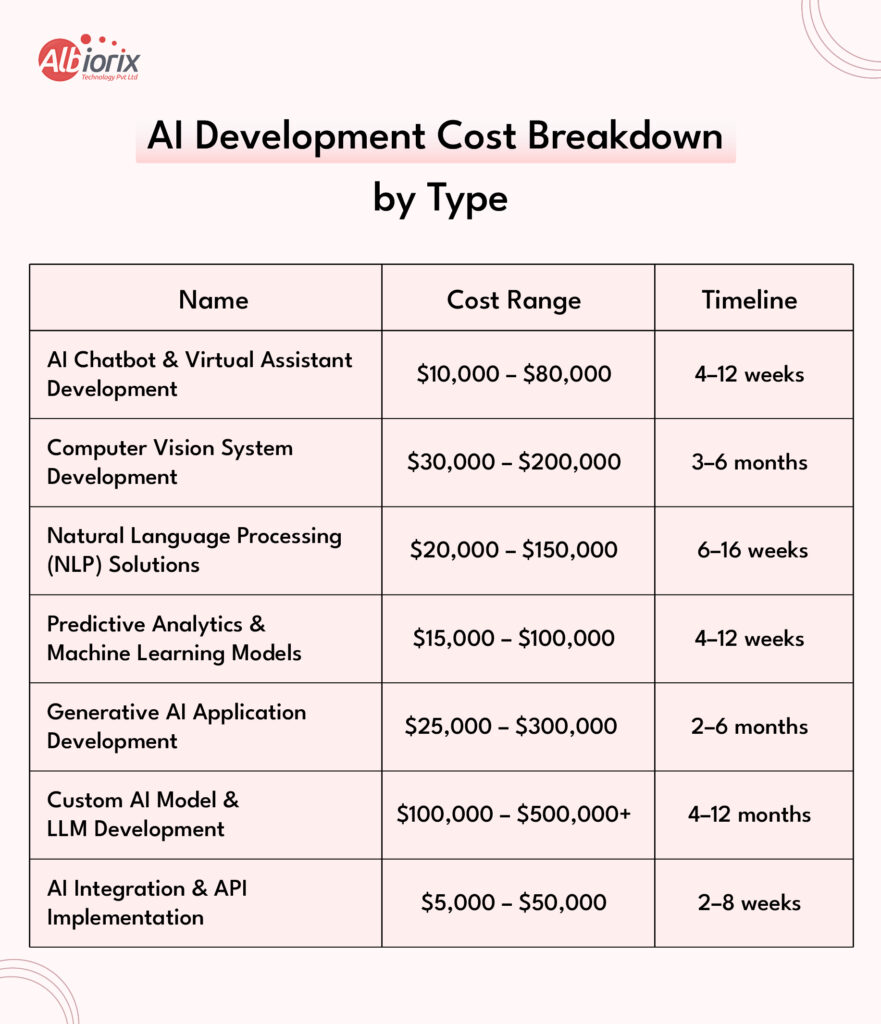
AI Development Cost Breakdown by Type

Below is an in-depth cost breakdown for the most common AI solutions businesses are building in 2026. Each section covers cost range, timeline, key cost drivers, and who it is best suited for.

AI Chatbot and Virtual Assistant Development

“Cost Range: $10,000 – $80,000 | Timeline: 4–12 weeks”

AI chatbots remain one of the most popular entry points for businesses investing in AI.

In 2026, chatbots have evolved far beyond scripted flows. Modern AI assistants use large language models (LLMs). They understand context, remember conversation history, and respond naturally to nuanced queries.

Cost drivers include:

  • Number of supported languages and conversation channels (web, WhatsApp, Slack, etc.)
  • Whether the bot uses a pre-built LLM API or a fine-tuned custom model
  • CRM and helpdesk integrations (Salesforce, Zendesk, HubSpot)
  • Custom training data and domain-specific knowledge bases
  • Admin dashboard, analytics, and conversation logging

A simple FAQ chatbot using GPT-4 API can be built for $10,000–$25,000. A sophisticated AI sales assistant with memory, lead qualification logic, and CRM integration will cost $50,000–$80,000 or more.

Computer Vision System Development

“Cost Range: $30,000 – $200,000 | Timeline: 3–6 months”

Computer vision AI allows machines to interpret and act on visual data from inspecting manufacturing defects to enabling autonomous checkouts in retail.

This is a more technical and costly AI category, mainly because it needs large, well-labeled image datasets.

Common applications include:

  • Quality control and defect detection in manufacturing
  • Facial recognition and access control systems
  • Retail shelf monitoring and inventory tracking
  • Medical imaging analysis (radiology, pathology)
  • Autonomous vehicle perception and drone navigation

The biggest cost variable is data labeling. A typical computer vision model requires thousands of annotated images.

If you lack proprietary image data, collecting and labeling it can cost $15,000–$50,000. This is before any model code is written.

Natural Language Processing (NLP) Solutions

“Cost Range: $20,000 – $150,000 | Timeline: 6–16 weeks”

NLP solutions help machines understand, interpret, and generate human language.

From sentiment tools to document summary engines and contract review systems, NLP is in high demand. It supports legal, healthcare, finance, and customer experience teams.

Typical NLP use cases businesses are funding in 2026:

  • Automated document classification and extraction
  • Sentiment analyzing for customer feedback and social media
  • AI-powered contract review and legal document analysis
  • Clinical note summarization for healthcare providers
  • Intelligent email routing and auto-response systems

Lower-end NLP projects that rely on existing transformer models (like BERT or GPT) via API cost $20,000–$50,000.

Specialized industries that require accuracy and domain knowledge can pay $100,000 to $150,000 for custom fine-tuned models.

Predictive Analytics and Machine Learning Models

“Cost Range: $15,000 – $100,000 | Timeline: 4–12 weeks”

Predictive analytics uses past data to forecast future outcomes. It can predict customer churn, equipment failures, demand spikes, fraud patterns, and revenue trends.

For data-rich businesses, this is often the AI investment with the fastest, most measurable ROI.

Cost variables:

  • Data quality and preparation (often 40–60% of total project effort)
  • Number of prediction targets and model complexity
  • Frequency of retraining (real-time vs weekly batch)
  • Dashboard and visualization requirements
  • Integration with BI tools like Tableau, Power BI, or Looker

A solid demand forecasting model for an e-commerce business typically runs $20,000–$45,000.

A real-time fraud detection system for a financial institution can cost $80,000–$100,000. It needs high accuracy and millisecond inference speeds.high accuracy requirements and millisecond inference speeds, can reach $80,000–$100,000.

Generative AI Application Development

“Cost Range: $25,000 – $300,000 | Timeline: 2–6 months”

Generative AI is the technology behind tools like ChatGPT, Midjourney, and GitHub Copilot. It is the fastest-growing AI development category in 2026.

Businesses are building custom generative AI applications to automate content creation, accelerate software development, personalize marketing at scale, and reinvent internal knowledge management.

Popular generative AI builds in 2026:

  • Branded AI writing assistants for marketing and content teams
  • AI code generation and developer productivity tools
  • Enterprise knowledge bases with AI-powered Q&A (RAG systems)
  • AI image and video generation tools for creative industries
  • Personalized product recommendation engines

The wide cost range here reflects the diversity of applications. A team can deliver a Retrieval-Augmented Generation (RAG) system built on top of GPT-4 for $25,000–$60,000.

A fully custom generative AI platform can cost $200,000 to $300,000 or more.

It may include proprietary model fine-tuning, multi-modal features, and enterprise security.

Custom AI Model and LLM Development

“Cost Range: $100,000 – $500,000+ | Timeline: 4–12 months”

At the high end of the investment spectrum is custom AI model development. It involves building and training large models on proprietary data. It does not rely on third-party APIs.

This is the territory of enterprises, research organizations, and technology companies that need full control. They need unique competitive moats and no dependence on external AI providers.

This investment makes sense when your use case needs domain knowledge that no existing model provides. It also fits when your data is too sensitive for a cloud AI provider. It can also work when inference volume is so high that API costs exceed ownership costs in 12–18 months.

AI Integration and API Implementation

“Cost Range: $5,000 – $50,000 | Timeline: 2–8 weeks”

Not every business needs a custom-built AI.

Many startups and SMBs gain great value by adding existing AI APIs, like OpenAI and Google Gemini.

They can also use AWS Rekognition and Azure Cognitive Services in their products and workflows.

This is the fastest and most cost-effective path to adding AI capabilities.

Examples include adding AI search to an e-commerce platform. You can integrate speech-to-text into a video call tool. You can embed AI summaries into a document management system.

If your goal is an MVP or proof of concept, this is almost always the right starting point.

Start Your AI Project with a Free Expert Consultation

Skip the guesswork and connect with our AI specialists today. In just one session, you’ll get clarity on costs, timelines, and the right AI solution for your business.


Get Started!

Hiring Models and Their Cost Implications

Beyond what you build, how you build it and who builds it has an enormous impact on your total investment. Here are the three main paths, with honest pros and cons for each.

Hiring ModelHourly Rate (USD)Best ForWatch Out For
In-house team (US/AU)$120 – $250/hrLong-term AI productsHigh fixed costs, slow to hire
AI Development Agency$80 – $180/hrEnd-to-end project deliveryChoose carefully — quality varies
Freelancers$50 – $150/hrSpecific components or POCsCoordination overhead, availability
Offshore Team$30 – $80/hrCost-sensitive buildsCommunication, timezone, quality risk

Why Many Businesses Choose an AI Development Agency

For most businesses, a specialist AI agency is a good choice. This is especially true for companies without a machine learning engineering team. It offers a strong balance of speed, quality, and cost.

A good agency brings a full team, like ML engineers, data scientists, UI/UX designers, and DevOps. It also brings a proven delivery process and clear accountability through defined milestones and deliverables.

The key is choosing the right agency. Look for a proven portfolio of AI projects, transparent pricing, clear communication, and post-launch support.

A free first consultation is a good sign. The agency should ask detailed questions about your goals before giving a quote. This shows you are working with a serious team.

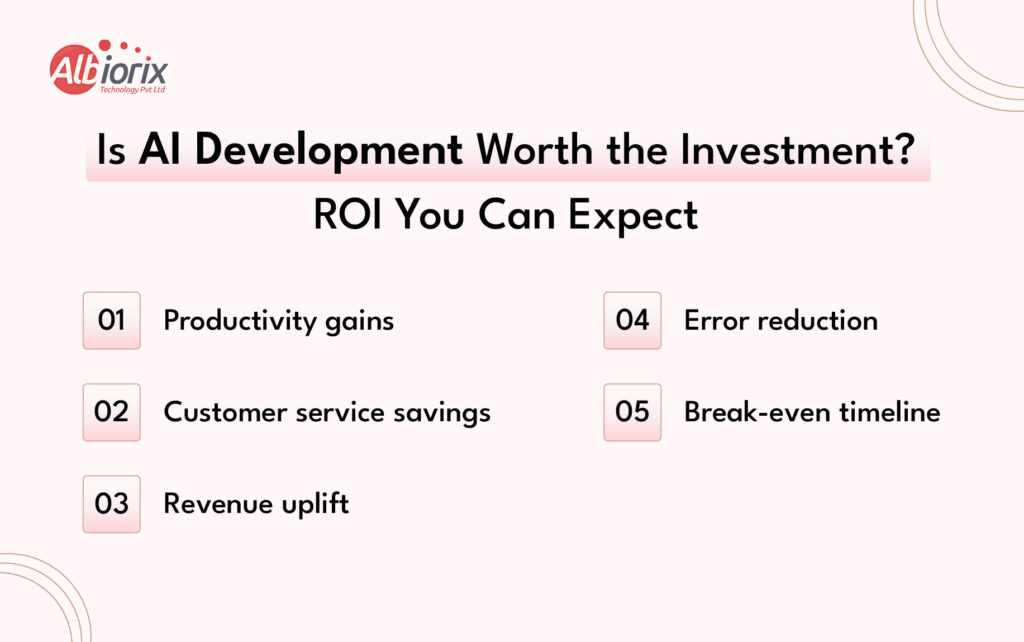
Is AI Development Worth the Investment?
Is AI Development Worth the Investment

Cost without context is meaningless. Before approving any AI development budget, the real question is: what will this AI solution return?

  • Productivity gains: McKinsey research finds AI automation can improve knowledge worker productivity by 20–45%. For a 50-person company, that is equivalent to gaining 10–22 additional full-time employees without increasing headcount.
  • Customer service savings: Businesses using AI chatbots for tier-1 support report 30–50% lower support costs. Well-set-up chatbots keep customer satisfaction scores the same.
  • Revenue uplift: AI-powered personalization in e-commerce lifts average order value by 10–30%. AI-driven lead scoring and qualification can improve sales conversion rates by 20–35%.
  • Error reduction: In data-heavy fields like finance, healthcare, and logistics, AI cuts human errors by 60–90%. This leads to lower costs and less compliance risk.
  • Break-even timeline: Most mid-sized AI projects reach ROI break-even within 6–18 months after launch. Customer-facing apps break even sooner. Complex internal systems often take longer.
Pro tip for decision-makers:
Frame AI development as a capital investment, not an operating expense. The upfront cost gives you a competitive edge that grows over time. It also becomes harder for competitors to copy the longer you use it.

Hidden Costs to Budget For

Many businesses are surprised by costs that emerge after the initial development phase. Here is what to plan for beyond the build cost:

  • Cloud infrastructure and compute costs: AI workloads that use many GPUs can cost $2,000 to $15,000 per month. Costs on AWS, GCP, or Azure vary by usage volume and model complexity.
  • Third-party API costs can be high. If your solution uses OpenAI, Anthropic, or Google AI APIs a lot, token costs can rise quickly. A high-volume chatbot can rack up $3,000–$20,000/month in API fees.
  • Model retraining and drift monitoring: AI models need periodic retraining as real-world data changes. Budget 15–25% of initial build costs annually.
  • User adoption and change management: Deploying AI is as much an organizational challenge as a technical one. Training staff, running change management, and managing resistance have a real cost.
  • Security audits and compliance reviews: Especially for regulated industries, periodic security audits and compliance reviews ($5,000–$25,000/year) are non-negotiable.

Stages of AI Development and What Each Stage Costs
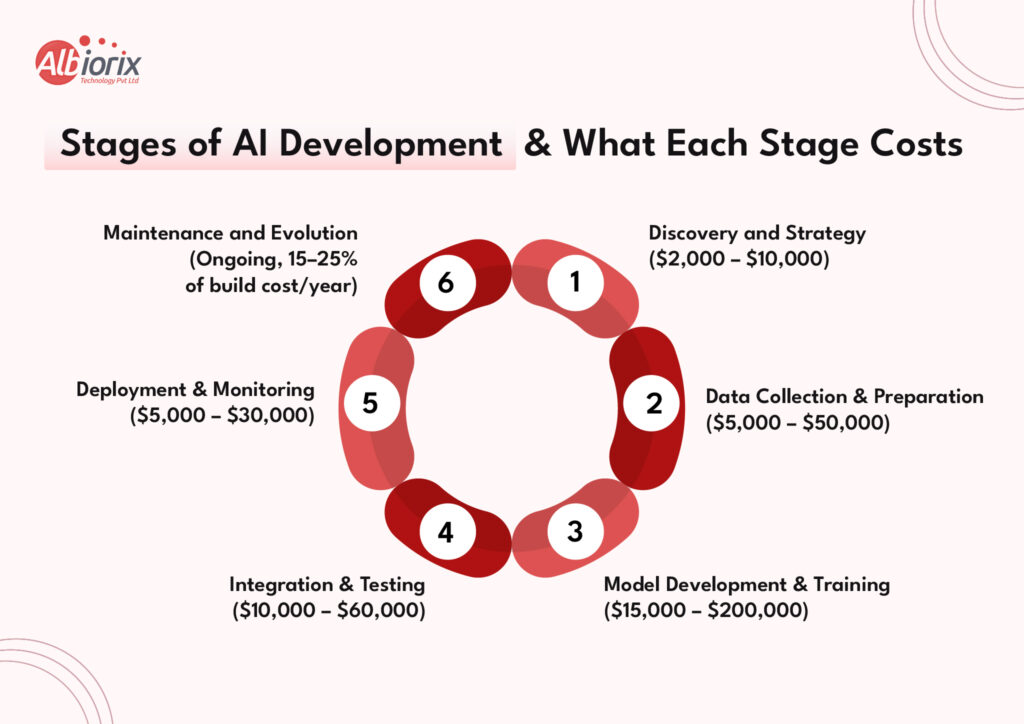
Stages of AI Development and What Each Stage Costs

Understanding how AI development is phased helps you plan your budget and manage risk. Most professional AI projects follow this structure:

Phase 1: Discovery and Strategy ($2,000 – $10,000)

Requirements gathering, feasibility study, data audit, technology selection, project roadmap. This phase helps you determine whether your idea is viable before you spend a cent on development. Some agencies offer this free as part of a scoping consultation.

Phase 2: Data Collection and Preparation ($5,000 – $50,000)

Sourcing, cleaning, labeling, and structuring training data. Often the most underestimated phase. Poor-quality data produces poor AI garbage in, garbage out.

Phase 3: Model Development and Training ($15,000 – $200,000)

Building the AI architecture, training on prepared data, iterating on model performance, and reaching target accuracy metrics. The core of the development investment.

Phase 4: Integration and Testing ($10,000 – $60,000)

Connecting the AI to your existing systems, APIs, and interfaces. Rigorous testing across edge cases, adversarial inputs, and real-world scenarios.

Phase 5: Deployment and Monitoring ($5,000 – $30,000)

Production deployment on cloud infrastructure, real-time monitoring, alerting, and performance dashboards. CI/CD pipelines for ongoing model updates.

Phase 6: Maintenance and Evolution (Ongoing, 15–25% of build cost/year)

Retrain on new data. Add new features. Apply security patches. Scale infrastructure as usage grows. Adapt to new AI capabilities as the technology landscape evolves.

How to Reduce AI Development Costs Without Cutting Corners

Smart AI investment is not about spending less, it is about spending right. Here are proven strategies:

  • Start with an MVP: Build a focused, minimal viable AI product first. Validate it with real users before investing in scale, additional features, or model customization.
  • Use pre-built models and APIs with care.
  • Off-the-shelf AI APIs can deliver 80% of the value at 20% of the cost. Use them for non-differentiating functions, custom build only for your true competitive advantage.
  • Invest in data quality early: Clean, well-labeled data dramatically reduces training cycles and costs. Cutting corners on data preparation creates expensive rework later.
  • Choose a phased delivery model: Break large AI projects into milestone-based phases. This reduces financial risk, allows for course corrections, and keeps the team accountable.
  • Negotiate a maintenance and support SLA: Ongoing support with your development partner is often 30–40% cheaper. It also costs less than hiring them ad hoc for each issue.
  • Leverage open-source frameworks: Frameworks like TensorFlow, PyTorch, HuggingFace Transformers, and LangChain dramatically reduce build time and cost for experienced AI developers.

Conclusion

AI development costs in 2026 vary widely. They range from $5,000 for a simple API integration. They can exceed $500,000 for a custom enterprise AI platform.

The right investment for your business depends on your goals, your data setup, the problem’s complexity, and the value AI will bring.

What is clear is this: the cost of not investing in AI is growing every year. Businesses that move early build compounding advantages better data, more refined models, and deeper organisational AI capability that latecomers cannot easily replicate.

The smartest investment is a well-scoped first project: focused, measurable, and designed to prove value before scaling. Get that right, and every subsequent AI investment becomes easier to justify, faster to deliver, and higher in return.

Ready to Build Your AI Solution? Get a free, no-obligation project estimate from our AI development team. We work with businesses in the US and Australia to design, build, and scale AI solutions with clear results.
Best AI Integration Tools, Platform and Strategy For Business

Summary: AI Integration is in huge demand. It is helping businesses automate tasks, enhance support services, and analyze data for business decisions. Amid the many AI integration tools on the market, we offer a guide to help you find the best AI solution for your business. From top AI models to GenAI Solutions, let’s find the right AI tools for your business in 2026.

The Growing Adoption of AI Integration in Businesses

Artificial Intelligence is one of the widely used business tools in 2026.

Organizations in developed nations like the USA, Australia, Germany, and the UK use AI and generative AI solutions.

They automate business operations, improve customer service, and support data-driven decisions.

They are amplifying their business productivity and ROI by using artificial intelligence.

In 2026, AI integration is very common among businesses. They are adding AI to their current systems. This will improve efficiency. It will automate decisions. It will also help them find deeper insights in their data.

This shift is driving the growing demand for AI integration across industries.

According to statistics, over 80% of businesses will likely add AI tools to their operations by 2027.

Many large organizations already use AI models and GenAI solutions for automation, predictive analytics, and customer service tools.

As a result, there is strong demand for professional AI integration services. This demand is high in the USA, Australia, and across Europe.

As AI technologies continue to evolve, businesses are increasingly partnering with experienced AI development companies to implement scalable and reliable solutions.

In this guide, we explain how AI integration works. We cover why businesses are adopting it. We review the best tools and platforms available. We also show how organizations can implement AI in their operations.

What is AI Integration?

AI Integration is the process of incorporating Artificial Intelligence technologies into your existing/traditional business systems, workflows, and applications.

The main purpose of AI integration with existing business systems is to automate tasks, analyze data, and improve decisions.

Many businesses globally have already integrated AI, and many on the verge of integrating it. But what is AI integration?

Businesses prefer AI integration services because it is less expensive than developing a custom AI solution from scratch.

Organizations add AI features to tools they already use. These tools include CRM platforms, marketing software, customer support systems, and data analytics platforms.

AI integration allows businesses to leverage the power of AI and improve their ROI by multiple folds.

For Example, Artificial Intelligence is integrated into a CRM system to automatically analyze customer behavior and predict purchasing patterns.

Similarly, AI-powered chatbots or voice assistants can be added to customer service platforms. They handle routine questions and provide instant responses.

Businesses increasingly rely on technologies explained in AI voice agent technology to automate support interactions.

Modern AI integration often involves technologies such as machine learning, natural language processing (NLP), predictive analytics, and computer vision.

These technologies allow businesses to process large volumes of data, detect patterns, and generate actionable insights in real time.

With professional AI integration services, companies can connect AI models to their existing systems. These systems include databases, APIs, cloud platforms, and enterprise apps. This helps create smarter, automated business operations.

Ready to Integrate AI into Your Business Operations?

Our team specializes in building scalable AI solutions that improve efficiency, enhance customer experiences, and drive long-term business growth.


Talk to AI Experts

Why Do Businesses Need AI Integration?

Businesses are integrating AI into their existing system to automate workflows, make informed decisions, and deliver personalized customer experiences. It helps them stay more productive, competitive, and evolve faster.

AI Integration is increasing among businesses of all sizes. Below are some of the most important benefits of AI integration for modern businesses.

  1. Smarter Data Driven Decisions: AI integration helps businesses process and analyze large amounts of unstructured data. It turns that data into a meaningful set of structured data. Organizations exploring intelligent automation strategies often compare types of AI voice agents to enhance data-driven decision systems.
  2. Improved Business Efficiency: One of the biggest reasons for AI integration is improved efficiency. With the help of AI Integration, businesses can automate representative tasks, including data entry, reporting, and customer responses. Companies implementing intelligent automation frequently explore reducing development cost strategies using AI tools.
  3. Better Customer Experience: With AI chatbots and AI voice agents, you do not need humans for customer support. These AI tools help businesses deliver faster, accurate, and more personal customer support at any time.
  4. Better Marketing Performance: With AI integration, marketing teams can analyze customer behavior, predict SEO trends, and plan their strategy. Organizations implementing conversational automation often evaluate AI voice platforms to scale customer support efficiently.
  5. Scalable Business Operations: With help from an experienced AI integration company, organizations can build scalable AI systems. These systems can evolve as their business grows. AI-driven automation helps businesses manage increased demand without significantly expanding operational costs.
  6. Competitive Advantage: Businesses that adopt AI early gain a strong competitive edge. Many companies now work with experienced AI voice developers to build advanced conversational automation systems.

Top Businesses Using AI Integration

Top Businesses Using AI Integration

Leading organizations in the USA, Australia and Europe are actively investing in AI integration to uplift and automate their operations and business productivity.

Here are some of the most prominent businesses using AI integration in 2026.

  1. Amazon: The eCommerce giant, Amazon, is using advanced AI integration for product recommendations and logistics optimizations. It also uses AI-powered chatbots and AI-powered voice agents to offer personalized customer support.
  2. Google: Google, the search giant, uses AI across its ecosystem. It helps users find the best results. It has integrated AI in search algorithms, advertising platforms, cloud services, and productivity tools.
  3. Microsoft: The tech giant, Microsoft, uses AI integration in enterprise solutions. It uses AI integration in cybersecurity, cloud computing, and business productivity platforms. Tools like Copilot leverage AI to enhance workplace efficiency.
  4. Netflix: The OTT giant, Netflix, uses AI integration to recommend movies and shows. It also uses AI to analyze user behavior and suggest personalized content. It helps Netflix significantly improve viewer engagement and retention.
  5. Shopify: Shopify integrates AI into e-commerce operations by helping businesses automate product recommendations, customer insights, customer support, and marketing strategies for online stores.

AI innovation is also changing industries like gaming. Companies use AI in product development to speed up innovation cycles.

Which Are the Top AI Tools for Small Business Operations

Which Are the Top AI Tools for Small Business Operations

The top AI integration tools for small business operations are ChatGPT, Zapier AI, and HubSpot AI.

Other popular tools include Jasper AI, Notion AI, and Grammarly AI.

Whether small or large, AI tools are becoming an integral part of business operations. It helps them automate processes, improve customer communication, and gain useful insight from the collected data.

Modern AI integration tools allow businesses to implement intelligent automation without requiring complex technical infrastructure.

Many organizations studying modern AI implementations begin with resources like the Generative AI development guide to understand architecture and deployment models.

Below are some of the most popular tools for AI integration used by small businesses.

  1. ChatGPT: It is one of the widely used AI integration tools in 2026. Businesses use ChatGPT to automate customer support, generate marketing content, and much more.
  2. Zapier AI: This AI tool allows businesses to connect multiple applications and automate workflows. It uses AI-powered triggers and automation features to do so.
  3. HubSpot AI: It provides AI-driven tools for marketing automation, lead scoring, email personalization, and CRM management. It is a very useful tool for businesses.
  4. Jasper AI: This AI tool is widely used by marketing teams. It is commonly used to create content, marketing strategies, marketing campaign ideation, and more.
  5. Grammarly AI: Grammarly helps businesses maintain professional communication through AI-powered grammar checking, tone suggestions, and writing improvements.
  6. Notion AI: This AI tool is different from the above one. It helps businesses organize information, generate documentation, automate summaries, and manage workflows.

No-Code AI Integration Platforms You Should Try

No-Code AI Integration Platforms You Should Try

If your business does not have an in-house AI team or an AI integration partner, try a no-code AI integration platform.

These No-Code AI integration platforms are equally useful and valuable. These platforms assist businesses in implementing AI solutions without writing complex code.

Below are some of the Top Platforms for AI Integration in 2026:

  1. Make: This no-code AI tool helps businesses build strong AI automation workflows across many apps without writing code.
  2. Peltarion: This no-code AI tool helps businesses train and deploy AI models. It supports predictive analytics and machine learning use cases.
  3. Obviously AI: This no-code AI tool helps businesses build predictive models. It uses simple data uploads and visual interfaces.
  4. Akkio: This no-code AI platform lets businesses create predictive insights from their data without any coding.
  5. Levity: This no-code AI platform helps businesses automate repetitive tasks such as document classification and email processing.

How to Choose the Right AI Integration Platform

Amid many AI models and GenAI tools in the market, it is important to choose the right AI tool for your business. As a business, you must carefully choose an AI tool that fits your business operations and long-term business goals.

Here are some practical tips to find the right AI integration platform.

  1. Evaluate Business Objectives: Before selecting an AI platform, businesses should clearly define their goals. Companies planning AI transformation often review insights about AI development costs to better understand budget planning.
  2. Check Integration Capabilities: There are many AI platforms in 2026. Choose one that integrates easily with your existing systems.
  3. Consider Scalability: Scalability is a key feature of an AI platform. Choose an AI tool that can scale and grow with your business needs.
  4. Assess Data Security: Online hacking and theft are rising. Choose an AI tool with strong data protection and cybersecurity standards.
  5. Hire Expert AI Integration Services: Working with experienced AI integration services providers ensures smoother deployment, customization, and long-term technical support. Businesses also explore strategies like AI reducing ERP costs when integrating AI into enterprise platforms.

Looking for a Reliable AI Integration Company?

Our experts help organizations unlock the full potential of artificial intelligence and build smarter, future-ready digital ecosystems.


Talk to us

AI Integrations for Marketing, CRM and Workflow Automation

AI integration is helping businesses improve efficiency across multiple operational areas such as marketing, customer relationship management, and internal workflow automation.

  1. AI Integration for Marketing: AI helps marketing teams analyze customer behavior, personalize campaigns, and optimize advertising strategies. Businesses can use AI to automate content creation, audience targeting, and campaign performance analysis.
  2. AI Integration for CRM: AI-powered CRM systems help businesses review customer interactions. They can predict buying patterns. They also improve sales forecasts. AI also assists sales teams in identifying high-value leads and improving conversion rates.
  3. AI Integration for Workflow Automation: AI enables businesses to automate repetitive operational tasks such as document processing, reporting, approvals, and internal communications. This significantly improves organizational efficiency and productivity.

How to Successfully Integrate AI: Steps to Follow

Implementing AI integration requires a structured strategy to ensure successful adoption across business operations.

  1. Identify business challenges that AI can solve
  2. Evaluate available data sources
  3. Select the right AI tools and platforms
  4. Develop AI models and integration architecture
  5. Integrate AI with existing business systems
  6. Test AI performance and accuracy
  7. Train employees to work with AI tools
  8. Continuously monitor and optimize AI systems

Following these steps helps organizations build reliable and scalable AI-powered business environments.

Albiorix Technology for AI Integration Services

Albiorix Technology for AI Integration Services

Businesses looking to implement AI successfully often partner with an experienced AI integration company like Albiorix Technology.

Here are some strong reasons to choose Albiorix Technology for AI integration services.

  1. Expertise in AI Development: Albiorix Technology has extensive experience in building AI-powered applications across industries including healthcare, fintech, retail, and SaaS platforms.
  2. Custom AI Integration Solutions: The company provides tailored AI integration strategies based on specific business needs rather than offering generic AI implementations.
  3. Seamless System Integration: Albiorix helps integrate AI with existing enterprise systems, cloud platforms, APIs, and third-party tools.
  4. Scalable AI Infrastructure: The team builds scalable AI systems that can support business growth and evolving technology requirements.
  5. Strong Data Security Standards: Albiorix follows modern data security and compliance practices to ensure safe handling of sensitive business information.
  6. End-to-End AI Development Support: From AI strategy consulting to deployment and ongoing optimization, Albiorix provides complete AI development and integration services.

Best AI Integration Services in the USA

Demand for AI integration services in the USA is rising fast.

Businesses want to modernize their operations with smart technologies.

Organizations across industries including healthcare, finance, retail, logistics, and SaaS are actively investing in AI-driven automation and data analytics solutions.

Healthcare organizations in particular are seeing major improvements in diagnostics and efficiency through AI in healthcare implementations.

Companies are increasingly adopting AI-powered CRM systems, predictive analytics platforms, and automated customer service solutions to enhance efficiency and customer satisfaction.

However, implementing AI successfully requires technical expertise, strategic planning, and deep understanding of business workflows. This is why many companies partner with experienced providers like Albiorix Technology for AI integration services.

Albiorix Technology offers comprehensive AI integration solutions tailored to the needs of modern businesses. If you would like to learn more about these solutions or discuss your project requirements, Contact Us for expert guidance.

Their team specializes in integrating machine learning models, automation tools, and AI-powered analytics platforms into existing enterprise systems.

By leveraging advanced technologies such as natural language processing, predictive analytics, and generative AI, Albiorix helps businesses unlock new growth opportunities.

For organizations seeking reliable AI integration services, partnering with an experienced technology company ensures faster implementation, optimized performance, and long-term scalability.

With the right AI integration strategy, businesses in the USA can significantly improve operational efficiency, customer engagement, and data-driven decision-making.

What Is The Average Cost of AI Development In USA?

Summary: The upfront cost of AI development may feel like an expensive deal at the moment, but not investing in AI development may cost you even more than this. If you are a business looking for AI development services in the USA, then this blog is just right for you. We will discuss the cost of AI development in the USA, how to control the development cost, and many other important aspects.

Custom AI Development Cost in the USA

We are now in 2026, and at this stage, we can no longer say that Artificial Intelligence is an experimental technology.

It is considered a powerful business tool that can enhance your productivity, automate tasks, and increase your ROI.

Use of AI or AI-powered tools is now a competitive advantage. And this is the reason why there is a huge need for AI development companies across the globe.

The use of Artificial Intelligence, or the AI-powered generative models, is making life easy for every industry.

It is used for predictive analysis in the fintech industry, to provide better treatment in the healthcare industry, and to suggest optimized routes in the logistics industry.

The use and implementation of AI vary according to the business needs, but the outcome remains the same.

Businesses across developed nations, like the United States, are at the forefront of using and integrating AI into their day-to-day operations.

They are using AI models or custom generative AI software to enhance productivity. But one question consistently arises before any implementation begins:

What is the actual cost of AI development in the USA?

The cost of AI development may differ in different locations, and there are many reasons for it.

If you are evaluating AI development services USA, planning to hire AI developers, or exploring custom AI solutions, this guide will give you a practical, transparent breakdown of:

  • Average AI development costs in the U.S.
  • Factors that influence pricing
  • Hidden costs businesses overlook
  • Cost comparison: in-house vs agency vs remote developers
  • Whether outsourcing to India makes financial sense
  • Future AI market forecasts and why delaying investment may be risky

Have an idea that can change the course of your business, but are worried about the development cost?

At Albiorix Technology, you can discuss your idea with AI experts and get a free quote instantly. We don’t charge – it’s a free consultation.


Talk to AI experts.

What is the Average Cost of AI Development in the USA?

The average cost of generative AI development in the USA depends on many different aspects.

If you are evaluating structured Generative AI development guide insights, planning to hire AI developers, or exploring custom AI solutions, this guide will give you a practical, transparent breakdown.

Small AI Projects (Proof of Concept or MVP)

Small AI projects are those projects that are usually developed to validate an idea before getting into full-scale development with a huge investment.

The objective of these types of AI projects is to solve specific business challenges with limited functionality and faster development cycles.

The estimated development cost of such small AI Projects is somewhat from $25,000 to $75,000.

These projects typically include:

  • AI chatbots
  • Basic recommendation systems
  • Workflow automation tools
  • AI integrations using existing APIs
  • Pilot generative AI implementations

Many startups begin with AI chatbot integration to validate customer engagement strategies before scaling further.

Mid-Level AI Solutions

Mid-level or Medium-sized AI solutions move beyond experimentation and aim to create measurable operational impact. A Mid-level AI solution involves custom data pipelines, deeper model training, and integration with enterprise systems.

The estimated development cost of a mid-sized AI solution is somewhat from $80,000 to $200,000.

These include:

  • Predictive analytics platforms
  • AI-powered SaaS features
  • Computer vision solutions
  • NLP-driven applications
  • Industry-specific custom AI solutions

Many enterprises optimize budgets by applying strategies explained in reducing development cost using AI-driven engineering models.

Enterprise-Grade AI Systems

These types of custom AI systems are highly complex, strategic, and time-consuming. They are a multi-layered platform designed for scalability, compliance, and long-term automation.

Enterprise-grade AI solutions are designed for the whole organisation and not for one or two departments.

The estimated development cost of an enterprise-grade AI solution is somewhat from $250,000 to $1M+.

Examples include:

  • Healthcare AI diagnostics systems
  • Large-scale fraud detection engines
  • Custom LLM-based enterprise assistants
  • AI platforms are integrated across multiple departments

Healthcare organizations increasingly invest in AI in healthcare to improve diagnostics, compliance, and patient care efficiency.

Hourly Cost of Hiring AI Developers in the US

Hourly Cost of Hiring AI Developers in US

The cost of hiring an AI Developer in the USA depends on many different factors. These factors are an AI developer’s expertise, specialisation, industry experience, and much more.

In the major cities in the United States, the cost of hiring AI developers may be even higher due to high demand and low supply.

Additionally, specialised skills like deep learning architecture or generative AI engineering command premium pricing. Along with all these factors, businesses must also consider indirect costs such as benefits, taxes, and long-term retention strategies.

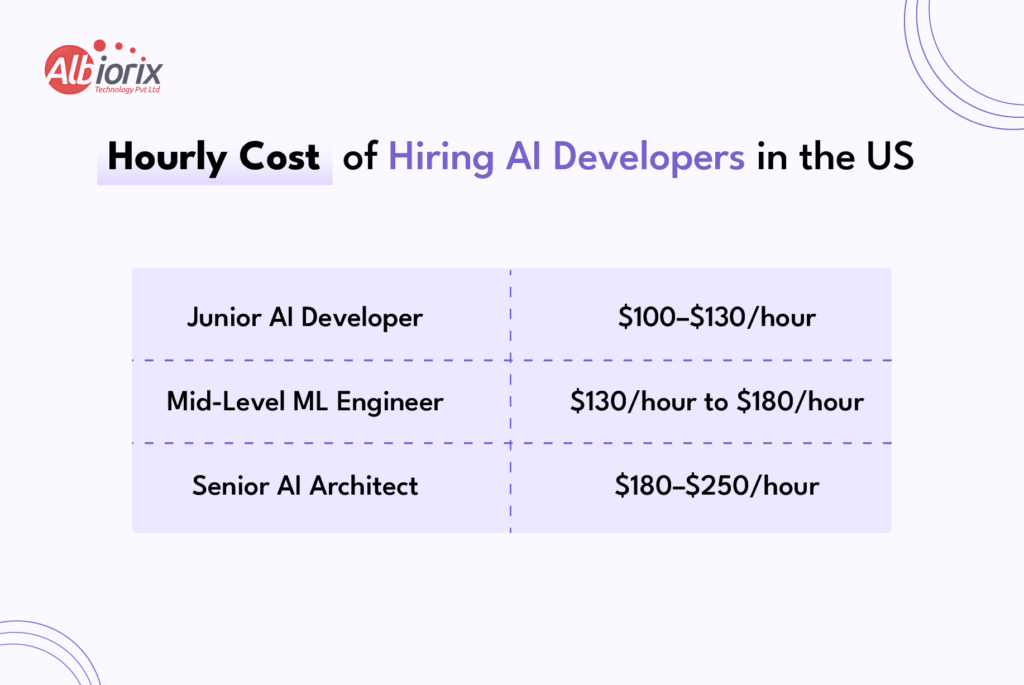
If you plan to hire AI developers directly, here’s what you can expect:

  • Junior AI Developer: The cost of hiring Jr. AI developers may range from $100–$130/hour. These developers are capable of handling tasks such as data preprocessing, model support tasks, and implementation under supervision.
  • Mid-Level ML Engineer: The cost of hiring Mid-level AI developers may range from $130/hour to $180/hour. These AI developers can design, develop, and deploy ML pipelines for production-ready AI features.
  • Senior AI Architect: The cost of hiring Sr. AI developers may range from $180–$250/hour. The role of Sr. AI architect is to lead AI strategy, system architecture, and complex model design decisions.

This makes AI development services in the USA among the most premium in the global market.

If you are planning to develop a custom AI solution for your business, then remember that the only hiring cost of developers is not the overall development cost of an AI solution. There are still different factors that influence the final budget.

Key Factors That Affect the Cost of AI Development

Key Factors That Affect the Cost of AI Development

The cost of AI development may vary from business to business as their use cases are different from each other. Moreover, the level of customization required in the solution also differs.

Understanding these cost drivers helps businesses create realistic budgets and avoid unexpected overruns.

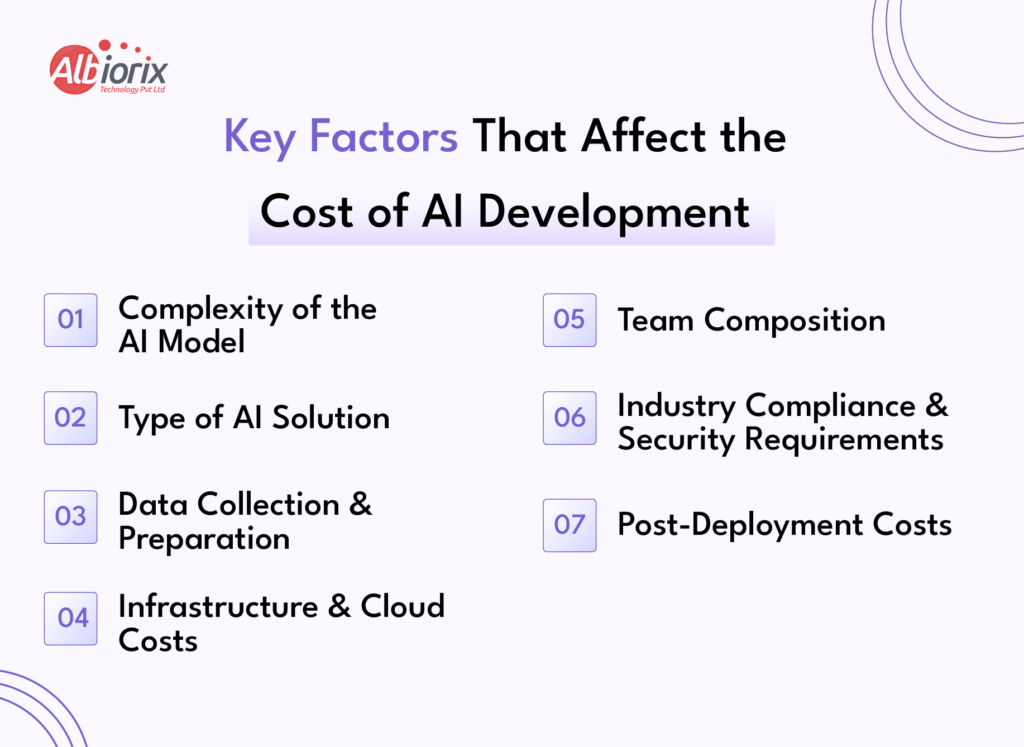
Factors Affecting the Cost of AI Development:

Complexity of the AI Model: The complexity of an AI model directly affects the cost of AI development. It also impacts the overall development time. More advanced and complex models need deeper experimentation and validation cycles.

A rule-based automation system costs significantly less than a custom-trained generative AI model.

  • API-based generative AI integration: Lower cost
  • Fine-tuned LLM: Moderate cost
  • Fully custom large language model: Very high cost

Businesses comparing AI vs automation solutions often notice major cost differences depending on intelligence depth.

Type of AI Solution: AI solutions for different industries require different types of specialization and expertise on different frameworks. Each domain has unique data and infrastructure requirements.

Different AI domains require different expertise:

  • Machine Learning (ML)
  • Natural Language Processing (NLP)
  • Computer Vision
  • Generative AI development services
  • Reinforcement Learning

Generative AI development services are currently among the fastest-growing and most investment-heavy segments due to compute and training requirements.

Data Collection & Preparation: Data readiness determines project success. If data is unstructured, incomplete, or inconsistent, additional effort is required before model training begins.

Data is often the largest hidden cost.

Expenses may include: 

  • Data acquisition
  • Data cleaning
  • Labeling
  • Annotation
  • Storage
  • Compliance validation

In healthcare environments, structured AI healthcare software requires extensive data cleaning and compliance validation.

Infrastructure & Cloud Costs: AI applications require scalable computing environments capable of handling large datasets and model training processes. GPU-based processing significantly increases infrastructure expenses.

AI systems require:

  • GPU-enabled servers
  • Cloud platforms (AWS, Azure, GCP)
  • Scalable data pipelines
  • Ongoing compute power for retraining

Enterprise-level AI infrastructure can cost thousands of dollars per month even after deployment.

Team Composition: When it comes to custom AI development, you will need a team of different experts. Along with AI developers, you will require domain experts and operational oversight.

 A typical AI development team may include:

  • AI Architect
  • Data Scientist
  • Machine Learning Engineer
  • Backend Developer
  • DevOps Engineer
  • UI/UX Designer
  • QA Specialist

The broader the team structure, the higher the total investment.

Industry Compliance & Security Requirements: Regulated industries face additional scrutiny and validation procedures. These increase both development and legal review costs.

Certain industries significantly increase AI costs:

  • Healthcare (HIPAA compliance)
  • Fintech (regulatory security audits)
  • Insurance (risk governance)
  • Enterprise SaaS (data privacy standards)

Compliance adds both technical and legal expenses.

Post-Deployment Costs: Artificial Intelligence keeps evolving, and so does your business; therefore, you will need professional support and maintenance services to ensure optimum performance of your AI solution. Continuous monitoring ensures accuracy and reliability

Ongoing costs include:

  • Model monitoring
  • Performance optimization
  • Drift detection
  • Retraining cycles
  • Infrastructure scaling

Annual maintenance can range from 15–25% of the initial development cost.

Hidden Costs Businesses Often Overlook

At the time of AI development, many businesses believed that the cost was what they estimated at the beginning.

However, there are some hidden costs of custom AI development, including experimentation, iteration, and scaling. These factors also add to the overall cost of development.

AI is not a one-time project but an evolving system. Budget planning must include flexibility for testing, optimisation, and change management.

Here are overlooked expenses:

  • Failed experimentation cycles
  • Bias mitigation and fairness testing
  • Security vulnerability assessments
  • Data governance implementation
  • Scaling adjustments
  • Continuous model improvement

A realistic AI development cost strategy accounts for long-term operational expenses, not just launch budgets.

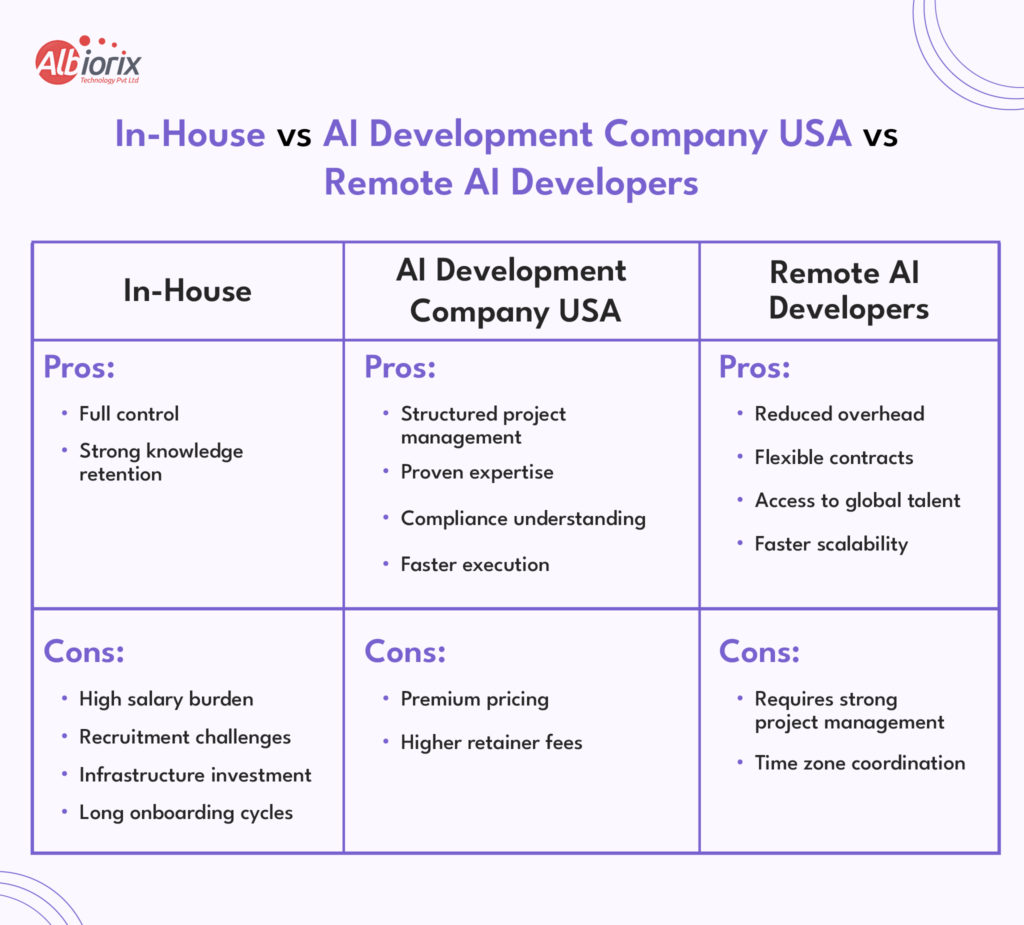
In-House vs AI Development Company USA vs Remote AI Developers

In-House vs AI Development Company USA vs Remote AI Developers

When a company plans to develop an AI solution for its business, there are different engagement models to choose from. Selecting the right engagement model is important for cost-cutting.

Each engagement model has different levels of control, flexibility, and scalability. Businesses must carefully choose the engagement model based on their business requirements, long-term goals, and future AI roadmap.

In-House Team of AI Developers

Building an internal team offers full strategic ownership but requires significant investment and time.

Pros:

  • Full control: You will have full control over the team. You can manage priorities, architecture decisions, and timelines internally.
  • Strong knowledge retention: Your AI expertise will stay within your organisation for the long term.

Cons:

  • High salary burden: You will have to pay competitive salaries to your AI developers, which can increase operational costs.
  • Recruitment challenges: AI talent is scarce and highly competitive in 2026; thus, you have to work hard to find the right resource.
  • Infrastructure investment: You have to build internal data and computing environments.
  • Long onboarding cycles: When you hire a resource, it takes some time for him/her to accommodate the project and align with business processes.

If we compare this engagement model with other available options, this model is a little expensive.

AI Development Company USA

Partnering with an AI Development company in the USA provides structured execution and specialised expertise.

Pros:

  • Structured project management: AI development companies in the USA have established workflows to reduce project delays.
  • Proven expertise: You can have access to experienced AI professionals with case studies.
  • Compliance understanding: AI development agencies in the USA have an in-depth understanding of industry-specific regulations.
  • Faster execution: As they have dedicated teams of AI developers under one roof, they can easily accelerate delivery timelines.

Cons:

  • Premium pricing: The USA-based AI development companies charge higher rates.
  • Higher retainer fees: Ongoing support may require monthly commitments.

The idea of partnering with a USA-based AI development company is a good choice if there is no limitation on the development cost. It is an Ideal choice for enterprises prioritising reliability over cost minimisation.

Hire AI Remote Developers

In 2026, many businesses will hire AI remote developers to save money and boost delivery time without compromising expertise. This model allows flexible scaling based on project requirements.

Pros:

  • Reduced overhead: There is no need to invest in office infrastructure or hire full-time AI developers with full-time benefits.
  • Flexible contracts: You can scale resources up or down as per the project requirements.
  • Access to global talent: You are free to hire AI developers from any part of the world. You can have access to a broader talent pool beyond local markets.
  • Faster scalability: You can quickly expand teams for large projects.

Cons:

  • Requires strong project management: When hiring remote AI developers, you will need to have clear communication and coordination skills.
  • Time zone coordination: Scheduling across regions may require planning.

For startups and mid-sized businesses, this often provides the best balance between cost and performance.

How to Reduce the Cost of AI Development

When you think about cutting the cost of development that does not mean you have to compromise with the quality or sideline some of the important features. Cost cutting means developing intelligently.

With the help of strategic planning and phased implementation, businesses can reduce the overall AI development cost in 2026.

Tip to Reduce AI Development Cost:

Start with an MVP: If you are having a limited budget for AI development, then always start with MVP. The MVP development focuses only on core functionalities required to validate the concept. It saves you from over-investment on unnecessary features.

Use Pre-Trained Models: Training an AI model for your business from scratch can be an expensive deal; thus, you can use pre-trained AI models. Using the already trained AI models and frameworks can reduce cost and efforts.

Rather than training from scratch:

  • Use existing LLMs
  • Fine-tune open-source models
  • Integrate APIs for generative AI

Enterprises modernizing internal systems often explore how AI reduces ERP costs before committing to large-scale AI infrastructure.

Define Clear Business Objectives: Make sure you are 100% clear about what you want to develop, because unclear scope creeps in and increases the development costs. Measurable KPIs ensure focused development.

Before hiring AI developers, clarify:

  • What business problem are we solving?
  • What measurable ROI do we expect?
  • How will success be defined?

Hybrid Hiring Model (US + Offshore): A hybrid structure combines strategic oversight with cost-efficient execution. It allows businesses to maintain quality while reducing hourly expenditure.

Keep strategic architecture and oversight in the US while leveraging offshore technical execution.
This dramatically reduces cost without sacrificing quality.

Should You Outsource Generative AI Development Services to India?

If you want to have an advanced AI solution for your business, then outsourcing AI development to India is also one of the best options. Over the last two to three decades, India has evolved as a hub of the software industry.

India has become one of the leading hubs for AI engineering talent.

Businesses building next-gen digital ecosystems often combine enterprise modernization strategies from enterprise software development with AI outsourcing models to optimize budgets.

Cost Comparison of AI Development

Hourly differences significantly impact total project budgets, especially for long-term engagements. Over a six-month AI project, the savings can be substantial.

  • US AI Developers: $100–$250/hour
  • India AI Developers: $30–$70/hour
  • Potential savings: 50–70%

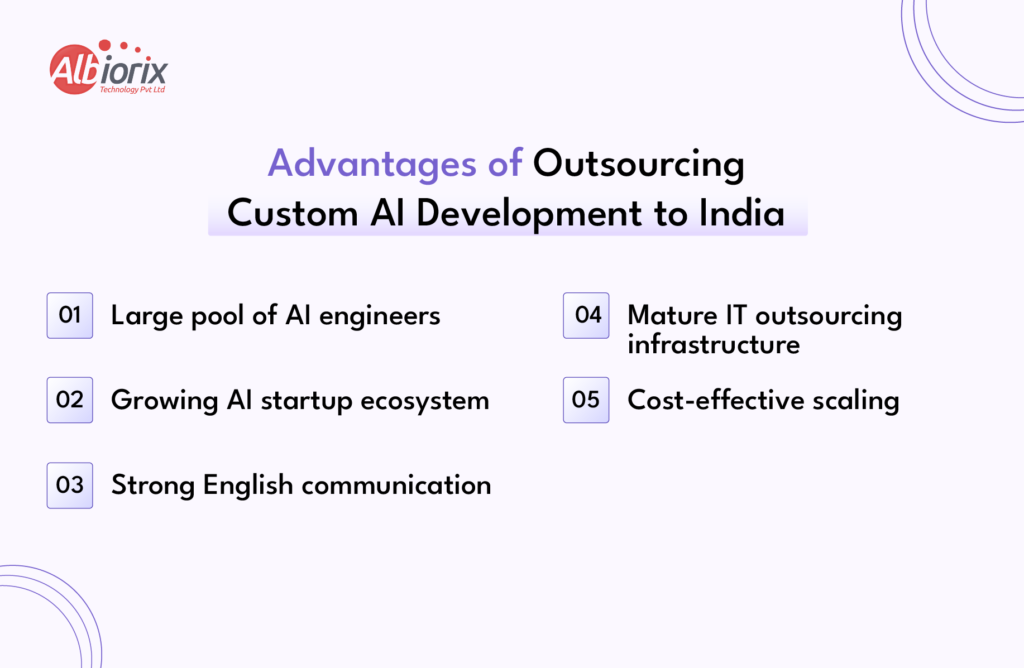
Advantages of Outsourcing Custom AI Development to India

Advantages of Outsourcing Custom AI Development to India

India is the growing hub of AI development. In the last five years, India’s AI ecosystem has grown rapidly with strong academic and technical foundations.

You can easily hire remote AI developers or partner with an AI development company with a strong portfolio.

Advantages of AI Development in India:

  • Large pool of AI engineers
  • Growing AI startup ecosystem
  • Strong English communication
  • Mature IT outsourcing infrastructure
  • Cost-effective scaling

If total outsourcing is not on your list, then you can also adopt a hybrid model. It means, US leadership with offshore AI development.

The Future of AI Market Forecast and Business Impact

Due to the benefits it offers to businesses worldwide, the use and adaptation of AI is increasing faster than any other digital transformation in the past decade.

Businesses that have already invested in AI are dominating their industries and motivating others to integrate AI as early as possible. The long-term economic impact of AI is expected to reshape global markets.

Industry projections indicate:

  • The global AI market is expected to surpass $1.5 trillion by 2030.
  • 70–80% of enterprises are expected to integrate AI into core operations within the next decade.
     
  • Generative AI alone is projected to add trillions of dollars to global GDP.
  • Up to 40% of business processes may become AI-automated within the next 10 years.

Let’s examine sector-specific growth:

  • Healthcare: AI-assisted diagnostics and predictive care systems are expected to become mainstream, improving treatment accuracy and reducing hospital costs.
  • Fintech: AI-driven fraud detection and risk modeling continue to expand, reducing financial crime losses globally.
  • Retail: Hyper-personalization and AI-powered inventory forecasting are redefining customer experience.
  • Manufacturing: Predictive maintenance is reducing downtime and optimizing production efficiency.
  • Games & Entertainment: AI-driven immersive experiences and AI in game development are transforming digital storytelling.
  • Education: Adaptive AI learning systems are personalizing student experiences at scale.
  • Logistics: AI-driven route optimization and supply chain forecasting are reducing delivery times and operational costs.
  • Real Estate: AI-powered property valuation and predictive market analytics are improving investment decisions.

The message is clear: businesses that delay AI adoption risk falling behind more agile competitors.

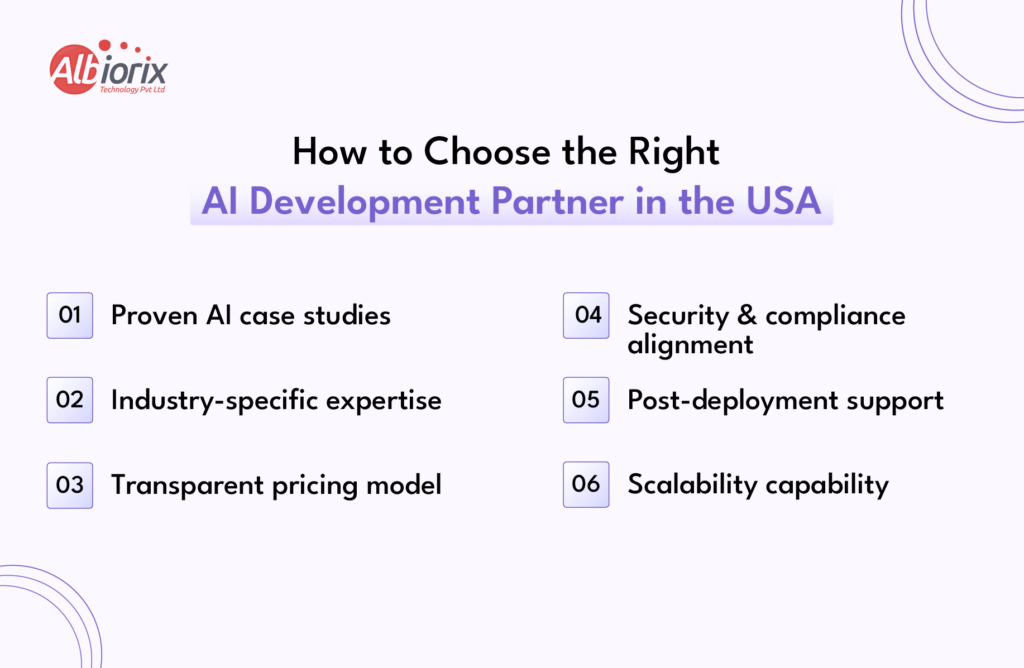
How to Choose the Right AI Development Partner in the USA

How to Choose the Right AI Development Partner in USA

Whether you want to develop an AI model or are in search of generative AI development services, finding the right partner is very important. It determines long-term success.

Along with the technical expertise in the AI domain, strategic alignment is also essential. Businesses should evaluate cultural fit, communication transparency, and long-term collaboration potential.

If you are evaluating generative AI development services in the USA, consider:

  • Proven AI case studies: The company you are planning to hire must demonstrate real-world implementation experience.
  • Industry-specific expertise: They must have familiarity with sector challenges in your domain.
  • Transparent pricing model: Make sure you are not charged with any hidden or surprise costs.
  • Security and compliance alignment: The AI development company you partner with must protect data integrity and the privacy of your business.
  • Post-deployment support: Along with the generative AI development services, the company must also be able to provide continuous optimisation and monitoring services.
  • Scalability capability: They must be able to scale as your business grows.

If you would like expert guidance tailored to your business needs, you can directly contact our AI experts for a free consultation.

Conclusion 

As said earlier, AI is no more an experimental word, it is real and reshaping competitive landscapes across industries. Businesses that approach AI strategically gain operational leverage and market differentiation. 

The cost of AI development in the USA ranges from $25,000 to over $1 million depending on complexity, data requirements, and scale.

But the more important question is:

What is the cost of not investing in AI?

As industries become increasingly automated and data-driven, AI adoption is shifting from optional innovation to operational necessity.

Whether you choose an AI Development company USA, hire AI developers in-house, or hire AI remote developers using a hybrid model, the key is strategic planning, phased investment, and ROI alignment.

The future of business is intelligent. The only question is how soon you adapt.