



The Ultimate Guide to Thriving Betting Software

With the smartphone revolution at its apex, it can be overwhelming for aspiring entrepreneurs to determine the right industry to enter.

Every business may seem to be perfect at the first sight, but you should consider the long-term goals before making any decisions. If you’re one of those individuals in 2024-25, you’re not alone.

With countless options available, choosing a sector with growth potential, stability, and profitability is crucial. Businesses that have created guide for sports Betting Apps development often highlight this industry as one that checks all these boxes.

The global sports betting market has experienced exponential growth in recent years, fueled by technological advancements and increasing interest in online gambling.

If you’re unsure about which business to start, sports betting software development presents an incredible opportunity with high demand and immense scalability.

The sport betting apps in the United States brought in $7.4 billion revenue in 2022 – a 71% increase on the previous year. It is estimated that by 2030, the revenue of sports betting apps is forecasted to be USD 205.60 billion.

In this blog, we’ll explore the booming sports betting market, share key statistics, and highlight why investing in sports betting software development could be your smartest move in 2024.

Why Sports Betting is Booming – Key Market Statistics

The sports betting industry has seen a meteoric rise over the last decade, driven by increasing internet penetration, the popularity of mobile apps, and the legalization of online betting in many countries.

Here are some critical statistics that demonstrate just how rapidly this market is growing:

  1. Global popularity: The sports betting market was valued at over $200 billion in 2020, and it’s expected to grow at a CAGR of 10.1% between 2021 and 2028. Online sports betting alone accounts for 40% of the global gambling market.
  2. Number of bettors: In the US alone, sports betting participation increased by 30% after legalization in 2018, with millions of active users on popular betting platforms like DraftKings and FanDuel.
  3. Revenue generation: Globally, the sports betting market generated $58 billion in 2022, and it’s projected to reach $93 billion by 2025. These numbers indicate the massive revenue potential in this sector.
  4. Mobile betting apps: Mobile apps are leading the charge in the sports betting revolution. According to research, 80% of all sports bets placed in the US in 2023 were made via mobile apps, showcasing the growing dominance of mobile platforms.

With such impressive statistics, it’s no wonder that many entrepreneurs are jumping on the bandwagon to invest in sports betting software development. The market is ripe for innovation, making it the perfect business to start.

Why Entrepreneurs Should Consider Sports Betting Software Development

Sports betting offers a unique business opportunity for several reasons. First, it’s a growing industry with a global audience. Second, the potential for revenue generation is vast.

Here’s why sports betting app development should be at the top of your business ideas list: 

  1. Low operational costs: Unlike traditional brick-and-mortar casinos, running a sports betting platform online requires significantly lower operational costs, as there’s no need for physical infrastructure.
  2. High profitability: With the global popularity of sports and the rise of online betting, the potential for profitability is immense. Sports betting platforms can generate consistent revenue through commissions and fees on placed bets.
  3. Tech-driven scalability: The tech infrastructure for sports betting software development is highly scalable. You can start small, offering services to a specific market or sport, and expand into new regions and sports categories as your platform grows.
  4. Growing customer base: More people are moving toward online and mobile platforms for sports betting, creating a vast, untapped customer base waiting to be captured.

Developing the right sports betting software can be the key to tapping into this lucrative market.

Features of Successful Sports Betting Software

The success of any sports betting business depends heavily on the quality and functionality of its software. There are numerous sports betting apps in the market, each offering its own unique selling point (USP).

This means you can also develop a betting app with a distinct idea and concept that sets it apart from the competition. Here are some must-have features that should be included in any top-tier sports betting software: 

  1. User-friendly interface: The interface should be intuitive and easy to navigate, allowing users to place bets effortlessly. A simple, clean design enhances the user experience and increases engagement.
  2. Live betting: Real-time data and live betting options are essential for modern bettors. Your software should support live odds and in-game betting, which is one of the most popular forms of betting today.
  3. Secure payment integration: Security is a top priority for any online platform, especially when money is involved. Your software should support multiple payment options, including e-wallets, credit cards, and cryptocurrencies, with secure encryption.
  4. Analytics and data insights: Offering users insights through data analytics can help them make informed bets, which adds value to your platform and attracts serious bettors.
  5. Compliance with regulations: Given the complexities of gambling regulations, it’s crucial to ensure your software complies with both local and international laws. This protects your business from legal issues and builds trust with users.

These features not only improve the user experience but also ensure your platform remains competitive in the rapidly growing sports betting market.

Ready to Launch Your Own Sports Betting App?

Take advantage of the booming sports betting market! Partner with our expert sports betting software development company to create a custom app tailored to your vision.


Contact us today!

Why Partner with a Sports Betting Software Development Company?

Building a sports betting platform requires in-depth knowledge of the industry, cutting-edge technology, and an understanding of compliance laws. This is where partnering with a sports betting software development company becomes critical.

Here’s why working with a specialized software development company can give you a competitive edge:

  1. Customization: Every business has unique needs. A professional development company can create custom solutions tailored to your specific market, sports focus, and business model.
  2. Scalability: They can build scalable platforms that grow with your business, ensuring that your software can handle increased user loads as your platform gains popularity.
  3. Compliance expertise: With ever-changing gambling regulations, partnering with a knowledgeable company ensures that your platform is compliant with all legal requirements in the regions you operate.
  4. Technology integration: A reputable company will incorporate advanced technologies like AI for predictive analytics, live streaming for real-time bets, and blockchain for secure transactions.

Partnering with a development company ensures your platform’s long-term success, security, and profitability.

Additionally, mobile app development companies have skilled teams of developers who can create a customized clone of your favorite betting app.

For example, if you’re looking to build a betting app similar to FanDuel or DraftKings, they can help you get started right away.

How Sports Betting App Development Is Leading the Future of the Industry

The future of sports betting lies in mobile apps. Sports betting app development is rapidly changing how bettors interact with platforms. The convenience and accessibility of mobile betting apps make them the preferred choice for most users.

  1. Mobile usage trends: Research shows that over 50% of global internet traffic now comes from mobile devices, and this trend extends to sports betting. Mobile apps provide users with on-the-go access to their favorite betting platforms.
  2. Engagement and retention: Mobile apps allow for a more personalized experience, with features like push notifications, user account tracking, and live betting options. This level of personalization improves user retention and increases betting frequency.
  3. Revenue potential: Sports betting apps are generating massive revenue streams. According to estimates, mobile betting accounts for over 60% of all online sports betting revenue.

Entrepreneurs looking to capitalize on the sports betting market should prioritize mobile sports betting app development for long-term success.

Key Benefits of Sports Betting Software Development
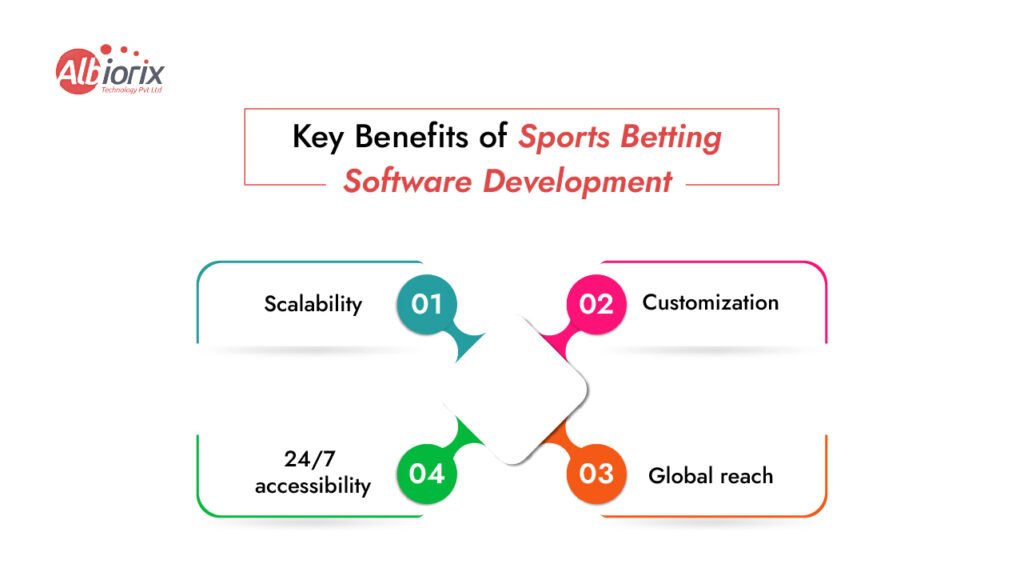
It’s no secret that the sports betting industry has flourished since legalization. So, if you’re seeking a business opportunity that promises strong financial stability, sports betting app development is a great option to consider.

  1. Scalability: As your business grows, your software should grow with it. Sports betting platforms can easily scale to accommodate more users, new sports, and global markets.
  2. Customization: Software can be customized to include features that appeal to specific audiences, such as specialized betting options for certain sports or regions.
  3. Global reach: The software can support multiple languages and currencies, allowing you to reach users from different parts of the world.
  4. 24/7 accessibility: Unlike physical betting shops, online sports betting software is always accessible, providing users the freedom to bet at any time, from anywhere.

A robust sports betting software ensures seamless user engagement by offering an intuitive interface and real-time updates, keeping your customers connected to your app.

With features like live betting, secure payment options, and personalized experiences, users are more likely to return frequently. This level of engagement boosts customer retention and long-term loyalty, ultimately driving business growth.

How to Get Started with Sports Betting Software Development

Ready to jump into this thriving market? To get started with sports betting software development, begin by outlining your business goals, target audience, and desired features for the platform.

Partner with an experienced sports betting software development company to build a scalable, secure, and user-friendly solution that meets market demands. Here’s how to get started:

  1. Market research: Understand the global and regional trends in sports betting, your competitors, and your target audience.
  2. Partner with a development company: Collaborate with a sports betting software development company that has experience in building robust, secure, and compliant platforms.
  3. Plan and customize: Define the features and functionalities that will set your platform apart from competitors.
  4. Compliance: Make sure your platform complies with local gambling regulations to avoid legal issues.
  5. Testing and launch: Thoroughly test your platform for performance, security, and user experience before launching it to the public.

Start Your Sports Betting Business Now!

Don’t miss out on the lucrative opportunities in the sports betting industry. Reach out to us today to discuss your project for free and take the first step toward launching your successful app.


Contact us today!

Why We Are the Right Sports Betting Software Development Company for You

At Albiorix Technology, we specialize in developing cutting-edge sports betting software that is tailored to meet the unique needs of businesses.

With years of experience in sports betting app development, we know how to create scalable, secure, and feature-rich platforms that engage users and drive revenue.

Our team of developers is skilled in the latest technologies, including AI, blockchain, and live-streaming integrations, with experienced Xamarin App Developers contributing to building robust cross-platform solutions.

We ensure that your platform is not only compliant with local laws but also offers an exceptional user experience that keeps bettors coming back.

Conclusion

The sports betting industry is booming, and sports betting software development presents a golden opportunity for entrepreneurs looking to enter a profitable, fast-growing market.

By offering scalable, customizable solutions and tapping into the global popularity of sports betting apps, you can create a successful business that stands the test of time.

If you’re ready to start your journey in the sports betting world, partner with a trusted sports betting software development company that can bring your vision to life.

To discuss your project for free with industry experts, please contact us or call us at (+91) 991-308-8360. You can also drop us a message on LinkedIn and we will get back to you at the earliest.

How to Create User-Friendly Interfaces for Healthcare Applications

Healthcare app development is booming. By 2025, the global mHealth apps market is expected to surpass $236 billion, driven by a rising demand for digital health solutions.

Healthcare apps—ranging from telemedicine platforms like Covantex to patient management systems—play a pivotal role in modernizing healthcare delivery. Yet, the success of these apps depends heavily on user-friendly interfaces.

The challenge is ensuring these applications cater to a diverse range of users, from tech-savvy patients to healthcare providers with minimal technological expertise.

In this blog, we explore best practices for designing intuitive, user-friendly healthcare software solutions that prioritize accessibility, simplicity, and engagement, ensuring both patients and professionals can easily interact with the application.

Why User-Friendly Interfaces Matter in Healthcare Apps

User experience (UX) is critical in healthcare apps because it directly affects usability, safety, and patient satisfaction.

Poorly designed interfaces lead to confusion, increased errors, and negative outcomes, especially when users are already under stress due to health issues.

For healthcare apps to achieve their full potential, whether they are appointment schedulers, remote monitoring tools, or diagnostic support systems, they must focus on usability, accessibility, and intuitive navigation.

Statistics worth noting:

  1. 65% of healthcare app users abandon an app if they find the interface difficult to navigate.
  2. Over 80% of healthcare professionals prefer using apps with intuitive dashboards and easy-to-read data visualizations.

Key Elements of User-Friendly Healthcare App Interfaces

Key Elements of User-Friendly Healthcare App Interfaces

Simplicity and Minimalism: The healthcare industry deals with complex data, but that doesn’t mean healthcare apps should reflect the same complexity. Clean, simple, and minimalist designs make it easier for users to navigate the app without being overwhelmed.

Reducing unnecessary steps in key workflows (like booking an appointment or accessing lab results) can drastically enhance the user experience.

For example, a healthcare app could display a summary of vital information upfront, followed by an option for more in-depth details. This design approach caters to users who only need high-level insights as well as those seeking comprehensive data.

Intuitive Navigation and Information Architecture: Navigation is essential in any app, but it’s particularly important in healthcare software solutions, where users are often interacting with critical health information.

The structure of the app should make it easy for users to find the information they need quickly and effortlessly.

Clear menu options, logical categories, and a well-defined user journey can help users complete tasks, such as booking appointments or reviewing prescriptions, with minimal confusion.

Consider organizing your app’s layout based on the user’s journey: initial sign-in, health data viewing, appointment scheduling, and finally, secure logout. Easy transitions between these stages ensure a smooth experience.

Accessibility and Inclusivity: A user-friendly healthcare app must cater to all users, including those with disabilities. Following the Web Content Accessibility 

Guidelines (WCAG), developers should ensure their apps offer:

  1. Scalable text for users with visual impairments
  2. Screen reader compatibility
  3. Voice control options for those unable to navigate via touch
  4. Color contrast that aids readability

Inclusive design improves user satisfaction and promotes greater adoption, especially among elderly patients who may not be as familiar with mobile technology.

Clear Visual Hierarchies and Data Presentation: Healthcare apps often present complex data, such as test results, vitals, or health trends. It’s important to break down this data into easily digestible chunks using clear visual hierarchies.

Prioritize key information and use graphs, charts, or color-coded alerts to present health trends effectively.

For instance, a patient’s blood pressure over time could be displayed via an easy-to-read line graph, with normal ranges indicated for quick visual reference.

Security and Trust: Trust is fundamental in healthcare apps due to the sensitivity of personal health information.

Clear security measures, such as two-factor authentication, HIPAA-compliant data storage, and privacy settings, should be built into the interface.

Transparency is key—users should know exactly how their data is stored and used.

Including clear calls to action (CTAs) like “Enable Two-Factor Authentication” or “Review Privacy Settings” can further assure users that their health data is protected.

Seamless Integration with Other Systems: Many healthcare apps need to communicate with Electronic Health Records (EHR), wearable health devices, or other third-party healthcare software solutions.

Ensuring seamless integration not only makes the app more functional but also offers a unified user experience where all necessary data is easily accessible.

Additionally, mHealth apps should support a variety of devices (smartphones, tablets, smartwatches) and operating systems (iOS, Android) to increase user adoption.

Patient-Centric Features: One of the primary goals of healthcare apps is to empower patients to manage their own health.

Features like personalized dashboards, medication reminders, appointment scheduling, and health progress tracking ensure that patients feel more in control.

Additionally, incorporating telemedicine or chat features into the app allows for instant communication with healthcare providers.

User Feedback and Continuous Improvement: A successful healthcare app evolves based on user needs. Incorporating feedback mechanisms within the app can help developers understand where users are facing issues and how to improve the interface.

Regular updates to enhance user experience based on this feedback show that the app is attentive to users’ needs and open to improvement.

For instance, regular usability tests and surveys can be conducted to assess whether the app’s design meets the evolving needs of healthcare providers and patients.

Transform Your Healthcare App Vision Into Reality

Looking to develop intuitive and user-friendly healthcare apps? Contact us today to build secure, scalable, and engaging mHealth apps tailored to your needs!


Reach out to us today

Top Healthcare App Design Trends In Near Future

Healthcare app design trends have been rapidly evolving, especially as new technologies emerge. To succeed in 2025, healthcare app developers must not only focus on design aesthetics but also integrate groundbreaking tech advancements.

Here are the top four design trends shaping the future of healthcare apps.

AI-Enabled Personalization: Artificial intelligence (AI) has revolutionized many industries, including healthcare, where its market is projected to grow from $20.9 billion today to $148.4 billion by 2029.

AI helps tailor healthcare solutions, offering personalized app experiences by analyzing user behaviors, preferences, and medical data.

AI also enables real-time interface adjustments, smart suggestions, and proactive alerts, all improving patient engagement and outcomes. Have a look at the AI-Powered healthcare app designed and developed by us.

For example, AI in healthcare apps can anticipate a user’s needs—like scheduling follow-ups or offering reminders for medications—making the interface more responsive and intuitive.

This personalization strengthens the relationship between patients and healthcare providers, improving overall care quality.

Natural User Interfaces (NUIs): One of the emerging trends in healthcare app design is Natural User Interfaces (NUIs).

These interfaces allow users to interact with apps using voice commands, gestures, or even gaze tracking, creating a seamless and efficient user experience. NUIs are particularly beneficial for patients with physical limitations, offering hands-free interaction.

However, NUIs come with a learning curve. While they provide great accessibility, they may be challenging for some users accustomed to traditional interfaces.

Incorporating both conventional touch-based interactions and NUI options can help ease this transition and accommodate a broader user base.

Gamification in Healthcare Apps: Gamification is another key trend transforming healthcare UX design

By incorporating game-like elements such as leaderboards, challenges, coins, and rewards, healthcare apps can encourage users to engage with the platform more consistently and follow medical recommendations.

The global market for gamification in healthcare is expected to reach $3.5 billion by 2030, growing at a 21.4% CAGR.

Gamification has proven particularly effective in patient adherence to treatment plans and ongoing health management, making routine healthcare tasks engaging and motivating.

Whether encouraging patients to meet fitness goals or adhere to medication schedules, gamified healthcare apps are boosting user retention and improving health outcomes.

Augmented Reality (AR): Augmented Reality (AR) is gaining ground as a key design feature in healthcare apps, especially for medical professionals.

AR enables healthcare providers to visualize complex procedures in real-time, improving accuracy and precision in diagnosis and treatment.

For healthcare app users, AR can also support physical therapy by guiding patients through exercises with real-time feedback. This interaction adds a layer of engagement, making recovery more engaging and effective.

In conclusion, integrating these design trends into healthcare app development is essential for creating user-friendly, future-ready applications.

AI-driven personalization, NUIs, gamification, and AR are all key drivers that can take your healthcare software solutions to the next level.

Build Next-Generation Healthcare Apps with Us

User-friendly Interfaces in Healthcare Apps

User-friendly interfaces in healthcare apps are not just a nice-to-have feature—they are a necessity for ensuring optimal patient care and efficient workflows for healthcare providers.

With the growing reliance on digital health tools, healthcare app development must focus on creating interfaces that are simple, accessible, secure, and engaging.

As we continue to witness the rise of mHealth apps, developing intuitive and seamless interfaces is crucial for long-term success.

Build Next-Generation Healthcare Apps with Us

Looking to build intuitive and engaging healthcare apps? Need a healthcare app that’s user-friendly, secure, and feature-packed? Contact us today! Our team has created numerous healthcare software solutions that drive results.

With our extensive experience in healthcare app development, we create healthcare software solutions that are easy to use, secure, and designed to improve patient outcomes.  

Let’s bring your vision to life! Get in touch today and see how we can develop a custom mHealth app for your organization.

Best eCommerce Software Development Services by Albiorix Technology

The global eCommerce landscape is expanding rapidly, and businesses must adapt to stay competitive. With more consumers shopping online, having a robust, scalable, and secure eCommerce presence is crucial.

Whether you’re a small local retail shop or a well-established brand in your area, having a powerful and attractive eCommerce website and mobile app is essential for the growth of your business.

In today’s competitive business scenario, owning an online store and mobile app isn’t just a trend—it’s a necessity for survival and long-term success. It is where eCommerce software development becomes a key factor in driving business growth.

At Albiorix Technology, we understand the significance of a powerful online presence. With over 12 years of experience, we have successfully delivered countless eCommerce projects to businesses in Australia, Europe, and the US.

In the last 12 years, we have designed and developed robust and scalable eCommerce software solutions for local retailers, vendors, and multimillion-dollar brands across the globe.

Therefore, whether you are a clothing brand, antique product seller, or want to sell toys online, get in touch with us.

We understand that each business is unique, and we assure you of the best online store that fits your budget and meets your expectations.

Our team of software developers specializes in custom eCommerce software development, ensuring that your business thrives in the digital era.

Why Does Your Business Need Custom eCommerce Software Development?

The eCommerce industry is booming. With global eCommerce sales projected to reach $6.54 trillion by 2024, it’s more critical than ever for businesses to establish a robust digital presence.

A well-developed eCommerce platform is the key to offering seamless user experiences, boosting sales, and staying competitive in the market.

Custom eCommerce software development allows your business to create a tailored online shopping experience that aligns with your unique goals.

Unlike off-the-shelf solutions, custom platforms offer scalability, flexibility, and advanced features designed specifically to meet your business needs.

With personalized designs, seamless integrations, and enhanced security, a custom eCommerce solution helps improve customer engagement, streamline operations, and boost sales, giving your business a competitive edge in the market.

At Albiorix Technology, we help businesses harness the power of eCommerce with our tailored solutions. From design to development and deployment, we ensure your eCommerce platform is equipped with the latest technology to drive success.

Why Choose Albiorix Technology for eCommerce Software Development?

With a proven track record of delivering high-quality eCommerce solutions, Albiorix Technology is the perfect partner for your business.

Our experience spans across multiple industries and markets, giving us the insights to craft tailored solutions for every client.

Over the past 12+ years, we have successfully handled countless eCommerce projects (including eCommerce Software and eCommerce Mobile Apps), ensuring that every platform we develop is not only user-friendly but also designed for scalability and security, providing you with a sense of safety and protection.

Here are some of the why Albiorix stands out as the best eCommerce software development company:

  1. 12+ Years of Experience: Extensive experience delivering successful eCommerce solutions across various industries.
  2. Custom Solutions: Tailored eCommerce platforms designed to meet your specific business needs and goals.
  3. Global Clientele: Proven track record with clients from Australia, Europe, and the US, ensuring global market understanding.
  4. Expert Development Team: A highly skilled team of software developers and designers with expertise in top eCommerce platforms.
  5. AI-Powered Solutions: Integration of AI to enhance user experience, automation, and operational efficiency.
  6. End-to-End Services: Comprehensive services from design and development to deployment and ongoing support.
  7. Security & Scalability: Focus on robust security features and scalable solutions that grow with your business.
  8. SEO-Optimized Platforms: Built-in SEO best practices to enhance visibility and drive organic traffic to your online store.
  9. Client-Centric Approach: Dedicated consultation and personalized strategies to ensure every project aligns with your vision.

Our experienced eCommerce software developers and designers are dedicated to building innovative, customer-centric eCommerce platforms that cater to your business needs and ensure sustainable growth in the global market.

Thinking about creating your own eCommerce software?

We’ve got you covered! Check out this complete guide to eCommerce software development from industry experts, packed with everything you need to know to get started.


Reach out to us today

Our eCommerce Software Development Services

At Albiorix Technology, we offer a wide range of eCommerce software development services that cater to businesses of all sizes and types.

  1. Custom eCommerce Development: We understand that every business is unique, which is why our custom eCommerce development solutions are tailored to your specific goals. Whether you’re a startup or an established business, our team can develop personalized platforms designed for your long-term success.
  2. Platform-Specific Development: Whether it’s Magento, WooCommerce, WordPress, Shopify, or any other platform, we provide tailored development solutions that align with your chosen platform’s capabilities, ensuring seamless integration and customization.
  3. eCommerce Web App Development: We create web applications that provide a smooth and efficient shopping experience for customers. Our web apps are designed to be fast, secure, and responsive, helping your business capture more leads and conversions.
  4. Mobile eCommerce Development: As mobile commerce continues to rise, our mobile eCommerce solutions enable you to offer a seamless shopping experience on smartphones and tablets. We specialize in both native and cross-platform mobile apps.
  5. Headless eCommerce Development: Headless architecture gives you the flexibility to update and maintain your eCommerce platform without affecting the front-end. It’s a scalable and future-proof approach that meets the evolving needs of your business.
  6. Integration of Payment Gateways: A smooth checkout experience is essential for customer retention. We integrate secure, reliable, and versatile payment gateways to support various payment methods.
  7. Inventory and Order Management Systems: Our custom eCommerce solutions include inventory and order management systems, allowing you to track stock, manage orders, and streamline operations efficiently.
  8. AI-Powered eCommerce Solutions: We integrate AI technologies into your eCommerce platform to provide personalized shopping experiences, automate processes, and enhance operational efficiency.

Key Features of Our eCommerce Solutions

Our eCommerce solutions are designed with features that enhance user engagement, security, and performance.

  1. User-Centric Design: We create intuitive, user-friendly designs that enhance the overall shopping experience, ensuring customers stay longer and convert faster.
  2. SEO-Friendly eCommerce Solutions: Our eCommerce platforms come with built-in SEO best practices, ensuring your website ranks higher on search engines like Google. This includes optimizing product pages, site structure, and performance.
  3. Security and Data Protection: We prioritize security by implementing the latest encryption protocols, ensuring that customer data is safe during every transaction.
  4. Scalability: Our eCommerce solutions are designed to scale with your business, accommodating growth in traffic, products, and customers.
  5. Third-Party Integrations: We integrate your eCommerce platform with essential third-party tools, including CRMs, ERPs, shipping solutions, and marketing automation tools, to streamline your business processes.

Top eCommerce Platforms Used Worldwide

The most popular eCommerce platforms globally include Shopify, Magento, WooCommerce, and BigCommerce. These platforms are favored for their ease of use, scalability, and extensive customization options.

Shopify is renowned for its simplicity and quick setup, while Magento offers powerful customization for larger enterprises.

WooCommerce, built on WordPress, is ideal for small to medium-sized businesses, and BigCommerce provides advanced features for scaling businesses.

Each platform is designed to help businesses create engaging, user-friendly online stores to drive sales and growth.

  1. Magento: Magento is an open-source SaaS and PaaS eCommerce platform hosted on AWS. Known for its extensive extension capabilities and competitive pricing, it’s the top choice for medium and large businesses looking for scalability and customization.
  2. WooCommerce: WooCommerce is a free, open-source eCommerce platform known for its simplicity and affordability. With numerous plugins and extensions, it offers enhanced functionality for businesses of all sizes.
  3. WordPress: WordPress is a highly flexible and open-source content management system (CMS) widely used for building eCommerce websites through plugins like WooCommerce. Its vast library of themes and plugins allows businesses to customize their online stores with ease.
  4. Salesforce: Salesforce Commerce Cloud 360 is a robust SaaS eCommerce platform offering advanced functionality for omnichannel, personalized customer experiences. It’s ideal for businesses aiming to enhance customer engagement across multiple touchpoints.
  5. PrestaShop: PrestaShop is an open-source eCommerce platform powered by MySQL and written in Symfony. With over 310 built-in features, it allows businesses to quickly set up a fully functional online store.
  6. Shopify: Shopify stands out for its no-code configuration, making it an ideal solution for small and medium-sized businesses. It integrates easily with WordPress and offers a user-friendly setup for quick online store launches.
  7. Oracle: Oracle’s eCommerce platform excels in flexible deployment, user experience management, and AI-driven personalization, providing a seamless online shopping experience for businesses of all sizes.
  8. CS-Cart: CS-Cart is a flexible platform that supports the creation of online stores and marketplaces, making it suitable for both small businesses and large-scale virtual malls.
  9. OpenCart: OpenCart is an open-source platform designed to build online stores with multiple delivery and payment options, driving increased sales and boosting revenue.

Custom eCommerce Software Development: Tailored to Your Needs

Over the past 12+ years, consumer behavior has rapidly shifted toward eCommerce, driving its exponential growth.

This shift has empowered businesses to offer engaging, convenient, and reliable experiences to their customers.

At Albiorix Technology, we specialize in providing custom eCommerce software development solutions tailored to your unique business objectives.

Our flexible development process ensures that we can adapt and evolve alongside your business needs.

As a trusted eCommerce software development company, we have successfully partnered with both established brands and growing startups across Australia, Europe, and the US.

Our unique approach combines deep customer insights with advanced technology, allowing us to deliver scalable, secure, and robust eCommerce solutions.

Our experienced team of business analysts, solution architects, UI/UX experts, eCommerce developers, quality testers, and marketers is committed to helping you create web and mobile eCommerce solutions that enhance customer satisfaction, build loyalty, boost sales, and drive business growth.

Get a Custom eCommerce Solution Tailored to Your Business Needs

Ready to take your online store to the next level? Partner with Albiorix Technology for custom eCommerce software development services. Contact us today for a free consultation and quote!


Reach out to us today

Our eCommerce Software Development Process

Our eCommerce software development process is designed to be flexible and customer-centric.

From initial consultation and business analysis to design, development, and post-launch support, we ensure each solution is tailored to meet your specific goals.

We prioritize scalability, security, and user experience to create powerful eCommerce platforms that drive business growth.

  1. Requirement Gathering and Consultation: Our team begins by understanding your business goals, target audience, and specific needs during a detailed consultation. This helps us develop a solution that aligns perfectly with your vision.
  2. Design and Development: We create wireframes and prototypes to visualize the product, and once approved, move into the development phase, ensuring every detail is tailored to your business requirements.
  3. Testing and Quality Assurance: Before deployment, we rigorously test your platform to ensure it’s free of bugs, secure, and ready for users.
  4. Deployment and Support: After a successful launch, we continue to provide ongoing support and maintenance to ensure your platform remains up-to-date and efficient.

Success Stories and Case Studies

We have worked with numerous clients across various industries, delivering eCommerce solutions that exceed expectations.

From small businesses to large enterprises, our eCommerce platforms have helped companies to grow and succeed in competitive markets.

Our clients have praised our attention to detail, technical expertise, and commitment to delivering quality.

  1. Quantify Ninja: Quantify Ninja is a web portal that provides innovative tools for Amazon FBA sellers to perform significant operations like monitoring and managing their sales, products, reviews, and feedback.
  2. CarBlip: CarBlip is an innovative online car-buying site that makes it easy for users to purchase a car based on their requirements.
  3. Amaka: Amaka is a salon booking app designed explicitly for businesses such as nail studios, beauty parlours, and hair styling.
  4. LetYouKnow: LetYouKnow is a buyer-to-seller matching engine and an e-commerce marketplace that allows users to make the best deal on cars by inputting various essential required parameters.

We have a huge collection of completed eCommerce projects in our portfolio, and if you want to review them, please visit our portfolio.

Conclusion

Albiorix Technology is your trusted partner for eCommerce software development.

With over 12 years of experience and countless successful projects, we have the expertise to help your business thrive in the digital marketplace.

Contact us today for a free consultation and quote.

Whether you’re looking for custom eCommerce software development or need a team to build your platform from scratch, we have the solutions to meet your needs. Call us at (+61) 489-940-484 or share your contact details today!

Healthcare CRM Software Development: Taking Patient Care to the Next Level

The rapid pace of technological advancements is reshaping every industry, from product development to logistics and entertainment, and the healthcare sector is no exception.

As the healthcare industry undergoes its technological transformation, the need for personalized and seamless patient care has become the call of the time.

Healthcare CRM software development is one of the solutions that revolutionize how healthcare providers engage with patients, optimize operations, and manage patient data.

By combining cutting-edge technology with patient relationship management, healthcare CRM solutions are elevating the quality of care, increasing patient satisfaction, and improving overall efficiency.

Even if we look at the global statistics, the healthcare CRM software market was valued at $17.9 billion in 2023 and is projected to surge to $30.7 billion by 2030, reflecting a robust CAGR of 8.0% from 2023 to 2030.

This remarkable growth underscores the healthcare industry’s acknowledgment of CRM technology as a vital asset.

Its ability to streamline patient management, enhance communication with partners, and enable more efficient healthcare delivery makes it essential to advancing patient care and operational efficiency.

These inspiring trends indicate the industry’s growing prominence of custom healthcare CRM software development.

The increasing adoption of healthcare CRM solutions by hospitals and healthcare professionals highlights a shift toward more patient-centric models, where technology streamlines administrative tasks and enhances the patient experience.

At Albiorix Technology, a leading healthcare CRM software development company, we are dedicated to offering a comprehensive look at healthcare CRM solutions.

This blog will delve into CRM software development, explore the benefits of custom healthcare CRM systems, discuss the overall development costs, and much more.

Transform Your Patient Care with Cutting-Edge Healthcare CRM Solutions

Ready to elevate your healthcare services? Streamline operations, improve patient engagement, and ensure seamless care delivery. Contact us today to learn how we can build the perfect solution for you!


Contact Us Today

What is Healthcare CRM Software?

Healthcare CRM software (Customer Relationship Management) is a specialized tool that helps hospitals, clinics, and healthcare providers manage relationships with patients, staff, and partners.

It centralizes patient information, making communication and coordination easier across the entire organization.

One key benefit of healthcare CRM is its ability to provide real-time insights. It automatically generates health reports and analytics, helping healthcare professionals understand patient behavior, track provider performance, and improve internal operations.

Beyond data, CRM software automates routine tasks like appointment scheduling, billing, and follow-up reminders. This saves time, reduces manual errors, and ensures patients get timely care.

With CRM, healthcare providers see higher patient satisfaction, fewer missed appointments, and better workflow efficiency. It helps doctors and staff stay organized, while patients enjoy a smoother, more connected experience.

As more hospitals worldwide adopt CRM solutions, it’s clear they play a vital role in improving both patient care and healthcare business operations.

Different types of Healthcare CRM Available in the Market

By now, you’ve likely grasped the core purpose of healthcare CRM software development—how it empowers healthcare organizations and enhances the user experience.

A healthcare CRM can handle various tasks, from data aggregation and operational support to corporate data analytics and more.

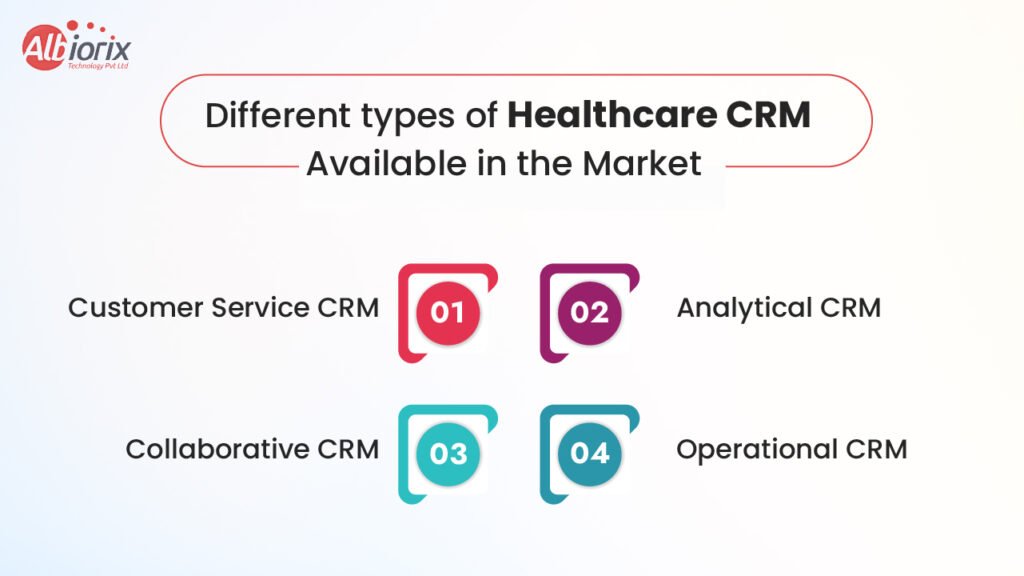
Based on its functionalities, there are five main types of healthcare CRM solutions, which are outlined below:

  1. Customer Service CRM: The primary purpose of Customer Service CRM in healthcare is to elevate the patient experience by offering personalized and efficient support. It includes systems for managing service tickets, live chats, and feedback. By promptly addressing patient inquiries, complaints, and comments, healthcare providers can build stronger relationships, resulting in higher patient satisfaction.
  2. Analytical CRM: Analytical CRM is designed to gather and store valuable patient data for future use, enabling healthcare organizations to communicate with patients in a more targeted manner. This personalized approach fosters greater patient trust, as individuals feel they are being treated uniquely, which in turn enhances patient retention and strengthens long-term relationships between patients and healthcare providers. For those seeking professional assistance, CRM consulting services offer expert guidance in implementing these systems effectively.
  3. Collaborative CRM: Collaborative CRM focuses on ensuring seamless communication and information sharing within a healthcare organization, extending to external partners such as patients, suppliers, and other stakeholders. This system enables constant collaboration on patient care strategies, appointment scheduling, and treatment coordination. By enhancing teamwork and communication, healthcare organizations can significantly improve the overall patient experience through better care coordination.
  4. Operational CRM: Operational CRM tools are designed to automate and streamline various administrative tasks within a healthcare organization, including appointment scheduling, patient registration, billing management, and inventory tracking. By taking over these routine functions, operational CRM frees healthcare staff from time-consuming administrative duties, allowing them to focus on delivering high-quality patient care and ensuring smooth daily operations.

Image Based on the Below Content

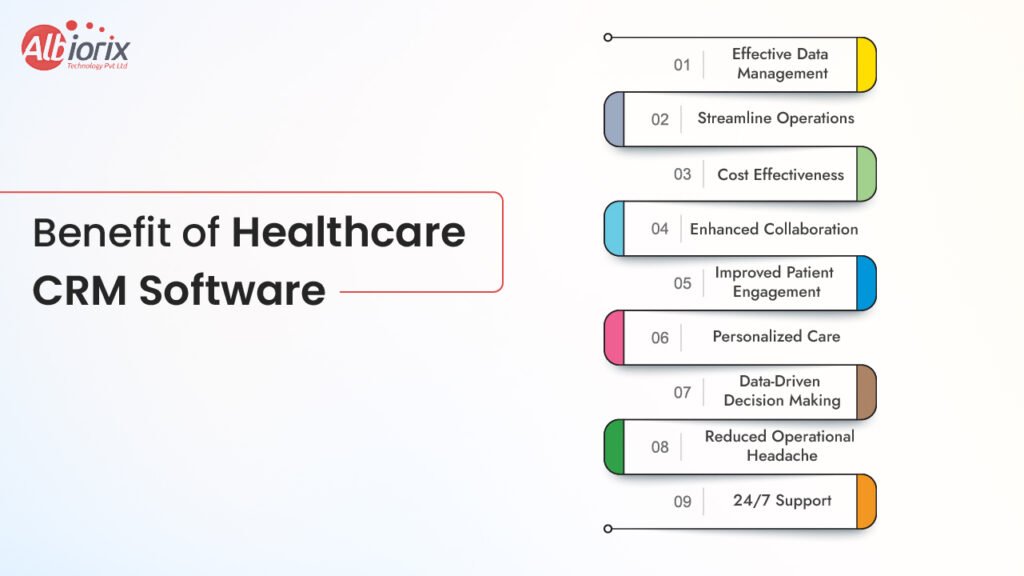
Benefit of Healthcare CRM Software

Healthcare CRM software is revolutionizing the healthcare industry by significantly improving patient care.

Leading healthcare organizations and professionals worldwide are adopting healthcare CRM systems to enhance patient experiences, boost efficiency, improve accuracy, and streamline operations.

Let’s delve into the exceptional benefits that a robust healthcare CRM solution brings to the industry, with a primary focus on patient care.

  1. Effective Data Management: In healthcare, effective data management means organizing patient information in a way that supports safe, high-quality care. CRM software helps by centralizing medical histories, treatment plans, and billing into one secure system. This ensures doctors and staff always have accurate, up-to-date data at their fingertips. By improving access and coordination, healthcare providers make better clinical decisions while protecting sensitive information with strict security measures, ensuring compliance with privacy regulations and enhancing overall patient care.
  2. Streamline Operations: Healthcare CRM software benefits patients and plays a pivotal role in reducing operational workload and improving staff productivity. Features like automated appointment scheduling, referral management, and inventory tracking significantly reduce staff workload and minimize errors, freeing up valuable time for healthcare teams to focus on patient care.
  3. Cost Effectiveness: Compared to traditional methods, healthcare CRM systems are far more cost-effective. By seamlessly integrating with Electronic Health Record (EHR) systems and other healthcare IT infrastructure, CRM solutions facilitate smooth data exchange and enhance cross-departmental collaboration. This optimization of workflows and decision-making ultimately leads to cost savings, contributing to the long-term financial sustainability of healthcare providers. Additionally, improved efficiency and reduced errors translate into better resource utilization and lower overall costs of healthcare delivery.
  4. Enhanced Collaboration: Healthcare CRM software significantly improves collaboration among healthcare staff, doctors, and everyone involved in patient care. With features that enable secure messaging, task assignments, and seamless sharing of patient information, teams can work together more effectively on treatment plans, share updates, and provide continuous care. This enhanced teamwork results in more coordinated care, reduced redundancy, and a holistic approach to supporting patients.
  5. Improved Patient Engagement: Engaging patients and delivering personalized care are critical factors in driving positive health outcomes. CRM software offers features that elevate patient interactions, such as appointment reminders, telehealth services, and secure patient portals. These capabilities empower patients to participate actively in their healthcare, fostering stronger provider relationships and better adherence to treatment plans.
  6. Personalized Care: With powerful data analytics capabilities, healthcare providers can tailor communications and care plans based on individual preferences, demographics, and medical histories. This personalized approach creates meaningful patient experiences, improving satisfaction, loyalty, and overall health outcomes.
  7. Data-Driven Decision Making: Data-driven decision making in healthcare means using accurate patient data and analytics to guide clinical and operational choices. CRM software simplifies this by providing real-time insights on patient behavior, treatment outcomes, and staff performance.
    With these insights, healthcare providers can make informed decisions that improve patient care, streamline operations, and enhance resource management. By relying on trusted data rather than assumptions, organizations ensure better outcomes, higher efficiency, and a more personalized healthcare experience for every patient.
  8. Reduced Operational Headache: By automating tedious and repetitive tasks, healthcare CRM software boosts team productivity while minimizing the risk of errors. Automating routine tasks frees up valuable time and resources, allowing staff to focus on more critical responsibilities. This results in increased efficiency, fewer mistakes, and the ability to accomplish more with fewer resources.
  9. 24/7 Support: Human availability is not always constant, but CRM chatbots can fill the gap by providing round-the-clock assistance to patients. These chatbots can offer essential medical advice anytime, ensuring patients receive support whenever needed, further enhancing the overall patient experience.

Boost Efficiency with AI-Powered Healthcare CRM Software

Take patient management to the next level with our AI-powered Healthcare CRM software. We offer innovative and affordable AI-powered solutions that fit your healthcare organization’s goals. Get in touch and start transforming your practice now!


Contact Us Today

Features of healthcare CRM Solutions

As a healthcare professional, you have many options when it comes to integrating CRM software into your operations. The choice ultimately depends on the unique needs of your organization.

However, there are a few key features that every healthcare CRM should have to maximize its effectiveness.

  1. Healthcare Automation: Healthcare CRM systems streamline administrative tasks and enhance productivity through comprehensive automation. By automating workflows, a hospital CRM system can help make clinical practices more efficient and accurate, allowing you to handle more patients effectively. It simplifies patient management, improves medical billing, and speeds up payment processing by closing gaps that cause delayed payments.
  2. Patient Data Management: One of the standout features of healthcare CRM software is its ability to manage vast amounts of patient data automatically. With just a few clicks, physicians can access real-time data from multiple sources, helping them make informed decisions quickly. This technology enables doctors to visualize patient cases, generate custom reports, and gain valuable insights to improve care.
  3. HIPAA Compliance: Healthcare organizations use CRM software to track patients, manage billing, optimize workflows, and boost patient engagement. Given the sensitivity of medical data, patients may be hesitant to share personal information. Therefore, any healthcare CRM must comply with HIPAA regulations to protect patient privacy. Ensure that your CRM solution includes data access safeguards, scalability, and automated data backups to maintain HIPAA compliance.
  4. Task Tracking: As organizations grow, so do their marketing and promotional activities. One key to successful marketing is building rapport with patients through targeted outreach. Healthcare CRM software tracks every task in the advertising department, providing real-time progress reports and helping manage promotional strategies efficiently. With task tracking, you can ensure your marketing campaigns run smoothly, making necessary adjustments as needed.
  5. Patient Portal: A healthcare CRM’s patient portal is designed entirely with patients in mind. It fosters trust and strengthens the relationship between healthcare providers and their patients. The portal allows patients to access their medical records, including test results, scans, and consultation notes, from anywhere. By giving patients up-to-date information about their health, this feature promotes greater awareness and enhances patient-doctor communication.

What is the cost of Healthcare CRM Software Development

Developing a healthcare CRM requires a dedicated effort, with a range of features and expertise integrated by your chosen development team.

Typically, the cost of building a healthcare CRM solution can range from $50,000 to $300,000, depending on several key factors. Let’s break these down in more detail:

  1. Complexity of Required Features: One of the most influential factors is the complexity of the features you want in your healthcare CRM solution. The more advanced the functionalities, the higher the development cost. Basic features like patient management tools are relatively cost-effective, while enterprise-level solutions with advanced analytics, workflow automation, and seamless EHR integration will push the costs higher. The scope of these functionalities will shape the overall budget.
  2. Development Team Size & Expertise: The size and expertise of your development team will also impact costs. Depending on the complexity of the project and the features you need, you’ll need to assemble a skilled team. Developer costs vary based on their experience level, domain expertise, and the number of hours they dedicate to your project. Specialized skills often command higher rates, but they can also ensure a more efficient development process.
  3. Deployment Model: Your choice between cloud-based Software-as-a-Service (SaaS) and on-premise deployment also affects the total cost. Cloud-based solutions typically have lower upfront costs but come with recurring subscription fees, while on-premise options may require a higher initial investment but offer reduced long-term operational expenses. Your decision here should balance your organization’s financial planning and infrastructure capabilities.
  4. Integration and Data Migration: Integrating the CRM software with existing IT infrastructure, such as EHRs, billing systems, and other healthcare applications, can be complex and costly. Migrating historical patient records into the new system is another challenging and expensive task. Keep in mind, the actual development costs will be heavily influenced by your organization’s unique needs, the project scope, and its overall complexity. To get an accurate cost estimate, it’s always wise to consult with a healthcare IT consulting company specializing in CRM solutions. They can provide a tailored cost breakdown that suits your specific requirements.

Emerging Trends in Healthcare CRM Software Development

As the demand for personalized patient care grows, healthcare CRM software continues to evolve with new technologies and trends.

One major trend is the integration of AI-driven predictive analytics, which helps healthcare providers anticipate patient needs and deliver proactive care.

Another key development is omnichannel patient engagement, enabling seamless communication across phone, email, chat, and mobile apps.

Furthermore, wearable device integration is gaining popularity, allowing CRM systems to collect real-time health data directly from patients.

This not only enhances remote monitoring but also improves chronic disease management. These innovations are shaping the future of healthcare CRM, making it more intelligent, patient-centric, and efficient.

Importance of Data Security in Healthcare CRM

In healthcare, data privacy is non-negotiable. With the rise of digital health records and CRM platforms, robust data security measures have become essential.

Modern healthcare CRM systems are designed to comply with HIPAA, GDPR, and other global data protection regulations.

Key security features include data encryption, role-based access control, and regular security audits.

Additionally, implementing multi-factor authentication (MFA) adds an extra layer of protection against unauthorized access.

These practices ensure that sensitive patient information remains secure, fostering trust between healthcare providers and their patients.

Role of CRM in Telemedicine and Remote Patient Monitoring

The surge in telemedicine has highlighted the importance of healthcare CRM in managing remote patient interactions.

A well-designed CRM system supports virtual consultations, remote follow-ups, and digital health record management, ensuring continuity of care beyond physical clinics.

By centralizing communication and health data, CRM software helps healthcare professionals deliver personalized care remotely.

Features like automated appointment reminders, secure messaging, and virtual health assessments improve patient engagement and reduce no-show rates in telehealth services.

Future Outlook: The Next Frontier of Healthcare CRM

Looking ahead, the future of healthcare CRM is set to be even more intelligent and predictive. Innovations like AI-powered virtual health assistants, blockchain for secure data sharing, and real-time patient feedback loops are on the horizon.

These advancements will not only enhance patient-provider relationships but also enable precision medicine, where treatments are tailored to individual genetic profiles and lifestyle factors.

Healthcare organizations that adopt these cutting-edge CRM technologies will be better equipped to offer holistic, patient-centered care in an increasingly digital world.

Albiorix Technology Can Built a Powerful Healthcare CRM Software for You

At Albiorix Technology, we understand that effective patient management is crucial for modern healthcare organizations.

With over a decade of experience in the industry, we excel in Healthcare CRM Software Development and are committed to delivering solutions that transform how healthcare providers manage patient interactions and streamline operations.

Why Choose Albiorix Technology for Your Healthcare CRM Solutions?

  1. Over 10 Years of Industry Experience: With more than 10 years of expertise in the field, Albiorix Technology has a deep understanding of the healthcare landscape. Our extensive experience allows us to develop Healthcare CRM Solutions that are not only sophisticated but also tailored to meet the specific needs of healthcare providers.
  2. Skilled Team of App Developers: Our team of app developers is highly skilled in creating robust and scalable CRM systems. We have successfully worked on various projects, leveraging our knowledge and technical expertise to deliver CRM solutions that enhance operational efficiency and patient care.
  3. Proven Track Record: We have a proven track record of handling similar projects with remarkable success. Our experience includes developing Healthcare CRM Software for a range of healthcare organizations, ensuring that we understand the unique challenges and requirements of the industry. Have a look at our portfolio for some amazing and landmark healthcare projects.
  4. AI-Powered CRM Solutions: In addition to traditional CRM features, we offer the development of AI-powered Healthcare CRM Software. Our advanced solutions integrate artificial intelligence to provide predictive analytics, automate tasks, and enhance patient engagement, taking your CRM capabilities to the next level.
  5. Affordable Services: At Albiorix Technology, we believe that top-quality CRM solutions should be accessible. Our services are competitively priced, offering you the best value without compromising on quality. We are dedicated to delivering effective solutions that fit within your budget.

Transform your healthcare operations with Albiorix Technology’s Healthcare CRM Solutions. Whether you need a basic CRM system or an advanced AI-powered solution, we are here to help you achieve your goals efficiently and affordably.

Contact us today to learn more about how we can tailor our solutions to meet your specific needs and drive your healthcare practice forward.

How AI in Product Development can be Potential Growth

The world of product development is evolving rapidly, and Artificial Intelligence (AI) has emerged as a game-changer.

From ideation to production, AI is streamlining processes, boosting efficiency, and helping businesses create products that meet ever-changing consumer demands.

For companies across Australia, Europe, and the US, adopting AI in product development is no longer optional—it’s a necessity for staying competitive. For this software development company plays important role making product AI

In this blog, we’ll explore the transformative power of AI in product development, delving into how it enhances everything from market research to prototyping and manufacturing. Let’s explore the future of product development powered by AI.

What is AI in Product Development?

At its core, AI involves the use of advanced algorithms, machine learning (ML), and data analytics to simulate human intelligence.

In product development, AI plays a vital role in automating and optimizing tasks such as idea generation, design, prototyping, and quality assurance.

AI enables companies to make data-driven decisions, predict customer preferences, and optimize production processes. It’s becoming integral in developing innovative products that meet market demands more effectively and efficiently.

The application of AI technologies like Machine Learning, Natural Language Processing (NLP), and Generative Design allows businesses to break free from traditional product development limitations and achieve faster results with fewer resources.

List of Different Industries Benefiting from AI-Driven Product Development

AI-driven product development is revolutionizing industries worldwide, allowing businesses to innovate faster, reduce costs, and deliver highly tailored solutions.

With its ability to analyze vast amounts of data, predict trends, and streamline processes, AI is transforming how products are conceived, designed, and brought to market.

Below are some of the key industries leveraging AI to enhance their product development cycles:

1. AI in Healthcare

AI in healthcare helping companies develop personalized treatments, improve diagnostics, and accelerate drug discovery. From medical devices to health monitoring apps, AI is driving innovation in patient care and treatment strategies.

2. AI in Automotive

In the automotive industry, AI is central to developing autonomous vehicles, enhancing safety features, and improving production efficiency. AI is also driving advancements in electric vehicles and predictive maintenance systems.

3. AI in Manufacturing

AI is optimizing production lines, reducing waste, and improving quality control in manufacturing. With AI-powered automation and predictive analytics, manufacturers can innovate products faster while minimizing operational costs.

4. AI in Retail

Retailers are using AI to design personalized products, predict market trends, and optimize inventory management. AI also plays a vital role in enhancing customer experiences through tailored recommendations and efficient supply chain management.

5. AI in Financial Services

In financial services AI is transforming product development in financial services by improving fraud detection, automating underwriting, and enhancing risk assessment. Fintech companies are leveraging AI to create innovative products, such as personalized investment solutions and predictive financial tools.

6. AI in Consumer Electronics

AI is enabling the development of smarter devices, such as virtual assistants, smart home systems, and wearable tech. Companies are using AI to innovate user-friendly, data-driven products that enhance convenience and connectivity.

7. AI in Energy

AI in energy helping companies develop more efficient systems for energy production, distribution, and consumption. From optimizing renewable energy sources to improving grid management, AI is driving sustainable product innovation in the energy sector.

8. AI in E-commerce

AI helping E-commerce platforms to utilize personalize shopping experience, predict customer preferences, and optimize product recommendations. AI-driven product development is also helping companies design more efficient fulfillment and AI logistics solutions.

9. AI in Agriculture

In agriculture, AI is transforming product development by improving crop management systems, precision farming tools, and autonomous equipment. These innovations are leading to higher yields, reduced resource usage, and more sustainable farming practices.

10. AI in Aerospace and Defense

AI is playing a critical role in the development of advanced aircraft, drones, and defense systems. Through predictive analytics and autonomous systems, AI is enabling safer, more efficient product development in these high-tech industries.

Unlock the Power of AI in Your Product Development

Ready to revolutionize your product development process with AI? Contact us to learn how to integrate AI into your development pipeline today!


Contact Us Today

AI in Market Research and Consumer Insights

AI revolutionizes the way businesses gather market research and understand consumer behavior. Traditional market research is often slow and resource-intensive, but AI-powered tools can analyze vast datasets in minutes, providing actionable insights.

1. Sentiment Analysis

AI algorithms can process customer feedback in real-time, helping businesses understand consumer sentiment toward existing products or new concepts. This data is invaluable in shaping product features and aligning with customer preferences.

2. Enhanced Consumer Personas

By analyzing purchasing habits, social media behavior, and demographic data, AI creates highly accurate consumer profiles. This ensures product development efforts are aligned with the right target audience, increasing the chances of success.

AI-Driven Ideation and Conceptualization

The ideation phase is where AI’s creative potential truly shines. Traditionally, brainstorming sessions would rely on human input, but AI algorithms can generate thousands of ideas based on market trends, consumer preferences, and historical data.

1. AI-Powered Brainstorming

AI systems like generative design algorithms can explore countless design possibilities based on set parameters. This helps businesses rapidly develop innovative product concepts that might otherwise go unnoticed.

2. Scenario Simulations

AI can simulate various scenarios to assess the feasibility of new product ideas, providing data-backed predictions on their potential market success. This reduces the risk of launching products that may not resonate with consumers.

AI in Product Design and Prototyping

In the design and prototyping phases, AI offers unprecedented efficiency and creativity. The technology not only speeds up the process but also introduces innovative approaches to product design.

1. Generative Design Algorithms

AI can create design iterations based on specific constraints and goals. This means businesses can evaluate hundreds or even thousands of design options in the time it would take human designers to create a few.

2. Prototyping with AI

AI-driven prototyping tools allow companies to create digital models and test them before moving to physical prototypes. This not only reduces costs but also accelerates the feedback loop, allowing for faster refinement of ideas.

Accelerate Product Innovation with AI

Transform your product development with AI! Talk to our AI product development experts to find out how you can stay ahead of the curve with AI-powered solutions.


Contact Us Today

AI in Testing and Quality Assurance

The traditional testing and quality assurance process can be slow and prone to human error. AI brings automation and precision to these stages, ensuring that products meet the highest standards of quality.

1. Automated Testing

AI-driven testing tools can run simulations and identify potential failure points far more quickly than manual testing. This allows businesses to detect issues early in the development cycle, minimizing costly rework later on.

2. Predictive Maintenance

AI can predict potential malfunctions or performance issues before they occur, based on real-time data analysis. This proactive approach ensures higher-quality products and a more seamless customer experience.

AI in Manufacturing and Production

AI isn’t just limited to design and development; it’s revolutionizing manufacturing and production processes too. From optimizing supply chains to predicting demand, AI is making production more efficient and cost-effective.

1. Predictive Analytics in Manufacturing

AI systems analyze production data to predict future demand, allowing businesses to optimize inventory and resource allocation. This reduces waste and ensures that production runs are as efficient as possible.

2. AI-Driven Supply Chain Management

AI tools can track and optimize every aspect of the supply chain, from raw material sourcing to product delivery. This leads to lower costs, shorter lead times, and more reliable production schedules.

AI-Enabled Customization and Personalization

In an era where customers demand personalized experiences, AI enables mass customization at scale. AI tools can analyze individual customer preferences and help businesses create personalized products.

1. Personalization at Scale

With AI, businesses can produce tailored products that meet specific customer needs without sacrificing efficiency. This gives companies a competitive edge by offering unique value to consumers.

2. Real-World Examples of Personalization

Brands like Nike and Coca-Cola are already leveraging AI to create personalized products based on consumer preferences. This trend will only grow, with AI enabling more brands to offer tailored experiences at scale.

Key Benefits of AI in Product Development

1. Faster Time-to-Market

AI speeds up the product development cycle, helping businesses launch new products faster than ever before. AI-driven tools enable faster ideation, prototyping, and testing, allowing companies to outpace competitors.

2. Improved Decision-Making

AI enhances decision-making by providing real-time data insights and predictive analytics. Whether it’s analyzing market trends or forecasting product performance, AI empowers businesses to make informed, strategic decisions with confidence.

3. Cost Reduction

By automating repetitive tasks and reducing human error, AI significantly cuts costs throughout the development process. Whether through improved efficiency or optimized production, companies can reduce overheads while maintaining high-quality outputs.

4. Enhanced Personalization

AI allows businesses to design products that are highly tailored to individual customer needs. By analyzing user behavior and preferences, AI helps create more customized product experiences, leading to higher customer satisfaction and brand loyalty.

5. Streamlined Collaboration

AI-powered tools improve communication and collaboration across different teams involved in product development. By providing real-time updates, insights, and progress tracking, AI ensures that all stakeholders are aligned and informed, speeding up the development process.

6. Risk Mitigation

AI helps identify potential risks early in the product development cycle by analyzing past data and trends. This predictive capability allows companies to address issues before they escalate, ensuring smoother product launches and minimizing costly setbacks.

7. Quality Assurance

AI-driven systems can perform continuous testing and quality checks throughout the development process. By detecting defects or inefficiencies early, AI helps maintain high standards of product quality while reducing the need for costly post-launch fixes.

8. Sustainable Development

AI can assist in optimizing resource usage during product development, leading to more eco-friendly and sustainable processes. From material selection to energy consumption, AI helps minimize waste and promotes greener development practices.

9. Innovation Acceleration

By analyzing large datasets and recognizing patterns that humans might miss, AI uncovers new opportunities for innovation. This can lead to the development of entirely new product categories or the enhancement of existing ones with cutting-edge features.

Future Trends in AI and Product Development

The future of product development lies in AI. Emerging trends such as AI-generated designs and autonomous manufacturing are set to reshape industries. Additionally, the integration of AI into sustainable product development will help businesses create environmentally-friendly products more efficiently.

Companies that embrace these trends early will gain a competitive advantage in their respective industries.

1. AI-Generated Designs

AI will play a pivotal role in automating the design process by generating innovative, data-driven product concepts. Algorithms will analyze customer preferences, market trends, and performance data to create optimized designs tailored to specific needs.

2. Autonomous Manufacturing

With advancements in AI and robotics, autonomous manufacturing will enable fully automated production lines. AI will oversee everything from material sourcing to quality control, reducing the need for human intervention and accelerating time-to-market.

3. AI-Driven Customization

AI will empower companies to offer hyper-personalized products by analyzing individual consumer data. This level of customization will allow businesses to produce unique products on a mass scale, meeting the specific preferences of each customer.

4. Sustainable Product Development

AI will facilitate eco-friendly product development by optimizing resource usage, reducing waste, and minimizing carbon footprints. AI-powered tools will help businesses develop sustainable products while meeting regulatory and environmental standards.

5. AI-Powered Prototyping and Testing

AI will streamline the prototyping and testing phases, using predictive analytics and virtual simulations to evaluate product performance. This will shorten development cycles and enable more efficient iterations of new products.

Elevate Your Product Development with AI

From ideation to launch, AI can enhance efficiency, reduce time-to-market, and drive innovation. Discover how AI can take your product development to the next level!


Contact Us Today

Conclusion

AI is no longer a futuristic concept—it’s here, and it’s revolutionizing how we develop products. By adopting AI in product development, businesses can enhance innovation, speed up time-to-market, and reduce costs. As a software development company, we specialize in offering AI development services to businesses across Australia, Europe, and the US. Whether you’re looking to streamline your product development process or explore new AI-powered solutions, we’re here to help.

Albiorix Technology is among the top-rated Software Outsourcing Companies in Australia, providing cutting-edge AI solutions across various industries and domains. Whether you need AI-powered software or a mobile app to accelerate your business growth, our expert AI developers are ready to assist you. To learn more about our AI development services, feel free to contact us or give us a call. In the meantime, explore our portfolio to see the AI-driven projects we’ve successfully delivered for our clients.

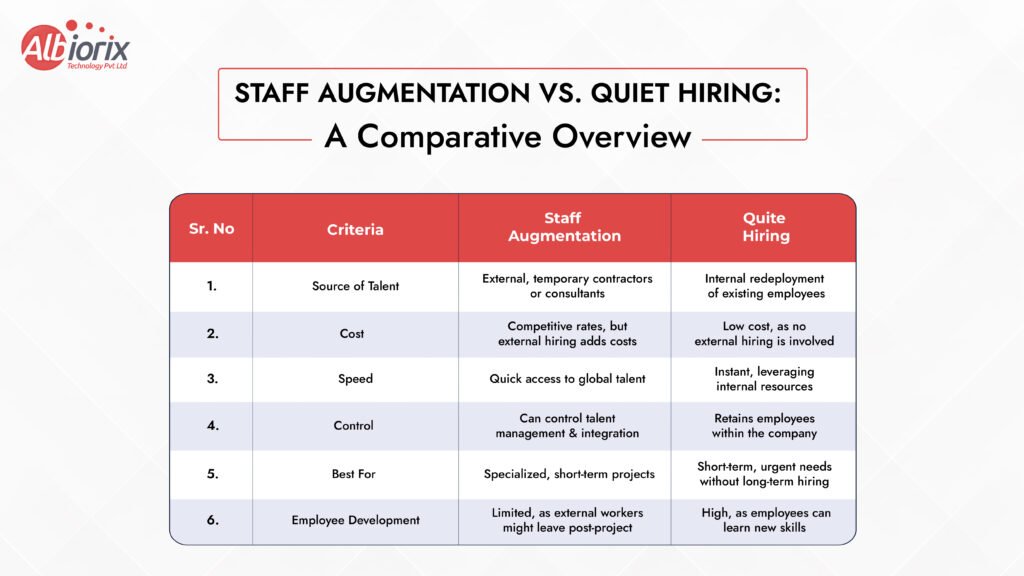
Staff Augmentation vs. Quiet Hiring: Which One Is Better For Your Business?

In today’s competitive business landscape, companies are constantly seeking flexible workforce solutions to address talent gaps, manage costs, and scale efficiently.

Two models gaining significant attention are staff augmentation and quiet hiring. But which one should you choose?

At Albiorix Technology, we’ve helped businesses worldwide navigate these staffing challenges. In this guide, we break down both approaches to help you decide which one fits your organization’s needs better.

What is Staff Augmentation?

Staff augmentation involves bringing external talent on board to fill skill gaps in your existing teams. These resources are often hired on a temporary or contract basis, allowing businesses to quickly scale up or down without long-term commitments.

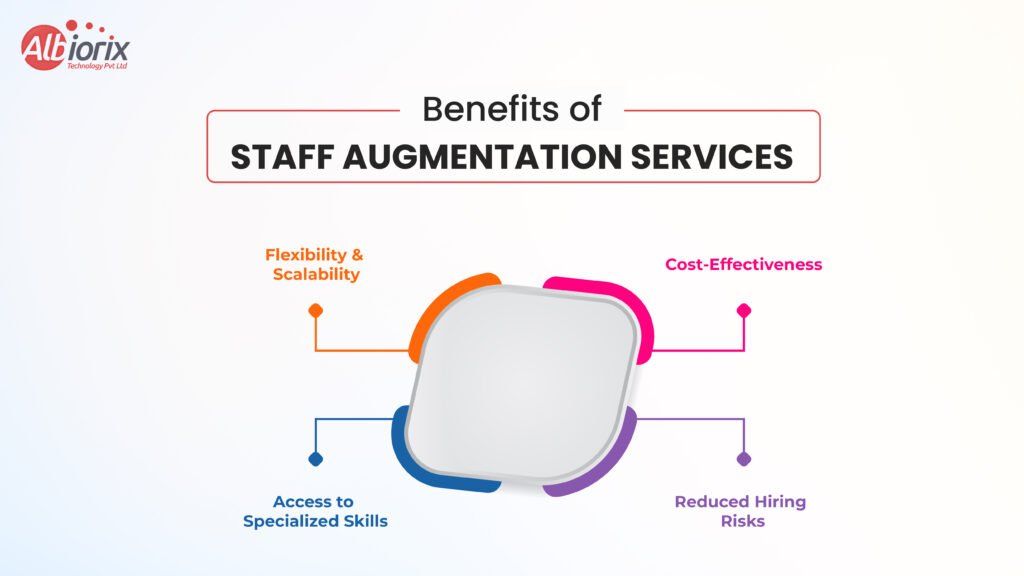
Key Benefits of Staff Augmentation

Staff augmentation provides unparalleled flexibility and scalability, allowing businesses to swiftly access specialized skills without long-term commitments.

This model helps manage costs effectively by avoiding the expenses associated with full-time hires, including benefits and training.

By leveraging a global talent pool of developers, companies can quickly onboard experts who fit their specific needs, enhancing project efficiency.

Additionally, staff augmentation enables internal teams to concentrate on their core competencies while external specialists handle specific tasks, driving overall productivity and innovation.

  1. Flexibility: You can hire specialized talent as needed for short-term projects or to fill skill gaps.
  2. Cost-Efficiency: Avoid the high costs associated with hiring full-time employees, such as benefits, training, and long-term commitments.
  3. Access to Global Talent: You can leverage remote staff from anywhere in the world, offering a wider pool of talent.
  4. Focus on Core Competencies: Staff augmentation lets your internal teams focus on their strengths while specialized contractors handle specific tasks.

Albiorix Technology provides staff augmentation services across industries, including healthcare, finance, and eCommerce. Our specialized developers integrate seamlessly into your teams, ensuring smooth operations without disruptions.

Transform Your Workforce Today!

Discover how Albiorix Technology can help you leverage the best of both staff augmentation and quiet hiring to meet your business needs. Let’s build a more agile and efficient team together!


Contact Us Today

What is Quiet Hiring: The Emerging Workforce Strategy?

Quiet hiring is an innovative approach where organizations redeploy internal talent to meet immediate business needs.

Unlike external recruitment or traditional hiring, quiet hiring focuses on optimizing the skills of your existing workforce by temporarily shifting employees to different roles or tasks.

What are the Key Benefits of Quiet Hiring?

Quiet hiring optimizes your existing workforce by redeploying internal talent to meet urgent needs, which helps avoid the costs and complexities of external recruitment.

This approach promotes cost savings and enhances responsiveness, allowing organizations to quickly address shifting demands.

It also fosters employee development by providing new challenges and opportunities for growth, which can boost morale and engagement.

By leveraging the skills and potential of current employees, quiet hiring supports efficient resource management and long-term organizational resilience.

  1. Cost Savings: No external recruitment costs or onboarding hassles. You maximize the productivity of your current workforce.
  2. Faster Response Time: Since you’re utilizing internal resources, it’s quicker to address sudden staffing needs.
  3. Upskilling Opportunities: Employees can gain new skills or experiences by taking on different roles, enhancing career growth.
  4. Increased Employee Engagement: Redeploying internal talent can boost morale, as it signals that the company values its skills and flexibility.

At Albiorix Technology, we advocate for quiet hiring where applicable. By internally shifting employees to meet evolving project demands, we ensure cost-effective, flexible workforce management while enhancing team dynamics.

Staff Augmentation vs. Quiet Hiring

Emerging Trends in Workforce Models

Workforce strategies are constantly evolving. Beyond staff augmentation and quiet hiring, businesses are now exploring hybrid workforce models, blending full-time, freelance, and AI-powered automation to maximize efficiency.

The rise of global remote teams, on-demand talent platforms, and skill-based project assignments reflects a shift towards more agile, cost-effective hiring approaches.

Companies adopting these trends are better equipped to navigate market uncertainties, adapt to sudden demand changes, and stay competitive.

Which One is Right for Your Business?

Choosing between staff augmentation and quiet hiring depends on your specific business needs and goals.

Staff augmentation is ideal for projects requiring specialized skills or temporary support, offering flexibility and access to global talent without long-term commitments.

In contrast, quiet hiring is best for organizations seeking to optimize their current workforce by reallocating internal resources to address immediate needs, which can be more cost-effective and foster employee development.

Assessing your project scope, budget, and internal capabilities will help determine the most suitable approach for your business. Both models offer significant benefits, but the right choice depends on your specific business needs:

  1. Short-Term Project Needs: If your organization is working on a one-time project that requires specific technical expertise, staff augmentation is likely the best solution. With Albiorix Technology’s extensive network of experienced developers, we can provide the talent you need quickly and efficiently.
  2. Long-Term Cost Efficiency: For companies focused on long-term growth without constantly expanding headcount, quiet hiring can be an excellent strategy. It ensures that you make the most of your existing workforce by reassigning them to higher-value projects.

How Albiorix Technology Can Help

At Albiorix Technology, we offer a range of workforce solutions to help businesses scale efficiently. From staff augmentation to bespoke development services, we ensure that your business has access to top talent without the hassle of long-term commitments.

Our dedicated developers come with years of experience in various industries, ensuring that they can hit the ground running and integrate seamlessly into your projects.

Whether you need additional hands for a large project or want to explore the benefits of quiet hiring, we’re here to guide you every step of the way.

Ready to Optimize Your Talent Strategy?

Get in touch to explore how staff augmentation or quiet hiring can enhance your operational efficiency and drive success. Don’t wait—let’s start crafting the ideal strategy for your business now!


Contact Us Today

When to Combine Staff Augmentation with Quiet Hiring

Often, the best workforce solution isn’t choosing between staff augmentation or quiet hiring — it’s knowing when to combine both.

For instance, internal redeployment (quiet hiring) can address immediate priorities, while staff augmentation brings in specialized skills for complex, time-sensitive projects.

This balanced approach ensures resource optimization, cost control, and project success.

At Albiorix Technology, we help businesses design tailored workforce strategies that smartly blend internal talent utilization with external expertise.

Key Considerations Before Choosing a Workforce Model

  • Project Duration & Complexity: Short-term, skill-specific tasks favor augmentation; broader business shifts suit quiet hiring.
  • Budget Constraints: Internal redeployment is cost-effective, while augmentation offers flexible scaling.
  • Internal Team Capacity: Evaluate if existing staff can take on new roles without affecting core operations.
  • Time to Onboard: Staff augmentation offers faster ramp-up for urgent needs. A clear assessment helps in making informed, strategic decisions.

Conclusion

Choosing between staff augmentation and quiet hiring depends on your specific business goals, budget, and timeframes.

Both models offer unique advantages, but with the right approach, you can optimize your workforce and achieve greater operational efficiency.

If you’re looking for flexible staffing solutions tailored to your unique needs, reach out to Albiorix Technology today.

Let’s explore how we can help you achieve your business goals through strategic workforce management. Contact us or call us at (+91) 991-308-8360. You can also DM us on LinkedIn.

Smart TV App Development to Dominate the Better Streaming Market

In today’s digital age, Smart TV app development has become a pivotal aspect of delivering seamless entertainment experiences to audiences worldwide.

The global Smart TV market was valued at USD 197.82 billion in 2022 and is expected to grow at a compound annual growth rate (CAGR) of 11.4% between 2023 and 2030.The surge in popularity of over-the-top (OTT) services has played a crucial role in driving this growth.

Major streaming platforms like Amazon Prime, Netflix, and Disney Plus are capitalizing on this trend by developing custom Smart TV applications to offer their services seamlessly to Smart TV users.

At Albiorix Technology, we specialize in providing top-notch Smart TV app development services that cater to diverse industry needs.

Whether you’re looking to develop a streaming app, gaming platform, or interactive TV experience, our expert team of app developers is equipped to transform your vision into a dynamic, user-friendly app that thrives on any Smart TV ecosystem.

Before learning more about our smart TV app and software development services and how it can benefit your business, let’s understand what is a start tv app and things related to it.

What is a Smart TV App?

A Smart TV app is a software application designed specifically to run on Smart TVs. These apps let users stream content, play games, or access services directly from their television—without needing any external device.

Whether it’s watching shows on Netflix, browsing YouTube, or even checking the weather, a Smart TV app brings these features to your big screen in a simple and user-friendly way.

Smart TV apps have changed how people interact with their TVs. Instead of just watching channels, users can now enjoy a wide range of interactive experiences, like on-demand movies, live sports, or even fitness programs.

These apps often support remote or voice control for easy navigation.

With the growing popularity of on-demand streaming services like Disney+, Hulu, and others, more people are turning to Smart TVs for entertainment. This shift is driving rapid growth in Smart TV app development.

For businesses, developing a Smart TV app is not just a trend—it’s a smart way to reach modern audiences who expect seamless, high-quality viewing experiences right from their home screens.

Get Started with Custom Smart TV App Development Today!

Ready to create a Smart TV app that will captivate your audience and boost your business? Albiorix Technology specializes in Smart TV app development services tailored to your needs. Contact us today!


Contact Us Today

List of Popular Smart TV Platforms

To build an app that thrives on Smart TVs, it’s important to understand the various platforms available. The most popular Smart TV operating systems include:

  1. Android TV: Offers flexibility with a wide range of apps and Google services.
  2. Roku: Known for its simplicity and ease of use, Roku powers millions of Smart TVs.
  3. Apple TV: Provides seamless integration with other Apple services and products.
  4. Tizen and WebOS: Found in Samsung and LG Smart TVs respectively, these platforms offer customized user experiences.

Each platform has its unique technical requirements, and a well-executed Smart TV app development project must account for these differences. Developing apps for multiple platforms increases a business’s reach and ensures a wider audience can access its content.

At Albiorix Technology, we have already created smart TV apps for our clients in Australia and across the United States, and MwareIPTV is one such app developed by our mobile app developers.

List of Popular Smart TV Apps Globally

Globally, there are several popular Smart TV apps that enhance the viewing experience for users. Leading the list are streaming giants like Netflix, Amazon Prime Video, and Disney Plus, offering vast libraries of movies and TV shows.

Other widely used apps include YouTube for video content, Spotify for music streaming, and Hulu for live TV and on-demand services.

Additionally, apps like Apple TV and HBO Max continue to dominate the market, providing a variety of entertainment options. As the demand for Smart TV content grows, more platforms are developing custom Smart TV apps to reach a wider global audience.

  • YouTube
  • Netflix
  • AT&T
  • Samsung TV Plus
  • Disney Plus
  • Tencent
  • Prime Video (Amazon)
  • FuboTV
  • Sling TV
  • Hulu
  • Philo
  • Paramount Plus

These apps exemplify the power of Custom Smart TV app development in enhancing user engagement and delivering high-quality, interactive content experiences.

What is Smart TV App Development?

Smart TV app development is the process of designing, building, and optimizing apps specifically for Smart TV platforms. These apps are tailored to large screens, delivering an immersive user experience with easy-to-navigate interfaces and high-quality visuals.

Whether it’s a streaming service, a gaming app, or an interactive shopping platform, businesses leverage Smart TV app development services to reach users directly in their living rooms.

At Albiorix Technology, we specialize in creating feature-rich Smart TV apps that seamlessly integrate with leading Smart TV operating systems, ensuring an enhanced viewing experience for users. Check out our portfolio of innovative and futuristic smart TV apps.

List of Key Benefits of Smart TV App Development

Key Benefits of Smart TV App Development

Investing in Smart TV app development offers several benefits for businesses:

  1. Enhanced User Engagement: Smart TV apps provide a more immersive experience than traditional TV, keeping users engaged for longer periods.
  2. Wider Audience Reach: With millions of households adopting Smart TVs, businesses can tap into a broader audience by developing customized apps.
  3. Monetization Opportunities: Businesses can generate revenue through ads, subscriptions, and in-app purchases.
  4. Brand Visibility: A Smart TV app offers businesses a chance to improve their brand’s visibility by appearing directly on users’ home screens.

For businesses looking to harness these benefits, partnering with a Smart TV app development company like Albiorix Technology is a smart investment.

Challenges in Smart TV App Development

Despite its advantages, Smart TV app development comes with its challenges: 

  1. Cross-Platform Compatibility: Each Smart TV platform has different technical requirements, making it necessary to develop apps that are compatible across multiple platforms.
  2. Performance Optimization: Ensuring that the app runs smoothly on large screens without compromising on speed or quality is critical.
  3. User Interface Design: Designing an intuitive and visually appealing interface that is easy to navigate on a TV screen requires specialized expertise.

At Albiorix Technology, we are well-versed in overcoming these challenges and delivering top-notch Smart TV app development services that cater to diverse client needs.

Future Trends in Smart TV App Development

As technology continues to evolve, the future of Smart TV app development looks promising. Some of the emerging trends include:

  1. AI Integration: AI-powered apps that personalize content recommendations and offer voice control.
  2. Augmented Reality (AR): Smart TV apps are beginning to integrate AR for more immersive gaming and shopping experiences.
  3. Improved User Interfaces: As screen sizes and display quality improve, user interfaces will become even more dynamic and intuitive.

By staying ahead of these trends, Albiorix Technology ensures that your Smart TV app remains competitive and future-proof.

Why Choose Albiorix Technology for Smart TV App Development?

Albiorix Technology stands out for its deep expertise and hands-on experience in Smart TV app development. The team understands the unique requirements of connected TV platforms and builds apps that are reliable, fast, and user-friendly.

With a focus on custom solutions, Albiorix ensures each app meets your specific business goals while offering seamless integration with popular platforms like Roku, Android TV, and Apple TV.

Clients trust Albiorix for delivering secure, scalable, and high-performing apps backed by strong post-launch support—making it a dependable partner in the rapidly growing Smart TV market.

MwareIPTV – A Flexible TV Platform by Albiorix Technology

At Albiorix Technology, we have extensive experience in Smart TV app development, having successfully created cutting-edge solutions for clients across various industries.

One of our notable projects includes the development of an IPTV and OTT Middleware platform—MWareIPTV. This platform integrates seamlessly with Smart TVs to deliver enhanced user experiences, offering customized content streaming solutions.

Below is the list of core features of MwareIPTV:

  1. Supports Multi-Device
  2. Globally Deployed
  3. CloudTV Based Platform
  4. 100% Uptime
  5. Supports Android, iOS, AppleTV, Windows, Roku, FireTV and more.

You can explore more about our Smart TV app development expertise by visiting our MWareIPTV portfolio.

Transform Your Business with Our Smart TV App Development Services

Take your business to the next level with innovative Smart TV app development from Albiorix Technology. Let’s build something exceptional together—reach out to us now to get started on your custom Smart TV app development journey.


Contact Us Today

Conclusion

In conclusion, Smart TV app development is an essential tool for businesses looking to reach a broader audience and enhance user engagement.

With the global market set for rapid growth, now is the perfect time to invest in Smart TV app development services.

It can give your business the much-needed boost in the world driven by smartphones and mobile apps.

At Albiorix Technology, we provide end-to-end solutions that ensure your Smart TV app not only meets industry standards but also delivers an exceptional user experience.

Contact us today to learn how we can help you develop a cutting-edge Smart TV app that will set you apart in the competitive entertainment landscape.

For a free consultation, you can also call us at (+61) 489-940-484 (NSW, AU). You can also DM us your questions on LinkedIn, and we will get back to you at the earliest.

Staff Augmentation Services That can Transforms Your Business

today’s dynamic business landscape, organizations need to remain agile and responsive to changing demands. Whether scaling quickly to meet project deadlines, acquiring specialized skills, or controlling costs, businesses must find innovative staffing solutions.

Staff augmentation services offer an ideal solution by allowing companies to supplement their existing teams with highly skilled professionals on a temporary basis.

This blog explores the benefits, types, and applications of staff augmentation services and how they can revolutionize your business operations.

What Are Staff Augmentation Services?

Staff augmentation is a flexible staffing strategy where companies hire external developers to fill specific roles within their teams for a defined period. This approach differs from traditional hiring, where permanent employees are brought on board.

Staff augmentation enables businesses to respond quickly to changing needs without the long-term commitments and overheads associated with permanent hires.

Types of Staff Augmentation Services

Staff augmentation services can be classified into several types based on geographic location and engagement terms.

These include Short-Term Augmentation, Long-Term Augmentation and Skill-Based Augmentation each offering different levels of proximity and cost benefits.

Additionally, companies can choose between contract-based or project-based staff augmentation, depending on the duration and scope of the requirement.

  1. Short-Term Augmentation: This model is ideal for projects with a temporary spike in workload, seasonal demands, or when specific skills are needed for a short period.

    Short-term staff augmentation allows businesses to scale up their workforce quickly and efficiently to meet immediate needs.
  2. Long-Term Augmentation: Companies that require ongoing support for extended projects or long-term initiatives can benefit from long-term staff augmentation.

    This approach provides consistency and continuity without the costs and commitments of permanent employment.
  3. Skill-Based Augmentation: Sometimes, a business requires specialized skills that are not available in-house.

    Skill-based augmentation involves bringing in experts with niche expertise, such as software developers, data analysts, or cybersecurity specialists, to work on specific tasks or projects.

Benefits of Staff Augmentation Services

Staff augmentation services offer numerous benefits to businesses, including the ability to quickly access specialized talent, enhance flexibility, and reduce overall hiring costs.

This approach allows companies to scale their teams efficiently while maintaining full control over the project management process, ensuring a faster response to dynamic market needs.

  1. Flexibility and Scalability: One of the primary advantages of staff augmentation is the flexibility it offers. Businesses can scale their teams up or down based on project requirements, allowing them to respond quickly to market demands.

    This scalability is particularly valuable in industries with fluctuating workloads or those that require rapid deployment of resources.
  2. Access to Specialized Skills: In an increasingly complex business environment, having access to specialized skills is crucial for success.

    Staff augmentation provides companies with the opportunity to bring in experts who possess the exact skills needed for a project.

    This access to top talent is particularly beneficial in the IT industry, where technology is constantly evolving, and businesses need to stay ahead of the curve.
  3. Cost-Effectiveness: Hiring full-time employees can be expensive, with costs including salaries, benefits, training, and onboarding.

    Staff augmentation offers a cost-effective alternative, allowing businesses to pay only for the skills they need when they need them. This approach reduces overheads and allows companies to allocate resources more efficiently.
  4. Reduced Hiring Risks: Permanent hires come with long-term commitments, and if an employee doesn’t fit well within the team or the project needs change, the costs associated with recruitment, training, and termination can be substantial.

    Staff augmentation mitigates these risks by providing temporary solutions, enabling companies to assess performance before making long-term decisions.

What is IT Staff Augmentation? 

In an era where digital transformation is no longer a choice but a necessity, businesses are increasingly relying on advanced technologies to stay competitive.

However, the rapid pace of technological change often outpaces the ability of companies to maintain an in-house team with all the necessary skills.

This is where IT staff augmentation becomes a crucial strategy, allowing companies to quickly acquire the specific expertise they need to drive digital initiatives forward.

Specifics of Staff Augmentation in the IT Industry

IT staff augmentation is a specialized form of staff augmentation focused on providing businesses with the tech talent they need on a temporary or project-based basis.

Unlike traditional hiring processes, IT staff augmentation allows companies to bring in experts with specialized skills, such as software development, cybersecurity, or data science, for as long as they are needed.

This model is particularly beneficial in the IT industry, where technology evolves rapidly, and the demand for skilled professionals often outstrips supply.

Unlock Your Business Potential Today

Ready to elevate your business operations? Discover how staff augmentation can provide the specialized skills and flexibility you need to thrive in a competitive market.


Contact Us Today

Importance of IT Staff Augmentation

Digital transformation is reshaping industries across the globe, enabling businesses to improve efficiency, innovate, and deliver better customer experiences.

However, successful digital transformation requires a combination of advanced technology and skilled professionals who can implement and manage these technologies.

IT staff augmentation plays a critical role in this process by providing businesses with the flexibility to access top-tier talent as needed, ensuring that digital transformation initiatives are executed effectively and efficiently.

Types of IT Staff Augmentation

IT staff augmentation services come in various models tailored to meet business needs. These include onshore, nearshore, and offshore augmentation, each offering different levels of proximity, cost-effectiveness, and ease of communication.

Additionally, companies can choose between contract-based or project-based augmentation, depending on the scope and duration of the required IT expertise.

  1. Onshore IT Staff Augmentation: Involves hiring IT professionals from the same country as the client company. This option offers the advantage of proximity and ease of communication, with fewer cultural and time zone differences.
  2. Nearshore IT Staff Augmentation: Refers to sourcing IT talent from neighboring countries or regions. Nearshore staff augmentation often balances cost-effectiveness with the benefits of geographical and cultural proximity.
  3. Offshore IT Staff Augmentation: Involves hiring software developers from countries far from the client’s location, often at a lower cost. While offshore staff augmentation can be highly cost-effective, it may present challenges related to time zones, language, and cultural differences.

How Does IT Staff Augmentation Work?

The process of IT staff augmentation typically begins with identifying the specific skills and expertise required for a project. Once the needs are defined, the next step involves sourcing and hiring professionals who match the criteria.

These professionals are then integrated into the existing team, where they collaborate with in-house staff to achieve project goals.

Throughout this process, the augmented staff remains under the client’s direct supervision, ensuring that the work aligns with the company’s objectives and standards.

Key Roles Typically Augmented

  1. Software Developers: Whether it’s web development, mobile app development, or backend systems, software developers are among the most commonly augmented IT roles.
  2. Cybersecurity Experts: As cyber threats become more sophisticated, businesses increasingly rely on cybersecurity experts to protect their digital assets.
  3. Data Scientists and Analysts: With the growing importance of data in decision-making, data scientists and analysts are in high demand for their ability to extract insights and drive business strategies.
  4. Cloud Engineers: As more businesses migrate to the cloud, the need for cloud engineers who can manage and optimize cloud infrastructure has grown significantly.
  5. DevOps Engineers: DevOps engineers bridge the gap between development and operations, ensuring smooth and efficient software delivery.

Benefits of IT Staff Augmentation 

IT staff augmentation provides businesses with critical advantages, including access to cutting-edge technical skills and the flexibility to scale teams based on project demands.

It allows companies to speed up development processes, reduce time to market, and meet evolving technological needs without the long-term commitments of full-time hires.

Benefits of IT Staff Augmentation
  1. Access to Cutting-Edge Technology Skills: IT staff augmentation allows businesses to quickly tap into a pool of highly experienced developers who possess the latest knowledge and expertise in cutting-edge technologies.

    This access is crucial for companies looking to implement new technologies, innovate, or keep up with industry trends.
  2. Reduced Time to Market: By augmenting their IT teams with experienced professionals, companies can accelerate project timelines and reduce time to market.

    This speed is essential in the fast-paced tech industry, where being first to market can provide a significant competitive advantage.
  3. Flexibility in Scaling IT Teams:One of the key benefits of IT staff augmentation is the ability to scale teams up or down based on project needs.

    This flexibility allows businesses to efficiently allocate resources, optimize costs, and respond to changing demands without the long-term commitments associated with traditional hiring.

Staff Augmentation vs. Outsourcing: Which is Right for You?

While both staff augmentation and outsourcing are popular staffing solutions, they serve different purposes and suit different business needs. Understanding the differences between these two models is crucial for making an informed decision.

Outsourcing involves delegating entire projects or functions to an external company. This approach is often cost-effective and allows businesses to focus on their core activities while the outsourced team handles specific tasks.

Staff Augmentation, on the other hand, involves integrating external professionals directly into your existing team. This model offers more control over the work process, as augmented staff work alongside your in-house team and are managed by your company.

Why Startups Should Consider Staff Augmentation

Startups can greatly benefit from staff augmentation as it allows them to scale their teams quickly, access specialized talent without the overhead costs of full-time employees, and maintain agility in a fast-paced environment.

This approach helps startups stay lean while ensuring they have the skills necessary to support growth and innovation.

  1. Scalability: Startups often experience rapid growth and fluctuating workloads. Staff augmentation allows startups to scale their teams quickly without the long-term commitments associated with permanent hires.
  2. Access to Top Talent: Startups may not have the budget to hire full-time experts, but staff augmentation provides access to skilled professionals who can contribute to crucial projects.
  3. Cost Savings: Startups can save on recruitment, training, and benefits costs by opting for staff augmentation, allowing them to allocate resources to other critical areas.

Transform Your Workforce with Expert Talent

Is your business struggling to find the right talent? Staff augmentation offers a powerful solution, giving you access to top-tier professionals exactly when you need them. Explore our expert staffing solutions.


Contact Us Today

Common Areas for Staff Augmentation in Startups

Staff augmentation is commonly utilized in areas such as software development, IT support, cybersecurity, and data analytics, where specialized skills are often needed on a temporary basis.

It’s also widely used for project management, QA testing, and cloud infrastructure, helping businesses manage workload spikes and achieve project-specific goals without permanent hires.

  1. IT and Software Development: Startups often require specialized technical skills to develop products and scale their operations.
  2. Marketing and Sales: Augmented staff can help startups build and execute marketing strategies or expand their sales efforts.
  3. Administrative and Operational Roles: Startups can use staff augmentation to support day-to-day operations and ensure smooth business processes.

Global Staff Augmentation: Expanding Your Talent Pool

In today’s globalized world, businesses are no longer limited by geography when it comes to finding talent.

Global staff augmentation allows companies to tap into a worldwide network of professionals, offering a broader range of skills and expertise. Below are some of the advantages of Global Staff Augmentation:

  1. Access to a Broader Talent Pool: Companies can find the best talent globally, not just locally, allowing for more diverse and innovative teams.
  2. Cost Savings: By leveraging lower-cost markets, businesses can reduce labor costs without compromising on quality.
  3. 24/7 Productivity: With teams distributed across different time zones, companies can achieve round-the-clock productivity, speeding up project timelines.

Staff augmentation services offer a powerful and flexible solution for businesses looking to enhance their teams, access specialized skills, and remain agile in an ever-changing market.

Whether you’re a startup looking to scale quickly, an established company needing additional resources, or a global organization seeking to tap into a broader talent pool, staff augmentation can help you achieve your goals efficiently and effectively.

By understanding the different types of staff augmentation and the benefits they offer, you can make informed decisions that drive your business forward.

As the business world continues to evolve, adopting staff augmentation services may be the key to staying ahead of the competition and ensuring long-term success.

Best Staff Augmentation Services in Australia, Europe, & The US

At Albiorix Technology, we offer flexible and tailored staff augmentation services across Australia, Europe, and the US, ensuring your business has access to top-tier talent when and where you need it.

Whether you’re looking to expand your IT team or enhance your project capabilities, our global staff augmentation services help you scale efficiently without compromising quality.

Partner with us today and unlock the power of highly skilled software developers that adapts to your unique business needs!

You can also call us at (+91) 991-308-8360 for a free consultation or DM us on LinkedIn, and we will get back to you at the earliest.

Proven Benefits of custom mobile app development For healthcare

Healthcare organizations are increasingly turning to technology to enhance patient care, streamline operations, and stay competitive. One of the most impactful tools in this digital transformation is custom healthcare mobile app development.

From improving patient engagement to optimizing workflows, custom mHealth apps are becoming indispensable in the healthcare sector.

These mobile healthcare apps have not only made patient care easier and more convenient for both patients and healthcare professionals, but they have also improved the accuracy of disease diagnosis.  

In this blog on Healthcare App Development, we’ll delve into why your healthcare organization needs custom mobile apps and explore the benefits from a developer’s perspective.  

Enhanced Patient Engagement and Experience 

Custom mobile apps offer a unique opportunity to engage patients in ways that were previously unimaginable.

These apps can be tailored to meet the specific needs of your patients, providing them with easy access to their medical records, appointment scheduling, medication reminders, and even virtual consultations.

By offering a personalized experience, custom mHealth apps improve patient satisfaction and encourage them to take a more active role in managing their health.  

Healthcare mobile apps, particularly patient engagement apps, have revolutionized the way healthcare providers connect with patients, enhancing communication and improving overall care outcomes. 

Streamlined Operations and Increased Efficiency 

Healthcare organizations deal with a vast amount of data daily, from patient records to billing information. Custom mobile apps can be designed to streamline these processes, reducing the administrative burden on healthcare staff.

By integrating with existing systems like Electronic Health Records (EHR) and billing software, custom apps ensure that data is easily accessible and organized.  

This not only increases efficiency but also reduces the likelihood of errors, which can be crucial in a healthcare setting.

Mobile app integration in healthcare, combined with EHR integration, enables seamless access to patient data, streamlining workflows and enhancing the quality-of-care delivery. 

Improved Communication and Collaboration 

Effective communication is vital in healthcare. Custom mobile apps can facilitate better communication between healthcare providers, patients, and administrative staff.

Features like secure messaging, push notifications, and real-time updates ensure that everyone involved in a patient’s care is on the same page. This improved communication leads to better care coordination and, ultimately, better patient outcomes. 

Healthcare communication tools and collaborative healthcare apps are transforming the way patient-provider communication is handled.

By streamlining interactions and ensuring timely updates, these technologies enhance the quality and efficiency of care delivery.

Unlock the Potential of Custom Healthcare Apps Today

Ready to elevate patient care and streamline your operations with a custom mobile app? Contact us today to start transforming your healthcare services with innovative, secure, and scalable mobile applications.


Connect Now

Data Security and Compliance 

One of the biggest concerns for healthcare organizations when adopting new technology is data security and compliance with regulations like HIPAA (Health Insurance Portability and Accountability Act).

Custom mobile apps can be developed with stringent security measures, ensuring that patient data is encrypted, stored securely, and only accessible by authorized personnel.

Additionally, developers can ensure that the app is compliant with industry standards, giving healthcare organizations peace of mind. 

HIPAA-compliant mobile apps are essential for maintaining healthcare data security, ensuring that patient information is protected at all times.

By developing secure healthcare apps, organizations can safeguard sensitive data while providing reliable and compliant digital solutions for patient care. 

Scalability and Flexibility 

Off-the-shelf solutions might offer quick fixes, but they often lack the flexibility needed to address the unique challenges of a healthcare organization.

Custom mobile apps, on the other hand, can be scaled and modified as your organization grows or as new technologies emerge. This scalability ensures that the app remains relevant and useful, providing long-term value. 

Scalable healthcare apps offer the flexibility to grow with your organization’s needs, ensuring long-term value and adaptability.

By investing in flexible mobile app development, you can create custom app solutions for healthcare that meet specific patient and provider requirements while evolving with industry changes. 

Features of Healthcare app

Competitive Advantage 

In an increasingly competitive healthcare landscape, having a custom mobile app can set your organization apart.

By offering a unique, tailored solution, you not only meet the specific needs of your patients but also position your organization as a leader in healthcare innovation. A well-designed app can enhance your brand image, attract new patients, and retain existing ones. 

To gain a competitive advantage in healthcare, organizations are increasingly turning to healthcare innovation through the development of custom healthcare apps.

These tailored solutions not only enhance patient care but also streamline operations, positioning healthcare providers at the forefront of industry advancements. 

Analytics and Insights 

Custom mobile apps can be equipped with powerful analytics tools that provide insights into patient behavior, app usage, and overall performance.

These insights can be invaluable for making data-driven decisions, improving patient care, and optimizing the app itself. By understanding how patients interact with the app, healthcare organizations can continuously refine their services and offerings. 

Healthcare analytics apps are revolutionizing the industry by enabling data-driven healthcare decisions that enhance patient outcomes and operational efficiency.

Leveraging mobile app insights, these tools provide healthcare professionals with actionable data to make informed, strategic choices. 

Personalized Care 

Custom mobile apps enable healthcare providers to offer personalized care by analyzing patient data and preferences. Features like personalized health plans, targeted reminders, and customized content help in addressing individual patient needs more effectively.

This personalized approach not only enhances patient satisfaction but also improves health outcomes. 

Personalized healthcare apps are transforming the landscape of healthcare personalization by offering customized patient care tailored to individual needs.

By integrating these apps into their practices, providers can enhance patient engagement and improve overall treatment outcomes through targeted, personalized solutions.

Tips to Find the Best Healthcare App Development Company 

Choosing the right healthcare app development company is crucial for creating a successful and efficient mobile application tailored to your organization’s needs.

With the increasing demand for digital health solutions, it’s essential to partner with a company that not only understands the complexities of healthcare but also excels in delivering customized, secure, and innovative app solutions. 

Healthcare App Development Company

Here are some key tips to help you find the best healthcare app development company: 

  1. Evaluate Industry Experience: Look for a healthcare app development company with a proven track record in the healthcare industry to ensure they understand regulatory requirements and best practices. Look at our portfolio for AI-powered healthcare apps. 
  2. Check for HIPAA Compliance: Ensure the company is skilled in developing HIPAA-compliant mobile apps, which are crucial for maintaining healthcare data security and patient confidentiality. 
  3. Assess Technical Expertise: Choose a company with strong technical capabilities in scalable and flexible mobile app development to create custom app solutions that can adapt to your evolving needs. 
  4. Review Portfolio and Case Studies: Examine their previous projects and success stories to gauge their ability to deliver high-quality, effective healthcare apps. 
  5. Consider Client Testimonials and References: Seek feedback from past clients to understand their experiences and the company’s reliability and performance. 

Discuss Support and Maintenance: Ensure the company offers comprehensive post-launch support and maintenance services to keep your healthcare app running smoothly.

Start Your Custom Healthcare App Journey Now

Don’t let your healthcare organization fall behind in the digital age. Partner with us to develop a custom mobile app that enhances patient engagement, improves efficiency, and ensures data security.


Explore Now

Conclusion 

The shift towards digital healthcare is undeniable, and custom mobile apps are at the forefront of this transformation.

By offering enhanced patient engagement, streamlined operations, improved communication, and robust data security, custom mobile apps provide healthcare organizations with the tools they need to thrive in a digital world.

From a developer’s perspective, the possibilities are endless, and the benefits are substantial. 

Investing in custom mobile app development is not just about keeping up with the latest trends; it’s about creating a sustainable, innovative future for your healthcare organization.

As the healthcare landscape continues to evolve, those who embrace custom technology solutions will be best positioned to lead the way. 

Healthcare app development is driving advancements in the industry by creating custom mobile apps for healthcare that address specific patient and provider needs.

These tailored healthcare technology solutions enhance efficiency and care quality, setting a new standard in digital health innovation.

To get started with your healthcare software development, please contact us or call us at (+91) 991-308-8360. You can also drop us a message on LinkedIn.