




FastAPI vs Flask: Key Differences That You Need To Know?

SummaryWhen you decide to develop a web solution for your business, choosing the right framework is only the first step. The real success of your web solution is powered by high-performing, scalable, and secure APIs. If you are looking to develop a custom API that can power your business in 2026, then Fast API and Flask are two of the best Python Frameworks to choose from. But, again, from these two, which one is more suitable as per your business needs, industry, and audience requirements requires careful consideration.

So, to help you decide the most suitable API development framework, we have brought you a detailed comparison between Flask and FastAPI – two of the best API development frameworks in 2026. From architecture planning to deployment and optimization, we will compare every aspect.

Fast API vs Flask

It becomes very important for you to choose the right framework and technologies if you are planning to develop a modern web solution for your business.

The framework you choose for development will have a direct impact on your website’s overall performance, security, scalability, and long-term stability.

When it comes to choosing the right web API development frameworks, Python is the forerunner.

There are many Python web frameworks available in the market for API development, but among all, two names are highly dominating and developers’ favorite. And they are Flask and FastAPI.

Flask and FastAPI are both Python frameworks for modern API development. In the last few years, both these frameworks have emerged as the most preferred tools to develop APIs that are high-performing, scalable, and lightweight.

Both are reliable, widely adopted, and powerful options for REST API development in Python. However, they differ in philosophy, performance capabilities, and ideal use cases.

The discussion around FastAPI vs Flask has grown significantly as businesses increasingly prioritize high-performance APIs, real-time data processing, and scalable cloud-native applications.

FastAPI is often praised for its modern architecture, impressive performance, and built-in automation features, while the Flask framework remains popular for its simplicity, flexibility, and mature ecosystem.

In 2026, there is a lot of debate going on over the web between these frameworks. Some believe FastAPI is better than Flask, whereas some support Flask when it comes to custom web API development.

In this blog, we have tried to compare the powerful frameworks of Python. In this Flask vs FastAPI comparison blog, we intend to help developers, technical decision-makers, and businesses understand when each framework makes sense.

Whether you are building your first API, scaling an enterprise platform, or exploring modern Python web frameworks, understanding FastAPI and Flask will help you make a confident and future-ready decision.

What are APIs?
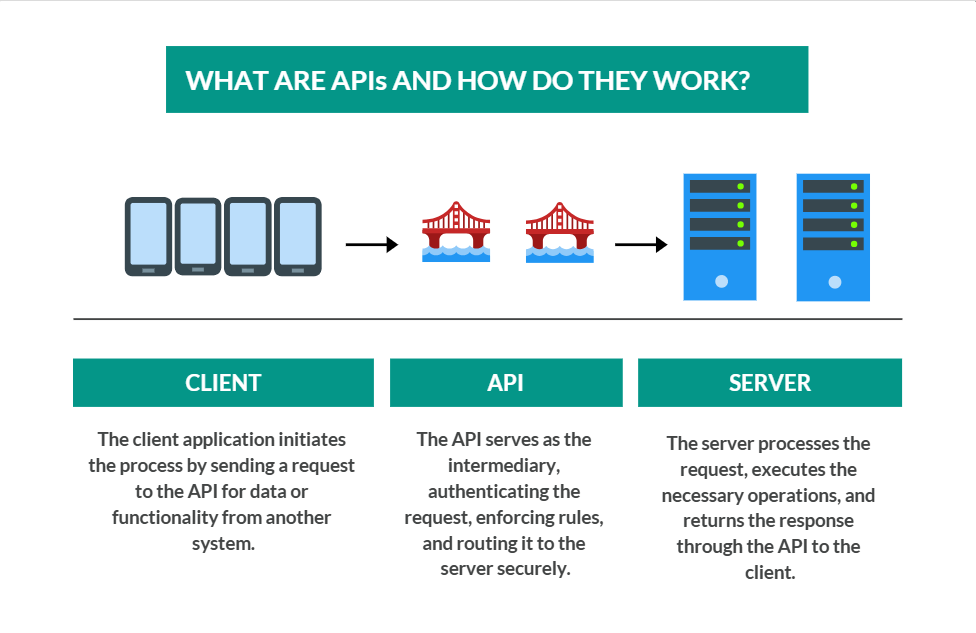
What are APIs and how they works

Before discussing and comparing two of the best web API development frameworks of our time – Flask and FastAPI,  let’s first understand what an API is and its role in web app development and custom software development.

An API (Application Programming Interface) is a connecting bridge between two different software systems.

It connects two different systems for sending and receiving messages, requests, exchanging data, and performing actions without the need for any external system.

In modern web apps and software solutions, custom-made web APIs are used to power mobile apps, AI—driven services, SaaS platforms, payment gateways, IoT ecosystems, etc.

Today, REST API development in Python is particularly popular because Python offers simplicity, scalability, and strong library support.

This is where leading Python web frameworks like FastAPI and the Flask framework come into play. They simplify routing, authentication, data validation, and response management, allowing developers to focus on business logic rather than infrastructure.

When you are building an API to power your business, it is important to handpick the right one because it will directly affect the performance, maintainability, and scalability of your API-driven applications.

Understanding APIs is crucial when evaluating a Flask vs FastAPI comparison, because the framework you choose will affect performance, maintainability, and scalability of your API-driven applications.

Need Expert Help with FastAPI or Flask Development?

Our experts specialize in FastAPI performance optimization, Flask framework development, and modern REST API development in Python.


Contact us today

What is FastAPI?

FastAPI is a modern, powerful, and high-performing framework designed to build custom APIs with Python. It allows businesses to develop APIs that are lightweight but efficient and fast.

In recent times, it has gained immense popularity among Python developers across the world. It allows developers to build APIs with features such as automatic validation capabilities, high performance, and friendly architecture.

Compared to other traditional frameworks for API development, FastAPI is more advanced, powerful, and allows for the development of APIs with high standards, such as asynchronous programming, type hints, and automatic documentation.

These capabilities significantly simplify REST API development in Python, reduce coding errors, and improve development productivity.

One of the biggest reasons the FastAPI vs Flask conversation has intensified is FastAPI’s speed.

Thanks to asynchronous support powered by Starlette and Pydantic, FastAPI delivers excellent throughput and responsiveness. It often outperforms many traditional Python web frameworks.

Another reason why FastAPI is preferred over other frameworks is its built-in documentation generation. It uses Swagger UI and ReDoc to generate a document.

Because of these two standout features, FastAPI is the first choice of developers. It represents a forward-looking solution for scalable APIs, microservices, and performance-critical applications.

What are the Key Features of FastAPI?
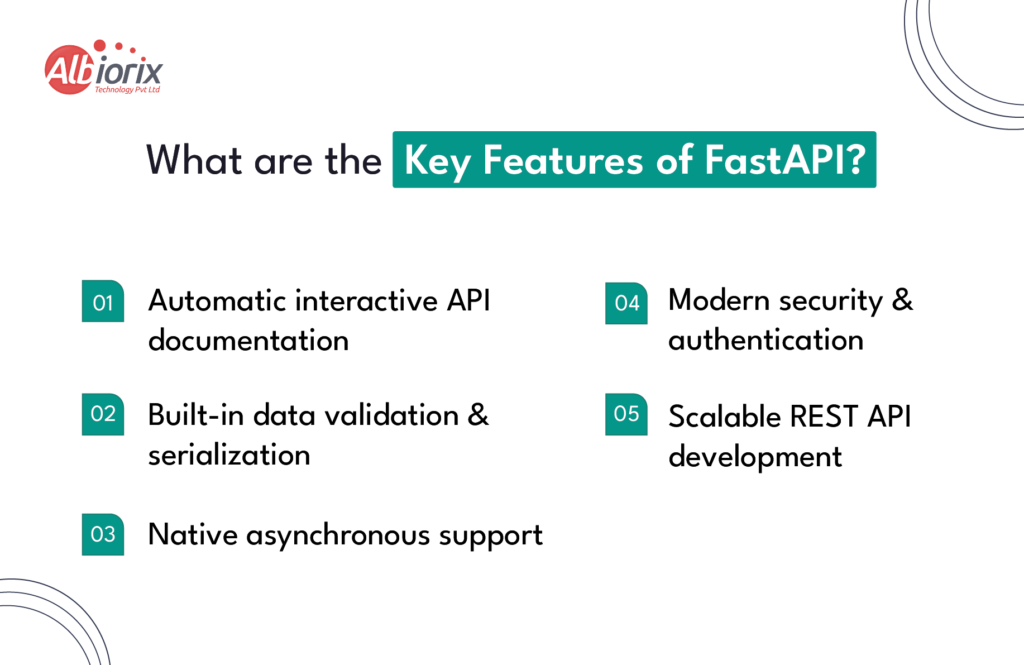
What are the Key Features of FastAPI

FastAPI is an API development framework designed and developed for efficiency, scalability, and boosting productivity. Its modern architecture easily aligns with modern cloud-native API requirements and high-performance backend systems.

Key FastAPI features include:

  1. FastAPI provides automatic interactive API documentation, which simplifies testing and improves collaboration between development teams.
  2. FastAPI uses Python type hints to enable built-in data validation and serialization with minimal manual coding.
  3. FastAPI offers native asynchronous support, which significantly enhances overall FastAPI performance in high-concurrency applications.
  4. FastAPI includes modern security and authentication capabilities that help protect API endpoints effectively.
  5. FastAPI supports scalable REST API development in Python, making it suitable for microservices and real-time applications.

What are the Pros of FastAPI?

According to the data online, FastAPI is one of the most preferred web API development frameworks in 2026.

As it can balance speed, productivity, and scalability, it is widely used to develop modern, scalable, and secure APIs for modern businesses and large organisations.

Key Pros of FastAPI include:

  1. FastAPI delivers excellent performance, making it ideal for high-traffic APIs and real-time applications.
  2. FastAPI accelerates development by automatically generating validation logic and API documentation.
  3. FastAPI supports asynchronous programming, which helps improve responsiveness and scalability.
  4. FastAPI works well for modern cloud-native architectures and scalable API ecosystems.

What are the Cons of FastAPI?

Despite the countless benefits of FastAPI, there are some cons to remember. The choice of FastAPI must be made based on the team working on the project and the project’s requirements.

Cons of FastAPI include:

  1. FastAPI has a smaller ecosystem compared to the long-established Flask framework.
  2. FastAPI requires understanding asynchronous programming concepts, which may challenge beginners.
  3. FastAPI has fewer legacy integrations than some older Python web frameworks.
  4. FastAPI evolves quickly, which may require periodic updates and adjustments.

What is Flask?

Flask is one of the most reliable and established Python web frameworks for API development. It is known for its simplicity, flexibility, and strong community support.

It is also called a microframework because it offers necessary web development tools without enforcing rigid project structures.

It is a lightweight framework that gives complete control over application architecture. This is the reason why most startups, enterprises, and tech experts choose Flask for prototypes, internal tools, and scalable APIs.

In many Flask vs FastAPI comparison discussions, Flask stands out due to its maturity. It has extensive documentation, a large developer community, and a wide range of third-party extensions.

Just as FastAPI is known for speed, Flask is known for reliability and accuracy. It is a dependable choice for REST API development in Python. Overall, Flask remains one of the most versatile and accessible Python web frameworks available today.

What are the Key Features of Flask?
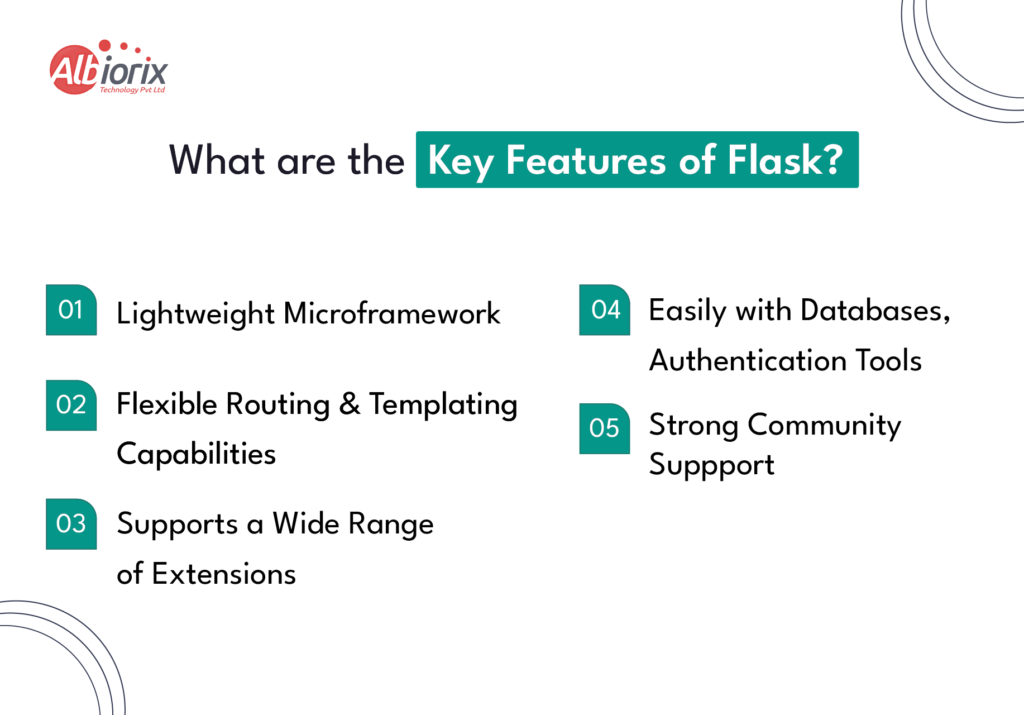
What are the Key Features of Flask

Flask is a modern API development framework that promotes simplicity, flexibility, and offers complete control. Because of these features, it is widely adopted for various web development scenarios.

Key features of the Flask framework include:

  1. Flask is a lightweight microframework that allows developers to build apps without any complexity.
  2. Flask offers flexible routing and templating capabilities to simplify application structure.
  3. Flask supports a wide range of extensions that can expand functionality as per the project’s needs.
  4. Flask integrates easily with databases, authentication tools, and third-party libraries.
  5. Flask has strong support from its community. It is much more than any other Python framework.

What are the Pros of Flask?

When it comes to developing a reliable and scalable API, Flask remains the first choice of Python developers. It prioritizes simplicity, flexibility, and easy customization.

Pros of Flask include:

  1. Flask is easy to learn and implement. It is a beginner-friendly framework.
  2. Flask provides high flexibility. It allows developers to customize application architecture.
  3. Flask has extensive documentation and strong community support.
  4. Flask works effectively for small to medium-scale REST API development in Python projects.

What are the Cons of Flask?

While Flask is reliable, certain modern performance requirements may highlight limitations.

Cons of Flask include:

  1. Flask may show lower performance compared to FastAPI in some fastapi vs flask benchmarks.
     
  2. Flask requires manual setup for some advanced features like validation and documentation.
  3. Flask has limited native asynchronous capabilities compared to newer frameworks.
  4. Flask scaling may require additional architectural planning for very large applications.

FastAPI vs Flask Comparison Table
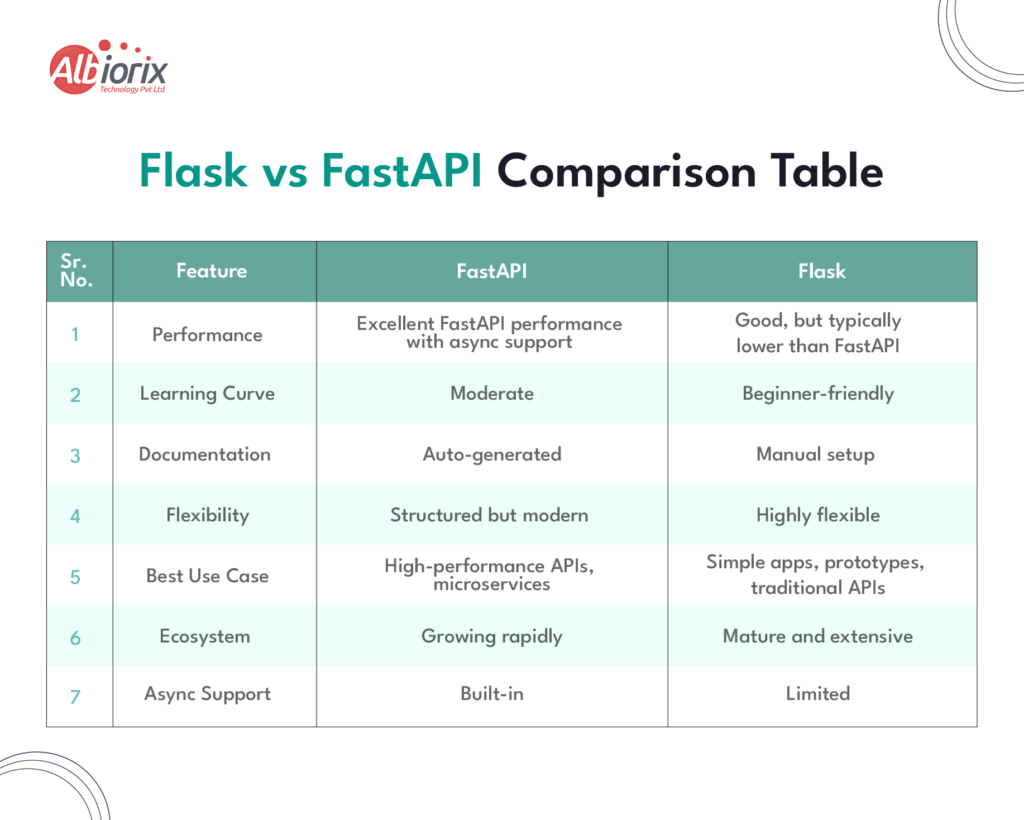
FastAPI vs Flask Comparison Table

What to Choose? Fast API vs Flask

In a comparison between Flask and FastAPI, the selection of the frameworks depends on many different factors. These factors are the type of project, your project goals, team expertise, and scalability.

The ongoing FastAPI and Flask comparison is not about proving one superior and another inferior. It is about selecting the right tool for your specific use case.

If your primary focus is scalability, performance, and automation, then FastAPI is the best choice. Its strong performance, built-in documentation, and modern async support make it highly suitable for microservices, cloud-native applications, and high-traffic APIs.

On the other hand, if you need a solution with high flexibility, simplicity, and rapid development, then Flask is the best alternative.

Its mature ecosystem, strong community, and ease of customisation make it ideal for startups, internal tools, and traditional API projects.

This Flask vs FastAPI comparison blog highlights that both frameworks have valuable roles within modern Python web frameworks.

Factors such as project complexity, development timeline, scalability needs, and team familiarity are some of the critical decisive factors.

Ultimately, choosing wisely ensures smoother REST API development in Python and long-term project success.

Planning an API Project? Let’s Choose the Right Framework Together

Whether you’re comparing FastAPI vs Flask or exploring Python web frameworks, our team can help you select, design, and implement the best API solution for your business goals.


Get in touch

API Development Services by Albiorix Technology

At Albiorix Technology, we specialise in custom API development for different industries and businesses. We use modern tools, scalable architectures, and industry-leading frameworks to deliver futuristic and powerful software solutions.

Our team has hands-on experience working with FastAPI, the Flask framework, and other advanced Python web frameworks to deliver secure, high-performance APIs.

It has been more than 10+ years since we have been helping businesses with robust API solutions for mobile apps, SaaS platforms, enterprise integrations, and cloud-native applications.

Whether you need high-speed APIs leveraging FastAPI performance advantages or flexible solutions built using Flask, our experts can guide you through the entire development lifecycle.

Why Choose Albiorix Technology for Custom API Development?
Why Choose Albiorix Technology for Custom API Development

Amid so many software development companies in India, what makes Albiorix Technology the best software development company? Well, there are many reasons.

With more than 10+ years of industry experience and powered by a team of 100+ seasoned developers, Albiorix Technology is one of the most reliable and steadily growing software companies in India.

We don’t just build custom software solutions for our clients; we develop digital solutions that power their dreams and ambitions.

Reasons to Choose Us for Custom API and Software Development:

  1. We help businesses save up to 30% on overall development costs.
  2. Due to our streamlined development approach, we develop solution 40% faster than others.
  3. We make sure our clients don’t receive any unexpected invoices. Pay for what you get.
  4. We develop software solutions that follow industry standards and compliances
  5. We allow you to handpick your team of developers with 100% control over them.
  6. Our software solutions are future-ready – ready to handle high traffic, security threats, and business challenges.
  7. We follow modern development trends for long-term maintainability that reduce post-launch maintenance efforts by 25%
  8. Our engagement models allow businesses to scale development teams.
Best Web Development Tools in 2026 for Modern Projects

In 2026, the best web development tools emphasize AI integration, performance, and streamlined, full-stack workflows. Leading tools include Next.js 15+, React, and Svelte 6 for frontend/full-stack, while PostgreSQL and Node.js remain top backend choices. AI-driven assistants like GitHub Copilot, Cursor, and Claude Code are essential for productivity, paired with VS Code.

Web Development Tools in 2026

With the in-depth penetration of digital transformation into every industry and business operation, the landscape of custom web development in 2026 is no longer about developing a simple online presence.

With more than 80% of businesses across the world depending on their website to find new customers and interact with them, a business website must be much more than just an online presence.

In 2026 and beyond, website development is all about creating more scalable, highly secure, futuristic, and AI-powered web solutions that drive results in real time. To achieve these results, you must know the best and latest web trends in 2026.

By choosing the best, trending, and future-proof web development tools (both backend and frontend tools), you will be able to have digital tools that will help your business grow, even in the toughest days.

Finding the right web development tools has become a strategic decision for businesses, startups, and developers alike.

A perfect combination of frontend and backend web development tools in 2026 will deliver a web solution that is great at performance, affordable, and ensures long-term ROI.

We are Albiorix Technology, and in this blog, we will discuss the most trusted and highly used web development tools in 2026.

We will provide a complete web development tools list, compare leading technologies, and help organizations/businesses identify the best tools for web development in 2026.

What Is a Web Development Tool?

A web development tool is any software, framework, library, or platform that helps developers build, test, deploy, and maintain web applications.

Every year, a new set of frontend and backend development tools is released in the market to meet the expectations of the audience.

Frontend Web Development Tools

The frontend web development tools are used to build the user interface (UI) and the user experience (UX).

Whatever users see in front of their eyes and interact with on the website is called the frontend of the website. These tools handle layouts, responsiveness, animations, accessibility, and performance while aligning with frontend framework choices.

Backend Web Development Tools

The backend web development tools are used to build and manage server-side logic, databases, APIs, business workflows, and much more.

It is the soul of the website that ensures proper functioning of all operations. They ensure data security, scalability, and seamless communication between the frontend and infrastructure.

In 2026, modern web development tools emphasize AI-driven development, cloud-native architecture, performance optimization, and security by design.

Web Development Tools Category List

To help you choose the most powerful toolkit for your project in 2026, here’s a complete table of web development tools across major categories:

Sr. NoCategoryTop 10 Tools (2026)
1Frontend Frameworks & LibrariesReact.js, Next.js, Vue.js, Angular, Svelte, Alpine.js, Preact, SolidJS, Astro, Lit
2CSS & UI ToolsTailwind CSS, Bootstrap 6, Material UI, Chakra UI, Ant Design, Bulma, DaisyUI, WindiCSS, Foundation, Figma
3Backend FrameworksNode.js, Express.js, Django, Laravel, Spring Boot, FastAPI, .NET Core, Ruby on Rails, Phoenix (Elixir), Koa.js
4API TechnologiesGraphQL, REST, gRPC, tRPC, Hasura, Apollo, PostgREST, Sanity, Strapi, Firebase
5DatabasesPostgreSQL, MySQL 9, MongoDB Atlas, Redis, DynamoDB, MariaDB, SQLite, CockroachDB, FaunaDB, Supabase DB
6DevOps & Deployment ToolsDocker, Kubernetes, GitHub Actions, Vercel, Netlify, Jenkins, CircleCI, Terraform, AWS CloudFormation, ArgoCD
7Testing & QA ToolsJest, Cypress, Playwright, Selenium, Mocha, Chai, PHPUnit, PyTest, Vitest, TestCafe
8Security & MonitoringSnyk, OWASP ZAP, Datadog, New Relic, Cloudflare WAF, Qualys, LogRocket, Sentry, Splunk, Checkmarx
9AI-Assisted DevelopmentGitHub Copilot, Tabnine, Replit AI, Codeium, AskCody, Codiga, MutableAI, CodeT5, DeepCode, Sourcegraph

Each of these tools plays a crucial role in modern workflows — from UI responsiveness and developer efficiency to enterprise-grade infrastructure and security.

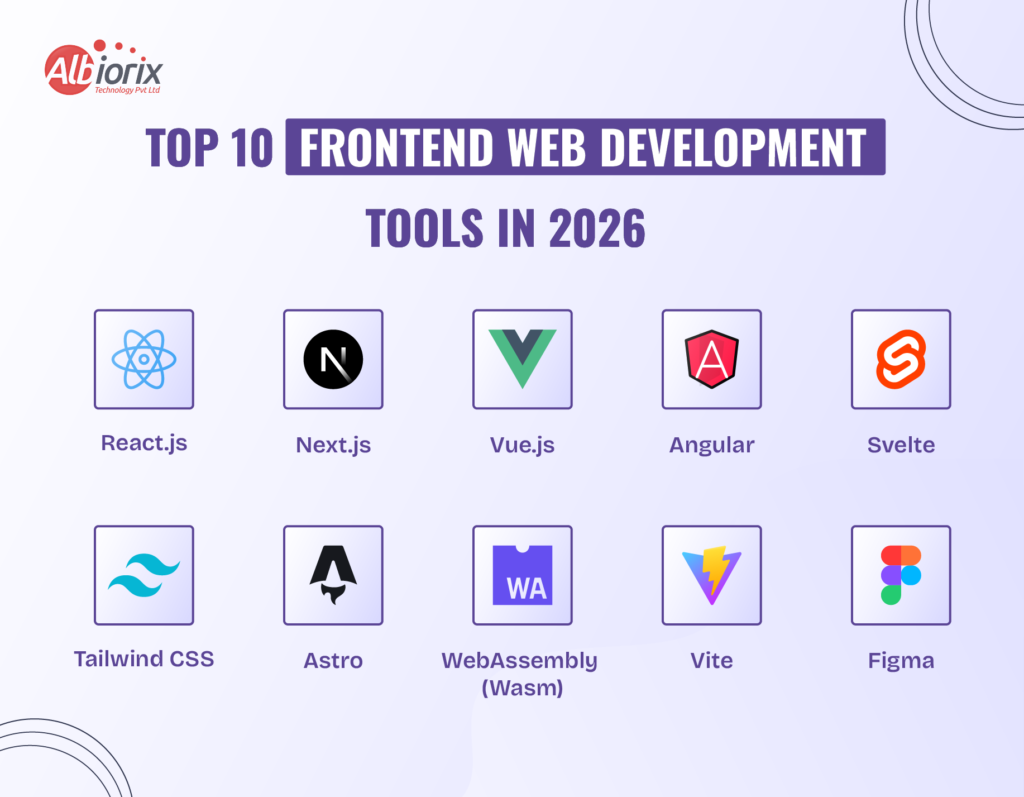
Top 10 Frontend Web Development Tools

Top 10 Frontend Web Development Tools

Frontend web development tools are rapidly evolving with time. In 2026, they are now driven by performance benchmarks such as Core Web Vitals, mobile-first indexing, and immersive user experiences.

  1. React.js: React is one of the most dominant frontend development tools. It powers more than 40% of modern web solutions globally. Its component-based architecture, virtual DOM, and massive ecosystem make it a top frontend web development tool in 2026.
  2. Next.js: Next.js is the second most dominant frontend web development tool. It is SEO-friendly and guarantees high-performing web apps in a very less time.
  3. Vue.js: Vue is also one of the most preferred front-end development tools in 2026. It is simple and scalable; therefore, it is the best web development tool for startups and big businesses.
  4. Angular: Businesses that are looking to develop enterprise-grade web solutions will choose Angular as their front-end tool. It has built-in security, TypeScript support, and scalable architecture which is perfect for large scale web solutions and Angular web development.
  5. Svelte: Svelte’s compile-time approach reduces runtime overhead, resulting in faster load times and smaller bundle sizes—an important ranking factor in 2026.
  6. Tailwind CSS: Tailwind CSS is a frontend development tool that helps in fast development. Its utility-first styling and rapid UI development helps build web solutions comparatively faster.
  7. Astro: Businesses that are looking for a content-driven and performance-first website will choose Astro in 2026. This frontend development tool focuses less on JavaScript and improves Lighthouse scores.
  8. WebAssembly (Wasm): WebAssembly enables near-native performance in browsers, making it ideal for complex, computation-heavy web applications.
  9. Vite: Vite has become the go-to build tool for modern frontend projects, offering instant server start and faster builds.
  10. Figma (Developer Handoff Tool): While primarily a design tool, Figma plays a critical role in frontend workflows by improving developer–designer collaboration and reducing UI inconsistencies.

Top 10 Backend Web Development Tools

Top 10 Backend Web Development Tools

Backend development in 2026 prioritizes scalability, cloud compatibility, API-first architecture, and security.

  1. Node.js: It is the most popular backend development tool in 2026. Most developers across the USA, India, and Australia use this tool to build powerful, scalable, and secure backends for web solutions.
  2. Express.js: It is one of the simplest yet most powerful backend development tools. It is built on top of Node.js and helps developers create APIs and backend services quickly.
  3. Django: It is the first choice of developers where they need high security and fast development by following backend best practices.
  4. Laravel: It is one of the widely used backend tools for PHP development. It makes coding easier and cleaner; therefore, it is the first choice for developers. It helps developers build applications faster with clean code.
  5. Spring Boot: It is one of the widely used backend development tools for large and enterprise-grade web applications. It is the first choice of businesses that need a web solution with high security, reliability, and scalability.
  6. Ruby on Rails: this backend development tool in 2026 is the favourite among startups and young entrepreneurs. Its clear structure and ready-to-use conventions help developers to build and launch applications faster.
  7. FastAPI: This backend development tool in 2026 will gain attention because of its speed and simplicity. It is best for developing applications that manage large volumes of data or are connected with AI or machine learning services.
  8. .NET Core: Owned and developed by Microsoft, this powerful backend technology allows developers to build web apps that run smoothly on different platforms. This backend development tool is preferred by businesses to build enterprise-grade web solutions with high performance.
  9. GraphQL: This backend tool is used to fetch only the data that an application needs. It helps in improving loading speed and makes frontend apps more efficient.

  10. Serverless Frameworks: Serverless tools let businesses run backend services without managing servers. They help reduce costs and automatically handle traffic spikes as applications grow.

Web Development Tools Comparison Table: How to Choose the Right Tech Stack

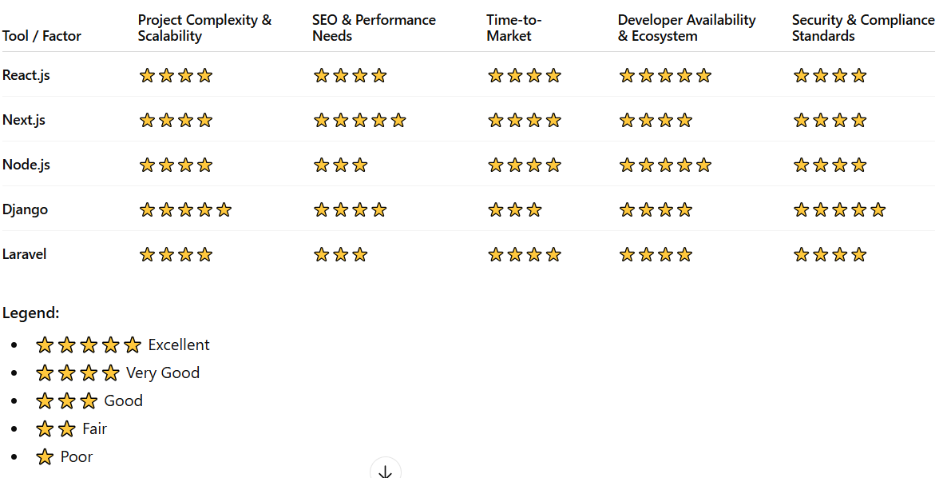
Choosing the right tech stack can make or break your project. The table below compares five leading web development tools using key decision factors for 2026:

Web Development Tools Comparison Table

What This Comparison Reveals:

  • Next.js is the ideal framework for those seeking a powerful, scalable, and SEO-friendly web solution. It is expected to dominate the market in 2026.
  • If your business needs highly secure web solutions, then Django is the best web development tool in 2026.
  • If you need a web solution that is powerful, engaging, attractive, and scalable, then the combination of React.js and Node.js is the best option. This combination will also accelerate the development process.
  • Laravel provides a balanced option for mid-sized projects aiming for rapid development without sacrificing security.

Emerging Trends in Web Development Tools

With the arrival of many new tools and technologies, the landscape of web development tools is rapidly evolving.

Looking at the current market trends, here we bring you the list of some of the most powerful and impactful tools that will shape 2026 and beyond, while reinforcing every web development best practice businesses need to stay competitive:

  1. AI-Assisted Coding Becomes Standard: With the entry of Artificial Intelligence, the use of AI tools like GitHub Copilot and Tabnine has become very common. These tools are developed to help developers write cleaner code with fewer bugs and errors. Moreover, these AI-powered tools are also known for boosting productivity.
  2. Cloud-Native & Edge Computing: With businesses requiring web solutions with very little loading time, tools such as Cloud-Native and Edge Computing are trending in the landscape of web development. These tools reduce latency and improve Core Web Vitals that are crucial for SEO in 2026.
  3. Low-Code & No-Code Integration: Over the last two to three years, the market has shifted towards the no-code and low-code strategies. It is because low-code and no-code enable rapid prototyping and allow non-technical owners to be stakeholders in the development process.
  4. Security-First Frameworks: The digital revolution has not only made it easy and fast to develop web solutions, but it has also increased the threats of online hacks. As a result, businesses are looking for highly secure web solutions, and as a result, tools such as Snyk and OWASP ZAP are in great demand.
  5. API-First & Microservices Architecture: API-driven architectures — powered by GraphQL and microservices — allow teams to scale individual components independently, improving maintainability and performance.

These trends in the web development landscape show a slow but steady shift towards intelligent automation, global scalability, and developer experience. This shift is to make sure businesses are getting future-proof web solutions.

Web Development Tools for Beginners

Web Development Tools for Beginners

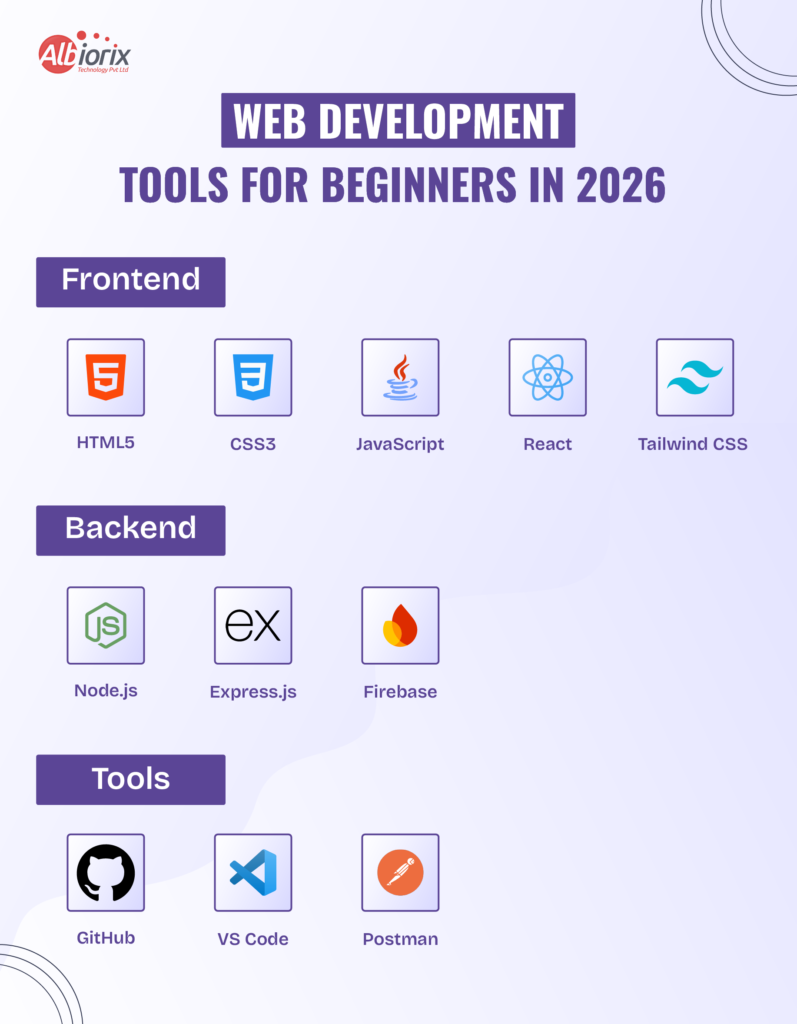
For those starting their journey, choosing beginner-friendly web development tools is crucial. Recommended tools for beginners:

  1. Frontend: HTML5, CSS3, JavaScript, React, Tailwind CSS
  2. Backend: Node.js, Express.js, Firebase
  3. Tools: GitHub, VS Code, Postman

These tools offer extensive documentation, community support, and real-world applicability—making them perfect web development tools for beginners in 2026.

Best Web Development Tools for Developers

In 2026, the best tools for web development are not going to be the ones that are popular, but the tools that are flexible, scalable, fast, and come with unbreakable community support.

Whether you are new to web development or an experienced web developers, always look for web development tools that support:

  • Rapid prototyping
  • Cross-platform performance
  • Scalability & maintainability
  • Security & compliance
  • Seamless integration with DevOps workflows

Web development tools like React.js, Next.js, Node.js, Django, and GitHub Actions are expected to be among the most preferred tools. These tools are known for delivering measurable business impacts.

In 2026, successful web solutions leverage tools that empower teams to innovate faster without compromising quality.

Conclusion

Choosing the best web development tools in 2026 is no longer about trends. It is about aligning technology with business goals—Contact Us to get expert guidance on selecting the right tools for your needs.

With the right frontend and backend tools, organizations can build future-ready web solutions that are fast, secure, scalable, and optimized for search engines and AI-driven discovery, including ecommerce web solutions.

If you need help selecting or implementing the right web development stack for your business, partnering with experienced web development professionals can make all the difference.

Top IT Companies in USA Driving Innovation in 2026

The United States of America is home to some of the most influential and top IT companies in the world. It is the reason why the USA is referred to as the hub of IT innovation.

There are thousands of software and tech companies across the United States that contribute to setting the trends in the digital world. In the list of the top 100 IT companies in the world, around 50 of the top IT companies will be from the USA.

From Silicon Valley to Austin, Seattle to New York, the country has built an ecosystem where innovation, venture capital, and world-class talent converge.

As of 2026, the USA software and tech companies are powering almost half of the world’s most valuable tech innovations.

But the questions arise, what are the aspects or factors that set the US IT companies apart from the other software development companies in the world? The IT companies in the USA are leaders in next-gen technologies.

Artificial intelligence, cloud computing, cybersecurity, Web3, and intelligent automation are not just trends here; they are foundational business drivers.

These trending and next-gen technologies are powering innovations in different industries such as healthcare, fintech, retail, logistics, real estate, education, and manufacturing, to name a few.

In this blog, we will list the top-ranked IT companies in the United States, and much more that can help you find the company best suited for your upcoming digital projects in 2026. So, let’s get started.

How We Rank the Top IT Companies in the USA

Before listing the top software development companies in 2026, businesses need to understand the criteria or factors we consider when ranking them.

From team size, years of industry experience, and the type of software solutions they provide, we rank IT companies on many different practical factors.

To ensure accuracy, credibility, and trustworthiness, our rankings follow a transparent and data-driven methodology.

  1. Innovation and R&D Investments: We evaluated how consistently each company invests in research, patents, emerging technologies, and next-gen product development.
  2. Market Capitalization and Revenue Growth: A company’s financial stability, year-over-year growth, and long-term market resilience are also decisive factors.
  3. AI and Cloud Adoption: One of the parameters for the rankings is AI and Cloud adoption. We analyze how deeply a company integrates these trending technologies into its products and services.
  4. Global Customer Base: A company with a global client base has the exposure to working on a wide range of IT projects for different industry clients.
  5. Security & Compliance: Priority was given to companies that demonstrate strong cybersecurity practices and regulatory compliance.

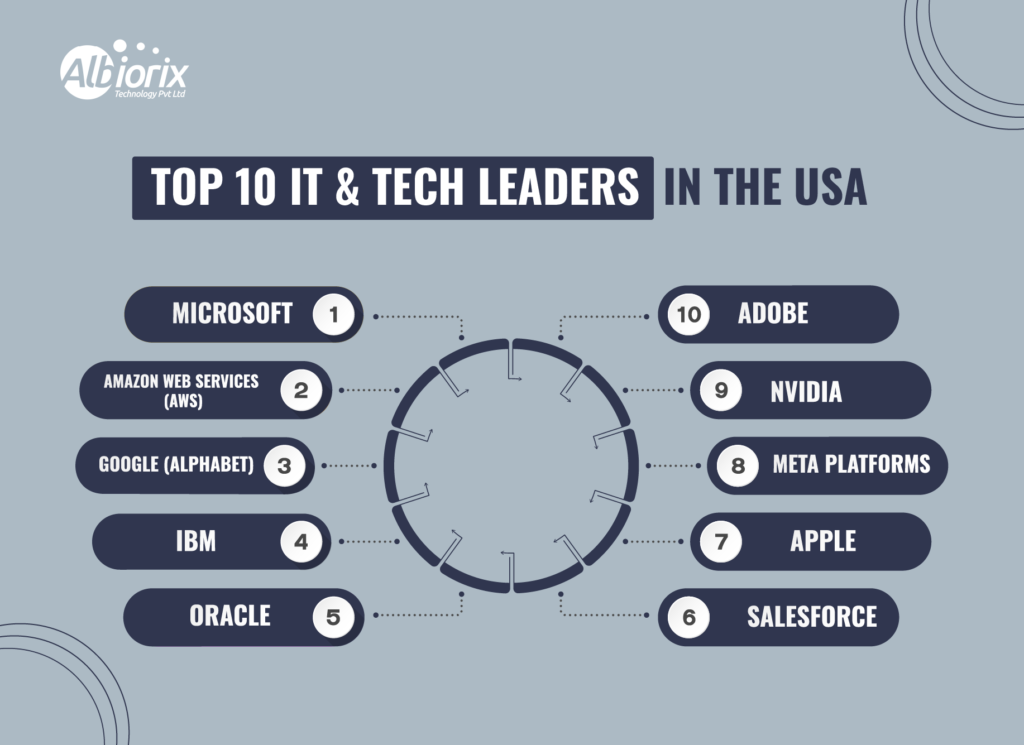
Top 10 IT and Tech Leaders in the USA

Top 10 IT & Tech Leaders in the USA

The top IT companies in the USA, including Microsoft, AWS, Google, and Apple, dominate enterprise software, cloud infrastructure, AI development, and global digital platforms, setting benchmarks for innovation and scalability.

  1. Microsoft: A global technology leader driving enterprise software, AI innovation, and scalable cloud solutions through Azure and Microsoft 365.
  2. Amazon Web Services (AWS): The world’s largest cloud computing platform, powering millions of startups, enterprises, and government organizations.
  3. Google (Alphabet): A pioneer in AI, search, data analytics, and cloud infrastructure with a strong focus on intelligent automation.
  4. IBM: A trusted enterprise technology company specializing in hybrid cloud, AI, and mission-critical business systems.
  5. Oracle: A leading provider of databases, enterprise software, and cloud infrastructure for global organizations.
  6. Salesforce: The world’s top CRM platform, enabling businesses to manage customers, sales, and data-driven engagement.
  7. Apple: A technology innovator known for its integrated ecosystem of hardware, software, and developer platforms.
  8. Meta Platforms: A digital leader redefining social interaction through immersive technologies, AI, and Metaverse innovation.
  9. Nvidia: The backbone of modern AI, powering machine learning, data centers, and next-generation computing.
  10. Adobe: A creative and digital experience powerhouse offering cloud-based design, marketing, and content solutions.

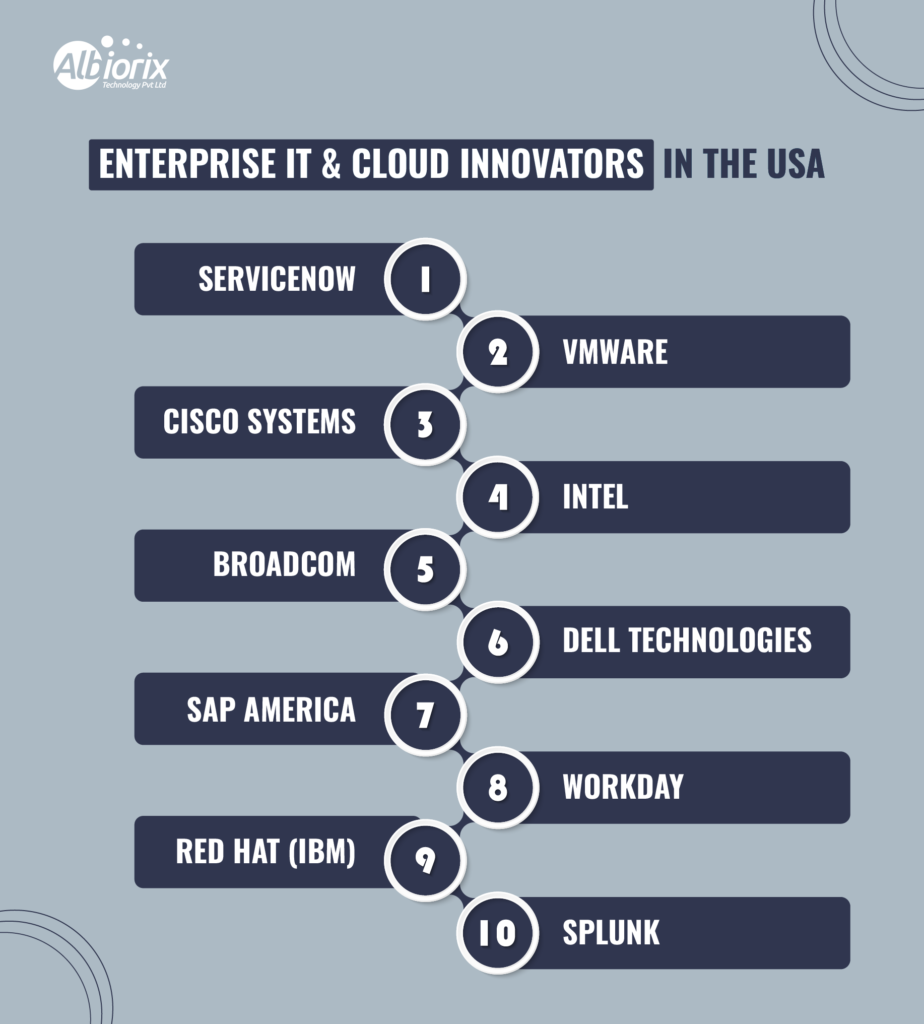
Enterprise IT and Cloud Innovators in the USA

Enterprise IT & Cloud Innovators in the USA

Enterprise IT and cloud innovators focus on workflow automation, virtualization, networking, data security, and ERP systems, helping large organizations modernize operations and improve digital resilience.

  1. ServiceNow: A leading workflow automation platform that streamlines enterprise operations using AI-powered solutions.
  2. VMware: A pioneer in virtualization and hybrid cloud technologies for modern IT infrastructures.
  3. Cisco Systems: A global leader in networking, cybersecurity, and enterprise connectivity solutions.
  4. Intel: A semiconductor giant driving innovation in AI processors, data centers, and edge computing.
  5. Broadcom: A key provider of enterprise-grade chipsets, networking, and software infrastructure.
  6. Dell Technologies: A trusted name in enterprise hardware, cloud systems, and data-driven infrastructure.
  7. SAP America: A market leader in ERP and enterprise application software for large-scale businesses.
  8. Workday: A cloud-native platform delivering HR, finance, and workforce management solutions.
  9. Red Hat (IBM): A leading open-source software provider powering hybrid cloud and enterprise Linux platforms.
  10. Splunk: A data analytics and cybersecurity firm specializing in machine data and real-time intelligence.

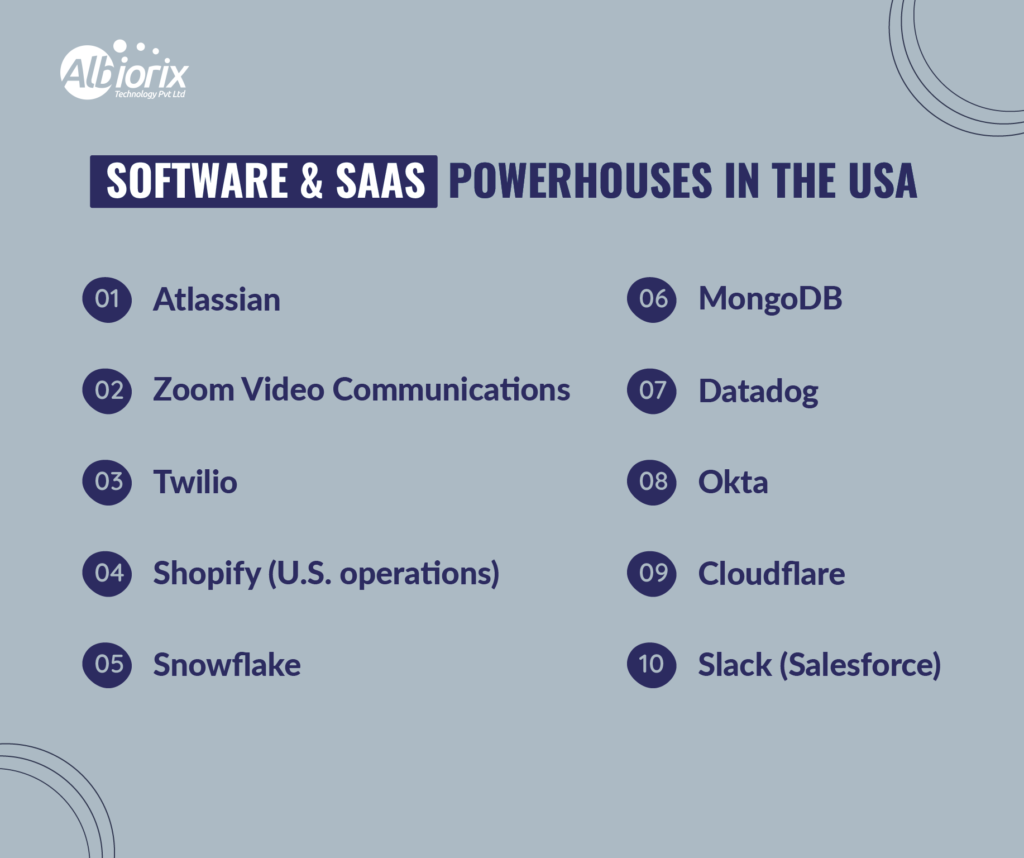
Software and SaaS Powerhouses in the USA

Software & SaaS Powerhouses in the USA

SaaS and software leaders in the USA specialize in collaboration tools, data platforms, cloud communications, and identity management, enabling faster deployment, lower costs, and scalable digital operations.

  1. Atlassian: A productivity software company empowering agile teams through DevOps and collaboration tools.
  2. Zoom Video Communications: A global leader in cloud-based video, voice, and collaboration platforms.
  3. Twilio: A communications API platform enabling developers to build real-time engagement experiences.
  4. Shopify (U.S. operations): A leading e-commerce platform helping businesses sell, scale, and grow online.
  5. Snowflake: A cloud-native data platform enabling secure and scalable data warehousing.
  6. MongoDB: A modern NoSQL database platform built for high-performance applications.
  7. Datadog: A monitoring and observability platform for cloud-scale applications and infrastructure.
  8. Okta: A leading identity and access management provider for secure digital experiences.
  9. Cloudflare: A global network enhancing web performance, security, and reliability.
  10. Slack (Salesforce): A real-time collaboration platform built for modern workplace communication.

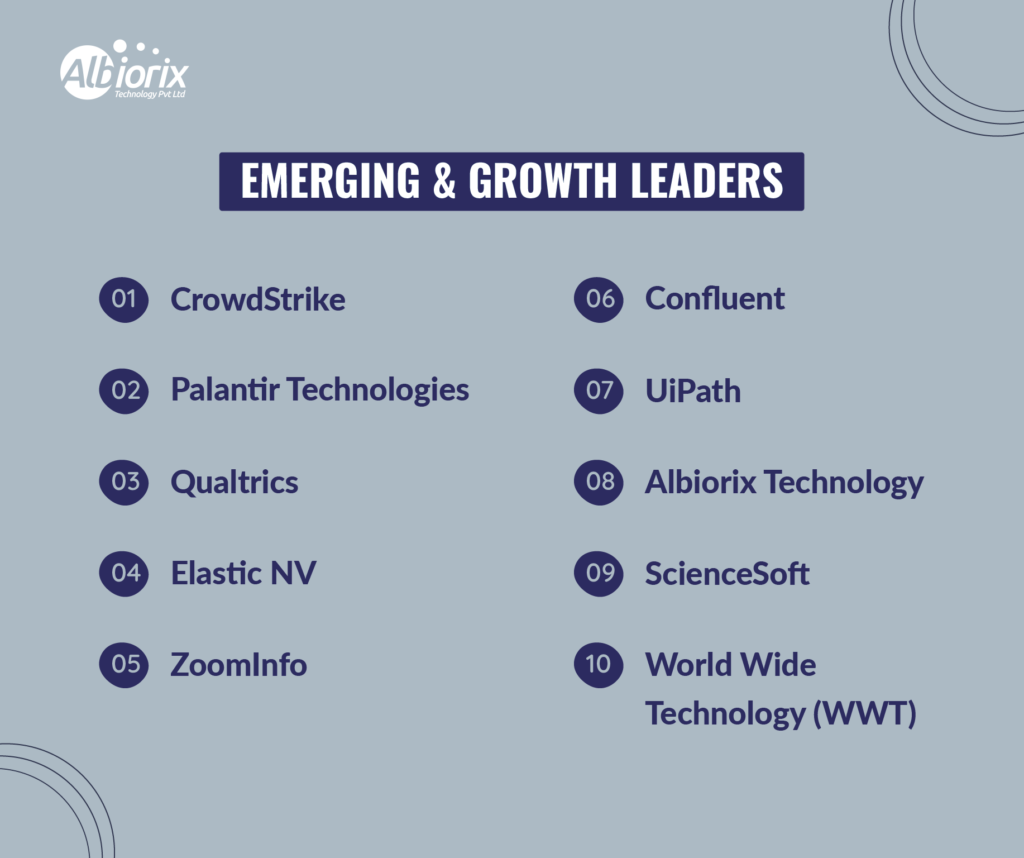
Emerging and Growth Leaders

Emerging & Growth Leaders

Emerging IT companies in the USA are gaining momentum through AI-first products, automation platforms, real-time analytics, and cybersecurity innovation, offering agile and industry-focused solutions.

  1. CrowdStrike: A cybersecurity leader protecting enterprises through AI-powered endpoint security.
  2. Palantir Technologies: A data analytics company helping organizations make intelligence-driven decisions.
  3. Qualtrics: An experience management platform capturing customer, employee, and brand insights.
  4. Elastic NV: A search and analytics company known for the Elasticsearch platform.
  5. ZoomInfo: A B2B intelligence platform delivering sales, marketing, and recruitment data.
  6. Confluent: A real-time data streaming platform built on Apache Kafka.
  7. UiPath: A robotic process automation (RPA) company driving AI-powered automation.
  8. Albiorix Technology: A leader in advanced AI solutions, intelligent software and web solutions.
  9. ScienceSoft: A global IT consulting and software development firm serving enterprises.
  10. World Wide Technology (WWT): A technology integrator delivering enterprise IT and digital solutions.

Fast-Growing Mid-Tier IT and Tech Firms

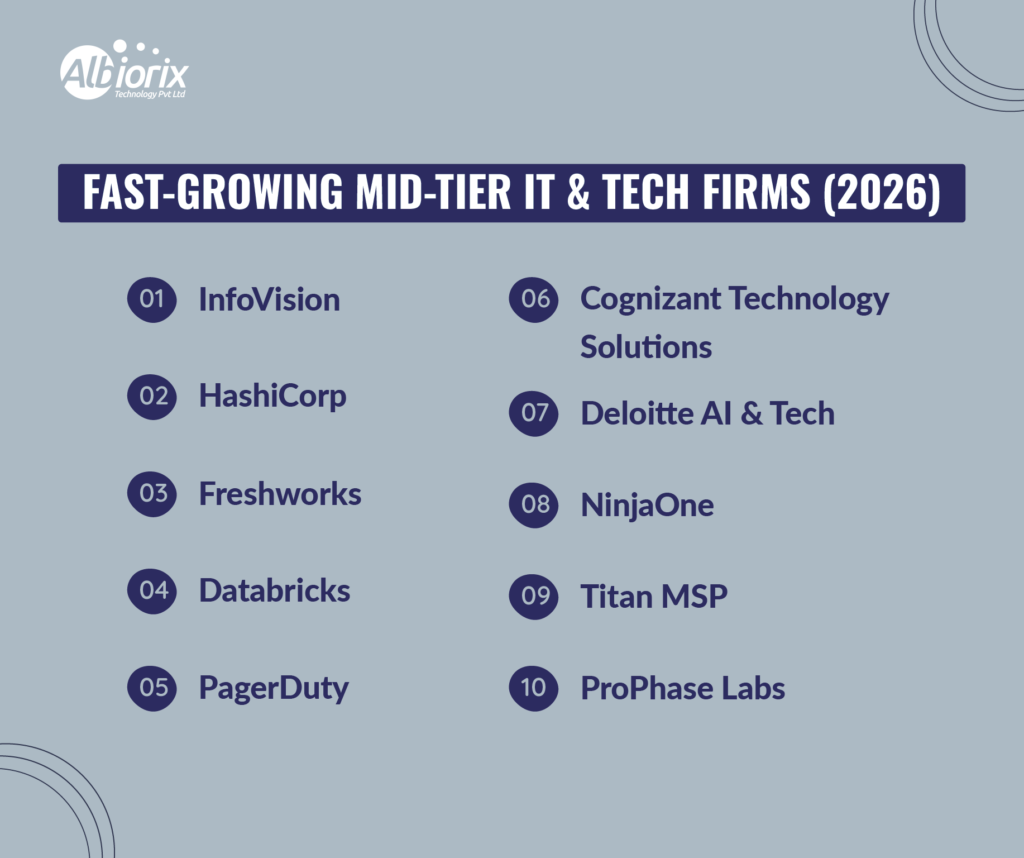
Fast-Growing Mid-Tier IT & Tech Firms

Fast-growing mid-tier IT firms are bridging the gap between startups and enterprises by delivering cost-effective, cloud-native, and AI-powered digital transformation services.

  1. InfoVision: A digital transformation company focused on cloud, data, and AI modernization.
  2. HashiCorp: A cloud automation company enabling infrastructure as code and DevOps workflows.
  3. Freshworks: A SaaS company offering AI-driven CRM, support, and business software.
  4. Databricks: A unified analytics platform combining data engineering and machine learning.
  5. PagerDuty: A digital operations platform for real-time incident response and automation.
  6. Cognizant Technology Solutions: A global IT consulting firm specializing in digital engineering and transformation.
  7. Deloitte AI & Tech: A consulting powerhouse delivering enterprise-grade AI and automation solutions.
  8. NinjaOne: An endpoint management platform simplifying IT operations.
  9. Titan MSP: A managed IT services firm focused on cybersecurity and cloud services.
  10. ProPhase Labs: A technology-enabled services company supporting business growth and transformation.

Conclusion

US-based IT companies remain global leaders by continuously innovating across AI, cloud, cybersecurity, and enterprise software, making them preferred partners for businesses and professionals worldwide.

2026 marks a year where cloud platforms, AI innovation, and agile software services define business success.

Whether you’re choosing partners, recruiting talent, or just exploring industry leaders, this USA IT company list 2026 gives you a strategic advantage. If you need help evaluating options or finding the right fit, Contact Us for expert support.

Looking for tailored recommendations — like top AI development partners or enterprise software vendors in a specific industry?

Top 10 Best Web Development Trends In 2026

Custom website development is considered the backbone of the IT industry. It is the process of developing custom websites for businesses and web application development that meet different business purposes and objectives.

We are officially into 2026, and this year is looked upon as a year of drastic evolution in the landscape of custom website development.

This evolution will be powered by state-of-the-art technologies such as metaverse, AI, blockchain, and IoT, to name a few, aligned with web development trends.

Looking at the current market scenarios and growth speed, the global web development market is expected to reach $124 billion by 2030.

This growth will be powered by trending technologies like AI integration, no-code/low code, and the expansion of serverless architecture, PWAs, and more, influenced by software development trends.

In this blog, we will talk about web development trends that will shape the industry in 2026 and beyond.

If you are a business owner or a part of the IT industry, then you must stay prepared to embrace these web development trends in 2026 for the best results in website development, mobile app development, and custom software development.

So, let’s talk about web development trends in 2026!

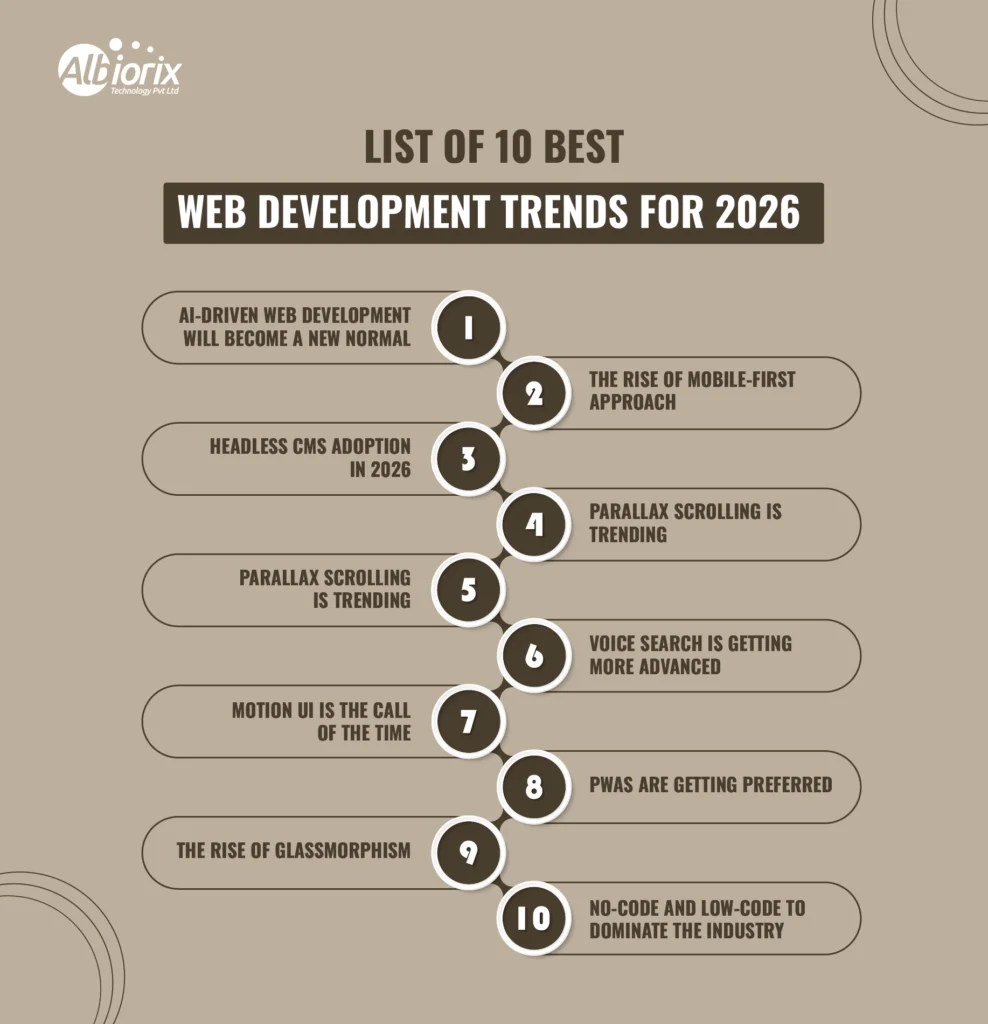
List of Top 10 Web Development Trends in 2026

List of Top 10 Web Development Trends in 2026

Below is the list of web development trends that will shape the industry in 2026 and beyond!

1. AI-Driven Web Development Will Become a New Normal

Well, if you look at the use of Artificial Intelligence in current web, mobile and software solutions, then you will understand that AI is here to stay for a long time.

Thus, Artificial Intelligence is going to become the new normal in the web development industry, similar to patterns seen in digital transformation trends.

AI is expected to shape 2026 with deep integrations in the development lifecycle. Instead of building every component manually, many businesses are using systems that can automate code generation, testing, optimization, and UI creation.

According to a survey by McKinsey, the results showed that more than 44% of companies plan to use AI to assist with development workflows. These numbers are expected to rise by 60% by 2026.

The increasing use of AI-powered tools such as IDEs, generative UI builders, smart debugging tools, and automated QA systems is helping developers build websites much faster with fewer errors.

Below are some of the top use cases:

  1. It can auto-generate UI components as per the guidelines
  2. It can assist in code refactoring
  3. It can provide the performance score before launch
  4. It can automate accessibility audits
  5. It can fix SEO issues to better rankings in SERPs.

There’s a misinterpretation that AI will replace humans. But, in this case, artificial intelligence will not replace humans; it will amplify their capacities, save time and effort.

In 2026 and beyond, AI and automation in web development will become the new normal for businesses seeking to develop highly scalable and intelligent websites.

2. The Rise of Mobile-First Approach

In 2025, more than 87% of the world population is using smartphones, which roughly estimates around 7.1 billion to 7.3 billion people.

This data clearly proves that we live in a world driven by smartphones, where more than 80% of users access the internet through their smartphones.

According to a report released by Stocklytics, in 2025, mobile web traffic soared to 62.7% 2025, approximately 10% higher than the previous year.

Thus, if you are a business looking to develop a website in 2026, then your web solution must be optimized for smartphone users across the globe.

This extremely high usage of smartphones also indicates that along with a website, your business must also have a mobile to ensure success. To make sure, your website solution is mobile friendly, you must:

  1. Add CSS queries to make sure screen elements adjust per the device
  2. Focus more on vertical screen orientations
  3. Have meta viewport tags that can rescale the websites
  4. Use web layout models like Flexbox

The mobile-first trend is also here to stay because smartphones are never going to go out of fashion. Thus, businesses should ensure their websites are mobile-friendly.

3. Headless CMS Adoption in 2026

To accommodate the changing needs of the end-users, companies are not shifting from old CMS systems to headless CMS platforms.

According to a report published by Storyblok, more than 80% of companies are using headless CMS for faster development and content flexibility.

Headless CMS Adoption is Exploding because:

  1. It allows content to be pushed to apps, websites, smart devices, etc.
  2. It allows developers to choose the front-end framework of their choice.
  3. It reduces the website’s load time.
  4. It helps the marketing team in promoting the content without disturbing the code.

This website development trend is now powering some of the high-performing websites on the web. It is the first choice of websites, such as eCommerce websites and media platforms, where flexible content systems are required.

Thus, it is among the top 5 web development trends in 2026.

4. Parallax Scrolling is Trending

It is the latest trend in the world of custom website development. Parallax Scrolling means the content in the background of a webpage moves at a separate speed that the content in the foreground while scrolling.

It is complicated for developers to add parallax scrolling on the webpage; especially for mobile devices. It is because most mobile screens do not support parallax scrolling yet.

However, it will not stop website developers from adding parallax scrolling to new websites and web applications.

5. Integration of Chatbots 2.0 in Websites

With the arrival of Artificial Intelligence, the use of Chatbots has increased drastically. The chatbots allow businesses to offer customer support services around the clock without any deep human intervention.

In 2025, chatbots are used to offer support services in banking, sales, online shopping, requirement gathering, and more. In a short span of time, chatbots have evolved a lot and become an indispensable part of many businesses.

AI-powered chatbots are becoming smart and intelligent with every past conversation. The use of AI, ML DL, and NLP have enhanced their potential to handle complex conversations with humans. These are the reasons; they do not require regular training or upgrades.

6. Voice Search is Getting More Advanced

The next big web development trend to follow in 2026 is Search by Voice. The voice search feature was first introduced by Google to help people find the exact services/products/information without typing any lengthy keywords or phrases.

In 2026, the Voice Search is looked upon as one of the core features of the website. There are virtual assistants like Apple Siri, Google Voice Search, and Amazon Alexa, to name a few, to boost the voice search features.   

According to information available over the web, nearly half of all online searches are done by voice – especially from smartphones and smart speakers. More than 71% of users prefer voice search over typing lengthy quotes as it is fast and convenient.

7. Motion UI is the Call of the Time

Motion UI is the call of the time because modern web users are expecting a fluid and intuitive experience without sacrificing usability. Motion UI is the first choice of many industries.

According to a report published by Almanac, more than 68% of websites added motion UI (micro animations or motion animations) on their website and observed approximately a 20% rise in web traffic.

Capabilities of Motion UI are:

  1. It can add micro animations
  2. It can add smooth transitions
  3. It can add scroll-triggered effects
  4. It can add interactive icons
  5. It can add hover-based behavior

As it offers an engaging and personalized experience to web users, this trend is among the most popular web development trends in 2026. It is highly preferred by SaaS websites, eCommerce websites, and Consumer-facing websites to influence audiences.

8. PWAs are Getting Preferred

The full form of PWA is Progressive Web Apps. It is one of the youngest web development trends in 2026. However, it is getting stronger with time. It is gaining popularity among large businesses and organizations.

Modern businesses love PWAs because they offer the best of both worlds. It provides the flexibility of traditional apps and the user-friendliness of standalone apps. Additionally, PWA apps can be used even without an active internet connection on any device.

Because of the benefits it offers, most of the web development experts believe that PWAs will someday completely replace the standard web apps in use today.

9. The Rise of Glassmorphism

The world of custom web development is evolving at a very fast pace, and it is becoming increasingly competitive. Developers and designers are constantly looking for new ways to impress their clients with innovative solutions.

In this race to stand out, several new and creative design features have been introduced—and one of them is called Glassmorphism.

Some developers and designers also refer to it as glass texture. This design style adds depth and visual richness to web interfaces. It allows designers to create web solutions that give users the feeling of looking through frosted or transparent glass.

Glassmorphism was first introduced by Apple in 2020, followed by Microsoft, and this trend is expected to grow significantly in 2026.

The main reason behind its popularity is that it makes UI elements like sliders, buttons, and cards stand out while maintaining a clean and modern look.

10. No-Code and Low-Code to Dominate the Industry

As the digital world is revolutionizing very fast, the use of no-code and low-code tools are rising rapidly.

According to a report by Research from Gartner, 75% of new web applications by 2027 will be powered by no-code and low-code platforms. This is a huge prediction for any tool.

No-code and Low-code tools will be used to develop:

  1. Landing pages
  2. Internal tools
  3. Automated Workflows
  4. Business dashboards
  5. ECommerce prototypes

Some of the most popular no-code and low-code platforms in 2026 are Bubble, Wix studio, Webflow, and framer.

This trend is not expected to replace custom web development in 2026, but it will surely speed up the development process with less errors.

Conclusion

No matter what trends come and go, the process of custom website development is and will remain a complex task for someone who is not that tech-savvy. If you need expert support to simplify the process, Contact Us to get the right guidance and solutions.

Albiorix Technology has experience delivering future-ready solutions across industries, including insights gained from platforms like sports betting apps.

Thus, if you feel like you’re confused or have questions in your mind, get them cleared today! Talk to our experts, discuss the feasibility of your idea, and get a free quotation instantly.

We offer web development services at a global level – we have clients from major parts of the world, including the US, UK, Europe, and Australia.

A Complete Guide To Website Development Process

Summary: The website development process is a structured seven-stage framework that transforms an initial concept into a high-performance live site. It encompasses everything from strategic planning and UI/UX design to front-end coding, rigorous testing, and final deployment. Following this systematic approach ensures your site is mobile-responsive, user-friendly, and perfectly aligned with your business goals.

We live in a digital-driven world, and in this world, you will need a solid digital presence for your business to ensure success, especially when aligned with modern web practices.

Along with the social media presence, you will also need a solid online presence where you can showcase all your services, products, and engage with your customers.

This is where a powerful, engaging, and intuitive website comes into play by following web development best practice.

A website is no longer just an online presence. In 2026, a business website will be your growth engine, a brand storyteller, and a conversion platform.

You will need a custom-made business website that meets your goals, exemplifies your business ethics, and reflects your company’s culture.

And, to develop a business website that meets all your requirements, you must understand how an engaging, intuitive, and SEO-friendly website is developed in 2026 using frontend frameworks.

The process of website development in 2026 is a bit different from the traditional one. Understanding the website development process is critical for businesses that want scalable, secure, and future-ready digital products.

Every step in the website development life cycle plays a strategic role in determining success – from ideation to optimization.

This in-depth website development guide breaks down the stages of website development, explains the types of websites, highlights essential website elements, and shows how custom websites deliver long-term value.

The goal is simple: help you make smarter, ROI-driven decisions while aligning with modern search behavior and Google’s EEAT (Experience, Expertise, Authoritativeness, Trustworthiness) standards.

What Is the Website Development Process?

Just as there is a standard development process for building anything, there’s also a detailed and defined website development process. This process is a structured framework that transforms business ideas into a fully functional digital platform.

A website development life cycle blends strategy, design, engineering, and optimization into a repeatable and measurable workflow, often supported by AI web development.

Unlike ad-hoc development, a mature process focuses on:

  1. Business objectives and user intent alignment
  2. Scalable architecture and performance optimization
  3. Security, compliance, and accessibility
  4. Search visibility and content discoverability
  5. Continuous improvement through data and feedback
  6. Long-term maintainability and flexibility

When the process is followed exactly and executed correctly, it reduces the risk of failure, reduces overall development costs, and reduces the time to market.

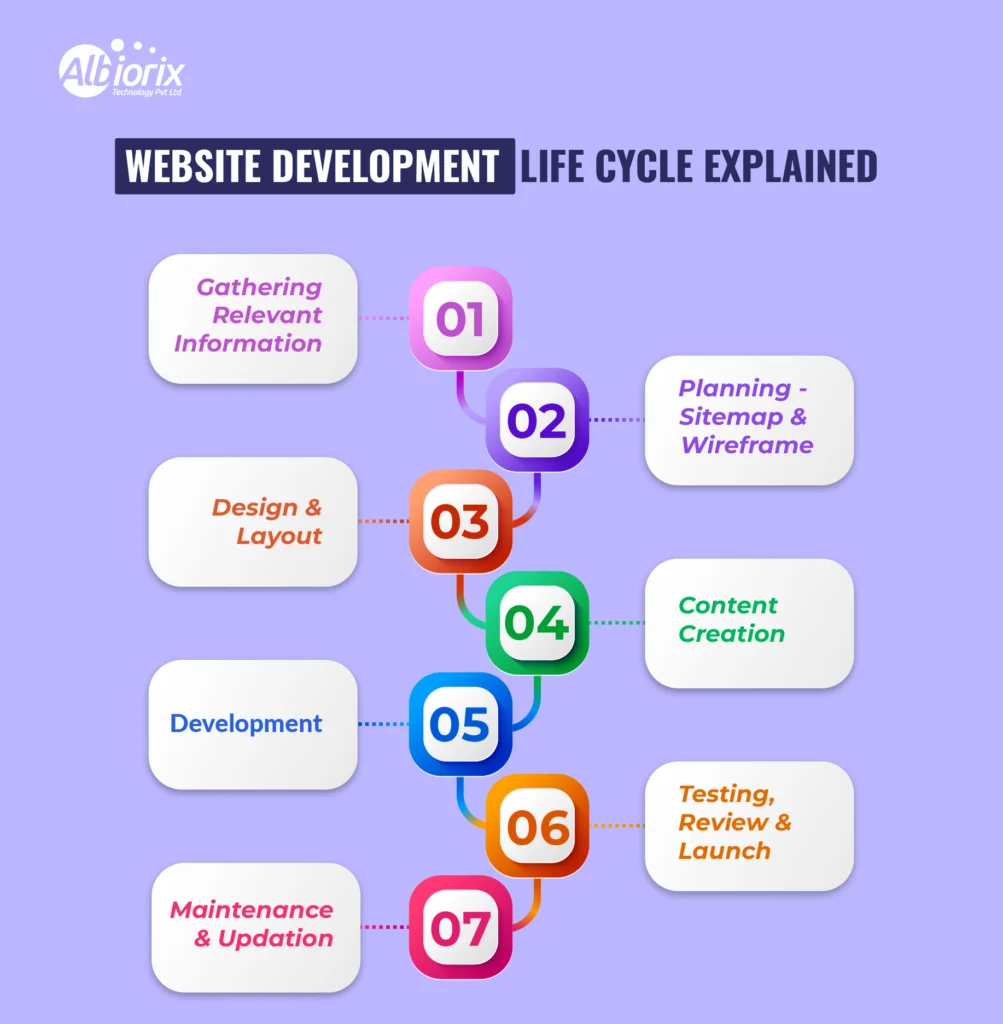
Website Development Life Cycle Explained

Website Development Life Cycle

The website development lifecycle outlines the process by which an idea is transformed into a fully functional digital business presence. This process from concept to execution is known as the website development life cycle.

Each phase in website development is built on the previous one to ensure clarity, accountability, and quality at scale.

Discovery and Requirement Analysis (Foundation Stage)

This is the most critical stage of the website development life cycle. In this initial step, critical decisions are made that directly impact performance, scalability, and cost of the website.

Key activities include:

  • Business goal identification and KPI mapping
  • Target audience and user persona research
  • Competitor and market analysis
  • Functional and non-functional requirement gathering
  • Technology stack evaluation using Angular frameworks
  • SEO and content architecture planning

A strong discovery phase ensures your custom website is built for real users—not assumptions.

Information Architecture and Planning (Structural Stage)

Once all the details are gathered and your business objectives are clear, it’s time to move to the next step of website development. This step is called structuring the experience.

This phase focuses on:

  • Sitemap creation and page hierarchy definition
  • User journey mapping and conversion paths
  • Navigation logic and internal linking strategy
  • Content placement aligned with search intent
  • Scalability planning for future features
  • Performance and load optimization planning

When a website’s architecture is developed on well-planned information, a website has great scalability, crawlability, usability, and ranking potential.

UI/UX Design (Experience Stage)

Back in 2010, website design was all about selecting fancy color combinations. Now, in 2026, the definition of website design has changed completely. It’s more than aesthetics. It is about behavior, trust, and usability.

In this step of the website development lifecycle, you need to concentrate on creating intuitive, engaging, and accessible experiences. You need to design an experience that sets up your website apart from competitors.

Key deliverables include:

  • Wireframes and interactive prototypes
  • Mobile-first and responsive layouts
  • Brand-consistent visual systems
  • Accessibility and usability standards compliance
  • Conversion-focused design patterns
  • Micro-interactions and engagement elements

The ultimate goal of modern custom websites in 2026 and beyond is to prioritize clarity, speed, and emotional connection.

Website Development and Engineering (Build Stage)

In this phase of the website development process, the strategy and design are moulded into a working digital product.

In this step, a team of website developers and software developers work together on the front-end and back-end of the website using Angular web development.

Core development activities include:

  • Front-end development using modern frameworks
  • Back-end logic and database architecture
  • CMS or headless CMS integration
  • API and third-party service integration
  • Security best practices implementation
  • Performance and code optimization

A robust development approach and agile development method ensure your website is fast, secure, and future-proof.

Testing and Quality Assurance (Validation Stage)

Once the backend and frontend of the website is engineered, it’s time to test the functions of the website with the real users.

The team of QC experts tests all the features, performance, user experiences, and functionalities of the website to ensure optimum functioning.

Testing typically covers:

  • Functional and regression testing
  • Cross-browser and cross-device compatibility
  • Page speed and performance audits
  • Security and vulnerability testing
  • Accessibility and compliance checks
  • SEO readiness and indexing validation

This stage protects brand credibility and reduces post-launch risks.

Deployment and Launch (Go-Live Stage)

After thorough testing of the website, it’s time to make it live and monitor the performance.

Launch activities include:

  • Production server configuration
  • Domain and hosting setup
  • SSL and security hardening
  • Analytics and tracking integration
  • Search engine submission and indexing
  • Final performance validation

A well-managed launch ensures a smooth transition with minimal downtime.

Maintenance, Optimization, and Growth (Evolution Stage)

Once the website is launched, it’s time to monitor it in terms of different parameters. You must monitor, maintain, and optimize your website continuously to ensure 100% uptime. Continuous improvement is essential for sustained performance.

Ongoing activities involve:

  • Content updates and SEO optimization
  • Performance monitoring and tuning
  • Feature enhancements and scalability upgrades
  • Security patches and compliance updates
  • UX improvements based on analytics
  • Conversion rate optimization (CRO)

This final stage turns your website into a long-term digital asset.

Types of Websites Built in 2026

Types of Websites

There are types of businesses that require different types of websites as per their end goals and objectives.

The layout, design, and functionalities of an ecommerce website cannot be similar to a healthcare website, especially when building eCommerce web solutions.

They are totally different and demand different types of functionalities to meet their industrial requirements.

Thus, it is important that you choose the right structure and functionalities of the website as per your industry and business requirements.

Each type serves a distinct purpose—from brand building to revenue generation—and plays a specific role within the broader website development process.

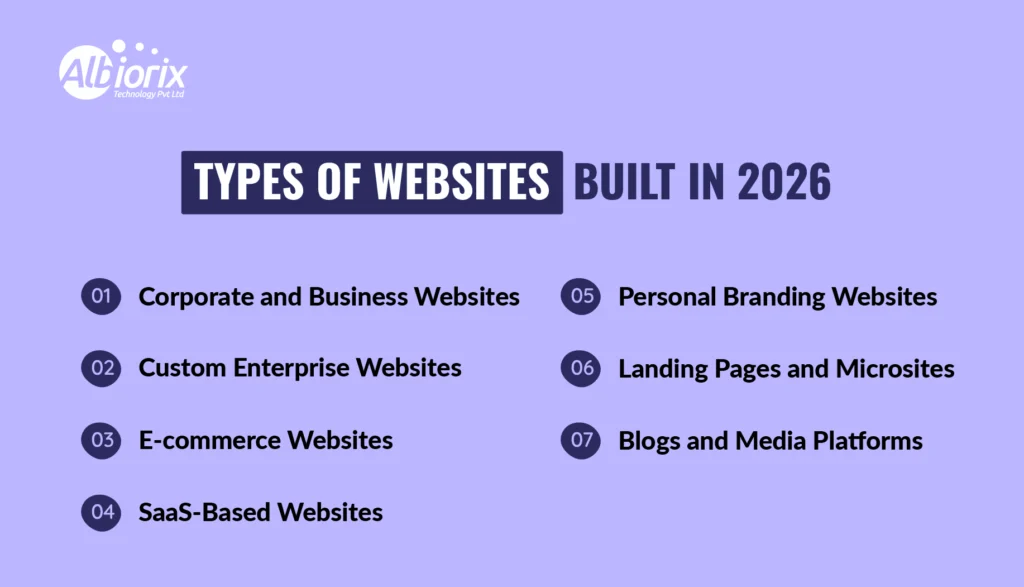
Common types of websites in 2026 include:

  1. Corporate and Business Websites: These websites are designed and developed to establish the credibility of a business. Its purpose is to communicate the brand values to the audiences, partners, and stakeholders.
  2. Custom Enterprise Websites: These types of websites are built for complex workflows, integrations, and scalability. They are designed and developed to support large organisations with advanced operational needs.
  3. E-commerce Websites: These are shopping platforms focused on online transactions, product management, payment gateways, and seamless customer purchase journeys.
  4. SaaS-Based Websites: These types of websites are developed to explain software value propositions, onboard users, and drive subscriptions or demos efficiently.
  5. Personal Branding Websites: These types of websites are built by professionals and creators to showcase expertise, projects, and achievements compellingly.
  6. Landing Pages and Microsites: These types of websites are built for conversions, promotions, and short-term marketing campaigns. They are also called Purpose-driven web pages.
  7. Blogs and Media Platforms: These types of websites are developed to educate, inform, and attract audiences through consistent, SEO-optimised content. They are simple, user-friendly, and intuitive.

As there are many different types of websites as per the industry’s needs and business objectives, it is important that you choose your type carefully.

By choosing the right website type, you can align everything in the right direction for long-term growth.

Key Website Elements That Define Success

When it comes to custom website development in 2026, there are some sets of elements that are mandatory. These key website elements lay the strong foundation of a successful website for your business.

These website elements work together to influence user experience, search visibility, trust, and conversion performance across the entire website development life cycle.

Core website elements include:

  1. Clear Value Proposition and Messaging: This element communicates with your audiences, tells them what you offer, and why your products/services matter. It helps them easily understand your relevance.
  2. Intuitive Navigation and Structure: This element allows users to find the products, services, or information they are looking for on your website. It also helps in improving crawlability and internal linking for search engines.
  3. Responsive and Mobile-Friendly Design: This website element ensures consistent performance and usability across all devices and operating systems. It is critical for engagement and SEO.
  4. High-Quality, SEO-Optimized Content: This element of a website delivers value-driven information that aligns with search intent and builds authority in your domain.
  5. Fast Loading Speed and Performance: The role of this website’s elements is to improve user retention, reduce bounce rates, and support higher rankings in competitive search results.
  6. Security, Privacy, and Compliance: The purpose of this website element is to protect user data, build trust, and ensure compliance with modern regulations and standards.

When these website elements are strategically optimized, they create a seamless experience that benefits both users and search engines alike.

Build a Website That Grows With Your Business

Partner with our website development experts to design and build a future-ready, high-performance digital platform aligned with your goals.


Contact Us

Why Custom Websites Outperform Templates

While templates may offer speed and lower upfront costs, custom websites are designed for long-term performance, scalability, and differentiation.

Many businesses prefer outsourcing web development to achieve faster execution and expert-driven results.

Benefits of custom website development include:

  1. Tailored User Experiences Aligned with Business Goals – Custom websites are built around specific user journeys, ensuring higher engagement and conversion rates.
  2. Scalable Architecture for Future Growth – The underlying structure supports new features, integrations, and traffic growth without rework.
  3. Better SEO and Performance Control – Custom code and architecture allow precise optimization for speed, indexing, and search visibility.
  4. Enhanced Security and Compliance – Security measures are implemented based on business risk, industry standards, and regulatory needs.
  5. Seamless Third-Party Integrations – Custom development enables smooth integration with CRMs, ERPs, analytics tools, and other systems.
  6. Unique Branding and Differentiation – A custom website reflects your brand identity without limitations imposed by pre-built themes.

In essence, custom websites are strategic digital assets that deliver measurable business value. They are not just built to launch—but built to scale, adapt, and compete.

Website Development Trends Shaping the Future

Website Development Trends Shaping the Future

The website development life cycle continues to evolve. It changes with emerging technologies, changing user behavior, and search engine intelligence. Based on these trends, it is decided how digital experiences are built.

In 2026 and beyond, businesses that are aligned with these website development trends are expected to perform better and deliver relevant, fast, and scalable business websites.

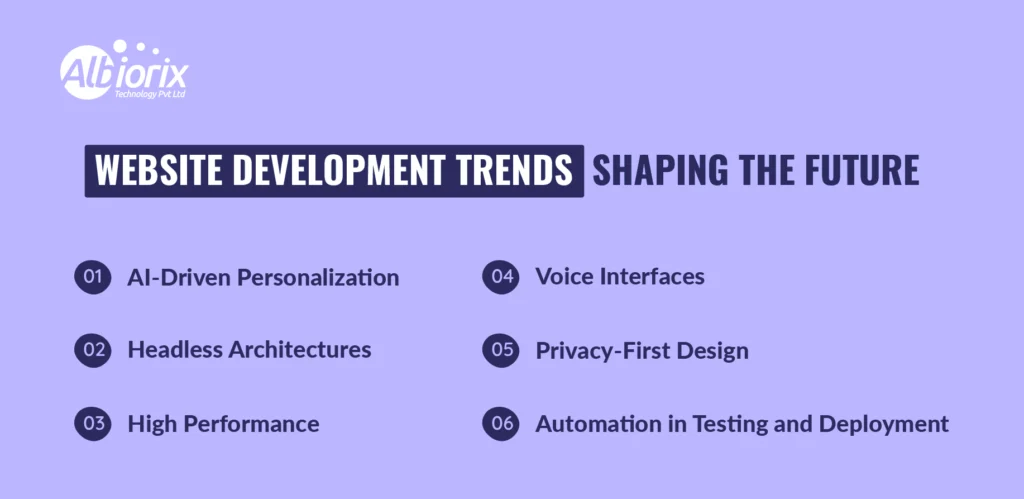
Key website development trends shaping the future include:

  • AI-Driven Personalization: With the arrival of Artificial Intelligence, most of the websites are now integrating AI to offer enhanced user experience. AI helps them offer personalized experiences.
  • Headless Architectures: By decoupling the front end from the back end, businesses gain flexibility to deliver consistent experiences across web, mobile, and emerging digital channels.
  • High Performance: In 2026, speed, stability, and responsiveness are the core ranking and user experience factors. Your website must offer a great experience.
  • Voice Interfaces: With the rise of voice search and AI assistants, websites are being optimized for natural language queries and conversational user interactions.
  • Privacy-First Design: As data regulations grow stricter, websites must be built with transparent data practices, consent management, and secure data handling.
  • Automation in Testing and Deployment: Automated testing, CI/CD pipelines, and monitoring tools enable faster releases without sacrificing quality or security.

Together, these trends signal a shift toward intelligent, adaptable, and user-centric websites. Businesses that future-proof their website development process today gain a long-term competitive advantage.

Best Website Development Services for Future-Ready Businesses

Selecting the right development partner is critical for long-term success. Businesses often decide to outsource web development to gain access to skilled teams, modern tools, and scalable delivery models.

A future-ready website must balance performance, scalability, security, and user experience while remaining adaptable to evolving digital trends.

Our approach to the website development process is rooted in deep discovery, thoughtful design, and robust engineering.

We build custom websites that align with your business objectives, reflect your brand identity, and deliver measurable outcomes. From startups to enterprises, our solutions are designed to scale as your business grows.

By combining modern frameworks, SEO-first architecture, and conversion-focused UX, we help businesses create websites that do more than look good—they perform, engage, and convert.

Whether you’re launching a new digital platform or modernizing an existing one, the right website development partner can turn your vision into a competitive digital asset.

Conclusion

The website development process is a strategic journey, not a one-time task.

By understanding the stages of website development, choosing the right types of websites, and optimizing essential website elements, businesses can create digital platforms that support long-term growth.

If you need help planning or executing your website strategy, Contact Us to get expert assistance.

In an era driven by AI, performance metrics, and user trust, investing in a structured website development life cycle and professional website development services is essential.

A well-built custom website is not just an online presence—it’s a foundation for innovation, credibility, and sustained success.

Custom Energy Management Software For New Modern Businesses

Energy management software (EMS) is a digital solution that monitors, analyzes, and optimizes energy consumption (electricity, gas, water) across buildings or industrial facilities.

By centralizing data and providing real-time insights, these platforms help identify waste, reduce operational costs, and meet sustainability or net-zero goals. 

In the world driven by a digital economy, businesses of any size can no longer depend on spreadsheets or disconnected systems to collect, store, monitor, analyze, and optimize energy usage data.

With rising energy costs, regulatory pressures, sustainability goals, and volatile energy market demands, there is a dire need for smart AI-driven software solutions.

This is where custom energy management software comes into play. Energy management software solutions help businesses in a number of ways and offer them a strategic advantage rather than just a technology investment.

We are Albiorix Technology, and we deal with custom energy management software development. In this blog, based on our experience, we will discuss energy management software, how it empowers utilities, how it benefits you and your business, and much more.

Custom Energy Management Software Development: Why It Matters More Than Ever

There’s a lot of talk about energy management software, but what exactly is it?

Custom energy management software development is the process of developing a digital platform as per the operational, regulatory, and commercial requirements of a business or an organization.

Compared to readymade and off-the-shelf software solutions offered in the market, tailored solutions easily adapt to your energy workflows. It does not limit your business to its limitations.

Energy businesses today operate in complex environments. It requires real-time data, forecasting, compliance reporting, distributed energy resources, and customer engagement for optimum performance and productivity.

A custom-built Energy Management System ensures scalability, flexibility, and long-term ROI while supporting innovation.

Reasons for the Growing Demand of Energy Management Software:

  1. Increasing energy price volatility
  2. Integration of renewable and distributed energy sources 
  3. Real-time monitoring and analytics needs
  4. ESG and sustainability reporting requirements
  5. Digital transformation of energy trading and utilities

Energy Management System: Core Components and Capabilities

It’s almost 2026, and you will find many different types of energy management software solutions in the market.

However, a modern and efficient software solution serves as the central intelligence layer for monitoring, controlling, and optimizing energy operations.

Custom energy management solutions are built as per the business requirements, and their core components and capabilities are;

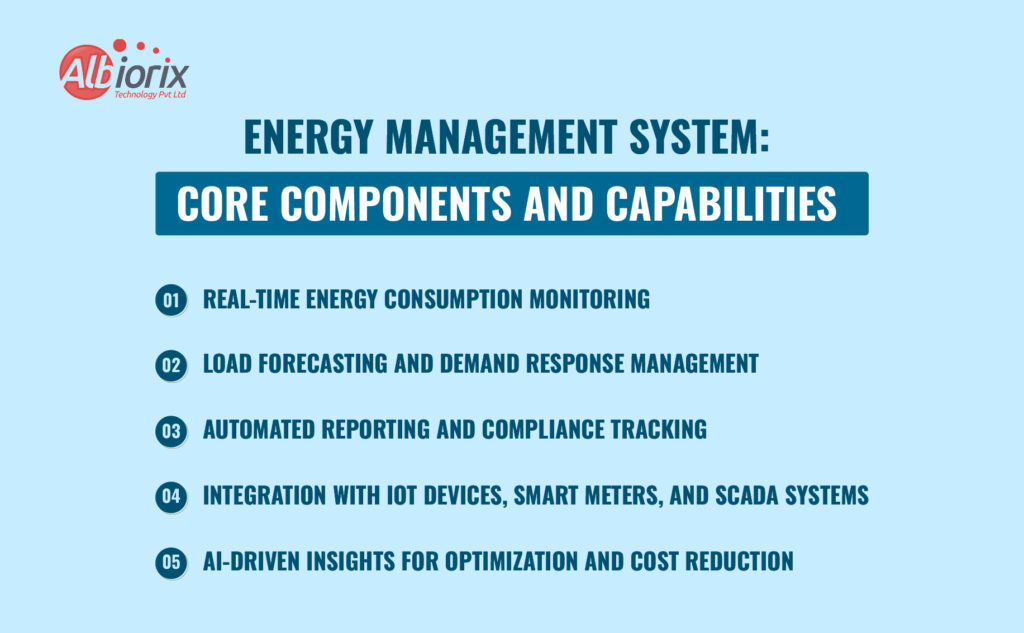
Typical capabilities include:

  1. Real-time energy consumption monitoring
  2. Load forecasting and demand response management 
  3. Automated reporting and compliance tracking
  4. Integration with IoT devices, smart meters, and SCADA systems
  5. AI-driven insights for optimization and cost reduction

These tailor-made software solutions allow you to collect, store, and analyze data for faster decision-making and enhance operational efficiency and productivity.

Energy Management Software for Enterprises and Utilities

Startups or small businesses may not require complex and powerful energy management software, but large organizations and utilities must invest in powerful software solutions. The latter goes above and beyond the basic monitoring and optimisation.

An enterprise energy management system is designed to manage energy across multiple locations, assets, and business units.

With enterprise-grade Energy Management Software, businesses can:

  1. Track energy usage across facilities and regions
  2. Identify inefficiencies and reduce operational costs
  3. Optimize procurement strategies
  4. Improve asset performance and lifecycle management
  5. Support corporate sustainability initiatives

Tailormade energy management software solutions ensure seamless integration with ERP systems, billing platforms, and third-party data sources. It can create a unified digital ecosystem for an organization that helps in increasing productivity.

Custom Energy Software Solutions for Energy Trading Businesses

Energy trading is highly dynamic, data-intensive, and time-sensitive. And because of this. off-the-shelf and traditional energy management solutions may fail to address the unique workflows of traders, brokers, and energy market participants.

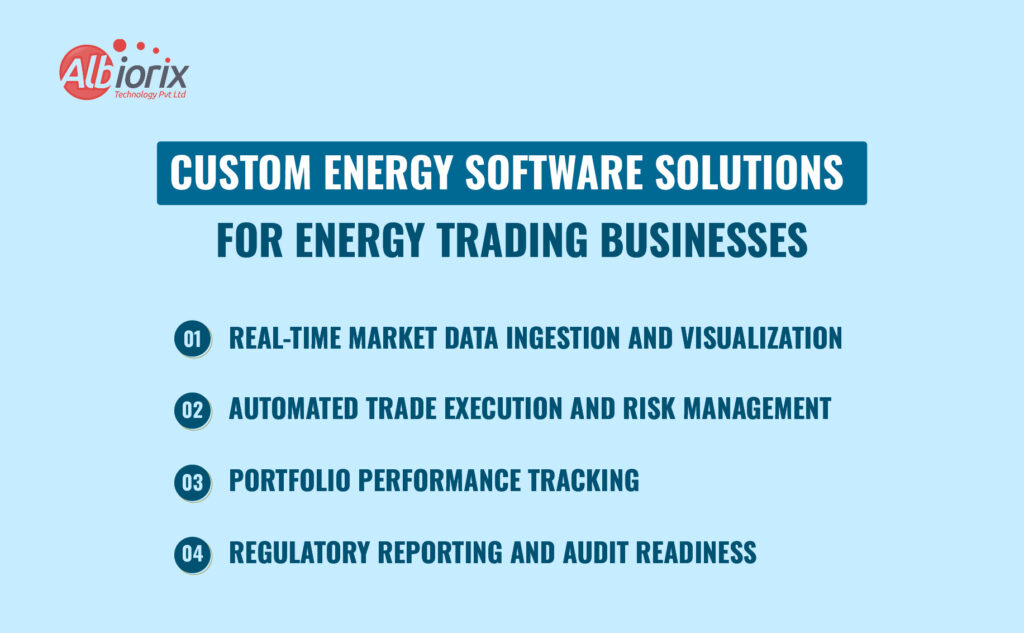
Custom energy software solutions enable:

  1. Real-time market data ingestion and visualization
  2. Automated trade execution and risk management
  3. Portfolio performance tracking
  4. Regulatory reporting and audit readiness

By building a tailored energy trading customer portal software, businesses can also provide clients with transparent access to pricing, contracts, settlements, and historical data. This approach can enrich trust and increase customer satisfaction.

Energy Trading Customer Portal Software: Enhancing Customer Experience

A modern energy trading customer portal software plays a critical role in client engagement. It serves as a secure, user-friendly interface where customers can interact with energy data and trading information in real time.

Key features of Customer Portal Software:

  1. Personalized dashboards and analytics
  2. Contract and billing management
  3. Real-time pricing and trade visibility
  4. Secure document management
  5. Self-service reporting tools

When developed as part of Custom Energy Management Software Development, customer portals can be fully aligned with backend trading systems, ensuring data accuracy and seamless user experiences.

Custom Energy Management Software vs Off-the-Shelf Solutions

In the beginning, ready-made energy management software solutions may feel affordable and cost-effective, but in the long run, they often feel like an expensive decision.

Custom energy management software is developed keeping your business requirements in mind, and to scale as your business grows.

Therefore, even though the cost of energy management software may be high initially, it turns out to be the best decision for your business.

Why Custom Energy Management Solutions are the best:

  1. They are tailored as per your workflows and user roles
  2. They come with scalable architecture for future growth
  3. They ensure better integration with legacy systems
  4. They come with enhanced security and data ownership
  5. In n Long-term, they are cost efficiency

A custom-built Energy Management System grows with your organization. Also, it supports innovation instead of limiting your business.

Transform Energy Operations with Custom Energy Management Software Development

We build future-ready energy management software that integrates seamlessly with your existing systems, enhances visibility, and drives measurable business outcomes.


Talk to our team today!

Role of AI, IoT, and Analytics in Energy Management Software

Advanced technologies significantly enhance the value of Custom Energy Management Software. By integrating AI, IoT, and advanced analytics, businesses can unlock predictive and prescriptive insights.

This integration of modern technologies can make your software future-proof and more productive.

Benefits of AI, IoT and Analytics Integration in a Software:

  1. It can predict maintenance and fault detection
  2. AI-driven demand forecasting
  3. It can detect real-time anomaly detection
  4. It can automated energy optimization strategies

There are tons of benefits of integrating modern technologies like AI, ML, and Machine Learning. They help enterprises transition from reactive energy management to proactive and intelligent decision-making.

Why Choose Custom Energy Management Software Development Services

When you partner with an experienced custom energy management software development services company, you can rest assured about the best software solution for your business.

This solution not only offers an upper hand to your business but also aligns with your business outcomes.

Benefits of Professional Software Development Services:

  1. They have a deep domain knowledge of energy markets
  2. They have dedicated resources for custom software development
  3. They have proven experience in building scalable platforms
  4. They can develop user-centric design and intuitive interfaces
  5. They can offer long-term support and continuous optimization

Software development companies like Albiorix Technology are the best partners for custom energy management software development. For a free consultation and quote, contact us today.

How We Help with Custom Energy Management Software Development

We are Albiorix Technology, and we are among the leading custom energy management software development companies worldwide.

Our team of developers has extensive experience in delivering energy management software solutions tailored to the unique needs of utilities, enterprises, and energy trading businesses.

With more than 10 years of industry experience, we know how to develop software solutions by combining advanced technologies with deep industry understanding.

Our Energy Management Software Development Services:

  1. We offer end-to-end Custom Energy Management Software Development services
  2. Our can design and develop enterprise-grade Energy Management System
  3. We can develop secure and scalable energy trading customer portal software
  4. Our software solutions can easily integrate with IoT, AI, & legacy systems
  5. We offer ongoing support, optimization, and upgrades

By choosing our custom energy software solutions, you gain a future-ready platform designed to optimize energy usage, improve profitability, and support sustainable growth.

Why Choose Us for Custom Energy Management Software Development

We deliver enterprise-ready Custom Energy Management Software that blends advanced technology with real-world energy domain expertise.

Our development approach focuses on long-term business value, regulatory readiness, and superior user experience.

What sets us apart:

  1. Proven expertise in Custom Energy Management Software Development
  2. Deep understanding of energy markets, utilities, and trading workflows
  3. Secure, scalable, and compliance-ready architectures
  4. Seamless integration with ERP, IoT, AI, and legacy systems
  5. Dedicated post-launch support and continuous optimization

Conclusion

If your organization is looking to modernize energy operations, improve efficiency, or gain a competitive edge in energy trading, our custom energy software solutions are designed for you.

Partner with us to build a future-ready Energy Management System, a robust enterprise energy management system, or an intuitive energy trading customer portal software—tailored precisely to your business goals.

Contact us today to discuss your Custom Energy Management Software Development requirements and turn energy data into measurable business outcomes.

What Are The Types of AI Voice Agents And How Businesses Use Them?

In 2025, there is considerable buzz about AI voice agent development. Many businesses and organizations are in search of perfect AI voice agents that can help offer enhanced customer support services and much more.

But what exactly is an AI-powered voice agent platform? Let’s find out.

What is an AI Voice Agent?

In simple and easy-to-understand words, an AI voice agent is a smart, voice-enabled system that is designed to communicate with humans.

Businesses, startups, and large organizations use AI-powered voice agent platforms for custom support, internal training, and other tasks.

It uses the latest technologies like Artificial Intelligence, Machine Learning, and many other advanced tools to provide natural and conversational speech.

Artificial Intelligence Voice agents are more advanced and intelligent than traditional IVR and chatbot systems. Off-the-shelf IVR systems and chatbots use static menus and predefined commands; AI voice agents are adaptive and self-learning.

They continually improve with every interaction, making it more efficient with each passing day. This is the reason why AI Voice agents are one of the most crucial digital transformations for businesses worldwide.

To develop a custom AI voice agent, AI agent development companies use powerful tools and technologies like Natural Language Processing (NLP), Automatic Speech Recognition (ASR), Text-to-Speech (TTS), and Machine Learning (ML).

Most AI agents available in the market can easily understand the intent, context, and sentiments of the humans on the other end of the call. And, based on these, it delivers accurate and relevant responses in real time.

We are Albiorix Technology, an AI Agent Development Company, with experience in custom AI voice agent development. Our objective is to help organizations design, deploy, and scale AI voice agents that drive operational efficiency and elevate customer experiences.

AI Voice Agent Adoption: What Data Says?

AI Voice Agent Adoption What Data Says

If you look at the latest global AI Agent Adoption data & statistics, you will clearly understand the dominance of the tool. From startups to established brands across the world, use tailored AI agents to offer personalized support services.

No matter what industry and geographics are, businesses are using it in one way or another to streamline their operations.

Let’s have a look at some interesting AI Voice Agent Adoption Data:

  1. The global Voice AI Agents market was valued at approximately $2.4–3.14 billion in 2024 and is projected to grow to $47.5 billion by 2034.
  2. Enterprises are rapidly adopting voice AI for cost savings, with implementations cutting support costs by up to 30%.
  3. Consumer voice assistant usage is massive, with ~8.4 billion global installations expected by 2025.
  4. In the USA, there are over 100 million smart speaker owners.
  5. In contact centers and customer service, AI-powered voice agents now handle up to 80% of Level 1/Level 2 queries.
  6. North America leads adoption, accounting for over 40% of the global Voice AI market share (around $0.9 — 1.2 billion in 2024 U.S. revenue).
  7. 93% of IT leaders have already implemented AI agents (including voice) or plan within the next two years.
  8. Approximately 79–85% of enterprises are expected to deploy them by the end of 2025 for efficiency and customer engagement.
  9. In Healthcare, approximately 90% of hospitals will use AI agents (including voice) by 2026 for tasks like appointment management and patient support.

Businesses across the world are increasingly replacing legacy IVR systems and chatbots with AI-powered voice agents. As a result of this, AI voice technology adoption is growing strongly in North America, Europe, Asia-Pacific, and the Middle East.

AI Voice Agents: What are their Types?

AI Voice Agents What are their Types

AI-powered voice agent platforms can be tailored to perform a wide range of roles depending on business needs. If you are unable to find a tool that fits your business flows, then you can also plan about custom voice AI agent development:

Below are the different types of AI Voice Agents:

1. Customer Support Voice Agents:

  • Handle inbound customer inquiries efficiently
  • Resolve common issues without human intervention
  • Escalate complex cases to live agents
  • Provide consistent, accurate responses
  • Operate 24/7 without downtime
  • Reduce customer wait times significantly

2. Sales & Lead Qualification Agents:

  • Engage prospects instantly through voice interactions
  • Ask qualifying questions based on predefined logic
  • Score and categorise leads intelligently
  • Schedule meetings with sales teams
  • Improve lead response time and conversion rates
  • Integrate seamlessly with CRM systems

3. Appointment Scheduling Agents:

  • Automate bookings and rescheduling
  • Send voice-based confirmations and reminders
  • Reduce no-show rates
  • Handle high call volumes efficiently
  • Improve customer convenience
  • Eliminate manual scheduling errors

4. Virtual Receptionist Agents:

  • Act as the first point of contact for callers
  • Route calls to the correct department
  • Provide business information instantly
  • Handle peak-hour call volumes
  • Enhance brand professionalism
  • Ensure no call goes unanswered

5. Internal Operations Voice Agents:

  • Assist employees with HR-related queries
  • Provide IT support and troubleshooting
  • Automate internal workflows
  • Deliver real-time data access
  • Improve employee productivity
  • Reduce internal support workload

Ready to Build Intelligent Voice Experiences?

Partner with Albiorix Technology to design AI voice agents that enhance customer engagement and streamline operations.


Speak with our AI experts today

AI-Powered Voice Agents: How Businesses Use Them

An AI voice agent is a multitasking tool, and businesses are using it as per their business requirements. It delivers measurable benefits across multiple business functions.

Some businesses are using it to offer great customer support services, whereas some organizations are using AI-powered voice agent platforms to automate high-volume voice interactions.

Here are the most common uses of AI-powered voice agents:

  1. Enhance customer experience through natural, human-like conversations
  2. Automate repetitive and high-volume voice interactions
  3. Reduce operational and staffing costs
  4. Improve response time and service consistency
  5. Enable businesses to scale without increasing headcount
  6. Generate actionable insights from conversation data

With strategic voice AI agent development, businesses gain a competitive edge while maintaining high service quality.

Types of AI Voice Agent Platforms: Choose Your Tool Wisely

Types of AI Voice Agents Platforms for a Business

There are many different types of AI Voice Agent platforms; thus, businesses have to be careful while picking one for them. They can deploy AI voice agents using various platform models, depending on their operational and compliance requirements:

Types of AI Voice Agents Platforms for a Business:

  1. Cloud-Based Voice AI Platforms: These types of AI voice agents are highly scalable and cost-effective. They are for rapid deployment and global operations.
  2. On-Premises Voice AI Solutions: These types of voice agents are perfect for organizations with strict data security and compliance requirements.
  3. Hybrid Voice AI Platforms: If you need an AI-powered voice agent that offers a perfect balance between cloud flexibility and on-premises control, then it is the perfect choice.
  4. Custom-Built Voice AI Systems: If you need a fully tailored AI voice agent solution designed as per your business requirements, then it is the best option. Most businesses are opting for this option and partnering with an experienced AI agent development company to bring their unique ideas to life.
  5. Industry-Specific Solutions: If you need an industry-specific solution to assist your customer, then this AI voice agent is optimized for niche use cases.

If you are not sure which voice agent is the best for you and your business, then an experienced AI Agent Development Company can help you. It can help you choose the right platform for long-term success.

Upgrade Your Business Communication with AI Voice Agents

From strategy to deployment, Albiorix Technology offers end-to-end AI Agent Development services that help businesses innovate, scale, and lead.


Start your AI voice journey

Best Voice AI Agents Developer: Hire from Albiorix Technology

If you are looking to hire the best voice AI agents developer, Albiorix Technology offers proven expertise in building intelligent, scalable, and secure AI voice solutions.

Whether you need a cloud-based AI-powered voice agent or an industry-specific voice agent to serve your customers, our team of AI voice agents developer is the perfect choice. You will find the perfect blend of experience and expertise.

Our approach to voice AI agent development focuses on real-world usability, business alignment, and long-term value. From ideation and conversational design to deployment and continuous optimization, we deliver end-to-end solutions that perform reliably at scale.

And most importantly, our team already has hands-on experience designing and developing a custom AI voice agent for one of our clients from the USA.

Why Albiorix Technology Is the Best AI Agent Development Company

Best AI Agent Development Company

Albiorix Technology is recognized as a trusted AI Agent Development Company because we offer:

  1. Proven AI Expertise: Our in-house team of engineers and AI developers has hands-on experience in NLP, speech recognition, and conversational AI systems. This expertise and experience allow us to offer the most advanced AI solutions in the market.
  2. Custom-First Approach: With more than 10+ years of industry experience, we have understood that there’s nothing like one-size-fits-all solutions. Therefore, every AI voice agent we develop is designed to align with your business processes and customer expectations.
  3. Enterprise-Grade Security: With the increasing cases of online hacking, we don’t take security features for granted. Our team of AI voice agent developers follow strict security and compliance standards to protect data and ensure system reliability.
  4. Seamless Integrations: Our AI agents integrate smoothly with CRMs, ERPs, call centers, and third-party platforms. It perfectly fits your legacy systems to offer a flawless experience to your targeted audience.
  5. Long-Term Partnership: We focus on continuous improvement, performance monitoring, and ongoing optimization; therefore, we offer post-development support and maintenance services.
     

Benefits of Our AI Agent Development Services

Our comprehensive AI Agent Development services deliver tangible business advantages:

  1. We can develop AI-powered voice platforms with natural, human-like voice interactions.
  2. We can develop an AI voice agent to improve customer satisfaction and engagement.
  3. Our AI voice agent development services can increase operational efficiency and reduce support costs.
  4. Our services are backed by faster response times and higher efficiency.
  5. We are known for developing scalable AI solutions for growing businesses.
  6. We ensure data-driven insights for continuous improvement.

By choosing Albiorix Technology, businesses invest in AI solutions that are reliable, adaptable, and future-ready.

Conclusion

In 2026, if you are looking for a tool that can help you transform your business, then AI voice agents are the right option. It will help your business communicate, operate, and scale on its own.

From customer engagement to internal automation, these intelligent voice systems enable faster responses, lower costs, and superior experiences.

Partnering with the right AI Agent Development Company is essential to unlock the full potential of voice AI.

With advanced expertise in voice AI agent development and comprehensive AI Agent Development services, Albiorix Technology empowers organizations to stay ahead in an increasingly voice-driven digital landscape.

To learn more about expertise in Voice AI agent development, feel free to contact us.

You can also DM us on LinkedIn, or you can have a look at our portfolio to understand our true potential.

How to Enter the Sports Betting App Development Market Successfully

Due to the digital revolution, the global sports betting industry is going to enter a new phase of growth in 2026.

This exponential growth will also be fueled by increased mobile adoption, regulated markets, real-time data access, and AI-driven personalisation.

Following a well-structured Sports Betting Software Development Guide can help businesses understand market dynamics, technology requirements, and compliance needs.

Therefore, if you are an entrepreneur, startup, or enterprise planning to enter this lucrative market, then you will have to find the best sports betting software development company in India.

In India, countless sports betting software development companies can assist you in the development of a personalized betting app that resembles your uniqueness and business model. Moreover, their services are affordable, fast, and reliable.

From simple betting software development to cross-platform sport betting mobile application development, you will find all the services under one roof.

This blog is written for businesses and young entrepreneurs who are not just exploring ideas but are seriously planning to launch, scale, and compete in the sports betting industry in 2026.

This blog will help you enter the sports betting industry in style.

Why 2026 Is a Strategic Year to Launch a Sports Betting Platform

The year 2026 is expected to be a great year for almost every industry, including the sports betting industry.

For the sports betting industry,  factors such as market maturity, clearer regulations, and improved technology ecosystems are expected to play a great role.

These factors will collectively reduce entry-level barriers for young businesses and startups and create lucrative business scenarios for long-term profitability.

In 2026, businesses that plan early can secure licenses, build compliant platforms, and launch with a competitive edge:

  1. Expansion of regulated betting markets across regions
  2. Mobile-first user behavior driving app-based betting
  3. Growing demand for live and in-play betting experiences
  4. AI-powered analytics are improving odds management and risk control
  5. Advanced payment technologies enabling faster and safer transactions

For businesses entering now or planning to enter the sports betting industry in 2026, the opportunity lies in building future-ready sports betting software rather than short-term solutions.

By leveraging Sports Betting Software Development Services, companies can ensure their platforms are scalable, secure, and built for long-term growth.

A sports betting software development company can develop a sports betting app and software that follows all regulatory standards, meets compliance, and engages users from the very first use.

What Businesses Need Before Entering the Sports Betting Industry

What Businesses Need Before Entering the Sports Betting Industry

Before investing in sports betting app development or platform software, businesses should be clear on the following fundamentals. Early clarity helps avoid costly rework, compliance delays, and scalability limitations later in the development lifecycle.

A well-defined foundation also improves investor confidence and speeds up go-to-market timelines.

Things to Consider Before Entering the Sports Betting Industry:

  1. Type of betting app: Decide the type of betting app or software you want to develop.
  2. Target market: Which type of market and audience you want to target with your betting app or software.
  3. Regional Jurisdiction: It is very important to understand the regional regulations and licensing requirements.
  4. Business model: Sportsbook, fantasy betting, white-label platform, or hybrid model
  5. Technology roadmap: Choose a technology that supports scalable architecture, integrations, and security planning
  6. Compliance readiness: You must take KYC, AML, and responsible gaming measures for safety.
  7. Long-term vision: Growth, feature expansion, and market differentiation
  8. Monetisation strategy: Betting margins, commissions, subscriptions, or hybrid revenue models
  9. Third-party integrations: You must integrate sports data providers, payment gateways, and compliance tools
  10. Marketing: You must have marketing strategies in place to attract and retain bettors.
  11. Maintenance strategy: You must have a maintenance strategy to ensure platform updates, bug fixes, and scaling.

A clear foundation significantly reduces risk and accelerates time-to-market. If you already have experience in betting app development, then you might be aware of all aspects.

However, if you are new to the industry, then it is recommended to contact a betting app development company from the start.

Sports Betting Software Development vs Sports Betting App Development

If you are a business that is planning to enter the sports betting industry in 2026, then you must have a proper understanding of the difference between the sports betting application and sports betting software. Both are different from each other.

However, the role of both these platforms is to offer a scalable, compliant, and revenue-ready betting ecosystem.

The betting platform you want to develop depends on many factors; thus, you must choose the right approach, the right combination of technologies, and long-term growth plans.

Sports Betting Software Development

This focuses on building the core platform, including:

  1. Odds and sportsbook engine
  2. Admin and risk management systems
  3. User management and reporting dashboards
  4. Integration with third-party data providers and payment gateways
  5. Compliance modules for KYC/AML

This is ideal for businesses planning full control, scalability, and long-term growth.

Sports Betting App Development

This focuses on the user-facing mobile experience, including:

  1. iOS and Android betting apps
  2. Live betting and real-time updates
  3. Secure wallets and transactions
  4. Personalized user interfaces
  5. Push notifications and engagement tools

Most successful betting businesses in 2026 will require both—a robust backend software platform and high-performance mobile applications. 

Sports Betting Software vs Sports Betting App Development

AspectSports Betting Software DevelopmentSports Betting App Development
Primary FocusCore backend platform & business logicUser-facing mobile experience
Key ComponentsOdds engine, admin panel, risk management, APIsiOS & Android apps, UI/UX, live updates
Target UsersOperators, admins, risk teamsBettors and end users
ScalabilityHigh – built to support large volumes and growthDepends on backend scalability
Compliance & SecurityCentralized compliance, KYC, AML, reportingSecure login, wallets, user data protection
Business ValueLong-term control, customization, and expansionUser acquisition, engagement, and retention
CostHigher initial investment, lower iterative costMedium investment, frequent updates needed 
MaintenanceEasier centralized updates and controlRequires synchronization with backend

Both sports betting app development and sports betting software development are totally different from each other. However, they are ultimately a betting platform that is in high demand in 2026.

Want to know the development cost of a sports betting platform? Then feel free to contact us. We offer free quotes and consultations.

Core Components of a Modern Sports Betting Platform

Compared to old and traditional sports betting software and apps, modern betting platforms are more advanced and require many different components/features.

A competitive sports betting solution typically includes:

  1. User registration and identity verification (KYC)
  2. Odds management and sportsbook engine
  3. Live betting and in-play features
  4. Secure wallet, deposits, and withdrawals
  5. Admin panel with reporting and analytics
  6. Risk management and fraud detection systems
  7. Multi-language and multi-currency support
  8. Real-time analytics dashboards for operators
  9. Fraud monitoring and responsible gaming alerts
  10. Player behavior analytics and engagement tracking

These components must work seamlessly to deliver reliability, speed, and trust.

Looking for a reliable sports betting software development company?

Albiorix Technology helps businesses build secure, scalable, and regulation-ready betting platforms.


Get a Consultation!

Technology Trends Shaping Sports Betting App Development

As the sports betting industry continues to evolve, technology is becoming the primary differentiator between average platforms and market leaders.

Discussions around the Future Of Sports Betting Apps highlight how innovation is reshaping user expectations and platform capabilities.

In 2026, sports betting app development will mainly focus on speed, performance, personalization, security, and real-time user experiences.

Thus, businesses must choose future-proof technologies to develop sports betting platforms.

Businesses that develop betting platforms adhering to these trends and requirements will attract more users, easily meet regulatory expectations, and scale efficiently in the future.

To stay competitive, betting platforms must align with emerging technology trends such as:

  1. They must be AI-driven personalization for betting recommendations and user engagement.
  2. There must be real-time data processing for live odds, in-play betting, and instant updates.
  3. There must be cloud-native architecture for scalability and high availability.
  4. There must be advanced security to prevent fraud and data breaches.
  5. It must have responsible gaming technology to meet regional regulatory standards and protect users.
  6. It must have microservices-based architecture for faster feature releases and easier maintenance.
  7. It must be able to easily integrate third party APIs and tools.
  8. It must have a data analytics and reporting engine to monitor user behavior and app performance.
  9. It must have AR/VR integration to offer an immersive experience.

If your betting software in 2026 is equipped with all the above features, then it will undoubtedly gain a competitive advantage over the ordinary betting apps currently available on the market.

With such sports betting software development, you can position yourself for long-term market leadership.

Cost of Sports Betting App and Software Development

Cost of Sports Betting App and Software Development

If you have firmly decided to jump into the lucrative market of sports betting in 2026, then the first question that might strike your mind is the cost.

Most businesses have these questions on their mind. The cost of a sports betting application/software development depends on many different aspects. There is no standard formula to calculate the cost of a sports betting app development.

However, knowing the cost of software development before starting the process is a smart move.

The development cost of a betting platform depends on factors such as platform complexity, regulatory compliance, technology stack, and long-term scalability needs.

A practical budget helps businesses plan better, avoid hidden expenses, and ensure faster time-to-market.

The cost of building a sports betting platform depends on:

  1. Number and Types of Features: If your betting app is simple, it will cost less, but if your app has complex/many features, it will cost you more.
  2. Advanced Apps: The development cost of a betting app with real-time odds, in-play betting, and user analytics is higher.
  3. Enterprise Grade Betting Software: If there are custom integrations such as advanced risk management, third-party integrations, etc., then the development cost will go high.
  4. Licensing & Compliance: If you are developing a betting software/app for global audiences, then the overall cost will rise.
  5. Support & Maintenance: The type of maintenance and support services you choose for your betting app also influences the cost of betting software development.
  6. Marketing Services: The type of marketing services you choose to promote your app affects the cost of app and software development.

These are some of the top aspects that directly influence the overall development cost of a sports betting platform.

Many other small factors can affect the cost; thus, it is recommended to contact a sports betting software development company for the exact cost and timeline.

Conclusion

When it comes to sports betting app development, Albiorix Technology is the perfect development partner. We are the leading sports betting software development company in India, offering end-to-end betting app development services.

From simple betting software to complex and cross-platform betting apps, we can develop solutions designed for the 2026 market demands.

Whether you want to develop a betting software from scratch or want to develop a replica of a famous betting application, our team is here to help.

If you’re ready to move forward or need expert guidance, Contact Us to discuss your requirements. We help businesses plan, launch, and scale their betting platforms with confidence.

Why Choose Albiorix Technology:

  1. End-to-end development partner: You get all the development services under one roof – from idea validation to full-scale deployment.
  2. Custom app & software development: We design and develop tailored betting solutions to match your business model and budget.
  3. Future-ready solutions: Our betting platforms are built for scalability, powered by AI, and developed using the latest technologies.
  4. Support & Maintenance: We guarantee long-term support and maintenance services for optimum performance of your app.
  5. Regulatory and Compliance Expertise: Our team of developers ensures your platform meets all licensing and KYC/AML requirements.
  6. Advanced analytics and AI integration: Data-driven insights to maximize user engagement and revenue.

Our approach ensures your platform is not just functional, but competitive, secure, and ready to dominate the evolving sports betting market.

How Good Software Development Company Associative is Better For Your Business

The process of digital product development is not just about writing the code and making it live. It is a complex process that demands the intervention of different types of expertise from various departments.

It requires expert strategists, experienced product architects, designing experts, and a team that can offer long-term support.

All these come together as a force for custom digital product development. And it is the reason why businesses are searching Google for a “Development Company Associative”.

The phrase “Development Company Associative” is often searched when businesses and startups are searching for a collaborative, trustworthy, multi-tech development partner.

It has nothing to do with your business size or budget; it is an outsourcing development agency that works for its clients globally.

Albiorix Technology is one such product development associate that can help you expand the digital infrastructure of your business.

Why Businesses Search for a “Development Company Associative”

Well, with the rise in the need for custom digital product development, businesses are constantly looking for a reliable digital product development company that can help them build a successful new product.

From young entrepreneurs to startups and established brands, all are searching for a “development company associative” who can support them from idea to launch.

These businesses are not just looking for an engineer or coder; they need a whole team under one roof that can help them with everything, including strategy, planning, and execution.

Companies in the US, UK, Australia, and Germany especially look for reliable offshore or nearshore development support to reduce cost and accelerate delivery while maintaining quality.

Top 5 Reasons Why Businesses are Searching for “Development Company Associative”

  • Full-Spectrum Services: This product development associative offers a full spectrum of services under one roof. They have expertise in mobile app development, web development, web app development, eCommerce development, and other digital products.

  • Mobile & App Development Expertise: Top-rated product development companies in India hold expertise in native Android/iOS, cross-platform solutions, and high-performance apps. These mobile apps deliver exceptional user experiences.

  • Custom Scalable Solutions: Businesses in the UK, Germany, and the US partner with this software development company associative for tailored, robust, and scalable digital software solutions and enterprise systems.

  • Advanced and Emerging Technologies: Attraction comes from proficiency in cutting-edge areas, including blockchain (Web3, DeFi, cross-chain bridges), AR/VR, and AI, helping businesses innovate and stay competitive.

  • Client-Focused Approach: With strict confidentiality, full code ownership transfer, transparent pricing, and a commitment to on-time delivery, it builds trust for long-term partnerships.

If building a custom digital product is on your 2026 roadmap, it’s wiser to partner with a professional product development agency rather than taking the DIY route—ensuring a smoother process and a more successful launch.

What a Software Development Company Associative Actually Does

What a Software Development Company Associative Actually Does

A software development company that works as an Associative for new product development acts as an extension of your internal development team.

They work closely with your team to understand business needs, product goals, user expectations, and long-term scalability.

Based on the information gathered, they will design and develop a product that will help your business grow and boost customer satisfaction.

A Software Development Associative Helps You With:

  1. Product discovery & requirement analysis
  2. UI/UX design based on your business model
  3. Mobile and web development using the right tech stacks
  4. Quality testing and reliable deployment
  5. Ongoing support, upgrades, and performance optimization

This collaborative, multi-service approach is what most businesses mean when searching for a development company associative online.

There’s a lot more that a software development company can help you with, and if you are interested in learning more, feel free to contact us.

How a Development Company Associative Helps You Build Better Products

An experienced product development team does not just build a digital product. They ensure the product fits market demand, scales well, and minimizes technical risk.

1. Understanding Your Business Needs 

Before writing a single line of code, the team performs requirement analysis, creates wireframes, and recommends the best technologies. This ensures your app or platform is both functional and future-ready, especially if you’re planning to scale.

2. Building High-Quality Mobile Apps 

When searching for terms like flutter development company associative, ios development company associative, or native app development company associative, users are usually looking for teams specializing in mobile technologies.

An associative dev company can help you build:

  • Flutter cross-platform apps
  • High-performance iOS apps
  • Native Android or custom mobile solutions

This ensures faster development, lower cost, and broad device coverage.

3. Delivering Modern Web Applications

Most businesses also need web platforms, dashboards, or content-driven sites. This is why we also see keywords like php development company associative, laravel development company associative, and wordpress development service provider associative.

These services help you launch:

  • Business websites
  • Custom dashboards
  • SaaS products
  • Enterprise systems

By combining mobile + web expertise, you get an end-to-end development experience.

Looking for a Product Development Partner in the USA, UK, or Australia?

Connect with Albiorix Technology—with years of experience and specialized teams, we help turn your ideas into reality.


Get in touch today!

Why Startups Prefer a Development Company Associative

Most startups across the world operate in a tight environment where speed, cost-efficiency, and flexibility matter the most. These factors collectively decide if the startup will succeed or not.

This is why many early-stage founders choose to work with a dedicated product development company rather than building everything in-house.

Reasons Why Startups Prefer a Development Company Associative:

  • Build an MVP quickly: They have a team of experts under one roof, so they can easily build a product very fast. Moreover, your ideas can be converted into a functional prototype in weeks.
  • Test the Idea: A product development company tests the product with real users. This testing validates assumptions and helps in refining the product to prevent any failure in the future.
  • No Heavy Charges: Startups can easily get access to talented and experienced product development experts within their budget. This allows them to build a product that is modern and future-proof.
  • Instant Modifications: If any changes are required in the product to make it more valuable, then these changes are addressed immediately without any delays. It increases the chances of success.

By hiring a top-rated digital product development company, startups and young entrepreneurs can focus on strategy, growth, and customer insights. They can depend on the experienced team to bring their vision to life.

With this approach, they can move from idea to live product efficiently, without breaking their bank balance and wasting too much time in research and analysis.

Why Mid-Sized Businesses Work with a Development Agency Associative

Mid-sized businesses in the US, UK, Australia, and Germany often run into challenges like project overflow, fast turnaround expectations, or the need for specialised technical skills that aren’t available in-house.

In these situations, partnering with a development company becomes a practical and scalable solution.

A development agency acts as an execution partner by providing:

  • White-label development: A product development agency can develop top-quality digital products as per its business needs.
  • On-demand engineering resources: They can easily hire full-time developers for short-term or long-term projects as per their requirements.
  • Multi-technology capabilities: A digital product development agency Associative has experts from different technologies under one roof.
  • Predictable delivery timelines: With experts working on their ideas, they get the exact launch date of the product.

By partnering with digital product development agencies, mid-sized businesses can easily expand their services while maintaining high-quality standards. This collaborative model enables businesses to grow, accept more projects, and stay competitive in fast-moving markets.

Technology Expertise You Get from an Associative Development Company

Technology Expertise You Get from an Associative Development Company

One of the biggest benefits of working with an associative product development company is its technical expertise.

They have separate teams of experts working on different tools and technologies, all under one roof.

Thus, instead of hiring experts from different places, you can leverage a full spectrum of modern technologies required for new product development.

A well-equipped development partner typically brings proficiency in areas such as:  

  • Flutter for cross-platform apps: Flutter is the in-demand technology to develop a cross-platform mobile application. A single codebase can be used for both iOS and Android apps.
  • iOS (Swift) for Apple ecosystems: If you want to target Apple ecosystems (iPhone and iPad), then Swift allows you to develop apps that are fast, scalable, and seamless.
  • PHP for backend systems: A reliable choice for building the server-side logic of web platforms, APIs, and enterprise applications that require strong stability and scalability.
  • Laravel for modern architectures: Laravel’s expressive framework helps in building secure, maintainable, and feature-rich backend systems.
  • WordPress for CMS-based websites: WordPress offers flexibility and content management capabilities; thus, it is best for every type of business website.
  • Native Android & iOS apps: Native app development ensures your app offers great performance, reliability, and device-level optimization.

By having access to this multi-technology expertise, your project can be built using the most suitable tech stack for your business goals.

Benefits of Working with a Development Company Across the US, UK, Australia and Germany

When you collaborate with a development company that works across major global markets like the US, UK, Australia, and Germany, you gain far more than just technical support. These product development companies benefit you in plenty of manners.

These companies are accustomed to diverse business cultures, regulatory expectations, and communication styles, which makes the entire development process smoother and more aligned with your needs.

Benefits of Working with an Experienced Development Company:  

  • Time-zone friendly collaboration: These companies structure their working hours regardless of where your business or agency is located.
  • Experience with Western markets: They are well familiar with western markets; thus, they understand user expectations, design standards, and business priorities.
  • Compliance with global data laws: A development partner well-versed in GDPR & other international regulations to ensure your project meets the required compliance standards.
  • Familiarity International Development Standards: Whether it’s coding conventions, accessibility guidelines, or industry-specific requirements, these companies build products that match Western quality benchmarks.

By working with such a development team, cross-border collaboration becomes effortless. You get predictable delivery, clear communication, and a final product that meets global standards—making the entire partnership more efficient, reliable, and future-proof.

How to Choose the Right Development Company Associative

How to Choose the Right Development Company Associative

Selecting the right development partner can significantly influence the success of your digital product. Instead of choosing purely based on price or quick timelines, it’s important to evaluate the company through a thoughtful checklist. Here are a few essentials to consider:

  • Portfolio: Review their past work to see whether they’ve built products similar to what you have in mind. A strong portfolio is a clear indicator of both capability and experience.
  • Tech Expertise: Confirm that they specialize in the technologies and frameworks your project requires. The right tech stack ensures better performance, scalability, and long-term stability.
  • Communication: Responsive, transparent communication is crucial. A good development partner provides regular updates, clear timelines, and proactive collaboration—especially in remote or cross-border setups.
  • Process: Ask about their development methodology. Companies that follow Agile or similar iterative processes offer more flexibility, faster delivery cycles, and continuous improvement throughout the project.
  • Post-Launch Support: A development company shouldn’t disappear once the product goes live. Ensure they offer technical support, maintenance, troubleshooting, and future upgrades.

Choosing a partner that checks all these boxes not only reduces project risks but also increases the chances of delivering a stable, high-quality digital product.

Conclusion

A software development company associative does far more than write code.

It acts as a strategic collaborator throughout your product’s lifecycle—helping you plan the roadmap, build the initial version, scale the product as user demand grows, and Contact Us for long-term support to keep everything running smoothly.

Whether you’re building a mobile app, a SaaS platform, a business website, or a custom enterprise system, the right development company brings the expertise, speed, and reliability needed to execute your vision effectively.

Their multidisciplinary teams, structured processes, and technical depth allow you to move from idea to launch with confidence.

If you’re preparing to bring your next idea to life, partnering with an experienced development company can transform that vision into a high-quality digital product—delivered on time, built to scale, and aligned with modern industry standards.