




25+ Types of Websites That You Can Create

Summary: Different types of websites in 2026 serve various purposes, from ecommerce and business websites to blogs, booking platforms, and social media sites. Choosing the right website type is essential for achieving your business goals, improving user experience, and scaling your online presence. This guide covers 28 popular types of websites with examples and estimated costs to help businesses, startups, and individuals make informed decisions.

The Updated List for Common Types of Websites 2026

Planning to build an online presence?

The first big decision is choosing the right type of website, and understanding the Difference Between Website and Web Application plays a key role in making the right choice. This decision affects your design, features, timeline, and budget.

This 2026 guide covers 28 common website types, with examples and estimated costs. Whether you’re starting fresh or upgrading an existing site, this list will help you understand your options.

Websites are evolving quickly, especially with AI and interactive platforms becoming more popular. Let’s explore the most relevant website types in 2026.

Let’s dive in,

Types of Websites for Businesses and Entrepreneurs

1. eCommerce Website

An eCommerce website allows businesses to sell products or services directly online.

These sites feature product listings, shopping carts, secure payment gateways, and order management systems making them one of the most revenue-driven types of websites for businesses of all sizes.

Estimated Development Cost: $3,000 – $25,000+ depending on product volume, custom features, and platform choice (Shopify, WooCommerce, custom build).

Examples:

  1. Amazon
  2. eBay
  3. Walmart

2. Business Website

A business website serves as a company’s primary digital identity showcasing services, team, location, contact information, and credibility. It’s often the first impression a potential client will have of your brand.

Estimated Development Cost: $1,500 – $10,000 depending on the number of pages, design complexity, and integration required.

Examples:

  1. Apple
  2. Salesforce
  3. Infosys

3. Portfolio Website

A portfolio website is designed for creatives, freelancers, designers, photographers, and developers to showcase their best work. Clean visuals and easy navigation are the hallmarks of a great portfolio site.

Estimated Development Cost: $500 – $5,000 depending on interactivity, animations, and CMS integration.

Examples:

  1. Behance
  2. Dribbble
  3. Cargo

4. Event Website

Event websites are built specifically around a conference, concert, webinar, or any one-time or recurring event. They typically include registration, scheduling, speaker information, and ticketing features.

Estimated Development Cost: $1,000 – $8,000 depending on ticketing integrations, live streaming, and attendee management needs.

Examples:

  1. TED
  2. Eventbrite
  3. SXSW

5. Personal Website

A personal website is your space on the internet to share your story, resume, blog, or ideas. It’s popular among professionals, influencers, authors, and thought leaders building a personal brand.

Estimated Development Cost: $300 – $3,000 depending on custom design and content features.

Examples:

  1. Tim Ferriss
  2. Seth Godin
  3. Barack Obama

Ready to Build Your Business Website? Let’s Talk


Get Your Free Quote & Consultation Today!

Types of Websites for Communities and Causes

6. Membership Website

Membership websites restrict some or all content to registered, paying, or approved users. They’re widely used by online educators, fitness coaches, professional associations, and content creators.

Estimated Development Cost: $2,000 – $15,000 depending on subscription tiers, gated content, and payment gateway setup.

Examples:

  1. Patreon
  2. MasterClass
  3. Coursera

7. Nonprofit Website

Nonprofit websites are designed to build trust, spread awareness, and drive donations or volunteer sign-ups. They focus on storytelling, impact reporting, and easy donation flows.

Estimated Development Cost: $1,000 – $8,000 depending on donation platform integration, event pages, and CMS needs.

Examples:

  1. UNICEF
  2. Charity Water
  3. WWF

8. Blog Website

A blog website is a content-driven platform where individuals or brands regularly publish articles, guides, or stories. Blogs remain one of the most powerful SEO and content marketing tools in 2026.

Estimated Development Cost: $500 – $4,000 depending on custom theme design, plugins, and monetization features.

Examples:

  1. HubSpot Blog
  2. Neilpatel
  3. Mashable

9. Informational Website

An informational website exists to educate or inform visitors about a topic, service, or product without selling directly. Government portals, reference sites, and FAQs fall into this category.

Estimated Development Cost: $800 – $6,000 depending on the depth of content, search features, and multimedia elements.

Examples:

  1. Wikipedia
  2. WebMD
  3. USA.gov

10. Online Forum

Online forums are community-driven platforms where users ask questions, share knowledge, and discuss topics. They build organic engagement and can become powerful authority sites over time.

Estimated Development Cost: $1,500 – $10,000 depending on the scale of community features, moderation tools, and integrations.

Examples:

  1. Reddit
  2. Quora
  3. StackOverflow

Your Community or Cause Deserves a Powerful Online Presence


Get a free quote for website development

Popular Types of Websites for Startups and Professionals

11. Community Website

Community websites bring people with shared interests together think alumni networks, hobby groups, or professional communities. They often combine social features, forums, and events in one platform.

Estimated Development Cost: $2,500 – $18,000 depending on social networking features, profiles, and content moderation needs.

Examples:

  1. LinkedIn
  2. Meetup
  3. Nextdoor

12. Startup Website

A startup website is designed to pitch a new idea or product, attract early adopters, and raise funding. Speed, clarity, and compelling storytelling are the key ingredients of a successful startup website.

Estimated Development Cost: $2,000 – $12,000 depending on product demo integrations, investor decks, and launch campaign features.

Examples:

  1. Notion
  2. Figma
  3. Stripe

13. Consulting Website

Consulting websites highlight expertise, case studies, and services to attract high-value clients. A strong consulting site builds authority and generates qualified leads through strategic content.

Estimated Development Cost: $1,500 – $10,000 depending on lead generation tools, blog integration, and booking functionality.

Examples:

  1. McKinsey
  2. Bain
  3. Deloitte

14. Booking Website

Booking websites enable users to schedule appointments, reserve tables, book rooms, or purchase time slots. These are common in the hospitality, healthcare, fitness, and beauty industries.

Estimated Development Cost: $2,000 – $15,000 depending on the booking engine, real-time availability, and payment processing.

Examples:

  1. Booking
  2. Zocdoc
  3. Calendly

15. Petition Website

Petition websites collect digital signatures to support social, political, or community causes. They combine storytelling with action-driven calls to motivate people to take a stand.

Estimated Development Cost: $1,000 – $6,000 depending on signature verification, sharing tools, and campaign management features.

Examples:

  1. Change
  2. Avaaz
  3. MoveOn

Startups & Professionals: Build a Website That Works as Hard as You Do


Claim Your FREE Quote Today!

Examples of Websites for Education, Lifestyle and Entertainment

16. School Website

School and educational institution websites serve as information hubs for students, parents, and staff. They include admissions info, academic calendars, faculty details, and often integrate learning management systems (LMS).

Estimated Development Cost: $1,500 – $12,000 depending on portal integrations, parent dashboards, and multilingual support.

Examples:

  1. MIT.edu
  2. KhanAcademy.org
  3. DPS.edu.in

17. Hobby Website

Hobby websites are passion projects built around specific interests cooking, gaming, gardening, photography, or crafts. They can evolve into monetized content platforms or brand-building tools.

Estimated Development Cost: $300 – $3,000 depending on design customization and content management needs.

Examples:

  1. AllRecipes
  2. IGN
  3. Instructables

18. Interactive Website

Interactive websites engage users with quizzes, games, calculators, animations, or personalized experiences. They see higher engagement rates and time-on-site than static alternatives.

Estimated Development Cost: $3,000 – $20,000+ depending on the level of interactivity, animation complexity, and custom logic.

Examples:

  1. Google Arts & Culture
  2. The Oatmeal
  3. BuzzFeed

19. Entertainment Website

Entertainment websites deliver content designed to amuse, inform, or engage a broad audience think streaming platforms, humor sites, fan fiction hubs, or celebrity news portals.

Estimated Development Cost: $3,000 – $30,000+ depending on content delivery infrastructure, video streaming, and user personalization.

Examples:

  1. Netflix
  2. Crunchyroll
  3. Tv.apple

20. Wedding Website

Wedding websites are created by couples to share their story, event details, RSVPs, gift registries, and photo galleries with guests. They’re both personal and highly functional.

Estimated Development Cost: $300 – $3,000 for custom-designed wedding sites; template-based options are cheaper.

Examples:

  1. TheKnot
  2. WeddingWire
  3. Zola

From Schools to Streaming We Build Every Kind of Website


Get a FREE consultation!

Niche and Emerging Website Types in 2026

21. Travel Website

Travel websites help users plan trips, compare destinations, book hotels and flights, and discover experiences. They combine rich visuals, search filters, and transaction features to inspire and convert.

Estimated Development Cost: $3,000 – $20,000 depending on booking engine integrations, dynamic search, and map features.

Examples:

  1. TripAdvisor
  2. Airbnb
  3. MakeMyTrip

22. Directory Website

Directory websites list businesses, professionals, or services in a searchable, categorized format. They generate revenue through featured listings, subscriptions, or lead gen fees.

Estimated Development Cost: $2,000 – $12,000 depending on listing features, search functionality, and submission workflows.

Examples:

  1. Yelp
  2. Justdial
  3. Clutch

23. Landing Page Website

A landing page website is a single-page, conversion-focused site built around one specific goal driving sign-ups, product purchases, or lead form submissions. Every element points to one CTA.

Estimated Development Cost: $500 – $5,000 depending on A/B testing tools, animation, and integration with marketing platforms.

Examples:

  1. Unbounce
  2. Instapage
  3. Product Hunt launches

24. News and Magazine Website

News and magazine websites publish timely articles, opinion pieces, features, and multimedia content. They require robust CMS systems, fast load times, and strong ad or subscription monetization.

Estimated Development Cost: $3,000 – $25,000 depending on editorial tools, ad integrations, and personalization features.

Examples:

  1. TheGuardian
  2. TechCrunch
  3. Bloomberg

25. Memorial Website

Memorial websites celebrate the lives of loved ones who have passed, offering a digital space to share stories, photos, tributes, and obituaries. They’re deeply personal and increasingly popular.

Estimated Development Cost: $500 – $4,000 for a custom-designed, heartfelt memorial website.

Examples:

  1. Ever Loved
  2. Forever Missed
  3. Legacy

26. Subscription Website

Subscription websites offer recurring value in exchange for a monthly or annual fee access to premium content, software, curated products, or exclusive communities.

Estimated Development Cost: $2,500 – $15,000 depending on billing systems, content management, and tier structure.

Examples:

  1. Spotify
  2. Substack
  3. The Athletic

27. Kid-Friendly Website

Kid-friendly websites are designed with age-appropriate content, bright visuals, and simple navigation for children. They must comply with online privacy regulations (COPPA, GDPR) and prioritize a safe experience.

Estimated Development Cost: $2,000 – $10,000 depending on compliance requirements, animated elements, and interactive features.

Examples:

  1. PBS Kids
  2. Coolmath Games
  3. National Geographic Kids

28. Social Media Website

Social media websites connect people through user-generated content, profiles, messaging, and shared communities. They are among the most technically complex types of websites to build but among the most impactful.

Estimated Development Cost: $10,000 – $100,000+ for a custom social platform; features and user scale drive cost significantly.

Examples:

  1. Instagram
  2. Twitter/X
  3. Facebook

We Build Every Type of Website and provide services like Website Development

We Build Every Type of Website and provide services like Website Development

Now that you’ve explored all 28 different types of websites, here’s the most important thing to know: no matter which type of website you need, our expert team can build it for you tailored precisely to your business goals.

We are a full-service website development company with experienced developers, UI/UX designers, and digital strategists who have delivered websites across industries from eCommerce stores and SaaS platforms to nonprofit hubs and AI-powered portals

Every project we take on is built from a deep understanding of your audience, your brand, and your growth ambitions.

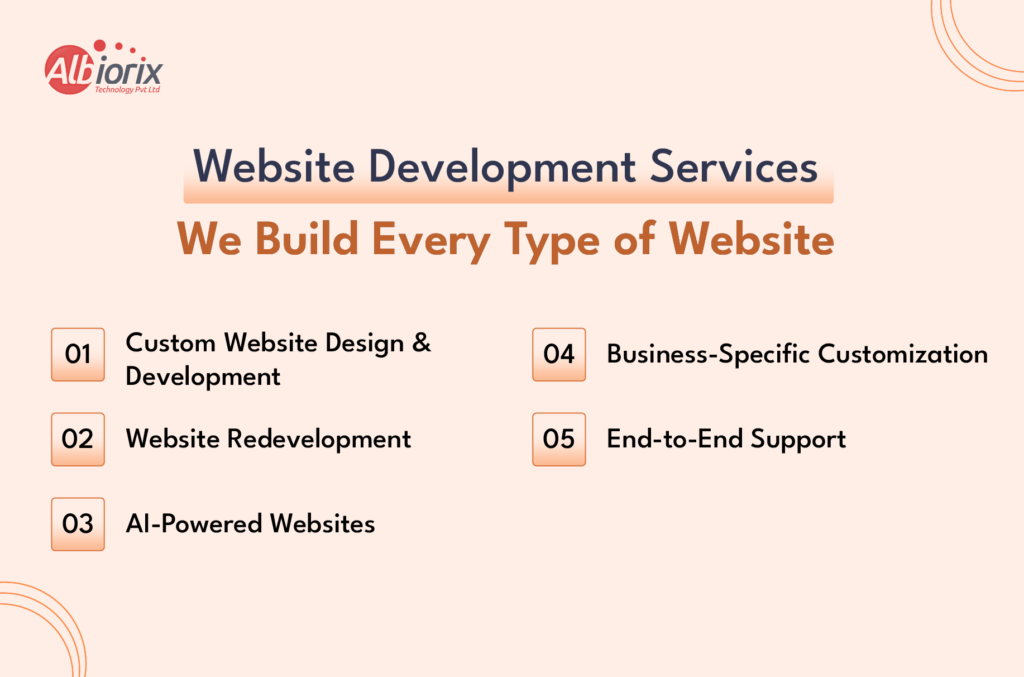
Here’s what we offer:

  1. Custom Website Design & Development: We build websites from the ground up, not from cookie-cutter templates. Your site will look, feel, and perform exactly how your business demands.
  2. Website Redevelopment: Already have a website that’s outdated or underperforming? We can completely redesign and rebuild it with modern technologies and better UX.
  3. AI-Powered Websites: We develop AI-integrated websites for any business type. Whether you need an intelligent chatbot, personalized content delivery, recommendation engines, or predictive search, we build it.
  4. Business-Specific Customization: We understand that every business is different. We customize every aspect of your website layout, color scheme, features, integrations, and user flows to match your exact needs.
  5. End-to-End Support :From strategy and design to development, testing, and post-launch maintenance, we’re with you at every step.

Why Choose Us as Your Website Development Company?

There are plenty of website development companies out there. Here’s why businesses from early-stage startups to established enterprises choose to work with us:

We don’t just write code. We think about your customers, your competition, and your conversion goals.

We build websites that are fast, secure, mobile-first, and optimized for search engines including AI-driven search experiences that are becoming the new standard in 2026.

Whether you’re looking to launch your first website, overhaul an outdated one, or build a complex custom platform, we deliver results that matter to your business.

And with our AI-powered website development capabilities, your site won’t just be digital real estate it’ll be a smart, adaptive tool that grows with your business.

Let’s Build Something Remarkable Together. You’ve seen 28 types of websites and what they can do. Now it’s time to build yours.

Whether you’re a business owner, entrepreneur, startup founder, or an organization ready to grow online we are the development team you’ve been looking for.

Conclusion

Choosing the right type of website is the foundation of every successful digital strategy. Whether you’re building an eCommerce store, a community platform, a personal blog, or an AI-powered business portal, partnering with a website development company ensures the right website is built the right way to transform how your audience finds you, trusts you, and buys from you.

This updated list of 28 different types of websites in 2026 reflects how varied and dynamic the web has become. There is truly a website type for every purpose and with the right development partner, building yours doesn’t have to be complicated.

Ready to take the next step? Our team is standing by with the expertise, creativity, and technical skills to make it happen. Reach out today for your free quote and consultation.

How Much Does AI Development Cost in 2026?

Summary: In 2026, AI development costs range from $10,000 for simple integrations. They can exceed $1 million for complex, enterprise-grade AI systems. Small projects generally cost $10k–$50k, while mid-level applications range from $50k–$250k. Key cost drivers include customized data training, infrastructure (GPU usage), and specialized AI talent.

A Complete Breakdown for Businesses, Startups & Enterprises

Artificial intelligence is no longer a technology of the future it is the competitive advantage of the present.

Businesses across the US and Australia are racing to integrate AI into their operations, products, and customer experiences. But one question comes up in almost every boardroom conversation:

How much does AI development actually cost?” The honest answer: costs range from $10,000 for a simple AI feature to $500,000+ for an enterprise custom AI system.

The range is wide and for good reason. Costs depend on what you are building, how you are building it, and who is building it.

We created a AI development guide to breaks down costs and everything for you in plain language no jargon, no vague estimates.

By the end, you will know what drives AI costs.

You will know what to budget for your project type.

You will also know how to make a smart investment decision for your business.

AI Development Cost by Project Type

Use this table for a fast overview before diving into the full breakdown below.

AI Project TypeEstimated CostTimelineBest for
AI Chatbot / Assistant$10,000 – $80,0004–12 weeksCustomer service, lead gen
Computer Vision System$30,000 – $200,0003–6 monthsManufacturing, retail, security
NLP / Text AI Solution$20,000 – $150,0006–16 weeksLegal, healthcare, fintech
Predictive Analytics$15,000 – $100,0004–12 weeksFinance, e-commerce, logistics
Generative AI App$25,000 – $300,0002–6 monthsContent, marketing, design
Custom AI Model (LLM)$100,000 – $500,000+4–12 monthsEnterprise, deep-tech, R&D
AI Integration / API$5,000 – $50,0002–8 weeksSMBs, startups, MVP builds

Get Your Exact AI Development Cost — Not Just Estimates

Every AI project is different, and generic price ranges won’t give you clarity. Share your requirements and receive a tailored cost estimate & timeline.


Contact Us!

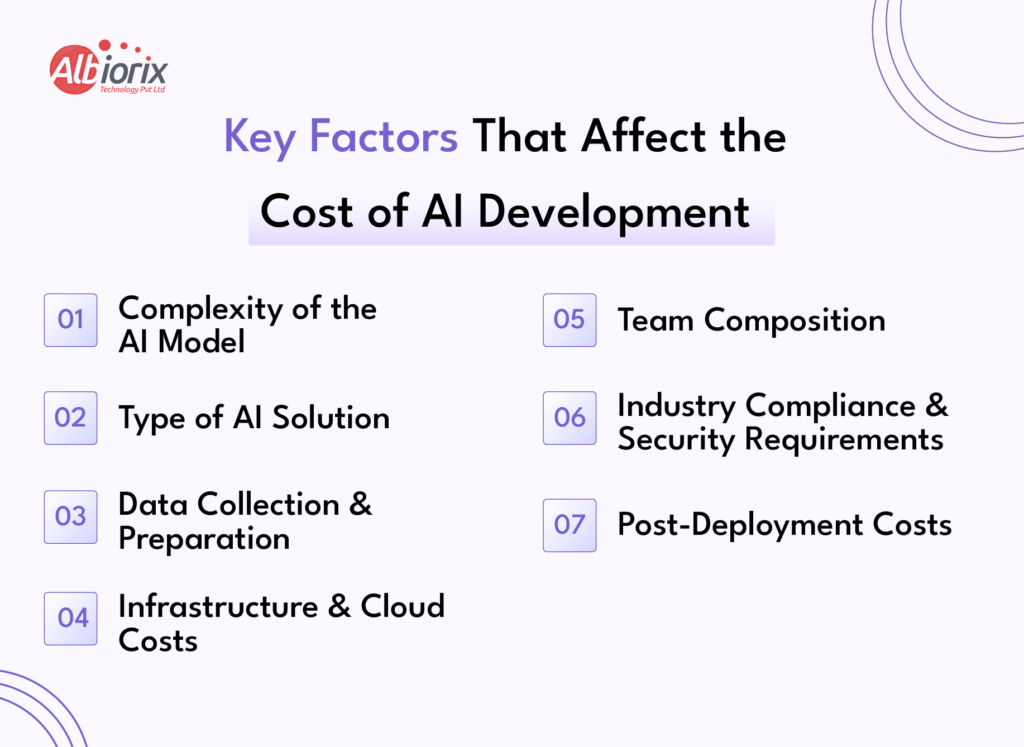
What Factors Drive AI Development Costs?

Before looking at specific numbers, it helps to understand the key levers that push costs up or down.

Two businesses asking for an ‘AI chatbot’ can receive quotes that differ by $100,000 and both quotes can be entirely justified. Here is why.

AI Project Complexity

A basic rule-based chatbot is worlds apart from a context-aware AI assistant trained on your proprietary data. The more sophisticated the logic, the higher the build cost. Complexity also increases testing, debugging, and maintenance overhead.

AI Model Type: Custom vs Pre-Built

Using APIs from OpenAI, Google, or AWS is much cheaper than training a custom model from scratch.

However, pre-built models give you less control. They may also add ongoing API costs. Sometimes, they miss domain-specific accuracy.

AI Project Data Requirements

AI runs on data. If you must collect, clean, label, and organize large proprietary datasets before training, it adds major cost. This work often costs $10,000 to $50,000 alone. The exact amount depends on data volume and quality.

AI Project Team Composition and Location

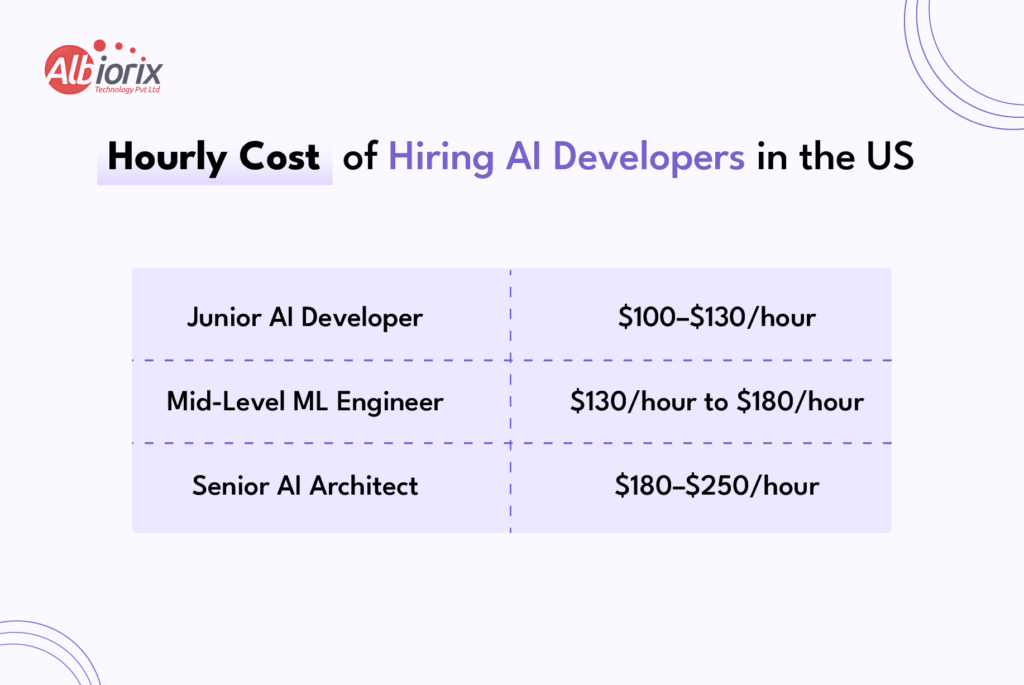
An in-house US team of senior AI engineers can cost $150–$250 per hour. An experienced AI agency might charge $100–$180/hr. Offshore teams average $40–$80/hr.

Location has a massive impact on total project cost, though quality and communication also vary.

AI Project Integration Complexity

Connecting your AI solution to existing CRMs, ERPs, databases, APIs, and workflows adds engineering hours. The more legacy systems involved, the more expensive the integration.

Compliance and Security Requirements

Industries like healthcare (HIPAA), finance (SOC 2, GDPR), and legal services need extra security.

They also require audit trails and compliance testing.

These needs can add 15–30% to the total development cost.

Maintenance and Ongoing Improvement

AI models degrade over time as real-world data drifts from training data. Budget 15–25% of initial development cost annually for maintenance, retraining, and updates.

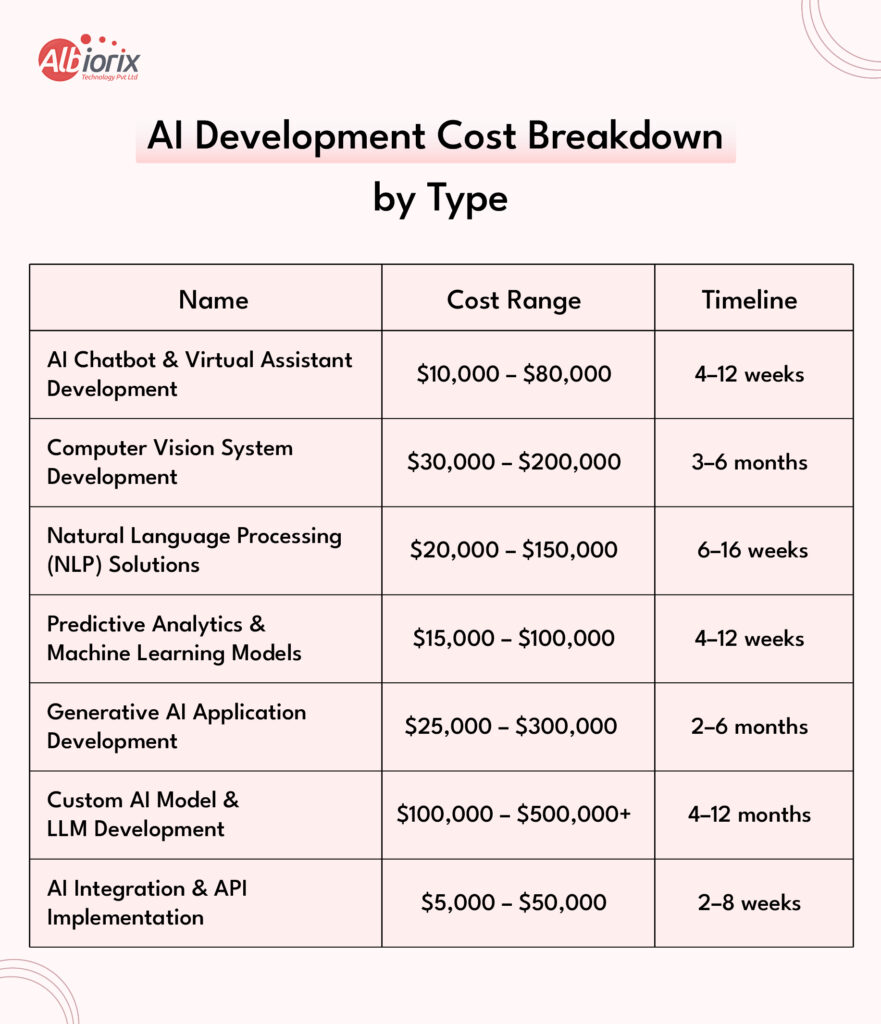
AI Development Cost Breakdown by Type

AI Development Cost Breakdown by Type

Below is an in-depth cost breakdown for the most common AI solutions businesses are building in 2026. Each section covers cost range, timeline, key cost drivers, and who it is best suited for.

AI Chatbot and Virtual Assistant Development

“Cost Range: $10,000 – $80,000 | Timeline: 4–12 weeks”

AI chatbots remain one of the most popular entry points for businesses investing in AI.

In 2026, chatbots have evolved far beyond scripted flows. Modern AI assistants use large language models (LLMs). They understand context, remember conversation history, and respond naturally to nuanced queries.

Cost drivers include:

  • Number of supported languages and conversation channels (web, WhatsApp, Slack, etc.)
  • Whether the bot uses a pre-built LLM API or a fine-tuned custom model
  • CRM and helpdesk integrations (Salesforce, Zendesk, HubSpot)
  • Custom training data and domain-specific knowledge bases
  • Admin dashboard, analytics, and conversation logging

A simple FAQ chatbot using GPT-4 API can be built for $10,000–$25,000. A sophisticated AI sales assistant with memory, lead qualification logic, and CRM integration will cost $50,000–$80,000 or more.

Computer Vision System Development

“Cost Range: $30,000 – $200,000 | Timeline: 3–6 months”

Computer vision AI allows machines to interpret and act on visual data from inspecting manufacturing defects to enabling autonomous checkouts in retail.

This is a more technical and costly AI category, mainly because it needs large, well-labeled image datasets.

Common applications include:

  • Quality control and defect detection in manufacturing
  • Facial recognition and access control systems
  • Retail shelf monitoring and inventory tracking
  • Medical imaging analysis (radiology, pathology)
  • Autonomous vehicle perception and drone navigation

The biggest cost variable is data labeling. A typical computer vision model requires thousands of annotated images.

If you lack proprietary image data, collecting and labeling it can cost $15,000–$50,000. This is before any model code is written.

Natural Language Processing (NLP) Solutions

“Cost Range: $20,000 – $150,000 | Timeline: 6–16 weeks”

NLP solutions help machines understand, interpret, and generate human language.

From sentiment tools to document summary engines and contract review systems, NLP is in high demand. It supports legal, healthcare, finance, and customer experience teams.

Typical NLP use cases businesses are funding in 2026:

  • Automated document classification and extraction
  • Sentiment analyzing for customer feedback and social media
  • AI-powered contract review and legal document analysis
  • Clinical note summarization for healthcare providers
  • Intelligent email routing and auto-response systems

Lower-end NLP projects that rely on existing transformer models (like BERT or GPT) via API cost $20,000–$50,000.

Specialized industries that require accuracy and domain knowledge can pay $100,000 to $150,000 for custom fine-tuned models.

Predictive Analytics and Machine Learning Models

“Cost Range: $15,000 – $100,000 | Timeline: 4–12 weeks”

Predictive analytics uses past data to forecast future outcomes. It can predict customer churn, equipment failures, demand spikes, fraud patterns, and revenue trends.

For data-rich businesses, this is often the AI investment with the fastest, most measurable ROI.

Cost variables:

  • Data quality and preparation (often 40–60% of total project effort)
  • Number of prediction targets and model complexity
  • Frequency of retraining (real-time vs weekly batch)
  • Dashboard and visualization requirements
  • Integration with BI tools like Tableau, Power BI, or Looker

A solid demand forecasting model for an e-commerce business typically runs $20,000–$45,000.

A real-time fraud detection system for a financial institution can cost $80,000–$100,000. It needs high accuracy and millisecond inference speeds.high accuracy requirements and millisecond inference speeds, can reach $80,000–$100,000.

Generative AI Application Development

“Cost Range: $25,000 – $300,000 | Timeline: 2–6 months”

Generative AI is the technology behind tools like ChatGPT, Midjourney, and GitHub Copilot. It is the fastest-growing AI development category in 2026.

Businesses are building custom generative AI applications to automate content creation, accelerate software development, personalize marketing at scale, and reinvent internal knowledge management.

Popular generative AI builds in 2026:

  • Branded AI writing assistants for marketing and content teams
  • AI code generation and developer productivity tools
  • Enterprise knowledge bases with AI-powered Q&A (RAG systems)
  • AI image and video generation tools for creative industries
  • Personalized product recommendation engines

The wide cost range here reflects the diversity of applications. A team can deliver a Retrieval-Augmented Generation (RAG) system built on top of GPT-4 for $25,000–$60,000.

A fully custom generative AI platform can cost $200,000 to $300,000 or more.

It may include proprietary model fine-tuning, multi-modal features, and enterprise security.

Custom AI Model and LLM Development

“Cost Range: $100,000 – $500,000+ | Timeline: 4–12 months”

At the high end of the investment spectrum is custom AI model development. It involves building and training large models on proprietary data. It does not rely on third-party APIs.

This is the territory of enterprises, research organizations, and technology companies that need full control. They need unique competitive moats and no dependence on external AI providers.

This investment makes sense when your use case needs domain knowledge that no existing model provides. It also fits when your data is too sensitive for a cloud AI provider. It can also work when inference volume is so high that API costs exceed ownership costs in 12–18 months.

AI Integration and API Implementation

“Cost Range: $5,000 – $50,000 | Timeline: 2–8 weeks”

Not every business needs a custom-built AI.

Many startups and SMBs gain great value by adding existing AI APIs, like OpenAI and Google Gemini.

They can also use AWS Rekognition and Azure Cognitive Services in their products and workflows.

This is the fastest and most cost-effective path to adding AI capabilities.

Examples include adding AI search to an e-commerce platform. You can integrate speech-to-text into a video call tool. You can embed AI summaries into a document management system.

If your goal is an MVP or proof of concept, this is almost always the right starting point.

Start Your AI Project with a Free Expert Consultation

Skip the guesswork and connect with our AI specialists today. In just one session, you’ll get clarity on costs, timelines, and the right AI solution for your business.


Get Started!

Hiring Models and Their Cost Implications

Beyond what you build, how you build it and who builds it has an enormous impact on your total investment. Here are the three main paths, with honest pros and cons for each.

Hiring ModelHourly Rate (USD)Best ForWatch Out For
In-house team (US/AU)$120 – $250/hrLong-term AI productsHigh fixed costs, slow to hire
AI Development Agency$80 – $180/hrEnd-to-end project deliveryChoose carefully — quality varies
Freelancers$50 – $150/hrSpecific components or POCsCoordination overhead, availability
Offshore Team$30 – $80/hrCost-sensitive buildsCommunication, timezone, quality risk

Why Many Businesses Choose an AI Development Agency

For most businesses, a specialist AI agency is a good choice. This is especially true for companies without a machine learning engineering team. It offers a strong balance of speed, quality, and cost.

A good agency brings a full team, like ML engineers, data scientists, UI/UX designers, and DevOps. It also brings a proven delivery process and clear accountability through defined milestones and deliverables.

The key is choosing the right agency. Look for a proven portfolio of AI projects, transparent pricing, clear communication, and post-launch support.

A free first consultation is a good sign. The agency should ask detailed questions about your goals before giving a quote. This shows you are working with a serious team.

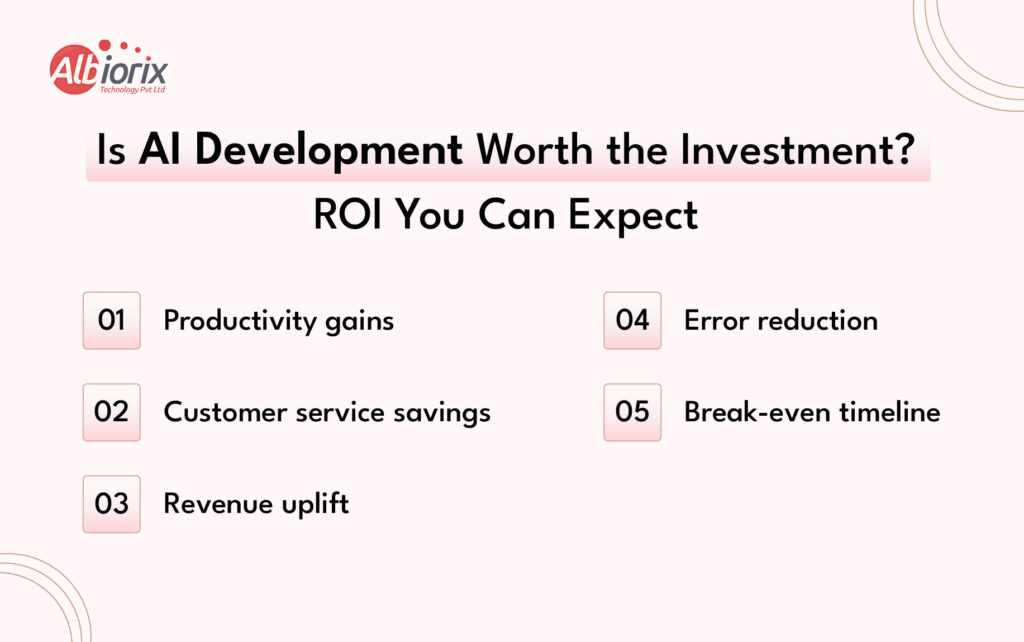
Is AI Development Worth the Investment?

Is AI Development Worth the Investment

Cost without context is meaningless. Before approving any AI development budget, the real question is: what will this AI solution return?

  • Productivity gains: McKinsey research finds AI automation can improve knowledge worker productivity by 20–45%. For a 50-person company, that is equivalent to gaining 10–22 additional full-time employees without increasing headcount.
  • Customer service savings: Businesses using AI chatbots for tier-1 support report 30–50% lower support costs. Well-set-up chatbots keep customer satisfaction scores the same.
  • Revenue uplift: AI-powered personalization in e-commerce lifts average order value by 10–30%. AI-driven lead scoring and qualification can improve sales conversion rates by 20–35%.
  • Error reduction: In data-heavy fields like finance, healthcare, and logistics, AI cuts human errors by 60–90%. This leads to lower costs and less compliance risk.
  • Break-even timeline: Most mid-sized AI projects reach ROI break-even within 6–18 months after launch. Customer-facing apps break even sooner. Complex internal systems often take longer.
Pro tip for decision-makers:
Frame AI development as a capital investment, not an operating expense. The upfront cost gives you a competitive edge that grows over time. It also becomes harder for competitors to copy the longer you use it.

Hidden Costs to Budget For

Many businesses are surprised by costs that emerge after the initial development phase. Here is what to plan for beyond the build cost:

  • Cloud infrastructure and compute costs: AI workloads that use many GPUs can cost $2,000 to $15,000 per month. Costs on AWS, GCP, or Azure vary by usage volume and model complexity.
  • Third-party API costs can be high. If your solution uses OpenAI, Anthropic, or Google AI APIs a lot, token costs can rise quickly. A high-volume chatbot can rack up $3,000–$20,000/month in API fees.
  • Model retraining and drift monitoring: AI models need periodic retraining as real-world data changes. Budget 15–25% of initial build costs annually.
  • User adoption and change management: Deploying AI is as much an organizational challenge as a technical one. Training staff, running change management, and managing resistance have a real cost.
  • Security audits and compliance reviews: Especially for regulated industries, periodic security audits and compliance reviews ($5,000–$25,000/year) are non-negotiable.

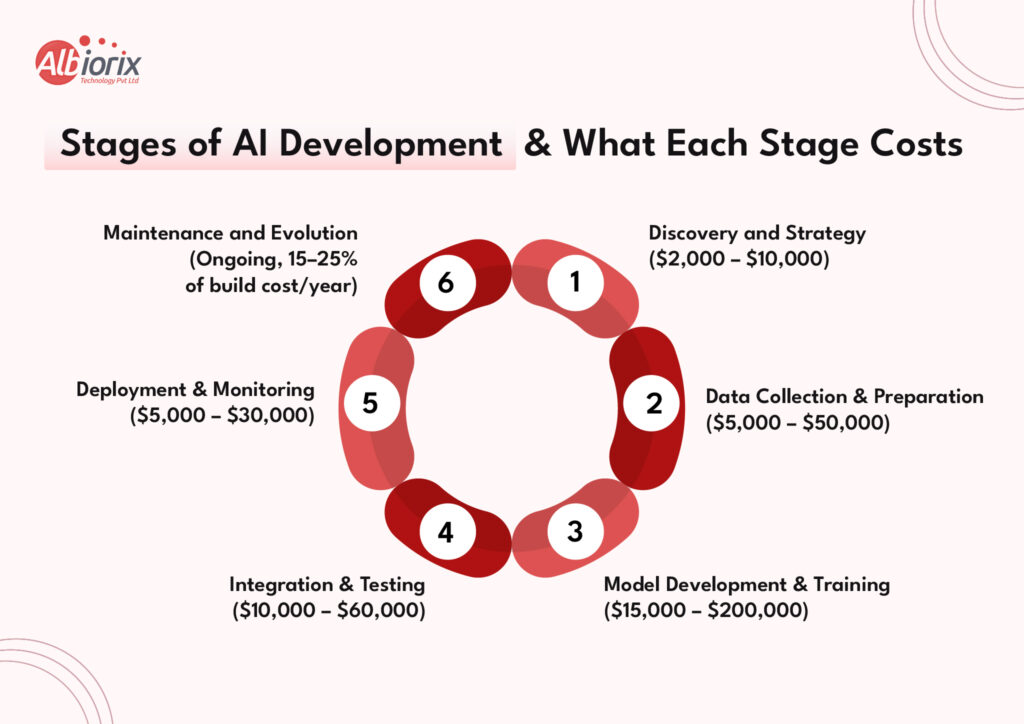
Stages of AI Development and What Each Stage Costs

Stages of AI Development and What Each Stage Costs

Understanding how AI development is phased helps you plan your budget and manage risk. Most professional AI projects follow this structure:

Phase 1: Discovery and Strategy ($2,000 – $10,000)

Requirements gathering, feasibility study, data audit, technology selection, project roadmap. This phase helps you determine whether your idea is viable before you spend a cent on development. Some agencies offer this free as part of a scoping consultation.

Phase 2: Data Collection and Preparation ($5,000 – $50,000)

Sourcing, cleaning, labeling, and structuring training data. Often the most underestimated phase. Poor-quality data produces poor AI garbage in, garbage out.

Phase 3: Model Development and Training ($15,000 – $200,000)

Building the AI architecture, training on prepared data, iterating on model performance, and reaching target accuracy metrics. The core of the development investment.

Phase 4: Integration and Testing ($10,000 – $60,000)

Connecting the AI to your existing systems, APIs, and interfaces. Rigorous testing across edge cases, adversarial inputs, and real-world scenarios.

Phase 5: Deployment and Monitoring ($5,000 – $30,000)

Production deployment on cloud infrastructure, real-time monitoring, alerting, and performance dashboards. CI/CD pipelines for ongoing model updates.

Phase 6: Maintenance and Evolution (Ongoing, 15–25% of build cost/year)

Retrain on new data. Add new features. Apply security patches. Scale infrastructure as usage grows. Adapt to new AI capabilities as the technology landscape evolves.

How to Reduce AI Development Costs Without Cutting Corners

Smart AI investment is not about spending less, it is about spending right. Here are proven strategies:

  • Start with an MVP: Build a focused, minimal viable AI product first. Validate it with real users before investing in scale, additional features, or model customization.
  • Use pre-built models and APIs with care.
  • Off-the-shelf AI APIs can deliver 80% of the value at 20% of the cost. Use them for non-differentiating functions, custom build only for your true competitive advantage.
  • Invest in data quality early: Clean, well-labeled data dramatically reduces training cycles and costs. Cutting corners on data preparation creates expensive rework later.
  • Choose a phased delivery model: Break large AI projects into milestone-based phases. This reduces financial risk, allows for course corrections, and keeps the team accountable.
  • Negotiate a maintenance and support SLA: Ongoing support with your development partner is often 30–40% cheaper. It also costs less than hiring them ad hoc for each issue.
  • Leverage open-source frameworks: Frameworks like TensorFlow, PyTorch, HuggingFace Transformers, and LangChain dramatically reduce build time and cost for experienced AI developers.

Conclusion

AI development costs in 2026 vary widely. They range from $5,000 for a simple API integration. They can exceed $500,000 for a custom enterprise AI platform.

The right investment for your business depends on your goals, your data setup, the problem’s complexity, and the value AI will bring.

What is clear is this: the cost of not investing in AI is growing every year. Businesses that move early build compounding advantages better data, more refined models, and deeper organisational AI capability that latecomers cannot easily replicate.

The smartest investment is a well-scoped first project: focused, measurable, and designed to prove value before scaling. Get that right, and every subsequent AI investment becomes easier to justify, faster to deliver, and higher in return.

Ready to Build Your AI Solution? Get a free, no-obligation project estimate from our AI development team. We work with businesses in the US and Australia to design, build, and scale AI solutions with clear results.

How AI Agents Are Transforming Sports Betting Apps

Summary: The AI revolution has taken the sports betting industry by storm. The use of popular AI models and generative AI solutions has increased in sports betting apps and software. Following a structured sports betting apps development guide can help businesses effectively integrate these technologies. The big sports betting brands in the USA and Australia have already integrated AI to offer an enhanced experience and make informed business decisions.

Introduction

The global sports betting market is no longer driven by instinct or luck — it’s being reshaped by intelligent, autonomous systems.

AI agents are now at the center of sports betting app development, powering everything from real-time odds computation to hyper-personalised user experiences.

Whether you’re a developer in the USA, an operator expanding into Australia, or a startup navigating Germany’s newly regulated market, understanding the role of AI agent development in sports betting apps is no longer optional — it’s a competitive necessity.

In this blog, we break down exactly how AI agents work inside sports betting platforms, what capabilities they unlock, and what it takes to build these systems for the world’s three fastest-growing betting markets.

The Market Opportunity Stats

Market Value in 2024Market ProjectionsUS Sports Betting MarketEngagement Via Mobile Apps
$100.9B Global sports betting market value in 2024$187.4B Projected market size by 2030 (11% CAGR)$149.6B US sports betting handle in 202590% Bets placed via mobile devices

These numbers tell a clear story: sports betting is a high-growth, mobile-first, and data-intensive industry. AI agents are the infrastructure that makes it all work at scale.

Want to increase the market share of your sports betting app?

Contact our team of AI developers to discuss how integrating AI can help boost growth in a competitive landscape.


Talk to AI experts

What Is an AI Agent for Sports Betting Apps?

An AI agent is not just a chatbot or a recommendation engine.

In the context of sports betting app development, an AI agent is an autonomous system that can perceive real-time data, reason about that data, make decisions, and take action — all without ongoing human input.

Unlike traditional algorithms that follow fixed rules, AI agents in sports betting apps:

  • Continuously learn from live data streams (player stats, weather, injuries, market movements)
  • Adapt their betting predictions and recommendations dynamically
  • Automate actions such as bet placement, odds adjustment, and fraud flagging
  • Operate across multiple tasks simultaneously — customer support, risk management, personalization

Key Insight:

AI agents in sports betting are the difference between a static platform and a living, adaptive system — one that gets smarter with every game played and every bet placed. 

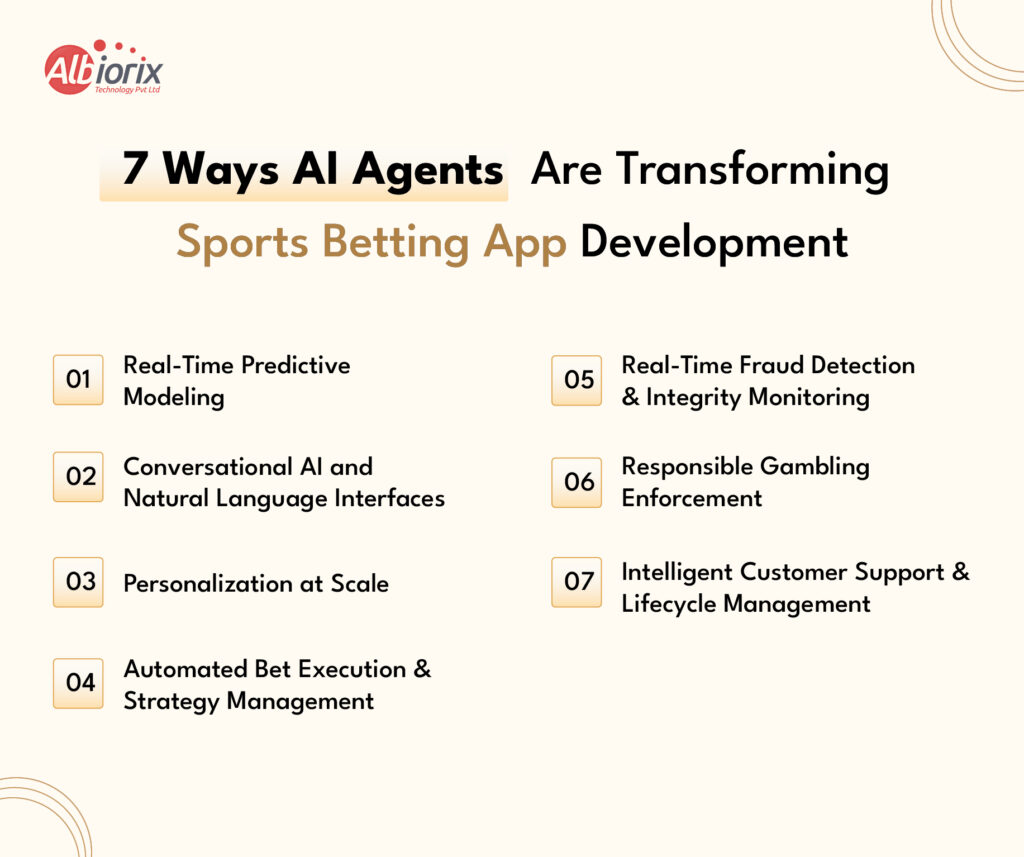
7 Ways AI Agents Are Transforming Sports Betting App Development

7 Ways AI Agents Are Transforming Sports Betting App Development

Real-Time Predictive Modeling

The most powerful application of an AI agent for sports betting apps is predictive accuracy.

Modern AI agents process historical performance data, player statistics, team dynamics, referee trends, and even environmental conditions like weather — and update predictions continuously during live events.

In 2025, AI-driven platforms are achieving up to 35% improvement in prediction accuracy compared to traditional statistical models.

Systems like those used by DraftKings can recalculate odds within milliseconds of an in-game event — a quarterback injury, a red card, or a missed penalty — giving both operators and bettors a decisive edge.

Market Data

The sports analytics market was valued at $854.5 million in 2023 and is forecast to reach $4.74 billion by 2030 (27.7% CAGR), making AI-powered prediction one of the most investable features in sports betting app development.

Conversational AI and Natural Language Interfaces

Gone are the days of navigating complex menus to place a bet. AI agents now power conversational interfaces that let users interact in plain language — by text or voice.

Imagine a bettor typing: “What are the best prop bets for the NBA game tonight?” and receiving an instant, personalized, data-backed response — with the option to execute the bet directly from the conversation.

Platforms like BetHarmony are already deploying AI agents that understand betting slang, support multiple languages, and execute complex parlay combinations through natural dialogue.

This is especially critical for operators targeting Germany and Australia, where localized language support dramatically improves user retention.

  • Supports multilingual communication for international markets (critical for Germany and Australia)
  • Voice-to-voice betting enables hands-free, in-game wagering
  • Reduces onboarding friction for new bettors in newly legalized markets


Personalization at Scale

AI agents analyze individual betting histories, preferences, and behavioral patterns to deliver hyper-personalized experiences. Rather than showing the same promotions and markets to every user, the platform adapts in real time.

Research shows that 60% of users prefer AI-personalized apps, leading to improved retention and increased bet volumes.

Platforms implementing personalized AI agent development have reported up to 30% improvement in user retention metrics.

  • Personalization features powered by AI agents include
  • Custom odds recommendations based on past behavior
  • Automated notifications for relevant sports events
  • Tailored promotional offers tied to individual betting patterns
  • Dynamic odds presentation based on a user’s preferred sports and markets

Automated Bet Execution and Strategy Management

AI sports betting agents can execute predefined betting strategies autonomously, removing emotional bias and enabling complex multi-leg strategies that would be impractical for manual execution.

This is the backbone of professional sports betting agent development: building systems that can identify value bets, monitor arbitrage opportunities across platforms, manage bankroll limits, and execute wagers at optimal timing — all within the rules of each jurisdiction.

Key Developer Note:
When building an AI agent for sports betting apps in the USA, ensure your automated execution features are compliant with state-level requirements.

In Australia, refer to the Interactive Gambling Act; in Germany, adhere to the Glücksspielstaatsvertrag (GlüStV) framework.

Real-Time Fraud Detection and Integrity Monitoring

AI agents are the first line of defense against match-fixing, fraudulent accounts, and suspicious betting patterns.

Systems like Sportradar’s Fraud Detection System (FDS) use machine learning to monitor thousands of betting markets simultaneously, flagging irregularities before they escalate.

For operators building sports betting apps in highly regulated markets like Germany or US states such as New Jersey and Pennsylvania, robust fraud detection is not just a feature — it’s a licensing requirement. 

AI-powered integrity tools can:

  • Detect sudden unexplained shifts in betting volumes
  • Cross-reference patterns against historical match-fixing data
  • Trigger automatic review workflows or account flags in real time
  • Integrate with KYC/AML systems for holistic compliance

Responsible Gambling Enforcement

One of the most socially significant applications of AI agent development in sports betting apps is responsible gambling.

AI agents can monitor individual user behavior in real time, identify early signs of problem gambling, and trigger interventions automatically.

This is increasingly a regulatory expectation.

The EU AI Act (effective February 2025) and Australia’s National Consumer Protection Framework both require platforms to implement safeguards that prevent exploitative personalization targeting vulnerable users. 

AI-powered responsible gambling tools include:

  • Behavioral tracking that flags loss-chasing patterns
  • Automated deposit limit enforcement and self-exclusion prompts
  • PlayScan-style risk scoring across user sessions
  • Regulatory-compliant affordability checks (especially relevant in Germany)


Intelligent Customer Support and Lifecycle Management

AI agents dramatically reduce the cost and latency of customer support in sports betting platforms. Operating 24/7, these systems handle everything from account inquiries and withdrawal processing to live bet assistance and dispute resolution.

For operators targeting multiple time zones — critical for USA (multiple time zones), Australia (AEST/AWST), and Germany (CET) — AI-powered support agents ensure consistent service quality without scaling human teams proportionally.

Beyond support, AI agents drive the entire user lifecycle: onboarding new users, re-engaging dormant bettors, and proactively surfacing upsell opportunities at the right moment in a session.

AI Agent Sports Betting Development: A Regional Breakdown

AI Agent Sports Betting Development: A Regional Breakdown

AI Agent Sports Betting Development: United States

The USA is the world’s most dynamic emerging market for sports betting.

Following the 2018 Supreme Court ruling that overturned the federal ban, 39 states and the District of Columbia have legalized sports betting, with more than 70% of the US population now having legal access.

US sports betting generated $149.6 billion in handle and $13.71 billion in revenue in 2025 alone. AI agent development in this market must account for: 

  • State-by-state licensing (New Jersey, Pennsylvania, Illinois each have unique requirements)
  • SAFE Bet Act proposals that may restrict manipulative AI targeting
  • Integration with major platforms like DraftKings and FanDuel APIs
  • NFL, BA, MLB, and college sports as primary markets driving live betting volume

The US market rewards AI agents that can operate with high-frequency real-time data given that 95% of bets are placed online and the majority during live game windows.

AI Agent Sports Betting Development: Australia 

Australia has one of the world’s most mature and regulated online betting markets.

Sports betting is legal nationally and governed by the Interactive Gambling Act 2001, with state-level licensing handled by bodies including the Northern Territory Racing Commission.

AI sports betting agents targeting Australia must support:

  • AFL, NRL, Rugby League, Cricket (Big Bash, Tests), and A-League as primary sports
  • Integration with dominant platforms including Sportsbet, TAB, Ladbrokes, and Bet365 Australia
  • National Consumer Protection Framework compliance (deposit limits, activity statements, bet confirmation tools)
  • Strong personalization for local sports culture and seasonal betting patterns


Australia’s mobile-first bettors and high sports engagement make it an ideal market for AI agents that specialize in live in-play betting and push notification management.

AI Agent Sports Betting Development: Germany

Germany’s sports betting market underwent significant regulatory transformation with the Glücksspielstaatsvertrag 2021 (Interstate Treaty on Gambling), which created a federally unified licensing framework. The market is strict but lucrative.

Key requirements for AI agent development for sports betting apps targeting Germany:

  • GlüStV-compliant licensing from the Gemeinsame Glücksspielbehörde der Länder (GGL)
  • GDPR and EU AI Act compliance for all data processing and user-targeting features
  • Mandatory responsible gambling tools including monthly deposit limits (€1,000 cap)
  • Support for German-language interfaces with localized Bundesliga, Champions League, and DFB-Pokal markets
  • Prohibition on live in-play betting on certain markets — AI agents must enforce geo-restricted bet types


Germany rewards platforms that combine rigorous compliance with premium user experience. AI agents that can enforce regulations programmatically — without degrading the UX — are a significant competitive advantage here.

Core Technology Stack for AI Sports Betting Agent Development

Building a robust AI agent for sports betting apps requires more than off-the-shelf machine learning. Here is the foundational technology architecture used by leading platforms in 2025:

Sr. NoLayer Technology/Tools
1Data Ingestion Real-time sports APIs (Sportradar, Stats Perform, Opta), web scraping, social media NLP feeds
2Machine LearningTensorFlow / PyTorch for predictive models; scikit-learn for statistical baselines; XGBoost for rapid odds recalculation
3AI Agent FrameworkLangChain / AutoGen for multi-step reasoning; OpenAI GPT-4 / Claude API for NLP interfaces
4Real-Time Processing Apache Kafka for event streaming; Redis for low-latency caching; Apache Flink for stream analytics
5Backend InfrastructureNode.js / Python FastAPI; microservices on AWS / Azure / GCP; PostgreSQL + TimescaleDB for time-series data
6Compliance LayerKYC/AML integrations (Onfido, Jumio); GDPR-compliant data pipelines; geo-restriction enforcement APIs
7Mobile/FrontendReact Native for cross-platform iOS/Android; WebSocket connections for live odds delivery

Challenges in AI Sports Betting Agent Development

Building AI agents for sports betting apps is complex. Development teams must navigate:

Data Quality and Latency

AI agents are only as good as their data. Partnering with certified sports data providers and building low-latency ingestion pipelines is non-negotiable, especially for live in-play betting features where odds can shift within seconds.

Regulatory Complexity Across Jurisdictions

A single platform targeting USA, Australia, and Germany must simultaneously comply with three distinct legal frameworks — each with its own licensing, advertising, responsible gambling, and data protection requirements.

AI agent development must embed compliance logic at the architecture level, not as an afterthought.

Model Bias and Transparency

If training datasets are unbalanced, AI agents can systematically favor certain teams or market outcomes.

Diverse training data, ongoing monitoring, and explainable AI features — which show users how recommendations are generated — are essential for both fairness and regulatory acceptance, particularly under Germany’s EU AI Act obligations.

Responsible Deployment

AI agents that learn individual behavioral vulnerabilities carry ethical obligations.

Platforms must implement the same intelligence that drives personalization to also enforce user protection — a dual mandate that requires thoughtful architecture and ongoing human oversight. 

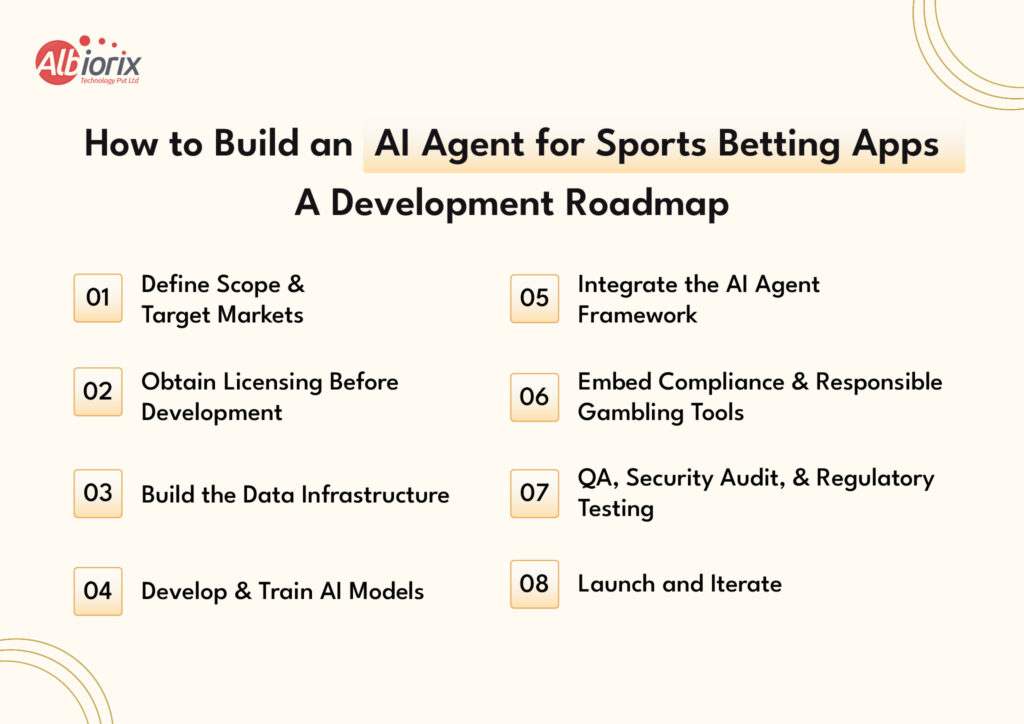
How to Build an AI Agent for Sports Betting Apps: A Development Roadmap

How to Build an AI Agent for Sports Betting Apps: A Development Roadmap
  1. Define Scope and Target Markets — Identify which sports, bet types, and jurisdictions the platform will support. This determines licensing requirements, data sources, and compliance architecture.
  2. Obtain Licensing Before Development — In the USA, this means state-by-state applications. In Australia, engage the Northern Territory Racing Commission or relevant state body. In Germany, apply to the GGL. Timeline: 3–12 months depending on jurisdiction.
  3. Build the Data Infrastructure — Integrate certified real-time sports data APIs. Establish event streaming pipelines capable of processing millions of data points per second during major sporting events.
  4. Develop and Train AI Models — Begin with foundational predictive models (match outcomes, player props). Layer in personalization engines and NLP interfaces. Use A/B testing frameworks to iterate model performance against live user data.
  5. Integrate the AI Agent Framework — Connect ML models to an agent orchestration layer that can reason, plan, and execute across multiple tasks: odds adjustment, user recommendation, fraud alert, and customer support simultaneously.
  6. Embed Compliance and Responsible Gambling Tools — Build KYC/AML flows, GDPR-compliant consent management, deposit limit enforcement, and behavioral monitoring into the core platform — not bolted on post-launch. 
  7. QA, Security Audit, and Regulatory Testing — Run compliance checks specific to each target region. Conduct penetration testing and verify that geo-blocking, age verification, and jurisdictional bet-type restrictions function correctly.
  8. Launch and Iterate — Start with a soft launch in one market. Use real user data to refine AI models continuously. Scale to additional markets once core performance and compliance are validated. 

Development Cost Range:
Custom AI-powered sports betting app development typically ranges from $65,000 to $300,000 USD depending on feature depth, AI integration complexity, and compliance requirements across markets.

The Future of AI Agents in Sports Betting 

The trajectory for AI agents in sports betting is clear. Several emerging developments will define the next phase of sports betting app development:

  1. Agentic Multi-Modal Systems: AI agents will process video feeds, audio commentary, and social media in real time — not just statistical data — to generate betting signals during live events.
  2. Autonomous Bankroll Management Agents: Fully autonomous agents that manage a user’s entire betting portfolio, adjusting stakes and strategy based on live market conditions and personal risk tolerance. 
  3. Decentralized AI Oracles: Integration with blockchain-based smart contracts to enable transparent, trustless AI-driven betting settlements — highly relevant for crypto-friendly markets.
  4. Regulatory AI: AI agents that monitor their own outputs for compliance violations in real time, automatically adjusting behavior based on jurisdictional rule sets — a critical advantage for multi-market operators. 
  5. Conversational Betting on Messaging Platforms: AI sports betting agents embedded directly into WhatsApp, Telegram, and social platforms, enabling bet placement through group chats — targeting Gen Z users in all three key markets. 

The global AI agent market itself is projected to grow from $5.1 billion in 2024 to $47.1 billion by 2030.

Sports betting is one of the most data-rich and decision-intensive industries in the world — making it one of the highest-value deployment environments for next-generation AI agent development.

Conclusion

AI agents are no longer a future-looking feature for sports betting apps — they are the present competitive standard.

Platforms that build intelligent, adaptive, real-time AI systems today will dominate the betting markets of tomorrow in the USA, Australia, Germany, and beyond.

Whether you’re looking to build a sports betting app from the ground up, integrate AI agent capabilities into an existing platform, or navigate the regulatory complexities of multi-market launches, leveraging Sports Betting Software Development Services can streamline the process and ensure scalability.

The investment in AI agent development delivers measurable returns: higher prediction accuracy, stronger user retention, lower fraud rates, and scalable compliance.

The sports betting industry is estimated to generate more than $221 billion between 2025 and 2029, powered in large part by the AI revolution.

The question is not whether AI agents will transform sports betting apps — they already are. The question is whether your platform will lead that transformation or follow it.

Best AI Integration Tools, Platform and Strategy For Business

Summary: AI Integration is in huge demand. It is helping businesses automate tasks, enhance support services, and analyze data for business decisions. Amid the many AI integration tools on the market, we offer a guide to help you find the best AI solution for your business. From top AI models to GenAI Solutions, let’s find the right AI tools for your business in 2026.

The Growing Adoption of AI Integration in Businesses

Artificial Intelligence is one of the widely used business tools in 2026.

Organizations in developed nations like the USA, Australia, Germany, and the UK use AI and generative AI solutions.

They automate business operations, improve customer service, and support data-driven decisions.

They are amplifying their business productivity and ROI by using artificial intelligence.

In 2026, AI integration is very common among businesses. They are adding AI to their current systems. This will improve efficiency. It will automate decisions. It will also help them find deeper insights in their data.

This shift is driving the growing demand for AI integration across industries.

According to statistics, over 80% of businesses will likely add AI tools to their operations by 2027.

Many large organizations already use AI models and GenAI solutions for automation, predictive analytics, and customer service tools.

As a result, there is strong demand for professional AI integration services. This demand is high in the USA, Australia, and across Europe.

As AI technologies continue to evolve, businesses are increasingly partnering with experienced AI development companies to implement scalable and reliable solutions.

In this guide, we explain how AI integration works. We cover why businesses are adopting it. We review the best tools and platforms available. We also show how organizations can implement AI in their operations.

What is AI Integration?

AI Integration is the process of incorporating Artificial Intelligence technologies into your existing/traditional business systems, workflows, and applications.

The main purpose of AI integration with existing business systems is to automate tasks, analyze data, and improve decisions.

Many businesses globally have already integrated AI, and many on the verge of integrating it. But what is AI integration?

Businesses prefer AI integration services because it is less expensive than developing a custom AI solution from scratch.

Organizations add AI features to tools they already use. These tools include CRM platforms, marketing software, customer support systems, and data analytics platforms.

AI integration allows businesses to leverage the power of AI and improve their ROI by multiple folds.

For Example, Artificial Intelligence is integrated into a CRM system to automatically analyze customer behavior and predict purchasing patterns.

Similarly, AI-powered chatbots or voice assistants can be added to customer service platforms. They handle routine questions and provide instant responses.

Businesses increasingly rely on technologies explained in AI voice agent technology to automate support interactions.

Modern AI integration often involves technologies such as machine learning, natural language processing (NLP), predictive analytics, and computer vision.

These technologies allow businesses to process large volumes of data, detect patterns, and generate actionable insights in real time.

With professional AI integration services, companies can connect AI models to their existing systems. These systems include databases, APIs, cloud platforms, and enterprise apps. This helps create smarter, automated business operations.

Ready to Integrate AI into Your Business Operations?

Our team specializes in building scalable AI solutions that improve efficiency, enhance customer experiences, and drive long-term business growth.


Talk to AI Experts

Why Do Businesses Need AI Integration?

Businesses are integrating AI into their existing system to automate workflows, make informed decisions, and deliver personalized customer experiences. It helps them stay more productive, competitive, and evolve faster.

AI Integration is increasing among businesses of all sizes. Below are some of the most important benefits of AI integration for modern businesses.

  1. Smarter Data Driven Decisions: AI integration helps businesses process and analyze large amounts of unstructured data. It turns that data into a meaningful set of structured data. Organizations exploring intelligent automation strategies often compare types of AI voice agents to enhance data-driven decision systems.
  2. Improved Business Efficiency: One of the biggest reasons for AI integration is improved efficiency. With the help of AI Integration, businesses can automate representative tasks, including data entry, reporting, and customer responses. Companies implementing intelligent automation frequently explore reducing development cost strategies using AI tools.
  3. Better Customer Experience: With AI chatbots and AI voice agents, you do not need humans for customer support. These AI tools help businesses deliver faster, accurate, and more personal customer support at any time.
  4. Better Marketing Performance: With AI integration, marketing teams can analyze customer behavior, predict SEO trends, and plan their strategy. Organizations implementing conversational automation often evaluate AI voice platforms to scale customer support efficiently.
  5. Scalable Business Operations: With help from an experienced AI integration company, organizations can build scalable AI systems. These systems can evolve as their business grows. AI-driven automation helps businesses manage increased demand without significantly expanding operational costs.
  6. Competitive Advantage: Businesses that adopt AI early gain a strong competitive edge. Many companies now work with experienced AI voice developers to build advanced conversational automation systems.

Top Businesses Using AI Integration

Top Businesses Using AI Integration

Leading organizations in the USA, Australia and Europe are actively investing in AI integration to uplift and automate their operations and business productivity.

Here are some of the most prominent businesses using AI integration in 2026.

  1. Amazon: The eCommerce giant, Amazon, is using advanced AI integration for product recommendations and logistics optimizations. It also uses AI-powered chatbots and AI-powered voice agents to offer personalized customer support.
  2. Google: Google, the search giant, uses AI across its ecosystem. It helps users find the best results. It has integrated AI in search algorithms, advertising platforms, cloud services, and productivity tools.
  3. Microsoft: The tech giant, Microsoft, uses AI integration in enterprise solutions. It uses AI integration in cybersecurity, cloud computing, and business productivity platforms. Tools like Copilot leverage AI to enhance workplace efficiency.
  4. Netflix: The OTT giant, Netflix, uses AI integration to recommend movies and shows. It also uses AI to analyze user behavior and suggest personalized content. It helps Netflix significantly improve viewer engagement and retention.
  5. Shopify: Shopify integrates AI into e-commerce operations by helping businesses automate product recommendations, customer insights, customer support, and marketing strategies for online stores.

AI innovation is also changing industries like gaming. Companies use AI in product development to speed up innovation cycles.

Which Are the Top AI Tools for Small Business Operations

Which Are the Top AI Tools for Small Business Operations

The top AI integration tools for small business operations are ChatGPT, Zapier AI, and HubSpot AI.

Other popular tools include Jasper AI, Notion AI, and Grammarly AI.

Whether small or large, AI tools are becoming an integral part of business operations. It helps them automate processes, improve customer communication, and gain useful insight from the collected data.

Modern AI integration tools allow businesses to implement intelligent automation without requiring complex technical infrastructure.

Many organizations studying modern AI implementations begin with resources like the Generative AI development guide to understand architecture and deployment models.

Below are some of the most popular tools for AI integration used by small businesses.

  1. ChatGPT: It is one of the widely used AI integration tools in 2026. Businesses use ChatGPT to automate customer support, generate marketing content, and much more.
  2. Zapier AI: This AI tool allows businesses to connect multiple applications and automate workflows. It uses AI-powered triggers and automation features to do so.
  3. HubSpot AI: It provides AI-driven tools for marketing automation, lead scoring, email personalization, and CRM management. It is a very useful tool for businesses.
  4. Jasper AI: This AI tool is widely used by marketing teams. It is commonly used to create content, marketing strategies, marketing campaign ideation, and more.
  5. Grammarly AI: Grammarly helps businesses maintain professional communication through AI-powered grammar checking, tone suggestions, and writing improvements.
  6. Notion AI: This AI tool is different from the above one. It helps businesses organize information, generate documentation, automate summaries, and manage workflows.

No-Code AI Integration Platforms You Should Try

No-Code AI Integration Platforms You Should Try

If your business does not have an in-house AI team or an AI integration partner, try a no-code AI integration platform.

These No-Code AI integration platforms are equally useful and valuable. These platforms assist businesses in implementing AI solutions without writing complex code.

Below are some of the Top Platforms for AI Integration in 2026:

  1. Make: This no-code AI tool helps businesses build strong AI automation workflows across many apps without writing code.
  2. Peltarion: This no-code AI tool helps businesses train and deploy AI models. It supports predictive analytics and machine learning use cases.
  3. Obviously AI: This no-code AI tool helps businesses build predictive models. It uses simple data uploads and visual interfaces.
  4. Akkio: This no-code AI platform lets businesses create predictive insights from their data without any coding.
  5. Levity: This no-code AI platform helps businesses automate repetitive tasks such as document classification and email processing.

How to Choose the Right AI Integration Platform

Amid many AI models and GenAI tools in the market, it is important to choose the right AI tool for your business. As a business, you must carefully choose an AI tool that fits your business operations and long-term business goals.

Here are some practical tips to find the right AI integration platform.

  1. Evaluate Business Objectives: Before selecting an AI platform, businesses should clearly define their goals. Companies planning AI transformation often review insights about AI development costs to better understand budget planning.
  2. Check Integration Capabilities: There are many AI platforms in 2026. Choose one that integrates easily with your existing systems.
  3. Consider Scalability: Scalability is a key feature of an AI platform. Choose an AI tool that can scale and grow with your business needs.
  4. Assess Data Security: Online hacking and theft are rising. Choose an AI tool with strong data protection and cybersecurity standards.
  5. Hire Expert AI Integration Services: Working with experienced AI integration services providers ensures smoother deployment, customization, and long-term technical support. Businesses also explore strategies like AI reducing ERP costs when integrating AI into enterprise platforms.

Looking for a Reliable AI Integration Company?

Our experts help organizations unlock the full potential of artificial intelligence and build smarter, future-ready digital ecosystems.


Talk to us

AI Integrations for Marketing, CRM and Workflow Automation

AI integration is helping businesses improve efficiency across multiple operational areas such as marketing, customer relationship management, and internal workflow automation.

  1. AI Integration for Marketing: AI helps marketing teams analyze customer behavior, personalize campaigns, and optimize advertising strategies. Businesses can use AI to automate content creation, audience targeting, and campaign performance analysis.
  2. AI Integration for CRM: AI-powered CRM systems help businesses review customer interactions. They can predict buying patterns. They also improve sales forecasts. AI also assists sales teams in identifying high-value leads and improving conversion rates.
  3. AI Integration for Workflow Automation: AI enables businesses to automate repetitive operational tasks such as document processing, reporting, approvals, and internal communications. This significantly improves organizational efficiency and productivity.

How to Successfully Integrate AI: Steps to Follow

Implementing AI integration requires a structured strategy to ensure successful adoption across business operations.

  1. Identify business challenges that AI can solve
  2. Evaluate available data sources
  3. Select the right AI tools and platforms
  4. Develop AI models and integration architecture
  5. Integrate AI with existing business systems
  6. Test AI performance and accuracy
  7. Train employees to work with AI tools
  8. Continuously monitor and optimize AI systems

Following these steps helps organizations build reliable and scalable AI-powered business environments.

Albiorix Technology for AI Integration Services

Albiorix Technology for AI Integration Services

Businesses looking to implement AI successfully often partner with an experienced AI integration company like Albiorix Technology.

Here are some strong reasons to choose Albiorix Technology for AI integration services.

  1. Expertise in AI Development: Albiorix Technology has extensive experience in building AI-powered applications across industries including healthcare, fintech, retail, and SaaS platforms.
  2. Custom AI Integration Solutions: The company provides tailored AI integration strategies based on specific business needs rather than offering generic AI implementations.
  3. Seamless System Integration: Albiorix helps integrate AI with existing enterprise systems, cloud platforms, APIs, and third-party tools.
  4. Scalable AI Infrastructure: The team builds scalable AI systems that can support business growth and evolving technology requirements.
  5. Strong Data Security Standards: Albiorix follows modern data security and compliance practices to ensure safe handling of sensitive business information.
  6. End-to-End AI Development Support: From AI strategy consulting to deployment and ongoing optimization, Albiorix provides complete AI development and integration services.

Best AI Integration Services in the USA

Demand for AI integration services in the USA is rising fast.

Businesses want to modernize their operations with smart technologies.

Organizations across industries including healthcare, finance, retail, logistics, and SaaS are actively investing in AI-driven automation and data analytics solutions.

Healthcare organizations in particular are seeing major improvements in diagnostics and efficiency through AI in healthcare implementations.

Companies are increasingly adopting AI-powered CRM systems, predictive analytics platforms, and automated customer service solutions to enhance efficiency and customer satisfaction.

However, implementing AI successfully requires technical expertise, strategic planning, and deep understanding of business workflows. This is why many companies partner with experienced providers like Albiorix Technology for AI integration services.

Albiorix Technology offers comprehensive AI integration solutions tailored to the needs of modern businesses. If you would like to learn more about these solutions or discuss your project requirements, Contact Us for expert guidance.

Their team specializes in integrating machine learning models, automation tools, and AI-powered analytics platforms into existing enterprise systems.

By leveraging advanced technologies such as natural language processing, predictive analytics, and generative AI, Albiorix helps businesses unlock new growth opportunities.

For organizations seeking reliable AI integration services, partnering with an experienced technology company ensures faster implementation, optimized performance, and long-term scalability.

With the right AI integration strategy, businesses in the USA can significantly improve operational efficiency, customer engagement, and data-driven decision-making.

What Is The Average Cost of AI Development In USA?

Summary: The upfront cost of AI development may feel like an expensive deal at the moment, but not investing in AI development may cost you even more than this. If you are a business looking for AI development services in the USA, then this blog is just right for you. We will discuss the cost of AI development in the USA, how to control the development cost, and many other important aspects.

Custom AI Development Cost in the USA

We are now in 2026, and at this stage, we can no longer say that Artificial Intelligence is an experimental technology.

It is considered a powerful business tool that can enhance your productivity, automate tasks, and increase your ROI.

Use of AI or AI-powered tools is now a competitive advantage. And this is the reason why there is a huge need for AI development companies across the globe.

The use of Artificial Intelligence, or the AI-powered generative models, is making life easy for every industry.

It is used for predictive analysis in the fintech industry, to provide better treatment in the healthcare industry, and to suggest optimized routes in the logistics industry.

The use and implementation of AI vary according to the business needs, but the outcome remains the same.

Businesses across developed nations, like the United States, are at the forefront of using and integrating AI into their day-to-day operations.

They are using AI models or custom generative AI software to enhance productivity. But one question consistently arises before any implementation begins:

What is the actual cost of AI development in the USA?

The cost of AI development may differ in different locations, and there are many reasons for it.

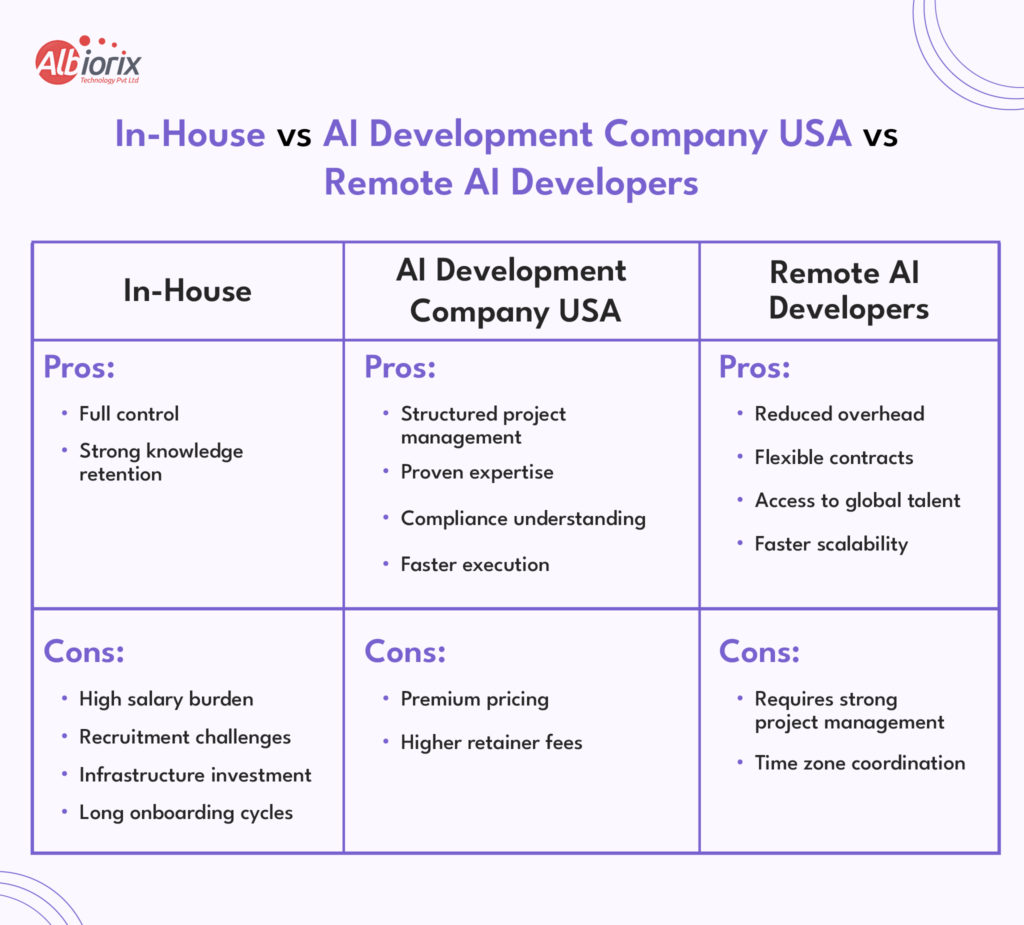
If you are evaluating AI development services USA, planning to hire AI developers, or exploring custom AI solutions, this guide will give you a practical, transparent breakdown of:

  • Average AI development costs in the U.S.
  • Factors that influence pricing
  • Hidden costs businesses overlook
  • Cost comparison: in-house vs agency vs remote developers
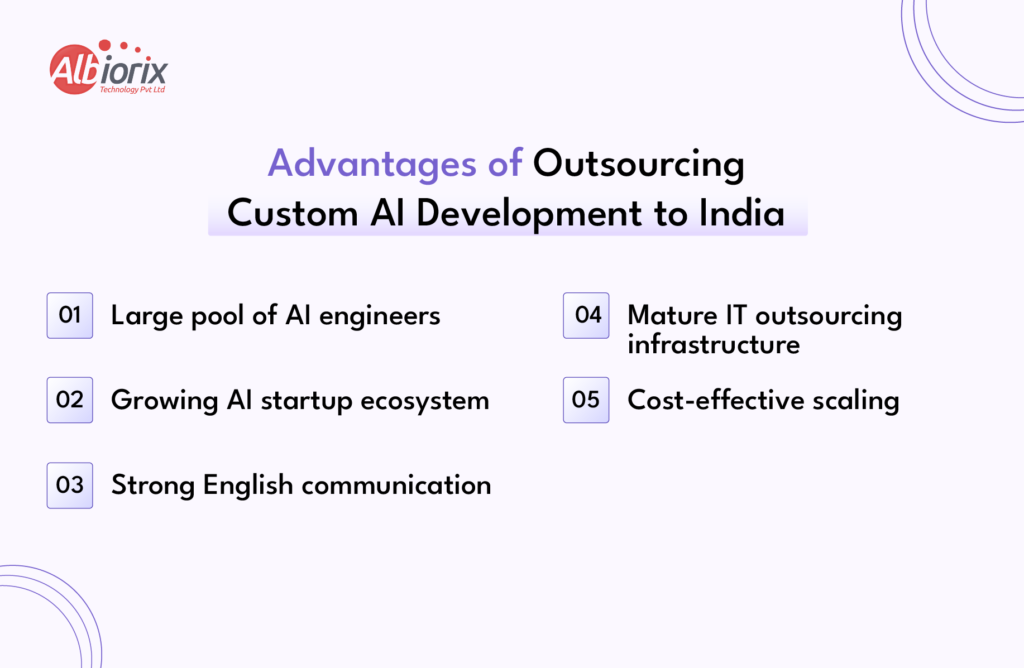
  • Whether outsourcing to India makes financial sense
  • Future AI market forecasts and why delaying investment may be risky

Have an idea that can change the course of your business, but are worried about the development cost?

At Albiorix Technology, you can discuss your idea with AI experts and get a free quote instantly. We don’t charge – it’s a free consultation.


Talk to AI experts.

What is the Average Cost of AI Development in the USA?

The average cost of generative AI development in the USA depends on many different aspects.

If you are evaluating structured Generative AI development guide insights, planning to hire AI developers, or exploring custom AI solutions, this guide will give you a practical, transparent breakdown.

Small AI Projects (Proof of Concept or MVP)

Small AI projects are those projects that are usually developed to validate an idea before getting into full-scale development with a huge investment.

The objective of these types of AI projects is to solve specific business challenges with limited functionality and faster development cycles.

The estimated development cost of such small AI Projects is somewhat from $25,000 to $75,000.

These projects typically include:

  • AI chatbots
  • Basic recommendation systems
  • Workflow automation tools
  • AI integrations using existing APIs
  • Pilot generative AI implementations

Many startups begin with AI chatbot integration to validate customer engagement strategies before scaling further.

Mid-Level AI Solutions

Mid-level or Medium-sized AI solutions move beyond experimentation and aim to create measurable operational impact. A Mid-level AI solution involves custom data pipelines, deeper model training, and integration with enterprise systems.

The estimated development cost of a mid-sized AI solution is somewhat from $80,000 to $200,000.

These include:

  • Predictive analytics platforms
  • AI-powered SaaS features
  • Computer vision solutions
  • NLP-driven applications
  • Industry-specific custom AI solutions

Many enterprises optimize budgets by applying strategies explained in reducing development cost using AI-driven engineering models.

Enterprise-Grade AI Systems

These types of custom AI systems are highly complex, strategic, and time-consuming. They are a multi-layered platform designed for scalability, compliance, and long-term automation.

Enterprise-grade AI solutions are designed for the whole organisation and not for one or two departments.

The estimated development cost of an enterprise-grade AI solution is somewhat from $250,000 to $1M+.

Examples include:

  • Healthcare AI diagnostics systems
  • Large-scale fraud detection engines
  • Custom LLM-based enterprise assistants
  • AI platforms are integrated across multiple departments

Healthcare organizations increasingly invest in AI in healthcare to improve diagnostics, compliance, and patient care efficiency.

Hourly Cost of Hiring AI Developers in the US

Hourly Cost of Hiring AI Developers in US

The cost of hiring an AI Developer in the USA depends on many different factors. These factors are an AI developer’s expertise, specialisation, industry experience, and much more.

In the major cities in the United States, the cost of hiring AI developers may be even higher due to high demand and low supply.

Additionally, specialised skills like deep learning architecture or generative AI engineering command premium pricing. Along with all these factors, businesses must also consider indirect costs such as benefits, taxes, and long-term retention strategies.

If you plan to hire AI developers directly, here’s what you can expect:

  • Junior AI Developer: The cost of hiring Jr. AI developers may range from $100–$130/hour. These developers are capable of handling tasks such as data preprocessing, model support tasks, and implementation under supervision.
  • Mid-Level ML Engineer: The cost of hiring Mid-level AI developers may range from $130/hour to $180/hour. These AI developers can design, develop, and deploy ML pipelines for production-ready AI features.
  • Senior AI Architect: The cost of hiring Sr. AI developers may range from $180–$250/hour. The role of Sr. AI architect is to lead AI strategy, system architecture, and complex model design decisions.

This makes AI development services in the USA among the most premium in the global market.

If you are planning to develop a custom AI solution for your business, then remember that the only hiring cost of developers is not the overall development cost of an AI solution. There are still different factors that influence the final budget.

Key Factors That Affect the Cost of AI Development

Key Factors That Affect the Cost of AI Development

The cost of AI development may vary from business to business as their use cases are different from each other. Moreover, the level of customization required in the solution also differs.

Understanding these cost drivers helps businesses create realistic budgets and avoid unexpected overruns.

Factors Affecting the Cost of AI Development:

Complexity of the AI Model: The complexity of an AI model directly affects the cost of AI development. It also impacts the overall development time. More advanced and complex models need deeper experimentation and validation cycles.

A rule-based automation system costs significantly less than a custom-trained generative AI model.

  • API-based generative AI integration: Lower cost
  • Fine-tuned LLM: Moderate cost
  • Fully custom large language model: Very high cost

Businesses comparing AI vs automation solutions often notice major cost differences depending on intelligence depth.

Type of AI Solution: AI solutions for different industries require different types of specialization and expertise on different frameworks. Each domain has unique data and infrastructure requirements.

Different AI domains require different expertise:

  • Machine Learning (ML)
  • Natural Language Processing (NLP)
  • Computer Vision
  • Generative AI development services
  • Reinforcement Learning

Generative AI development services are currently among the fastest-growing and most investment-heavy segments due to compute and training requirements.

Data Collection & Preparation: Data readiness determines project success. If data is unstructured, incomplete, or inconsistent, additional effort is required before model training begins.

Data is often the largest hidden cost.

Expenses may include: 

  • Data acquisition
  • Data cleaning
  • Labeling
  • Annotation
  • Storage
  • Compliance validation

In healthcare environments, structured AI healthcare software requires extensive data cleaning and compliance validation.

Infrastructure & Cloud Costs: AI applications require scalable computing environments capable of handling large datasets and model training processes. GPU-based processing significantly increases infrastructure expenses.

AI systems require:

  • GPU-enabled servers
  • Cloud platforms (AWS, Azure, GCP)
  • Scalable data pipelines
  • Ongoing compute power for retraining

Enterprise-level AI infrastructure can cost thousands of dollars per month even after deployment.

Team Composition: When it comes to custom AI development, you will need a team of different experts. Along with AI developers, you will require domain experts and operational oversight.

 A typical AI development team may include:

  • AI Architect
  • Data Scientist
  • Machine Learning Engineer
  • Backend Developer
  • DevOps Engineer
  • UI/UX Designer
  • QA Specialist

The broader the team structure, the higher the total investment.

Industry Compliance & Security Requirements: Regulated industries face additional scrutiny and validation procedures. These increase both development and legal review costs.

Certain industries significantly increase AI costs:

  • Healthcare (HIPAA compliance)
  • Fintech (regulatory security audits)
  • Insurance (risk governance)
  • Enterprise SaaS (data privacy standards)

Compliance adds both technical and legal expenses.

Post-Deployment Costs: Artificial Intelligence keeps evolving, and so does your business; therefore, you will need professional support and maintenance services to ensure optimum performance of your AI solution. Continuous monitoring ensures accuracy and reliability

Ongoing costs include:

  • Model monitoring
  • Performance optimization
  • Drift detection
  • Retraining cycles
  • Infrastructure scaling

Annual maintenance can range from 15–25% of the initial development cost.

Hidden Costs Businesses Often Overlook

At the time of AI development, many businesses believed that the cost was what they estimated at the beginning.

However, there are some hidden costs of custom AI development, including experimentation, iteration, and scaling. These factors also add to the overall cost of development.

AI is not a one-time project but an evolving system. Budget planning must include flexibility for testing, optimisation, and change management.

Here are overlooked expenses:

  • Failed experimentation cycles
  • Bias mitigation and fairness testing
  • Security vulnerability assessments
  • Data governance implementation
  • Scaling adjustments
  • Continuous model improvement

A realistic AI development cost strategy accounts for long-term operational expenses, not just launch budgets.

In-House vs AI Development Company USA vs Remote AI Developers

In-House vs AI Development Company USA vs Remote AI Developers

When a company plans to develop an AI solution for its business, there are different engagement models to choose from. Selecting the right engagement model is important for cost-cutting.

Each engagement model has different levels of control, flexibility, and scalability. Businesses must carefully choose the engagement model based on their business requirements, long-term goals, and future AI roadmap.

In-House Team of AI Developers

Building an internal team offers full strategic ownership but requires significant investment and time.

Pros:

  • Full control: You will have full control over the team. You can manage priorities, architecture decisions, and timelines internally.
  • Strong knowledge retention: Your AI expertise will stay within your organisation for the long term.

Cons:

  • High salary burden: You will have to pay competitive salaries to your AI developers, which can increase operational costs.
  • Recruitment challenges: AI talent is scarce and highly competitive in 2026; thus, you have to work hard to find the right resource.
  • Infrastructure investment: You have to build internal data and computing environments.
  • Long onboarding cycles: When you hire a resource, it takes some time for him/her to accommodate the project and align with business processes.

If we compare this engagement model with other available options, this model is a little expensive.

AI Development Company USA

Partnering with an AI Development company in the USA provides structured execution and specialised expertise.

Pros:

  • Structured project management: AI development companies in the USA have established workflows to reduce project delays.
  • Proven expertise: You can have access to experienced AI professionals with case studies.
  • Compliance understanding: AI development agencies in the USA have an in-depth understanding of industry-specific regulations.
  • Faster execution: As they have dedicated teams of AI developers under one roof, they can easily accelerate delivery timelines.
Cons:

  • Premium pricing: The USA-based AI development companies charge higher rates.
  • Higher retainer fees: Ongoing support may require monthly commitments.
The idea of partnering with a USA-based AI development company is a good choice if there is no limitation on the development cost. It is an Ideal choice for enterprises prioritising reliability over cost minimisation.
Hire AI Remote Developers

In 2026, many businesses will hire AI remote developers to save money and boost delivery time without compromising expertise. This model allows flexible scaling based on project requirements.

Pros:

  • Reduced overhead: There is no need to invest in office infrastructure or hire full-time AI developers with full-time benefits.
  • Flexible contracts: You can scale resources up or down as per the project requirements.
  • Access to global talent: You are free to hire AI developers from any part of the world. You can have access to a broader talent pool beyond local markets.
  • Faster scalability: You can quickly expand teams for large projects.

Cons:

  • Requires strong project management: When hiring remote AI developers, you will need to have clear communication and coordination skills.
  • Time zone coordination: Scheduling across regions may require planning.

For startups and mid-sized businesses, this often provides the best balance between cost and performance.

How to Reduce the Cost of AI Development

When you think about cutting the cost of development that does not mean you have to compromise with the quality or sideline some of the important features. Cost cutting means developing intelligently.

With the help of strategic planning and phased implementation, businesses can reduce the overall AI development cost in 2026.

Tip to Reduce AI Development Cost:

Start with an MVP: If you are having a limited budget for AI development, then always start with MVP. The MVP development focuses only on core functionalities required to validate the concept. It saves you from over-investment on unnecessary features.

Use Pre-Trained Models: Training an AI model for your business from scratch can be an expensive deal; thus, you can use pre-trained AI models. Using the already trained AI models and frameworks can reduce cost and efforts.

Rather than training from scratch:

  • Use existing LLMs
  • Fine-tune open-source models
  • Integrate APIs for generative AI

Enterprises modernizing internal systems often explore how AI reduces ERP costs before committing to large-scale AI infrastructure.

Define Clear Business Objectives: Make sure you are 100% clear about what you want to develop, because unclear scope creeps in and increases the development costs. Measurable KPIs ensure focused development.

Before hiring AI developers, clarify:

  • What business problem are we solving?
  • What measurable ROI do we expect?
  • How will success be defined?

Hybrid Hiring Model (US + Offshore): A hybrid structure combines strategic oversight with cost-efficient execution. It allows businesses to maintain quality while reducing hourly expenditure.

Keep strategic architecture and oversight in the US while leveraging offshore technical execution.
This dramatically reduces cost without sacrificing quality.

Should You Outsource Generative AI Development Services to India?

If you want to have an advanced AI solution for your business, then outsourcing AI development to India is also one of the best options. Over the last two to three decades, India has evolved as a hub of the software industry.

India has become one of the leading hubs for AI engineering talent.

Businesses building next-gen digital ecosystems often combine enterprise modernization strategies from enterprise software development with AI outsourcing models to optimize budgets.

Cost Comparison of AI Development

Hourly differences significantly impact total project budgets, especially for long-term engagements. Over a six-month AI project, the savings can be substantial.

  • US AI Developers: $100–$250/hour
  • India AI Developers: $30–$70/hour
  • Potential savings: 50–70%

Advantages of Outsourcing Custom AI Development to India

Advantages of Outsourcing Custom AI Development to India

India is the growing hub of AI development. In the last five years, India’s AI ecosystem has grown rapidly with strong academic and technical foundations.

You can easily hire remote AI developers or partner with an AI development company with a strong portfolio.

Advantages of AI Development in India:

  • Large pool of AI engineers
  • Growing AI startup ecosystem
  • Strong English communication
  • Mature IT outsourcing infrastructure
  • Cost-effective scaling

If total outsourcing is not on your list, then you can also adopt a hybrid model. It means, US leadership with offshore AI development.

The Future of AI Market Forecast and Business Impact

Due to the benefits it offers to businesses worldwide, the use and adaptation of AI is increasing faster than any other digital transformation in the past decade.

Businesses that have already invested in AI are dominating their industries and motivating others to integrate AI as early as possible. The long-term economic impact of AI is expected to reshape global markets.

Industry projections indicate:

  • The global AI market is expected to surpass $1.5 trillion by 2030.
  • 70–80% of enterprises are expected to integrate AI into core operations within the next decade.
     
  • Generative AI alone is projected to add trillions of dollars to global GDP.
  • Up to 40% of business processes may become AI-automated within the next 10 years.

Let’s examine sector-specific growth:

  • Healthcare: AI-assisted diagnostics and predictive care systems are expected to become mainstream, improving treatment accuracy and reducing hospital costs.
  • Fintech: AI-driven fraud detection and risk modeling continue to expand, reducing financial crime losses globally.
  • Retail: Hyper-personalization and AI-powered inventory forecasting are redefining customer experience.
  • Manufacturing: Predictive maintenance is reducing downtime and optimizing production efficiency.
  • Games & Entertainment: AI-driven immersive experiences and AI in game development are transforming digital storytelling.
  • Education: Adaptive AI learning systems are personalizing student experiences at scale.
  • Logistics: AI-driven route optimization and supply chain forecasting are reducing delivery times and operational costs.
  • Real Estate: AI-powered property valuation and predictive market analytics are improving investment decisions.

The message is clear: businesses that delay AI adoption risk falling behind more agile competitors.

How to Choose the Right AI Development Partner in the USA

How to Choose the Right AI Development Partner in USA

Whether you want to develop an AI model or are in search of generative AI development services, finding the right partner is very important. It determines long-term success.

Along with the technical expertise in the AI domain, strategic alignment is also essential. Businesses should evaluate cultural fit, communication transparency, and long-term collaboration potential.

If you are evaluating generative AI development services in the USA, consider:

  • Proven AI case studies: The company you are planning to hire must demonstrate real-world implementation experience.
  • Industry-specific expertise: They must have familiarity with sector challenges in your domain.
  • Transparent pricing model: Make sure you are not charged with any hidden or surprise costs.
  • Security and compliance alignment: The AI development company you partner with must protect data integrity and the privacy of your business.
  • Post-deployment support: Along with the generative AI development services, the company must also be able to provide continuous optimisation and monitoring services.
  • Scalability capability: They must be able to scale as your business grows.

If you would like expert guidance tailored to your business needs, you can directly contact our AI experts for a free consultation.

Conclusion 

As said earlier, AI is no more an experimental word, it is real and reshaping competitive landscapes across industries. Businesses that approach AI strategically gain operational leverage and market differentiation. 

The cost of AI development in the USA ranges from $25,000 to over $1 million depending on complexity, data requirements, and scale.

But the more important question is:

What is the cost of not investing in AI?

As industries become increasingly automated and data-driven, AI adoption is shifting from optional innovation to operational necessity.

Whether you choose an AI Development company USA, hire AI developers in-house, or hire AI remote developers using a hybrid model, the key is strategic planning, phased investment, and ROI alignment.

The future of business is intelligent. The only question is how soon you adapt.

Generative AI Development: A Ultimate Business Guide to GenAI Solutions in 2026

Summary: A Generative AI Development Company helps businesses build custom GenAI solutions that automate workflows, enhance productivity, and reduce development costs. In 2026, partnering with the right AI development company is essential for achieving long-term digital growth and operational efficiency.

Generative AI Development Company

Well, it’s 2026, and we are officially into the era of Generative AI. It is no longer a fancy word used by a top AI development company in the USA or India, nor is it a futuristic concept discussed in innovation labs somewhere in Germany or the UK.

It is real, and it is transforming the entire digital landscape. It is all around us and marks a thumping impression.

Generative AI is transforming how businesses operate, how new products are developed, and how customers are served more efficiently.

GenAI tools are used in many ways, including creating personalized content, developing marketing strategies, automating workflows, and assisting customers more efficiently without human intervention.

In short, it is transforming how businesses operate, innovate, and compete.

With the accelerated use of GenAI tools and software, businesses have realized that for higher efficiency and productivity, they cannot simply rely on standard and traditional GenAI tools offered in the market.

To achieve desired business goals in the long term, they must invest in Generative AI tool development, and it is possible only if they partner with an experienced Generative AI development company somewhere in India or the USA.

In this blog on GenAI Development Companies, we will thoroughly discuss different aspects of GenAI, GenAI apps, and how to find the right generative AI development companies that can help your business scale, even in the time of tough competition.

What is a Generative AI (GenAI)?

Well, there’s a lot of talk about the uses of Generative AI in different business operations, but what it is exactly – “What is GenAI”?

In easy-to-understand words, Generative AI (GenAI) is a branch of Artificial Intelligence systems that is used to create new content, including text, images, code, audio, video, and even synthetic data.

It can understand prompts, context, and intent to produce meaningful, high-quality, and original results in seconds.

Ready to Build Smarter with Generative AI?

Let’s build scalable GenAI solutions that give you a competitive edge in 2026 and beyond.


Contact us!

What are the Uses of Generative AI (GenAI)?

The use of GenAI in 2026 is seen across a wide range of business applications. For instance, when it comes to marketing, businesses can use generative AI to create personalized marketing campaigns, product descriptions, and social media captions.

Similarly, when it comes to custom software development, it helps software developers by writing code, debugging, and speeding up the development cycles.

There are many uses of GenAI in 2026, as it can be tailored to meet business requirements and long-term goals.

From automating repetitive tasks to enhancing creativity and decision-making, GenAI is becoming an integral part of modern business operations through intelligent automation systems.

Why Is GenAI So Popular in 2026?

GenAI is very popular among businesses because of its speed, scalability, and cost efficiency. With the increasing competition, businesses are under constant pressure to innovate faster at a lower development cost, and this is where GenAI comes to escape.

GenAI delivers at both fronts – it allows developers to do more with limited resources, reduce development time, reduce development expenses, and unlock new revenue opportunities.

Many enterprises are already seeing measurable results in how they reduce development cost using AI-driven workflows.

With the use of generative AI, a business can experience tangible productivity gains and competitive advantages.

Thus, due to these reasons and benefits, GenAI is popular among startups, mid-sized businesses, and large organizations across global markets.

Which Industries are Leveraging out of Generative AI Solutions?

Industries that Leveraging Generative AI Solutions

One of the main reasons why Generative AI is getting popular is that it is no longer limited to tech companies. It is now integrated into daily operations across traditional and emerging industries.

GenAI is widely used to automate documentation, offer personalized customer services, automate repetitive tasks, and much more. Here’s how different sectors are using GenAI and the most common tools for driving adoption.

  1. Healthcare: Doctors, hospitals, and health-tech companies are at the top of the list when it comes to the use of generative AI. They use GenAI for clinical documentation, medical research summarization, patient communication, and diagnostic support through advanced AI healthcare software solutions.
  2. Finance: The use of GenAI in Fintech is also widespread. Banks and finance companies are using generative AI for fraud detection insights, automated reporting, risk analysis, and AI-powered customer assistants. The most common platforms used by them are Bloomberg (BloombergGPT) and Microsoft Copilot.
  3. Restaurant: The use of GenAI in restaurants is also very common. It is used for menu optimization, demand forecasting, generating marketing content, and AI chatbot integration to enhance customer engagement.
  4. eCommerce: When it comes to the use of Generative AI in the eCommerce industry, online retailers are not left behind. GenAI is used to generate product descriptions, get personalized recommendations, offer automated customer support services, and set dynamic pricing. The most common tools used are Shopify Magic and AI search powered by Adobe.
  5. Logistics: Most of the logistic companies are using GenAI to route optimization insights, predictive demand planning, and automated documentation. AI capabilities integrated within SAP and IBM platforms are widely used.
  6. Games and Sports: In the games and sports industry, GenAI is used to design games, create realistic characters, analyze matches, and find fan engagement content through advanced AI game development models.
  7. Social Networking: In social networking, GenAI is used for content moderation, generating captions, algorithm recommendations, and AI-generated filters. The social networking giants like Meta integrate generative AI to increase user engagement.
  8. Travel: The generative AI is used for itinerary planning, chatbot booking assistants, personalized recommendations, and automated customer communication using modern AI voice agents.
  9. Real Estate: Real estate firms use GenAI for virtual property descriptions, automated valuation insights, and AI-driven marketing campaigns. CRM and AI integrations within Salesforce help streamline client communication.
  10. Education: Educational institutions leverage GenAI for personalized tutoring, content creation, curriculum design, and automated grading systems. AI solutions powered by OpenAI and Google are widely adopted.
  11. Entertainment: Media and entertainment companies use GenAI for scriptwriting assistance, video editing, music generation, and digital avatar creation. Creative tools from Adobe and AI research from NVIDIA are shaping content production.
  12. Government: Public sector organizations apply GenAI for citizen service automation, policy documentation drafting, data analysis, and fraud detection. Enterprise AI solutions from IBM and Microsoft are commonly deployed.

Across industries, generative AI tools are becoming embedded in everyday workflows — not just as automation software, but as intelligent systems that enhance decision-making, productivity, and customer experience.

Top Tech Stack Used for Generative AI Solution Development

  1. Deep Learning Frameworks: Tensor Flow, PyTorch, Keras, Caffe, MXNet, DeepLearning4j Chainer, and Theano.
  2. Modules & ToolKits: OpenAI GPT, OpenAI DALL-E, NVIDIA  StyleGAN, NVIDIA NeMO, Fast.ai, DeepMind Sonet, and AllenNLP.
  3. Generative AI Models: GPT 3, GPT 4, DALL-E, VQ-VAE, VAE, WaveGAN, DeepDream, DeepArt, and Pix2Pix.
  4. Neural Networks: RNN, CNN, GAN, VAE, Transformers, LSTM Networks, RBM, DBM, and DRLN.
  5. Libraries: TensorFlow, PyTorch, Keras, OpenAI Gym, Theano, Caffe, MXNet, and Fast.ai.
  6. Image Classification Models: AlexNet, VGGNet, ResNet, Inception, MobileNet, DenseNet, Xception, and GoogLeNet.

Which AI Models Used to Develop Generative AI Solutions?

AI Models that Used to Develop Generative AI Solutions

Most generative AI development companies across the world are using some of the top-rated AI models to develop generative AI solutions for businesses.

These AI models help them build efficient and scalable GenAI business solutions that unlock new possibilities for automation, innovation, and personalization.

Most Common AI Models Used in 2026:

  1. GPT: Generative AI development companies integrated GPT3, GPT3.5, and GPT4 into business applications to create conversations, build smart and self-evolving chatbots, and enable natural language processing.
  2. Midjourney: It is an AI-powered image generator. Generative AI development services integrate Midjourney into existing systems of a business to allow them to enhance their creative journey. This GenAI integration allows them to create visually appealing and engaging images.
  3. DALL-E: A Generative AI Development company with expertise in DALL-E, assists businesses by integrating this AI model into their system so that they can create plausible images. It allows businesses to create original and engaging visuals.
  4. Gemini: Gemini is an intelligent AI-powered chatbot powered by LaMDA. With the use of this AI model, businesses can enhance user experience for their clients. Integrating the Gemini AI Model allows them to offer highly personalized and around-the-clock support services.

Top 4 Benefits of Generative AI Development for Your Business

  1. Increased Automation: Generative AI business solutions are known for increasing automation across various aspects of a business. AI-driven automated tools can easily handle repetitive tasks so that your team can be allocated to other productive work. GenAI automated solutions keep you ahead of the competition.
  2. Increased Productivity: GenAI can be used to boost the productivity of your existing team. The generative AI tools help in faster data analysis, decision-making, streamlining workflows, and resource allocation. It will help you achieve more in less time.
  3. Cost Optimization: When you use GenAI tools to automate tasks, reduce errors, and improve efficiency, your overall operational cost is reduced. Enterprises adopting AI-driven ERP systems are already experiencing how AI reduces ERP costs by 30% significantly.
  4. Enhanced Creativity: With the use of the latest GenAI tools, you can boost your creativity to the next level. You can create fresh images, original content, marketing ideas, and business development roadmaps with the help of GenAI solutions.

Generative AI Security Risks Businesses Must Know

Just like the two sides of a coin, along with the positive points, there are also some side effects of generative AI. With the use of GenAI solutions, generative AI security risks have also risen in 2026.

According to the data available on the web, more than 70% of the businesses reported an AI-related security incident in 2024.

Development isn’t just about building; it’s about protecting. See our latest Generative AI Security Risks Guide to secure your enterprise deployment.

The top 5 most common AI Security Risks are: 

  • Prompt Injection Attacks
  • Data Leakage and Model Exposure
  • Malicious AI-generated Code
  • Hallucinations Leading to Security Failures
  • Software Supply Chain Vulnerabilities

What Services Does a Generative AI Development Company Offer?

What Services Does a Generative AI Development Company Offer

Top Generative AI Development Services:

  1. Generative AI Model Development: Most AI development companies in India and the USA use machine learning algorithms to develop custom generative AI solutions as per the business requirements. They carefully configure and train these GenAI models to ensure high-quality outcomes.
  2. Generative AI Model Replication: Under the hood of Generative AI development services, some companies offer generative AI model replication services. They develop replicas of the top and most popular AI models, such as ChatGPT and DALL-E. This generative AI modelling service helps businesses with new business opportunities.
  3. Model integration and Deployment: An experienced AI development company integrates and deploys an AI model as per the business requirements. They carefully analyze your business requirements, long-term business goals, and targeted audiences to suggest the most suitable AI models.
  4. Upgrade and Maintenance Services: GenAI development companies also offer AI model upgrade and maintenance services. The sole purpose of these services is to help you stay ahead in the competitive market. They have a team of skilled GenAI developers to optimize the performance of your existing AI models/solutions.
  5. AI Model Fine Tuning: Generative AI development services are also used to fine-tune and optimize the existing AI models. By doing this, an AI model can adapt to the changing or domain-specific use cases and data sets. AI model fine-tuning and optimization improve accuracy and efficiency.
  6. AI Model Architecting: The team of generative AI developers can be hired to design and architect a new AI model for your business. It allows businesses to select a suitable neural network architecture and optimize hyperparameters.

What is the cost of generative AI development in 2026? 

Most businesses want to invest in generative AI development, but most of them are concerned about the cost of AI development.

The cost of generative AI development depends on many different factors. The initial investment may seem high at the moment, but in the long run, it will turn out to be a beneficial business decision.

AI Development Cost by Project Type: 

  1. AI Chatbot / Assistant: It may cost from $10,000 to $80,000
  2. Computer Vision System: It may cost from $30,000 to $200,000
  3. NLP / Text AI Solution: It may cost from $20,000 to $150,000
  4. Predictive Analytics: It may cost from $15,000 to $100,000
  5. Generative AI App Development: It may cost from $25,000 to $300,000

The above-mentioned is just a high-level and approximate. Cost of AI development. For the exact cost of custom AI development, get in touch with our team of AI engineers at Albiorix Technology.

Why is Albiorix the Best Generative AI Development Company?

Why is Albiorix the Best Generative AI Development Company

In the era driven by Artificial Intelligence, choosing the right generative AI development services is extremely crucial for your business. It will decide the success and failure of your digital transformation journey.

Whether you are a startup looking to explore the potential of GenAI for the first time or an established brand looking to scale intelligent automation, you need more than just a team of generative AI developers. You need a strategic technology partner in the form of a generative AI app development company.

As an experienced Generative AI development company in India, we focus on delivering measurable business outcomes to our clients from Australia, the UK, Germany, and the USA. Here’s what makes us the most suitable AI development company for your business requirements:

  1. Save up to 30% on Development Costs: Our optimized AI development frameworks, reusable components, and strategic implementation approach help you significantly reduce overall development expenses without compromising on quality or performance.
  2. Reduce Project Development Time by Up to 25%: With streamlined workflows, agile methodologies, and AI-accelerated engineering practices, we ensure faster deployment so you can enter the market ahead of competitors.
  3. Work with the Top 1% AI Developers: Our team consists of highly skilled AI engineers, data scientists, and solution architects who bring deep expertise in GenAI models, LLM integration, and enterprise-grade AI solutions.
  4. 10+ Years of Strong Industry Experience: With over a decade of hands-on experience in AI and advanced technology development, we understand industry-specific challenges and deliver solutions aligned with real-world business needs.
  5. 100% On-Time Project Delivery: We follow structured project management frameworks and transparent communication processes to ensure every milestone is delivered as committed — without delays.
  6. Professional Post-Development Support & Maintenance: Our commitment does not end at deployment. We provide ongoing optimization, model fine-tuning, monitoring, and technical support to ensure your AI systems continue to perform at peak efficiency. 

If you are looking for scalable AI-powered systems, advanced AI voice agent developers and intelligent business automation experts can help you achieve your digital goals faster.

We are ready to help you build scalable AI solutions that drive real growth.

Conclusion

If you are a business that wants to stay competitive, offer your customers better services, and increase your ROI, then generative AI development is worth considering. To explore how it can fit into your strategy, Contact Us for expert consultation and next steps.

Most businesses in the USA, Australia, and the UK have already developed custom AI solutions or are planning to invest in generative AI development services.

How AI Reduces ERP Development Costs by 30%

Summary: The use of AI in ERP development is very common. Almost every business and organisation across the world follows this trend. It helps them save on development costs. In this blog, we will discuss how the use of AI in custom ERP system development can help businesses save time and money. We will also discuss how AI in ERP development will shape the industry trends.

Cost of ERP System Development

For modern businesses in 2026, ERP systems have become an indispensable part of their day-to-day operations, and integrating AI development services can further enhance automation, analytics, and decision-making capabilities.

There are many traditional and ready-made ERP software systems offered in the market, but they do not fulfill all your business requirements at once.

Custom ERP development is one of the best solutions, but it is also an expensive deal. The cost of ERP system development may often break your budget.

Along with the expensive development cost, companies also face problems such as complex customization, integration with legacy systems, lengthy development cycles, and continuous maintenance costs.

All these factors collectively make ERP development a time-consuming and financially demanding process.

Most companies in 2026 are seeking an ERP software solution that is fast, intelligent, and cost-effective. They need systems that can improve productivity and ROI without increasing budgets.

It is where AI in ERP development is making a real difference. Artificial intelligence helps automate tasks, optimize development processes, reduce manual effort, and improve decision-making across the ERP lifecycle.

In 2025, businesses that used AI-driven development approach report a 30% reduction on the overall ERP development cost.

While the exact amount saved on the ERP development may vary from project to project, the trend is clear – use of Artificial Intelligence can help in reducing development cost, development time, minimise errors, and lowering operational costs.

Businesses that adopt AI early often gain competitive advantages through faster deployment, better analytics, and more efficient workflows.

As ERP systems continue evolving, AI is becoming not just an option but a strategic necessity for cost-effective enterprise software development.

What is an ERP System?

There’s a lot of talk about ERP systems and their uses. But what is it exactly, and how is it useful to a business in increasing its productivity?

ERP stands for Enterprise Resource Planning. It is a software system that helps businesses manage core operations, including finance, HR, inventory, sales, supply chain, and customer relationships in one integrated platform.

In simple words, an ERP system connects different business operations/departments effectively so that the data flows smoothly across departments in an organization.

By 2025, the adoption ratio of ERP systems will be widespread across different industries. According to the reports, most of the large and medium-sized businesses and organizations are using some form of ERP system to increase productivity.

In fact, adoption among small businesses is also growing quickly due to cloud-based solutions.

Here’s how ERP systems help businesses:

  • It helps them improve operational efficiency
  • It provides them with real-time business insights
  • It helps them enhance internal collaboration across departments
  • It helps them reduce manual work and data duplication
  • It supports them in making better business decisions

There are many different types of ERP systems available on the market. Some of the most popular ERP systems in 2026 are on-premises ERP, cloud ERP, hybrid ERP, and industry-specific ERP solutions.

Some of the most widely used ERP software solutions include offerings from SAP, Oracle, and Microsoft. These platforms support global enterprises with advanced automation, analytics, and integration capabilities.

Overall, ERP works as the digital backbone of modern businesses. It helps them streamline operations, reduce costs, and scale efficiently.

Build Smarter ERP Systems with AI — Reduce Costs, Improve Efficiency

Partner with Albiorix Technology to develop custom AI-powered ERP solutions tailored to your business goals.


Contact Us

What Is AI in ERP Development?

AI in ERP development refers to the use of artificial intelligence, machine learning, and automation technologies throughout the ERP development lifecycle.

Use of AI in planning and design, development, testing, deployment, and maintenance. The use of AI in custom ERP development is to increase efficiency, reduce development costs, and build an intelligent enterprise solution.

Use of AI in ERP System Development

  • Planning: Artificial Intelligence is used to analyze business requirements, historical data, and industry trends. This information supports business plan projects, estimates development costs, and uses available resources smartly.
  • Development: When it comes to custom ERP solution development, there are AI-assisted coding tools to speed up the development process. Developers use these tools to write code faster and deliver error-free solutions in less time. AI automation reduces repetitive tasks, shortens development cycles, and improves software quality.
  • Testing: AI-driven testing tools are more accurate and faster. They can detect bugs faster and automatically, run predictive test scenarios and ensure better performance before ERP launch. AI-powered testing reduces manual testing time.
  • Deployment: AI supports smoother deployment through automated configuration, performance monitoring, and predictive risk analysis. It minimizes downtime and deployment errors.
  • Maintenance: After an ERP system is launched, AI can be used to monitor its performance, predict failures, automate updates, and improve security. It reduces maintenance costs and operational disruptions.

Overall, ERP development with the help of AI can deliver measurable results. It can save money, time, and effort. It can guarantee enterprise software with high performance, amazing scalability, and great safety.

Why Traditional ERP Development Is Expensive

Traditional ERP development often requires significant time, skilled manpower, and continuous maintenance.

It required constant involvement of various teams, including development teams, testing teams, and other resources, to successfully complete a project. This dependence of different teams increases the development cost and overall development time.

Traditional ERP development is expensive compared to AI development because of the following reasons:

  • Customisation complexity: Developing an ERP solution as per the unique business needs is a tricky job. It requires extensive planning and development efforts.
  • Manual development and testing costs: Instead of AI, when a team of developers is used to develop a solution and QA experts to test it, the overall development time and cost increase.
  • Integration challenges: Along with the development and testing, one more thing that takes time is integrating ERP with legacy systems, CRMs, and third-party tools. It requires a lot of tech expertise and patience.
  • Long deployment cycles: Traditional implementations can take months or years, increasing operational costs.
  • Maintenance overhead: Post-development support and maintenance services are very important to uphold the performance of the system. Continuous updates, bug fixes, and performance monitoring by humans add long-term expenses.

These are some of the most common issues that affect the overall cost of ERP development in traditional style.

How AI Lowers Software Development Costs in ERP

How AI Lowers Software Development Costs in ERP

Artificial intelligence can improve the efficiency of the ERP development lifecycle.

Where traditional development methods require different development teams to work on a single project, an AI-powered development tool can execute different tasks, including planning, development, testing, deployment, and maintenance.

Here’s how AI lowers software development costs:

  • Automated Requirement Analysis: Smart and intelligent AI can easily and clearly analyze business data and user behavior to define accurate development requirements. All this is done in a span of time that reduces rework and development delays.
  • AI-Assisted Coding & Development: There are AI-powered coding tools that assist developers in speeding up the development process. These tools also help them with code optimization and error reduction. It improves productivity while lowering development costs.
  • Intelligent Testing & QA Automation: Automated testing tools detect issues early, reducing costly post-launch fixes. AI testing also ensures better system reliability.
  • Predictive Maintenance & Support: AI predicts potential system failures and recommends preventive actions. This reduces downtime and maintenance expenses.
  • Smart Integration & Data Migration: Artificial Intelligence can simplify data mapping, data migration, and system integration. It makes ERP implementation more efficient and faster.
     

The use of AI in ERP development results in faster and more efficient solutions. These capabilities result in measurable cost savings in enterprise software projects.

Key Areas Where AI Delivers ERP Cost Savings

The use of AI in ERP System development not only saves money during the development lifecycle, but it also helps even after the deployment. Businesses that have adopted AI have reported improved efficiency and lower operational expenses.

Some of the key areas where AI helps in saving money are:

  • Faster development timelines: AI-powered development tools and automation collectively accelerate coding, testing, and deployment. It means faster development and shorter time to market.
  • Reduced human errors: AI coding minimises mistakes during development that lead to costly fixes.
  • Optimised infrastructure usage: Smart resource allocation lowers hardware and cloud costs.
  • Lower long-term operational costs: Predictive maintenance reduces downtime and support expenses.
  • Enhanced decision intelligence: AI analytics improve business efficiency and profitability.

These factors contribute significantly to overall AI cost savings in enterprise software.

Also Read: Use of AI in Web Development

ROI of AI in ERP Development

Instead of following traditional development methods, if you invest in AI, the revenue will be immediate and long-term.

Businesses that have invested in AI for ERP and web development have seen productivity gains, reduced operational costs, and faster time to market. ROI of AI in ERP development will boost your business growth at double the speed.

Key ROI aspects include:

  • Short-term vs long-term ROI: Initial AI investment may be higher than the traditional methods, but in the long run, the revenue and savings are substantial.
  • Quantifying savings: Companies measure ROI through reduced development time, fewer errors, and increased productivity.
  • Case-style scenario: For example, a mid-sized manufacturer adopting AI-driven ERP testing reduced deployment time by 25% and maintenance costs by nearly 20%.
  • Metrics to track: Development cost per module, downtime reduction, productivity improvement, and system performance KPIs.

In 2026, businesses need to understand the long-term benefits of investing in AI. The ROI of AI in ERP development can help businesses in many ways.

Affordable ERP Development Solutions Using AI

Affordable ERP Development Solutions Using AI

If you examine current development trends, AI is used in the development of almost every digital product. From websites to mobile apps, AI in digital product development is doing magic for developers and businesses alike.

The use of AI in ERP system development can help businesses save a lot of money, deliver a flawless product, and shorten time to market.

Not only big businesses or organizations, but even small businesses and startups can use AI in ERP development without worrying about a massive development budget.

Affordable approaches include:

  • AI-driven low-code/no-code: With a no-code/low-code approach, the ERP development becomes faster.
  • Cloud + AI synergy: With the use of scalable cloud infrastructure, businesses can reduce upfront investment.
  • Modular ERP development: AI-powered development tools allow businesses to develop and implement features gradually.
  • Partnering with an AI-driven ERP company: Expert AI-development companies ensure efficient implementation.

These strategies enable affordable ERP development solutions while maintaining quality and scalability.

For AI in ERP Development, Contact Albiorix Technology

For AI in ERP Development, Contact Albiorix Technology

In 2026, businesses are not looking for ordinary or traditional ERP solutions. They need a custom ERP software solution that is scalable, efficient, and cost-effective. And you are one of them, then you are in the right place.

Albiorix Technology is an AI development company in USA; we are among the top companies using and implementing AI in digital solutions for different businesses and industries.

Being one of the top-rated AI development companies, we help organizations in Australia, the USA, and across Europe build custom ERP solutions powered by AI and modern automation tools.

Our expertise spans AI-powered websites, mobile applications, and digital products designed specifically for business needs. If you are planning an AI-driven ERP implementation, our team can support you from strategy to deployment.

Why Albiorix Technology for AI Development:

  1. Custom AI-Driven ERP Solutions: At Albiorix Technology, we hold expertise in designing and developing ERP systems as per your business workflows. We use AI automation to improve efficiency, reduce costs, and enhance decision-making.
  2. Expertise in Gen AI Development Services: Our team of AI developers holds expertise in developing intelligent applications using generative AI technologies.
  3. Proven AI Product Development Experience: In the last 10 years, we have successfully developed AI-powered websites, mobile apps, and digital solutions that align with real business requirements.
     
  4. End-to-End AI Implementation Support: We are a complete AI development company in USA. Our in-house team of Gen AI developers is known for offering services like AI consultation, AI development, AI planning, AI integration, etc.
  5. Business-Centric Innovation Approach: Being one of the most trusted AI development companies, we focus on ROI, scalability, security, and long-term performance for enterprise solutions.

Conclusion

Artificial Intelligence is rapidly transforming the digital landscape around every business. ERP development using AI tools is trending as it helps improve efficiency and reduce costs.

From automated coding to predictive maintenance, AI helps organisations achieve faster implementation and better performance. To discover how these capabilities can transform your operations, Contact Us for expert guidance and tailored solutions.

Businesses that have adopted AI-driven ERP solutions have reported significant cost benefits.

They have also experienced reduced development timelines, lower maintenance expenses, and improved operational productivity. These advantages directly impact competitiveness and profitability.

Companies that leverage AI today are better positioned to build resilient, future-ready enterprise systems while maintaining cost efficiency.

How AI-Powered Software Development Reduces Costs

Summary: Artificial Intelligence is transforming how businesses build and scale software. This blog explores how AI-powered software development helps reduce costs, accelerate product delivery, and improve operational efficiency.

It also covers real-world benefits, industry adoption trends, and how businesses can successfully implement AI-driven development to stay competitive in today’s digital landscape.

AI-Powered Software Development

Artificial Intelligence is not just a fancy word. It has taken the digital world by storm. Every industry and business is integrating AI-powered software solutions to automate and streamline their operations and please their clients.

In recent years, AI and its associated tools and technologies have become an integral part of every business, whether small or large. It is now known as a strategic business enabler.

Many organizations across industries are increasingly integrating Artificial Intelligence into their software development process to reduce costs, speed up development time, enhance product quality, and offer better customer experience.

In 2026, modern businesses (including startups and young entrepreneurs) are not asking the questions like “Should We Use AI?” Instead, they are asking, “How can we use AI-powered digital products to Stay Competitive in the Market?”

It is because AI-Powered development services are not only helping them optimize and automate their business operations, but they are also helping them reduce the operational costs and accelerate time to market.

We are Albiorix Technology, and we develop AI-Powered Software solutions that help businesses save money, automate boring tasks, improve business operations, offer better customer services, and more.

We are an AI Development company that skillfully combines human expertise with AI-driven tools, automation frameworks, and modern development practices to help businesses build intelligent, scalable, and cost-efficient digital solutions.

What AI in Software Development Really Means

Most of the top-rated software development companies in India, Australia and the USA are using intelligent tools and automation to enhance the software lifecycle.

The use of AI in software development doesn’t mean replacing; instead, it helps the development teams work faster, smarter, and more productively.

  • AI automates code suggestions that improve developer productivity
  • AI-powered testing detects bugs at the early stages of development
  • Predictive analysis using AI helps in developing better products
  • AI-powered chatbots and automation features
  • AI-powered faster deployment through smart DevOps automation
  • Data-driven optimization for performance improvements

These are some examples of the use of Artificial Intelligence in software development. The amazing capabilities of AI help software developers deliver reliable digital products while controlling development costs.

Ready to Build Smarter Software with AI?

Whether planning a new digital product, optimizing an existing platform, or exploring AI integration, expert guidance can make the difference.


Talk to AI Experts

How AI Helps Reduce Software Development Cost

One of the biggest reasons companies invest in AI development services is cost optimization. Software projects traditionally require significant time, manpower, and infrastructure.

AI helps streamline these processes.

  • AI automates repetitive coding and testing tasks
  • With the use of AI tools, lean development teams become more productive
  • Early bug detection by AI tools saves teams from rework
  • Faster development with the use of AI tools shortens time-to-market
  • Infrastructure optimization lowers operational expenses
  • Improved planning using AI analytic tools reduces project delays

Software development using AI tools allows businesses to achieve better ROI without compromising quality. Organizations partnering with experienced AI development companies often find they can scale innovation while maintaining predictable budgets.

How AI-Driven Software Development Helps Businesses

How AI-Driven Software Development Helps Businesses

The adoption of AI in software development has rapidly increased in recent years because of many good reasons.

The advancements in machine learning models, cloud computing, and automation platforms have acted as a catalyst in the AI adoption process.

Here’s How AI-Driven Software Development Helps Businesses:

1. Reduce Technology Costs by Up to 30%:

Artificial Intelligence creates smarter development workflows, which reduce manual efforts, overall development cost, and maintenance costs.

Key advantages include:

  • Automated Coding Assistance: There are AI-powered coding tools that assist developers in accelerating the development cycles and reducing repetitive tasks.
  • Efficient Resource Utilization: AI-powered development tools minimize the need for large development teams.
  • Predictive Maintenance: Artificial Intelligence identifies issues at the early stages and prevents them from becoming expensive.
  • Optimized Infrastructure Usage: AI helps reduce cloud costs through intelligent resource allocation.
  • Reduced Testing Costs: AI-powered automated testing improves accuracy while lowering QA expenses.
  • Lower Long-Term Maintenance Costs: AI monitoring prevents recurring technical debt.

The right use of AI-powered development tools helps businesses increase their ROI and saves them from development hiccups.

2. Stabilize Your Product with a Lean, Expert Team:

With the help of AI-powered software development tools, a lean team can also deliver a premium-quality software solution faster without compromising reliability.

What this means for your business:

  • Improved Code Quality: AI can analyze and detect bugs at the early stages for better code quality.
  • Better Performance Optimization: AI can detect bottlenecks during the initial phases of development and suggest optimization points for better performance.
  • Faster Issue Resolution: It can predict and resolve issues faster to avoid any downtime.
  • Continuous Monitoring: AI systems can monitor the application 24*7 for consistent and optimum performance.
  • Scalable Architecture Guidance: It can help developers build a scalable architecture for future-ready systems.
  • Reduced Risk of Failures: AI’s intelligent testing improves product stability.

A lean AI-enabled development team can deliver better outcomes than large traditional teams. It can save you up to 30% on the overall development cost while shortening your application time to market.

3. Replace Expensive In-House Development Costs:

When you have the right set of AI software development tools, then there is no need to maintain a large internal team of software developers, which can cost you a lot.

AI-powered outsourcing benefits include:

  • Access to Specialized AI Talent: There will be no need to hire full-time experts.
  • Flexible Engagement Models: You can scale your development team as per the project requirements and timelines.
  • Faster Project Delivery: With the use of pre-trained AI workflows, you can easily accelerate the development of lifecycles.
  • Reduced Hiring Costs: You can save a lot of money on recruitment, training, and other retention expenses.
  • Focus on Core Business Goals: Let experts handle technical execution.
  • Better Technology ROI: Get enterprise-level expertise cost-effectively.

This approach helps businesses stay agile while controlling operational expenses.

4. Accelerate Development Using AI Tools:

AI tools are transforming software development speed and efficiency.

Examples of AI acceleration:

  • Automated code suggestions and generation
  • Smart debugging tools
  • Automated UI testing
  • AI-driven documentation generation
  • Predictive analytics for product improvements
  • Continuous performance optimization

These capabilities enable faster time-to-market — a critical competitive advantage.

Industry-Wise AI Adoption Trends

AI Trends Adoption

According to trends and data available on the web, not only are IT companies adopting AI at a faster pace, but industries including healthcare, entertainment, tourism, fintech, and education are among the forerunners.

Almost every industry is integrating artificial intelligence in its software development and digital transformation initiatives.

  • Healthcare: AI-powered healthcare software and applications are used in predicting diagnostics, patient monitoring, and healthcare automation. Intelligent AI mHealth apps improve patient care and clinical decision-making.
  • Fintech: AI-powered fintech software and systems are used for fraud detection, risk analysis, and customer personalization. Automation of operations using AI improves efficiency.
  • Retail & eCommerce: AI offers a personalized shopping experience for each customer. Moreover, AI chatbots and AI-powered voice agent virtual assistants enhance customer engagement and satisfaction.
  • Manufacturing: Predictive maintenance reduces downtime. AI-powered automation improves operational efficiency.
  • Logistics & Transportation: AI in logistics and transportation is used to optimize routes, track delivery, and manage fleet. It reduces overall headaches and improves supply chain resilience.
  • Software Development: Use of AI in custom software development is trending. It accelerates coding, testing, and deployment. Intelligent DevOps improves productivity and product quality.

Organizations that are adopting AI in their day-to-day operations early are gaining significant competitive advantages.

In 2026, if you are keen to give your business a boost with an AI-powered software solution, get in touch with the team of the best AI software developers at Albiorix Technology.

Custom AI Solutions for Your Business & Your Customers

Custom AI solutions can help streamline operations, enhance customer experiences, and drive smarter decision-making.


Contact Us

The Future of AI in Software Development

The use of AI and AI tools in custom software development is growing rapidly. The emerging trends in the market suggest even deeper integration of AI across the development cycles.

Trends: Future of AI in Software Development

  • AI-assisted coding will soon become an industry standard
  • There will be hyper-automation across all  business operations
  • There will be integration of AI with cloud-native architectures
  • There will be an increased focus on ethical and responsible AI
  • AI will be used for smarter predictive analytics for product innovation
  • There will be continuous optimization through machine learning feedback

Businesses investing early in AI-driven development solutions are likely to gain significant competitive advantages in the coming years.

Choosing the Right AI Development Company

When it comes to custom gen AI software development, you will need the help of the best AI development company nearby.

With numerous options available on the internet, it is essential to find the right development partner. It is because not all IT companies have the same level of expertise or business understanding.

Qualities of a Trusted AI Development Company:

  • They will have proven experience in AI-powered software development
  • Their in-house teams will have a strong understanding of business objectives
  • They will be extremely transparent with pricing and timelines
  • They will follow agile development practices for flexibility
  • They will follow all the data security rules and compliance standards
  • They will be committed to long-term maintenance and support services

A reliable software development partner will not only focus on technology but also on delivering tangible business outcomes. Albiorix Technology is one such AI/ML development company with a collection of landmark projects in its portfolio.

Our AI Development Services for Businesses

We are an AI-focused software development company in India. We are among the forerunners in AI adoption and have delivered many landmark AI-powered digital solutions for our clients.

Our AI development services are built differently. Our approach combines deep technical expertise, industry insights, and a strong business-centric mindset.

When we are developing a custom AI solution for our clients, our goal is not only to implement AI tools but also to deliver a practically useful solution that helps businesses and accelerate business growth.

Every AI initiative is aligned with measurable outcomes, so organizations can see tangible value rather than experimental results.

What Sets Us Apart as an AI Development Company

  • Skilled AI Developers with Real-World Project Experience: Our in-house team of AI engineers, data scientists, and software developers brings hands-on expertise across industries. With this experience, we develop AI Solutions that are practical, scalable, secure, and align with your real business needs and goals.
  • Rapid Development Using AI Automation Tools: The use of AI tools in software development aims to shorten development lifecycles. Our lean team of developers holds expertise in all the modern AI tools that can accelerate coding, testing, and deployment. The smart use of AI automation tools reduces manual effort, speeds up delivery timelines, and allows businesses to launch products faster without compromising quality.
  • Cost-Efficient Delivery Models: The use of AI tools not only shortens development time but also helps businesses save on development costs. Moreover, our flexible engagement models help organizations save more. AI-driven workflows enable our in-house lean development teams to maintain high productivity while optimizing operational costs.
  • Scalable Architecture Design: Our AI solutions for businesses are designed with future growth in mind. Scalable architecture design ensures that a system can handle a large volume of data, high web traffic, and scale as per the future growth requirements of a business.
  • Focus on Measurable Business Outcomes: Success is defined by clear business metrics, including cost savings, improved efficiency, faster delivery, and enhanced customer experience. Our AI solutions convert your investments into real ROI.
  • Customer-Centric Development Methodology: Close collaboration with clients ensures transparency, faster feedback cycles, and solutions tailored to specific business goals. The focus remains on solving customer challenges rather than simply delivering technology.

Why Choose Albiorix Technology for AI Development in India

Why Choose Albiorix Technology for AI Development in India

In 2026 and beyond, integrating AI in your business is mandatory for future growth. However, AI Adoption is not as easy as it sounds. It is about achieving measurable business impact using the latest tools and technologies.

We are Albiorix Technology – an AI development company. We help businesses adopt and integrate AI in their business operations for enhanced productivity and customer satisfaction.

Whether you need a custom AI software solution from scratch or want an AI tool to boost your business operations, we have an AI solution for every business under one roof.

We help organisations leverage AI to reduce development costs, accelerate delivery, and build scalable digital solutions with real business value.

Reasons Why Albiorix Technology for AI Solutions in India:

  • You can save up to 30% on Development Costs. We use AI-driven workflows and optimised delivery models to reduce overall technology spending.
  • You can get your project launched approximately 20%-40% faster than the estimated time. Our AI-assisted development strategy accelerates coding, testing, and deployment cycles.
  • You can work with the best lean team of AI developers in India. Get access to the top 1% of AI talent without hiring costs or any recruitment overhead.
  • You get scalable Business AI Solutions built for future growth. Our AI architecture is 100% designed to support expansion without major rework.
  • You can improve your operational efficiency by up to 25%. Our AI automation solutions can reduce manual processes and increase productivity.
  • You receive long-term post-development support from a team of the best AI developers. This continuous improvement ensures your AI systems stay effective and competitive.

    Conclusion

    AI-powered software development company is reshaping how businesses build, scale, and optimize digital products.

    From reducing development costs and improving efficiency to accelerating innovation and enhancing customer experiences, AI has become a critical business differentiator.

    If you’re ready to integrate AI into your strategy, Contact Us to explore the right solutions for your business. Organizations that strategically adopt AI today will lead tomorrow’s digital economy.

    If you’re looking to reduce development costs, build future-ready applications, and leverage AI effectively, partnering with an experienced AI development company can make all the difference.

    A Practical Guide of Enterprise Software Development

    For modern organizations and businesses planning to scale up in 2026, custom enterprise software development has become a strategic necessity.

    This is because, when a business grows, handles multiple teams, and depends heavily on data to make effective business decisions, off-the-shelf or traditional enterprise software solutions fall short.

    This is why tailor-made enterprise software development is important. It helps businesses with software solutions that are dedicatedly developed for their business, operations, and targeted audiences.

    We also have some interesting data that suggests why enterprise software has gained popularity in recent times.

    According to a study, more than 70% of large enterprises are investing in custom software development to enhance their operational efficiency, unify automation, and improve data-driven decision-making.

    By 2026, global enterprise software spending is expected to cross $900 billion, driven by AI adoption, cloud-native platforms, and intelligent automation.

    The use and need of enterprise software are no longer limited to large businesses or organizations. Due to the benefits it offers, many mid-sized and fast-growing startups have also started investing in enterprise application development.

    This has led to the increased adoption of enterprise-grade software solutions in various businesses.

    In this practical guide, we break down enterprise software in simple terms—what it is, who uses it, how it’s developed, and how modern enterprises can future-proof their digital ecosystem in 2026 and beyond.

    What is Enterprise Software?

    Well, we all are talking about enterprise software or enterprise-level software solutions, but what exactly is it?

    So, enterprise software means a large-scale application/software designed and developed to meet the complex requirements of a growing business or organization.

    It differs from the regular software solution or ready-made software/applications offered in the market. They are built to manage and streamline complex business tasks, help in making data-driven decisions, and offer better customer service at any stage of business.

    In easy-to-understand words, enterprise software helps businesses run their daily operations smoothly, manage data centrally, and make informed decisions for business betterment.

    These types of custom software solutions are developed to support businesses in growing, scaling up, and achieving long-term business goals.

    Examples of Enterprise Software in 2026 Include:

    • ERP systems like SAP or Oracle, used for finance, HR, and supply chain management
    • CRM software such as Salesforce or HubSpot, used for customer management
    • Enterprise resource planning tools, inventory systems, and payroll platforms
    • Business intelligence and analytics software
    • Enterprise mobile and web applications used internally by teams

    What makes enterprise software different is its focus on reliability, scalability, and customization. It is designed to adapt as the business grows, ensuring long-term value and operational efficiency.

    Build Future-Ready Enterprise Software

    Partner with our expert team to design and build custom enterprise solutions that align with your goals and support long-term growth in 2026 and beyond.


    Contact Us

    Which Type of Businesses Use Enterprise Software?

    So, as we have learned about what enterprise software is, it’s time to learn about the types of businesses using these types of software solutions.

    As stated above, most of the large businesses and organizations are already using enterprise software solutions.

    But, due to its benefits, even mid-sized businesses from different industries have joined the trend. The businesses belonging to healthcare, manufacturing, retail, and logistics are among the top to use enterprise-level software solutions.

    But, as said, businesses belonging to industries like education, entertainment, real estate, and tourism are also joining the trend.

    In 2026, many SaaS companies, mid-sized businesses, startups, and even governments depend on enterprise software to streamline operations and scale efficiently.

    Any business managing complex processes, large teams, or high volumes of data can benefit from enterprise software solutions.

    Enterprise Software helps businesses by:

    • Automating repetitive tasks and reducing manual errors
    • Centralizing data for better visibility and reporting
    • Improving collaboration across departments and locations
    • Enhancing security, compliance, and data governance
    • Supporting faster decision-making through real-time insights
       

    In competitive markets, enterprise software enables organizations to stay agile, reduce operational costs, and deliver better customer experiences. This is why enterprise software development in 2026 has become a core digital asset rather than an optional investment.

    What is the Standard Enterprise Software Development Process?

    What is the Standard Enterprise Software Development Process

    The enterprise software development process is well-structured so that it aligns with business requirements and long-term goals. Below are the core steps of enterprise application development, and they are:

    Enterprise Software Development Process:

    • Requirement Analysis: It is the first step of enterprise software development. In this step, all the details are collected, such as business goals, workflows, challenges it faces, and what its technical requirements are. Based on these details, a plan is prepared to develop enterprise software that aligns with business needs.
    • Solution Architecture: In this second step, a scalable and secure architecture is designed by the team of developers. It covers aspects such as technology stacks, integrations, and system scalability.
    • UI/UX Design: The third step in the process of enterprise application development is to create an engaging UI/UX design. The UI/UX is designed to inspire high adoption across different teams in an organisation.
    • Development & Integration: Once the UI/UX part is done and approved, it is time to start the development. The development includes building modules and integrating them with existing systems such as ERP, CRM, or any other third-party tools.
    • Testing & Quality Assurance: As soon as the development is completed, it’s time to test the software with real scenarios. A team of QA experts tests the solution to ensure high performance, security, scalability, and reliability.
    • Deployment & Ongoing Support: After the solution is deployed, it is monitored by the team of experts and continuously improved based on user feedback and evolving business needs.

    A structured enterprise software development process reduces risks, ensures long-term scalability, and delivers measurable business value.

    How Many Different Types of Enterprise Software Solutions Are There?

    How Many Different Types of Enterprise Software Solutions Are There

    There are many different types of enterprise software solutions to meet the different needs of different businesses. Some of the most common examples of enterprise software solutions are mentioned below:

    Different Types of Enterprise Software Solutions

    • ERP Systems: Manage finance, HR, inventory, and supply chain in one platform
    • CRM Software: Centralize customer data, sales, and support operations
    • Enterprise Mobile Applications: Enable workforce mobility and remote operations
    • BI & Analytics Tools: Provide actionable insights from enterprise data
    • Content Management Systems: Manage digital content and documents securely
    • Human Resource Management Systems: Handle recruitment, payroll, and employee data
    • Supply Chain Management Software: Optimize logistics, procurement, and vendor management

    Each solution plays a key role in improving efficiency, visibility, and control across enterprise operations. Businesses choose them as per the business requirements.

    What Is an Enterprise Mobile Application?

    An enterprise mobile application is a business-focused mobile app. It is built to support internal operations, employees, or enterprise customers.

    Compared to other mobile apps and software solutions like consumer apps, these applications prioritise security, scalability, and system integration.

    Enterprise mobile applications allow different teams in an organization to access critical business data anytime, anywhere.

    This helps businesses boost productivity and responsiveness. In 2026, with remote and hybrid work becoming the norm, enterprise mobility is no longer optional.

    Common use cases include:

    • Sales and field service applications
    • Inventory and warehouse management apps
    • HR self-service and employee engagement platforms
    • Secure internal communication tools

    Modern enterprise mobile applications integrate with ERP, CRM, and cloud systems, and often include AI-powered features like predictive analytics, chatbots, and automation.

    They help businesses stay agile, improve operational efficiency, and deliver faster decision-making at every level.

    What Are ERP Systems?

    ERP stands for Enterprise Resource Planning Systems. ERP systems are integrated platforms that help organizations manage critical business operations in one centralized system.

    These typically include finance, accounting, human resources, procurement, inventory, and operations.

    Benefits of ERP systems include:

    • Real-time visibility into business performance
    • Better financial planning and cost control
    • Streamlined workflows across departments
    • Improved regulatory compliance and data security

    In 2026, modern ERP systems are cloud-based, AI-enabled, and highly customizable. They support automation, predictive insights, and seamless integration with other enterprise software—making them essential for scalable and future-ready businesses.

    What Is CRM Development?

    CRM development focuses on building customized Customer Relationship Management systems tailored to a company’s sales, marketing, and customer support processes.

    Unlike generic CRM tools, custom CRM solutions align perfectly with business workflows and customer journeys.

    CRM development helps businesses:

    • Manage leads, prospects, and customer interactions
       
    • Improve sales forecasting and pipeline visibility
    • Enhance customer support and retention
    • Gain actionable insights from customer data

    Modern CRM development in 2026 incorporates AI-driven recommendations, automation, and omnichannel communication.

    This allows businesses to deliver personalized experiences, improve conversion rates, and build long-term customer relationships.

    A well-designed CRM becomes a growth engine—connecting teams, data, and customers on a single intelligent platform.

    Talk to Enterprise Software Experts

    Have an enterprise software idea or need to modernize existing systems? Our experienced enterprise software development team is ready to guide you


    Get in touch

    Enterprise Application Development Services by Albiorix Technology

    Every business in 2026 will need a powerful, scalable, and secure enterprise software and application, and if you feel your business also needs one, then it’s time to consider custom enterprise software development.

    Many companies offer enterprise application development services to businesses in Australia, India, the USA, and Europe.

    If you are looking for a reliable and professional enterprise application development company, Albiorix Technology is the best choice. Our services are designed for modern businesses in 2026 so they can achieve more success in the coming years.

    Top Enterprise Application Development Services include:

    • Custom Enterprise Software Development: Our team of software developers can build custom enterprise software that aligns perfectly with your business operations and long-term goals. Our software solutions are developed to manage complex business operations easily, handle large volumes of users, and provide security from any online hacks.
    • AI-Powered Enterprise Applications: We live in an AI age; thus, our solutions leverage artificial intelligence, machine learning, and automation to deliver predictive insights, smart recommendations, and process optimization. This type of smart and intelligent enterprise software solution helps businesses improve decision-making and increase operational efficiency.
    • Cloud-Native & SaaS Solutions: We develop secure, cloud-native and SaaS-based enterprise applications that offer high availability, flexibility, and cost efficiency. These solutions are built to scale seamlessly while supporting modern DevOps and microservices architectures.
    • Enterprise Mobile Application Development: If your business needs a secure and high-performing enterprise mobile application, then we offer the best enterprise mobile application development services. Our mobile apps will empower your remote teams and field employees to deliver with the same efficiency. These apps integrate smoothly with existing enterprise systems, ensuring real-time data access and productivity on the go.
    • System Integration & Modernization: Our team modernizes legacy systems and integrates enterprise applications with ERP, CRM, and third-party platforms. This ensures smooth data flow, improved performance, and minimal disruption to ongoing business operations.
    • Ongoing Support & Optimization: We provide continuous monitoring, performance optimization, and feature enhancements to keep your enterprise applications reliable and future ready. Our support ensures long-term stability, security, and business continuity.

    Enterprise Application Development Company

    Enterprise Application Development Company

    We are Albiorix Technology, a forward-looking enterprise application development company in India.

    In our journey of more than 10+ years, we have provided enterprise application development services to clients from Australia, the USA, and Europe.

    We are among the top software development companies, and below are a few reasons to choose us for enterprise software development:

    Why choose us: 

    • Global Delivery Expertise: When it comes to custom enterprise software development, we stand second to none. In the span of 10 years, we have successfully delivered enterprise applications to clients across Australia, the USA, and Europe. Our enterprise application development services come with the commitment of quality, transparency, and timely delivery of the projects.
    • AI & Emerging Technology Focus: We are among the top enterprise software development companies in India that focus on delivering modern and futuristic software solutions. Our development approach is driven by AI, automation, cloud computing, and data intelligence. We provide solutions that help businesses improve agility, efficiency, and competitiveness.
    • Industry-Specific Solutions: We understand that no businesses are the same; thus, all our enterprise apps are unique and developed to meet your unique business requirements and long-term goals. We make sure our enterprise-level software solutions follow industry standards and regional and international compliance. Our expertise in all the domains ensures solutions that are practical, scalable, and results driven.
    • Scalable & Secure Architecture: Every solution we develop at Albiorix Technology is 100% secure and scalable. Our team of software developers follow enterprise-grade security standards, data protections practices, and architecture patterns to ensure long-term growth.
    • Customer-Centric Development Approach: We focus on understanding your business goals, users, and processes before writing a single line of code. This ensures high user adoption, better ROI, and software that truly supports your business operations.
    • Future-Ready Technology Stack: We use modern frameworks, APIs, and cloud platforms designed for performance and scalability. Our technology choices ensure your enterprise applications remain adaptable well beyond 2026.

    Conclusion

    If you’re planning to develop enterprise software for your business, we’re here to help. Our team combines industry experience, technical expertise, and a future-focused mindset to deliver enterprise solutions that scale with your growth.

    We have successfully built enterprise software for multiple industries, helping organizations improve efficiency, automation, and decision-making.

    Whether you need a custom enterprise platform, ERP system, CRM development, or enterprise mobile application, we have the right team for your vision.

    Get in touch with us today to build enterprise software that drives real business impact in 2026 and beyond.