



Video Streaming App Development: A Complete Guide + Cost, Features & Monetization

A video streaming app is a software application that delivers audiovisual content (live or on-demand) over the internet so users can watch without downloading files — and understanding its structure is a key part of Product Development for any modern digital platform.

It includes everything from Netflix-style on-demand movies to live event streams and short-form social video.

These platforms are commonly called streaming services, OTT apps (over-the-top), VOD apps (video-on-demand) or simply video apps depending on region and context.

By 2027, the landscape is huge: there are hundreds of major global streaming platforms plus thousands more regional and niche apps (broad catalog lists and community-maintained directories run into the many hundreds).

The user scale is massive and still growing. Estimates put global video/OTT users in the multi-billion range for 2025 — several sources report figures from roughly 4.5 to 5.3 billion people engaging with OTT/video streaming services that year; major platforms alone will count billions of viewers (for example, YouTube viewership alone is estimated at ~2.5 billion viewers in 2025).

Platform breakdowns matter when you build an app: because Android controls roughly ~71–72% of the global smartphone base and iOS the remainder (~27%), the majority of mobile streaming app users are on Android devices, while smart TVs / connected TV households already number in the ~1+ billion homes and continue rising — meaning TV apps are now a primary consumption surface alongside mobile.

Why this matters for 2026: the market’s revenue and user growth remain very strong — analysts project double-digit growth over the rest of the decade and market size expanding sharply (industry forecasts put the global video-streaming market well into the hundreds of billions and growing toward the $300–400+ billion range by the late 2020s).

That combination of enormous audience, shifting device mix (mobile + connected TV), and rising ad/subscription revenue makes building a best-in-class streaming app one of the highest-potential product plays for 2026.

What is a video Streaming App aka Live Streaming App?

A video streaming app is a digital platform that delivers video content. It allows users to watch movies, live sports, TV shows, live broadcasts, and user-generated clips directly over the internet.

With a video streaming app (OTT platform), there is no need to download the content. Users can access content directly on any internet-enabled device, such as smartphones, laptops, desktops, and TVs.

In many parts of the world, these apps are called OTT apps, VOD platforms, streaming services, or simply online video apps, depending on the market and type of content.

OTT platforms are extremely popular in the USA, Australia, and Europe.  Today, streaming has become the default way people consume videos across the world.

Some of the Most Popular OTT platforms include:

  1. Netflix
  2. Amazon Prime Video
  3. Disney+ / Hotstar
  4. Hulu
  5. HBO Max / Max
  6. YouTube & YouTube TV
  7. Apple TV+
  8. Peacock
  9. Paramount+
  10. BBC iPlayer
  11. Rakuten Viki
  12. DAZN (sports)
  13. Sling TV
  14. Tencent Video, iQIYI, Youku (China)
  15. VIU (Middle East & Asia)

These platforms lead globally, while hundreds of regional and niche OTT apps serve specific languages, genres, or communities.

Top 5 Video Streaming Platforms in 2025 (with User Counts and Future Outlook)
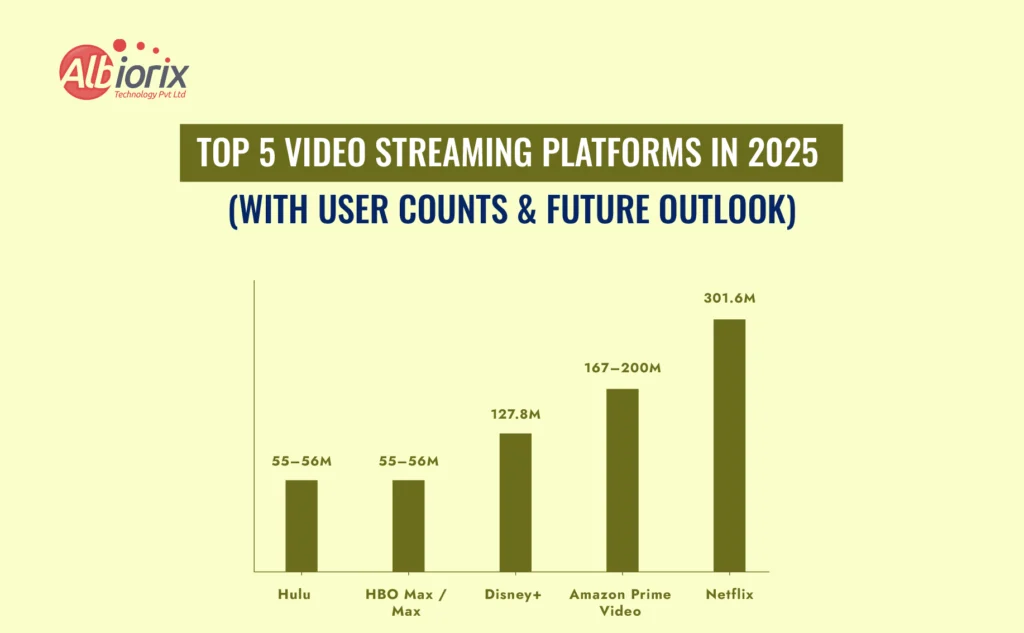
Top 5 Video Streaming Platforms in 2025

As of 2025, the global video-streaming space is dominated by a handful of major platforms that together account for hundreds of millions of subscriptions worldwide.

Based on recent data, here are five of the largest OTT services — along with their approximate user base as of 2025 and what their growth might look like toward 2030.

PlatformApproximate Subscribers / Paid Users (2025)What Makes It Stand Out / NotesProjected Growth or Outlook by ~2030*
Netflix301.6 million globallyWorld’s largest streaming service; vast global reach across 190+ countries; vast library of movies/series; high daily engagement.Expected to remain a top player. Netflix likely shifts focus more on retention, original content & hybrid/ad-supported models.
Amazon Prime Video167–200 millionStrong global footprint, bundled with broader Amazon ecosystem; combines SVOD + added benefits for Prime users.Some estimates project 250-270 million global subscribers in the next few years.
Disney+127.8 million paid subscribers globally (Q3 2025)Known for strong family-friendly & franchise content (animation, blockbuster films, exclusive originals); growing international expansion.Disney+ is expected to continue expanding internationally; long-term potential to reach higher global market share.
HBO Max / Max55–56 million paying subscribers in 2025 (US-centric)Strong presence in United States, known for a mix of recent shows, original content, and a range of plans (including ad-supported).Likely to keep a steady hold in its core market.
Hulu55–56 million paying subscribers in 2025 (US-centric)Strong presence in United States, known for a mix of recent shows, original content, and a range of plansLikely to keep a steady hold in its core market

Want to develop an OTT app from scratch or create a replica of a popular streaming platform?

Get in touch with our expert team today and turn your video streaming idea into a high-performing, scalable app that engages users worldwide.


Contact Us

How to Make Money by Video Streaming App Development?

One of the biggest advantages of launching a video streaming app in 2026 is that the business model can generate revenue in multiple ways—not only through subscriptions but also through ads, in-app purchases, live events, and creator monetization.

Modern OTT platforms are designed to be profitable from day one if the right pricing model, content strategy, and audience niche are identified early.

Popular Monetization Models for Streaming Apps

Most successful OTT platforms generally rely on one (or a combination) of these models:

  • SVOD (Subscription Video-on-Demand): Most of the OTT platforms/video streaming apps are earning from the SVOD model.

    In this model, users pay subscription fees to the platform on a monthly or yearly basis. It is the primary method of making money from an OTT/video streaming platform.

  • AVOD (Ad-Supported Video-on-Demand): Along with the subscription charges, these OTT platforms make money from ads. Free content on these video streaming apps is supported by ads.
      
  • TVOD (Transactional / Pay-Per-View): There are some OTT platforms that charge users only for the content they consume. Users only have to pay for the movies, events, live shows, and sports they watch.

  • Freemium Model: Some OTT platforms allow users to watch some video content for free, but if they want to watch premium content, then they have to subscribe to the freemium model.

  • Hybrid Monetization: Some modern OTT platforms increasingly combine subscription + ads + live events to maximize revenue per user.

    It is one of the most trending monetization models. This model creates a win-win situation for both the platform owners and the users.

Additional Revenue Channels in 2026

New-age streaming apps now earn beyond traditional subscriptions with features such as:

  • Live-event ticketing (concerts, sports, webinars)
  • Live-commerce & product selling
  • Tipping and donation systems for creators
  • Paid live sessions, workshops, tutorials
  • Sponsored content and brand partnerships
  • Affiliate product placements inside content

This flexibility allows both content creators and platform owners to turn video streaming into a high-revenue business ecosystem rather than just a media library.

Why Hire Android App Developers for OTT App Development

If you are planning for OTT app development in 2026, then the first platform you must target is Android. With the highest number of smartphone users across the world, Android OTT app opens up the door to around 80% of smartphone users globally.

Even in 2026, Android will continue to dominate the global mobile market, which means most video streaming apps will receive the highest user volume on Android devices.

In 2026, building an OTT platform without a strong Android experience means missing a huge audience segment.

You will miss the most lucrative and rising market from regions such as India, Asia, the Middle East, and South America, where Android leads the ecosystem.

Hiring experienced Android app developers helps you build a video streaming platform that is optimised for performance, secure media playback, adaptive bitrate streaming, and smooth viewing on different device types and screen sizes.

Skilled Android developers also understand important OTT components like user authentication, DRM (Digital Rights Management), offline downloads, push notifications, and integration with Google TV and Android TV.

A team of professional Android app developers can help you implement powerful monetisation models, including subscription (SVOD), advertising (AVOD), and pay-per-view options.

This all allows you to start making money from day 1. Hiring Android app developers for OTT app development can be an important decision.

Hire Developers to Launch Your iOS and Android OTT Video Streaming Platform

Whether you need an iOS OTT app or an Android video streaming application, hire expert iOS and Android app developers from Albiorix Technology.


Get a quote!

iOS App Development Services for Video Streaming Apps

iPhone and iPad users are looked upon as the most valuable OTT audiences; therefore, you will need Professional iOS app development services to develop video streaming apps that are fast, feel awesome, and secure.

An iOS app development service allows you to target the entire Apple ecosystem, including Apple TV.

When you hire a team of experienced iOS OTT app developers, they help you develop a video streaming app with modern features such as adaptive bitrate, secure content delivery, AI-based recommendations, and offline viewing.

These features ensure smooth video performance even during network issues.

Compared to Android users, iPhone and iPad users are more likely to buy subscriptions to different OTT platforms. Which means an iOS-first or iOS-friendly OTT strategy can significantly increase revenue per user.

With custom iOS development, your video streaming application can offer seamless viewing, stable playback, Face ID authentication, and deep integration with Apple ecosystem tools.

IOS app development services can offer you an OTT platform that is more premium, secure, and future-ready.

We Are the Best Video Streaming App Development Company in India

If you are looking to develop a video streaming app or want to develop a replica of popular OTT platforms like Netflix, then get in touch with Albiorix Technology.

We have more than 10+ years of industry experience in building custom OTT apps for clients coming from Australia and the USA. Our team of OTT developers have hands-on experience in developing custom video streaming apps.

As a leading video streaming app development company in India, Albiorix Technology specializes in creating high-performance OTT apps tailored to your audience, business goals, and platform needs.

Our video streaming app development services cover everything from conceptualisation and design to development, deployment, and ongoing support.

In the last 10 years, we have developed custom OTT platforms for clients across industries. From startups to enterprises, we have helped businesses own video streaming apps that scale seamlessly across mobile, web, and smart TVs.

Our global client base includes satisfied partners in Australia and the USA. We design and deliver OTT solutions that meet international standards.

By choosing us, you get more than just an app—you get a partner who understands monetization, user engagement, and technology trends in 2026.

Whether it’s SVOD, AVOD, live streaming, or hybrid OTT models, our team ensures your platform delivers a smooth, secure, and immersive viewing experience.

If you’re ready to turn your video streaming idea into a revenue-generating video streaming app, contact us today and let our experts guide you through every step of your OTT app journey.

Conclusion

To develop a successful video streaming application in 2026, you will need a perfect blend of strategy, technology, and user experience.

We are among the top OTT app development companies in India, and we offer end-to-end video streaming app development services that help businesses reach global audiences, engage users, and monetise effectively.

Whether you want to develop an OTT platform from scratch or want to develop a duplicate of a popular video streaming application, our team of experts will ensure your app is fast, secure, and aligns with your future goals.

Contact us today to turn your video streaming idea into a high-performing, revenue-generating platform.
Why Payment Gateway Integration Is The Successful For Digital Products

While shopping online, did you ever click on the “Buy Now” button, and drop the plan of buying a product because the payment took a lot of time, failed unexpectedly, or asked for too many details? You are not alone.

Many businesses revisit their checkout flow during Product Development to eliminate delays, simplify steps, and ensure a smooth user experience. Most online shoppers would have done that because no one likes a slow or below-average shopping experience.

Moreover, people also abandon shopping if they feel the payment gateway is insecure or confusing.

That’s exactly where payment gateway integration becomes the backbone of successful digital product development. It’s not just a technical add-on; it’s the critical link that decides whether a user completes a transaction or disappears forever.

In today’s digital-first world, users expect seamless, frictionless experiences from the moment they land on your app to the final payment confirmation.

A smooth payment flow enhances trust, boosts conversions, and ultimately determines how your digital product performs in the real market.

In this blog, we will discuss payment gateway integration, why it is considered the backbone of a successful digital product, types of payment gateways, and much more. So, stay tuned with us!

What Is Payment Gateway Integration?

Think of a payment gateway as the digital “cashier” of your app or website. Payment gateway integration simply means connecting your product to this cashier so users can pay you securely using cards, UPI, wallets, or net banking—without any manual effort from your end.

The entire payment process might look simple from the front, but there are a lot of things going on in the backend. Behind the scenes, when a user enters the payment details, these payment details are encrypted by the payment gateways.

These encrypted details are then sent to the bank for approval and verification. Once the details are confirmed and verification is approved by the bank, the success/failure message returns accordingly. All these back-end processes happen in a matter of seconds.

But the question arises, why is the payment gateway so important? The answer is simple. Every new digital product today, a mobile application, SaaS product, ecommerce Store, or an online marketplace, totally depends on smooth payment to flourish.

A secure and reliable payment gateway means fewer abandoned carts, more successful transactions, safer user experiences, and ultimately more ROI for your business.

This is why payment gateway integration is extremely important for the success of new digital products in 2026 and beyond!

Not sure which payment gateway is best for your digital product?

Get expert advice for free and make the right choice with confidence. We are the best product development company in India.


Contact Us!

Why Payment Gateway Integration Matters During Digital Product Development

When you are building a digital product like a mobile app, a SaaS platform, an ecommerce website, or a marketplace, a payment gateway is not just another feature.

It is a crucial part of your digital product, and you must think about it from the very first day. A right payment gateway shapes the entire user experience, trust, and conversion journey.

A well-integrated payment gateway ensures users can complete transactions quickly, safely, and without friction. This smooth experience directly influences them and leaves a positive impact on your product and business.

Smooth payments build confidence, whereas complicated or slow checkouts create instant drop-offs.

For companies investing in digital product development services, planning payment gateway integration early makes everything easier.

Your digital product development agency can design the right flows, choose the best APIs, and ensure security and compliance from day one—saving time, cost, and major rework later.

In short, early and seamless payment integration is a core ingredient of a high-performing digital product—not an afterthought.

Choosing the Right Payment Gateway for Your Product

Just like no two businesses are the same, not all payment gateways are built the same. There are many different types of payment gateways offered in the market; therefore, you must choose the right one for your digital product.

If you do not have a proper understanding of the payment gateways, then it is better to discuss it with your product development company. They are the right ones to suggest to you the best option based on your product type and targeted audiences.

The right selection of payment gateways at the time of new product development can make a huge difference in how users interact with your product.

The ideal gateway must be secure, support global currencies, extremely transparent with platform fees, fast in processing the payments, and have developer-friendly APIs to make integration easy and convenient.

When building a digital product, you can choose from options such as Stripe, Razorpay, Cashfree, PayU, and Square.

All these options are the best, but you must select the payment gateway based on aspects such as your audience, geography, business model, type of your digital product, and scalability needs.

To help you understand better, let’s say Stripe payment gateway is the best for global SaaS platforms, whereas Razorpay is excellent for India-first apps. The world-famous payment gateway, PayPal, is ideal if your users prefer wallet-based payments.

If you are confused about the available options, then take the help of your digital product development agency. They can help you pick the best option considering all the important criteria.

An experienced team understands the nuances of each gateway, evaluates technical requirements, ensures compliance, and helps you pick the option that aligns perfectly with your product’s architecture and growth plans.

Instead of trial-and-error, you get expert guidance that saves both time and money.

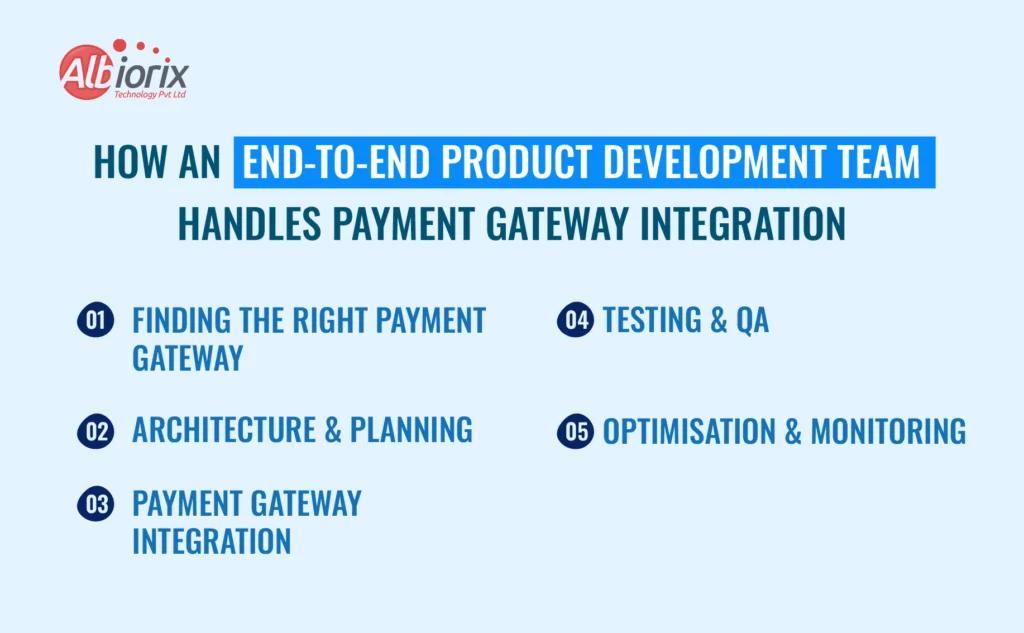
How an End-to-End Product Development Team Handles Payment Gateway Integration

How an End-to-End Product Development Team Handles Payment Gateway Integration

When you work with an end-to-end product development team, payment gateway integration becomes smooth. It becomes a well-organized process instead of a last-minute technical headache.

Since everything from strategy to design, back-end, and QA is handled under one roof by the team of experts, the entire flow stays aligned and efficient.

A typical payment gateway integration flow looks like this:

  1. Finding the Right Payment Gateway: As a first step, the end-to-end product development team understands your business model, audiences, geography, and the type of payment you want to accept.

    This analysis provides them with in-depth insight and makes it easy for them to choose the right payment gateway for their digital product.

  2. Architecture & Planning: As a second step, the team of developers and solution architects map out how the payment system fits into your product infrastructure.

    Both these teams work together to plan APIs, security layers, database structures, and user flows to ensure scalability and compliance.
      
  3. Payment Gateway Integration: The team of back-end developers integrate the selected payment gateway into your digital product using secure APIs. The team of designers ensures that the checkout UI feels seamless and consistent.

  4. Testing & QA: Once the team of back-end developers integrates the payment gateway with the digital product, it’s time to test it.

    The QA team runs end-to-end tests to check successful payments, failures, refunds, retries, speed, device compatibility, OS compatibility, and more. This set of tests ensures everything works flawlessly before launching.

  5. Optimisation & Monitoring: Once your digital product is developed and launched, it’s time to track the real-time user behaviour, monitor issues, and optimise the payment experience.

    Continuous analysis and optimisation will maximise conversions and reduce drop-offs.

The biggest advantage of partnering with a digital product development agency is that you get all the work done under one roof.

They have a team of back-end developers, front-end developers, DevOps, and QA specialists for custom new product development and payment integration. They ensure a smooth development process and payment integration.

Why Hiring a Product Development Company in India Offers Strong Value

Partnering with a product development company in India brings a unique mix of cost efficiency, technical depth, and real-world fintech experience. It can turn out to be a smart choice for businesses developing payment-heavy digital products.

Digital product development agencies in India are known for delivering high-quality solutions at lower costs. It allows startups and enterprises to stretch their product budgets without compromising performance or security.

This becomes especially important when you are developing payment systems that need precision, scalability, and compliance.

Moreover, the companies offering digital product development services have extensive experience in integrating multiple gateways like Stripe, Razorpay, Cashfree, PayU, PayPal, and global platforms.

They are able to gain this experience by working with businesses from different industries and verticals.

Thus, hiring a product development company in India for payment gateway integration is the right decision.

In short, working with an Indian product development company means you get the perfect balance of affordability, expertise, and speed—especially for products where payments play a mission-critical role.

Common Integration Mistakes and How a Good Team Avoids Them

Common Integration Mistakes and How a Good Team Avoids Them

At the time of custom digital product development, payment gateway integration may look simple, and an easy-going task, but it is complicated. There are a lot of things that can go wrong at the time of integration if not handled carefully.

Many digital products struggle with issues that could have been avoided with the right digital product development agency and planning.

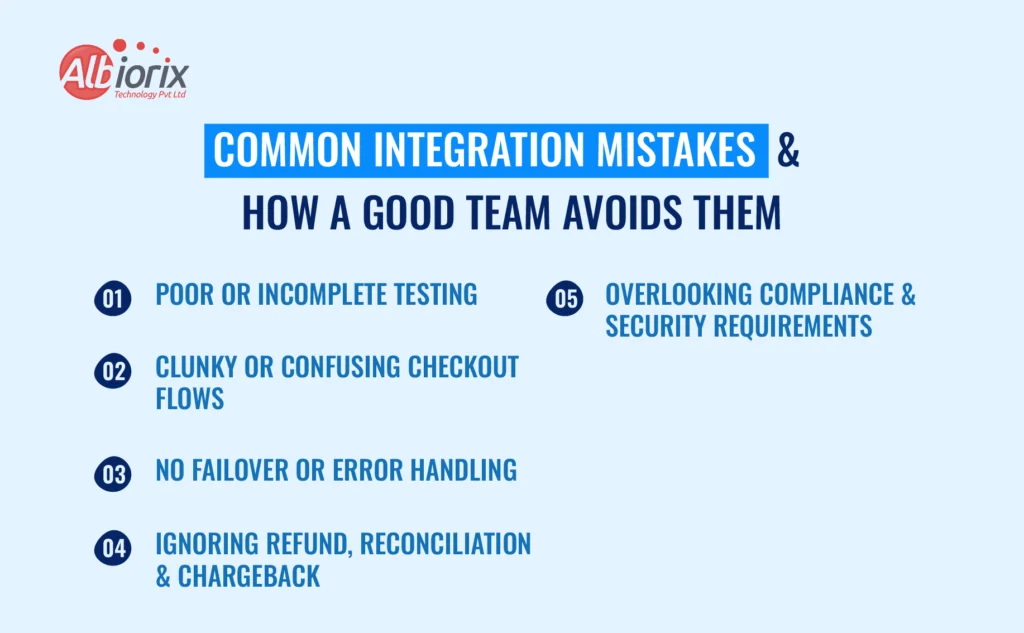
Common Integration Mistakes to Avoid:

  1. Poor or Incomplete Testing: One of the most common mistakes we come across is that companies test only successful payment scenarios. Whereas the real issues are failed payments, timeouts, network drops, and device limitations.

    An experienced product development company runs end-to-end, edge cases, and stress testing to check every possible scenario before the launch of a new product.

  2. Clunky or Confusing Checkout Flows: Long forms, too many steps, or inconsistent UI can instantly increase drop-offs.

    An expert digital product development agency can streamline the flow, reduce friction, and ensure the checkout matches the product’s overall UX standards.

  3. No Failover or Error Handling: There are many digital products that are not programmed to handle failovers or fallbacks. While using such a digital product, when payment fails, users hit a dead end.

    A team of developers implement smart retries, clear error messages, and alternate payment options to stop users from abandoning the process.

  4. Ignoring Refund, Reconciliation & Chargeback: Without proper backend workflows, refunds become manual, chargebacks go unnoticed, and accounting becomes a mess.

    Thus, in the case of failed transactions, an automated refund system must be activated with an admin tool to track the full lifecycle of a transaction.

  5. Overlooking Compliance & Security Requirements: From PCI-DSS to tokenization and encryption, payments require strict standards.

    Experienced digital product development company ensures secure integration, updated SDKs, and compliant data flows from the start.

In short, professional digital product development services not only integrate a payment gateway but they also ensure it works seamlessly, safely, and reliably in the real world.

Conclusion

In the digital world, payments aren’t just a feature. They are the moment of truth for your product.

Professional and proper payment gateway integration shapes user trust, smoothness the purchase experience, and directly impacts your conversions and revenue. When done right, it becomes a strategic advantage instead of a technical hurdle.

If you’re building or scaling a digital product, having the right development expertise can make all the difference.

An experienced digital product development company ensures your payment flows are secure, intuitive, and optimized from day one—so you can focus on growth, not technical headaches.

Ready to build a product with seamless payments at its core? Want to learn more about our digital product development services? Contact us, today!

Let’s create something amazing together.

Top-Rated Healthcare CRM Software Development Service For Better Growth

We are almost into 2026, and at this point in time, most doctors, healthcare professionals, and healthcare organizations have understood that healthcare CRM software development is no longer a nice-to-have thing.

It’s a central pillar of the modern-day healthcare industry that helps them offer a next level of patient care.

Healthcare CRM systems are the need of time, and looking at the current market trends in the future belongs to the more advanced and custom-made, AI-powered healthcare CRM software. 

In the last few years, especially after the arrival of Artificial Intelligence and Machine Learning, the digital health landscape has exploded.

Individual practitioners and large-scale hospitals in 2025 depend on healthcare software solutions and CRM systems to offer enhanced patient care and manage their day-to-day tasks. This has also led to the rise in the need for healthcare CRM software development services.

But what’s fueling this rapid rise in custom healthcare CRM demand? 

Healthcare CRMs are of great use to doctors and healthcare organizations. It helps them streamline and manage tasks, including appointment flows, access to patient histories, patient care gaps, treatment reminders, teleconsultation, and much more.

It helps them improve patient care, course of treatment, and patient satisfaction in an organized way.   

With so many benefits of healthcare CRM systems, most organizations have shifted to a more integrated, patient-centric, and productive platform known as Healthcare CRM software. It helps them turn fragmented data into coordinated proactive care.

Why is Healthcare CRM System Booming?

Over time, the healthcare industry has evolved a lot. Pen and paper got replaced by standard software, and now off-the-shelf software is being replaced by futuristic CRM systems.  

It has become a useful tool for everyone associated with the healthcare industry. Here are some numbers that will help you understand why Healthcare CRM software is in high demand in the market:   

  1. Healthcare organizations using CRM systems have reported up to a 42% reduction in missed appointments.   
  2. Many healthcare organizations and individual practitioners saw a 35% improvement in patient satisfaction.   
  3. According to a report published by Research Gate, the implementation of CRM systems in medical facilities improved patient data accessibility by 42% and redundant administrative workflows dropped by 49%.   
  4. After the implementation of the Healthcare CRM system, some healthcare organizations reported that patient retention increased by 41%.   
  5. Facilities leveraging CRM reported up to a 25% reduction in operational costs and a 33% boost in revenue-cycle efficiency.   
  6. As of 2024, roughly 48% of new healthcare CRM installations include AI-driven analytics modules — up from ~23% in 2020. Market Growth Reports  
  7. Around 67% of healthcare providers globally reported using CRM solutions for population-health management initiatives. 

Why Every Healthcare Organization Will Need a Custom Healthcare CRM in 2026?

As we move into 2026, healthcare organizations are entering a new era where patient expectations, regulatory demands, and digital-health innovations are evolving faster than ever.

In such a fast-evolving digital landscape, off-the-shelf and traditional CRM systems may not be able to keep up with this shift.

Hospitals, clinics, multi-specialty networks, and even individual practitioners now require tailor-made CRM systems that align with their unique workflows, data models, and patient-care goals.  

A custom healthcare CRM empowers organizations to centralize patient data, automate communication, streamline appointment management, and deliver more coordinated, personalized care.

It also easily integrates with legacy systems such as EHRs, telehealth platforms, billing systems, lab portals, and pharmacy networks to create a unified ecosystem that streamlines operations and increases customer satisfaction.    

Custom CRMs in 2026 also bring powerful advantages such as advanced analytics, AI-driven predictions, automated follow-ups, and personalized care pathways.

These capabilities not only reduce administrative load but also help healthcare professionals make faster, smarter decisions. Such an AI-powered healthcare CRM system is a necessity in 2026 and beyond. 

Key Benefits of a Tailor-Made Healthcare CRM

Key Benefits of  Healthcare CRM software
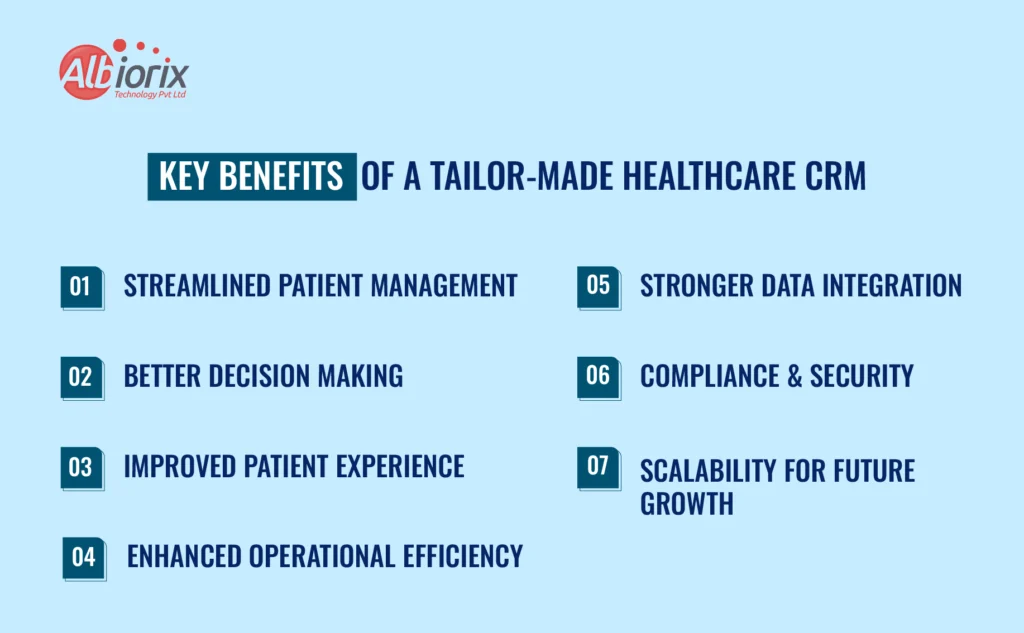
  1. Streamlined Patient Management: A CRM system allows you to automate repetitive tasks such as appointment scheduling, setting reminders, making patient follow-ups, and scheduling patient care.   
  2. Better Decision Making: An AI-powered Healthcare CRM software offers you detailed insight into care gaps, possible risks, and treatment options. A set of predefined data helps in making informed and patient-centric decisions.   
  3. Improved Patient Experience: Healthcare CRM systems help in offering enhanced patient care and treatment. It allows doctors and hospitals to establish personalized communication and a faster response to patients’ questions and queries.   
  4. Enhanced Operational Efficiency: When almost all tasks are automated and streamlined, you can focus on your core tasks like patient care and treatment. It increases operational efficiency.   
  5. Stronger Data Integration: A CRM system designed and developed keeping in mind your legacy system easily integrates with EHRs, billing, labs, and telemedicine systems into one unified platform.  
  6. Compliance & Security: Top healthcare software development companies like Albiorix Technology are known for developing custom workflows ensuring HIPAA, GDPR, and region-specific regulatory compliance.  
  7. Scalability for Future Growth: It can easily adapt to new services, departments, and digital health expansions. 

In 2026 and beyond, the healthcare industry will be more digital, data-driven, and patient-centric. Therefore, you will need a custom healthcare CRM to ensure smooth and streamlined operations.

A CRM system is no longer a luxury; it is the backbone of a modern healthcare ecosystem that ensures better outcomes, higher satisfaction, and sustained operational excellence.

Can a custom-made healthcare CRM software help your business grow?

Absolutely yes! A CRM system built around your unique workflows can help your practice or healthcare organization flourish in multiple ways.


Get yours today!

What types of healthcare CRM software you need as a Healthcare Professional? 

There are many different types of healthcare CRM software systems. For doctors, hospitals, clinics, and healthcare organizations, they must handpick the right CRM system based on their workflows, size, and patient care models.

There are many different types of readymade CRM systems available on the market, but a custom-made solution is the best fit.   

Here are the Most Common Types of CRM Systems

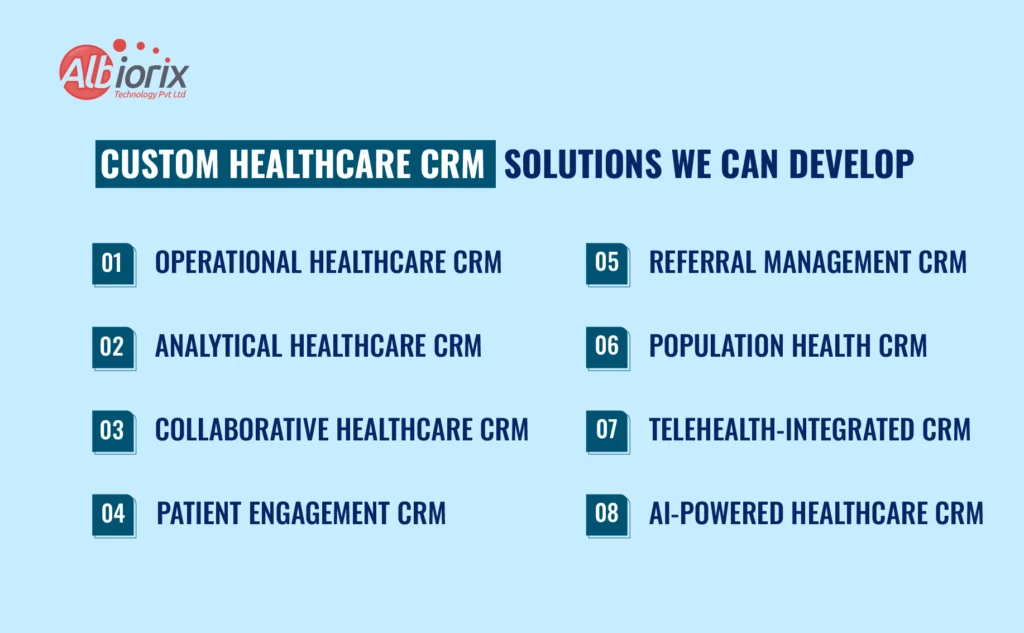
  1. Operational Healthcare CRM: This type of CRM system is used to manage day-to-day processes such as appointments, reminders, billing, and patient registrations.   
  2. Analytical Healthcare CRM: This type of healthcare CRM system is used to gather and analyze patient data. It collects data such as patients’ visits, medical history, and past interactions.   
  3. Collaborative Healthcare CRM: This type of healthcare CRM system is used to connect different doctors and departments in a hospital. It keeps all the doctors, nurses, and other supporting staff on the same page.   
  4. Patient Engagement CRM: This type of CRM system is used to manage patient communication. It helps improve patient satisfaction and strengthens long-term patient relationships.   
  5. Referral Management CRM: This type of CRM system is used to track referrals between primary care providers, specialists, and hospitals. It prevents referrals from leaking and speeds up patient routing and treatment.   
  6. Population Health CRM: This type of CRM system allows doctors and hospitals to monitor a group of patients based on risk factors, health conditions, and locations, and care requirements.   
  7. Telehealth-Integrated CRM: This type of healthcare CRM software makes it easy to centralize virtual consultations, scheduling, patient communication, and video-visit data. It makes remote care simple and consistent.   
  8. AI-Powered Healthcare CRM: This type of CRM system is powered by artificial intelligence. It assists doctors and hospitals in prediction, risk scoring, treatment options, and more. It increases accuracy and reduces manual effort for faster treatment.   

Need a CRM System? Try Our Healthcare CRM Software Development Services 

In 2026, if you are willing to modernize your hospital, clinic, or healthcare practice with a futuristic and AI-powered CRM system, then our healthcare CRM software development services are here to help.

Our custom CRM development services can help you modernize operations, streamline patient management, and develop a fully connected ecosystem that will take your practice to the next level.  

As a trusted healthcare CRM software development company with 10+ years of industry experience, we build tailor-made CRM solutions designed as per your unique workflows, specialty, and patient care needs.

We will ensure that the CRM system we develop fully accompanies the way you work.  

Whether you need a CRM for patient engagement, multi-department coordination, referral tracking, or data-driven decision-making, we deliver fully customized, scalable, and secure systems that integrate seamlessly with EHR/EMR platforms, telehealth tools, labs, billing systems, and more. 

Custom Healthcare CRM Solutions We Can Develop  

Custom Healthcare CRM Solutions
  1. Operational Healthcare CRM: If you need a CRM system that can automate appointment scheduling, patient follow-ups, visit reminders, and daily workflows, then our operational healthcare CRM development services are just right for you.   

  2. Analytical Healthcare CRM: If you are a hospital or a healthcare organization that needs a CRM system with real-time dashboards, AI-insights, and predictive analytics for smarter clinical decisions, then get in touch with us.

    Our Analytical Healthcare CRM development is perfect for you.   

  3. Collaborative Healthcare CRM: If you are a large healthcare organization or a hospital looking for a CRM system that can effortlessly connect all the doctors, nurses, pharmacists, billing teams, and labs for uninterrupted collaboration, then Collaborative Healthcare CRM is the best option.
     
  4. Patient Engagement CRM: Do you need a custom healthcare CRM software for your hospital or clinic that can enhance your communication with the patients through chats, SMS, apps, telehealth links, etc.?

    Then we can develop a patient engagement CRM system for your hospital and clinic.  
     
  5. Referral Management CRM: Our referral management CRM system is a tool that will help you track inbound and outbound referrals.

    It will eliminate leakages and speed up patient routing and the treatment process.   

  6. Population Health CRM: Does your hospital or healthcare organization need a smart tool to manage the chronic care program efficiently and identify at-risk patient groups? Then our population health CRM system is the smart option.   

  7. Telehealth-Integrated CRM: We are among the top healthcare CRM software development companies that can design and deliver a smart and intelligent telehealth-integrated CRM system for your clinics, hospitals, and healthcare organizations.

    It will help you offer high-quality virtual patient care.  

  8. AI-Powered Healthcare CRM: Integration of Artificial Intelligence can make your CRM system more intelligent and future-ready.

    Get in touch with our team of AI experts to build an AI-powered healthcare CRM system that can use intelligent automation for triage, predictions, personalization, and workflow optimization.   

When it comes to healthcare CRM software development, Albiorix Technology stands second to none. Our team of software developers can build any type of CRM system with any sort of complication from scratch.  

Every CRM system we build is HIPAA-ready, scalable, user-friendly, and engineered to support the future of healthcare.

If your organization is planning to upgrade or build a system from scratch, we can help you create a CRM that drives efficiency, enhances patient experience, and supports long-term growth.

Albiorix Technology – Among the Top Healthcare Software Development Companies in India 

As the healthcare industry undergoes massive technological reforms, it is important that you also adopt and integrate these reforms into your existing system to offer better patient care.

Whether you are an individual practitioner, a clinic, or a healthcare organization, you must welcome these changes with open arms.   

To adopt and integrate these technological reforms, you will need the help of an experienced healthcare software development services provider like Albiorix Technology.

The latter has a proven track record of designing and developing simple to complex mHealth solutions as per the business needs.   

We are among the top healthcare CRM software development companies in India. Our CRM solutions are trusted by some of the top doctors, hospitals, clinics, startups, and global healthcare organizations.   

With years of domain expertise, a strong team of healthcare software developers, and a proven track record of delivering secure, scalable, and intuitive medical software, we help organizations accelerate their digital transformation and enhance patient care across every touchpoint. 

As one of the most reliable healthcare software development companies in India, we specialize in building fully customized healthcare solutions ranging from CRM platforms and EMR/EHR systems to telehealth apps, patient engagement tools, AI-driven analytics solutions, and workflow automation platforms.

Our development approach focuses on regulatory compliance (HIPAA, GDPR), clinical accuracy, interoperability, and long-term scalability. 

Healthcare Software Development Companies in USA and Australia 

Doctors, hospitals, and healthcare organizations in the USA and Australia are rapidly adopting advanced digital solutions.

These healthcare software solutions help them manage patient demands, automate workflows, follow regulatory requirements, and shift towards value-based patient care.   

Ranked among the top healthcare software development companies in the USA and Australia, Albiorix Technology plays a crucial role in helping these hospitals, clinics, and medical enterprises modernize their systems and deliver more efficient, patient-centric care.

Our healthcare software development services allow them to own custom solutions that are secure, compliant, and scalable.   

Our team has hands-on experience in building healthcare solutions, including EMR/EHR platforms, healthcare CRM systems, telehealth applications, patient engagement tools, AI analytics engines, and workflow automation platforms.

With strong expertise in HIPAA, HL7/FHIR standards, and regional healthcare regulations, we ensure that organizations can seamlessly integrate technology without compromising safety, reliability, or clinical accuracy.  

For hospitals and healthcare organizations looking for top healthcare software development companies in the USA and Australia, Albiorix Technology is the right technology partner.

We have a talented team, proven domain experience, and globally trusted engineering practices to offer you top-tier healthcare CRM software solutions.   

Conclusion

As the healthcare industry continues its rapid digital evolution, the need for intelligent, secure, and fully customized mHealth software solutions has never been more critical.

From enhancing patient experiences to optimizing clinical workflows and enabling data-driven decision-making, modern healthcare CRM and healthcare software systems are reshaping how hospitals, clinics, and practitioners deliver care.  

Whether you operate in the USA, Australia, or anywhere around the world, investing in the right technology partner can determine how future-ready your organization truly is.

By choosing a trusted healthcare software development company, you position your organization to embrace innovation, improve operational efficiency, and build a more connected, patient-centric future in 2026 and beyond. 

If you have an idea that can revolutionize patient care and the entire healthcare industry, then we have the talent to convert our ideas into digital solutions.

To discuss your ideas with our experts, please schedule a free consultation or call us at (+91) 991-308-8360. You can also DM us on LinkedIn.

Top-Rated Video Streaming App Development Company For Better Growth

The demand for video streaming apps is skyrocketing in 2025 because there are millions of users consuming OTT content daily across smartphones, smart TVs, and the web.

There are hundreds of video streaming apps on the market, but only a few have become successful.

Behind every successful online streaming platform is a robust, scalable, and feature-rich video streaming solution engineered to deliver seamless viewing experiences.

These video streaming platforms have everything that users need to keep themselves engaged and entertained.

High-quality Video Streaming App Development Services ensure smooth playback, multi-device compatibility, advanced content management, and strong security.

All these factors combine to make a competitive OTT platform for today’s fast-growing OTT market.

At Albiorix Technology, we specialize in creating powerful, intuitive, and high-performing video streaming platforms (mobile apps and web solutions). For over 10 years, we have been among the top video streaming app development companies in Australia and the US.

We tailor video streaming platforms that align with your business needs. Whether you’re launching a new OTT platform or upgrading your existing one, our OTT experts help You build innovative solutions that keep users engaged and help you scale effortlessly.

Whether you want a standard OTT app, a premium video streaming platform like Hulu, or a powerful AI-enabled streaming solution like Netflix or Disney+, our team ensures world-class performance, intuitive UX, and next-level engagement.

Get a free consultation and quote for OTT application development for Smart TV and apps from experts with 10+ years of proven experience.

Clone an App or Take a Fresh Start?

Whether you want to build a video streaming app from the ground up or create a high-quality clone of a leading OTT platform, our expert OTT developers are ready to bring your vision to life.


Contact Us!

Understanding Video Streaming App Development

Video streaming app development is a vast term. It involves the development of OTT platforms that can deliver on-demand and live video content with high speed, security, and flawless user experience.

There are many big players like Netflix, Amazon Prime Videos, Hulu, and more. In the face of such fierce competition, businesses are looking to develop OTT application development for Smart TV that are faster, AI-powered, secure, and user-friendly.

Key Features Every Video Streaming Platform Needs in 2026

  1. High-Quality Video Playback: With the arrival of 4K and 8K devices and video quality, customers are expecting high-quality video playback. So, your OTT platform must offer smooth streaming services with adaptive bitrate technology.

  2. Content Management System: If you are going to develop a video streaming app in 2026, then don’t forget to integrate a powerful and scalable CMS system. It allows you and your users to organize, upload, schedule, and manage content easily.

  3. Multi-Device Support: Your audience is not only watching the video content from iOS and Android devices.

    They are accessing your content from a wide range of devices powered by many different operating systems; therefore, your video streaming app in 2026 must support content on different devices and OSs such as mobiles, tablets, smart TVs, and web.

  4. Secure Payment Gateways: With the rising cases of online fraud and data hacks, make sure the payment gateway you use is highly secure and follows all the government guidelines.

    Your audiences are going to make payments for many things, like subscription charges, pay-per-view charges, and more, so the payment gateway must be safe, secure, and user-friendly.

  5. User Profiles & Recommendations: Just like the popular OTT platforms in 2025, your video streaming apps must also suggest tailored notifications to your users.

    It must allow the profile creation, profile management, and send personalized watch lists and AI-powered suggestions.

An expert development partner ensures all these features work flawlessly together. A reliable video streaming app development company like Albiorix integrates cutting-edge features that enhance UX and simplify content operations.

With the rise in the need for modern, futuristic, and AI-powered video streaming apps and software, companies like Albiorix Technology have led the way by offering many landmark solutions.

MwareTV is a flexible TV platform with cutting-edge features designed and developed by Albiorix Technology with amazing features that enhance watching experience.

Key Features of a Cutting-Edge Video Streaming App

Key Features of a Cutting-Edge Video Streaming App

In the world of video streaming apps, there are many big names and brands available. To compete with such big names as Netflix, Amazon Prime Video, Hulu, and more, you must develop a video streaming app in 2026 equally or more powerful than these established players.

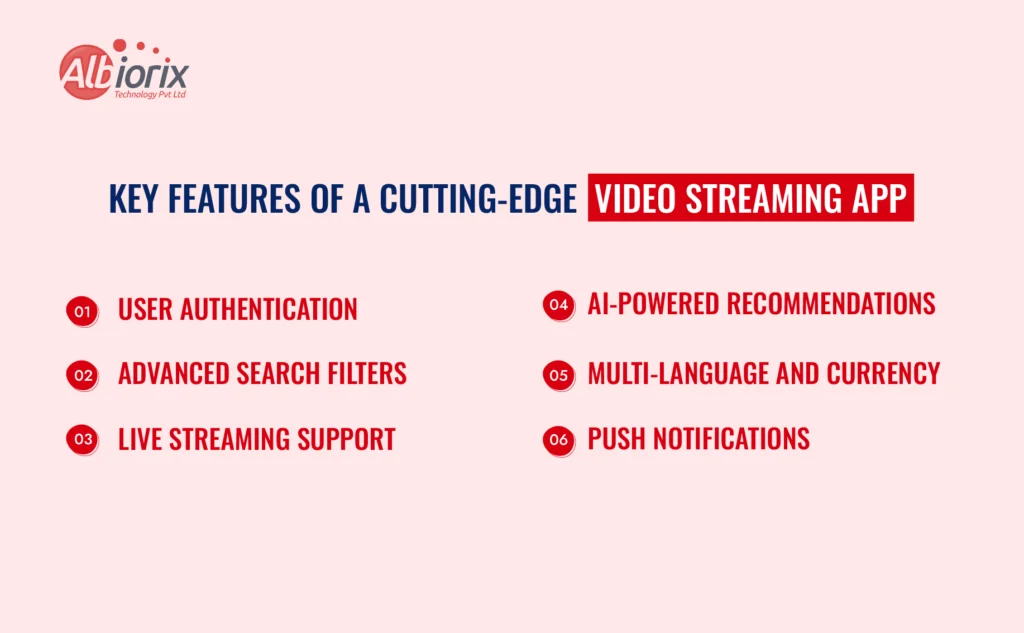
Being an OTT platform development company, we have collected a list of the top 5 features of a video streaming platform in 2026, and they are:

  1. User Authentication: Your audience must be able to log in multiple ways. You must allow login via OTP, social media accounts, and biometrics, to name a few.
  2. Advanced Search Filters: Your video streaming app in 2026 must allow users to search for video content using filters like genres, categories, languages, ratings, and more.
  3. Live Streaming Support: There are many stars and influencers who love live streaming; thus, your OTT platform in 2026 must support real-time broadcasting with minimal latency.
  4. AI-Powered Recommendations: The entire digital revolution is powered by Artificial Intelligence. Thus, your video streaming platform must also be loaded with AI. It must be able to send personalized recommendations using AI and user behavior.
  5. Multi-language and Currency: If you want to target global audiences with your OTT application development for Smart TV, then it must support all the major currencies and all the major languages spoken around the world.
  6. Push Notifications: Your OTT platform in 2026 must be allowed to send push notifications to your audiences. It must be related to new content added, discount offers, recommendations, and more. 

These sets of cutting-edge features will elevate user engagement and maximise viewer retention. It increases the chances of becoming successful amid the cutthroat competition.

Benefits of Custom Video Streaming App Development

Choosing custom OTT development services ensure your platform is unique, scalable, and ready for future growth. Also, these video streaming app development companies provide valuable suggestions and post development support to ensure 100% uptime of the app.

Benefits of custom video streaming app development:

  1. Tailored OTT Solutions: When you choose custom OTT app development, you don’t get a clone of an already existing app, but you get a platform that is designed around your brand, audiences, and business model.

  2. Scalability: A custom-made OTT platform is designed and developed to handle millions of audiences at a time. It is developed using the latest frameworks and technologies to smoothly handle heavy traffic.

  3. Enhanced User Experience: With custom OTT app development, you can provide a clean UI, smooth navigation, and fast content delivery to your audience.

  4. Seamless Integrations: When you opt for custom video streaming app development, the integration of third-party apps and APIs becomes very easy for the developers.

    You can easily integrate payment APIs, analytics tools, ad servers, CDNs, and more.

  5. Robust Security: Custom OTT app development ensures next-level security such as DRM, encryption, tokenised URLs, and digital rights protection.

  6. Real-Time Analytics: Custom solutions allow you to monitor user behaviour, content performance, and engagement.

    With this data, you can make suitable changes and increase the chances of your app’s success.

Albiorix Technology ensures your streaming platform delivers exceptional user and business value.

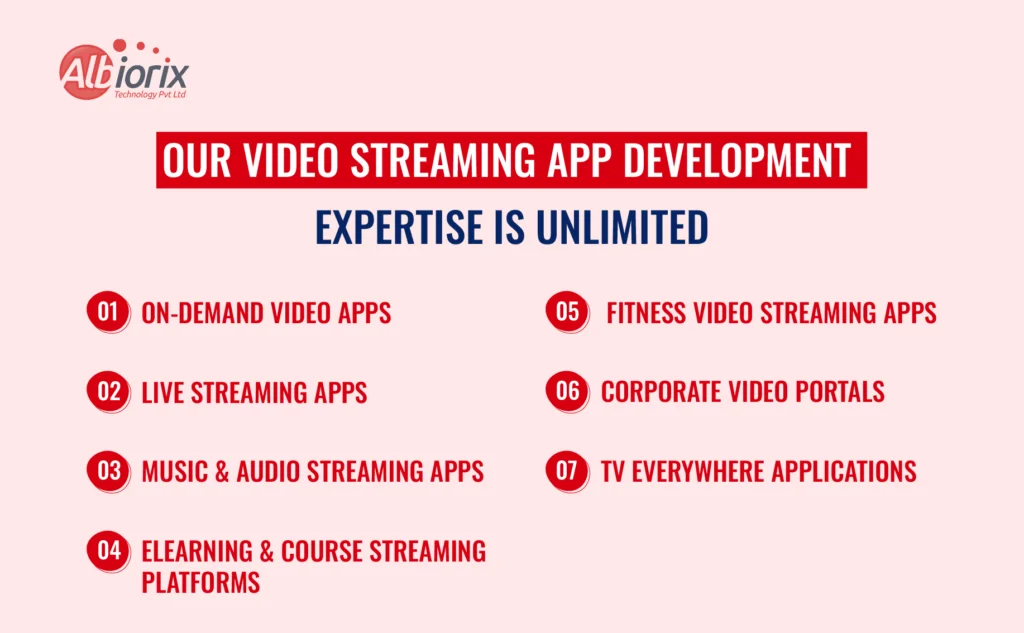
Our Video Streaming App Development Expertise is Unlimited

Our Video Streaming App Development Expertise is Unlimited

As a top-rated video streaming app development company, Albiorix Technology builds cutting-edge OTT experiences across every category.

We specialize in:

  1. On-Demand Video Apps: We build binge-worthy OTT apps like Netflix and Hulu that deliver cinematic, personalized viewing anytime, anywhere.

  2. Live Streaming Apps: We design and deliver real-time, ultra-low-latency live streaming solutions built for high traffic and zero interruptions.

  3. Music & Audio Streaming Apps: We build high-quality, buffer-free audio streaming apps engineered for immersive listening experiences.

    Music & Audio Streaming Apps: We build high-quality, buffer-free audio streaming apps engineered for immersive listening experiences.

  4. eLearning & Course Streaming Platforms: We develop scalable learning platforms with smooth video delivery, adaptive courses, and engaging content playback. 

  5. Fitness Video Streaming Apps: Our team can design and develop dynamic fitness platforms offering interactive workouts, live classes, and seamless multi-device streaming. 

  6. Corporate Video Portals: Get secure internal video hubs designed for training, communication, and enterprise-grade content management. 

  7. TV Everywhere Applications: Our team of developers can create cross-device TV apps that bring premium streaming to Smart TVs, mobile, and web with a unified experience. 

Every solution is optimized for high performance, powerful security, and seamless streaming. 

Latest Trends in OTT and Video Streaming in 2026  

The OTT industry is constantly evolving with the arrival of new technologies and user expectations. In 2026, it is expected to come up with many new features, including smarter personalization, immersive experiences, and secure content delivery.    

At Albiorix Technology, we develop a video streaming app and platform with all these next-gen features and innovations. This approach ensures that your OTT platform is future-ready and stays ahead in a rapidly evolving streaming industry.    

  1. AI and Machine Learning: In the age of AI, the OTT platforms will have AI content recommendations based on users’ past journeys, content viewing patterns, and time of watching content.  
  2. Blockchain: The introduction of Blockchain will ensure temper-proof content ownership, transparent royalty distribution, and secure licensing.  
  3. AR/VR Content Streaming: AR/VR streaming delivers 360° content, virtual environments, and lifelike experiences for entertainment, fitness, and education.  
  4. Interactive Streaming: OTT apps with interactive streaming will boost user participation. It will have futuristic features such as co-watching, real-time reactions, and audience-driven content.  
  5. Cloud-Based Streaming (CDN Integration): Cloud + CDN ensures lightning-fast content delivery, even during peak traffic. It enables global reach with minimal buffering, high availability, and dynamic scaling. 

Albiorix Technology – The Best Video Streaming App Development Company

Albiorix Technology is the best video streaming app development company. We have designed and developed OTT application development for Smart TV such as MwareIPTV from scratch. 

If you are planning to develop a world-class video-streamline app or software that is AI-ready and built for performance, then Albiorix Technology is the right OTT development company to partner with.  

We have worked on many different types of streaming apps, such as OTT platforms, Smart TV apps, and multi-device streaming ecosystems. Our expert team ensures seamless development from idea to deployment.   

Partner with us to develop an OTT platform that is AI-powered, fast, secure, and future-ready. We can help you lead the streaming industry. 

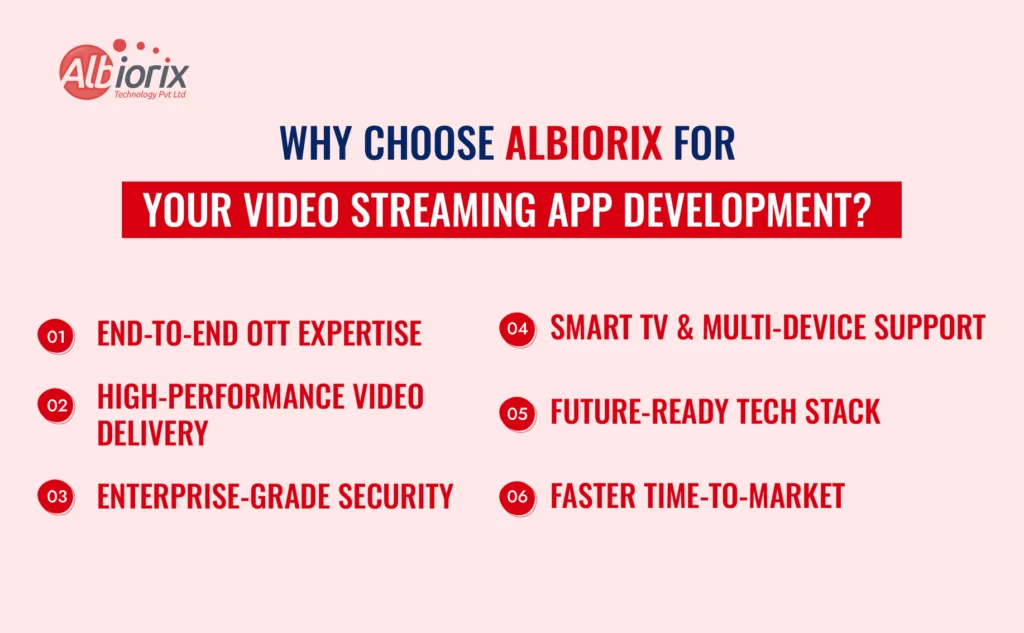
Why Choose Albiorix for Your Video Streaming App Development? 

Why Choose Albiorix for Your Video Streaming App Development
  1. End-to-End OTT Expertise: We already have hands-on experience in developing OTT platforms from scratch. Our team can handle every part of your streaming platform development with confidence.  
     
  2. High-Performance Video Delivery: We use the latest tools and technologies to ensure the OTT app is ultra-fast, adapts bitrate streaming, with zero-buffer experiences. 

  3. Smart TV & Multi-Device Support: To ensure you can target audiences from all around the world, we develop video streaming apps that support all the major mobile operating systems, TV OSs, etc.   

  4. Future-Ready Tech Stack: To make sure your OTT platform is future-ready, we use trending technologies, including AI, cloud, CDN, etc. We also use scalable microservices for long-term growth.  

  5. Faster Time-to-Market: Our agile development method ensures rapid delivery without compromising quality.   

OTT Platform Development for Every Business — From Fortune 500 to Startups 

Our professional OTT development services are for all – from fortune 500 to startups. Whether you’re an emerging startup or a global enterprise, we will help you build powerful, scalable, and feature-rich OTT platforms in 2026 tailored to your vision.

Our solutions adapt to every business size, audiences, and industry need, ensuring a seamless and future-ready streaming experience.

Our OTT Development Services Include:

  1. Custom OTT Platform Development: We offer end-to-end solutions tailored to your business model, budget, and audience.
  2. Live Streaming App Development: We build high-quality, real-time streaming platforms for events, sports, news, and more.
  3. Video-on-Demand (VOD) Solutions: Netflix-like platforms with advanced content management and monetization.
  4. Multi-Platform App Development: We build OTT apps for mobile, web, Smart TVs, and streaming devices.
  5. Monetization & Subscription Integration: SVOD, AVOD, TVOD, and hybrid models built to maximize revenue.
  6. Content Security & DRM Implementation: Enterprise-grade protection for secure streaming across all devices.

Launch Your Own Netflix-Level Streaming App Today!

Let’s bring your OTT vision to life with stunning design, robust architecture, and seamless streaming. Connect with our experts today for a free consultation and custom quote.


Contact Us

Best Video Streaming App Development Services 

In 2026, the video streaming and OTT space will be filled with immense opportunities. Therefore, you must have a powerful platform to stand above the competition.

Albiorix Technology is the right video streaming app development company. We can build secure, scalable, and fully customised video streaming solutions designed to boost engagement and revenue.

If you are ready to launch your video streaming app in 2026, then contact Albiorix Technology today. We offer free consultation, a quote, and app improvement suggestions. You can call us at or DM us on LinkedIn.

Best AI Voice Agents Developer For Future Growth

If you think that an AI voice agent is a futuristic concept, then you are wrong. It’s here, and there are high chances that you have already come across this amazing AI-powered solution.

Partnering with an AI Development Company helps businesses understand and adopt this technology effectively. It is the present and the fastest-growing automation technology in the world.

AI-powered voice agents have penetrated almost every industry by replacing chatbots and IVR systems.

From customer support to sales, lead qualification, appointment booking, outbound calling, and operations, businesses everywhere are shifting to AI-powered voice agents to scale faster and serve customers 24/7.

These AI-powered voice agents are very efficient, human-like, and evolve with past experiences.

According to a report published by Markets and Markets, the global conversational AI market is projected to reach $49.9 billion by 2030, with voice-based AI agents leading the growth curve.

In another report by Gartner, it is mentioned that more than 30% of all outbound sales and customer service interactions will be handled by AI agents by 2026.

Thus, in most businesses where customer support services or sales calls are required, AI-powered voice agents are expected to dominate the market.

As businesses accelerate toward digital transformation, the real challenge is this:

Who can build powerful, human-like, reliable, and scalable Voice AI Agents that truly understand your customers… and your business needs?

The answer:

Albiorix Technology — Your Trusted Partner & the Best Voice AI Agents Developer for High-Growth Businesses. We are among the top AI agent development companies in India, powering businesses in Australia, Europe and across the United States (US).

Introduction to Voice AI Agent

There’s a lot of buzz regarding Voice-Based Conversational AI in 2025, but what exactly is it? An AI voice agent platform is a more intelligent, smart, and advanced conversational system powered by speech recognition, deep learning, NLP, and LLMs.

It allows users to interact with your business naturally — just by speaking — enabling lightning-fast, accurate, and human-like responses.

As Artificial Intelligence and other modern technologies power it, it is more advanced and intelligent than traditional chatbots and IVR systems.

This Voice-Based Conversational AI is used by businesses and large organizations to handle thousands of calls simultaneously by automating repetitive operations.

In 2026, AI voice agents will redefine how businesses deliver customer experiences and sales calls.

Why Voice AI Agents Are Becoming Essential

  • Customers expect instant support
  • Businesses need lower operational costs
  • Companies want to reduce dependency on human teams
  • Organizations are adopting automation and AI-first strategies

This is exactly where Albiorix Technology comes in — delivering enterprise-grade, custom-built Voice AI Agents tailored to your business.

Our AI Agent Development services are designed to level up your business in the age driven by Artificial Intelligence.

Still unsure whether your business truly needs an AI-powered Voice Agent?

How about a free expert consultation? Speak with our AI specialists, share your requirements, and we’ll help you understand which type of AI voice agent—if any—is the right fit for your business.


Get in touch with us today.

What Makes a Best Voice AI Agents Developer?

With the rise in the need for custom AI solution development, the number of services providers has also increased by leaps and bounds.

However, it is important for you to choose the right AI agent development company to ensure the success of your AI adoption.

As an expert and experienced AI development company in India, we have listed the top 5 points that separates leaders from everyone else.

  • Deep Expertise in Voice AI Agent Development: A top-tier AI solution developer must understand the complete AI voice pipeline.

    He must be well aware of aspects such as Automatic Speech Recognition (ASR), Text-to-Speech (TTS), LLM-powered reasoning, and more.

    We have a team of AI developers who can build AI voice agents that are fast, accurate, and human-like.
  • Advanced Skills in NLP, LLMs & Speech Technologies: True intelligence comes from understanding nuance, tone, emotion, and context.

    AI voice platforms developed at Albiorix Technology use GPT-based LLMs, domain-specific training, emotion-aware voice synthesis, and multi-turn conversational memory.
  • Custom AI Agent Development Services: No two businesses are the same; thus, the AI agent development services must be personalized as per their unique workflows.

    We are known for the development of a custom AI Voice Agent Platform that can be used for customer support, sales, lead qualification, appointment booking, tele-calling, and internal operations.
  • Enterprise-Grade Infrastructure: We develop auto-scaling architecture, secure data pipelines, high-bandwidth audio processing, and fail-safe fallback mechanisms to ensure the system handles thousands of calls concurrently.
  • Continuous Learning & AI Model Improvement: One of the most crucial qualities of an AI voice agent is that it must keep learning and evolving from past experiences and interactions.

    It must be able to provide personalized and intelligent solutions to ensure long-term value and adaptability.

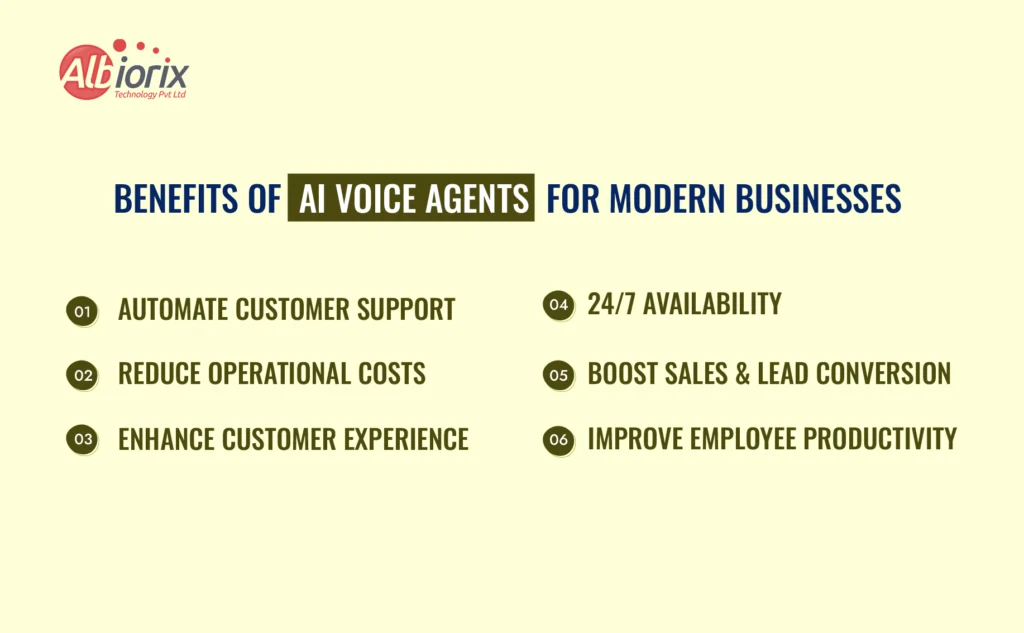
Benefits of Voice AI Agents for Modern Businesses

Benefits of Voice AI Agents for Modern Businesses

No matter whatever is the domain, industry or business operations, the integration of artificial intelligence is constantly benefiting the businesses in one or the other ways.

Similarly, Voice AI agents are not just another AI solution; it is a business multiplier.

Here are the top benefits of Voice AI Agents:

  • Automate Customer Support: AI-powered voice agents can solve up to 60-80% of queries instantly.

    It can resolve customer queries, including FAQs, order tracking, account-related queries, order status updates, etc. Overall, it can reduce the call-center workload.
  • Reduce Operational Costs: A single AI voice agent can handle thousands of calls simultaneously. This eliminates the need to hire and train human customer care executives; thereby reducing the operational cost by 60-70%.
  • Enhance Customer Experience: Intelligent Voice AI agents can respond instantly with personalized answers, natural voice tone, and multilingual support, without any waiting time.

    This instant response increases customer satisfaction and trust in your brand.
  • 24/7 Availability: AI-powered Voice agents are working around the clock without any intervention from human resources. This makes your business available 24/7 and 365 days a year.
  • Boost Sales & Lead Conversion: AI voice agents can be used to automate lead qualification, tele-calling, and follow-ups to increase conversions.

    These types of AI-powered voice platforms free your valuable resources to focus on high-value prospects.
  • Improve Employee Productivity: By handling repetitive tasks, AI agents let employees focus on strategic initiatives, boosting overall productivity.

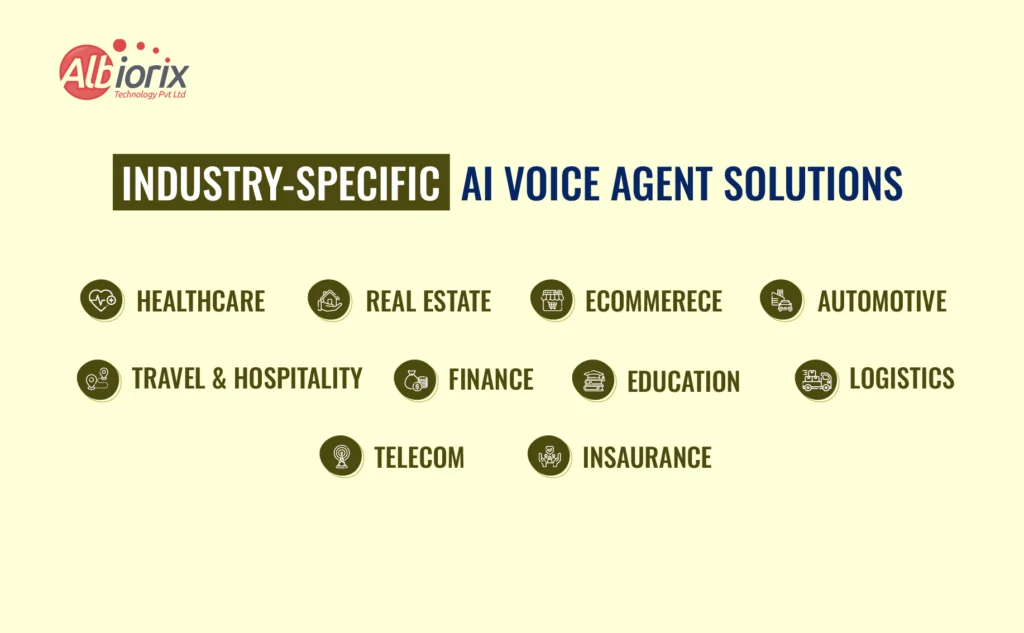
Industry-Specific AI Voice Agent Solutions

Industry-Specific AI Voice Agent Solutions

Albiorix builds custom AI voice agents for multiple industries, designed specifically to handle industry challenges:

  • Healthcare: Our AI agents help healthcare organizations and doctors with appointment booking, patient queries, and emergency triaging.
  • Real Estate: Our AI voice agent helps in lead qualification, property info, and site visit scheduling.
  • Automotive: Our AI solution helps with service booking, test drive scheduling, and customer queries.
  • Travel & Hospitality: Our custom AI agents help with reservation handling, itinerary queries, and 24/7 guest support.
  • Finance: Our AI voice agents help with loan inquiries, EMI reminders, verification calls, and customer support.
  • Ecommerce: Our Voice AI Agents help with order tracking, returns, post-purchase support, and product recommendations.
  • Education: Our AI-powered solution helps with admission inquiries, student assistance, and campus information.
  • Logistics: Our AI voice agent helps with Shipment tracking, delivery updates, and operational support.
  • Telecom: Our AI solution helps with service activation, plan upgrades, and billing inquiries.
      
  • Insurance: Our AI agent voice platform helps with claim assistance, policy info, and premium reminders.

Our AI Agent Development Company Capabilities

At Albiorix Technology, we deliver full-scale, end-to-end AI voice solutions for enterprises, startups, and global organizations. Our team combines technical expertise, business understanding, and creative intelligence to deliver superior outcomes.

  • End-to-End Voice AI Agent Development Services: From strategy to deployment, we manage every step for seamless AI implementation.
  • Custom Workflow Automation: We can develop an AI agent that can mirror and optimise your specific business processes, especially when comparing AI Agents vs Traditional Automation to determine the best approach for your operations.
  • Multi-platform integration: We can connect a single AI solution with different platforms such as CRM, ERP, WhatsApp, call centre tools, and more.
  • ASR + TTS Expertise: Our Voice AI agents can respond in human-like voices with better clarity and natural human-like flow.
  • LLM-Powered Intelligence: Our intelligent and advanced AI voice agents can understand the intent, context, and industry-specific language to provide accurate responses.
  • Secure & Compliant Deployment: We develop AI voice agent platforms following all the industry guidelines and compliance. We adhere to GDPR, HIPAA, and SOC 2 standards for safe AI adoption.

    AI Analytics & Insights – Our Voice AI agents can track and optimise customer interactions with actionable intelligence.
  • Custom Multi-Language Voice Agents: Our AI voice agents can engage global audiences through multilingual capabilities.

Want to know which type of Voice AI Agent is best suited for your business?

Talk to our expert Voice AI Agent developers in India. Based on your business workflows and customer needs, we’ll recommend the most effective solution tailored to your goals.


Contact us today!

Voice AI Agent Development Process – How We Build High-Quality AI Voice Systems

Albiorix Technology is the best AI Agent Development Company in India. We have separate teams of AI developers to give you the most rewarding AI solution for your business. We follow agile methodology for AI development.

Here’s insight on our AI Agent Development Process:

  1. Requirement Analysis: When you share your product idea/vision with us, our team of AI developers applies insights from AI in Product Development to deeply evaluate your requirements.

    We analyse your idea in terms of your business goals, call volume, workflows, and automation required. This in-depth analysis helps us in AI voice agent development that perfectly aligns with your operations.
  2. Conversation Flow Design: Once we evaluate your requirements and mutually agree on the solution to be developed, we start designing the flow of the AI agent.

    Our team of AI developers designs natural dialogues that mimic human conversations, support multi-turn interactions, context handling, and error recovery.
  3. LLM Training: Once the conversation flow design for an AI agent is ready, it’s time to train the models on business-specific FAQs, documents, CRM data, and historical interactions for accuracy and personalization.
  4. Voice Pipeline Setup: We configure advanced ASR, NLP, and TTS systems to enable fast, precise, and human-like responses.
  5. Integrations: Once the voice setup is completed, our team of best voice AI agent developers integrate it with CRM, ERP, telephony, WhatsApp, and other business tools for seamless interaction and data flow.
  6. Testing & Optimization: Once the custom AI voice agent is developed, it’s time for rigorous testing. This testing ensures performance, naturalness, and accuracy. Continuous improvement models refine agent behavior.
  7. Ongoing Support: We monitor and improve AI agents post-deployment for enhanced accuracy, customer satisfaction, and ROI.

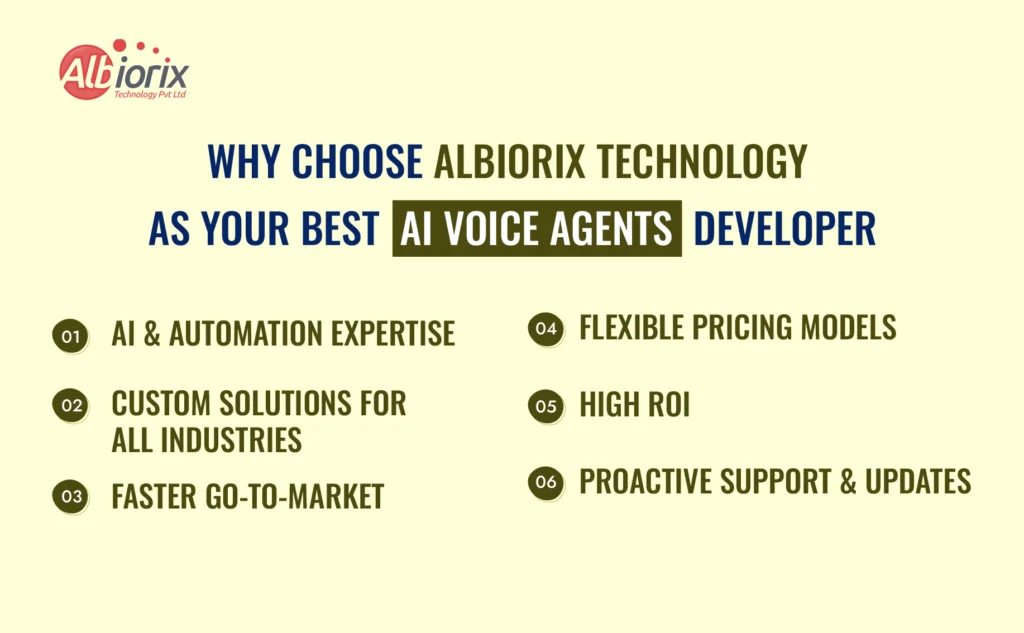
Why Choose Albiorix Technology as Your Best Voice AI Agents Developer

Why Choose Albiorix Technology as Your Best Voice AI Agents Developer

Albiorix Technology stands out as a leading AI voice agent development company with deep expertise in building reliable, human-like, and enterprise-grade conversational systems.

Our team blends advanced AI technologies with domain-specific knowledge to deliver intelligent voice solutions tailored to your business processes.

With a commitment to quality, speed, and innovation, we ensure every project transforms customer experiences and drives real business impact.

Here are some reasons why we are the best voice AI agents developer in India, Australia, and the US:

  1. AI & Automation Expertise: We have years of experience in Artificial Intelligence and Automation for delivering enterprise-grade AI solutions.
  2. Custom Solutions for All Industries: Every AI-powered voice platform is created as per your business requirements, business workflows, and audiences. Our AI agents are tailored to your specific business operations to ensure high productivity.
  3. Faster Go-to-Market: We have a team of experienced AI developers to ensure a faster time to market, leveraging AI-Powered Software Solutions alongside our collection of pre-built AI components and frameworks that help in reducing the overall development time.
  4. Flexible Pricing Models: We are extremely genuine about the cost of AI agent development. You only have to pay for the services you get or need. Moreover, we don’t surprise you with any unwanted or surprise invoices.
  5. High ROI: Our custom AI voice agent platform helps our clients by offering 3x faster service, 60% cost reduction, and improved customer satisfaction.
  6. Proactive Support & Updates: Our AI agent development services do not end with the development and launch of the product. We offer continuous improvement suggestions to ensure your AI agent remains cutting-edge and future ready.

Cost of Voice AI Agent Development – Latest Pricing Guide

AI Agent TypeFeaturesPrice RangeIdeal For
Basic AI Voice AgentHandles FAQs, single workflow, simple TTS/ASR$3,000 – $8,000Small businesses, startups
Business-Grade AI AgentMulti-workflow, CRM integration, advanced NLP$10,000 – $25,000Mid-sized businesses, SMEs
Enterprise-Level AI Voice SystemMulti-language, multi-platform, LLM-powered, scalable$30,000 – $100,000+Large enterprises, global corporations

Want to know the cost of AI voice agent development for your business?

We offer a free consultation and project quote. Connect with our AI experts to clarify your doubts, outline a clear development roadmap, and receive a customized cost estimate.


Contact us today

Build High-Performance Voice AI Agents with Albiorix Technology

Voice AI is transforming how businesses operate, support customers, and scale. But to leverage its true potential, you need the best Voice AI Agents developer. You must find a company that understands technology, business, and customer psychology.

Albiorix Technology stands at the forefront of AI innovation, delivering human-like, reliable, intelligent, and enterprise-grade Voice AI Agents that elevate your customer experience and accelerate growth.

We are among the top voice ai agent development companies in India.

If you’re ready to automate your communication, cut costs, and scale faster, then get in touch with us today. Albiorix Technology is the Voice AI Partner you’ve been searching for.

Let’s build your AI-powered future for your business — together.

Types of Healthcare Software for Hospitals, Clinics, and Startups Everything You Need To Know

We are almost into 2026, and the healthcare industry is going through one of the most significant digital transformations.

With the arrival of fast and affordable internet services, advanced smartphones, and artificial intelligence, the traditional ways of treatment and healthcare are being replaced by more advanced, intelligent types of healthcare software and mobile applications.

From electronic health records to telemedicine and AI-driven diagnostics, different types of healthcare software are now the backbone of modern medical systems.

These healthcare software and mobile applications are not only liked by doctors and hospitals but are equally admired by patients all across the globe.

As we are getting closer to 2030, hospitals, clinics, and doctors across the USA and Australia are increasingly adopting innovative healthcare software development solutions.

These healthcare mobile apps and software are helping them improve patient outcomes, streamline operations, and ensure regulatory compliance.

According to a research by Grand View Research, the global healthcare IT market is expected to reach $1.3 trillion by 2030 with a growing rate of 18.7%.

This motivating growth in the healthcare industry is due to digital-first initiatives growing patient expectations, and the rapid evolution of technologies such as AI, IoT, and cloud computing.

In this blog on healthcare software solutions, we’ll explore the different types of healthcare software, their business impact, and how AI is redefining the healthcare software landscape in 2026.

We’ll also uncover how Albiorix Technology—a trusted AI development company—helps global organizations design scalable, secure, and intelligent digital health platforms.

What is Healthcare IT Software?

Healthcare Software is a broad term. Any digital system or platform designed and developed to manage medical data, improve patient care, and streamline healthcare operations can be called healthcare software.

The latter helps doctors, hospitals, pharmacies, clinics, and other healthcare providers to run efficiently and offer better services.

Modern healthcare software development covers appointment scheduling, record management, predictive analytics, and much more.

It empowers healthcare teams to make data-driven decisions, automate repetitive workflows, and maintain compliance with standards such as HIPAA (US) and APP (Australia’s Privacy Principles).

Types of Healthcare Software Solutions

There are many different types of healthcare software on the market. Some are used to offer virtual consultations, some to maintain patient data, and more. Depending on their uses, here are 14 types of healthcare software expected to dominate in 2026.

EHR and EMR Software:

Electronic Health Record (EHR) and Electronic Medical Record (EMR) Software serve as the digital backbone of healthcare organizations. They store patient histories, diagnoses, and test results securely for authorized access.

Stats: According to HIMSS, over 96% of hospitals in the US now use certified EHR systems. Popular examples include Epic, Cerner, and Allscripts.

Key Benefits: EHR and EMR software help hospitals centralize patient data, reduce errors, and improve coordination, forming a vital part of healthcare app development today.

Hospital Management Software (HMS):

Hospitals manage thousands of patients and daily operations, relying on robust hospital management systems to streamline these tasks. HMS simplifies admissions, appointments, inventory, and scheduling.

  1. Popular Tools: There are many HMS tools offered in the market, but MedStar HIS and eHospital Systems are very popular. The market is not shifting towards AI-powered Hospital Management Software.
  2. Key Benefits: Resource optimization and real-time dashboards help hospitals operate efficiently through custom healthcare software solutions.

Practice Management Software (PMS):

PMS, Practice Management Software, is an extremely useful healthcare software in 2025 for all, from smaller clinics to private practices.

This exclusive mHealth software solution automates appointments, billings, insurance claims, and many other tasks. Managing these time-consuming tasks allows healthcare providers to focus on patient care.

  1. Popular Tools: There are many different types of Practice Management Software available in the market, but Kareo, NextGen, and DrChrono are among the top 3 PMS in 2025.
  2. Best For: Clinics, dental offices, and mental health centers that benefit from simplified daily operations supported by healthcare CRM development.

Medical Billing Software:

Revenue cycle management is one of the most challenging parts of healthcare. Billing and coding software automates claim submissions and ensures compliance with payer regulations.

Medical billing software systems help healthcare providers to efficiently manage the billing and payment cycles.

  1. Stats: Over 88% of hospitals plan upgrades to reduce claim rejections. This growing need aligns with the impact of AI in healthcare for faster, smarter billing automation.
  2. Popular Tools: Almost every hospital and healthcare service provider is using one or the other billing software, but AdvancedMD, AthenaCollector, and CareCloud are the most popular medical billing software in 2025.

    These healthcare software solutions ensure faster payments, reduced denials, and real-time tracking.

Telemedicine and Telehealth Platforms:

After the COVID-19 pandemic, telehealth has become the new normal in the healthcare industry. These platforms allow doctors and patients to connect virtually for consultations, prescriptions, and follow-ups.

  1. Stats: In Australia, telehealth claims surged by over 1,800% between 2020 and 2023 (Australian Digital Health Agency). Around 44% of U.S. patients had a virtual visit in the previous 12 months (as of a 2024 survey), and of those, 94% are willing to use it again.
     
  2. Popular Tools: There are many different types of telemedicine software in the market, but doctors, hospitals, and other healthcare professionals prefer Teladoc, Doxy.me, and Amwell

    These virtual platforms highlight how mobile apps transform healthcare by offering accessibility and cost efficiency.

Remote Patient Monitoring (RPM) Software:

RPM software systems collect and transmit patient vitals, including heart rate, glucose levels, and oxygen saturation, to healthcare providers in real-time.

By using RPM software, doctors and healthcare organizations can diagnose health issues in less time and effort.

  1. Stats: Over 70 million patients globally use RPM tools. Such progress is part of the future of healthcare apps driven by connected care.
  2. Popular Tools: Some of the most popular Remote Patient Monitoring software in 2025 are Livongo, Validic, and CareSimple. These types of RPM software are extremely useful in chronic disease management and post-surgery recovery.

Healthcare CRM Software:

Healthcare CRM software is designed and developed to improve patient engagement through targeted communication, reminders, and personalized outreach.

This type of mHealth software solution keeps doctors and patients connected. It helps doctors and healthcare organizations improve retention and better patient relationships.

Popular Tools: Salesforce Health Cloud and Zoho Health CRM. This technology supports healthcare mobile app development by maintaining patient relationships and retention.

    Medical Imaging and Diagnostics Software:

    These types of healthcare software solutions are in huge demand in 2025. Many doctors and healthcare organizations use medical imaging and diagnostics software to process and analyze medical imaging data such as MRIs, CT scans, and X-rays.

    These healthcare solutions not only save time but also offer highly accurate results. The demand for AI-powered medical imaging and diagnostics software is expected to surge in 2026.

    1. Popular Tools: Siemens Syngo, Arterys, and Aidoc. Such innovation illustrates AI in healthcare advancements enhancing precision diagnostics.
    2. Key Benefits: This type of software helps in faster diagnosis and reduced human error. Now, neither doctors nor patients have to wait long for the medical reports.

    Pharmacy Management Software:

    This type of software solution is designed and developed to help both retail pharmacists and hospital pharmacies. It helps them to maintain and manage drug inventory and prescriptions.

    1. Popular Tools: PioneerRx and Liberty Software. These tools are part of AI healthcare software evolution reducing medication errors and ensuring compliance.
    2. Key Benefits: This software helps in streamlining inventory and minimizing medication errors. Retail pharmacists and hospital pharmacies can easily keep an eye on available stocks.

    Clinical Decision Support Systems (CDSS):

    CDSS is a modern, technology-driven healthcare software solution that helps doctors and healthcare organisations in making informed courses of treatment based on patients’ clinical profiles and medical knowledge.

    This type of mHealth software uses patient health data, clinical guidelines, and other healthcare information to assist doctors in diagnosis and treatment recommendations.

    1. Popular Tools: Elsevier, ClinicalKey, and UpToDate. These systems benefit from the growing IoT and AI in healthcare integration improving diagnostic precision.
    2. Key Benefits: Clinical Decision Support Systems work on evidence-based decision-making; thus, they help in improving care with higher accuracy. It helps reduce treatment errors.

    Healthcare Analytics and BI Tools:

    This type of healthcare IT software converts healthcare data into actionable insights to support better decision-making. It reduces the chances of human errors.

    These types of healthcare software are used in hospitals for Predictive analytics, cost optimization, and population health tracking.

    1. Stats: According to Deloitte, it has been found that more than 92% of healthcare executives believe analytics will be crucial to their organization’s success by 2026.
    2. Popular Tools: Power BI, Qlik Sense, and Tableau. This move toward predictive analytics highlights AI’s impact on healthcare in enabling data-driven care.

    Laboratory Information Management Systems (LIMS):

    These types of healthcare software solutions are used in 2025 for managing and tracking samples, generating reports, managing data within a laboratory, and improving laboratory efficiency.

    These types of healthcare IT software ensure speed and accuracy.

    1. Popular Tools: LabWare and STARLIMS. These solutions represent the product development innovation behind modern lab automation.
    2. Key Benefits: These types of healthcare software in 2025 help in Efficient lab management and compliance.

    Healthcare Learning Management Systems (LMS):

    These types of healthcare software in the USA and Australia are used to train healthcare staff.

    Healthcare organisations and hospitals make use of these types of healthcare software to create, deliver, and track training for employees.

    LMS platforms deliver courses, track certifications, and maintain compliance records.

    Popular Tools: HealthStream and Docebo. Such eLearning platforms are transforming user interfaces in healthcare apps to enhance usability and compliance.

    Healthcare ERP Software:

    These types of healthcare IT software solutions can also be called healthcare management software.

    The primary role of these types of mHealth solutions is to integrate and automate various tasks of a healthcare organization, including finance, human resources, supply chain, and patient management, to name a few.

    These types of healthcare software in 2025 are ideal for large hospital networks.

    1. Popular Tools:  Oracle Healthcare Cloud and SAP S/4HANA. These enterprise platforms show the evolution of healthcare app development trends in managing large-scale operations.
    2. Key Benefits: These types of healthcare software solutions offer enterprise-level visibility and cost control.

    Comparison of Top Healthcare Software Categories

    Software TypePrimary FunctionIdeal UsersExample
    EHR / EMRCentralized medical dataHospitals & ClinicsEpic, Cerner
    HMSEnd-to-end hospital opsLarge hospitalsMedStar HIS
    PMSScheduling & billingPrivate clinicsKareo, NextGen
    TelemedicineVirtual carePatients & ProvidersTeladoc
    Billing SoftwareRevenue managementAdmin staffAthenaCollector
    AnalyticsData insightsHealthcare execsPower BI
    AI SoftwarePredictive careHospitals, LabsIBM Watson Health

    The Role of Different Types of Healthcare Software

    The Role of Different Types of Healthcare Software

    There are many different types of healthcare software used in hospitals, each serving a critical purpose. Some solutions manage day-to-day operations, while others streamline clinical workflows and enhance the treatment process.

    By 2026, AI healthcare software and cloud solutions will drive a new era of precision care, automating tasks and enabling smart decision-making.

    Different types of healthcare software in 2026 will not just be a convenience — they will be strategic business enablers.

    1. Enhancing Patient Experience: Post-COVID-19 pandemic, patients expect digital convenience, and that’s where different types of healthcare IT software come into play.

      From online bookings to virtual consultations, different types of software systems help create a seamless experience that builds trust and loyalty.
    2. Operational Excellence: Hospital management software solutions in 2026 are expected to play a crucial role in automating many tasks within the industry. This task automation will reduce overall burden, lower cost, and offer a high level of patient care.
    3. Data-Driven Decision Making: With analytics and AI, healthcare organizations can identify trends, predict disease outbreaks, and make proactive decisions that save lives.
    4. Regulatory Compliance and Security: With the arrival of SaaS based healthcare software and Cloud-based software solutions, healthcare professionals and healthcare organizations do not have to worry about security and compliance.

      Whether it is HIPAA in the USA or APP in Australia, modern healthcare software solutions protect patient data and reduce legal risks.
    5. Interconnected Ecosystems: Modern healthcare software promotes interoperability—allowing seamless data exchange between hospitals, pharmacies, and insurance providers.

    Build or Upgrade Your Healthcare Software with Confidence

    Whether you’re developing a new healthcare software systems from scratch or enhancing your existing one, Albiorix Technology is here to help. We bring expertise, innovation, and reliability to every project.


    Let’s innovate together

    Role of AI-Powered Healthcare Software

    Artificial Intelligence is redefining the healthcare industry faster than ever. By 2026, AI-powered healthcare software will become the cornerstone of predictive, preventive, and personalized medicine.

    1. Predictive Analytics and Diagnostics: AI algorithms can analyze vast datasets to detect patterns—helping doctors identify potential health issues before they escalate. AI can reduce diagnostic errors by up to 40%, according to a Harvard Medical School study.
    2. Automated Administrative Workflows: AI chatbots and voice assistants are now handling routine queries, scheduling, and patient intake—saving hospitals thousands of work hours annually.
    3. AI in Medical Imaging: Deep learning models can detect tumors or anomalies in radiology scans with accuracy rates surpassing 95%.
    4. Virtual Nursing Assistants: AI-powered nursing assistants offer around-the-clock patient support, reducing the burden on medical staff and enhancing care continuity.
    5. Personalized Treatment Plans: Using AI and genomics, healthcare software can now suggest personalized treatment pathways based on individual genetic profiles.

    This innovation-driven transformation reflects how AI is redefining healthcare globally.

    Conclusion

    The digital transformation of healthcare is here. From EHRs to predictive analytics, software now defines how organizations operate and deliver care. Providers in the USA and Australia are moving toward data-driven, patient-centered systems.

    Partnering with a leader like Albiorix ensures innovation, compliance, and scalability in your journey toward modern healthcare solutions. Learn how Albiorix Technology drives healthcare innovation for organizations worldwide.

    Albiorix Technology — Your Trusted Healthcare Software Development Partner

    With over a decade of expertise in healthcare software development services, Albiorix builds secure, HIPAA-compliant, and AI-driven mHealth solutions across domains.

    Our team specializes in building robust, HIPAA-compliant, and AI-integrated mHealth solutions across healthcare domains.

    Whether you need a telemedicine app, EHR system, or AI analytics dashboard, we bring a blend of domain knowledge, technical expertise, and innovation to every project.

    Why Albiorix Technology for Healthcare Software Development Services?

    Why Albiorix Technology for Healthcare Software Development Services
    1. Proven Expertise: 10+ years of experience in healthcare software projects.
    2. Security-First Approach: Healthcare Software Solutions with HIPAA, GDPR, and APP compliance.
    3. Technology Stack: .NET, Angular, React, Node.js, Python, and AI frameworks.
    4. End-to-End Delivery: From concept and UX design to deployment and support. We also offer support and maintenance services.
    5. Client-Centric Approach: Agile collaboration and transparent communication.
    6. Experience: Hands-on experience of developing different types of healthcare software solutions. Have a look at our portfolio.

    Contact Albiorix Technology today to discuss your healthcare software needs and get a free consultation. Partner with the best healthcare software development company and lead the path of innovative healthcare in 2026.

    Healthcare’s future in 2026 and ahead is digital. The question is: Are you ready to innovate?

    AI Agents vs Traditional Automation: What Is The Best Difference?

    Some years back, the definition of Automation was eliminating tedious and repetitive tasks. But in 2026, the definition of automation has completely changed. With the technological revolution in every field and industry, automation is all about intelligence, adaptability, and real-time decision-making.

    Partnering with an experienced AI Development Company can help organizations identify the right processes to automate, ensuring smarter, data-driven operations. Most businesses are automating many tasks and operations, but many of them are also confused about which tasks to automate to increase operational efficiency and productivity.

    Traditional automation tools, including scripted bots, think RPA, and macros, are very popular among organizations in 2025. These automation tools have helped businesses in increasing efficiency and productivity. But with the arrival of Artificial Intelligence, traditional automation tools are now being replaced by smart, intelligent AI Agents. The latter are the new favorites of businesses across the globe because of their ability to learn, automate, and evolve on their own.

    So, it’s 2026, and if you want your business to stay competitive and future–ready, then you have to understand the core difference between AI Agents Vs Traditional Automation. You have to understand the key difference and what’s the best option for your business.

    In this blog post on AI Agents vs Traditional Automation, we will cover all the important topics, including AI-powered software solutions, adoption trends, and use cases that define the new era of intelligent automation.

    What is Traditional Automation?

    Definition of Traditional Automation:

    Traditional automation is a rule-based system or bots that follow predefined instructions to complete repetitive and structured tasks. These tasks include data entry, invoice processing, report generating, and much more. The sole purpose of the traditional automation was to boost the operational efficiency and accuracy of any operations without or with minimal human intervention.

    For many decades, traditional automation has been the backbone of many business processes. It helped businesses increase efficiency and productivity with fewer efforts and without constant monitoring. Some of the most used traditional automation forms were Robotic Process Automation, Rule-based Scripts, Macro-driven Tasks, Scheduled Batch Jobs, and Workflow Engines.

    What Traditional Automation Does Well?

    • Traditional Automation automates repetitive, structured, and rule-based tasks.
    • Traditional Automation reduces errors and delivers consistent outputs.
    • Traditional Automation is faster than manual operations or human interventions.
    • Traditional Automation easily integrates with legacy software systems to remove manual steps.
    • Traditional Automation helps in cost reduction.

    What are the Limitations of Traditional Automation?

    Traditional Automation was extremely helpful to businesses, but it too had some limitations. Below are some of the most common limitations in the era of digital revolution:

    • Rigidity: In traditional automation tools, automation rules are hard to code. Therefore, any change in the input format or the exception path required manual intervention or reprogramming of the entire code.
    • No Learning: Traditional Automation tools do not learn from past behaviors. If there are any changes in the conditions or the required outputs, you need to update the software and workflows manually.
    • Limited to Structured Data: Most traditional automation software worked on fixed fields with formatted documents or APIs. Any unstructured text, image data, voice, or contextual understanding remained unsupported.
    • Heavy Maintenance: When a business grows or requires a change in the process, a traditional automation tool/software requires maintenance. It increases cost and often leads to delay.
    • No Real-time Decision: Traditional Automation tools and software normally work on predefined instructions via code. It cannot dynamically adjust to new incoming patterns, context or feedback loops.

    Traditional Automation is the best for high-volume repetitive tasks. But, if you are a business with rapid changes in workflows, higher customer expectations, and regulatory shifts, then you need modern and adaptive AI automation tools – AI Agents.

    Are you confused between AI Automation and Tradational Automation?

    Talk to our expert team of AI developers to discover which solution best fits your goals and future growth. Book a free consultation today


    Call now!

    What Are AI Agents?

    Definition of AI Agents:

    An AI Agent is an intelligent software system that can understand context, learn from data, make decisions on its own, and act autonomously without any major human intervention. AI Agents are completely different from traditional automation tools/software. They can adapt to changes, handle complex or unstructured information, and keep improving from past experiences.

    Powered by Artificial Intelligence, AI Agents are the next-gen layer of automation. AI Agents not only execute tasks, but it also perceives, reasons, learns, and adapts. It keeps improving itself with every past experience.

    Businesses are now combining AI Agents with AI product development initiatives to create adaptive, intelligent enterprise tools that align with business goals.

    What AI Agents can do?

    Powered by Artificial Intelligence, AI Agent is a software entity that:

    • Understands context
    • Learns over time via data feedback loops
    • Makes decisions autonomously or semi-autonomously
    • Handles unstructured data
    • Communicates naturally
    • Adapts workflows in real time, not just follow static rules

    Compared to traditional bots and automation software, AI Agents are designed and developed to evolve over time. Instead of following fixed logic, they can optimize the outcome as per the query.

    What are the Core Capabilities of AI Agents?

    AI agents are more powerful, scalable, and intelligent compared to traditional automation tools and software. Here are some of the core capabilities that make AI Agents the first choice in 2026:

    1. Adaptive Learning & Feedback Loops: AI Agents keep learning new things; thus, they improve over time. They improve as input data changes or new cases emerge.
    2. Contextual Decision Logic:  – Instead of “if-then” rules only, they can infer intents, handle ambiguous inputs, or escalate intelligently.
    3. Multimodal Data Handling: They might combine ecommerce transaction records with natural language feedback, images, or voice logs.
    4. Conversational Interaction: Instead of rigid structured dialogs, AI Agents can interact via natural-language chat / voice interfaces.
    5. Autonomous Orchestration: Orchestrating across multiple systems (CRM, ERP, email, scheduling) in a dynamic manner.

    These capabilities enable AI Agents to go beyond automation → toward “Autonomous Workflows.”

    AI Agents vs Traditional Automation — Key Differences

    Here is a detailed comparison to highlight what business owners need to focus on:

    FeatureTraditional AutomationAI Agents
    Decision LogicHard-coded, rule-basedContextual, probabilistic, model-driven
    Learning / AdaptationNoneContinuous learning from feedback & data
    Data Types SupportedStructured, fixed schemaStructured + unstructured (text, voice, image)
    Flexibility to ChangeLow — requires manual updatesHigh — self-adjusts based on inference & feedback
    Scalability for ComplexityMedium — good for stable tasksHigh — can handle complex workflows & branching logic
    Interaction StyleFixed UI or API triggersConversational / natural language + UI + backend logic
    Response to ExceptionsFails or triggers manual interventionCan infer and route intelligently, request clarification, ask questions
    Maintenance Over TimeHigh (rule updates, versioning)Lower (models retrained / auto-improve, fewer manual rule changes)
    Speed of DeploymentFast for simple tasksSlower up-front due to model-training / design, but faster adaptation later
    Governance & Oversight NeedsClear audit trail, easier auditsMore complex (ML explainability, model monitoring, ethics / bias)

    Summary: AI Agents are not just a normal automation software or tool with a touch of Artificial Intelligence. They are a completely different approach that combines automation, intelligence, learning, and evolving. It can transform how business processes evolve over time.

    Modern AI voice agent platforms are one example of this evolution, offering intelligent and conversational automation capabilities far beyond what traditional bots can achieve.

    AI Agents Adoption Trends & Statistics (2025-2026)

    AI Agents are becoming the first choice for businesses when it comes to automation. The AI-powered automation tools are not just helping businesses in streamlining operations but are also helping them reduce errors and increase customer satisfaction.

    In industries like healthcare automation and IoT-enabled medical systems, AI Agents are revolutionizing workflows — from clinical data handling to predictive diagnostics — reducing human effort while increasing precision.

    In 2026, the need for more advanced and intelligent AI agents will boom like never before. To help you understand better, we have collected AI Agents adoption data so that you can understand why AI agents are good for your business, and they are:

    AI Adoption & Investment in 2026

    • According to a McKinsey report on AI in the Workplace, 92% of executives expect to increase their spending on AI over the next three years. Also, the same report says that around 55% expect investments in Artificial Intelligence to grow by at least 10%.
    • According to a report published by PwC, nearly 49% of technology leaders say AI is fully integrated into their company’s core business strategy. This report suggests that AI is not just an experimental project but a strategic priority.
    • According to a report by Exploding Topics, 78% of companies are already using at least one AI tool. It means more than 90% are already using AI or planning to adopt it in the near future.

    Productivity & ROI Insights on AI Agents

    • According to an online report published by Per Vena Solutions, 54% of businesses that have implemented AI tools report measurable efficiency gains or cost reduction.
    • According to a report by Google (via Reuters-reported pilot), it was found that the use of Artificial Intelligence for administrative tasks saves almost 122 hours every week per worker in the UK pilot. It is potentially contributing to great economic gains.
    • According to the latest report by BCG, 5% of global companies (out of 1,250 surveyed) are currently deriving measurable value from AI investments. Following this, many more companies are planning to integrate AI agents and solutions into their business.

    Real-World Use Cases of AI Agents in Business Automation

    Real-World Use Cases of AI Agents in Business Automation

    The AI revolution in 2025 has taken the business world by storm. Most organizations have already integrated AI agents into one or another business operation and are yielding great results. No matter what the size of your business, AI agents have the potential to improve the efficiency and productivity of your business by 2X.

    Top Use Cases of AI Agents include AI in eCommerce for personalized product recommendations and AI in video game development for creating adaptive, player-responsive gaming experiences.

    AI Agents are also reducing clinical burden in healthcare software by automating patient communication, data entry, and administrative tasks — freeing doctors and nurses to focus more on care delivery.

    Top Use Cases of AI Agents in 2025:

    1. Customer Experience & Support:
      1. Sentiment-aware chatbots: The modern and intelligent AI Agents (AI Voice Agents) can easily detect the tone on the other side of the call. Based on the tone, it can escalate the issue or suggest retention offers.
      2. Automated Follow-up: The futuristic AI Agents (also called AI Voice Agents) can arrange automated follow-up calls based on customer feedback. Based on the past communication, it can predict churn.
    2. Finance & Accounting:
      1. Smart Invoice Verification: AI agents (tools and software) are using OCR + AI logic to flag suspicious invoices. They can also auto-resolve discrepancies.
      2. Fraud Detection: AI-powered tools and software can proactively monitor transaction patterns and flag abnormalities in real time. In this way, it keeps your business protected from any type of fraud.
    3. Supply Chain & Logistics:
      1. Dynamic Route Optimization: AI Agents in logistics are smart enough to adjust routes in real-time based on traffic, weather, delays, and customer priorities. It helps in any major delays, saves money, and increases customer satisfaction.
      2. Predictive Maintenance Agents: There are AI-powered software that constantly monitor equipment sensor data. If they experience any unusual fluctuations, it instantly suggests preemptive servicing.
    4. Human Resources:
      1. Candidate Screening: AI agents in Human Resources are helping companies in screening candidate profiles and scheduling interviews based on the screening. It ensures bias-aware evaluation.
      2. Sentiment Analysis: It also helps companies in analyzing the sentiments of the employees. Based on the sentiment analysis report, the company can decide on retention or training.
    5. Sales & Marketing Automation:
      1. Lead Scoring & Nurturing: AI agents in Sales and Marketing are monitoring lead behavior and triggering personalized outreach.
      2. Content Recommendations: AI-powered software for content writing and email writing suggests strong and powerful email content sequences based on engagement metrics.
    6. Operations/IT:
      1. Categorization & Remediation: AI Agents for Operations and IT triage IT tickets, escalate or even trigger fixes where safe.
      2. Documents and Workflows: There are AI agents for operations that digest regulatory updates and adjust internal policy workflows.

    Every use case listed above demonstrates how AI Agents don’t just “execute” — they continuously optimize, learn from outcomes, and integrate with multiple systems. The use cases of AI agents and AI-powered software solutions are way too varied and unique in different industries.

    Limitations of Traditional Automation vs AI Solutions

    Traditional Automation was helpful to every industry before the arrival of AI solutions. It helped businesses optimize, automate, and streamline their day-to-day operations. However, with the evolution of AI-powered software solutions, companies are less preferring traditional automation because of its limitations.

    Here’s a clear, business-friendly comparison table showing the limitations of traditional automation vs AI solutions (AI Agents):

    AspectTraditional Automation (Limitations)AI Solutions / AI Agents (Advantages)
    Learning & AdaptabilityStatic and rule-based; cannot learn from new data or exceptionsContinuously learns and adapts from data, feedback, and changing scenarios
    Data HandlingWorks only with structured data (spreadsheets, forms, databases)Can process both structured and unstructured data like text, images, and voice
    Decision-MakingExecutes predefined instructions; no reasoning abilityMakes context-aware, intelligent decisions in real time
    ScalabilityDifficult to scale as rules must be manually updated for new casesScales effortlessly across departments with dynamic learning
    MaintenanceRequires constant human intervention to update scripts or workflowsSelf-optimizes and reduces maintenance through autonomous learning
    Error HandlingFails when input deviates from expected format; requires manual fixesDetects, corrects, and learns from errors automatically
    FlexibilityRigid; limited response to changing business processes or conditionsFlexible and adaptive to new business logic, data sources, and user behavior
    Business ValueImproves efficiency but limited innovation potentialDrives innovation, agility, and continuous process improvement
    Decision SpeedOperates on predefined schedules or triggersResponds instantly using predictive analytics and real-time insights

    Is your traditional automation tool falling short of your business needs?

    It’s time to upgrade with an expert AI development company. We offer free consultation and a personalized quotation.


    Contact us today!

    Choosing Between AI Agents and Traditional Automation for Your Business

    Choosing between AI Agents and traditional automation depends on your business operations and long-term goals. Traditional Automation might be an affordable solution for your business in 2026. However, if you want to keep your business future-ready, a custom AI solution is highly recommended. Integrating AI-powered business automation tools ensures scalability, intelligence, and adaptability across workflows.

    Traditional Automation might be an affordable solution for your business in 2026. In the long run, if you want to keep your business ready for the future, then a custom AI solution is a must. So, integrating AI Agents/software is highly recommended.

    Cost Comparison of AI Agents and Automation Systems

    There might be a huge difference in the development cost of AI agents and traditional automation systems, but before taking your call, you must think about the future of your business, future trends, and the needs of your customers.

    The development cost of a traditional automation tool in 2026 requires lower upfront investment. It also ensures quicker deployment in your existing system. However, in the long run, the overall cost may rise due to frequent updates, limited scalability, and periodic maintenance.

    On the other hand, AI Agents’ development cost may involve higher initial setup costs, but they continuously learn and optimize operations, reducing manual intervention and maintenance over time. Their ability to adapt to new workflows and handle complex processes delivers a stronger return on investment (ROI) and greater cost efficiency at scale, especially for businesses aiming for sustainable, intelligent automation in the coming years.

    The future of AI Agents in Process Automation in 2026 and Beyond

    The future of AI Agents in process automation in 2026 and beyond is about moving from rule-based workflows to self-learning, autonomous systems. AI Agents or AI-powered software solutions will not only execute tasks but analyze, decide, and optimize processes in real time.

    Powered by large language models and multimodal AI, they’ll enable self-optimizing business operations, human-AI collaboration, and predictive decision-making. In the coming years, AI Agents will evolve into digital co-workers, driving smarter, faster, and more adaptive business automation across every industry.

    What Experts Say About AI Business Automation

    A few decades back, the shift from manual work to traditional automation was considered revolutionary and incremental. But the shift from traditional automation to AI automation is considered transformational. A forward-thinking business owner will always choose AI agents and AI-powered software solutions as it offers the promise of automation that keeps evolving, adapting, and scaling intelligently.

    If you want your organization to thrive in 2026 and beyond, now is the time to audit your automation stack, run targeted pilots, and begin embedding AI Agents into your core workflows.

    Because the future of business isn’t just doing more with less — it’s doing smarter with evolving systems.

    Conclusion

    In conclusion, the future of business efficiency lies not in rigid, rule-based automation but in intelligent, adaptive AI Agents that evolve with your organization. By adopting AI Voice Agents and intelligent automation, businesses can unlock new levels of productivity, agility, and innovation — staying ahead in a world where speed and intelligence define success.

    By adopting AI Agents and intelligent automation, businesses can unlock new levels of productivity, agility, and innovation — staying ahead of competitors in a world where speed and intelligence define success. The shift isn’t just about upgrading technology; it’s about future-proofing your business.

    Now it’s a good time to Contact us to embrace AI-powered automation and lead the next era of smart, self-optimizing enterprises.

    Migrating Legacy Apps to Angular: A Complete Guide

    Are you still maintaining that decade-old app to manage your business operations? Do you feel like these old-age web and mobile apps are slow, difficult to scale, and complex to debug?

    Do you feel like upgrading your existing apps to the latest version that’s more efficient, powerful, loaded with features, and scalable? If yes, then this blog is just right for you.

    Every business, whether small or large, is breathing in a highly competitive market. In such scenarios, they cannot afford to depend on outdated web and mobile applications.

    Using decade-old software that limits performance, security, and scalability can cost them their fortune. Still, many businesses use legacy software solutions with no technological support.

    Moreover, these software solutions are not aligned with the latest industry standards and fail to meet the expectations of end-users.

    Businesses that continue using such systems know how challenging it is to maintain them they’re expensive, vulnerable to hacks, and offer a poor user experience. That’s where Angular for web development comes into play.

    Migrating legacy apps to Angular is the best way to step up to the new age tech trends. Angular is an open-source, front-end web application framework maintained by Google.

    It is the most reliable, future-proof, and scalable framework to migrate your legacy apps to. It has a robust, scalable, and component-driven architecture that simplifies development, enhances performance, and ensures long-term maintainability.

    In this blog on Legacy App Migration to Angular in 2026, we will discuss why you should migrate your legacy apps to Angular, step-by-step migration strategy, benefits of migrating legacy apps to Angular, and much more.

    So, keep reading the blog if you are planning for legacy app migration in 2026.

    What is Legacy App Migration?

    Even though we are in the middle of a digital revolution that is powered by AI, most of the businesses are still using those decade-old web and mobile applications.

    Legacy app migration is the process of transforming or upgrading your old software systems. It is the process of building modern, efficient, and scalable web applications using the latest tools and technologies.

    It is very important to migrate your legacy app as it helps you streamline and automate your business operations and offer better customer services to your targeted audiences.

    For Legacy App Migration in 2026, most of the businesses across the globe are placing their trust in Angular, an open-source framework by Google.

    Legacy App Migration means moving your old AngularJS, .NET, or PHP-based app to a modern Angular environment. This migration allows businesses to enhance performance, security, and user experience.

    The most interesting part of the legacy app migration is that you don’t have to rebuild the whole app from scratch.

    When Should You Consider Legacy App Migration?

    When Should You Consider Legacy App Migration

    Legacy app migration becomes essential when your current software fails to meet business or industry standards. If your system is slow, hard to maintain, or incompatible with modern devices, it’s time to migrate.

    Migration isn’t just a technical upgrade it’s a strategic move to stay competitive, secure, and adaptable to future innovations.

    Here are five reasons to migrate legacy apps in 2026:

    1. Outdated Technology Stack – If your current framework no longer receives updates, it’s time to move to modern technologies.
    2. Performance Bottlenecks – Slow load times negatively impact user satisfaction; frameworks like Angular fix that.
    3. Security Risks – Older systems are prone to vulnerabilities, while Angular’s built-in security features safeguard your data.
    4. Maintenance Complexity – If your system is complex to maintain, migration ensures scalability and uptime.
    5. Modern User Expectations – Users demand responsive and engaging interfaces; Angular delivers with its progressive web capabilities and modern UX.

    For businesses in eCommerce, these capabilities can directly impact conversions and engagement check out benefits of using Angular for eCommerce development for more insights.

    What is Angular?

    Angular is one of the most widely used web and app development frameworks developed by Google. It helps developers build powerful, high-performing, and scalable single-page applications (SPAs).

    Because it’s backed by Google, Angular provides modular design, dependency injection, and reactive programming allowing developers to build seamless user experiences with faster load times.

    If you’re planning to build a mobile, web, or desktop application, Angular is an excellent choice. Learn more in Why choose Angular for web app development to understand why it’s the go-to framework for modern businesses.

    Do You Want to Know Why Angular Is the Best Framework for Migration in 2026?

    Our Angular experts at Albiorix Technology can help you explore the full potential of Angular migration from strategic planning and code modernization.


    Contact Us

    Why Migrating Legacy Apps to Angular is the Best Strategy?

    There are many modern technologies and frameworks you could consider for migration, but Angular stands out as a powerful, future-ready solution.

    Built and maintained by Google, it combines enterprise-level scalability with a developer-friendly ecosystem, making it ideal for both incremental migrations and complete rebuilds.

    Reasons Why Migrating Legacy Apps to Angular is the Best Strategy in 2026:

    • Component-Based Architecture: Angular’s modular approach makes it easier to migrate, manage, and scale large applications.
    • TypeScript Integration: Strong typing and tooling improve code quality and maintainability.
    • Two-Way Data Binding: Simplifies synchronization between models and views.
    • Comprehensive Tooling & CLI: Automates repetitive tasks to streamline testing and deployment.
    • Cross-Platform Compatibility: Enables responsive web, mobile, and desktop app development with a unified codebase.
    • Enterprise-Grade Security: Google’s backing ensures regular updates and optimized security for mission-critical applications.

    If you want to explore the top frameworks compatible with Angular migration, check out best Angular frameworks for web development a useful resource for planning tech upgrades.

    Step-by-Step Angular Migration Guide: How to Migrate an Old App to Angular in 2026

    How to Migrate an Old App to Angular

    At first, migrating a legacy or outdated application to Angular might sound complex, but with a structured approach, it becomes easy, manageable, and rewarding.

    This step-by-step Angular migration guide will help you understand how to migrate an old app to Angular effectively minimizing risks, preserving functionality, and ensuring performance improvements along the way.

    Here’s How to Plan and Execute a Successful Angular Migration:

    1. Analyze Your Existing Application:

    Start by auditing your current architecture, dependencies, and third-party libraries. Identify reusable modules and components that need rebuilding. This helps define your migration roadmap.

    2. Choose the Right Migration Approach:

    Depending on your app’s size and complexity, you can opt for:

    • Full Rewrite – Ideal for smaller apps needing a total rebuild.
    • Incremental Migration – Use tools like ngUpgrade to run AngularJS and Angular simultaneously.
    • Modular Approach – Migrate feature by feature to minimize disruption.

    3. Set Up the Development Environment:

    Configure essential tools such as Node.js, Angular CLI, and TypeScript. Establish a clean project structure to ensure consistent builds and deployments.

    4. Migrate Components, Services, and Dependencies:

    Convert legacy components into Angular modules. Replace outdated patterns like controllers and directives with Angular’s modern components and dependency injection mechanisms.

    5. Optimize and Modernize the Codebase:

    Refactor old code using Angular best practices implement lazy loading, improve routing, and leverage RxJS for reactive programming.

    6. Test Throughout the Migration Process:

    Use tools like Jasmine, Karma, or Cypress to test code stability and compatibility. Automated testing ensures every migrated component performs reliably.

    7. Deploy and Monitor:

    After testing, deploy your app in a staging environment. Set up CI/CD pipelines for automated builds and continuous testing. Use tools like Lighthouse and Firebase Analytics to monitor performance.

    By following this structured Angular migration strategy, you can transform an aging application into a high-performing, maintainable, and future-ready solution.

    For expert-led assistance through every migration phase, our team specializes in Angular development services from analysis to deployment.

    By following this step-by-step Angular migration strategy, you can transform an aging application into a high-performing, maintainable, and future-ready digital solution empowering your business with the speed and flexibility that modern web frameworks offer.

    Need Help Migrating Your Legacy System?

    Talk to our Angular experts today and discover how we can help you accelerate your digital transformation journey.


    Call us!

    Common Challenges in Angular Migration (and How to Solve Them)

    Migrating legacy systems can be complex and full of challenges. Common issues include dependency mismatches, architectural gaps, and team learning curves. Understanding these challenges upfront helps ensure a smoother migration.

    Typical Challenges & Solutions:

    • Outdated Dependencies: Audit and upgrade obsolete libraries to Angular-compatible alternatives.
    • Architectural Mismatch: Redesign apps into modular, component-based structures for scalability.
    • TypeScript Learning Curve: Provide training to your team or work with experienced developers.
      (Explore 10 key skills to look for when hiring an Angular developer to ensure your migration team has the right expertise.)
    • UI/UX Regression: Rebuild interfaces with Angular component libraries for a consistent look and feel.
    • Downtime Risks: Use incremental migration strategies with ngUpgrade to minimize service disruptions.

    Best Practices for a Smooth Angular Migration in 2026

    Best Practices for a Smooth Angular Migration

    Migrating a legacy application to Angular is quite a challenging task with lots of complications. But, if it is done rightly and in a structured manner, it is easy. For a faster, secure, and future-ready product, make sure you have a roadmap ready for the migration.

    However, for a smooth and seamless migration process, it is advisable to follow the Angular migration best practices that limit risks, maintain app stability, and improve overall app quality.

    Best Practices for a Smooth Angular Migration in 2026:

    1. Start with a Comprehensive Code Audit: Before you start the migration process, make sure you have tested your legacy application to find out any potential issues. Pinout components that can be used again, modules that need to be rewritten, and remove dependencies that have to be replaced.
      A proper roadmap for legacy app migration will help you prevent downtime and service disruptions.
    2. Use an Incremental (Hybrid) Migration Approach: Instead of rebuilding everything at once, you can consider an incremental migration using ngUpgrade. This migration approach allows your old and new frameworks to coexist temporarily. It reduces the downtime and ensures business continuity during the migration process.
    3. Keep Angular and TypeScript Versions Updated: When you are migrating your legacy app, make sure you are migrating to the latest version of Angular and TypeScript. When you are using the latest versions of Angular, you get the benefits of the latest features, you get an app with enhanced performance, and long-term support from the community.
    4. Adopt a Modular Architecture: Before you start the migration process, divide your app into self-contained, reusable modules. This migration practice will make it easier for you to maintain the code, accelerate the development process, and make your app ready for future updates.  This strategy also allows your team of Angular developers to work on different modules at the same time, thereby increasing your team’s efficiency.
    5. Implement Automated Testing Early: Do not leave the testing for the last. Take help of the latest testing tools like Jasmine, Karma, and Cypress to test your application from the start. Automated testing helps in detecting bugs early and ensuring the migrated modules function as expected.
    6. Optimize Performance and Security: Once the migration is completed, it’s time to optimize the performance and security of your app. And for that, you can use tools like Lighthouse and Angular DevTools to analyze performance and identify bottlenecks.  Additionally, you can also use Angular’s built-in sanitization mechanisms and route guard to increase app security.
    7. Maintain Clear Documentation: it is important that you document the entire migration process. It will help you in onboarding a new developer. It will not only simplify the onboarding process, but it will also be helpful in future upgrades and maintenance.
    8. Leverage CI/CD for Deployment: Set up Continuous Integration and Continuous Deployment (CI/CD) pipelines to automate testing, builds, and deployments. It minimizes human error, speeds up releases, and provides consistent delivery to production.

    For deeper insights on structuring your next-gen app, read Angular architecture best practices a guide to building scalable, maintainable applications.

    Useful Tools and Resources for Angular Migration in 2026

    Useful Tools Resources for Angular Migration

    Legacy app migration is a challenging task, and it becomes more complicated if you are not using the right set of tools.

    Fortunately, the Angular community is very active, and they offer a comprehensive set of tools and frameworks for smooth Angular migration and upgrade.

    The right use of these tools simplifies the entire migration process – from auditing and setup to testing and deployment.

    Most Effective Angular Migration Tools and Resources:

    1. NgUpgrade: This is one of the most useful Angular migration and upgradation tools. This tool is used for incremental migration. It allows you to run Angular and AngularJS in parallel within the same application. This tool allows you to migrate components one by one without interrupting your services or downtime.

      Best for: Teams migrating large-scale AngularJS applications gradually.
    2. Angular CLI: It is a powerful command-line tool that allows developers to easily set up, configure, test, and deploy a project. It automates repetitive tasks, including building bundles, generating components, and running tests. This tool is very useful if you want to improve the development efficiency.

      Best for: Rapid project setup and enforcing best practices throughout the codebase.
    3. UpgradeModule: This tool is used along with ngUpgrade. This tool is used to bridge the gap between legacy and modular Angular components. It helps developers bootstrap hybrid applications where both Angular and AngularJS modules can coexist during the transition phase.

      Best for: Seamless integration between legacy and modern Angular frameworks.
    4. TypeScript & RxJS: When you are migrating legacy apps to Angular, it means you are moving from JavaScript to TypeScript. The latter offers strong typing, better tooling and cleaner code. When TypeScript is combined with RxJS, it allows developers to handle asynchronous operations more efficiently. This results in a faster and more stable app.

      Best for: Writing cleaner, scalable, and maintainable code during and after migration.
    5. Angular Material: If you want your new app to look modern with fresh UI components, then Angular Material is the way. It has a library of ready-to-use and responsive UI elements that follow Google’s Material Design principles. These UI elements by Angular Material ensure visual consistency and a professional look across all the application modules.

      Best for: Modernizing outdated interfaces while maintaining UX consistency.
    6. Protractor & Cypress: These two testing tools allow you to test your application during and after the legacy app migration. Protractor is the best for Angular-specific tests, and Cypress is suitable for modern end-to-end testing. Both these tools ensure your migrated app is running smoothly, easy to maintain, and performs well.

      Best for: Automated end-to-end testing and regression checks post-migration.
    7. Angular DevTools: It is a debugging and profiling extension tool. It offers a useful insight into application performance, component hierarchies, and change detection. If you want to optimize your Angular Application, then it is a must-have tool.

      Best for: Performance monitoring and real-time debugging after migration.

    If you’re wondering how Angular compares to other leading frameworks like React or Vue, explore Angular vs React: A complete comparison for a detailed breakdown of pros, cons, and ideal use cases.

    Top 6 Mistakes to Avoid in Angular Migration in 2026

    Top 6 Mistakes to Avoid in Angular Migration

    If done the right way and professionally, migrating a legacy app to Angular can transform your product’s scalability, performance, and maintainability.

    However, some teams make mistakes during app migration that can be an expensive deal.  These mistakes ultimately result in delays, higher expenses, and underperformance.

    Top Mistakes to Avoid in Angular Migration in 2026:

    1. Skipping the Pre-Migration Assessment: Without any prior homework related to legacy app migration, don’t jumpstart the Angular migration process. Do proper and detailed auditing of your existing legacy app.  A detailed auditing of your existing app is required because there are hidden dependencies, hard-coded logic, and unsupported libraries that can create problems during the migration.
    2. Ignoring TypeScript Proficiency: It is possible that your existing legacy system is built with JavaScript. As Angular is built with TypeScript, do not underestimate its learning curve. It might lead to poorly structured and hard-to-maintain code. To avoid this, you can train your team to learn TypeScript.
    3. Neglecting Testing During Migration: In many cases, it has been observed that some teams delay testing until the final migration stage. This delay in testing can lead to complex debugging and performance issues. So, to avoid this migration mistake in 2026, implement automated testing from day one using tools like Jasmine, Karma, or Cypress.
    4. Overlooking Performance Optimization: If you want your app to perform well after migration, then don’t forget to optimize it for performance. The common reasons behind the poor performance of your migrated app can be unnecessary change detection cycles, large bundle sizes, and unoptimized lazy loading. To avoid these mistakes, you can use DevTools to monitor and optimize performance before deployment.
    5. Underestimating UI/UX Consistency: One common mistake during migration is neglecting design consistency. It leads to mismatched UI elements and poor user experience. To avoid this Angular migration mistake in 2026, you can use Angular Material. It has a library of UI components to offer a consistent UI/UX experience.
    6. Ignoring Security Best Practices: Legacy applications often carry vulnerabilities that can carry over during app migration. Therefore, make sure you address all those vulnerabilities before the migration process starts. To eliminate these vulnerabilities, you can use tools like Angular’s built-in sanitization, route guards, and HTTP interceptors.

    By avoiding these Angular migration mistakes in 2026, you can ensure a smoother, more efficient, and future-proof modernization journey.

    With a clear plan, a strong technical foundation, and an experienced team of Angular Developers, you can transform even the most complex legacy systems into a powerful, scalable Angular application that’s ready for the next decade of digital innovation.

    Conclusion

    As we move into 2026, legacy app migration is no longer an option it’s a necessity. Businesses that continue running outdated systems risk falling behind in performance, security, and scalability.

    Migrating to Angular empowers organizations to deliver fast, secure, and user-friendly applications that align with modern user expectations.

    Its modular architecture, active developer community, and continuous updates from Google make it one of the most reliable frameworks for the future.

    At Albiorix, we specialize in helping businesses migrate legacy systems to Angular with zero downtime, ensuring a seamless transition and measurable performance gains. Our Angular migration services help you modernize confidently and sustainably.

    Ready to bring your outdated systems into the modern age? Let’s future-proof your digital infrastructure with Angular the framework designed for scalability, performance, and innovation.

    Ready to Migrate Your Legacy App in 2026?

    If you’re planning to modernize your existing application, Contact our expert Angular developers at Albiorix Technology can help you design a smooth migration strategy from audit to deployment with zero downtime and maximum performance.

    Let’s build your future-ready Angular app in 2026!

    Why Businesses Are Rapidly Adopting Odoo ERP For Better Growth

    What is an ERP software solution? Why is there a huge demand for ERP solutions like Odoo in 2026? What is the future of ERP in the coming years? What are the benefits of ERP solutions that are motivating businesses to move to ERP?

    Many companies are now focusing on Odoo ERP Customization to tailor the platform to their unique business needs. Known as Enterprise Resource Planning, ERP is a kind of software that integrates and automates core business processes into a single system. An ERP for business helps them streamline operations, unify data, and respond to change with agility.

    In this blog on ERP Systems and Software, we will learn everything about the ERP system, what the benefits of ERP software solutions are, why businesses are moving to ERP like Odoo, and much more. So, if you are a business owner and want to know what an ERP for business is and how it can help your business as well, then don’t skip this blog.

    Why ERP Systems Like Odoo Matter in 2026

    The global economy is moving at a very fast pace. To stay updated with the changing business and finance scenarios, companies must keep themselves prepared — and it can be done with the help of advanced and modern ERP Software Solutions like Odoo.

    There are plenty of off-the-shelf ERP systems offered in the market, but all of them have their limitations, are expensive, and complex to maintain. After a few years, these types of ERP systems turn out to be liabilities. That’s why businesses are moving to modern, flexible, and customizable ERP systems like Odoo. With more than 16 million active users, Odoo ERP stands as one of the best ERP software for businesses in 2026 and beyond.

    What is an ERP System?

    Enterprise Resource Planning is an integrated software system that helps businesses and organizations manage and automate their core business processes. A modern ERP system is designed to help organizations manage finances, human resources, supply chain, manufacturing, inventory, and customer relationships.

    Most businesses have switched to advanced ERP systems such as Odoo to get rid of disconnected applications and spreadsheets. An ERP software solution can easily centralize data and workflows, allowing departments to collaborate efficiently and make real-time decisions.

    With tons of benefits, an ERP is now the digital backbone of modern enterprises, helping them streamline operations and drive growth.

    Why Businesses Are Moving to Odoo ERP

    Why Businesses Are Moving to Odoo ERP

    In 2026, businesses around the world are looking for ERP systems that are agile, affordable, and powered with AI capabilities — and Odoo fits all these criteria perfectly.

    It is an open-source ERP software with a modular design and seamless scalability. It empowers companies to modernize operations, automate workflows, and stay competitive.

    Reasons Why Businesses Choose Odoo ERP:

    1. Cost-effective: Odoo’s flexible model offers both free and enterprise editions without heavy licensing fees.
    2. Modularity & Customization: It features CRM, Sales, Inventory, Accounting, HR, and more — allowing tailored adoption. Learn how to personalize it in our guide on How to Customize Odoo.
    3. Odoo Community & Ecosystem: With over 40,000 community apps, Odoo’s innovation never slows down.
    4. Adoption & Growth: Over 137,000 businesses use Odoo, proving its scalability and agility.

    Business Benefits of Switching to Odoo ERP

    As we move into 2026, organizations across industries are realizing that legacy systems can’t keep up with the pace of digital transformation. After some time, Legacy ERP systems become liabilities for businesses. This is why Odoo ERP is looked upon as a trusted ERP software solution.

    Odoo is a Future-Ready ERP for companies. It combines flexibility, automation, and real-time insights to help businesses operate smarter, faster, and more efficiently. Due to the benefits it offers, organizations are switching to Odoo ERP in 2026 and beyond. Here are a few business benefits of moving to Odoo ERP in 2026:

    Key Benefits of Odoo ERP:

    • Unified Platform: Centralizes CRM, Sales, Procurement, HR, eCommerce, and more.
    • Lower Total Cost of Ownership (TCO): Saves up to 70% compared to legacy systems.
    • Faster Deployment & Agility: Businesses can go live in weeks, not months.
    • Extensibility & Integrations: Connects with platforms like Shopify and Magento effortlessly.

    If you’re ready to tailor Odoo to your business needs, check out Odoo Customization Services with Albiorix — your trusted Odoo partner.

    Need a reliable Odoo Customization Partner?

    We’ll help you customize, integrate, and scale Odoo to match your goals.


    Get in touch with us!

    Open-Source ERP Benefits and How Odoo Supports Digital Transformation

    In the digital era, open-source ERP systems like Odoo are helping businesses transform and evolve. It helps businesses by allowing them to integrate, automate, and harness the power of data-driven insights. Moreover, the flexibility of customization that Odoo offers is unparalleled, and this is how Odoo supports digital transformation.

    Odoo Supports Digital Transformation

    1. Transparency and Vendor Independence: Odoo is an open-source ERP software solution. Its source code is visible and modifiable. You can inspect the code, extend, and adapt. Even after this, the business-critical logic remains under your control.
    2. Rapid Innovation Through Community: Odoo have a strong and active community of developers. This community periodically releases new features, fixes bugs, and optimizes the performance of the ERP system. Due to the active contribution of this community, the pace of innovation increases and businesses benefit from it.
    3. Enabler of Digital Transformation: When we talk about the digital transformation of a business, we are talking about the whole system and not any specific function or process. It is about reimagining how a business operates. In the journey of digital transformation, Odoo helps businesses by centralizing data, enabling cross-functional workflows, exposing data analytics, and automating processes end-to-end. 

    Reasons to Choose Odoo Over SAP/Oracle

    Reasons to Choose Odoo Over SAP/Oracle

    By 2026, companies will take the choice of Odoo over SAP and Oracle because of its flexibility, costs, and build around adaptability. When comparing Odoo vs SAP vs NetSuite, many businesses find that Odoo’s open-source ERP software offers a modern interface and an AI-ready ecosystem, making it a more intelligent choice than other ERPs. Odoo is the right ERP for business planning to scale in the digital age.

    Why Choose Odoo Over SAP/Oracle

    1. Lean Architecture & Cost: SAP and Oracle are often powerful and expensive due to the software license, infrastructure, and sometimes need for vendor consulting and IT resources, and sometimes customization. Odoo provides comparable core capabilities while incurring much less overhead, making it a complementary product offering for mid-market and growing organizations.
    2. Agility vs Legacy Anchor: SAP/Oracle systems have legacy anchors, including complex upgrade cycles, heavy or bulky modules, and vendor lock-in. Odoo’s modular, contemporary architecture enables agility that also allows organizations to quickly tap into and rollout features.
    3. Feature Depth vs Flexibility: While SAP/oracle might win in certain industry verticals—e.g., transportation tools, Odoo is often more flexible and scalable, allows more complex feature sets, and allows the organization to mold its configuration rather than requiring rigid processes that are frequently industry mandated.
    4. Quick Comparisons: Some comparative assessments show that Odoo has 60% of the SME ERP market (in selected markets) due to favorable cost-feature mix. In fact, in many use cases, particularly businesses that prioritize Agile, flexible, feature complex, and cost, K-12 Odoo often leads rather than using a heavyweight solution.

    How Odoo ERP Improves Business Efficiency

    Odoo is the most modern, innovative, and flexible ERP for businesses today. Many companies explore Odoo Customization to align the platform perfectly with their workflows.

    Odoo empowers businesses to achieve higher productivity and operational excellence with real-time insights and unified operations.

    1. Process Automation & Workflows: Odoo helps businesses automate repetitive tasks. It automates tasks such as auto-invoice after delivery, auto-reorders, and much more. It helps businesses save time and effort. It also increases productivity.
    2. Real-Time Dashboards & Analytics: Odoo helps in real-time data analysis because it shares the same data backbone and KPI Dashboards. As it shares the same data, it can generate data in real-time to make informed business decisions.
    3. Seamless Inter-Module Data Flow: Data from sales flows automatically into inventory, manufacturing, accounting, and analytics. Therefore, there is no need for duplicative data entry, reducing errors and delays.
    4. Less Redundancy & Human Error: By encapsulating business rules centrally (rather than in disconnected spreadsheets or legacy silos), Odoo helps reduce discrepancies, misalignments, and rework.

    Odoo helps businesses boost productivity, accelerate cycles, and make data-driven decisions faster than ever.

    Future of ERP for Small and Medium Businesses and Odoo ERP for Growing Startups

    The future of ERP for small and medium-sized businesses largely depends on its flexibility, cost-effectiveness, and the extent to which it can scale when needed. And, compared to all the legacy ERPs for business, Odoo is the top contender.   

    Odoo is open-source, and its modular design allows businesses (even startups) to grow exponentially. It has features that enable businesses to scale, adapt to market changes, and do not demand heavy investment.

    Democratizing ERP: As ERP becomes more modular, open, and AI-enabled, small and medium businesses (SMBs) are no longer excluded. The future lies in lean, scalable ERP stacks that grow with the business.

    Startups & Growth Use-Cases: Most startups, in the beginning, use manual and light tools like spreadsheets and QuickBooks to manage their business. But, as the business scale and complexity increase, they need a robust ERP for business. They need an ERP software solution that is powerful, affordable, and customizable. Odoo fits here perfectly:

    • Start with CRM, invoicing, inventory
    • Add manufacturing, HR, POS as needed
    • Pivot and adapt as product lines or markets change

    Because Odoo doesn’t force you into an “all-or-nothing” deployment, it aligns with the uncertain, lean growth model of startups.

    Two-Tier and Hybrid Models: Larger companies may use Odoo in subsidiaries or newer lines while maintaining a core ERP in HQ (two-tier ERP). That hybrid approach offers both flexibility and centralized control—especially relevant for multi-national organizations.

    Impact of AI and Automation in Odoo ERP

    Impact of AI and Automation in Odoo ERP

    AI and automation are changing how Odoo ERP works. They help businesses make smarter decisions, reduce manual work, and get things done faster. With these tools, Odoo makes daily operations smoother and more efficient.

    1. Smarter Decisions with AI: Odoo is adding more AI features that can predict and plan ahead. For example, it can help with demand forecasting, maintenance alerts, customer churn prediction, and detecting unusual data. These features turn Odoo into a smart system that gives useful suggestions instead of just storing information.
    2. Automation for Daily Tasks: Many repetitive tasks like matching invoices, classifying expenses, or balancing accounts between companies can now be automated. Odoo can connect with bots or automation tools to handle this work, saving time and reducing errors.
    3. The Future with Generative AI: In the near future, Odoo may include AI agents that can watch your business data, suggest improvements, or even take small actions on their own. You might even be able to “chat” with your ERP — asking questions or giving commands in normal language to get instant answers or reports. 

    Conclusion

    As businesses become more digital and competitive, the need for smart, flexible, and affordable ERP systems is growing fast. Odoo ERP has become a popular choice for all types of companies — from small startups to large enterprises. It offers great scalability, strong automation tools, and the freedom of an open-source platform.

    Partnering with an experienced Odoo Customization Company can help businesses tailor the platform to their unique workflows and maximize its potential.

    If you’re considering implementing Odoo or exploring how it can transform your operations, feel free to Contact Us for guidance and tailored solutions.

    With its modular setup, built-in AI features, and a large global community, Odoo continues to evolve with your business needs.

    Looking ahead to 2026 and beyond, Odoo isn’t just helping companies manage daily operations — it’s shaping the future of how businesses run and grow. If your company is still using an old legacy system, now is the perfect time to switch to Odoo and experience a smarter, more connected way of working.