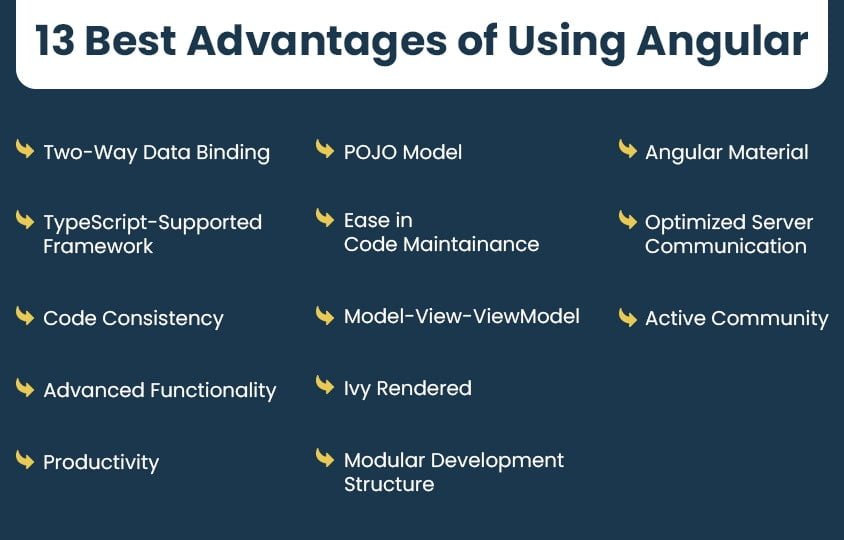






Angular Best Practices To Build Great Web Applications Projects

Developed and maintained by Google, Angular which is a complete rewrite of the AngularJS framework is designed explicitly for building dynamic programming structures.

The primary base or we can say that Angular’s main building blocks are modules, components, metadata, templates, data binding, services, directives, and dependency injection.

It typically comes up with a wide spectrum of other internal platforms for designing SPAs using leading technologies like HTML, CSS, and Typescript.

And as we know that TypeScript development services is a superscript of the JavaScript framework that is specifically used fordeveloping Angular apps.

By using Angular technology, we can create more compatible and robust UI applications. Because of these functionalities, Angular is still one of the most popular front-end frameworks in 2023.

To make it easy, we have come up with an article that demonstrates the angular best practices that every developer needs to adapt to build robust web applications.

Key Takeaways

  • You’ll come across various Angular best practices in 2023 that help you improve the efficiency, maintainability, and performance of Angular applications.
  • It covers topics such as lazy loading, Angular CLI, Angular Material, reactive forms, RxJS, AOT compilation, and error handling.
  • By following these best practices, developers can streamline their development process and create high-quality Angular applications.

16 Angular Best Practices That You Need To Follow

Angular is the best framework for developing feature-rich and robust web applications for your business needs. To know more about the AngularJS frameworks, read the post on what is Angular.

Now, let’s explore some of the Angular best practices that you need to follow in 2023 for designing and building robust web application development.

1. Use Angular CLI

Angular CLI (Angular Command Line Interface) is an end-to-end and robust tool that helps you with initialization, development, maintenance, test process, and even debug Angular applications.

The primary role of the Angular command line interface tool is to simplify the overall approach and fast-track schedules.

So, when using Angular CLI for your in-house Angular apps, you must know the essential functions of Angular CLI. So, if you want to install CLI using NPM packages, you must use npm install -g @angular/cli.

Now, let us explore some of the commands that help you deal with Angular CLI commands.

  • ng new: To create a new Angular app from scratch and can start a fully functional application right out of the box.
  • ng create:To use test shells for creating components, routes, services, and pipes with a single command.
  • ng serve: It is primarily used for an application developed locally and needs to be tested in the developing phase.
  • ng test:It runs end-to-end or local unit tests of the most common command.
  • ng lint: It plays a vital role in creating a code shine using its own lint rules.
  • ng add @angular/pwa: If you want to set up an Angular service worker.

With the help of Angular CLI, you find it easy to initiate the website development process, and is considered to be one of the easiest ways to understand the business logic, no matter, if some other developer has worked on it.

It will eventually reduce a lot of costs and boosts the time of developers.

Drive Your Business Growth With Angular Application

Our team of talented Angular developers are proficient in developing single-page applications as per your business requirements.

Contact Us

2. Use ES6 Functionality

The full form of ES6 is ECMAScript 6 which allows you to deal with new syntax and angular features to make code that is more modern and clear. ES6 is continuously modernized with new functionalities and features.

Often, there exist many ES6 features like Let and Const, Arrow Functions, and Object Literals string interpolation making JavaScript programming easier for you.

3. Maintaining Proper Angular Folder Structure

One of the most common Angular JS best practices is maintaining files and folder structure that make the work easier for you.

Let’s see angular folder structure best practices and how you need to name files and classes and how to organize the angular folder system in an Angular project.

  • File Naming

As a part of angular folder structure best practices, you must give special attention to the file name, especially during file creation. In addition, the file names must be consistent with the same pattern in which we mention the file’s feature module first and then the type, dot separated.

It means that you must use the same file name and same template file for your Angular app.

Some examples of file naming are home.component.ts or home.component.html file, or auth.service.ts. You can add more descriptive names to the existing environment files by using a dash(-) to separate the words in the name: menu-admin-user.component.ts.

Above all, the most important thing is that the file and folder names should convey their purpose.

  • Class Naming

The proper use of the upper camel case style with the added suffix typically represents your file type in the class names. Some examples are TcHomeComponent, and AuthService.

  • Folder Structure

Apart from the file name, maintaining the angular folder structure plays an essential role in Angular framework development. The best way to manage the folder system is depicted in the image shown below:
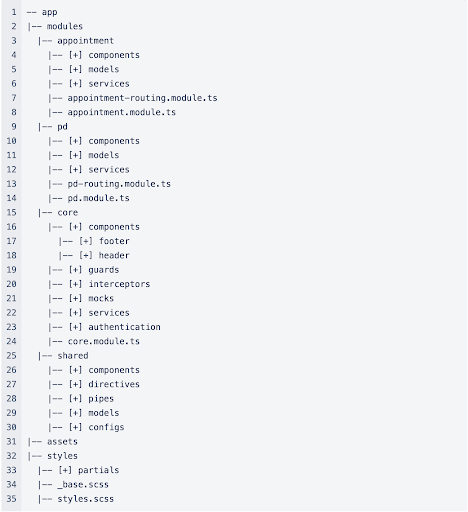
Folder Structure for Angular Best Practices

Related Post: What is Promise in Angular

4. Make a Habit of Using Lazy Loading

Lazy loading typically loads different modules like documents, JS, CSS, videos, images, etc. It is solely responsible for enhancing the application’s load time speed, and it is usually done by breaking it into multiple packets and loading them on request.

Instead of using other related functions to perform a lazy load of the feature modules, lazy loading can be helpful to you while your large application loads.

Lazy load processing will only take place when something is really used.

The Angular developers working in the best AngularJS development company utilize the lazy-loading function to loadChildren instead of loading the component level in the AppRoutingModule routes configuration using Angular router module.

Once your Angular application starts, a distinct app feature module can be lazy-loaded or loaded on demand. And is considered to be one of the Angular best practices in 2023 to follow.

Copy
const routes: Routes = [
  {
    path: 'profile',
    loadChildren: () => import('./modules/profile/profile.module').then(m => m.ProfileModule)
  }
];

5. Angular Coding Practices

One of the most common Angular best practices is that you must follow Angular code standards. This is one of the Angular services’ best practices that is an impressive way of programming web applications and mobile development.

In Angular applications, you can follow certain Angular coding structure, standards and styles to get the best user experience.

It becomes challenging for Angular developers to fix bugs and reflect on immediate issues, especially when dealing with complex code structures.

Let’s explore some angular code standards, as a part of Angular guidelines, need to follow to make web application development comply with the angular coding standards guide.

  • For every file, the code must not exceed 400 lines limit.
  • For every function, the code must not exceed 75 lines.
  • You may use the custom prefix to eliminate particular container element name collisions with other Angular apps’ parent and child components and native HTML elements.
  • Make a habit of using “const” if you find only the possible values of the environment variables, Angular app is intact.
  • Property name ,file name, and method name must be in lower camel case.
  • The best option is always to leave one empty line between imports and modules like third-party and application imports and third-party modules and custom modules.
  • As in some programming languages, we shouldn’t name our interfaces with the starting capital I letter.

We designed an online car-buying site that allows users to buy a new car with varied features like financing, and leasing, and even supports home delivery.

6. Using “trackBy” Along With ‘ngFor’

‘ngFor’ allows Angular developers to quickly re-render the whole DOM tree after making any significant changes in the array. It will eventually help Angular make DOM changes specific to defined array rather than re-rendering DOM.

Obviously, Angular re-renders is one such process that will take more loading process and typically take more time than utilizing ‘trackBy’.

If you are using ‘ngFor’ like:

Copy
<ul>
 <li *ngfor= "let item of collection;"> {{item.id}} </li>
</ul>

So, you make any change, the entire DOM elements tree will be automatically re-rendered.

Copy
@component
selector: 'my-angular-app',
template: '
<ul>
 <li *ngfor=let item of collection; trackBy: trackByFn"> {{item.id}} </li>
</ul>
<button (click)="getItems()"> Refresh Items </button>',
})
export class App {

constructor() {
   this.collection = [{id: 1}, {id: 2}, {id: 3}];
}

getItems() {
   this.collection = this.getItemsFromServer();
}

getItemsFromServer(){
   return [{id: 1}, {id: 2}, {id: 3}, {id:4}];
}
trackByfn(index, item) {
   return index;
}

7. Using Interfaces

Interfaces play an essential role, especially when they need to create a contract for class. Moreover, it helps you to create the class to implement functions and properties declared inside the interface.

One example is to have angular life cycle hooks in the component: class HomeComponent implements OnInit and OnDestroy in the Angular application.

With the use of interfaces, you can easily deal with object literals. If our object is an interface type, it is obligated to implement all of the interface’s properties.

8. Single Responsibility Principle

One of the standard Angular best practices that every developer needs to follow is not to create more than one component, service, or directive inside a single file.

As a part of the single responsibility principle, every file in an Angular application should be solely responsible for developing a single and separate functionality.

With the help of the single responsibility principle, we are keeping our files clean, readable, and maintainable.

9. Make a Habit of Using Safe Navigation Operator (?)

On the safer side, the developers must use the safe navigation operator to access a property directly from only one object in a component’s template.

For a null object, when you try to access a property, they will get an exception.

But if they make a habit to use the save navigation (?) operator, the template will ignore the null value and will access the property once the object is not null anymore.

Related Post: Resolver in Angular

10. Use OnPush change detection strategy

By using the OnPush change detection process, Angular will only check for changes when the input changes, rather than every time there is a change in the application.

Copy
// app.component.ts

@Component({
  selector: 'app-root',
  templateUrl: './app.component.html',
  changeDetection: ChangeDetectionStrategy.OnPush
})
export class AppComponent {
  @Input() items: Item[];
}

11. Prevent Memory Leaks in Angular Observable

Observable memory leaks are common in almost every programming language, framework, or Angular component libraries. And yes, Angular is no exception to that.

Observables play a vital role to prevent memory leaks and helps in designing and building an Angular project for every business need in the Angular applications.

It is solely capable to streamline the application data, but memory leak is one of the severe issues that might occur if you are not focused. It can create the worst situation in mid of development.

Related Post: Angular Promise vs Observable

Angular Best Practices That Developers Need to Follow To Avoid Leaks.

  • Using async pipe
  • Using take(1)
  • Using takeUntil()

Related Post: Angular Development Tools

12. Using index.ts

index.ts helps you to keep all related things together so that they don’t have to be bothered about the source file name. This helps reduce the size of the import statement.

For example, we have article/index.ts as

Copy
export * from './article.model';
export * from './article.config';
export {ArticleComponent} from './article.component';

You can easily import all such things directly using the source folder name.

Copy
import {Article, ArticleConfig} from '..article';

13. Build Reusable Components

If you need to use UI in many places in the Angular application, they need to build a component out of it and use the feature.

It will save you from a lot of trouble if there are some drastic changes in the UI. So, you need not change the UI code quality in all places. Instead, you can change the code in the component, and that is it.

For this, you may have to use property and event bindings to pass inputs to the reusable components as a part of Angular material best practices and receive output events from all the components, respectively.

We Have An Expertise in Front-End Development Services

Our front-end development team are always ready to provide top-notch web application development solutions for your daily business needs.
Contact Us

14. Using Immutability

Objects and arrays are the reference types in javascript. If we want to copy them into another object or an array and modify them, the best practice is to do that in an immutable way.

By upgrading such types immutably, we are preserving the original objects and arrays and modifying only their copies. The easiest way to modify objects and arrays immutably is by using the es6 spread operator (…):

Copy
this.user = {
  name: 'Mike',
  age: 35,
  address: 'Text Street 134'
}


let updatedUser = {
  ...this.user,
  name: 'Mark'
}

We are copying the user object and then just overriding the name property.
Let’s take a look at how to use the spread operator with arrays:

Copy
public results = [20, 22, 24];
let newNumbers = [...this.numbers, 55, 57];

Now if we remove or modify any of the numbers from the newNumbers array, the original array is going to be preserved with all of its values.

15. Implementing Lazy Loading

Implementing a lazy loading feature is strictly recommended for you, especially when dealing with multi-modular structure applications.

The good part of this approach is that they can quickly load resources on demand, not all at once. It will eventually help them in decreasing the startup time. Modules we are loading applications lazily as soon as a user navigates to their routes.

Related Post: jQuery vs Angular

Let’s show how to set up a lazy load in our module:

Copy
const appRoutes: Route[] = [
  { path: 'home', component: HomeComponent },
  { path: 'owner', loadChildren: "./owner/owner.module#OwnerModule" },
]

In this code file example, the HomeComponent loads eagerly but the OwnerModule and all the smart components registered in that core module file loads in a lazy manner.

16. Try Not to Use ngIf with complex expressions

Rather than using ngIf, one of the best Angular best practices that you must follow is adopting using ngSwitch for better performance.

Related Post: Explore latest Version of Angular 16

Conclusion

We’ve come across the Angular best practices in terms of Angular coding and other essential parameters that make the Angular application process smooth. The Angular project framework makes it easy for you to design and build web applications.

With this comprehensive, opinionated blog on the best practices, we have covered all the major aspects and best practices that can be used by businesses in their Angular development process and reap maximum benefits from it.

In addition, there’s always scope to improve and write code as per angular coding standards and build web and mobile apps. You can unlock the full potential of Angular with Albioirx comprehensive Angular development expertise, Let’s get started!!

What is Angular Ivy: Next-Generation Compilation and Rendering Pipeline

Since the launch of the Angular 9+ version, the performance of the Angular runtime is quite good but the loading time is longer because of the large file size which affects the overall performance of the application.

So the question arises in the mind: Is there any specific solution to get rid of it? Yes, Angular IVY is the one-stop solution that takes the responsibility to make your application faster and smaller.

But what exactly does this new technology do? Let’s start by understanding the basic definition of Angular Ivy.

What is Angular Ivy?

Angular Ivy is the next-generation rendering engine introduced by the Angular team to improve application performance, build times, and debugging capabilities.

It replaces the older View Engine and brings more flexibility, smaller bundle sizes, and faster loading for Angular applications.

With Ivy, Angular apps compile ahead of time (AOT) by default, which results in faster rendering and better runtime performance. It also enables tree-shaking, a process that removes unused code, making your app lighter and more efficient.

Developers also benefit from improved error messages and enhanced debugging, making it easier to maintain and scale applications.

As an experienced Angular development company, we’ve successfully migrated projects to Ivy and seen significant improvements in app performance and maintainability.

Our team understands how Ivy’s advanced architecture supports future-ready web applications.

Whether you’re building a dynamic single-page app or upgrading an existing Angular project, Ivy ensures your app runs faster and smoother.

Its modern framework reflects Angular’s ongoing commitment to performance, trust, and developer experience—exactly what businesses need for high-impact, scalable solutions.

Create a Feature-Packed Web Application Using Angular

We are dedicated to working closely with our clients to ensure that the project is completed on time, on budget, and meets or exceeds all expectations.


Contact Us

9 Essential Features of Angular Ivy

After having a look at the basic concept of Angular Ivy, it’s time to explore its features of Ivy Angular in detail.

1. Lazy-Loaded Components

Lazy-loaded components are parts of an application that are only loaded when needed, rather than during the initial load. This means your app starts faster because it only loads the most important content first.

With the help of Angular Ivy, developers can easily use lazy-loaded components without needing extra configuration like Angular modules. This simplifies the setup and helps reduce the size of the files that load when a user first opens the app.

When lazy loading is used correctly, it keeps the app light and responsive. For example, if a feature or page is not used right away, its code is skipped until the user actually clicks on it. This saves time and data.

Angular Ivy also supports dynamic rendering, so components can be loaded on the go—even without routing.

Tools like component render modules help connect the pieces needed for the component to work, and libraries used only by that component stay in the background until required.

2. Amendments to Differential Loading

Starting with Angular 9, differential loading changed. The build process now creates the modern ES2015+ bundle first. After that, it generates the older ES5 bundle separately.

This shift simplifies the build steps and improves loading for modern browsers, while still supporting older ones. It ensures faster performance without dropping backward compatibility.

3. AOT Compilation Everywhere

AOT is enabled in application builds, the development server, and tests by default. However, if we talk about AOT compilation, it works significantly slower than JIT compilation, so JIT plays an essential role in application development and testing.

By using AOT compilations, the developers have the freedom to quickly build and rebuild time improvement during the entire Angular application development.

Suppose the developer uses JIT compilation in some phases of the project application and only AOT compilation in the last build. In that case, the chances of having errors to be evoked during the project build or worse, specifically at runtime.

4. Bundle Sizes

With Angular Ivy, bundle sizes are handled more efficiently thanks to its tree-shakable instruction set. This means only the rendering code your application actually uses gets included, which helps reduce the final bundle size.

This is especially useful for developers building micro frontends, Angular Elements, or apps where Angular isn’t managing the whole page. In these cases, Ivy ensures you ship only what’s necessary.

Compared to the older View Engine, Ivy often leads to smaller bundle sizes—but the impact depends on your app. For smaller apps, the difference is significant.

For larger, complex apps, the main bundle might increase slightly, but lazy-loaded parts usually shrink.

Overall, Ivy improves performance by optimizing what’s delivered to the browser, making your Angular apps faster and more efficient.

5. Globalization

For locales like number formatting, date formatting, and other regional settings, the Angular developers usually perform dynamically loaded at runtime instead of having to be registered at compile time.


Copy

// main.ts 

import ‘@angular/localize/init’;

import { loadTranslations } from ‘@angular/localize’;

loadTranslations({

  ‘8374172394781134519’: ‘Good Morning, {$username}! You’re Welcome to {$appName}.’,

}

);

6. Compile-Time Inlining

Compile-time inlining in Angular simplifies how localization is handled during the build process. Starting from Angular 8, developers only need to compile the app once.

Instead of building separate bundles for each language, Angular replaces $localize placeholders with the actual translated text at build time.

By using the @angular/localize package, you can enable support for multiple languages easily.

The major advantage? If your app supports just one language, Angular automatically removes unused localization code from the bundle. This results in smaller, faster-loading apps without extra configuration.

Need help setting up Angular localization with this approach?

The excellent part about this feature is that the developers no longer have to include Angular’s localization code in the bundles if they only have a single language.

If we don’t use localized templates, the i18n* Ivy instructions are tree-shaked from the bundle.

Related Post:angular route resolver

7. Additional Provider Scopes

Compile-time inlining in Angular simplifies how localization is handled during the build process. Starting from Angular 8, developers only need to compile the app once.

Instead of building separate bundles for each language, Angular replaces  placeholders with the actual translated text at build time.

By using the @angular/localize package, you can enable support for multiple languages easily.

The major advantage? If your app supports just one language, Angular automatically removes unused localization code from the bundle. This results in smaller, faster-loading apps without extra configuration.

8. Improved Developer Experience

Ivy plays a vital role in improving the working experience of the Angular developers. It typically enables the Angular Language Service to support additional checks while developing. Till now, it is considered to be the biggest improvement to the developer experience.

File Path Checks

All the component stylesheets and template paths are regularly verified by the Angular Language Service to provide the best developer experience. The developers can efficiently design and build robust web applications using proper file path checks.

Template Type Checks

Templates are type-checked, meaning member names and types are usually verified, even in embedded views. As a result, the runtime errors are now detected easily while developing and building.

Moreover, it doesn’t seem to have added the same options as if we would set “strict”: true in the compilerOptions object. It becomes essential to compare the Angular workspace strict option with the TypeScript compiler strict option.

Strict Template Type Checking

Since Angular version 5, the developers have an option to enable template type checking s by setting “fullTemplateTypeCheck”: true in the angularCompilerOptions object.

Ivy comes up with strict template type checking. When this new Angular compiler option is set, the value offullTemplateTypeCheck is ignored.


Copy

{

  “//”: “tsconfig.json”,

  “angularCompilerOptions”: {

    “strictTemplates”: true

  }

}

The principle of strict template type checking is verifying the types of property bindings and respecting the strictNullChecks option. It also checks the types of template references to directives and components, including generic types.

Template context variables’ types are also being verified, which is excellent for NgFor loops. The $event type is checked for event bindings and animations. The type of native DOM elements is verified with strict template type checking.

9. Improved Styling Experience

Compile-time inlining in Angular Ivy improves how styles and localization are handled. With Ivy, developers can combine static HTML classes with Ngstyle and Ngclass seamlessly. This means better control and cleaner styling.

It also supports CSS Custom Properties with proper scoping to each component’s DOM. This helps keep styles modular, easier to maintain, and tailored to each component without affecting the whole app.

Top 6 Advantages of Using Angular Ivy Compiler

1. Smaller Apps

As compared to ViewEngine, Angular Ivy is much more efficient. For each component in Angular, the developers typically use less code to generate applications since the compiler removes the unused parts of Angular.

Moreover, it brings a significant impact on the web application size. For example, the difference in bundle size between Angular 9+ apps and post versions of Angular 9 apps is almost 40%.

It’s a big deal since the app size is one of the main drawbacks of Angular compared to other libraries like React and Vue. Also, the drop in bundle sizes improves the overall performance of the apps you build.

2. Efficient Testing

With the implementation of Ivy, the developers and users can quickly expect a 40-50% boost in test speeds of web applications. It is made possible with the help of TestBed, which has been completely revamped and is now much more efficient.

So the developers become free from recompiling all components during each test cycle. The primary role of TestBed in Ivy is to avoid recompilation between tests unless a component has been manually overridden.

3. Debugging Tools

Application debugging becomes much easier for developers. And it is made possible by utilizing Angular Ivy for application development.

For example, the developers use the new ng object for debugging while running an application in Development Mode. This will help the Angular developers gain access to instances of your components, directives, etc.

4. Enhanced Handling of Styles and Style Merging

The handling of styles has been dramatically improved in Ivy. Usually, if there were two competing definitions for a style, those styles would destructively replace each other. Now they are just merged predictably.

In Ivy, bindings do not depend on the timing of changes to these expressions; instead, there is a clear, consistent order of precedence, with the most specific style having the highest importance.

For example, a binding to [style.color] overrides a conflicting binding to [style].

5. Lazy Loading

Angular Ivy is solely responsible for any component to be lazy-loaded and dynamically rendered. Components can be lazy-loaded and rendered without Angular modules or routing.

Moreover, the libraries that are utilized by a lazy-loaded component are bundled into lazy-loaded chunks.

6. AOT Compilation

The AOT Compiler has seen a great deal of improvement because of Ivy’s new architecture. Till Angular 8, JIT compilation was preferred the preferred compiler since AOT was too slow.

Now in Ivy AOT is the default compiler thanks to the huge improvements in build and rebuild times.

We designed an online car-buying site that allows users to buy a new car with varied features like financing, and leasing, and even supports home delivery.


View Our Work

How To Enable Angular Ivy?

Ivy can be enabled in an existing project with the latest Angular version but also directly scaffold a project with Ivy.

Enable Ivy in an existing project

Having an existing Angular project run:

Copy

$ ng update @angular/cli@next @angular/core@next 

Both the Angular core and the CLI will be updated at the latest release candidate. One interesting thing to notice is the “aot”: true in the angular.json workspace configuration file:

AOT compilation with Ivy is faster and should be used by default.

Then add the angular compiler options in the tsconfig.app.json:

Copy

{

   “compilerOptions”: { … },

  “angularCompilerOptions”: {

    “enableIvy”: true

  }

}

Generating new project with Ivy
To start a new project with Ivy run:

Copy

$ new my-angular-app –enable-ivy

How To Disable Angular Ivy?

To disable Ivy:
In angular.json set “aot”: false;
in tsconfig.app.json remove the angularCompilerOptions option or set “enableIvy”: false.

Drive Your Business Growth With Single Page Application

As a prominent AngularJS development company, Albiorix possesses strong expertise in building single-page applications for small, medium, and large-scale businesses.


Contact Us

Conclusion

I hope you got a clear idea of the concept of what is Ivy in Angular and how Ivy Angular help your build robust web applications for your business needs.

Angular’s future is entirely dependent on IVY that comes up with incredible features that Angular with every new version. In Angular 11+, Ivy completely takes over the compiler (Ivy Angular compatibility compiler) and provides a stronger core structure than ever.

Ivy is a very important stepping stone in Angular history.

It changes how the framework internally works, without changing Angular web app development and it also sets the ground for Angular Elements to become much more popular in our Angular applications.

Next JS vs React: Better Ways to Choose a Framework for Front-End Development

What is the most essential factor that can effectively enhance the developer’s experience? Of course, selecting the right library or framework for the project is the ultimate parameter.

And if we talk about the developer experience, we simply redirect to the factors that easily emphasise the developer’s convenience.

The primary focus of the developers is to make a selection of easy-to-use and convenient frameworks. So, it becomes essential to search for the best and leading framework to make web app development easily.

Many developers or individuals struggle to figure out the difference between Next JS vs React. They generally find a lot of confusion while choosing the right technology stack for their project.

Therefore, on a regular basis, we come up with comparison information on NextJS Vs React and review them in detail from time to time in our blog posts.

Key Takeaways

  • Next.js is a framework built on top of React, while React is a JavaScript library used for building user interfaces.
  • Next.js provides many features out-of-the-box, such as server-side rendering, automatic code splitting, and optimized performance, while React only provides the basic building blocks for building a UI.
  • Next.js is great for building static or dynamic websites, while React is best suited for building web applications that require a lot of interactivity.
  • Next.js is easier to set up and get started with, especially for beginners, while React requires more configuration and setup.
  • Next.js has a steeper learning curve for more advanced features, while React has a more gradual learning curve and is easier to understand and use.
  • Choosing between Next.js and React depends on the specific needs of your project, such as the level of interactivity, the need for server-side rendering, and the complexity of the application.

What is Next JS?

Before we start to understand the basic difference between React Vs NextJS, we need to get through the basic definition of NextJS and React.

Next JS is an open-source JavaScript framework that allows you to quickly build a fast and user-friendly web application development for your business needs. Moreover, it is also responsible for developing static websites using React. Vercel is the creator of Next JS.

Typically based on Node.js and Babel, Next JS easily integrates with React to design and build robust Single Page Applications.

This makes the server-side convenient and more for your web development needs. Many developers working with the best ReactJS development company typically use Next JS for building static websites.

With its active support of React babel and webpack, Next JS usually provides a feature-packed solution for server-side rendering (SSR) of React components.

Next.js is an open-source JavaScript framework that allows developers to create dynamic and static web applications and websites using robust reusable components.

Furthermore, Next.js provides many features, such as static export, preview mode, pre-rendering, faster compilation, virtual DOM, and automatic building size optimization.

In my view, the existing Next.js version is something React has been missing for quite a long time and it plays an essential role in designing and building complex web apps for your business needs.

Next JS is equipped with features that make it easy for the developers to create an application. Furthermore, the documentation is excellent, becoming increasingly popular among developers for front-end development services.

Next.js is a popular framework, but that doesn’t mean you should always use it.

Where You can use Next JS?

  • Developing blocks to develop web applications
  • Designing and Developing UI
  • Website Development
  • Landing Pages Creation

Looking For a Reliable Next.js Development Company?

Look no further! Contact us today to discuss your project.

Contact Us Now!

Advantages and Disadvantages of Next JS

After having a look at the concept of what is NextJS, we’ll focus on the NextJS vs React article about the advantages and disadvantages of Next JS.

Advantages of Next JS

1. Quicker Development

Next.js is an open-source Javascript framework that comes up with various built-in Next JS components, libraries, and compatibility, which in turn, allows the developers to develop MVP within short intervals.

This helps you get a quick user review or feedback and make proper changes using the virtual DOM feature without wasting any time.

2. Easy To Code

With the help of Next JS, the developers can easily deal with web app development.

As Next JS is totally dependent on JavaScript, the developers can efficiently enhance the performance optimization features of web applications by creating dynamic applications using less code and a familiar language.

3. Enhanced User Experience

Next.js makes you stop being limited to plugins, templates, themes and other restrictions forced by developing web applications for almost all business needs.

This platform is a boon for JavaScript developers, making it easy for them to develop front-end applications as per your requirements that align with your business goals.

4. Large Community

For Next JS, you’ll come across different learning and production resources made available by a stronger user community.

Such Next.js community help developers to chat about Next.js, ask questions, show off their projects, and find Next.js jobs

5. SEO-Friendly

As we know, Next.js is a JS framework that helps developers build faster and lighter static websites, which in turn, the application automatically become SEO-friendly.

Therefore, it’s a higher chance to rank your website and landing pages on the first static pages of search engines.

6. Super Fast Rendering

You will be able to see every change you make by reloading the website. The component creation is rendered in real-time, making it easy to keep track of changes as they occur.

7. Built-in CSS

You can import CSS styles from a JavaScript file into Next.js for faster automatic server rendering.

The easiest way for the developers to write CSS in a Next.js application is through its global stylesheet using its built-in CSS support.

Every newly created Next.js project comes with a styles folder and inside it, a global.css stylesheet.

8. Image Optimization

With the help of the Next.js framework, the developers can easily scale-up images by using the best format – WebP using the image optimization feature.

The Next.js Image component, “next/image”, is nothing but an extension of the HTML element, designed explicitly for modern web development.

These scores are an important measurement of user experience on your website and are factored into Google’s search rankings.

9. ESLint Support

EsLint is one of the best analytic tools that help developers quickly identify problems and error patterns.

And Next.js is one such best backend frameworks that makes it easy for the developers to easily use ESLint with “scripts”: { “lint”: “next lint”}. Moreover, Next.js ESlint help find errors like image, anchor, CSS, etc.

Disadvantages of Next.JS

1. Few Usage Options

Next.js is a framework that is limited to using only a file router. It means that the developers are not allowed to perform any modifications or cannot change the way it works with API routes.

In addition, the developers can also make use of the Node.js server to use dynamic API routes.

2. No Router Flexibility

React framework does not come up with the facility that allows the developers to utilize a router other than its own populated one (or perhaps add Redux).

In simple words, we can say that React framework’s dynamic routing is not flexible as compared with other frameworks.

3. Cost of Flexibility

Next JS is one such framework that does not provide many built-in front pages. So, the developers need to create pages or applications from scratch by strictly following the front-end layer lifecycle.

4. Development and Management

To create an eCommerce platform by using the Next.JS framework, you are not required to have a team of in-house developers. Instead, you will need a dedicated person to handle the development and management afterwards.

5. Lack of Built-in State Manager

With the help of the Next.js framework, if the developers make use of state management patterns, they also need to use Redux, MobX or something like that.

6. Low on Plug-ins

As compared to other leading Javascript frameworks like Gatsby.js, it is not possible to make use of other easy-to-adapt plugins.

By having a look at the basic details of what is NextJS, we’ll analyze the basic concept of ReactJs in to understand the major difference between NextJS vs React.

What is ReactJS?

Jordan Walke is the creator of ReactJS. The first deployment of React was done on Facebook’s newsfeed in the year 2011 and then in 2012 on Instagram.

ReactJS is an open-source Javascript library used explicitly to build robust and interactive user interfaces for SPAs (Single Page Applications). React is a client-side JavaScript library, which means it runs on the client/user’s machine in the browser instead of on a server.

ReactJS is an open-source library used explicitly for building robust user interfaces for SPAs (Single Page Applications). React is a client-side JavaScript library, which means it runs on the client/user’s machine in the browser as opposed to running on a server.

React makes it easy for developers to create web apps that can change or synchronise your data without reloading the page.

The primary purpose of React is that it can be used to create components that can efficiently handle the view layer for web and mobile apps.

It comes with various React features like server-side rendering that allows ReactJS developers to create reusable UI components.

What is React Used For?

  • Building an Interactive User Interfaces
  • Developing Social Networking sites
  • Development of Single Page Applications(SPAs)
  • Native App Development
  • Big Brands Use it: New York Times, Meta, Netflix, SalesForce SoundCloud and WhatsApp Web

Advantages and Disadvantages of React

Let’s explore the advantages and disadvantages of React that will help you know the real difference between Next JS vs React.

Advantages of React

1. Easy-To-Learn and Use

It comes with good React docs, tutorials, and training resources to create React project. Any React developer with JavaScript experience can easily understand and start building web applications using React in a few days.

2. Building Dynamic Web Applications Just Got Easier

Building a dynamic web app specifically using HTML strings was tricky because it required complex coding process, but React solved that problem and made it easier. In short, the development of React application is much easier than Next JS.

3. Reusable Components

React consists of multiple components, each with its own logic and controls. These React components are responsible for rendering a small, reusable piece of HTML that can be reused wherever needed.

All such reusable components help you build robust web application development smoothly with the help of server-side rendering features.

Related Post: Best React UI Frameworks

4. Increased Productivity

React improves performance through the virtual DOM. React is the framework that helps both businesses and React developers enhance their productivity by developing robust web applications.

5. Support for Convenient Tools

React has also gained popularity due to its handy set of visualization tools. These tools make the developer’s task clear and simple.

The primary aim of React development is to design and build scalable web applications using server-side rendering functionality for all business needs.

6. Optimized for SEO

Traditional JavaScript frameworks have an SEO problem. Search engines usually have trouble reading JS-heavy applications.

Many web developers have criticized this problem. React solves this task by helping developers navigate various search engines with ease.

This is because React apps can run on the server and the virtual DOM will render and return to the browser just like a normal web page.

Build Feature-rich and Robust Web and Mobile Apps

Albiorix have a team of top-notch developers that are always ready to build client-centric solutions.

Get Started!

Disadvantages of React

1. High rates of the development process.

High growth rates have a constantly changing landscape. In the event of the inconvenience that the development environment is constantly changing so quickly, some developers do not feel comfortable regularly re-learning new ways of working.

It can be difficult for them to accept all these changes with all continuous updates. They need to constantly update their skills and learn new ways of doing business.

2. Too frequently updated documentation

This is another disadvantage of constantly updated technologies. React technologies are updated and accelerated so quickly that there is no time to create proper documentation.

To overcome this, developers write instructions themselves as new releases and tools become available in their current software project development needs.

3. View Part

React only covers the app’s complex UI layers and nothing else. Therefore, you still need to choose other technologies to get a complete set of development tools for your project.

4. Development Pace

React JS is constantly evolving and changing. The pace at which React is developed can be seen as an advantage or a disadvantage depending on who you are.

The developers who see these ongoing changes as an advantage would argue that React is constantly being improved and making their jobs easier.

The React JS developers who see the pace of the development environment as a disadvantage would argue that they have to constantly relearn how to work with React JS, which is difficult to keep up with.

It should be noted, though, that React’s core API routes have gotten a lot more stable in recent years. Most updates today affect the library and new features like virtual DOM, server-side rendering.

5. Lack of Documentation

This drawback is tied to people’s concern with the pace of React’s development process. As a result of rapid development, educational documentation and resources can be sparse in covering the latest updates and changes.

Due to the number of updates and new releases, there’s simply not enough time for writing complete documentation.

Since ReactJS is an open-source framework, developers are able to create their own offline support documents, but since anyone can create these resources, you could come across poor resources that offer little help.

6. Non-Vigilant Focus on User Interface

React contains a myriad of tools used to develop and create user interfaces. However, unlike frameworks, React JS is not an ‘all-in-one tool’ for the app development process.

Therefore, if you happen to use a model-view-controller (MVC), React development is only responsible for the UI. The developers have to create the model and controller part by using other tools.

For building user interfaces, you will have to apply more tools that will cover other crucial parts like the backend and data storage.

You will need additional tools for app programming interfaces (APIs), dynamic routing, and other parts as well.

Related Post: NativeScript vs React Native

7. JSX as a Barrier

In simple terms, JSX is a JavaScript extension that can make the code more readable and clean. While the JSX syntax extension makes things easier for some developers, other web developers and designers find the JSX code too complex and challenging to grasp.

JSX doesn’t negatively impact the performance or User Interface capabilities of ReactJS. This con is more of a preference than anything else.

8. Incomplete Tooling Set

Businesses should understand that the horizon of React only covers the UI layer of the application. Other than this, everything related to the web development project is out of its periphery.

Thus, even after implementing React web app development, the developers still need to choose a framework to build fast, beautiful, and compatible UI.

Since the entire tooling set is not available only with React, the developers will face difficulties completing the project.

Related Post: Vue vs React

Next JS VS React: The Comparison Table

Now, let’s compare NextJS Vs React by considering various essential parameters.

Next JSReact
Next is a framework for react which is built upon react library.React is a library, not a framework.
Next is famous for Server-side rendering and static generation of websites.React on the other side support client-side rendering.
Next can be difficult for someone to learn without prior ReactJS knowledge.React can be easier to learn as compared to NextJS.
The web apps built using NextJS are very fast.The web apps built using ReactJS are slow as compared to NextJS.
Next doesn’t require offline support.React requires offline support.
With NextJS, we can build an entire web application.React helps in building the beautiful UI of a web application.x
The cost of developing an app using NextJS is low.The cost of developing an app using ReactJS is also low.
In NextJS public folder, there is no index.html file as an HTML file will be made in Nextjs according to the type of need.In Reactjs single HTML file, index.html is present in a public folder that manages the whole React app using a single JS file.

Conclusion

Next Vs React: which is the best one? That’s a great question, but it’s not right! Using a framework for building web apps depends on your requirements, cost, and other development requirements.

Both React and Next.js are great technology providing you with the best development experience.

Using Next.js provides you with the best server-side rendering (SSR) and static site development experience and also lets you manage your web applications easily with many tools.

So, if we compare React and Next.JS, React can be a great framework for building single-page apps like UI, etc moreover React is more versatile as it is a Javascript library, not a framework.

What is Promise in Angular Development?

A Promise in Angular is a way to handle asynchronous operations, like fetching data from a server or processing user actions, without getting stuck in callback hell. It represents a task that will either complete successfully (resolve) or fail (reject) in the future.

Before Promises, developers used nested callback functions to manage async tasks, which made code hard to read and maintain. With ES6, JavaScript Promises were introduced to simplify this.

In Angular, Promises help manage asynchronous workflows more cleanly, making apps faster and easier to debug. They allow developers to write code that reads like a sequence of steps, improving clarity and maintainability.

By using Promises, Angular developers can build responsive, smooth user experiences while keeping the codebase simple and organized.

What is Promise in JavaScript?

A promise is a JavaScript or TypeScript object that may produce a value at some point in time. A promise may be in one of 4 possible states:

  • fulfilled – The action relating to the promise succeeded
  • rejected – The action relating to the promise failed just because an error occurs during promise implementation
  • pending – It’s an initial state that hasn’t fulfilled or rejected yet
  • settled – Has fulfilled or rejected

Get Custom-Tailored Web App Development Solutions For Your Business Needs

We strictly adhere to the standard software development lifecycle to provide the best possible IT solutions for your business success.


Contact Us

How To Create a Promise in JavaScript?

Let’s highlight a simple example of creating a promise in plain JavaScript.

Copy
var promise = new Promise((resolve, reject) => {
  resolve("Promise Resolved"); 
})

promise.then((success) => { 
  console.log(success);
})
.catch(function(error) => {
  console.log(error);
}); 
// Output: Promise Resolved

The developers from the leading AngularJS development company implements Promises by calling the then() and catch() methods.

  • then() method: It takes two callback functions as parameters and is invoked when a promise is either resolved or rejected.
  • catch() method: It takes one callback function and is invoked when an error occurs.

Now, let us understand the basic concept of “what is Promise in Angular?”

Related Post: Angular Resolver

What is Promise in Angular?

When the AngularJS developers are dealing with asynchronous operations like an HTTP request, they are not sure of the exact time to get a response from the server. By default, Javascript is a programming language that is

  • Synchronous;
  • Blocking; and
  • Single-threaded language.

In simple words, we can say that the Javascript engine can process only one code at a time in a single thread. So, when a thread is blocked, we can’t execute other code that is also blocked, making JS slow and unable to perform multiple operations.

On the other hand, the asynchronous operation is solely responsible for making code nonblocking. It means that it allows the developers to execute multiple codes at the same time.

In the Angular framework, the developers can quickly achieve asynchronous by utilising the following method.

  • The Callback function
  • The Promise from Javascript can be used in Angular.
  • Observable using Rxjs library in Angular: Library for reactive programming using Observables.

You may also like to read: What is Angular?

Moreover, while dealing with an asynchronous operation, the developers can quickly move the code to the following line by allowing UI remains responsive.

The user continues working on the application while asynchronous operations like HTTP requests are processed in the background.

Now the concept of Promise in Angular comes into the picture.

The Promise in Javascript is nothing but a piece of task that is wrapped in asynchronous operation and notified whenever the asynchronous process is completed or failed at some point in the future.

Two possible outcomes occur when the developer runs the Promise: The Promise is completed or failed.

With the help of the async and await keyword with Promise, it becomes easy for the developers to deal with easy to read, write, and we can also use “try and catch” for error handling with (async & await).

Planning To Develop a Robust Single-Page Application?

Albiorix is a leading AngularJS Development Company having core expertise in designing and building feature-rich applications for all your business needs.


Contact Us

Angular Promise Example

Its time to see how to use promises in Angular development First, we will create a simple Angular application using Angular CLI.

ng new angular-promise-example –routing=false –style=css

This command will create a new Angular application with no routing and CSS for stylesheet format. Next, we will set up HttpClient to send API requests to web servers to create or fetch data.

Fetching data is a standard asynchronous operation as you always have to wait for an amount of time to receive the requested data. In Angular development, you can use HttpClient for fetching data.

HttpClient uses RxJS Observables to handle asynchronous operations; let’s see how to use JavaScript/ES6 Promises instead.

In the app/app.module.ts file of your project, add the following changes:

Copy
import { NgModule } from '@angular/core';
import { BrowserModule } from '@angular/platform-browser';
import { FormsModule } from '@angular/forms';
import { HttpClientModule }  from '@angular/common/http';

import { AppComponent } from './app.component';
import { HelloComponent } from './hello.component';

@NgModule({
  imports:      [ BrowserModule, FormsModule, HttpClientModule ],
  declarations: [ AppComponent, HelloComponent ],
  bootstrap:    [ AppComponent ]
})
export class AppModule { }

Next, open the src/app/app.component.ts file and add the following code to send a HTTP GET request and process the response using a Promise in Angular.

Copy
import { Component } from "@angular/core";
import { HttpClient } from "@angular/common/http";@Component({
selector: "app-root",
templateUrl: "./app.component.html",
styleUrls: ["./app.component.css"]
})
export class AppComponent {
title = "Angular Application and Promises Example";API_KEY = "e40d07f00b094602953cc3bf8537477e";

constructor(private httpClient: HttpClient) {}

ngOnInit() {
console.log("Angular Promises");
this.fetchDataAsPromise()
.then((data) => {
console.log(JSON.stringify(data));
})
.catch((error) => {
console.log("Promise rejected with " + JSON.stringify(error));
});
}

fetchDataAsPromise() {
return this.httpClient
.get(
`https://newsapi.org/v2/top-headlines?sources=techcrunch&apiKey=${this.API_KEY}`
)
.toPromise();
}
}

We import HttpClient and inject it via the component constructor and use it to send the HTTP request.

Next, we call the get() method to send the request and the toPromise() method to convert the returned RxJS Observable to a promise.

Copy
fetchDataAsPromise() {
return this.httpClient
.get(
`https://newsapi.org/v2/top-headlines?sources=techcrunch&apiKey=${this.API_KEY}`
)
.toPromise();
}

In the ngOnInit() life-cycle method, we send the actual request by calling the then() method of the promise as follows:

Copy
this.fetchDataAsPromise()
.then((data) => {
console.log(JSON.stringify(data));
})
.catch((error) => {
console.log("Promise rejected with " + JSON.stringify(error));
});

If the promise is resolved successfully we simply output the data in the console and in case of an error we display the error.

Related Post: Angular Promise Vs Observable

Why Use Promises in Angular Instead of Callbacks?

In Angular development, Promises are preferred over traditional callbacks because they provide a clearer and more manageable way to handle asynchronous operations.

Unlike callbacks, which can become deeply nested and hard to follow (known as “callback hell”), Promises allow developers to chain .then( ) and .Catch( ) methods, making code cleaner and easier to maintain.

Promises also offer better error handling. With callbacks, error handling logic often gets duplicated or missed. Promises centralize this by allowing a single .Catch( ) block to handle any error in the chain.

This makes Angular applications more reliable and easier to debug, especially when dealing with HTTP requests, data fetching, or other time-consuming operations.

Common Use Cases of Promises in Angular Development

Here are some real-world examples where Angular developers commonly use Promises:

  • Fetching API data (e.g., user profiles, product listings)
  • Form submission handling with server response
  • Authenticating users with login/logout operations
  • Uploading files and waiting for completion status
  • Executing dependent asynchronous tasks in a sequence

Using Promises ensures these tasks are handled smoothly, without blocking the UI, and gives users a faster, more responsive experience.

Conclusion

So, I hope you got a clear vision on what is Promise in Angular development is. In addition, we came across the concept of JavaScript Promises introduced in ES6.

We have seen the implementation of JavaScript promises that can be specifically included in the application.

In addition, we came across the example of creating a promise in the Angular application.

Still, if you have any query related to web application development, Angular is the best and leading option that help you build applications for all business verticals.

9 Great Example Of Websites Built With Angular Framework

Angular is one of the most popular web frameworks compared to other popular JavaScript frameworks. It is a full-fledged package for frontend development, with excellent MVC architecture implementation, directives, two-way data flow and dependency injection.

But the main question arises here: Who uses Angular? With its rich features, Angular has been adopted by many leading companies globally. To make it easy, we have presented a list of the most popular websites built with angular framework.

You’ll see the technical aspects and the reasons for these websites using Angular as their priority. But first, a brief introduction to Angular and why so many businesses gravitate towards it for their frontend needs.

What is Angular Framework?

Developed and maintained by Google, Angular is an open-source JavaScript framework that plays an essential role in the front-end development of dynamic web pages.

The first version is AngularJS but experienced massive redesigning, and a new version, Angular 2+ or Angular, was available in 2016.

Angular is a leading front-end framework for developers wanting to create a user-driven web application. Angular websites are responsive, feature-rich and easy to navigate.

You can even consult the best Angular development company to build a web application from scratch.

Website development is made easy with the functionalities offered by Angular. Some of the technical angular features that help the developers to quickly build dynamic web applications include:

  • MVC architecture
  • HTML templates
  • Bidirectional data flow
  • Extendible template language

If you want to know more about the Angular framework, do not forget to read the article of what is Angular.

Build Your Business Application Using Angular Framework

Our AngularJS development team are always ready to provide the best web solutions by strictly following the Angular best practices.

Contact us today!

9 Best Websites Using Angular Framework

Now let’s highlight the list of angular website examples

1. Google

Google Made With Angular

Google is a popular website built with Angular framework. Google typically uses the AngularJS frameworks to develop many parent products.

However, the incredible user-friendly nature and high performance are unknown worldwide. Popularly known as one of the global search engines, Google is also well-known for many other defined products like:

  • Google Play Store
  • Google Voice app
  • G Suite homepage
  • Google Open Source
  • Google Play Books
  • Google Arts and Culture

Apart from this websites that use angular, the Google.org website is one of the super Angular website examples. It uses technology for humanitarian movements and is an exceptional example of Angular’s powers.

However, one can always look at the whole list from other sources. They all are characterized by smooth transitions, providing a holistic product user experience.

2. UpWork

Upwork Made With Angular

UpWork is a popular online freelancing platform that helps businesses connect with skilled professionals across the world. It allows companies to post projects, review freelancer profiles, conduct interviews, and manage payments—all in one place.

Whether you need help with writing, web development, design, or marketing, UpWork offers access to a wide pool of talent.

Freelancers create detailed profiles showcasing their skills and experience, while businesses can choose the right person for the job based on reviews, ratings, and work history. It’s a secure, flexible way to hire and work remotely.

The web application of UpWork uses Angular to offer features such as

  • In-app calling
  • payment gateways
  • Testing

With a thriving community of over 18 million users and 5 million registered clients, angular website is the robust high performing solution that companies like UpWork need.

3. Gmail

Gmail Made With Angular

Gmail is a widely used free email service developed by Google. As of 2021, it has over 4.1 billion users globally, making it one of the most trusted platforms for personal and professional communication.

Gmail offers a simple, single-page interface that allows users to read, send, and manage emails efficiently. It runs smoothly even under high traffic because it uses the Angular framework, which helps in loading and rendering data quickly.

The front-end design ensures that users can access new messages without reloading the page, making email management fast and reliable for daily use.

4. Deutsche Bank

Deutsche Bank Made With Angular

Deutsche Bank is one of the top banks in the world, having a distinct presence in more than 58 countries. The front-end development of the world-renowned Deutsche Bank is done by Angular development.

It typically uses the Angular 10+ version to develop the developer portal’s first page.

The AngularJS developer has its own Deutsche Bank API program feature that acts as a passage for several associations worldwide to strengthen the transaction system of Deutsche Bank in their web application development.

With the help of the Angular framework, the enormous amount and degrees of transaction and traffic are easily managed.

The primary goal of many organizations is to gain this level of functionality coupled with the right amount of usability and ease for the user.

Related Post: Angular Best Practices

5. Paypal

Paypal Made With Angular

PayPal is an American multinational finance company, and everyone knows this leading organization. PayPal is a web-based money transfer company having more than 305 million active client accounts.

The regular users supporting online money transfers are familiar with the credibility and trustworthiness of the Paypal company. And the excellent part of Paypal is that there are about 305 million active users globally and still counting.

To enable high security and seamless transactions while transferring money, Paypal is made with Angular 10+, making the website robust, simple & straightforward.

Moreover, it is perfect enough to deal with high loads. In addition, Angular 10+ allows PayPal to support constant feeds of transaction data.

We Help You Build Single-Page Applications for Business

Albiorix is a top-rated Angular development company who strive to provide the best optimum web app solutions.

Contact us today!

6. Freelancer

Freelancer Made With Angular

Freelancer is an Australia-based platform that connects businesses with freelancers across the globe. With clients in over 247 domains, it allows individuals to find remote work opportunities and employers to hire skilled professionals for various projects.

The platform supports collaboration between clients and freelancers, helping them complete jobs efficiently online. Due to its large user base, Freelancer emphasizes a responsive and easy-to-use interface.

To handle this demand, the company uses Angular 8+ to build a smooth and reliable website. This ensures users enjoy consistent performance and a seamless experience while browsing or managing projects.

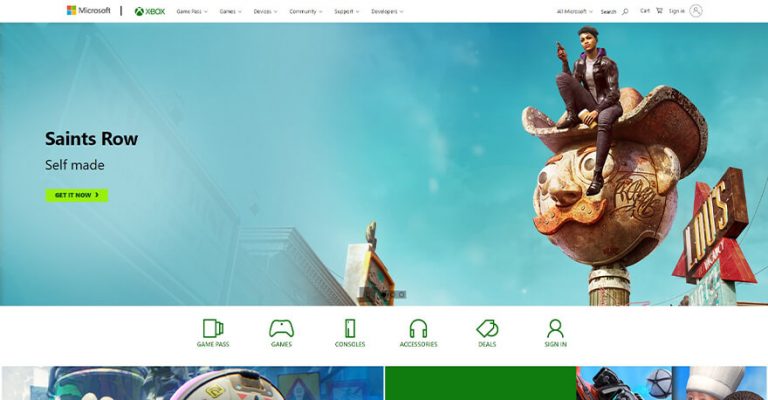
7. Microsoft Xbox

Microsoft Made With Angular

Microsoft Xbox is a video gaming brand that provides a holistic gaming experience with several aspects of gaming and other considerations.

This gaming platform is very engaging and attractive for users, especially youngsters. The good part of this platform is that the users can quickly navigate through the website without much ado.

With the help of Angular technology, Microsoft has designed its product and services, and one of them is Xbox. Mircosoft Xbox is also built with Angular, making it attractive, smooth, and robust.

The angular framework is solely responsible for its smooth navigation and making it easy for the users to handle massive traffic. Moreover, Angular quickly maintain a beneficial and responsive experience for active users.

Apart from Microsoft Xbox, Microsoft has some leading websites that use Angular and they are

  • Microsoft homepage
  • Microsoft Azure
  • Microsoft Flow
  • TimeFind

Microsoft support page

8. WikiWand

Wikiwand Made With Angular

Wikipedia is the platform that every internet user acknowledges. So yes, the design structure is somewhat complex and feels basic sometimes. WikiWand provides a modern touch to Wikipedia pages to overcome such challenging factors.

WikiWand modernizes the wiki’s boring design structure, adding a new menu, dashboard, and other navigational features to enrich the user experience. In addition, this platform acts as a wrapper design over Wikipedia.

With the help of Angular technology, WikiWand has adopted an entirely new design structure. Along with the design structure, the platform extends the functionality of Wikipedia pages.

As a result, it is now more readable and easy to navigate and offers a seamless user experience.

9. Forbes

Forbes Made With Angular

Forbes began as an American business magazine and has evolved into a major online platform for news, business insights, and market trends. It publishes articles that cover finance, innovation, entrepreneurship, and leadership, attracting a global audience.

To handle its high traffic and deliver a smooth reading experience, Forbes uses Angular 9+ along with technologies like Core-JS, BackboneJS, and LightJS. These tools help ensure fast page loads and responsive performance.

The platform is also known for its bi-weekly magazine, which continues to reflect important shifts in global business and economics.

These are the popular Angular websites that have attracted millions of daily users with interactive UI/UX and expert services.

About 108 million global visitors gain satisfactory user experience on this website. So, these are the top companies using Angular for their business applications and enhance their business website productivity on a large scale.

If you want to start your web project like these best Angular websites, it is really important to know why they are developing websites using Angular

Why Angular For Website Development?

AngularJS is a Complete Frontend Package

In comparison to other JS frameworks AngularJS framework is an essential part of the MEAN stack the free and open-source JavaScript software stack.

MEAN stack ( Free and open-source JavaScript software stack)

  • MongoDB
  • Express.JS
  • Angular
  • Node.JS

Two-way Data Binding

Once the Angular developers make any changes to the View, the data automatically gets updated and vice versa. With the help of two-way data binding in the Angular website, it is easier to maintain consistency among all other layers

MVC Architecture

In the Model-View-Controller architecture, the application is divided into three components: the model, the view, and the controller. This architecture allows for separating concerns, making it easier to maintain and modify the application.

Directives

With the help of directives, Angular developers can extend the functionality of HTML components, it also controls DOM (Document Object Model) trees and component libraries with all of this, the website page speed and performance enhance at an extensive level and provide a smooth user experience to end users.

Faster Development

AngularJs With its data-binding approach and simplified MVC, the Angular framework is the perfect choice for web development. Moreover, it is responsible for enhancing the web app development speed.

Inbuilt CLI

AngularJS is framed with an inbuilt command-line interface (CLI), making it easy for Angular developers to initialize new web devlopmnet projects.

Conclusion

So far, we have highlighted the most popular websites hitting the market, that websites built with angular framework.

So, if anyone asks me which are angular website examples?, then my answer goes to view the article that mentions the list of leading angular websites built using the Angular framework.

Angular is one such framework equipped with many features that satisfy all web application development requirements, and you can create well-functioning AngularJS apps.

Contact Albiorix Technology to develop the right web solution for your company. Our team of hire AngularJS developers can provide expert guidance throughout the web app development process if you require assistance.

Apple Event 2022: Apple Announcement of ‘Far Out’ With Event Rumours [iPhone 14, Apple Watch Series 8]

September 7 is the big day when every user is actively waiting for the Apple event, as made official by an invitation Apple sent out announcing a “Far Out”-titled event.

Apple today announced that it would hold a special event at the Steve Jobs Theater on the Apple Park campus in Cupertino, California. In addition, there will be an in-person component with media members invited to Apple’s campus.

What are the Expectations of this great “Far-Out” Event?

The iPhone 14 and iPhone 14 Pro are the most anticipated announcement, while the Apple Watch 8 and AirPods Pro 2 are other possible product launches happening sooner rather than later.

The event will be full of an outer-space vibe, with cosmic stars creating a silhouette of the Apple logo. Like past Apple events, this one will have a theme — Far Out. What does this mean? That remains to be seen.

This means pre-orders for the products unveiled at the event are around the corner. Check out our iPhone 14 pre-order guide, which assumes you’ll be able to pre-order at least one of the new phones starting September 9.

Launching of iPhone 14

Launching of iPhone 14 at Apple Event 2022
(Image credit: Apple)

Apple’s “Far Out” September event is expected to be focused on The iPhone 14 series. However, iPhone users are expecting to get introduced to the latest launch of the new iPhone 14 Plus. A bigger model will be excellent additional features from the current iPhone 13 will be the primary focus of the audience.

The launching of the iPhone 14 Pro at the Apple September event is expected to introduce a new design, a better processor, and huge improvements on the camera’s side.

Launching AirPods Pro 2

AirPods Pro 2 AT Apple Event 2022
(Image credit: Apple)

Launching the new AirPods Pro 2 is the much-awaited surprise that users expect from the Apple September event. And this surprise is given by none other than Bloomberg’s Mark Gurman.

As per the recent news, the name of the following AirPods Pro model code will be B698. It will be equipped with the next version of the H1 chip, Apple’s audio processor.

Moreover, LC3 codec support references related to AirPods Max beta firmware predict that AirPods Pro 2 will be the first device to add Bluetooth 5.2 support.

The primary goal of this codec is to bring more stability and efficiency to wireless earbuds. In addition, this feature will help AirPods Pro 2 improve the sound quality for voice calls and songs with higher-bitrate support.

Although low-energy Bluetooth and LC3 codec don’t promise “Lossless Bluetooth,” they will surely improve sound quality significantly.

Launching of Apple Watch Series 8

Apple Watch Series 7 At Apple Event
(Image credit: Apple)

In this big Apple announcement, the Apple Watch Series 8 is a device we expect to see. If we talk about the rumours, the upgrades of the Apple Watch 8 in comparison to the Apple Watch 7 are not so much as per expectations, but that doesn’t mean the Series 8 won’t be the best smartwatch yet.

An Apple Watch 8 body temperature sensor could easily deal with the Samsung Galaxy Watch 5 skin temperature reader. So, in that case, it would effectively pair with the new workout features found in watchOS 9.

Apple Watch 8, as part of watchOS 9 for Apple Watch 8, can expect a new power-saving mode that extends battery life.

Finally, rumours say the Apple Watch Series 8 will come up with two additional smartwatch models: the new Apple Watch 8 Pro and Apple Watch SE 2.

Launching of Apple Mixed Reality Headset

Apple Mixed Reality Headset at Apple Event 2022
(Image credit: Apple)

For many years, the big rumours about the Apple Mixed Reality Headset have been moving around in the market. Finally, with optimistic hope, the Apple company could revive Steve Jobs’s “One More Thing” phrase to tease the company’s upcoming Mixed Reality headset.

The users expect to unveil the Apple Mixed Reality Headset by the end of this year and start being sold in 2023. So the Apple September event could be the perfect timing for Apple to disclose to the public that it’s entering a new market.

Click Here To Join Apple Event 2022

Make Yourself Ready on 7th September at 10:30 PM IST. Or you can even watch online at apple.com or on the Apple TV app.

Furthermore, if you are planning to attend any web design conference, you can checkout for 20 Web Development and Design Conferences To Know & Attend in 2022 and 2023.

Top 10 Best Angular Development Tools For Business Growth

The Angular framework has become a boon in building a dynamic web page for almost all business needs. However, as we all know, developing code is always a tedious task to do. Agreed?

AngularJS Developer is assisted with an efficient bundle of Angular developer tools to help every developer work efficiently within less time.

Let’s go through some of the prominent Angular development tools available for Angular web application development ingeniously and efficiently.

10 Most Popular Angular Development Tools

Let’s highlight some of the best Angular developer tools that make it easy for Angular developers to do coding smoothly.

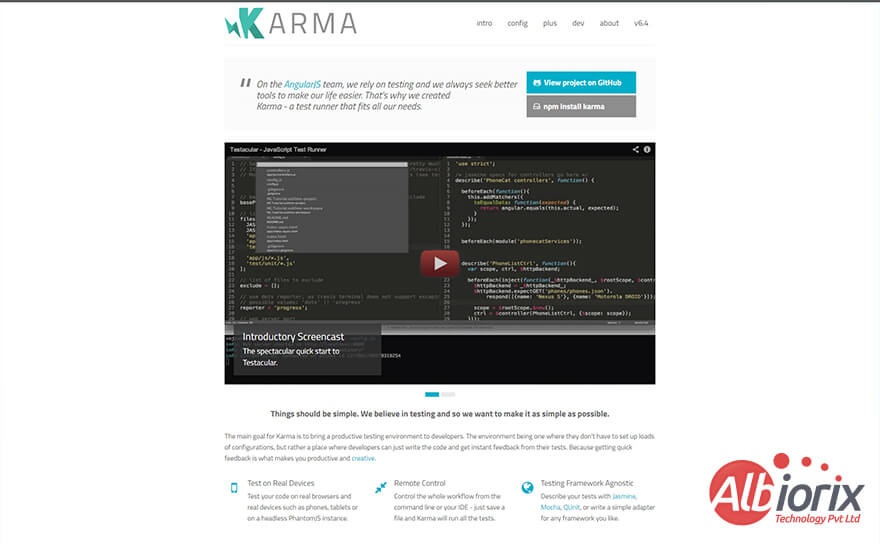
1. Karma

Karma Angular Development Tool

Karma is considered one of the leading angular tools that are a boon for Angular developers to test AngularJS codes in a real-time environment without any hassles.

This QA, testing, and open-source framework allows developers to uncover potential flaws, defects, and glitches quickly and helps developers ease the testing task.

The exciting part of this framework is that developers deploy Karma to test their products directly on actual devices and browsers.

With its ‘on-ground testing’ capability, Karma is solely responsible for identifying potential issues, bugs, and glitches compared to a simulated/lab setting.

Once the Angular developer runs a specific test in the browser, reports are generated in the CLI (Command Line Interface), giving steady criticism on each test’s status.

Karma Angular developer tools is solely responsible for performing different tests like E2E testing, midway testing, unit testing, and so forth.

Want to know more about the Angular frameworks in detail? Continue reading the article on what is Angular.

ProsCons
✅ Easy-to-use Angular developer tools for Angular development❌ No Support for NodeJS testing
✅ Easily extensible❌ No plugin for Eclipse (yet)
✅ You can easily deal with browser-based testing configuration and headless tests❌ This Angular development tool has a steep learning curve.
✅ Provides the option of running clients/servers either separately or on the Development computer.❌ You need to perform a full restart when any change in the plugin updates is done.

Build Robust SPA For Your Business With Our Development Team

We have a team of talented Angular developers having proficient in working with Angular best ide to provide the best optimum IT solutions.

Contact Us

2. Jasmine

Jasmine - Angular UI Development Tool


The next in our list of Angular development tools is the Jasmine framework.The Jasmine framework is one such AngularJS development tools helps Angular team eliminate the need to rely on browsers or other JavaScript testing environments.

Jasmine typically follows an easy-to-use syntax that brings convenience to the developers while writing and testing AngularJS codes.

As a result, Jasmine works best while testing Node.js code and on websites or web pages that support Java script languages and Javascript runtimes, making Jasmine one of the primary Angular devtools.

Jasmine is an open-source Angular development tool designed explicitly for testing and can run on any JavaScript-empowered stage.

The Jasmine framework is solely responsible for dealing with both BDD (Behavior-Driven Development) and TDD (Test-Driven Development).

Moreover, testing and debugging features become easy when you have these Angular development tools in your arsenal to easily create websites or web pages for your business.

ProsCons
✅ Complete transparency in using every library or framework of your choice.❌ You’ll require plenty of configurations to work with this open-source platform.
✅ Jasmine’s community is quite big.❌ You need to opt for an assertion library or a mocking framework before making use of the Jasmine framework.
✅ Quite easy to learn the Jasmine framework.❌ The entire configuration process is a very challenging one.
✅ You’ll get a robust programming style and patterns as per your needs.❌ Compared to other frameworks, it’s quite a heavy platform.

3. Protractor

Protractor -Angular UI Development tools.


ProtractorOne of the best and most preferred AngularJS development tools and IDE created by Google and is an end-to-end testing framework is Protractor. It is specifically used for developing web applications, including testing and quickly runs on browsers.

The Protactor typically conducts tests in real software and allows your tests to be automatically synchronized to the page. This software development tool supports Node.js, Mocha, Jasmine, and Selenium to deal with rapid development capabilities.

Protractor stands out in the crowd of Angular JS testing frameworks because it can autonomously sync the web page being worked upon with the testing sessions as soon as the runtime ends. This offers a true-to-life testing ecosystem experience.

ProsCons
✅ Easy to write and manage page objects.❌ It supports only javascript.
✅ It supports behaviour-driven frameworks like Jasmine, Mocha, Cucumber etc.❌ It runs very well in the chrome browser. It doesn’t have much support on other browsers.
✅ Running automation script in multiple machine is achieved in an easy way in protractor.❌ You’ll not find any robot class support in the Protractor framework.

Related Post: Angular Best Practices To Build Web App

4. Webstorm

Webstorm -Angular Development Tools


Webstorm is the best Angular IDE many developers from AngularJS development company use regularly. Webstorm includes an Angular online editor and is typically compatible with leading technologies like Node.js, HTML, and CSS.

This IDE for AngularJS is one of the most-popular Angular development IDE and is considered an intelligent code editor, making it a suitable choice for developers to work efficiently.

In addition, Webstorm is considered to be the best IDE for AngularJS development and offers innovative coding options including better source code management to AngularJS developers with great navigation angular tools and error-detecting unique features.

ProsCons
✅ All the bug-related updates are available to you frequently for improving the app performance.❌ Performance – it’s pretty resource-hungry.
✅ Fast and efficient.❌ A full restart of the Angular IDE is mandatory for every plugin update.
✅ This Angular development tool comes up with great JavaScript support (Web + NodeJS)❌ Initially, it will take some time for the app startup & will load the whole project.

Related Post: Software Development Trends 2023

5. Mocha.js

Mocha- Best Angular Development Tool


Mocha.js is a testing framework with impressive features for performing asynchronous testing. Its active support in browser and Node.js includes a profound interface that can intuitively test code for synchronous and asynchronous.

It is considered one of the top-rated Angular development tools many developers use to perform tests in sequential order.

Moreover, it allows the developers to provide complete customization option and fair reporting while mapping unidentified issues to their relevant test cases.

This JS considers nonconcurrent testing for reporting and planning and makes it adaptable for accuracy.

ProsCons
✅ Mocha.js is an Angular development that has a clear and simple API.❌ Tests cannot run in random order.
✅ You can use an assertion library that is solely responsible for throwing exceptions on failure.❌ Mocha.js is a tool that allows the use of any assertion library.
✅ This Angular development tool comes up with BDD-oriented or TDD-oriented business functions.❌ No auto mocking or snapshot testing.
✅ With the help of this Angular development tool, asynchronous testing is very simple.❌ It requires deep configuration.

6. Angular Kickstart

Angular-KickStartbest -Angular Development Tool


The primary use of Angular developer tools is to make Angular applications faster. In addition, it helps the Angular developers for hire automate the development process easier during the entire Angular application development.

Its easy-to-use interface makes Angular Kickstart the top-rated Angular development tool. As a result, the developers can efficiently deal with the quick gratifications of all the essential business requirements.

Angular Kickstart is one such Angular development tool that for enhancing the pace of development process initiative by bringing together Gulp JS, Bower, and Angular JS to increase the speeds of your Angular JS development endeavour.

Not only does Angular speed up the development process its modular structure also caches code to make it reusable, thus easing development process even further.

ProsCons
✅ Angular Kickstart is one such Angular development tool that brings a clear and simple API for AngularJS development.❌ The testing process becomes challenging for the developers and that’s what makes the long development process.
✅ You can quickly address all bugs due to subsequent updates of the product.❌ You’ll need a full IDE restart for plugin updates.
✅ Communication with the server becomes easier with this Angular development tool.❌ It runs very well in the chrome browser and not on other browsers.

7. Angular Fire

Angular Fire The Angular Development Tools


Angular Fire is a backend development tool that fosters dynamic API features, 3-way data binding, and superior development capacity.

This impressive AngularJS developer tool provides developers with flexible API and 3-way data binding with additional development capabilities to ease development. This helps to develop the web app back end of your Angular projects quickly.

Angular Fire facilitates dynamic API features and superior development capacity that efficiently manages everything ranging from binary data files like images, videos, and blobs to synchronized real-time binding files.

ProsCons
✅ There are well-established good practices and patterns to follow when one uses Angular Fire.❌ Angular Fire is one such Angular development tool that has a very steep learning curve.
✅ make beautiful and remarkable works through which, we can then test your business web applications simply.❌ Testing in a Development Environment does get confusing why deployment takes long.
✅ Easy to use and easy to maintain.❌ You’ll come across multiple challenges like loss of $watch, observables, $emit,$broadcast and $on.
✅ This Angular development tool is the best option for UX, it is easy and information loads.❌ With the need of a bigger app for your needs, you’ll require more resources and of course, the app performance will get affected too.

Related Post: Angular Vs React Vs Vue

8. Djangular

Djangular- Angular Development IDE


Djangular is an Angular development tool that allows developers to create content explicitly using Djangular per application.

In simple words, Djangular provides a reusable app that offers better app integration with AngularJS. As a result, the developers can efficiently find it easy to use Angular apps per site. Moreover, they can even create a consistent structure across all of your Django apps.

One of the features of DJangular is that it offers namespacing AngularJS content and a flexible framework, including Angular components libraries.

ProsCons
✅ Allows namespacing AngularJS content per Django app.❌ You’ll require plenty of configurations to work with this platform.
✅ This Angular development tool allows the AngularJS apps and modules to be included (or not) based on Django’s settings.❌ Compared to other frameworks, it’s quite a heavy open-source platform.
✅ Includes an AngularJS module that includes a subset of features similar to Django.❌ the end-to-end testing is quite confusing as it might take a long time to deal with the entire deployment process.
✅ This AngularJS tool allows you to efficiently include a patch to AngularJS’s $resource module directly to enable end-of-URL slashes as per the requirements of Django framework.❌ With the need of a bigger app for your needs, you’ll require more resources and of course, the app performance will get affected too.

Are You Planning To Build a Web Application For Business?

We designed an online car-buying site that allows users to buy a new car with varied features like financing, and leasing, and even supports home delivery.

Contact Us

9. Rest-angular

It is one of the essential Angular material tools for developers to deal with large data consumption from REST API. The primary responsibility of the Rest-Angular tool is to utilize the web application information directly from the RESTful API.

It simplifies standard GET, POST, DELETE, and UPDATES requests and requires minimum client code.

ProsCons
✅ This Rest-Angular tool allows you to use HttpClient API to handle the HTTP requests.❌ Components in your application are not allowed to fetch or save data directly to your application.
✅ Communication with the server becomes easier with this Angular development tool.❌ The testing process is quite confusing as it might take a long time to deal with the entire deployment process.

Related Post: Digital Transformation Trends 2023

10. NG-Inspector

NG Inspector -Angular Development IDE


Ng-inspector is an impressive tool that enables browsers with an inspector pane that helps Angular developers to develop, debug, and understand Angular applications quickly.

With the help of this innovative tool, developers find it easy to deal with scopes by utilizing controllers and directives for Angular applications.

NG-Inspector is nothing but an extension for Safari and Google Chrome. Moreover, the developers can distinguish each display scope faster by utilizing Directives and Controllers.

Finally, it can add an auditor sheet to the browser to help in the development phase, troubleshooting, and grasping the AngularJS applications.

ProsCons
✅ Browser extension for Chrome, Safari and Firefox.❌ With the need of a bigger app for your needs, you’ll require more resources and of course, the AngularJS applications performance will get affected too.
✅ This Angular development tool plays an essential role to develop, debug and understand your AngularJS applications.❌ Ng-inspector is a tool that takes a while to start up and load the entire project.
✅ You can easily see the whole scope hierarchy in your AngularJS application.❌ Ng-inspector is a tool that takes a while to start up and load the entire Angular app projects.
✅ As you mouse over the scopes in the pane, their DOM nodes are highlighted on the page.❌ You’ll need a full Angular IDE restart for plugin updates.

Conclusion

So, we have seen the list of top AngularJS development tools or we can say Angular Dev tools that helps software developers to deal with web app development smoothly.

Angular development is the best option to make web apps faster by integrating seamless features and functionalities.

So, if you are planning to build a new web app or Angular application, the perfect option is to hire an AngularJS developer proficient in web development that help you deal with the best Angular developer tools.

At Albiorix, we have a large pool of talented and experienced AngularJS developers who helps you in building a dynamic app to streamline your Angular JS project objectives using a streamlined Angular JS development environment.

How Does Angular Work? A Guide for Better Development

Angular is a framework for building client-side web applications. It typically uses HTML, CSS and TypeScript language. The exciting part of the Angular framework is that Google develops it.

Angular provides developers robust tools for the development of client-side web Applications. Angular is a purely Javascript framework that completely follows component-based architecture to build a robust and responsive single-page application (SPA).

But the main question arises in mind: how does Angular work? So we have covered detailed information about the scenes of working on the Angular applications.

Key Takeaways

  • Angular is a structural framework for building web applications that uses TypeScript as its programming language.
  • Angular follows a component-based architecture that allows developers to create reusable UI components and build complex applications with ease.
  • Angular has a powerful set of features like two-way data binding, dependency injection, and directives that make it easy to develop dynamic web applications.
  • Angular has a hierarchical dependency injection system that allows components to be loosely coupled, making it easy to replace or update individual components without affecting the entire application.
  • Angular has a modular architecture that allows developers to break down an application into smaller modules that can be loaded on-demand, improving performance and reducing load times.
  • Angular has a built-in router that enables developers to build Single Page Applications (SPAs) that provide a smooth and seamless user experience.
  • Angular provides a set of tools like the Angular CLI that automates the process of creating, testing, and deploying Angular applications.

What is Angular Framework?

Angular is an open-source framework as well as a platform that is designed explicitly for developing web apps and single-page applications.

Angular is written in TypeScript programming language and strictly follows HTML template and a great declarative language for building robust web applications.

The developers working with an AngularJS development company typically uses Angular framework to design and build scalable web applications by implementing core and optional functionality as a set of TypeScript libraries.

Are You Planning To Develop Single-Page Application for Your Business?

Our talented Angular developers are proficient in designing and building front-end applications for all your business needs.

Contact Us

Understanding Angular App Development Structure

After exploring the basic concept of what is Angular framework, it’s time to understand how Angular works, it becomes essential for the developers to deeply analyze the workspace structure and application configuration involved in the Angular structural framework process.

Every Angular app works in the form of a workspace. By default ng new name_of_application command generates a skeleton application at the root of the workspace in the below fashion.

Copy
workspace/(folder name is name_of_application given at cmd)
... (workspace-wide config files)
src/ --(source and support files for application)

The developers usually refer to this structure as a ‘multi-repo’ development style where each application has its workspace. In addition, the ‘workspace’ folder consists of workspace-specific configuration files, whereas the ‘src’ folder consists of application-specific files and folders.

Let’s see details about the essential configuration files related to the workspace for building dynamic applications.

Workspace Configuration Files

  • angular.json – The file manages the workspace and project-specific defaults for every Angular build and development purpose. No matter how many npm packages the developers have installed in the workspace, they need to specify the list of packages to be used when they need them in your application in angular.json.
  • package.json – This AngularJS framework file includes the project’s metadata and plays an essential role in managing the project’s dependencies, scripts, npm package versions and many more.
  • package-lock.json – This file includes all the information related to npm packages installed in the npm_modules folder. Some info like package version, hash to verify the package integrity and list of its dependencies are included in the file.
  • tsconfig.json – TypeScript is a language developers typically use to develop Angular apps. This file specifies root files and compiler options required to compile our web application development process.

Application Configuration Files

index.html – It’s the same page of HTML rendered for the AngularJS app and displayed to the user in the browser.

main.ts – It’s an important file in the Angular application and is responsible for compiling all reusable components and template files with JIT(Just In Time) compiler.

Moreover, the developers can also use the Ahead Of Time compiler by adding –aot flag to ng build or ng serve CLI commands(Recommended for production environment).

Related Post: What is Promise in Angular

How Does Angular Work?

In an Angular application, a module is nothing but a collection of components, directives, pipes, and services that are typically used in the application. All such groups communicate with each other to effectively build robust functionality to make your application secure and robust.

Angular comes up with a list of built-in modules like the HTTP module (to make an HTTP call from the application), and an extensive enterprise application is nothing but a collection of such modules.

Below are the eight building blocks of Angular application that every developer typically use on a regular basis to make smooth application development process:

  • Modules: For every Angular application, you will have only one root module named AppModule. The module usually provides the Angular developers with the bootstrap mechanism that makes it easy to launch the new application secure and robust.
  • Components: Like modules, every Angular project contains at least one component, the root component. The primary role of the root component is to connect the component hierarchy with a page document object model (DOM) element.
  • Services: The Angular developers create a service class when no specific data or logic is associated with the particular view. In addition, the developers can even share the data or logic among different reusable components. The @Injectable decorator immediately precedes the service class definition.
  • Templates: Angular templates are nothing but a combination of HTML and Angular markup. The primary aim of such templates is to modify HTML elements before they are displayed quickly. In addition, template directives provide program logic, and binding markup connects your application data and the DOM manipulation.
  • Metadata: Metadata is nothing but an instructor that informs Angular about how to process a class. It is designed explicitly to decorate the class so that the developers can quickly configure the expected behavior of a class.
  • Data Binding: The Angular data binding concept typically handles real-time communication between a template and its related component. Moreover, data binding is also a boon for communication between parent and child components.
  • Directives: Angular components libraries and directives are interconnected with each other. In simple words, we can say that directives and components both are essential building blocks of blocks of Angular web apps.
  • Dependency Injection: The primary role of the Angular developer is to keep the component classes short and straightforward. And that’s what Dependency Injection (DI) does. Dependency Injection eliminate such task and is not responsible for fetching data from a server, validating the user input, or logging directly into the console.

To know more about each building block in detail, click here.

Drive Your Business Growth with Intuitive & Dynamic Single-Page Web Applications

Your search ends here as we help you provide the best and most cost-effective solutions for your development needs.

Contact Us

Angular Bootstrapping Process

When an Angular application loads, that specific process is known as bootstrapping. Generally, the Angular project file structure is divided into three categories:

  • Application files
  • Bootstrap files
  • Configuration files

The below figure demonstrates the exact location of these files.

Angular Bootstrapping Process

Angular application’s bootstrapping process usually initiates from the main.ts file. This file includes the basic configurations for the main module that need to be loaded initially.

In the below figure, you can see that we have passed the bootstrap module in the main.ts. Subsequently, write code flows to Appmodule from this main.ts.

Angular Loads Appcomponent

In an App module, we can define a bootstrap Array specifically at the @NgModule decorator. So, at this point, Angular loads AppComponent as the root component on UI.

Passed The Bootstrap Module in the Main.ts.

Let’s recall; Bootstrapping is the technique of initializing the root module and loading the root component into the index.html file In the Angular eco-system. So multiple things happen in the background when we run ng serve, or ng build.

Background When We Run NG Serve, or NG Build

Related Post: Angular Promise vs Observable

Now, let’s see how a bootstrapping process works step-by-step.

  • With the help of the tsc TypeScript compiler, the compilation of application Javascript code starts.
  • Webpack is used for bundling and minification of javascript files.
  • The deployment and bootstrapping process take place.
  • Run JIT compiler for all components, AngularJS directives and pipes.
  • Render index.html in the browser.

Do you know the primary difference between JIT and AOT compiler?

In the AOT compiler, the compilation process usually occurs during build time, whereas in JIT, the compilation happens during runtime in the browser.

The angular.json file usually includes multiple configuration properties related to building and development. However, the ‘builder’, ‘index’ and ‘main’ properties under ‘build’ are the essential parameters that play a vital role in Angular development.

Copy
"build": {
"builder": "@angular-devkit/build-angular:browser",
"options": {
.......
"index": "src/index.html",
"main": "src/main.ts",
.......
}

So, once the developer gives the command ng serve or ng build, Angular CLI searches for angular.json for these specific properties.

‘builder’ property informs Angular CLI where it can find developers to build Angular apps for the browser environment.
‘index’ and ‘main’ properties help AngularJS developers to specify an index.html file to be rendered in the browser and main.ts, which handles the bootstrapping process.

Now, it’s time for the Angular CLI to call the typescript compiler to transpile all the typescript codes into a javascript code using the configuration provided in tsconfig.json.

And if we talk about “index.html” file, you’ll see only element defined inside thetag. is the root component template language injected specifically at runtime.

Apart from these, there is neither any javascript file nor any reference to style links.

Copy
<!DOCTYPE html>
<html lang="en">
<head>
  <meta charset="utf-8">
  <title>Sample Application</title>
  <base href="/">
  <meta name="viewport" content="width=device-width, initial-scale=1">
  <link rel="icon" type="image/x-icon" href="favicon.ico">
  <link rel="stylesheet" href="styles.a7a7ed6d783a0950.css" media="print" onload="this.media='all'">
  <noscript>
    <link rel="stylesheet" href="styles.a7a7ed6d783a0950.css">
  </noscript>
</head>
<body>
  <app-root></app-root>
  <script src="runtime.0298365924d274ea.js" type="module"></script>
  <script src="polyfills.daf14d28d6c3636f.js" type="module"></script>
  <script src="main.94e04dd2c597738f.js" type="module"></script>
</body>
</html>

Once the angular developer transpiles the typescript codes, Angular CLI uses Webpack to minify and bundle all the essential files easily. And such files are then added as a reference to the index.html file.

Let’s look at the working of each file:

  • runtime.js – It contains utility codes used by Webpack, making it easy for the developers to load other files.
  • vendor.js – It has 3rd party library codes which are imported into ngModules.
  • polyfill.js – It contains the polyfills required to make the app compatible among different browsers.
  • main.js – It contains all the javascript codes written in our application.

When the developer runs the ng serve command, application codes are specifically built in the local environment and served from memory.

On the other hand, ng build returns all the transpiled codes into the dist folder, which can be deployed to any hosting vendor and served from there.

At runtime in the browser, main.js is one file solely responsible for bootstrapping Angular apps. Therefore, it is a crucial file containing all application codes and how to compile and run them. And as we know that Angular CLI search for angular.json to get the main.ts file.

Let’s look at the static documents like main.ts file; it has a couple of import statements along with some lines of code.

Copy
import { enableProdMode } from '@angular/core';

import { platformBrowserDynamic } from '@angular/platform-browser-dynamic';import { AppModule } from './app/app.module';

import { environment } from './environments/environment';

if (environment.production) {
enableProdMode();
}

platformBrowserDynamic().bootstrapModule(AppModule)
.catch(err => console.error(err));

Instead of using import statements, the developers can utilize the business logic code to enable production mode if the target environment is production. In the above code, the line platformBrowserDynamic().bootstrapModule(AppModule);. defines a lot of action when executed by Angular CLI.

As we can see from the above code, you need to import the platformBrowserDynamic module from the @angular/platform-browser-dynamic library.

Next, the developer calls platformBrowserDynamic().bootstrapModule(AppModule) by passing the root AppModule as a parameter.

Behind the scenes, the bootstrapModule is responsible for creating a JIT compiler instance where it crawls through all components, directives and pipes declared in AppModule @NgModule decorator and other feature modules imported in AppModule.

Once it finds the Component having ‘app-root’ as its selector, it will render the component template in index.html.

But how does Angular know where to find a template for in index.html? Let’s find out in the next section.

Looking For the Best Angular Development Services?

Albiorix has Angular developers that use cutting-edge technology to build creative web applications for clients.

Contact Us

The root AppModule we passed earlier refers to the @ngModule decorator in AppModule. @NgModule decorator contains metadata of all the components, directives and pipes, along with other feature modules imported under AppModule.

It also specifies services available at the app level under providers and bootstrap property, specifying the root component as shown below.

Copy
import { NgModule } from '@angular/core';

import { BrowserModule } from '@angular/platform-browser';

import { AppComponent } from './app.component';

@NgModule({
declarations: [
AppComponent
],
imports: [
BrowserModule
],
providers: [],
bootstrap: [AppComponent]
})
export class AppModule { }

Once the developers identify the root AppComponent, it utilizes the @Component decorator in AppComponent. @Component contains metadata of the below properties :

  • selector: It is used to identify all the components in the Angular app.
  • templateUrl: It provides a path to the component HTML template file.
  • styleUrls: It gives the path to component styles.
Copy
import { Component } from '@angular/core';

@Component({
selector: 'app-root',
templateUrl: './app.component.html',
styleUrls: ['./app.component.css']
})
export class AppComponent {
title = 'Sample Application';
}

There it is! app-root specified in selector matches with app-root in index.html. It then finds an HTML template along with styles and renders the same in index.html where app-root is present.

Related Post: Resolver in Angular

Conclusion

Finally after this post on how angular application works, we can say that an Angular application is a tree to component and these components are further enabled to add behavior to UI through

  • Services
  • Pipes
  • Directives
  • Dependency injection, and
  • Modules

Such aspects are basically a logical unit of a big application, many modules are tied together to build a robust Angular Application.

For some core and basic key features, AngularJS solves majority of issues as it provides us with some built-in modules, pipes and directives and we can also create our own building blocks and tie them together to build an enterprise-level application.

So in nutshell Angular application works as a component of trees tied together to build modules and an enterprise-level Angular application.

Contact Albiorix to unlock limitless possibilities with Angular to build the next-generation, modern, and responsive web application for business. Our dedicated Angular developers create stunning web applications using their expertise.

13 Proven Advantages of Angular Framework for Web Development

Introduction

As per the recent survey by Stack Diary, it has been found that front-end framework in 2022.

Angular is a component-based framework that plays an essential role in front-end development. Angular developers find it relatively easy to design and build web applications. It’s just because the framework is easy to learn and use.

However, it is not limited to this; there’s more. Next, we’ve listed the advantages of the Angular framework that will help developers to build applications quickly and smoothly.

What is Angular?

Angular is a popular open-source framework used to build web applications. Created and maintained by Google, it helps developers build fast, responsive websites and apps using HTML, CSS, and TypeScript.

It’s known for its two-way data binding, which means updates in the user interface automatically reflect in the code and vice versa. This makes Angular ideal for dynamic, real-time applications like dashboards, forms, and single-page apps.

Angular is widely trusted by professionals due to strong community support and Google’s ongoing updates. It follows best practices for security and performance, which makes it a reliable choice for business-critical projects.

Whether you’re building a simple website or a complex enterprise tool, Angular provides the tools and structure developers need to deliver clean, scalable, and maintainable code.

See a detailed list of websites that are using Angular for web development.

list of websites that are using Angular


Top 13 Advantages of Angular Framework

Hope you got a clear idea of what is Angular. Let’s highlight some of the best advantages of using the Angular framework that help developers working in AngularJS development companies build web applications smoothly.

13-advantages-of-using-angular

1. Two-Way Data Binding

Two-way data binding is a feature in Angular that keeps the user interface and data model in sync. When you update the component, the view changes automatically—and vice versa. This real-time connection saves time by reducing manual updates.

It’s especially useful for forms, live previews, and dynamic applications. Backed by Angular’s strong framework and community support, two-way data binding improves efficiency and helps developers build smoother, more responsive web experiences.

2. TypeScript-Supported Framework

A TypeScript-supported framework like Angular uses TypeScript to make coding more structured and easier to manage. TypeScript helps catch errors early, which saves time during debugging.

Because it’s a superset of JavaScript, developers get advanced features while still writing familiar code. This leads to cleaner, more reliable applications.

For businesses, it means fewer bugs, better performance, and easier maintenance of large projects—especially when applications grow over time.

Take Your Web Application to the Next Level with Angular Development

Let us help you build a robust and dynamic web app with our Angular development services.

Contact us

3. Code Consistency

Compared to other frameworks like React, Angular is a fully-fledged responsive web design framework that makes it easy for you to create a component, service, or module in seconds.

This open-source framework is a boon for creating consistency throughout the entire code base for the developers. Moreover, it is one of the prime benefits of the Angular framework that is essential to strive to offer feature-rich web application solutions.

The Angular developers use CLI to improve code consistency to create certain repeatable code blocks from the command line. Also, the framework’s documentation serves as an up-to-date reference for developers.

4. Advanced Functionality

Once you configure the Angular development setup, you’ll get almost everything out of the box. In simple words, Angular provides essential tools that typically handle functionalities like routing, Angular material, designing perspectives, and many more.

With its preconfigured environment, the Angular framework makes it easy for the developers to deal with the development and integration testing phases.

The good part of the Angular framework is that the developers do not have to opt for any specific third-party libraries. Still, they can directly use the official libraries as the Angular team dictates.

As a result, the application developed with the Angular framework is equipped with better cybersecurity and higher code quality.

5. Productivity

One of the biggest advantages of using the Angular framework is maintaining code consistency throughout the entire Angular development lifecycle. This code consistency as Angular advantages plays a vital role in improving the productivity of the web application.

So, you do not need to spend time identifying what a function, utility, or component does; instead, they should focus on creating an Angular application with robust functionalities and high performance.

Once the developer gains expertise in writing a component, another component can be easily written by strictly following the same guidelines and coding structure.

The Angular framework supports code readability features, making it comfortable for Angular developers to do easy coding for an ongoing project. Moreover, Angular developers can easily catch potential bugs earlier, making it possible using great IDEs such as VS Code and WebStorm.

6. POJO Model to Eliminate External Dependencies

The Angular framework follows the Plain Old JavaScript Objects (POJO) Model to make the code structure lightweight and independent. The primary role of this Model is to help you get rid of using complicated functions or methods in Angular programming. 

As the POJO model needs less coding, it eliminates the need for third-party frameworks or plugins for the developers. As a result, the POJO model makes the Angular application load quickly and gives outstanding user accessibility.

Additionally, the Model allows us to keep the scripts clean, making the framework goal-oriented.

7. Ease in Code Maintainability

Angular is one such framework that provides code maintainability in several ways. For example, if the developer wants to upgrade the application from the previous version, Angular takes care of updating all the Angular-related packages at the same time.

By just giving one command, “ng update”, the developers can quickly update the Angular application. In addition, components can be easily decoupled and replaced with improved implementations.

Albiorix crafted web and mobile application that allows users to easily search for a car by entering the essential car options, colour specifications, and location.

8. Model-View-ViewModel Architecture to Unify Independent Structures

The Angular framework enables you to build a clean user interface with seamless business logic. Furthermore, Angular developers can easily bifurcate the business logic from UI components using the MVVM model.

The primary reason behind such bifurcation is that the Angular framework strictly follows the controller’s communication between the Model and the view component.

9. Ivy Renderer – Next-Generation Renderer for Enhanced Performance

Ivy renderer is a boon for the developers responsible for providing unique code debugging and a user-friendly app experience.

Moreover, the developers find it easy to make the framework more accessible and set an excellent example by lowering file sizes while maintaining the framework as a feature-rich platform.

10. Modular Development Structure

A modular development structure in Angular lets developers break the code into smaller, manageable parts called modules. This keeps the code clean, reusable, and easier to maintain.

It allows teams to work independently on different sections without conflicts. As a result, development becomes faster and more cost-effective. The modular approach also supports app scalability and smooth collaboration, especially in large projects.

Angular’s built-in support and strong community make this structure even more efficient and reliable.

11. Optimized Server Communication

With Angular, caching becomes a breeze! By producing static files, Angular eliminates the extra load on CPUs. Furthermore, the framework’s response time to API calls is quite fast.

In the case of an Angular application, the pages in the document object model are rendered for user actions. It provides a rapid user experience and does not need users to wait for the app to become fully engaged.

12. Angular Material

The essential part of the Angular framework that helps developers in many ways is Angular Material. It is one of the best advantages of the Angular framework that every Angular developer are interested in.

So the name says it is a collection of ready-to-use, well-tested User Interface components and modules that typically follow Google’s Material Design principles.

The Angular material is composed of

  • Navigation patterns
  • Form controls
  • Responsive buttons
  • Indicators

Components are adapted to suit multiple browsers, well-documented, and written based on the latest guidelines.

Developed by the Angular community, these modules simplify the design workflow for teams, allowing developers to add new elements and develop applications rapidly with minimal impact on performance.

13. Active Community & Easy-to-Access Information

Angular has a strong, active community that helps developers solve problems quickly. Whether you’re facing bugs or learning the framework, you’ll find helpful answers from forums, tutorials, and documentation.

The framework is beginner-friendly and backed by plenty of easy-to-understand resources like guides, FAQs, and articles. This support system makes Angular a go-to choice for developers, helping teams work efficiently and reducing learning curves for new users.

Need Reliable Angular Developers For Your Project?

We’re here to help – contact us today!

Contact us today!

So, these are the common and prime advantages of the Angular framework that you can efficiently grab to deal with your business goals.

What are the Popular Websites Built With Angular Framework?

At first, Google developed Angular to use internally for its websites and services. As a result, angular is the most prominent framework designed primarily for developers to use as a robust solution, even for big data projects.

Many famous companies’ websites are currently built with the AngularJS framework, including Gmail, Upwork, Paypal, Forbes, and many more.

Angular Makes Web App Development Smoother

After having a look at the Angular advantages, we must agree that Angular is a powerful framework that helps us provide highly performant, innovative, and user-friendly web, mobile, and desktop solutions.

And yes, such solutions may be single-page applications, PWAs, large-scale enterprise software, cross-platform mobile apps, etc.

Angular is not just limited to being a framework; it is a robust platform with various tools and structural peculiarities that help developers write clean code faster and easier.

Once you hire Angular developers from a reputed Angular development company, you’re assured of getting:

  • an affordable front-end part of a cross-platform solution,
  • a responsive, efficient, and high-quality web or desktop app,
  • a readable and testable code,
  • a maintainable codebase,
  • a powerful Material Design solution.

If you enjoyed reading about the Angular advantages or benefits of the Angular framework and want to bring your business idea to life using this framework, don’t hesitate to contact us.